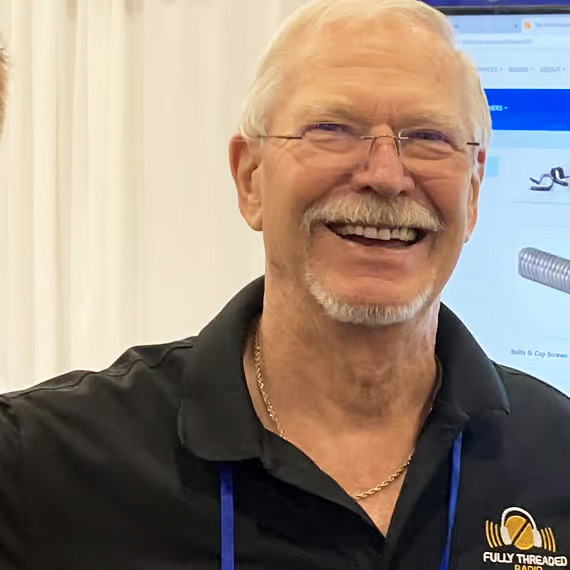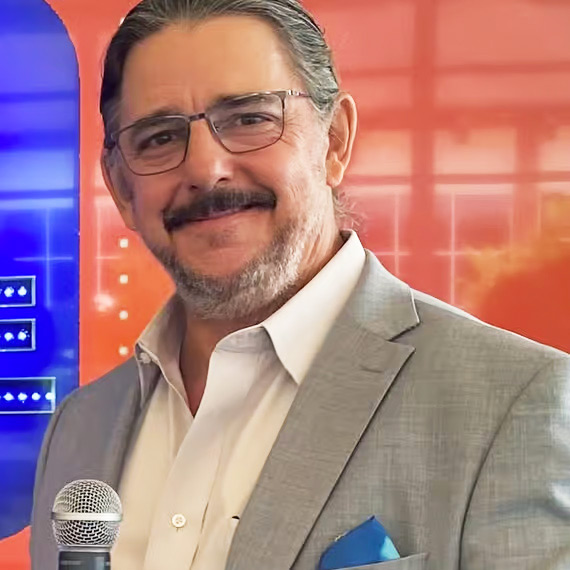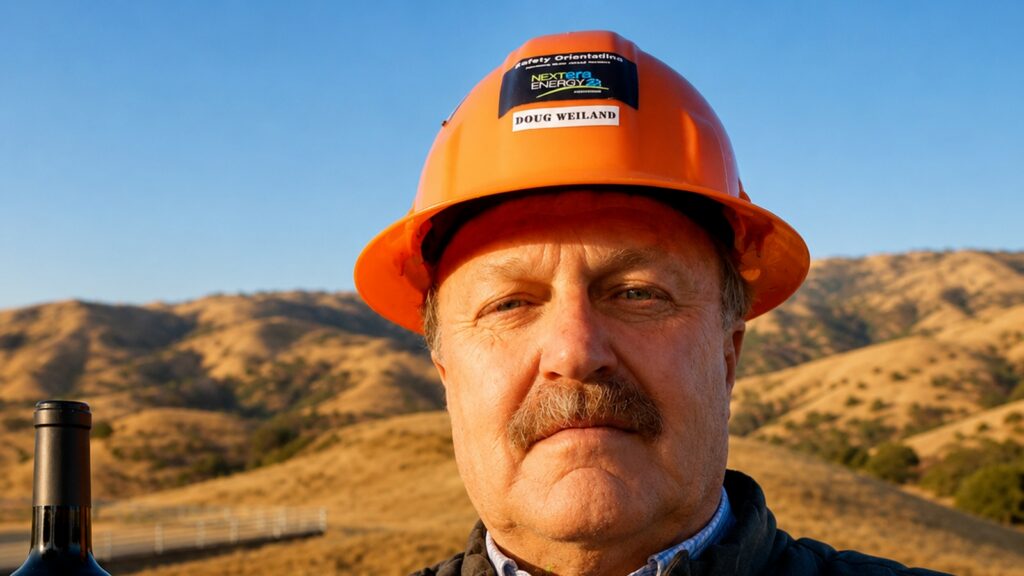
Professional fastener consultant and vintner Doug Weiland discloses his best recipe for a thread business with legs (1:46:42). 2026 Hall of Fame inductee Tim Roberto Jr. of LSG joins Mike McNulty to dissect the latest red hot FDI numbers on the Fastener News Report (57:45). Industry guru Carmen Vertullo previews his upcoming in-person risk management conference (21:59), then returns with a Fastener Training Minute covering a seldom discussed HE topic (1:34:04). Show directors Anya Falcone and Linette Dao look ahead to an all-new IFE in Phoenix (41:31). PLUS: Commercial rents plummet and MWFA HOF inductions. Brian and Eric consider ways to defend against Amazon Business and think about a yaht. Run time: 02:50:14
Show Links:
Risk Management for the Fastener Industry presented by Carmen Vertullo December 3-4 San Diego
Doug Weiland’s neighbor’s winery, Big Dog Vineyards
MWFA Hall of Fame Class of ’26
International Fastener Expo Oct. 7-9, 2026
Amazon Business Reaches $60BB Revenue – What it Means for Distributors
Fastener Training Week Richard “Todd” Penland Scholarship
FNR Bumper Music: G Dead, Providence Civic Center 6/26/74
Inside Episode 230
Doug Weiland’s recipe for a fastener business with legs; Tim Roberto Jr. and Mike McNulty on a red-hot July Fastener Distributor Index; Anya Falcone and Linette Dao preview an all-new International Fastener Expo in Phoenix; Carmen Vertullo on his Risk Management for the Fastener Industry conference and on when a failure is NOT hydrogen embrittlement; Marco Rodriguez on the five most tenant-favorable industrial markets.
Episode 230 is built around a long conversation with Doug Weiland, professional fastener consultant and vintner. Weiland’s father founded Lord and Sons in 1969; Doug and two partners bought it and ran it for about 10 years before Gebruder Thiele of Bremen, a privately held company doing about three billion in sales, became majority owner. He later worked eight years at Stelfast, Inc., helped Bob and Darren open the West Coast for INxSQL, holds patents in seismic bracing and concrete inserts, and planted a Cabernet vineyard in the hills of Milpitas with a view of San Francisco. He now consults for Carver Consulting and for an Asian import house opening in the United States.
On the Fastener News Report, Mike McNulty is joined by Tim Roberto Jr., vice president at Star Stainless Screw in the LindFast Solutions Group and a 2026 MWFA Hall of Fame inductee. The seasonally adjusted July 2026 Fastener Distributor Index stayed strong at 59.9, basically the same as June’s five-year high of 60.0 and the 15th straight month in expansion territory, while the forward-looking indicator jumped to 61.6, a new four-year high. The top story is Hillman’s agreement to acquire Kanebridge Corporation, and McNulty’s Back Page is about LinkedIn.
Two conversations look ahead to events. Show director Anya Falcone and marketing director Linette Dao walk through International Fastener Expo 2026 in Phoenix, October 7-9: the inaugural International Fastener and Assembly Summit (IFAS) on Wednesday, October 7, a welcome party at The Churchill, the Fastener Fest happy hour on the show floor, and a 50% off expo pass for the Fully Threaded community with code THREADED. Earlier, Carmen Vertullo previews Risk Management for the Fastener Industry, a two-day in-person event December 3-4 in San Diego with attorney Niles Sharif and keynote Dr. Mark Broeker.
Vertullo returns with a Fastener Training Minute on ruling hydrogen embrittlement out of a fastener failure investigation: four conditions must all be present, and if any is missing it is not HE. Marco Rodriguez’s Cresa Industrial Real Estate Update counts down the five most tenant-favorable large industrial markets in the country, and Brian and Eric close by reading Ian Heller’s column on what a $60 billion Amazon Business means for distributors. The complete transcript follows the editorial material.
Episode 230 at a Glance
- Feature: Doug Weiland (Carver Consulting) — Lord and Sons, Gebruder Thiele, Stelfast, Inc., INxSQL, patents, the vineyard years, and a business philosophy built on solving problems
- Fastener Distributor Index, July 2026: 59.9 (June: 60.0, a five-year high); forward-looking indicator (FLI) 61.6, a new four-year high; 15th straight month in expansion
- FNR guest commentator: Tim Roberto Jr., vice president, Star Stainless Screw / LindFast Solutions Group; 2026 MWFA Hall of Fame inductee
- FNR top story: Hillman Group to acquire Kanebridge Corporation ($315M)
- International Fastener Expo 2026, Phoenix, October 7-9: inaugural IFAS summit, welcome party at The Churchill, Fastener Fest happy hour; 50% off expo pass with code THREADED
- Risk Management for the Fastener Industry — Carmen Vertullo, December 3-4, San Diego, with Niles Sharif and keynote Dr. Mark Broeker
- Fastener Training Minute: when is it NOT hydrogen embrittlement — hardness above HRC thirty-nine, a source of hydrogen, a load greater than seventy-five percent of yield, and a delayed fracture
- Cresa update: top five tenant-favorable industrial markets — Seattle, East Bay, Denver, Inland Empire, Baltimore
- Also: MWFA 2026 Hall of Fame class, Brisket Fest and the Sleep in Heavenly Peace bed build, the Richard Todd Penland Scholarship at Eurolink, and Amazon Business at $60 billion
- Run time: 02:50:14
What You’ll Learn
- Weiland’s mantra at Lord and Sons: deliver a 95% complete order to a job site within 50 miles, and do not compete on price — a customer who wants to pick apart your price is not your customer.
- Give customers material when they need it, not when you think they need it; a reasonable price, not the cheapest, plus problem-solving is the recipe that worked.
- Innovation paid: seismic bracing approved by the state of California and adopted by Unistrut, a precast concrete insert, and a bolt stand that sold ten million units; Lord and Sons was the first construction supply house in the United States with a structural engineer on staff.
- Weiland’s rule for building a team: hire only people dramatically smarter than you, and listen to your people and your customers.
- The July 2026 FDI held at 59.9 against June’s five-year high of 60.0, sales came in at 82.7, and the six-month outlook hit 66% better, twenty-eight the same, six percent worse — one of the strongest outlooks recorded.
- Tim Roberto Jr. reads the ISM PMI alongside the FDI: 55.6 versus 53.3, the strongest expansion since May of ’22, with an expansion in manufacturing employment for the first time since July of ’25.
- Pricing is no longer linear with material: tooling, labor and energy are pushing costs that have no index to point to, which makes pass-through conversations with customers harder.
- Hillman is acquiring Kanebridge, a master distributor of more than forty-four thousand commercial and military-grade fastener SKUs, to gain a foothold in the US industrial market alongside Hillman’s industrial presence in Canada.
- IFE 2026 adds a one-day executive summit, IFAS, on October 7 with two tracks — strategic programming curated by the IFE team and technical breakouts — the day before the expo floor opens.
- Trade-show advice from Anya Falcone: you have three seconds for a passing attendee to decide to stop, so brand touchpoints before the show matter as much as the booth.
- To rule hydrogen embrittlement out: a fastener below HRC forty (grade eight, 10.9, A325, A490) is not susceptible; no source of hydrogen means no HE; the load must exceed seventy-five percent of yield; and the fracture must be delayed, from hours to days.
- Susceptibility rises sharply with hardness: around HRC 43 to 45, the top end of normal threaded fasteners such as 12.9 socket head cap screws and ASTM A574, the risk is much higher.
- Vertullo’s twenty-four and forty-eight hour torque check: retighten at the twenty-four-hour mark and again at forty-eight hours; if the fastener has not failed or cracked, it is considered not to have hydrogen embrittlement.
- Industrial rent growth has effectively flatlined nationally and fourteen of the thirty-five largest US markets recorded negative rent growth last quarter; Baltimore is the most tenant-favorable large market on Cresa’s index.
- Ian Heller’s advice on Amazon Business at $60 billion: build digital capabilities including AI, make complexity your strategy, and add services, integration and technical support that Amazon cannot match.
Featured Voices
Hosts: Eric Dudas, Brian Musker
- Doug Weiland: Professional fastener consultant and vintner; Lord and Sons, Stelfast, Inc., INxSQL; consulting for Carver Consulting.
- Mike McNulty: Fastener Technology International; Fastener News Report.
- Tim Roberto Jr. — LSG: Vice president, Star Stainless Screw / LindFast Solutions Group; 2026 MWFA Hall of Fame inductee; FDI guest commentator.
- Carmen Vertullo — Carver Consulting: Fastener Training Institute / Carver Labs, El Cajon, California; Risk Management for the Fastener Industry conference and the Fastener Training Minute.
- Anya Falcone: Show director, International Fastener Expo.
- Linette Dao: Marketing director, International Fastener Expo.
- Marco Rodriguez — Cresa: Cresa; Industrial Real Estate Update.
- Dr. Mark Broeker
- Niles Sharif
Also Heard
- Craig Penland — Eurolink Fastener Supply Service
- Christian Reich
Explore Episode 230
Timestamped guide to the episode. Times link to the transcript below.
- 00:00 — Cold open: show ID line and teaser clips (Weiland, Roberto, Vertullo); Produced show intro: ‘Time for Fully Threaded Radio’
- 01:42 — Opening segment: Eric Dudas and Brian Musker
- 15:13 — Opening segment part 2: NFBBQA / Brisket Fest contribution to Sleep in Heavenly Peace bed build (Aug 30, SWD); MWFA 2026 Hall of Fame class; Naperville Fastener Association gathering Aug 31 (Sable Hotel); lead-in to Carmen
- 21:57 — Opener: Carmen Vertullo previews ‘Risk Management for the Fastener Industry’ (Dec 3-4 2026, Sheraton Harbor Island, San Diego; Niles Sharif; keynote Dr. Mark Broeker)
- 37:32 — Cresa Industrial Real Estate Update with Marco Rodriguez: top five tenant-favorable industrial markets (Seattle, East Bay, Denver, Inland Empire, Baltimore)
- 41:32 — News-segment lead-in: IFE 2026 preview with show director Anya Falcone and marketing director Linette Dao (Phoenix Oct 7-9; IFAS summit; golf; welcome party at The Churchill; Fastener Fest happy hour; code THREADED)
- 57:54 — Fastener News Report — Mike McNulty (Fastener Technology International); sponsored by Volt Industrial Plastics
- 57:54 — FNR open: thanks Anya and Carmen; sponsor credit; rundown (Roberto/FDI; Hillman–Kanebridge; headlines; Back Page on LinkedIn)
- 01:00:35 — Fastener Distributor Index (July 2026: 59.9; FLI 61.6 four-year high) with guest commentator Tim Roberto Jr., vice president, Star Stainless Screw / LindFast Solutions Group
- 01:24:32 — FNR top story: Hillman to acquire Kanebridge Corporation ($315M); FNR Fastener Newsmaker headlines (corporate and personnel); FNR Back Page: LinkedIn
- 01:26:49 — FNR top story: Hillman to acquire Kanebridge Corporation ($315M); FNR Fastener Newsmaker headlines (corporate and personnel); FNR Back Page: LinkedIn
- 01:28:42 — FNR top story: Hillman to acquire Kanebridge Corporation ($315M); FNR Fastener Newsmaker headlines (corporate and personnel); FNR Back Page: LinkedIn
- 01:34:10 — Fastener Training Minute — Carmen Vertullo: when is it NOT hydrogen embrittlement
- 01:34:10 — FTM part 1: ruling out hydrogen embrittlement; ‘when we come back’
- 01:46:42 — Feature: Doug Weiland, professional fastener consultant (Carver Consulting)
- 02:39:50 — Closing segment: Brian and Eric
Feature conversation
Doug Weiland: Lord and Sons, Gebruder Thiele, the vineyard years, and a recipe for a fastener business with legs
Eric Dudas sits down with Doug Weiland, who is listed simply as a professional consultant but has done everything in the fastener world and is currently working with Carmen Vertullo at Carver Consulting. His father founded Lord and Sons in 1969; Doug and two other partners bought it and ran it about 10 years until a partner’s exit brought in German billionaire Bernd Hackemeier’s Gebruder Thiele of Bremen, a privately held company with 10 or 12 operating units doing about three billion in sales, as majority owner. Around 2006 Bernd’s son Martin took control, philosophical differences about running a family-style fastener business followed, and Weiland sold his interest after two years spent finding his replacement. Lord and Sons was one of FCH’s early members, back around 2007 and 2008.
The vineyard began over glasses of wine on a deck in the hills of Milpitas: two years and more money than he would like to admit, French grafts from Bordeaux planted in two thousand and one, a first award-winning vintage in two thousand and six, soils assayed equal to or better than Napa, and award after award for the Cabernet. It is a labor of love rather than a business — 6,000 pounds of grapes cost $10,000 to raise, sell for $11,000, and take 1,000 hours — though his neighbor, who went on to build a winery, told him the winery side is where the profit is. Weiland’s wine education came from his billionaire partner, whose 20,000 bottles of first-growth French Bordeaux were appraised at $26 million in 1998; the same partner paid himself a hundred and fifty thousand dollars a year at a three-billion-dollar company with the balance on results.
After retirement at fifty-seven, Don Haggerty hired him to help open Stelfast, Inc. on the West Coast — three weeks off a year, no supervising and no being supervised — where he worked eight years, met Carmen Vertullo, and came to admire Surinder and Simi Sakuja. He then met Bob at an IFE show and, knowing nothing about software but everyone in the industry, opened doors for Bob and Darren at what became INxSQL, including the tense first installation at Lord and Sons that Darren resolved by sitting in an office for a week. His old company now runs over $100 million on that system with 200 users.
On innovation: Lord and Sons built its business on solving problems. It developed one of the first seismic bracing systems approved by the state of California, which Unistrut adopted and which the patent office split into two patents; a stainless steel concrete insert with a grounding tie; a jacking system for seismically bracing mobile homes; and a bolt stand for concrete embeds that sold ten million units. It was the first construction supply house in the United States with a structural engineer on staff, ran thread rolling, thread cutting, robotic welding, a stamp shop and a metallurgist PE, redecked the Golden Gate Bridge, and today its engineering group of four SEs and two PEs designs for data centers on projects of $50 million or more; only 9% of those who challenge the California SE exam pass it. Weiland expects the company to be a half-billion to billion-dollar business within five to 10 years.
The philosophy: up and down cycles are opportunities, because a down market sends everyone looking for a better supplier and an up market strains service. The Lord and Sons mantra was a 95% complete order to a job site within 50 miles; when big customers pointed to cheaper prices, Weiland asked what 100 electricians at 100 bucks an hour with nothing to work on was costing them. Give people material when they need it, charge a reasonable but not the cheapest price, hire people dramatically smarter than you, and listen. Bernd’s two rules on arrival were that business is personal and, for anyone who disagreed, help finding a new job; Weiland’s own view is that money alone is not the motivation — achievement, making somebody’s life better, and being a good human being are. He is now consulting for Carver and for an Asian import house, forty years in business, opening in the United States.
I wanted to hire only people that were dramatically smarter than me. People would say, “Why do you do that?” And I’d say, “I wanna be the dumbest person in the room ’cause I wanna learn from people.” That’s what life’s about, learning and applying the knowledge that you’ve learned to solving problems.
By the Numbers
- 95% — Lord and Sons order-completeness mantra for job-site delivery (02:22:47)
- $100 million — Annual volume Weiland’s former company runs on INxSQL (02:09:07)
- $26 million — 1998 appraisal of his partner’s 20,000-bottle Bordeaux collection (01:55:52)
- 9% — Pass rate for those who challenge the California SE exam (02:18:13)
- $50 million — Project size threshold the company’s engineering team targets (02:17:45)
Recurring segment · sponsored by Volt Industrial Plastics
Fastener News Report: July FDI 59.9 and FLI 61.6 with Tim Roberto Jr., Hillman to acquire Kanebridge, and LinkedIn on the Back Page
Mike McNulty of Fastener Technology International opens with the July 2026 Fastener Distributor Index: seasonally adjusted 59.9, basically the same as June’s five-year high of 60.0, the 15th straight month in expansion territory. The forward-looking indicator, also known as the FLI, jumped to 61.6, a new four-year high versus 56.7. Sales were way up at 82.7 and deliveries increased slightly; employment, inventories and pricing all dropped, employment barely. The six-month outlook drove the FLI: 66% of respondents expect things to be better, twenty-eight the same and only six percent worse, an improvement on last month’s fifty-four, thirty-eight and eight.
Guest commentator Tim Roberto Jr., vice president at Star Stainless Screw, reads the FDI alongside the ISM PMI, which came in at 55.6 versus 53.3 — the strongest expansion since May of 2022, a seventh straight month above 50, and the first expansion in manufacturing employment since July of ’25. On the stainless side he sees some reversion of pricing after increases driven first by nickel and then by fuel, labor, energy and even the tungsten in tooling. Strong segments include infrastructure, defense, aerospace and large construction rather than residential; both men are surprised by resistance to data centers. He also notes the PMI detail that 20% of manufacturers showed contraction in July versus only 5% in June, which may explain why some respondents feel slower than the headline numbers.
Survey comments: July was a very strong month, sales remain strong with new business onboarding, master distribution inventory sold out on some commodities, and increases on prices, lead time and freight are being passed along. Roberto’s view is that pricing used to move linearly with material but tooling, labor and energy now push costs with no index to point to, which is the hardest part of customer conversations; LSG works to ease increases where it can. At Star Stainless the week brought the integration of the High-Q specialized fastener divisions, and LSG continues to invest in inventory, value-add services under a new VP, Jared, process improvement under VP of operations Heather, and an omni-channel e-commerce platform that will fulfill one PO from multiple locations. The segment ends with the Dodgers and a three-peat.
Top story: Hillman Group entered a definitive agreement to acquire Kanebridge Corporation, which supplies more than forty-four thousand commercial and military-grade fastener SKUs to distributors throughout the USA and Canada from warehouses in Illinois and California and has been a partner to customers for over fifty years; Kanebridge will operate within Hillman’s commercial and industrial business led by Chris Martin, complementing Hillman’s industrial presence in Canada. Newsmaker headlines include Fastener Industries acquiring VAMP Screw Products, Distribution Solutions Group going private, PrimeSource Brands acquiring Starborn Industries, MW Fasteners naming James Margiotta CEO, and LSG promoting Alex Acosta to senior vice president, corporate development. On the Back Page, McNulty argues LinkedIn has become the only viable business networking platform — indispensable for research, noisy as a feed — which is exactly why in-person events like Fastener Week in Chicago, Fastener Training Weeks and regional association gatherings still matter.
Everybody’s gonna have a hard time when prices go up. That’s definitely difficult. I think it’s managing that, and I think that’s relationship, so that customers at least understand where things are going, and it’s communication conversation.
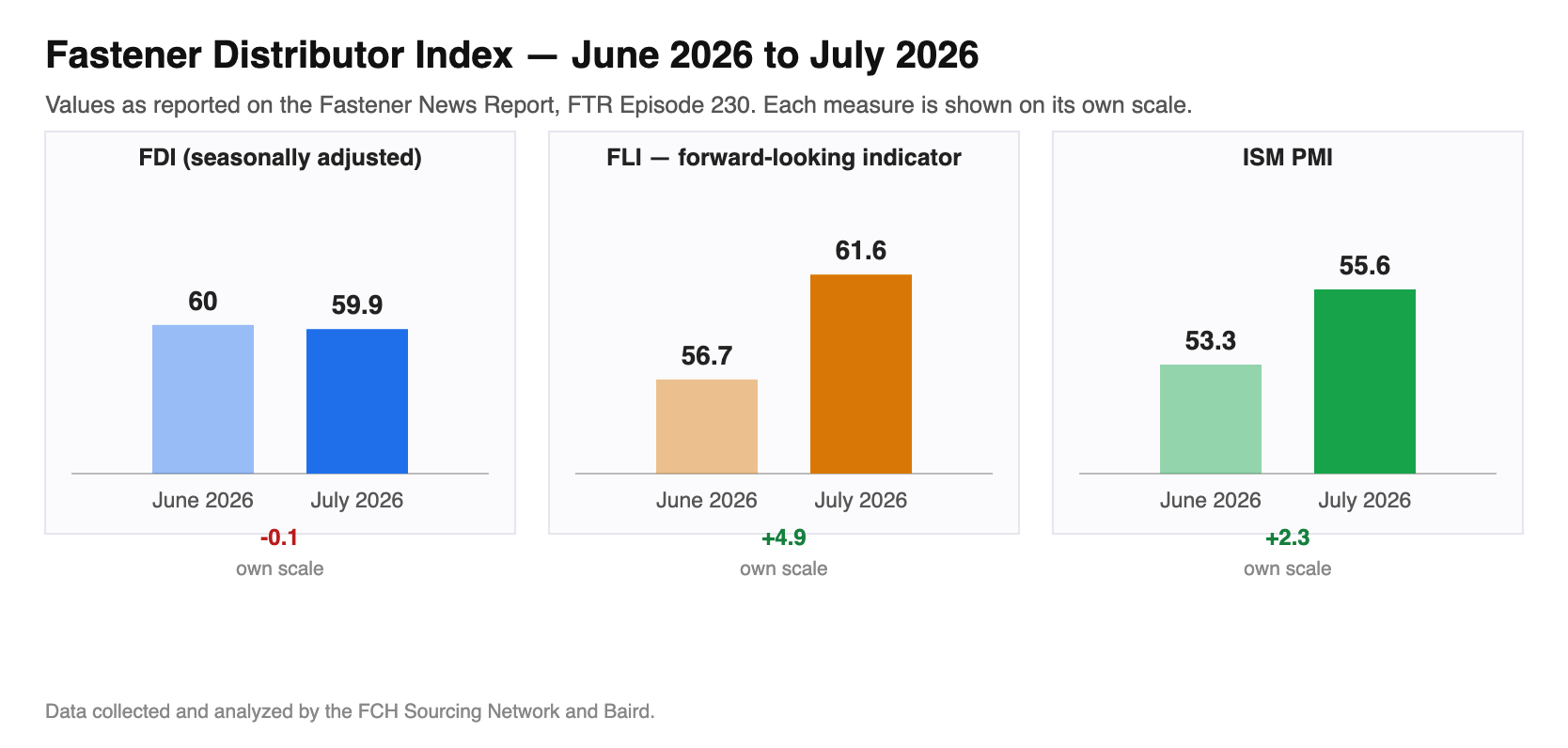
- FDI (seasonally adjusted): 60 → 59.9
- FLI — forward-looking indicator: 56.7 → 61.6
- ISM PMI: 53.3 → 55.6
- 57:54 — FNR open: sponsor credit and rundown
- 01:00:35 — Fastener Distributor Index, July 2026 (59.9; FLI 61.6) with guest commentator Tim Roberto Jr.
- 01:24:32 — Top story: Hillman to acquire Kanebridge Corporation ($315M)
- 01:26:49 — Fastener Newsmaker headlines: corporate and personnel
- 01:28:42 — Back Page: LinkedIn, the only viable business networking platform
By the Numbers
- 59.9 — Fastener Distributor Index, July 2026 (seasonally adjusted) (01:00:35)
- 60.0 — FDI, June 2026 (five-year high) (01:00:35)
- 61.6 — Forward-looking indicator (FLI), July 2026 — new four-year high (01:00:48)
- 56.7 — FLI, prior month (01:00:48)
- 82.7 — FDI sales component, July (01:05:04)
- 66% — Respondents expecting better conditions in six months (01:06:16)
- 55.6 — ISM PMI, latest (01:02:57)
- 53.3 — ISM PMI, prior month (01:02:57)
- 20% — Share of manufacturers showing contraction in July (ISM PMI detail) (01:15:13)
Terms and Technical Notes
- FDI (Fastener Distributor Index) — The Fastener Distributor Index, also known as the FDI, is the monthly survey result Mike McNulty reports with a guest commentator; the July 2026 result was 59.9. (00:58:23)
- FLI (forward-looking indicator) — The forward-looking indicator, also known as the FLI, is driven primarily by the six-month outlook; in July 2026 it jumped to 61.6, a new four-year high. (01:00:48)
Event preview
International Fastener Expo 2026 in Phoenix: Anya Falcone and Linette Dao on IFAS, the welcome party, Fastener Fest and code THREADED
Show director Anya Falcone and marketing director Linette Dao make their first podcast appearance to preview International Fastener Expo, October 7-9, 2026 — the Vegas Show in Phoenix, as Eric puts it. Falcone came from an Emerald events company and believes in the connections trade shows bring; Dao says she did not choose the fastener industry, it chose her. On Wednesday, October 7, the day before the expo floor, IFE launches its inaugural International Fastener and Assembly Summit, also known as IFAS, a one-day executive summit with a dual-layer format: a strategic program track curated by the IFE team on AI-driven manufacturing, supply chain resilience and zero defect quality, and technical breakouts of actionable case studies.
The welcome party returns, at The Churchill, and the Fastener Fest happy hour runs from 3:00 to 4:00 PM on day one of the show floor with central and in-booth bars. Asked the perennial Fully Threaded question about carpeting, Falcone says the vibe does not change and the new branding will look and feel different. Her trade-show know-how: you have three seconds for a passing attendee to decide to stop, so digital marketing and sponsorships that put your brand in front of attendees before the show are as important as the booth. Next steps for listeners: lock in hotel blocks and flights on the website, watch the show directory deadline, and register at fastenershows.com with discount code THREADED for a 50% off expo pass.
By the Numbers
- 50% — Expo pass discount for the Fully Threaded community with code THREADED (00:56:41)
Terms and Technical Notes
- IFAS (International Fastener and Assembly Summit) — The International Fastener and Assembly Summit, also known as IFAS, is IFE’s inaugural one-day executive summit on Wednesday, October 7, the day before the expo floor, with a strategic track and a technical track. (00:46:04)
Event preview
Risk Management for the Fastener Industry: Carmen Vertullo’s two-day conference, December 3-4 in San Diego
Carmen Vertullo explains the conference that grew out of decades of failure investigations, consulting and expert-witness work: the same technical problems recur, and executives — not just QA, purchasing and sales — need to understand what causes fasteners to fail and what to do about it. The original title was Risk Management for a Risky Business until a large supplier-importer client objected to the word risky. Attorney Niles Sharif, a friend of 40 years, covers legal risk — what happens when you get served, sales agreements, non-competes — as the attorney you call before you need an attorney. Keynote Dr. Mark Broeker, author of Lessons from the Navy, speaks on leadership culture and when a boss wants to hear bad news.
The program includes risk management tools, hands-on small-group exercises, when to use a consultant, AI as a risk management tool, and short one-on-one consultation slots after the seminar. It is in-person only because sensitive cases will be discussed, capped at about 50 seats, at the Sheraton Harbor Island in San Diego near the airport. Discounts apply for fastener standards committee members, certified fastener specialists from the FTI, and Carver on-call clients; coffee break, lunch and happy hour sponsorships are available. Eric notes the dates moved from September to December 3-4 and that a link is in the show notes.
Recurring segment · Fastener Training Institute
Fastener Training Minute: when is it NOT hydrogen embrittlement
From the Fastener Training Institute in Carver Labs in El Cajon, California, Carmen Vertullo takes up a topic he has never covered: ruling hydrogen embrittlement out of a fastener failure investigation. Like any investigation, you put every suspect on the wall and remove them one at a time, and HE is the one everyone names first. Four conditions must all be present. First, hardness: a fastener specified below HRC forty — grade eight bolts, 10.9, ASTM A325 and A490 — is not susceptible, and he has never seen a legitimate HE failure on those unless something else was wrong. Susceptibility increases dramatically with hardness; around HRC 43 to 45, the top end of normal threaded fasteners such as 12.9 socket head cap screws and ASTM A574, the risk is far greater.
Second, a source of hydrogen: no hydrogen, no HE. Dip-spin coatings such as Dacromet, Geomet and Magni let monatomic hydrogen escape, while zinc plating traps it. Third, load: the fastener must carry more than seventy-five percent of its yield strength, which is why small socket and tapping screws rarely show HE — the head breaks or the threads strip before that load is reached — and why some users deliberately do not tighten into the yield zone. Fourth, timing: the fracture must be delayed, from a few hours to a few days, as mobile hydrogen generates a micro crack that propagates to catastrophic failure; his lab retightens at twenty-four and forty-eight hours, and a fastener that has not failed is considered free of HE. A written HE prevention strategy across the supply chain, baking after plating and testing are the controls; fracture-surface appearance is a sideshow that mostly matters in court. Future segments will cover baking and testing strategy.
- 01:34:10 — Part 1: ruling out hydrogen embrittlement
By the Numbers
- 10.9 — Property class named among fasteners not susceptible to hydrogen embrittlement, below HRC forty (01:37:46)
- 12.9 — Socket head cap screw class at the high-susceptibility end (HRC 43-45) (01:38:40)
Sponsored feature · Cresa Industrial Real Estate Update
The five most tenant-favorable industrial markets: Seattle, East Bay, Denver, Inland Empire, Baltimore
Marco Rodriguez of Cresa reports a massive recalibration in the industrial sector: national rent growth has effectively flatlined and fourteen of the thirty-five largest US markets recorded negative rent growth last quarter. His countdown of the most tenant-favorable large markets runs from Seattle, with notable vacancy hikes and shadow and sublease inventory, to the East Bay, where slower leasing velocity lets tenants demand free rent and better renewal options — including a distributor client who negotiated a twenty percent rent reduction mid-lease — then Denver, the Inland Empire, where rent growth has turned negative over the past year, and number one Baltimore, with the highest tenant favorability score on Cresa’s proprietary index. Across all five, landlords are competing for creditworthy occupiers, so tenants with leases expiring in the next eighteen to twenty-four months, or mid-lease in these hubs, should act now.
Related FTR / FCH Resources
- Fastener Technology International (FTR partner page)
- Cresa (FTR partner page)
- Eurolink Fastener Supply Service (FTR partner page)
More Episode Links
Complete Transcript — Episode 230
Verbatim Descript transcript. Headings mark approved segment boundaries; speaker names appear only where evidence resolves them.
00:00 — Cold open: show ID line and teaser clips (Weiland, Roberto, Vertullo)
[00:00:00] Speaker: It’s Fully Threaded Radio, episode two hundred thirty.
[00:00:04] Speaker 2: We like to look at problems, look at things that people struggle with on job sites, and then find a way to do it smarter, better, faster, cheaper, and then work with the customers to show them an installed cost actually that’s dramatically better than what their current methodology is, and then so much that it becomes industry standard or it’s adopted as industry standard.
[00:00:28] Speaker 2: That’s where we made our money.
[00:00:31] Speaker 3: Customers are usually understanding if you can point them to, “Hey, this is what, what’s causing this to go on.” And so if we tell them, “Hey, energy’s up, labor’s up,” and it’s like, okay, where can we see this data to be able to point to it? It’s not always very clear.
[00:00:46] Carmen Vertullo: Over the years that I have been a consultant and a trainer, a product developer, and so on, owning a fastener test lab, doing lots of failure investigations and consulting in the expert witness realm, I’ve seen a lot of what gets us in trouble in the fastener industry.
[00:01:04] Carmen Vertullo: And at some point you would think we would all be educated and it would all go away, but it doesn’t.
01:19 — Produced show intro: ‘Time for Fully Threaded Radio’
[00:01:19] Speaker 5: Time for Fully Threaded Radio
01:42 — Opening segment: Eric Dudas and Brian Musker
[00:01:42] Eric Dudas: It is Fully Threaded Radio, voice of the FCH Sourcing Network. This is the online, on-demand, predominantly fastener-related podcast where we discuss all things related to industrial threaded fasteners. So if that’s your cup of tea, this is your podcast. I’m so glad you clicked in. Hey, everyone, Eric Dudas with you, coming to you from semi-rural Northeast Ohio, and the co-host of Fully Threaded Radio is with us as well.
[00:02:07] Eric Dudas: He’s the man with the deep Southern accent, known as the hardest-working man in the online fastener game. He’s Brian Musker. Hey, brother.
[00:02:15] Brian Musker: Yeah. How are you? You didn’t mention the fact that I’m in completely not semi-rural Chicago.
[00:02:23] Eric Dudas: I did not, and regular listeners are well aware of that. I guess the geography shtick is Something I gotta work on replacing, but, uh, thank you for pointing it out,
[00:02:34] Brian Musker: Bry.
[00:02:34] Brian Musker: It’s all right.
[00:02:35] Eric Dudas: No worries. Now we’ll skate right into the episode here on this episode 230 of the podcast. We’ll be publishing this time about August 12th, 2026, and although the dog days of summer are definitely here, at least where I am, the fastener industry is going strong.
[00:02:53] Brian Musker: Very strong, you could say.
[00:02:55] Eric Dudas: We’re watching those inquiries fly by on the FCH Sourcing Network, and we’ll hear further evidence of that fact when we talk to Mr. Tim Roberto Jr., Vice President of the Linfast Solutions Group Star Stainless Division. That’s getting a little complicated to say now, Bry. They reorganized everything over there.
[00:03:15] Eric Dudas: Y’all know who Tim Roberto Jr. is, folks. Right.
[00:03:18] Brian Musker: Yeah, you’re right. For many years.
[00:03:20] Eric Dudas: Yes, with LSG. He joins Mike McNulty of Fastener Technology International today on the Fastener News Report. They’re gonna drop big numbers on us because the FDI and FLI are off the charts. So this has been an ongoing trend.
[00:03:37] Eric Dudas: Mike and Tim will wrap all that up for us.
[00:03:39] Brian Musker: Good.
[00:03:40] Eric Dudas: Plus, Mike has all the headlines, and his back page report today is kind of amusing. He’s gonna talk a little bit about his perspective on LinkedIn.
[00:03:49] Brian Musker: Interesting. Okay.
[00:03:50] Eric Dudas: Classic McNulty, don’t miss it. Our feature segment today is a lengthy conversation with self-described professional fastener consultant.
[00:04:01] Eric Dudas: He’s been around, he’s done it all. He knows a lot of people. He’s Doug Wheeland. Currently, he’s working with Carver Consulting. That’s Carmen Vertullo’s quality lab.
[00:04:10] Brian Musker: Yeah.
[00:04:11] Eric Dudas: But he’s been all over the place over his career, and we cover a lot of ground during this discussion. I think my favorite part of it, Bry, is when he gets a little philosophical about the purpose of business and what motivates him.
[00:04:24] Eric Dudas: You know, when you get to the stage of a fastener career that he’s reached, you can talk freely. I always love it when we get guys on the podcast who are in that position. Well, this is one of those conversations you’re gonna wanna sit back and really soak it in.
[00:04:38] Brian Musker: Okay, good. Look forward to it, actually.
[00:04:40] Eric Dudas: We didn’t make a big deal out of it, but Doug was recuperating from knee replacement surgery while we recorded this, so I think he might’ve been feeling extra mellow, you know?
[00:04:49] Eric Dudas: He al- Really opened up during this one. Doug Wieland, our feature segment today. We’re gonna get things started on the podcast today with a conversation with Carmen Vertullo. You might remember last episode we plugged his upcoming Risk Management for the Fastener Industry two-day in-person conference, and there’s been a, an important date change for that event.
[00:05:13] Eric Dudas: So if it interested you, you need to take note that the new dates for that two-day in-person event are December 3rd and 4th, 2026. Okay. Previously it was slated for September, but I don’t wanna confuse things. Carmen will be here after our break to straighten all that out and to set the table. He’s got quite an event set up, and we’ll cover it A to Z.
[00:05:37] Eric Dudas: Dropping us into the news report, we’re gonna get a complete preview of International Fastener Expo 2026 from show director Anya Falcone and marketing director Lynette Dao. IFE’s taking place in Phoenix this year. Lot of changes and some really cool features that they’ll tell us all about.
[00:05:56] Brian Musker: I can’t wait to hear that.
[00:05:57] Brian Musker: Okay.
[00:05:58] Eric Dudas: And after the fastener news, as always, Carmen returns with the Fastener Training Minute.
[00:06:03] Brian Musker: Your favorite subject.
[00:06:05] Eric Dudas: If you’ve wanted to know more about intergranular spaces in metallurgy and the ways to rule out hydrogen embrittlement, you’re gonna love this one. And yes, Bry, it is my favorite subject-
[00:06:16] Eric Dudas: ’cause it’s so mysterious and so ubiquitous, you know? I mean, that’s a great combination. So Fastener Training Minute today with Carmen Vertullo. Don’t miss it.
[00:06:24] Jake Davis: Cool.
[00:06:25] Eric Dudas: Plus, Marco Rodriguez is back with another Cressa commercial real estate update. The whole rent picture is flipped, and if you’re out there looking for a new facility, you’ll be very interested to hear what Marco has to say on this edition.
[00:06:40] Eric Dudas: Reach out and give him a call, Marco Rodriguez, he’s on LinkedIn. All right, lots going on, and it’s all made possible by our partners. The title sponsors of Fully Threaded Radio, Linfast Solutions Group. Don’t miss their new supply chain solutions platform. It’s built for distributors, powered by expertise, Linfast Solutions Group.
[00:06:59] Eric Dudas: And Brighton Best International, tested, tried, true, Brighton Best. Fully Threaded Radio is also sponsored by Buckeye Fasteners, BTM Manufacturing, Eurolink Fastener Supply Service, Andrews International, Global Fasteners, InSQL Software, Jay Lanfranco, Fastener Technology International, MW Components, 3Q Inc.,
[00:07:24] Eric Dudas: The International Fastener Expo, Volt Industrial Plastics, and Worth Industry USA.
[00:07:30] Brian Musker: So they’re all, and they’re all great people. So just a note about all these people that sponsor Fully Threaded Radio, you know, you can’t make something out of nothing. And so it’s the same with podcasts to get people together and do all this stuff.
[00:07:43] Brian Musker: It takes time and lots of it. And so we couldn’t really do this without the sponsors. So if you’re thinking of fasteners, you think of them because that’s the way you pay them back.
[00:07:52] Eric Dudas: Today’s lineup is filled with outstanding fastener industry information. It’s all brought to you for the low, low price of absolutely nothing because of our partners.
[00:08:01] Eric Dudas: So I agree with you, Bry. And you can let us know what you think of all of it. The email address, ftr@fullythreaded.com. Brian and I are also out there on LinkedIn, so you can catch us that way as well. Couple of things before we drop for a quick message. We couldn’t discuss it when we were recording with Tim because they hadn’t made the official announcement yet, so the timing wasn’t with us, but we wanna say congratulations, Tim Roberto Jr.,
[00:08:29] Eric Dudas: long time with Star Stainless, now of course Linfast Solutions Group. He’s the 2026 IFE Hall of Fame inductee.
[00:08:39] Brian Musker: I love to hear that. Couldn’t go to a more deserving guy.
[00:08:42] Eric Dudas: 100%. Long time coming, long overdue.
[00:08:45] Brian Musker: That’s cool.
[00:08:45] Eric Dudas: Way to go, Tim.
[00:08:46] Brian Musker: Yep.
[00:08:47] Eric Dudas: We’ll see you out there in Phoenix. And of course, the other half of that announcement is that the Young Fastener Professional of the Year was announced as well.
[00:08:56] Eric Dudas: This year, that distinction goes to Taryn Goodman. She’s VP at Industrial Rivet & Fastener.
[00:09:02] Brian Musker: Okay, cool.
[00:09:04] Eric Dudas: That’s right, and longtime FCH members.
[00:09:06] Brian Musker: Oh, very, very, yes.
[00:09:08] Eric Dudas: The rivet king. Yeah. So Taryn, maybe she’s known as the rivet queen, I don’t know, but-
[00:09:13] Brian Musker: Yep, should be …
[00:09:15] Eric Dudas: we’ll make sure Lynn tracks her down on the show floor.
[00:09:18] Brian Musker: Yeah.
[00:09:18] Eric Dudas: Congratulations, Taryn. What an honor. It
[00:09:21] Brian Musker: is.
[00:09:22] Eric Dudas: Also like to congratulate Gobel Fasteners. Got a message from Christian Reich the other day. He pointed out that they are celebrating their 10th year in the US market, and of course, they’ve been partners of the podcast for many years. It’s been great to watch you guys grow, Christian and Marcel.
[00:09:40] Eric Dudas: Wonderful team, and we’re looking forward to watching more expansion in the future. 10 years, great job, guys. We’ll see those guys out in Phoenix too, Bri, but Christian’s kind of a man of few words, so usually when Lynn goes up to him, she gets one comment- … and he won’t say that they’re celebrating 10 years, you know, so she’s gonna have to pry it out of him.
[00:10:02] Eric Dudas: Make sure she does that, okay?
[00:10:04] Brian Musker: Well, it’s an achievement to break into any market, especially the American market, and, um, you know, they work very consistently, and they have to have a good product to do that
[00:10:14] Eric Dudas: All right, one more announcement from another of our great partners, also an amazingly driven team.
[00:10:21] Eric Dudas: That’s Eurolink. Craig Penland, who’s the president and CEO over there, just announced a new scholarship. It’s the Richard Todd Penland Scholarship. This is in memorial of his late brother, who was involved with Eurolink in its early days, and there’s details about this at the Eurolink Fastener Supply Service website.
[00:10:42] Eric Dudas: There’s a quote here. Craig said, “My hope is that this scholarship honors Todd’s legacy by helping develop and inspire the next generation of fastener professionals. Todd believes strongly in relationships, hard work, and helping people succeed, and I think this is a fitting way to carry that forward.”
[00:11:00] Eric Dudas: Again, get details over at eurolinkfss.com. And just before we pause for a short break, there’s one weirdness coming up in the segment with Carmen, and that is that we recorded it as if he was introducing the news segment, and we did that because we had the whole thing put to bed before the date change, and that’s a whole other issue unto itself, which I won’t go into here.
[00:11:29] Eric Dudas: But there was a lot of uncertainty about whether the event was even gonna happen at all for a while, and so we had the IFE people lined up, so we decided we’d use that slot. But then when the new date came, we said, “Well, we’re just gonna have to run with this thing.” So today’s episode is gonna be a first, Bry.
[00:11:46] Eric Dudas: We’ve actually got two segments that introduce Mike McNulty. What do you think of that?
[00:11:50] Brian Musker: Really? Really. Well, he should be very impressed.
[00:11:55] Eric Dudas: Well, he picks it up. You’ll see when he recorded his part, he played right along with it, and, uh- … it worked out just fine. I m- I just want everyone to know that we’re not losing our minds over here.
[00:12:05] Eric Dudas: That’s the r- reason that it happened that way, and, well, it’s just part of the fastener podcasting game. You know, you gotta roll with stuff like that.
[00:12:13] Brian Musker: I think the thread rollers in the audience will really appreciate that.
[00:12:18] Eric Dudas: Yeah. Good one, Bry. All right, we’ll leave it there, and we’ll talk to you folks in just a minute.
[00:12:24] Eric Dudas: Thanks for clicking in, everyone. It’s Fully Threaded.
12:27 — Produced show-ID bumper: ‘Right here Talk Radio for the fastener industry… Brian and Eric, Fully Threaded…
[00:12:27] Speaker 9: Right here Talk Radio for the fastener industry. It’s not really all that bad for the most part. Brian and Eric, Fully Threaded Radio.
12:42 — Commercial break 1
[00:12:42] Speaker 10: Need impact and standard sockets? Brighten Best has you covered. Renowned for quality products, Brighten Best sockets have the durability and quality you need with high strength, steel construction, and a lifetime warranty helping you conquer any job.
[00:12:56] Speaker 10: From heavy duty applications to general use, BBI has a full range of inch and a metric sockets in stock. Available now. Visit brightenbest.com or call for large inventory, quality service, and fast delivery. Brighten Best, a partner you can count on
[00:13:19] Speaker 11: J. Len Franco Fasteners has been making quality nuts in all kinds of sizes and materials for over 50 years. Specialized in the manufacturing of high performance lock nuts for high temperature, high vibration in areas where reusability is key. ISO certified and working with a large distributor network that we are always interested in growing with customers who care about quality, performance, and reliability.
[00:13:46] Speaker 11: And if you love nuts as much as I do, then you can reach out to us. We are always looking to grow our distribution network, and we service Canada, USA, and Mexico. There’s not much we haven’t done, and we’re happy to speak to anyone. J. Len Franco Fastener Systems, serving North America and beyond.
[00:14:04] Speaker 11: jlenfranco.com.
[00:14:10] Speaker 12: Hey, fast friends. Larry Lindstrom here from Lindstrom Fasteners, your home for all things metric. In every family, there’s someone to make sure everything lines up. DIN, ISO, JIS, all the standards to keep things moving right. That’s me. Metric fasteners, fully covered. Hard to source items, already handled. And when your orders need to be packaged, labeled, and ready for your floor, we keep it simple and efficient.
[00:14:35] Speaker 12: If your supply chain stretches across the globe, you can count on us to keep everything moving smoothly from start to finish. Because when parts are moving fast on your end, everything stays on schedule. LinFast Solutions Group. One family, endless solutions.
14:52 — YLT: Deb with 3Q Inc
[00:14:52] Speaker: Hi, this is Deb with 3Q Inc, your source for a wide variety of US-made parts from the heart of the fastener industry. You’re listening to Brian and Eric on Fully Threaded Radio.
15:13 — Opening segment part 2: NFBBQA / Brisket Fest contribution to Sleep in Heavenly Peace bed build (Aug 30, SWD)
[00:15:13] Eric Dudas: Back with you with more fastener podcasting juiciness.
[00:15:17] Brian Musker: Thank you. All flavor.
[00:15:20] Eric Dudas: That’s what we’re all about, Bry. We’ll be talking about the NFBBQA in just a second too. And then Carmen Virtulo will be joining us. He’ll be warming up his risk management two-day in-person conference. It’s coming up in December.
[00:15:34] Eric Dudas: You’ll hear all about it. All right, so the MWFA Fastener Week is coming. That’s the next stop on the fully threaded world tour this summer,
[00:15:46] Brian Musker: Bry. Right, yeah.
[00:15:47] Eric Dudas: And I’d like to get this out right at the top here because we need to share some recognition. The Sleep in Heavenly Peace charity bed build is happening on August 30th to get everything started at Fastener Week.
[00:16:00] Eric Dudas: And I’m very happy to say that the NFBBQA will be making a very nice contribution to that event this year.
[00:16:07] Brian Musker: Well, I guess it stands to reason because Brisket Fest up in Ohio was such a great success.
[00:16:14] Eric Dudas: It was, and it’s to everybody’s great credit. I’d like to give a hat tip to InSQL Software. They were our main corporate sponsor partner this year for Brisket Fest.
[00:16:24] Eric Dudas: Carver Consulting helped us out quite a bit too. So did all of our partners, really. And there were a lot of people who made personal contributions. John Kovach, Rosa Hearn, Steve Andresic, Tony Martinez, of course, with the Tyrannosaurus rex-sized chicken legs and a matching giant-sized box of Buckeye Fasteners chapstick.
[00:16:45] Brian Musker: Yeah, and don’t forget that Joe Schumacher kicked in the sports memorabilia too.
[00:16:50] Eric Dudas: Oh, yeah, that was huge. Went over great in the raffle. We had such a giant raffle this year. I mean, it was actually almost ridiculous. But we had a lot of fun, and it’s all coming together, and it will be presented to Sleep in Heavenly Peace at Fastener Week.
[00:17:06] Eric Dudas: So onward and upward, NFBQA.
[00:17:09] Brian Musker: Yeah.
[00:17:10] Eric Dudas: You know, I think, but this got lost in the mix somehow, there’s gonna be some barbecue at the BedBuild too. I completely forgot about that. Did you get wind of any of that?
[00:17:19] Brian Musker: Well, I know it was all being talked about, okay.
[00:17:22] Eric Dudas: Huh. So much going on, we can’t keep it all straight.
[00:17:25] Eric Dudas: Anyway, it’s gonna be at SWD, home of the Black Ox.
[00:17:29] Brian Musker: Right.
[00:17:29] Eric Dudas: Right there in the parking lot on Sunday morning, August 30th.
[00:17:33] Brian Musker: Yeah, don’t need it quite so much in the morning as I do after a few hours of sanding.
[00:17:38] Eric Dudas: You work up a lot of appetite- … getting all those beds together, don’t you?
[00:17:42] Brian Musker: I do, yes.
[00:17:43] Eric Dudas: Well, everybody over at the MWFA is working hard to get ready for Fastener Week, and we mentioned the IFE Hall of Fame ahead of the break.
[00:17:52] Eric Dudas: Well, the MWFA also has a Hall of Fame announcement. They’ll be inducting a whole class of honorees. I guess I’ll just run down. These are all well-known names, Bri, especially in the Midwest. Dave Gawlik, StealthFast. Bob Baer, Abbott Interfast. Bob “GQ” Baer, that is.
[00:18:12] Brian Musker: Of course. As if it could be someone different, yeah.
[00:18:14] Eric Dudas: Yeah, that Bob Baer.
[00:18:15] Brian Musker: Oh, that one. Yeah, cool.
[00:18:17] Eric Dudas: Becky Rousseau-Body, she’s with Simpson Specials these days. Paula Evitts, Avante Imports. Nick Viggiano, veteran Brighton guy. Rich Cavoto, Metric and Multi. You knew that one was coming.
[00:18:31] Brian Musker: Yeah.
[00:18:32] Eric Dudas: And here’s my favorite of all. Well, I guess I shouldn’t say that, but I’m pretty happy about this one.
[00:18:37] Eric Dudas: Joe Davis, ISCO.
[00:18:39] Brian Musker: Oh, cool. Yeah.
[00:18:40] Eric Dudas: That’s right. That’s, uh, Valdez’s father. Sadly, he’s receiving this posthumously, but I know Jake is full of pride on that. He’s a future MWFA Hall of Famer himself, of course. But Joe Davis was one of the first guys in the fastener industry that I used to talk to when we were first getting FCH going.
[00:19:00] Eric Dudas: I remember calling up over there, and he would always give me the time of day, you know? It wasn’t never, like, a give me the order kind of a call, but he’d always let me talk to him for a little while. So I’m really happy about this one.
[00:19:12] Brian Musker: Yeah, I remember talking to him, too. He’s the guy who I remember telling me we were not correctly detecting stove bolts, and, um, he was right, actually.
[00:19:23] Eric Dudas: Of course he was right.
[00:19:25] Brian Musker: Yeah, I know. I ended up actually paying a lot of attention to him because he was pointing out it’s really easy to tell. It’s a round-headed slotted machine screw with a diameter about, thread diameter about a quarter of an inch. That’s a stove bolt.
[00:19:39] Eric Dudas: And his legacy lives on in the FCH scrubber.
[00:19:43] Brian Musker: Yep. Yes, it does.
[00:19:45] Eric Dudas: That little tidbit will go on to help lots of other vendors of stove bolts. MWFA also has a company category for their Hall of Fame, and this year they have two that they’re inducting, SWD and Sums and Specials.
[00:20:00] Brian Musker: Cool.
[00:20:01] Eric Dudas: Congratulations to everybody. All right, one more thing before we jump over to Carmen.
[00:20:07] Eric Dudas: I guess there’s gonna be a little overlap here, but the Naperville Fastener Association has an annual gathering that’s kind of a tradition that they kinda glom on to Fastener Week. You’ll be happy, Bry, because this year the commemorative glassware is in a shot glass. So you’re a big bourbon guy.
[00:20:25] Brian Musker: Or me- or mezcal.
[00:20:25] Brian Musker: Or mezcal.
[00:20:27] Eric Dudas: Even better. Just what you wanted, an 80th anniversary MWFA shot glass.
[00:20:32] Brian Musker: It’s very good. I do actually have a set of shot glasses, but I’m missing the MWFA one.
[00:20:38] Eric Dudas: Well, then you all people shouldn’t miss this, Bry. Now, this is an unsanctioned event.
[00:20:46] Brian Musker: Yeah. So?
[00:20:49] Eric Dudas: But it’s happening on Monday, August 31st. The Naperville Fastener Association will convene high atop the Sable Hotel.
[00:20:57] Eric Dudas: It’s over at Navy Pier, downtown Chicago. You should plan to arrive around 6:00 PM or stop by whenever your schedule allows. It says that right here on the invitation Pick up your shot glass and find out who’s gonna win this year’s prestigious Form, Fit, and Function Award, which is our annual tradition.
[00:21:17] Brian Musker: Okay.
[00:21:17] Eric Dudas: I guess I’m not at liberty to divulge that. We voted on that earlier, but it’s not here, so I guess they’re withholding that until the big night. Anyway, a lot of people are coming into town for golf the next day and everything, or maybe setting up early for the tabletop. Head on down to the Sable Hotel Monday night.
[00:21:36] Eric Dudas: Hang out with all your NFA pals.
[00:21:38] Brian Musker: Sounds good.
[00:21:39] Eric Dudas: And you can hang out with Carmen Vertullo and his pal, Nile Sharif, if you head out to San Diego in December.
[00:21:45] Brian Musker: December would be a great time to be in San Diego, actually. I
[00:21:48] Eric Dudas: think a lot of snowbirds head out there for it, and in addition to the great weather, the Risk Management for the Fastener Industry Conference kind of seals the deal.
21:57 — Opener: Carmen Vertullo previews ‘Risk Management for the Fastener Industry’ (Dec 3-4 2026, Sheraton Harbor…
[00:21:57] Eric Dudas: Let’s hear Carmen talk all about it. Okay. If you heard the last podcast, you know that Carmen has an event coming up. I twisted his arm, got him to jump on with me right now. Hey, Carmen.
[00:22:08] Carmen Vertullo: Hey, Eric. How are you, man?
[00:22:09] Eric Dudas: Excelente. Glad you could do this. It’s always so hard to get you to talk on mic, you know, but here you are.
[00:22:16] Carmen Vertullo: I am happy to be here, and, uh, blessed that you asked me. Thank you very much.
[00:22:21] Eric Dudas: Let’s talk about this event. It’s super exciting. We talked about it during the last episode, and it was hot off the presses, but this is the Risk Management for the Fastener Industry. It’s a two-day in-person event happening December 3rd and 4th at the Sheraton Harbor Island Bay Tower that’s in…
[00:22:39] Eric Dudas: Well, it’s near beautiful El Cajon, California, San Diego, folks. And run this down for us. What’s it all about? What are you gonna be presenting?
[00:22:48] Carmen Vertullo: Well, over the years that I have been a consultant and a trainer, a product developer, and so on, owning a fastener test lab, doing lots of Failure investigations and consulting in the expert witness realm, I’ve seen a lot of what gets us in trouble in the fastener industry, and at some point you would think we would all be educated and it would all go away, but it doesn’t.
[00:23:13] Carmen Vertullo: It just– the same problems recur, and it occurred to me that perhaps we should be educating not just our people in QA and purchasing and the warehouse and sales quality about how to prevent fastener problems, but really our executive level and management people need to know where the risks are in the business that they’re conducting when it comes to fastener transactions.
[00:23:40] Carmen Vertullo: Now, we all have risks in our businesses. You know, you got HR drama, you got tariffs, you got taxes, compliance, all this crap goes on. This is not about that. This is about the technical things that cause our fasteners to either fail or be misapplied that come back to us, that cost us time and money, and it can be a lot of time and money, and God forbid, uh, we have broken equipment or someone gets hurt or killed.
[00:24:08] Carmen Vertullo: It can really turn your life upside down when you’re on the receiving end of one of these failure problems.
[00:24:14] Eric Dudas: Oh, tell me about it. You’ve told me many times over barbecue some of these hair-raising nightmare stories.
[00:24:19] Carmen Vertullo: And I have to tell you, um, one of my great clients, and I won’t say the name, but if I did, you would know who this client was, is very excited about this program.
[00:24:28] Carmen Vertullo: They’re a large, uh, supplier, not a distributor, but a supplier importer, and they’re at the mercy of hundreds of distributors who could put them at risk, and they’ve seen it both, you know, in the laboratory and in the courtroom. They feel, m-m-matter of fact, that the original title for this program, I don’t know whether to call it a program or a seminar or a conference, whatever, all that applies, workshop.
[00:24:54] Carmen Vertullo: The original title was Risk Management for a Risky Business, and they said, “No, I don’t really want you to classify our business as risky because it’s not.” And in fact, that’s true. When you consider the millions and millions of transactions that we have probably daily and the number that turn into a nightmare, there are riskier businesses than this.
[00:25:16] Carmen Vertullo: But it is a risky business, and lots of people get trapped in situations that if they had been handled better in the beginning, and that includes not just knowing what can bite you in the ass and n-being how– knowing how to deal with it when it happens, but the prevention process. That’s why I’m not doing this on my own.
[00:25:38] Carmen Vertullo: I’m gonna be presenting all of the war stories, the technical things, uh, all of the, uh, experiences based on the people in the room that will matter to them. But I also have help from two really good friends. One is Niles Sharif. Niles and I have been friends for, geez, I don’t know, 40 years at least. Niles is an attorney, and, uh, he is going to help us understand some of the legal things, some of the things we have to do to cover ourselves in our transactions legally to assign risk properly from a legal point of view.
[00:26:14] Carmen Vertullo: ‘Cause at the end of the day, if it gets really bad and you end up in court, you know, that’s where you’re gonna re- or actually prevent going to court, uh, that’s where you need, uh, legal help. Now, most large companies have staff attorneys or retained attorneys, but if, if you do or even if you don’t, Niles has a consultancy called Legal Advisory, Sharref Legal Advisory, Crisis and Consultancy.
[00:26:38] Carmen Vertullo: And what Niles is, he’s the attorney you call before you need an attorney to see if you need an attorney. Short consultations, or if you’re already engaged in a legal thing and you’re not happy with how your attorneys are performing, things like that, he will help you know the lay of the land much better.
[00:26:56] Carmen Vertullo: So you’re gonna talk about things like, um, what happens when you get served or when you get sued. How do you keep yourself out of trouble with things like sales agreements and non-compete things?
[00:27:08] Eric Dudas: So you guys are a couple of powerhouses in your respective areas, and you’re teaming up to do this. Then on top of it all, you’ve got another really, really heavyweight guy presenting, your keynote speaker, Dr.
[00:27:20] Eric Dudas: Mark Broeker. Wow.
[00:27:22] Carmen Vertullo: Well, I met Dr. Broeker several years ago. Uh, he wrote a book called Lessons from the Navy. It’s a leadership book, really. And he’s a leadership trainer, presenter, travels all over the, well, the world, I guess now. Spends a lot of time with the United States government. And his role is to help companies create cultures where there’s openness, transparency, low-risk organizations, uh, by building trust.
[00:27:48] Carmen Vertullo: Because, you know, if you’re a boss, when do you wanna know bad news, you know? And if you don’t have the right culture, you might not find out about the bad news until it’s too late to do something about it. So he’s gonna give us a few illustrations. He a- he has spoken to the faster industry once before.
[00:28:04] Carmen Vertullo: He was at NFDA in Long Beach a couple of years ago, so I’m really blessed and happy to have Mark alongside. He’ll be there for the first day in the morning. But then one of the things we’re going to do is after the seminar, the after hours, Niles and I will be available for short in-person consultations, one-on-one, no charge.
[00:28:24] Carmen Vertullo: You just have to sign up for it and take the slot. And, you know, as far as what’s in the program, we have our keynote. Niles will talk about legal risk. I’ll talk about what gets us in trouble. We have risk management tools, tips and tricks, things that you can put into your quality management system and in your culture that keep you from ending up in trouble.
[00:28:44] Carmen Vertullo: We have some hands-on small group exercises. And then on the next day, we’ll continue with what gets us in trouble and present some good legal resources and talk about consulting. When do you need a consultant? How does that work? And then, of course, your quality management system. And somewhere in all of this, of course, we’re gonna talk about AI.
[00:29:06] Carmen Vertullo: and how it can be used in the fastener industry for a risk management tool. My personal feeling is right now AI can be risky. So we’ll see. Um, we’re, we’re, we’re hoping to have a special guest appearance by someone, uh, to help us with that. And by the way, this whole thing, as Eric said, is at the Sheraton Harbor Island, right near the San Diego Airport.
[00:29:29] Carmen Vertullo: It’s damn near walking distance, and, uh, you can get to all the great places in San Diego easily from there, the beaches, the bays, SeaWorld, the zoo, of course, the airport.
[00:29:38] Eric Dudas: All right. Well, as usual, you’re cramming in a lot into what you do. Lot of value, lot of knowledge here. I’m looking at this conference schedule, and by the way, everybody, we’re gonna put a link to this on the show notes for the episode.
[00:29:52] Eric Dudas: So if you go to fullythreaded.com and you go to this episode… I don’t know where you’re listening to it, if you’re on Spotify or wherever you are, but come to fullythreaded.com, look at this episode. There is a link to the event. The whole schedule is there.
[00:30:07] Carmen Vertullo: A- And a registration link.
[00:30:09] Eric Dudas: And the registration link.
[00:30:10] Eric Dudas: Thank you. So again, this is December 3rd and 4th. It’s a great conference. It sounds like it’s really well needed in the industry. And you’ve got limited seating, don’t you? I mean, you are capping this thing at 50, isn’t it?
[00:30:24] Carmen Vertullo: Well, that’s what the room holds, so
[00:30:26] Eric Dudas: we’ll see. All right. So, so act now, in other words, folks.
[00:30:29] Eric Dudas: Carmen, you’ve been a great supporter of the podcast for so long. We’re happy to help you to promote this, and, uh, looking forward to seeing and hearing positive results. And of course, our longtime sponsors of the Fastener News Report coming right up, Volt Industrial Plastics, the title sponsors of Fully Threaded Radio, Brighton Best International, and Star Stainless, and the Lindfast Solutions family of companies Well, Carm, you were mentioning the war stories, and I see here that both on day one and on day two, you’ve got the what gets us in trouble sessions, and you’ve got war stories for those, and I hope that you’ll let me record at least one of those and play it at a later date on the podcast.
[00:31:12] Carmen Vertullo: You know, Eric, that is a great q- uh, question, and, uh, one of the, one of the things I’ve been asked by some prospective attendees is could I do this online? And to be honest with you, we’re gonna be talking about some sensitive topics in that room, and, um, one of my great, uh, supporters and sponsors for the program read some of the things I had in my first cut of the brochure and he said, “Hey, some of that’s a little bit too close to home.
[00:31:38] Carmen Vertullo: People might not want the scabs pulled off these wounds so badly,” you know?
[00:31:42] Eric Dudas: Sure, sure.
[00:31:43] Carmen Vertullo: Um, so we do have to be careful, but I promise you, we will have at least one we can record that will be suitable and, I guess, appropriate without embarrassing anybody or, you know, pointing fingers at any guilty parties.
[00:31:56] Eric Dudas: No, I got it. I got it. It sounds like, uh, Nile’s earning his paycheck right there, Carmen.
[00:32:01] Carmen Vertullo: Well, he, he, he was a little bit late with it, though. I had to get warned by somebody else, but that’s okay. Um, I think one of the most important things I need to let folks know about this is, like all of these kinds of programs, it’s a huge amount of money I’m having to spend to get this going.
[00:32:18] Carmen Vertullo: You know, we got a room block and food and beverage and all that stuff, and, um, I’m a shameless promoter of anybody’s stuff, especially my own. So we’re looking for sponsors for this thing, and we have some categories of sponsors, like a water cup, a nice water ug- I don’t know what you call those little insulated water cups, because they want $4 for a bottle of water at the hotel.
[00:32:42] Carmen Vertullo: They’ll give us the water cooler for free if we provide the cups. So we can put your name on the cup.
[00:32:48] Eric Dudas: Well, it is California.
[00:32:50] Carmen Vertullo: Yeah, well, I, I see this everywhere- … so I’m, I’m not embarrassed about it. We have, uh, coffee break sponsors, a free coffee cup you’ll be getting. Everyone will get one of those. We have two lunch sponsors ’cause we have lunch both days.
[00:33:04] Carmen Vertullo: We have a happy hour sponsor for the evening fun, and I will give a whole bunch of people an opportunity to do that. I hope you’re one of them. If you’re listening to this and, uh, just call me or email me, I’m not that hard to get ahold of. So I hope we get some sponsors. But one of the questions I have had is, “Hey, who should I send to this?
[00:33:24] Carmen Vertullo: I can’t go. I’m the owner of the company,” or, “I’m the CEO. I’d love to go, but I have some stuff right up against it.” First off, even though this is built around upper level management, anybody in the company that’s involved with decision making, risk should attend. That could be any management person, any person that you think is ascending into management or supervision or you want to be on your management staff.
[00:33:49] Carmen Vertullo: Great, great training. Um, it’s a good way to get some corporate knowledge passed down. And by the way, early attendees, this program is not written, so we will present the types of cases that matter to the people who are in the room. So, you know, if I don’t have any structural bolt people in there, we might not talk about structural bolts very much, but I think we will.
[00:34:11] Carmen Vertullo: So that’s one of my favorite topics and one of the more risky topics out there in the world. So please consider going. I’m not gonna tell you the price. It’s not that much though it’s a two-day event. I’ve been told the price is too low, but it is what it is. It’s already printed. And if money is the issue and you really want to attend, we have some discounts for anyone who is a member of any of our major fastener associations, NFDA, PacWest, Midwest, et cetera.
[00:34:39] Carmen Vertullo: If you are a fastener standards committee person, you serve on a fastener standards committee, you get a discount. If you are a, a certified fastener specialist, CFS from the FTI, you get a discount. And if you are a Carver on-call client, you get a super discount. So there’s a lot of ways to make that relatively low price a lot lower for you.
[00:35:00] Eric Dudas: We’re talking about the Risk Management for the Fastener Industry two-day in-person event happening December 3rd and 4th with Carmen Vertullo, Nilesh Sharif.
[00:35:11] Speaker 10: And Mark Brooker.
[00:35:12] Eric Dudas: It’s gonna be a big one. All right, Carmen, we’ll hear from you in a few moments. You’ll be talking about hydrogen embrittlement at that time.
[00:35:21] Eric Dudas: In between now and then, though, and by the way, thanks for jumping on to share all this with us, you know what time it is now.
[00:35:28] Carmen Vertullo: Yes, I do, Eric. And now for news about screws you can use, here’s Mike McNulty.
35:36 — Produced show-ID bumper: ‘Brian and Eric, your online Fastener Talk Radio brothers in thread’ (no person)
[00:35:36] Speaker 9: Brian and Eric, your online Fastener Talk Radio brothers in thread, Fully Threaded Radio.
35:49 — Commercial break 2
[00:35:49] Jake Davis: Hello, my fastener amigos. This is Jake Valdez Davis with BTM Manufacturing. During our trade show off season, I found myself navigating the hills of Costa Rica in search of the perfect coffee beans. Just like BTM Manufacturing’s commitment to service, finding the right beans matters, especially for our industry favorite U-Bolt Blend coffee.
[00:36:09] Jake Davis: Whether it’s domestic vent wire parts like anchor bolts, U-bolts, single end or double end studs, or great coffee, you can count on BTM to do everything on our end to deliver the absolute best. BTM Manufacturing, a commitment to service.
[00:36:33] Speaker 13: From thousands of in-stock fasteners, including NAS and MS hardware to custom parts built to your specifications, MW Components delivers. With US manufacturing across eight locations, we offer cold heading, precision machining, fully custom solutions, and engineering support for challenging applications.
[00:36:50] Speaker 13: From rapid prototyping to full production, we deliver the capabilities and skill for your most demanding needs. Learn more at mwcomponents.com/fasteners. Rock
[00:37:00] Speaker 14: rebels and industrial icons, it’s time to crank that volume to 11. Euro-Lake has taken the world stage to celebrate their 25th anniversary tour.
[00:37:08] Speaker 14: You’ve heard our monster singles, Rock Solid Metric Fasteners, Chopped Up and Serviced, Navel in
[00:37:17] Speaker 12: the Quote Jungle.
[00:37:19] Speaker 14: Jamming quality metric parts with lightning-fast delivery. Join the Euro-Lake tour. We’re here to rock your metric fastener world. Euro-Lake, 25 years of rock and hard-to-find metric fasteners delivered.
37:32 — Cresa Industrial Real Estate Update with Marco Rodriguez: top five tenant-favorable industrial markets…
[00:37:32] Marco Rodriguez: This is Marco Rodriguez from Cresa with your industrial real estate update. They say the only certainties in life are death, taxes, and a landlord increasing your rent.
[00:37:41] Marco Rodriguez: Is that true? Because in quite a few major markets across the country right now, that old rule simply does not apply. We are witnessing a massive recalibration in the industrial sector. National rent growth has effectively flatlined, averaging a mere zero point zero one percent quarter over quarter across large hubs.
[00:37:58] Marco Rodriguez: In fact, fourteen of the thirty-five largest US markets have recorded negative rent growth last quarter. This rapid cooling has created a window of opportunity for occupiers. Let’s count down the top five most tenant-favorable large industrial markets in the country where tenants now hold all the cards.
[00:38:16] Marco Rodriguez: Starting the countdown at number five, Seattle. Landlords in the Pacific Northwest are currently staring down notable vacancy hikes and highly elevated availability rates. With a substantial amount of shadow inventory and sublease space hitting the market, the frantic bidding wars of the past few years are officially over.
[00:38:33] Marco Rodriguez: Tenants finally have the breathing room to push back on aggressive escalations and demand better terms. Coming in at number four, the East Bay. Northern California has a dramatic deceleration in leasing velocity. Slower activity combined with a steady influx of available options means the power dynamic has completely inverted.
[00:38:51] Marco Rodriguez: If your business is looking to plant a flag or expand in the East Bay of San Francisco, you finally have the leverage to demand substantial concessions, from free rent periods to much more favorable renewal options. To give you a real-world example of how powerful this market shift is, we recently helped a national industrial distributor approach their landlord mid-lease.
[00:39:11] Marco Rodriguez: They liked the location, and the landlord absolutely didn’t want them to leave, so we were able to successfully negotiate a twenty percent rent reduction right then and there without even waiting for the lease to expire. That is the kind of leverage inherent in these numbers. Moving to number three, the Mile High City, Denver, is seeing a significant imbalance between new supply and actual tenant demand, forcing landlords to offer much more flexible terms and higher tenant improvement allowances than we’ve seen in years.
[00:39:38] Marco Rodriguez: At number two, the Inland Empire of California. The undisputed heavyweight of Southern California logistics has hit a wall. Rent growth in the Inland Empire has actually turned negative over the past year, dropping by about four point five percent. With a heavy supply of newly constructed unleased space and stagnant net absorption, landlords are highly motivated and, in some cases, desperate to cut aggressive deals just to protect their occupancy and satisfy their lenders.
[00:40:03] Marco Rodriguez: And the number one most tenant favorable large market in the country right now is Baltimore. It’s clocking in with the highest tenant favorability score on our proprietary index. Baltimore landlords are aggressively wrestling with elevated vacancy and a massive influx of corporate sublease space. If you are an occupier, it is absolutely a goldmine for deal making right now.
[00:40:23] Marco Rodriguez: Across all five of these prime logistics corridors, the story is exactly the same. Landlords are looking at empty space, watching the clock tick, and competing hard for credit worthy occupiers. This gives you the ultimate upper hand to secure major rent discounts, structural flexibility, and capital for your build outs.
[00:40:41] Marco Rodriguez: If you are in one of the tenant favorable markets expiring in the next eighteen to twenty-four months, or even if you are mid-lease like our distributor friend and your footprint touches any one of these major hubs, now is the time to strike. You need to start the conversation early to maximize your leverage.
[00:40:54] Marco Rodriguez: If you want to talk nuts and bolts or roofs and walls, I’m Marco Rodriguez from Cresset. You can easily find me on LinkedIn or email me directly at mrodriguez@cresset.com. Until next time, don’t forget to pay your rent. Just make sure you’re not overpaying.
41:13 — YLT: Rosa Hearn from LindFast Solutions Group (Star Stainless, Stealth Fast, Lindstrom Fasteners, Big Bolt)
[00:41:13] Rosa Hearn: Hey, this is Rosa Hearn from Lynfast Solutions Group, home of Star Stainless, Stealth Fast, Lindstrom Fasteners, Big Bolt, and more, and you’re listening to Fully Threaded Radio.
41:32 — News-segment lead-in: IFE 2026 preview with show director Anya Falcone and marketing director Linette Dao…
[00:41:32] Eric Dudas: And it’s the news segment. Many people’s favorite part of the podcast with good reason. Mike McNulty will be up shortly. This time he’ll be joined with Tim Roberto Jr., president of Star Stainless. They’ll be taking a look at another wild FDI. Man, if you’ve been looking at that. All right, so the news segment, everyone who’s been in the industry for more than 10 minutes knows that the big story coming right around the corner, it’s the International Fastener Expo that’s coming up in October, and a lot of changes this year, including the location, Phoenix, Arizona, and a whole bunch of new faces with IFE.
[00:42:11] Eric Dudas: I got two of them with us right now. Anya Falcone, she’s the show director, and Lynette Dao, she’s the marketing director. Ladies, thank you for jumping on. I’m looking forward to hearing all about what’s gonna happen this year in Phoenix.
[00:42:25] Anya Falcone: Thanks, Eric. Anya here. Very happy to be here, and very excited to be a part of IFE team.
[00:42:31] Linette Dao: And thank you so much again, Eric. This is Lynette, and I’m very excited that we have the opportunity to share what we are doing at International Fastener Expo in Phoenix.
[00:42:42] Eric Dudas: And from the sound of it, there’s a lot too. We’ve talked a couple of times leading up to this conversation, and you’re both really, really pulling strong for this year’s event.
[00:42:52] Eric Dudas: Let me ask you this, Anya, what’s the most exciting thing coming down the road so far that you can think of?
[00:42:57] Anya Falcone: You know, it might not be one particular event or one particular activation, but I’m really just excited to see the show come together. I’ve only been a part of it for a short period of time, but I’m already really excited about how intentional, collaborative, and focused the team is towards building a really valuable event for our customers.
[00:43:19] Eric Dudas: How did you get into the Fastener Show? You’ve been with Emerald for a while, right?
[00:43:23] Anya Falcone: Well, I actually was with a different events company, which is an Emerald-like company, and the opportunity presented itself to me. I believe wholeheartedly in the connections that trade shows can bring and how important it is to still have in-person opportunities in this ever-growing digital era that we find ourselves in.
[00:43:45] Anya Falcone: So for me, it was really exciting to take on ownership of a brand like Fastener, where there’s so much opportunity, um, where we can, again, bring the industry together, develop the community, but also see where it’s going. So for me, it’s kind of twofold. It’s one, it’s a really interesting, uh, space to be a part of, and then, you know, the other hand, I just, I love the creativity that being in the ev- events industry can bring where you can problem solve on a daily basis, but you can also watch something turn from a, you know, concrete hall into a, a lively event.
[00:44:19] Anya Falcone: So those are, those are the things that I love the most about the events industry, but also being a part of the Fastener Show.
[00:44:26] Eric Dudas: Well, I think you’ve got the fastener industry pegged there. It’s definitely one of those industries that still relies heavily on the personal touch. And so Lynette, as you’ve jumped into your role over there on the marketing side, what have you found about fastener people that seems conducive to this whole idea?
[00:44:44] Linette Dao: I always joke that I didn’t choose the fastener industry. It definitely chose me. I, I, you know, I come from an events and marketing background, and I, when I joined IFE, International Fastener Expo, I realized that this isn’t just another trade show event. This community, I would like to call it that, is really built on relationships and fasteners are small, but they hold everything together, right, from airplanes to bridges to medical devices and the everyday products that we use.
[00:45:17] Linette Dao: So for me, it’s been incredibly rewarding to help create an event that helps bridge that community together.
[00:45:25] Eric Dudas: Wow. Okay. You got a good feel for that in a short time. Good for you. Well, the event this year, International Fastener Expo, we call it the Vegas Show, ladies. This year we’re calling it the Vegas Show in Phoenix.
[00:45:36] Eric Dudas: I hope you don’t mind. But, uh, a lot of history there, you know. Uh, starting on October seventh, actually, with a piece of it that’s newer. You’ll fill us in here in just a second, and the expo itself is on October eighth and ninth. Folks can get info on this at fastenershows.com. Registration and all that is there.
[00:45:57] Eric Dudas: So who wants to dive in? What happens on October seventh? What’s that all about? It’s a new feature you’ve got coming.
[00:46:04] Linette Dao: I can kick us off here. Um, so on Wednesday, October seventh, the day before the expo floor, we are very excited to launch our inaugural summit called the International Fastener and Assembly Summit, also known as IFAS, and this is essentially a new one-day executive summit that is a high impact program created for technical leaders from the aerospace, the automotive, electronics, medical devices, and industrial manufacturing, essentially where fastening and assembly is mission critical.
[00:46:37] Linette Dao: The importance of IFAS is that it has a unique dual layer format for education where attendees can hop in between the two different tracks. We have a strategic program track, which is curated by the IFE team. You can hear from senior leaders from companies like General Motors, McKinsey, Yasakawe, Bain & Company.
[00:46:58] Linette Dao: The idea is that they will be sharing practical strategies for AI-driven manufacturing, supply chain resilience, and then zero defect quality. On the technical side, we do have breakouts that is led by a partnership with Fastener Training Institute, and they will be addressing engineering challenges as joint design, failure analysis, compliance, and quality systems.
[00:47:21] Linette Dao: And the idea here behind this track is that they will be presenting actionable case studies and real solutions so attendees can learn from this and take away and drive smarter decisions, reduce risk, and then help raise performance across operations. As part of the summit, there is another component tied to it that is very important to highlight is the matchmaking piece, and the idea behind this is that we want every attendee that is attending IFAS is that we want them to be able to have dedicated matchmaking appointments that can help meet the needs of their business goals, interests, and challenges.
[00:48:01] Linette Dao: We wanna be able to create meaningful conversations, stronger partnerships for our attendees and our sponsors, and the s– idea is that we want them to be able to have a higher return on the time that they are the people that are attending, that they’re investing in their time.
[00:48:17] Eric Dudas: Yeah, the, um, speed dating concept is pretty popular in the fastener industry.
[00:48:22] Eric Dudas: I think that’s gonna be a hit, so I’m glad that’s coming. And it sounds like you’ve really put together a high-value, high-octane kind of an education track with two simultaneous tracks going. So good job. And, uh, now simultaneous to that on the 7th, though, for the non-education-minded folks, you’ve also got the golf tournament
[00:48:42] Anya Falcone: Oh, we do. Yes, and we’re making sure that it is starting early. We are still in a desert, and we get that it gets hot, so we don’t want anybody, uh , feeling the heat and in a bad way. Um, you should feel the heat. You wanna bring your golf A-game. Um, but yeah, the golf tournament will be taking place a- as well as an opening night welcome party.
[00:49:02] Anya Falcone: Uh, it’s gonna be happening at The Churchill, a very cool venue. I think it’s going to resonate well with the space and the industry, and what you’ll find there is just an intentional way for everybody at the end of the day, so after golf is done, after IFAS is done, um, for anybody that’s in town and is done with exhibitor move-in, they can come together, uh, have a drink, have a bite to eat, and just do what we do best, which is network, connect, enjoy each other’s company, uh, smell the fresh air, and, you know, be in, again, another desert because I guess that’s how we pick locations nowadays is we just kind of figure out the, the driest and hottest places to go
[00:49:39] Anya Falcone: So, um, yeah- … we’re, we’re excited. We’re excited about adding back the welcome party. We’re still going to have, just to jump ahead a little bit, the Fastener Fest happy hour on day one of the show floor, which is another intentional networking opportunity, so really leaning into the fact that we know this industry loves to connect, loves those conversations that can happen more naturally over a beer or a beverage.
[00:50:03] Anya Falcone: So we’re really trying to offer as many of those opportunities as possible.
[00:50:08] Eric Dudas: Very cool. Yeah, the Phoenix Convention Center in Phoenix is a really nice facility. I’ve been there. And so you just said that that after-hours networking event is happening sort of as a happy hour on the show floor. Did I hear that right?
[00:50:23] Anya Falcone: That’s correct. So from 3:00 to 4:00 PM on day one, so the last hour of the show floor, there will be central bars throughout the show floor, as well as some in-booth bars happening. Uh, again, just, you know, not to interrupt the business and the conversations that are already taking place, but just to add another layer to it, uh, just to unwind and keep going with those conversations, but over, again, a- an adult beverage, if you will.
[00:50:49] Anya Falcone: So that’s, um- Sounds
[00:50:50] Eric Dudas: right. Yep …
[00:50:51] Anya Falcone: that’s really the main, you know, the main goal is to just really help start that unwinding process. You know how it is after long days on the show floor. Again, all of us- Of course … you know, I, I love events, but we, we, we know how those fluorescent lights can feel after a long day.
[00:51:06] Anya Falcone: So we’re just trying to, uh, really bring some energy back to that last hour of the show.
[00:51:12] Eric Dudas: Okay, well you’re speaking the fastener industry’s language once again. Good job. So dare I ask about the floor coverings this year? Will there be carpeting in the venue
[00:51:22] Anya Falcone: Who needs carpeting? Come on now Okay. We’re, we’re an industrial venue, my friend.
[00:51:28] Anya Falcone: It’s, uh, we… You know, I’ve actually done shows in convention centers with no carpeting, and the vibe does not change in a meaningful way. But, you know, I completely understand if people are used to a little extra padding under their feet. But I think it’s going to feel a little different just because we’re in a convention center, not, you know, in a, in a, in a traditional convention center, I should say.
[00:51:48] Anya Falcone: So all of those things are good things. It gives us opportunities to show the show off in a different way, to offer our new branding, which is going to look and feel different than if the years past. So there’s a lot of great things to be excited about that are new to this year that are just refreshes, again, on the branding and, and different layouts of the floor.
[00:52:06] Anya Falcone: So I think you’re gonna walk through the halls, you’re gonna have great interactions, you’re gonna have meaningful conversations, you’re going to meet with the people that you’re doing business with already, and that’s the whole point of this thing, whether there’s carpet or not. So yeah, just make sure you wear comfortable shoes.
[00:52:22] Eric Dudas: Okay, good response to that difficult question. It’s an ongoing thread here on Fully Threaded Radio, so I had to bring it up. But I will say that the new look, the branding overall looks great. Again, fastenershows.com. And when I changed the subject to golf earlier, I was looking on the site, you have the whole schedule for the education tracks, and that’s pretty helpful.
[00:52:44] Eric Dudas: People can get out there to see what’s out there, backtracking a little bit. And if you need carpeting, just head over to the Linfast Solutions Group booth or Brighton Best International, because they get like triple padding under their booths every year, you know? So hang out there. Gives you another reason to do that.
[00:53:01] Eric Dudas: And of course, the title sponsors of Fully Threaded Radio, conveniently Brighton Best International and Star Stainless in the Linfast Solutions Group family of companies. The Fastener News Report has been brought to us for many years by Volt Industrial Plastics. They’ll be out there in Phoenix as well.
[00:53:18] Eric Dudas: A lot of people listening are gonna be out there, Lynette and Anya. What should they be doing right now to prep up for this? I mean, in terms of registration or sponsorship opportunities perhaps. Where do they go next?
[00:53:32] Linette Dao: So for attendees, after you register, go ahead and book your hotels. We’ve got exclusive discounts with competitive pricing.
[00:53:40] Linette Dao: It’s on our website. You go to our website, we have a hotel page that’s dedicated. We have a few hotel blocks, and the best thing right now is to lock in your hotel deals and book your flights and get yourself to International Fastener Expo. And then with exhibitors, for sponsorships, we have a few remaining sponsorships.
[00:53:59] Linette Dao: Our big one is our show directory deadline. That is coming up in a few weeks. So if you are interested in participating at International Fastener Expo, you want extra visibility, the best time right now is to book your booth, purchase a few sponsorships, so you can extend that visibility to on-site presence.
[00:54:20] Anya Falcone: And I’m gonna take it a little bit of a step further. I’m gonna– I know this, uh, podcast is you guys are the fastener people. I’m, I’m not gonna own that knowledge, but I’m the trade show people, and now here’s a little trade show science for you. So it takes about three seconds to own an interaction, uh, and, and, and to get an attendee’s attention once they are on site.
[00:54:42] Anya Falcone: You have three seconds for that person walking past your booth to say that they wanna stop. So one, we know the way you present yourself in your booth has a lot to do with that and how energetic the people are that are working your booth to interact with people and pull them out of the aisles. First and foremost, foundational, right?
[00:55:03] Anya Falcone: But more than that, it’s the branding that you invest in beyond the booth. What digital marketing are you doing? What sponsorships are you doing to push your brand out so that it’s in front of other people? These are all touch points that every exhibitor should be mindful of, not because we want you to just spend more money.
[00:55:22] Anya Falcone: That has really nothing to do with it. It’s to make sure that your brand is in front of attendees’ faces so that when it comes time for that three-second interaction, they’ve already recognized your brand because they saw it somewhere else first when they were interacting, registering for the event itself, trying to, you know, see who they were gonna meet with.
[00:55:40] Anya Falcone: So all of those additional touchpoints can be really helpful to making your experience successful and for your ROI. So that’s just a little, you know, trade show know-how to throw at you guys.
[00:55:50] Eric Dudas: That’s solid wisdom right there you dropped, and people need to pay attention to it. Sounds fundamental, sounds basic, but if you don’t do it, you’re really not taking full advantage of the investment you’re making in the time and the money.
[00:56:03] Eric Dudas: So thank you for that. International Fastener Expo coming up in October. The website is fastenershows.com. We’ve been speaking with Anya Falcone, she’s the show director. Lynnette Dow, she’s marketing director. Ladies, I sure do appreciate you being here to talk about the show. A lot of people are excited about it.
[00:56:21] Eric Dudas: We’re all looking forward to the new venue, see what happens. We’re gonna talk to you out there. Hopefully, you’ll run into Lynn on the show floor. We’ll get your thoughts then. And, uh, it’s been a pleasure.
[00:56:32] Linette Dao: I did wanna say, Eric, for your fully threaded community, I’ve actually extended an offer of a 50% off expo pass.
[00:56:41] Linette Dao: So using the discount code THREADED, all they have to do is simply go to fastenershows.com, click on the Attend button, and as they are registering, using the discount code THREADED to get that 50% off expo pass.
[00:56:56] Eric Dudas: Jamming in even more value. Excellent job.
[00:57:00] Anya Falcone: And I don’t have a, a discount code to offer you, I just have my time.
[00:57:04] Anya Falcone: So if any of you are headed to the Midwest Fastener Week in Chicago, uh, you can come find me and meet our newest team member, Kelsey. Um, also, if you are not gonna be there, I’m gonna be on site in Phoenix, and I’d love to meet you on site, so please try to track me down. Feel free to reach out to me or just stop me in an aisle and, and those are the conversations that I look forward to having is, is connecting with everyone.
[00:57:27] Anya Falcone: So looking forward to an awesome event.
[00:57:30] Eric Dudas: Once again, great first introduction on the podcast, ladies. Anya, we talked about it, to get fully christened into the industry, you know what comes next.
[00:57:40] Anya Falcone: Now, for news about screws that you can use, here’s Mike McNulty.
57:54 — Fastener News Report
57:54 — FNR open: thanks Anya and Carmen
[00:57:54] Mike McNulty: Thanks, Anja. Oh, and also thanks to Carmen. That sounded like a pretty good session. This is Mike McNulty from Fastener Technology International magazine, bringing you the Fastener News Report, which is sponsored by Volt Industrial Plastics, makers of the world’s finest plastic fasteners. Socialism is in vogue again, inflation refuses to quit, unhinged tariffs are back, the Iran war is on again, off again, regular season baseball is rounding third, and Anthony Fauci is finally silent.
[00:58:23] Mike McNulty: But I am still focused on fasteners and ready to deliver today’s Fastener News Report. In this episode, star Stainless Group Vice President Tim Roberto Jr. joins us to reveal the latest results of the Fastener Distributor Index, also known as the FDI. Also in today’s broadcast, we have our top story on Hillman & Cainbridge, plus newsmaker headlines from Fastener Industries, FDH Arrow, Packer Fastener, the Gilchrist Foundation, MW Fastener, Trufast, ASTM, Linfast Solutions Group, Decker, and more.
[00:58:53] Mike McNulty: On the back page, we’re going to talk about LinkedIn. We’ll get to all of that and the latest FDI results right after this.
[00:59:02] Heidi Volltrauer: Hi, this is Heidi Volltrauer with Volt Industrial Plastics, and there are four things that separate us from the rest. There is a difference, competitive pricing, fast lead times and delivery, no minimum quantity orders, and our customer service is above the rest. With a heritage of growth and hard work, Volt Industrial Plastics is committed to our customers and our future.
[00:59:24] Heidi Volltrauer: You are valued. We take pride in our company and the products we manufacture. We welcome every opportunity to put our experience, technical expertise, and rapid response production capabilities to work for you. Contact a member of our friendly, knowledgeable sales team today to find out how we can help.
[00:59:42] Heidi Volltrauer: You know the website, voltplastics.com.
[00:59:51] Speaker 12: Hey, fast friends. Larry Lindstrom here from Lindstrom Fasteners, your home for all things metric. In every family, there’s someone to make sure everything lines up. DIN, ISO, JIS, all the standards to keep things moving right, that’s me. Metric fasteners, fully covered. Hard to source items, already handled. And when your orders need to be packaged, labeled, and ready for your floor, we keep it simple and efficient.
[01:00:16] Speaker 12: If your supply chain stretches across the globe, you can count on us to keep everything moving smoothly from start to finish. Because when parts are moving fast on your end, everything stays on schedule. LinFast Solutions Group. One family, endless solutions.
[01:00:31] Speaker 21: Back to the Fastener News Report with Mike McNulty
01:00:35 — Fastener Distributor Index (July 2026: 59.9
[01:00:35] Mike McNulty: The seasonally adjusted Fastener Distributor Index for July 2026 stayed strong at 59.9, basically the same as last month’s five-year high result of 60.0, seasonally adjusted.
[01:00:48] Mike McNulty: This was the 15th straight month of the FDI being in expansion territory. The forward-looking indicator, also known as the FLI, jumped to 61.6, a new four-year high versus the respectable 56.7 result in July. Fastener Distributor Index data is collected and analyzed by the FCH Sourcing Network and Baird. The FDI seeks to identify demand pricing and outlook trends within the American fastener distribution industry.
[01:01:14] Mike McNulty: To get some insight on these results, we’re going to talk to Star Stainless Screw Vice President, Tim Roberto Jr. Hi, Tim. Thanks for joining us on the Fastener News Report.
[01:01:23] Tim Roberto Jr.: Hi, Mike. Good to be with you. Good to be back. Thanks for having me.
[01:01:27] Mike McNulty: Yeah, good to have you back on. The last time we talked, uh, you were basking in the glow of the Los Angeles Dodgers championship.
[01:01:35] Tim Roberto Jr.: Still, still are until they, they have a new champion.
[01:01:40] Mike McNulty: Lots of people are expecting a repeat, so w-we can, we can discuss that later. We can
[01:01:44] Tim Roberto Jr.: only hope.
[01:01:45] Mike McNulty: Yeah. So anyways, let’s, let’s go back on the, what the, the main, main, uh, purpose of the, this, uh, this talk here is the FDI results, which are pretty good. What do you think?
[01:01:54] Tim Roberto Jr.: Yeah, I, I think it’s, uh, indicative of, of what we’ve been hearing and seeing in the, the market. I, I love that for the FDI, we also refer to the ISM PMI, the Institute for Supply Management Purchase Managing, uh, Managers Index, and I think if you look deeper into that, you’ll see a lot of why we’re seeing such positive numbers, and even the FLI, that was just phenomenal to see.
[01:02:17] Tim Roberto Jr.: For us, when you look at the PMI, you’re seeing some records that we haven’t seen three years. I think they were saying the strongest expansion in, uh, the PMI since May of ’22, which again is going back a while and, and saying something. I think we’re seeing some, uh, strong segments and, and areas of, uh, the market and definitely in manufacturing that’s picked up.
[01:02:38] Tim Roberto Jr.: Uh, while it’s still seeing some headwinds, um, that’s why I think you’ll see some comments in the, the FDI as well that there’s some mixed comments of people who are very strong, very, uh, fluent in, in what’s going on in the market, but then others who are seeing some struggles. I think people would think it, it’s contradicting, but I think you’re actually seeing both
[01:02:56] Mike McNulty: Yeah.
[01:02:57] Mike McNulty: The, uh, I mean, you mentioned the, uh, the PMI is, uh, you know, w- that actual number is 55.6 versus 53.3 last month, whi- which was a good number, and it’s a seventh straight month above 50, highest result of this year, and then you said the highest since, uh, 2022, so.
[01:03:13] Tim Roberto Jr.: Yeah, strongest expansion, yeah. They were expecting a, a 54 and they got a 55.6, so that’s a, that’s a huge jump, uh, in that PMI.
[01:03:22] Tim Roberto Jr.: It’s– You’re seeing just the accelerated rate. It’s, uh, fastest, I think, since November of ’21. It’s, uh, phenomenal to see the, the numbers that are, uh, we’re seeing out there.
[01:03:31] Mike McNulty: Yeah, I mean, it, to me, it’s really good to see tho- those numbers, especially when you were– like you said, the headwinds like, you know, price increases, inflation, energy prices, all these, these, uh, geopolitical things, you know, tariffs coming back on the scene, all these different things, and it’s still just zooming along.
[01:03:47] Tim Roberto Jr.: Yeah. I know in the, the fastener world, we talk a lot about the idea of the narrative that’s out there, and we hear a lot of the negative narrative, but there’s also sa- a lot of positives i- in light in what you say. The headwinds as far as, as cost goes, that, there, there’s no denying that we’re, we’re seeing those costs as far as freight, uh, energy, fuel, everything else that, that’s up, and yet you’re still seeing such strong numbers is indicative of a, a real resilient e- economy.
[01:04:12] Mike McNulty: Yeah. So let’s, uh, let’s jump into some of the numbers we had. Uh, the sales result was way up, uh, I think over, over 80 this time, and deliveries increased slightly. Um, everything else dropped: employment, inventories, and pricing. But, you know, inventories going down and pricing going down, those are not necessarily bad things.
[01:04:29] Mike McNulty: Those are, you know, things are moving off the shelves, and both of them came down the year to year and the month to month. What do you see there?
[01:04:35] Tim Roberto Jr.: Yeah. Um, we’re seeing some, um… I, I know for us on the stainless side, we’re seeing s- some, uh, reversion of, of pricing, but I think that was also because pricing was going up so quick, uh, so fast.
[01:04:47] Tim Roberto Jr.: And it was this idea of at first it was the metal markets, it was nickel, and then it was like, “Oh, no, we have all these other costs.” It was the fuel, it’s the labor, it’s the energy, it’s even the tungsten in the tooling. It’s like all these things are up, and so your price is up. And I think they went up very quick and then saw some pushback on it.
[01:05:04] Tim Roberto Jr.: And so I know for us, we’ve seen over the last month some drawback on, on some of the increases that they were bringing in pretty heavy. But, I mean, even the sales, to your point, uh, to see that in 82.7, that, it’s a very strong number.
[01:05:17] Mike McNulty: Mm-hmm. So everybody had a, had a good time selling this, uh, this past month.
[01:05:23] Tim Roberto Jr.: That’s for sure. In a month that’s generally, like, slower because you have factory shutdowns and everything else, so usually you get-
[01:05:29] Mike McNulty: Vacations …
[01:05:30] Tim Roberto Jr.: vacations and everything else, so you, you kinda expect July to be a little bit slower, and to see it as strong as it is, uh, wa- was definitely indicative of a, a, a good economy.
[01:05:40] Mike McNulty: Yeah, and then the, the other numbers I mentioned, everything else went down. Uh, employment, but I mean, just barely. It’s almost basically the same as it was last time. And, uh, inventory is just slightly down. Um, customer inventories went down by, like, five points.
[01:05:53] Tim Roberto Jr.: Yeah. Which was interesting ’cause even if you look, again, deeper into the, the PMI, they had an expansion in employment, which is the first time since, I think, July of ’25.
[01:06:01] Tim Roberto Jr.: So manufacturers are a little bit up in their employment, while we’re– we may not be seeing that yet. Um, I think that’s where maybe the FLI is kind of showing us where we’re gonna go, uh, because of things like the PMI that maybe even things like employment will be up.
[01:06:16] Mike McNulty: So the, uh, the six– you mentioned the FLI, which was driven primarily by the six-month outlook, which, uh, we recorded 66% of respondents expecting things to be better six months down the road, twenty-eight the same, and only six percent expecting them to be worse.
[01:06:31] Mike McNulty: And that’s, uh, that’s an improvement even on last month’s results, which were pretty strong, of fifty-four, thirty-eight, and eight. And this sixty-six, twenty-eight, six, I think is– I didn’t go back and check the history, but it’s one of the best I can recall seeing.
[01:06:44] Tim Roberto Jr.: I, I was thinking the same thing. When you, you think of only six percent that says it’s lower, I, I think-
[01:06:49] Tim Roberto Jr.: in, in the current, like, climate we have today, we would have six per– six percent of the population that would tell us today is not Thursday. But hey, we, we know it is. Um, so to have only six percent say it’s, it’s lower, that was actually phenomenal.
[01:07:01] Mike McNulty: Right. And almost two-thirds saying it’s gonna be better.
[01:07:04] Tim Roberto Jr.: Correct.
[01:07:05] Mike McNulty: And if we do the math, then six months pushes us, uh, into 2027, so.
[01:07:09] Tim Roberto Jr.: Yep.
[01:07:10] Mike McNulty: Something to think about there. So anything else you wanna mention on the, on the raw numbers on the, uh, FDI or the FLI?
[01:07:18] Tim Roberto Jr.: No, like I said, I just thought it, again, it, uh, overall, definitely, uh, strong and, and impressive, and I think it’s indicative of, again, what we’ve been seeing, uh, in the market.
[01:07:28] Tim Roberto Jr.: I know certain segments that are just booming, um, and we’re seeing it just, like, from different, uh, aspects of it. I know for us, even, like, sometimes– and I think there was a comment, too, that we’re seeing, uh, master distribution struggle with inventory. Yeah. It’s going faster than we can get it to come in, so it’s, it’s been im-impressive to see.
[01:07:47] Mike McNulty: So you said some s- some segments are just booming. Do any– you wanna divulge it, divulge what those are?
[01:07:52] Tim Roberto Jr.: You see, like, infrastructure, um, defense, aerospace, those kinds of, uh, markets are, are very strong. Um, construction overall, more on, uh, large construction and, uh, infrastructure construction as opposed to residential, I think is dying right now.
[01:08:07] Tim Roberto Jr.: But, um, yeah, we’re, we’re seeing some definite areas of, of growth there.
[01:08:12] Mike McNulty: And then there’s the, uh, the data center
[01:08:15] Tim Roberto Jr.: Yep, definitely, uh, strong in, in certain areas of the data centers as well.
[01:08:19] Mike McNulty: But I am, I am… I have to say, you know, as a, as a sidebar, I’m kind of surprised that people are, like, saying, “We don’t want data centers in our, in our state or in our country.”
[01:08:27] Mike McNulty: Again, I
[01:08:27] Tim Roberto Jr.: think it’s a narrative. It, it’s a, a misunderstanding of, like, what that’s gonna cause, the, the, the sense of, like, not understanding, like, the jobs it creates and the, the aspects of both the economy that it, it definitely helps to, to promote, I think. Uh, people will… There’ll always be both sides of that conversation, but the hope is that we can have some sense o- of a market that would be able to address the concerns that people would have both in those areas, but also, like, continue to grow.
[01:08:54] Tim Roberto Jr.: Because in some of these areas, these are, are rural areas where they’re al- also adding, like, infrastructure to power grids and everything else that will help those local areas. Mm-hmm. So you would hope people would be a little bit more open, but I think it’s just a conversation we need to have, and I think we need leaders to kinda help us navigate those tough conversations.
[01:09:12] Mike McNulty: And it’s almost something that people wouldn’t even think about unless they were told it’s a problem.
[01:09:17] Tim Roberto Jr.: Correct.
[01:09:19] Mike McNulty: Out in the middle of nowhere, and it’s like, what difference does it make? Yeah, so anyways, that’s a, that’s a sidebar, as I mentioned. So let’s, uh, let’s move on to the, the commentary and, uh, the overall takeaway from Baird, who puts together reports, as they said it was July commentary was constructive overall.
[01:09:36] Mike McNulty: First comment is pretty straightforward: July was a very strong month. Uh, second one is, “Sales remain strong as we continue to onboard new business. We’re staying on track to our 2026 sales forecast with no noticeable softening demand from customers,” end quote. Uh, next one says, “Many segments are up significantly.
[01:09:54] Mike McNulty: Some that have been flat are beginning to increase and expected to increase in Q4 of this year and Q1 of next year. Master distribution inventory sold out on some commodities.” That’s the one you were referring to, I think, right?
[01:10:06] Speaker 2: Yep.
[01:10:07] Mike McNulty: Uh, next one, “Market conditions continue to improve, particularly within the heavy duty, heavy duty truck segment of the automotive industry.
[01:10:14] Mike McNulty: We’re seeing strong opportunities with several future programs currently in development.” Do you have any take on the heavy duty truck segment?
[01:10:20] Tim Roberto Jr.: We actually don’t deal a lot with that directly. Sorry-
[01:10:23] Mike McNulty: Okay …
[01:10:24] Tim Roberto Jr.: Mike. Uh, but we have heard from alike suppliers that they’re starting to see some of it, um, uh, start to pop up and grow.
[01:10:31] Mike McNulty: I’m just wondering what’s, what’s driving that. I, I, I have a, a friend who, he’s this is another sidebar. He works as a, uh, uh, for a company that makes, they make these dump trucks, that they buy trucks, and then they modify them into a special, specialty dump trucks, and then he drives the truck to the customer.
[01:10:49] Mike McNulty: And he’s- Really? … you know, every week he’s, you know, we’re in Ohio, and he’s driving to, out to the East Coast, the West Coast, all over the country, and they, they can’t sell these, these vehicles fast enough. And then when people see them, they’re like, “Oh, well, we want one of those.” And then they just call and order
[01:11:04] Tim Roberto Jr.: them.
[01:11:04] Tim Roberto Jr.: Wow. Yeah, I, I, I think some of it might just be, uh, again, because we’re seeing infrastructure spending in those kinds of areas- Yeah … you’ll start to see heavy trucks that would definitely be needed, uh, to suffice that.
[01:11:16] Mike McNulty: Right. Uh, the next comment, “Market conditions remain favorable with overall economic growth continuing at a solid pace.
[01:11:23] Mike McNulty: We’re seeing increases on prices, lead time, and freight. We’re passing along increases to our customers. Most are understanding, others not so much.” What’s your, uh, experience with the pass on?
[01:11:34] Tim Roberto Jr.: Of course. I like everybody’s gonna have a hard time when, when prices go up. That, that’s definitely difficult. I think it, it’s managing that, um, and I think that’s relationship, uh, so that customers at least understand where things are going, and it’s communication conversation.
[01:11:48] Tim Roberto Jr.: For us, we’ve had really good conversations with customers to try and, uh, ease what we can. Uh, overall, LSG is very good at that, of trying to have those conversations of easing it as it goes, but knowing, hey, I, I mean, ultimately, when it’s said and done, if your price is going up, eventually we’re gonna have to get to that point.
[01:12:03] Tim Roberto Jr.: But, um, how we could do to navigate that and make it a little bit easier for customers, that’s really our job, uh, as we manage these.
[01:12:10] Mike McNulty: Yeah, it’s just, uh, like you said, keeping close to your customers.
[01:12:14] Tim Roberto Jr.: Correct.
[01:12:15] Mike McNulty: Okay. We got, uh, we have two more comments. The second to last one is, “Unfortunately, the cost decrease,” and maybe that’s in products, “is being mitigated by unquantifiable costs such as energy costs.”
[01:12:27] Tim Roberto Jr.: Yeah. Yeah, I think that’s, that’s always hard ’cause like we see… And, and it was always for us, like historically pricing was very linear. That it was, hey, when material goes up, this is what you would expect, uh, the price increase to be. But like, again, th- they’re very right. I know on the stainless side for this year from January to today, it hasn’t been linear because you go to the indices that we have, and you look at those indices, and if you add them all up, it’s like, well, pricing’s much higher than what these indices say is because, to your point, they’re gonna bring in other things that are behind the scenes that they’re dealing with the transportation costs, that they’re dealing with such things as bags, uh, going up because of, uh, chemical products and, uh, the, uh, conflict in the Middle East and those kinds of aspects that they look at.
[01:13:14] Tim Roberto Jr.: Tooling, labor, all these like other inputs that are up that you can’t have indices to be able to show, um, that really is, is pushing that. And it, it’s frustrating, and that’s always the hardest part ’cause to your previous question about like customers, customers are usually understanding if you can point them to, hey, this is what, what’s causing this to go on.
[01:13:31] Tim Roberto Jr.: And so if w- we tell them, “Hey, energy’s up, labor’s up,” and it’s like, okay, where can we see this data to be able to point to it? Uh, it’s not always very clear, uh, and again, not very linear to that point.
[01:13:44] Mike McNulty: All right. Then, uh, the last comment is our, uh, one of our favorite subjects, uh, tariffs, and it says, “Nice to see some tariff dollars return.”
[01:13:51] Mike McNulty: Have you guys got any tariff money back?
[01:13:53] Tim Roberto Jr.: Uh, honestly, I, that’s, I wouldn’t know yet. That, I wouldn’t see it myself, but like, uh, that would be through the supply chain. I, I’m not sure where we’re at there. I know it, it didn’t affect fasteners as much as it did other industries just because we had the, um, the 301s and everything else that really aren’t gonna be affected by it.
[01:14:12] Tim Roberto Jr.: So it was more of a small percentage of, of what we dealt with.
[01:14:15] Mike McNulty: Yeah, I saw something about, I think, I think it may be Amazon saying they were gonna do some tariff returns. I’m like, oh.
[01:14:22] Tim Roberto Jr.: Yeah. Well, I mean, A- Amazon, they have a lot more product that would’ve, uh, dealt with it so-
[01:14:27] Mike McNulty: Right …
[01:14:27] Tim Roberto Jr.: uh, we weren’t, uh, as, uh, fortunate to be able to be in that situation.
[01:14:32] Mike McNulty: To get the overturn. And now we have new, new types of tariff on the, uh, on the horizon or already thrown around.
[01:14:39] Tim Roberto Jr.: Ah, yeah. Exactly.
[01:14:43] Mike McNulty: They keep finding a way to bring them back.
[01:14:45] Tim Roberto Jr.: Well, yeah.
[01:14:49] Mike McNulty: Um, any– that, that’s it for the commentary. Anything else you wanna mention on the comments or on the FDI and the FLI or that before we move into the part where we let you tell us what’s going on with, uh, Star Stainless and LS?
[01:15:00] Tim Roberto Jr.: Yeah. The commentary, l- like we said, um, we had some people that were, uh, noting that they felt it was a little bit slower. They were expecting a, a bigger July, and I think that goes back to what we were saying, th- there’s a contradiction there. It’s like s- so many people are saying, “Hey, this is strong.
[01:15:13] Tim Roberto Jr.: There’s so many markets that are strong. What’s going on on the other side?” It was interesting. If you go back to that ISM PMI, you dig a little bit deeper. What it, it said in there that I noted is that it said 20% of the manufacturers, uh, showed contraction in July as opposed to only 5% in June. So you’re seeing some markets in some segments, maybe some different verticals that are being affected, where n- not everybody’s seeing it like, “Oh yeah, not all my customers are, are doing great.
[01:15:37] Tim Roberto Jr.: Why do we see, uh, such, uh, strong numbers for the FDI and FLI when I’m not seeing it in particular?” Could be exactly that. You point to what’s going on in your particular localized market and seeing more on the, the micro level as opposed to the macro level that we’re seeing.
[01:15:52] Mike McNulty: Yeah. So macro is good, but yeah, there’s always gonna be some, some spots that are tough and some that are, are surging and everything in between.
[01:16:00] Tim Roberto Jr.: Yep, for sure.
[01:16:01] Mike McNulty: All right. So what’s, uh, what’s going on, uh, new at Star Stainless and, uh- That’s very fast.
[01:16:07] Tim Roberto Jr.: Yeah,
[01:16:08] Mike McNulty: there’s a- Lots, right?
[01:16:08] Tim Roberto Jr.: There’s a lot going on. There’s, there’s a lot, and it, it’s a good thing. Um, definitely good. It, it goes back to what we say, we’re, we’re very much about continuous improvement.
[01:16:16] Tim Roberto Jr.: What we actually saw this week, uh, for Starr was integration of High-Q and Starr High-Q, uh, specialized fasteners, uh, self-clinching hardware, uh, trilobe fasteners, uh, thread forming both steel, stainless across the board. Uh, very good at standoffs and spacers and everything in between. Uh, specialize on the, the West Coast market, great customer service, uh, great feel for the customers that they were dealing with, but smaller, uh, per se, and so not well known across the US.
[01:16:45] Tim Roberto Jr.: And so what we did is we integrated the two divisions and brought them on board with Starr. So now we’re gonna basically be bringing that nationwide to that product as well. So you’re gonna actually s-see, uh, Starr Stainless continue to expand what we carry, both not out– just outside of stainless, we’re also gonna be carrying steel, yellow zinc, all these things that I have to get used to, new words, uh-
[01:17:06] Tim Roberto Jr.: uh, trivalent and all these other things that I’m, I’m learning this week, which has been, uh, definitely fun. But it’s definitely good to be able to, to grow this, uh, such a great company, but to grow that offering at Starr and just to bring on that team that’s been amazing, Tammy, Laura, Diego, and all that they’re doing has been awesome to see.
[01:17:22] Tim Roberto Jr.: So that’s more on the Starr side. As far as LSG, just continue to see that expansion like we talked about. Um, definitely, uh, investing in, in the inventory, seeing where we’ve had, uh, spots where we’ve had holes in the inventory. We’re having to, to make some of those investments. And so the nice part about it is we’re have willing partners who are willing to invest in different resource, whether it be through the inventory itself or also people and process.
[01:17:48] Tim Roberto Jr.: So we’re seeing things like value-add services. We, we brought on a motivated, excellent gentleman in Jared, who’s gonna be our VP of value-add services to kind of tackle what that’s gonna look like and how we could be more intentional about some of the things we do and bring better, uh, customer service.
[01:18:02] Tim Roberto Jr.: And then our v- uh, VP, um, of operations, Heather, is working with, uh, different warehouses to bring about, uh, process improvement, especially on Starr for shipping and delivery times, uh, to make it faster and quicker for people. We had this Amazon mentality that it’s like, “Hey, you need it to get out quicker.”
[01:18:20] Tim Roberto Jr.: We still to this day handpick, so for us, if you want 10 pieces, we’re gonna pull 10 pieces. And so there’s definitely a labor component to that, but we’re looking at different ways, whether it be through, uh, warehouse management systems that we haven’t utilized before that we’re looking into possibly utilizing.
[01:18:33] Tim Roberto Jr.: It’s been awesome to see some of the changes in how we’re continuing to grow as a company.
[01:18:39] Mike McNulty: And, uh, you guys, you know, you’re talking about, uh, Lenfas Solution groups, it seems like you’re, you’re hiring guys every week or guys and gals every week.
[01:18:46] Tim Roberto Jr.: Yeah, ’cause we’re– So, like, uh, like the thing is, is we continue to, to grow, and we, we see this expansion, we see the need.
[01:18:52] Tim Roberto Jr.: It’s just like when you, you fix your house, you, you fix a kitchen, and you said, “Oh, yeah, now the dining room needs it, now the living room needs it.” And that’s kind of what we’re seeing is these different aspects. But, I mean, the, the nice part is w-we’ve found some amazing people to bring on. I mean, we had OJ, who retired long ter-long time, uh, employee of StealthFast, and Freddy came right in and, and did such a great job of, of leading.
[01:19:12] Tim Roberto Jr.: Then Tim Vath, a young guy, leading, uh, Lindstrom, doing an amazing job there. So we’re seeing some quality people step into roles, uh, that they weren’t in before and, and really just running with it, doing a, a great job a-as a team, but also as individuals.
[01:19:26] Mike McNulty: Yeah. A lot, lots going on and at the trade shows, you guys are always have a very active, uh, presence there and all the, uh, different graphics and people and-
[01:19:34] Tim Roberto Jr.: Yes
[01:19:35] Tim Roberto Jr.: lots, lots of products. Rosa, Rosa makes sure that we’re, we’re on it with our marketing and everything else. We’re gonna make sure that we’re out there and that you know who we are. So it, it’s been amazing to see. It, it really is a, a good situation and, and so cool to, to be able to be a part of.
[01:19:48] Mike McNulty: And I just saw, I saw a post, uh, I think it was posted yesterday on LinkedIn, that you guys are preparing to launch a new omni-channel e-commerce platform.
[01:19:57] Tim Roberto Jr.: Yes. Yes, yes, yes. That in itself, so it’s gonna be amazing when it’s all said and done, so bear with us. There, there’s gonna be definitely a, a learning curve to it, but I mean, how awesome that’s gonna be is to be able to go to one site and be able to put in what you need, and it’ll fulfill it through Star, StealthFast, uh, Lindstrom, you name it.
[01:20:18] Tim Roberto Jr.: We’re gonna, uh, Solution Industries, we’re gonna be able to fulfill that product through that one site to be able to, to do the one PO and then ship it from those multiple locations. It’s, oh, it, it’s a, a game changer for us for sure.
[01:20:30] Mike McNulty: So I’m looking at this little logo. It’s a shopping cart with the, uh, Lenfas Solution group’s logo inside of it.
[01:20:39] Tim Roberto Jr.: Yeah. We should probably get a, uh, a shopping cart with Stainless Stan. Our– That’s our little, uh, guy pushing the, the cart. That would be awesome.
[01:20:47] Mike McNulty: Or sitting at the computer.
[01:20:48] Tim Roberto Jr.: Yeah, that’s right, fulfilling that, that product.
[01:20:51] Mike McNulty: On his tablet. Okay.
[01:20:53] Tim Roberto Jr.: But it’s a, it’s a great model, and, uh, and for us, we’re excited about it ’cause it, it again, uh, encompasses an area that we know we needed to be better, e-commerce.
[01:21:01] Tim Roberto Jr.: To build on top of a, a strong team that we already have. We have some of the best salespeople in the world, and so we’re not looking to take away from that. We’re looking to, to build on that, uh, to continue to respond to what customer needs are. We’re hearing it. Customers tell us, “Hey, we, we want a better e-com platform,” because, hey, I, I have to work, and I know that.
[01:21:17] Tim Roberto Jr.: I, I mean, last night I was in the office till nine thirty PM, and so you’re not gonna get anybody else that’s in the office to be able to, to quote something. So they need something like that. And so for us, we’re, we’re trying to respond to the customer need, to the market, and everything that we, we hear, the feedback we get, we take very serious.
[01:21:34] Mike McNulty: Yeah. Well, from looking from the outside at you guys, it looks like, uh, got a lot good going on, so keep up the good work.
[01:21:39] Tim Roberto Jr.: Oh, for sure. Yep, definitely appreciate it.
[01:21:42] Mike McNulty: Good. Anything else to, to add on, uh, on what Star and LSG are doing?
[01:21:47] Tim Roberto Jr.: No, just continue to, to watch, uh, Rosa put the new product out there. We, like, every day it seems like we’re adding new product.
[01:21:54] Tim Roberto Jr.: We, we really have this mentality that we, we hate a no quote. And so i- as much as you, you see it from us that we have to no quote, you know internally we’re saying, “What’s it gonna do to fulfill that quote moving forward? Maybe we’re not gonna get it this time, but we’re gonna work to see what it’s gonna take to get it the next time.
[01:22:10] Tim Roberto Jr.: If we don’t have it, we’re gonna make sure we have it.”
[01:22:12] Mike McNulty: Go out and get it.
[01:22:13] Tim Roberto Jr.: That’s for sure.
[01:22:14] Mike McNulty: All right. Well, I’m gonna use this as a segue that we, we mentioned the Dodgers at the beginning, and the Dodgers, I’m gonna bring them up here. They went out and got, uh, the best pitcher available to bolster their roster.
[01:22:26] Mike McNulty: Via
[01:22:26] Tim Roberto Jr.: trade. So I have, I have people, like, crying about it. “Oh, they spend so much money. They do all this.” He was there via trade. Anybody else coulda got him, and the Dodgers did it. Yes, we were committed. Yeah. So, hey, don’t, don’t blame us for being committed to it. Uh, um, but unfortunately we’ve lost six in a row, so-
[01:22:41] Mike McNulty: Yeah, right.
[01:22:42] Mike McNulty: That, that’s
[01:22:42] Tim Roberto Jr.: the funny part … that, that’s not a good thing to talk about. You stole
[01:22:44] Mike McNulty: my line.
[01:22:45] Tim Roberto Jr.: I know. I know. I was actually supposed to be at that game yesterday, but I, I couldn’t. I had too many things going on at work. But, uh, yeah, so we’re gonna to get it right and hopefully we’ll, we’ll have this three-peat when it’s all said and done.
[01:22:58] Mike McNulty: Well, well, I mean, your, your point is, you know, you, you play to win and, and why not? You know? And, and other teams coulda got him too, and they were, they were afraid to do it and
[01:23:06] Tim Roberto Jr.: For sure. Quality people, just like LSG. We’re like the Dodgers in every way.
[01:23:11] Mike McNulty: So let, let me ask you about baseball. What is your preference for…
[01:23:15] Mike McNulty: Do you like to go to games, watch games, or listen to games, or all of the above?
[01:23:19] Tim Roberto Jr.: I’d love to go if I could. I, I, d- it’s hard to find the time to be able to go. Yeah. Love to, to go, but I, I’ll, I’ll watch. I’m, I’m an old school guy. I, I have an old soul, and I, I just love watching a baseball game. There, there’s something, uh, catharsis about, like, just sitting down and watching the game.
[01:23:35] Tim Roberto Jr.: It, it’s, uh, therapeutic for me. I, I love it. I love the rhythm. I love the strategy. I’m a management guy, so I, I love systemic management and seeing even within the game how it’s managed. All the moves going. It, it’s awesome to watch. Yes, it’s awesome to watch.
[01:23:48] Mike McNulty: Yeah, it’s a lot of fun. I, I like, uh… I guess at this time my w- my preference is to go in person, and, uh, when I was a kid it was, uh, listening to them.
[01:23:56] Tim Roberto Jr.: Oh, yeah. Yeah, that’s… I, I remember tho- those days back in the day. We had Vin Scully, so.
[01:24:01] Mike McNulty: Yeah, well, I was… Yeah, it’s, ’cause that’s who I’m thinking of. Yeah, he was the best. Awesome
[01:24:04] Tim Roberto Jr.: to
[01:24:04] Mike McNulty: sit
[01:24:04] Tim Roberto Jr.: in
[01:24:04] Mike McNulty: front
[01:24:04] Tim Roberto Jr.: of the radio. Yep. For sure.
[01:24:07] Mike McNulty: All right. Well, we’re, yeah, we’re, we’re, uh, coming into the, uh, the final stretch for the regular season, so I’m, I’m paying attention, and I’m admiring the Dodgers from afar.
[01:24:17] Tim Roberto Jr.: Well, that’s good. There’s plenty of room on the bandwagon, so welcome aboard, Mike.
[01:24:23] Mike McNulty: All right. Well, good. You know, it’s good to have you on, good to talk about fasteners and baseball and everything else.
[01:24:28] Tim Roberto Jr.: Always good to catch up. I appreciate it, Mike.
[01:24:30] Mike McNulty: Thanks for joining us.
[01:24:31] Tim Roberto Jr.: All right, take care.
01:24:32 — FNR top story: Hillman to acquire Kanebridge Corporation ($315M)
[01:24:32] Mike McNulty: That was Star Stainless Screw Vice President, Tim Roberto Jr. The FDI number for July 2026 was 59.9 versus 60 in June of 2026.
[01:24:42] Mike McNulty: Visit fdisurvey.com to participate in the process and get a detailed PDF copy of Baird’s monthly analysis. Now for today’s top story. Hillman Group entered into a definitive agreement to acquire Kanebridge Corporation for a purchase price of three hundred and fifteen million dollars, subject to regulatory approval and customary closing conditions.
[01:25:05] Mike McNulty: Kanebridge supplies more than forty-four thousand commercial and military-grade fastener SKUs to distributors throughout the USA and Canada from its warehouses in Illinois and California, selling exclusively to distributors in commercial and industrial channels. Kanebridge prides itself on maintaining industry-leading fill rates, its proprietary digital ordering platform, Fastnet, which enables same-day shipping, and its longstanding relationships with industrial and specialty distributors.
[01:25:33] Mike McNulty: These capabilities have made Kanebridge a critical partner for customers for over fifty years. John Michael and Dinolfi, Hillman president and CEO, commented, quote, “Kanebridge gives us an immediate and credible foothold in the industrial channel, which we’ve identified as one of our biggest growth opportunities.
[01:25:50] Mike McNulty: Their master distributor model, capabilities-driven platform, and longstanding distributor relationships make it a great fit for us. This acquisition will follow the same discipline, accretive approach to M&A that has built Hillman over the past sixty years, and we’re looking forward to welcoming Kanebridge to the Hillman team.”
[01:26:08] Mike McNulty: End quote. Following the completion of the acquisition, Kanebridge will operate as part of Hillman’s commercial and industrial business, led by Chris Martin, executive vice president of that division. Martin commented, “Like Hillman, Kanebridge has decades of experience taking great care of customers, maintaining strong fill rates, and providing a long tail of specialty fastener SKUs.
[01:26:30] Mike McNulty: Kanebridge’s focus on the US industrial market complements Hillman’s extensive industrial presence in Canada, broadening our combined reach across North America. The Kanebridge platform makes a great addition to our commercial and industrial business.” End quote. The transaction was approved by the board of directors of both companies.
01:26:49 — FNR Fastener Newsmaker headlines (corporate and personnel)
[01:26:49] Mike McNulty: Hillman is a leading provider of hardware and related products serving retail, pro distribution, and industrial customers. Next up, today’s Fastener News Maker headlines. In corporate news, Fastener Industries acquired VAMP Screw Products Company. FDH Aero opened a new sales and distribution site in Canada and became a Penn Aero distributor.
[01:27:11] Mike McNulty: Distribution Solutions Group is going private. Keller and Kalbach established a new operation in Germany. Index Industries expanded its Virginia operations. PrimeSource Brands acquired Starborn Industries. Packer Fastener opened two new distribution centers. The Gilchrist Foundation awarded scholarships to Riley McDaniel, sponsored by Monroe WCL, to Drake Herron, sponsored by Upstate Industrial Supply, and to Noah Cooper, who was sponsored by Cambridge Corporation.
[01:27:42] Mike McNulty: In personnel news, MW Fasteners announced James Margiotta as its new CEO. Trufast welcomed Eric Flores and Zeke Salua to its sales operations. Women in the Fastener Industry, also known as WiFI, announced Jessica Cohn of AZ Wire and Cable and Melanie Stepula of Engineered Parts Sourcing as winners of the Joanne Sherman eLearning Scholarship ASTM honored William King, formerly of Brighton Best International, and Kevin Menke of Fastenal, with Committee F-16 awards.
[01:28:16] Mike McNulty: Andrews International appointed Wally Tapie as vice president of sales. Linfast Solutions Group, also known as LSG, promoted Alex Acosta to senior vice president, corporate development, and Decker Manufacturing hired Rebecca Frye as CFO. You can get details on all of these stories and more in Fastener Technology International Magazine and the Fastener News Report monthly newsletter, both available online at fastenertech.com.
01:28:42 — FNR Back Page: LinkedIn
[01:28:42] Mike McNulty: Now let’s turn to the back page to talk about LinkedIn. Whether you love or hate LinkedIn, it’s become the only viable business networking platform. Years ago, professionals had choices. There were industry forums, company blogs, association websites, even Twitter and Facebook for business discussions.
[01:29:00] Mike McNulty: Today, if you’re in business, you’re on LinkedIn, because that’s where everyone else is, and that’s the site’s greatest strength and its biggest weakness. On one hand, LinkedIn is a tremendous research tool. You can find company contacts, career histories, industry news, and new business opportunities in minutes.
[01:29:17] Mike McNulty: For editors like me, as well as for salespeople and recruiters, it’s basically indispensable. On the other hand, finding valuable and relevant information often feels like searching for a needle in a haystack or trying to think at a rock concert. You might log in looking for fastener industry news, and five minutes later, you’re scrolling past cryptocurrency experts, motivational speakers, political debates, fitness influencers, and someone announcing that they’re honored and humbled to receive yet another award.
[01:29:44] Mike McNulty: Some folks may even spend more time preparing posts about work than actually doing it, and the interesting posts often disappear as fast as they are entered into your feed. I have heard LinkedIn being compared to attending a trade show, but I don’t think that’s accurate. It’s more like walking into a convention center that’s hosting every trade show in America all at the same time.
[01:30:03] Mike McNulty: Sure, there’s good information there, but there’s also a lot of noise and lots of distractions. And this is why industry events like Fastener Week in Chicago, as well as upcoming Fastener Training Weeks and regional association gatherings still matter more than networking platforms. Everyone is at these events for the same reason.
[01:30:21] Mike McNulty: The conversations are focused on fasteners, the exhibitors are relevant, and perhaps most importantly, you get something LinkedIn can’t provide: real human interaction and physical presence. LinkedIn’s greatest advantage and disadvantage are the same. Everyone and everything is there. It’s a great tool, but it can’t replace trade shows, association meetings, customer visits, trade magazines, business lu- newsletters, podcasts like Fully Threaded Radio, or even simple phone calls.
[01:30:49] Mike McNulty: The irony is that many people complain about LinkedIn but keep using it because customers, suppliers, competitors, and colleagues are all there Since it has no real competition, LinkedIn is and will continue to be an online networking paradox. I think that LinkedIn works best when it’s treated as just one tool in the toolbox, not the entire toolbox or even the most important tool
[01:31:17] Mike McNulty: This has been Mike McNulty of Fastener Technology International magazine bringing you the Fastener News Report. Please send your news, pictures, comments, corrections, or complaints to me at mcnulty@fastenertech dot com.
01:32:50 — Commercial break 3
[01:32:50] Speaker 22: Precision matters, Gobel delivers. Our distributors and authorized dealers partner with us because they’re done dealing with the usual headaches: long lead times, unpredictable back orders, and inconsistent quality from low-cost providers. At Gobel, we don’t play those games. We keep consistent stock, we ensure dependable delivery, and we back every order with real technical support that keeps your projects moving on schedule.
[01:33:17] Speaker 22: Because when precision matters, Gobel delivers
[01:33:23] Speaker 23: First, there was fire, and man said “
[01:33:27] Speaker 24: Fire good.”
[01:33:29] Speaker 23: Then there was the wheel, and man said “
[01:33:33] Speaker 24: Wheel good.”
[01:33:35] Speaker 23: With the invention of the wheel came the need for fasteners, and man loudly exclaimed “
[01:33:41] Speaker 24: Buckeye good.”
[01:33:43] Speaker 23: Buckeye Fasteners, providing quality products since the dawn of man. The preceding message was brought to you by Buckeye Fasteners and the Ohio Nut and Bolt Company, proud Fastener Show sponsors of Old Rusty Bolt Beer, official beer of the traveling salesman.
[01:33:57] Speaker 24: Tell them Grog sent you. Oh
01:34:10 — Fastener Training Minute
01:34:10 — FTM part 1: ruling out hydrogen embrittlement
[01:34:10] Carmen Vertullo: Everyone, welcome to the Fastener Training Minute. I’m Carmen Bertulo, coming to you from the Fastener Training Institute in Carver Labs in beautiful El Cajon, California. Today’s topic, while not exceedingly rare, is one I have not spoken directly about in a while, and that topic is hydrogen embrittlement.
[01:34:30] Carmen Vertullo: Specifically, when is it not hydrogen embrittlement? When you see some kind of a fastener fracture, failure, separation, whatever you want to call it, and the investigation ensues, and we need to rule out hydrogen embrittlement. How do we do that? It’s a very important thing. It can save a lot of time, money, and aggravation if you’re aware of the basic principles of ruling out hydrogen embrittlement, and when we come back, I’ll tell you what they are.
[01:35:01] Eric Dudas: Quality products, quality service, quality customers. That’s 3Q Inc, a fastener distributor unlike any you’ve worked with before. With its unique remote managed inventory stocking programs, wide array of secondary service offerings, and wholly owned cold forming capability, 3Q Inc. has been supporting fastener distributors since 2008.
[01:35:23] Eric Dudas: 3Q offers a wide range of 100% American-made fasteners, including ITW Cems lock washers, as well as specialty and imported parts. Give 3Q a call today to discuss your needs and experience 3Q quality for yourself. 3Q Inc, www.threeq-inc.com.
[01:35:46] Speaker 25: Downtime and inventory surprises cost time and money and pull focus from what matters most. Worth Industry builds inventory management programs tailored to your operation. The results? Lower total cost of ownership, predictable material availability, higher uptime, faster replenishment, and safer, more organized facilities.
[01:36:05] Speaker 25: With fewer escalation, less firefighting, and clear accountability, companies run smarter and operate with confidence. Visit worthindustry.com today.
[01:36:20] Carmen Vertullo: Hello, everyone again. Thanks for joining the Fastener Training Minute. This is Carmine Vertullo, and today we’re talking about hydrogen embrittlement, specifically when it’s not hydrogen embrittlement. We often are tasked here at Carver Labs with fastener failure investigations when the suspect cause of the fastener failure is hydrogen embrittlement.
[01:36:41] Carmen Vertullo: And almost always, when a fastener breaks unexpectedly, whoever saw it break or was around when it broke or is responsible for it breaking or fixing it or dealing with it, that’s at the top of their list. Is it hydrogen embrittlement or not? And so there are several things that must be present for a failure to be classified as hydrogen embrittlement.
[01:37:03] Carmen Vertullo: And like all investigations, whether it’s a homicide or burglary or a fastener failure, you throw all the suspects up on the wall, every single thing you can think of, round them all up and remove them one at a time. And what you’re left with, even if you can’t prove it, is probably the culprit or the culprits, because there may be more than one and you may not be able to eliminate all of them.
[01:37:25] Carmen Vertullo: But we do want as early as possible in the investigation to eliminate hydrogen embrittlement. So let’s start at the very top of the list. The first order cause or contributor to a fastener failure that is caused by hydrogen embrittlement is the condition of the fastener in terms of its strength and hardness.
[01:37:46] Carmen Vertullo: If it is a fastener by specification that is below HRC forty, that is not above HRC thirty-nine, then it is not susceptible to hydrogen embrittlement Those include things like grade eight bolts, 10.9, ASTM A325s, A490s, and so on. But notice I said by specification, and by the way, I have never seen a legitimate hydrogen embrittlement failure having investigated at least hundreds, maybe thousands of cases.
[01:38:17] Carmen Vertullo: I’ve never seen a legitimate HE failure on any of those classifications of fasteners that are below HRC 40 that was not something else wrong with the fastener, which is also relatively rare. It’s not to say that you can’t have, let’s say, a grade eight bolt with hydrogen embrittlement, but what would cause that is the grade eight bolt was above its specified hardness.
[01:38:40] Carmen Vertullo: It was HRC 41 or HRC 40 even. And as the hardness goes up, the susceptibility increases dramatically. So at HRC 40, we have susceptibility for sure. HRC 41, we don’t really know. Is it twice as bad or, uh, one and a half times as bad or five times as bad? But once we get up into around HRC 43, 44, 45, which is the top end of normal threaded fasteners are socket head cap screws, 12.9, ASTM A574, and some aerospace hardware, then we are super, super susceptible to hydrogen embrittlement.
[01:39:19] Carmen Vertullo: So if we don’t have one of those fasteners, and even if we do and its hardness is below HRC 39, then you can take HE hydrogen embrittlement off the list. That includes only what we call internal hydrogen embrittlement, which is the hydrogen embrittlement that would result from the plating process, typically zinc or cadmium plating.
[01:39:42] Carmen Vertullo: So that’s the second thing we need, by the way, is a source of hydrogen. No source of hydrogen, then it can’t be HE. So if your parts are, let’s say, Dacromet or Geomet or MagniCoated or something that does not introduce hydrogen, then it can’t be hydrogen embrittlement. And in that same topic area is, is the hydrogen trapped in the steel or not?
[01:40:06] Carmen Vertullo: And the hydrogen gets trapped in the steel or confined from escaping by the zinc coating. Zinc is sort of impermeable to hydrogen gas. And by the way, that hydrogen gas we’re talking about is what’s called monatomic hydrogen, a single atom of hydrogen, not a molecule. We’ll discover why that matters in a minute.
[01:40:26] Carmen Vertullo: And so if the hydrogen can escape the coating, and normally it can, for example, with some of the dip-spin coatings, GEOMET, MAGNI, DACROMET, so on, hydrogen gets through those very easily. So even though we may introduce hydrogen in the process of that coating through the cleaning process using acids, it’s going to easily escape at room temperature on its own in a short amount of time, maybe a day or so.
[01:40:51] Carmen Vertullo: So if we don’t have hydrogen, we don’t have hydrogen embrittlement, so we can take it off the list if we see that. The third thing that is very crucial, and these are kind of in order, hardness and strength, source of hydrogen, and then the fastener must be put under a load, a substantial load, at least seventy-five percent of the yield strength.
[01:41:10] Carmen Vertullo: And as a matter of fact, lots of users that want high-strength fasteners in their joint but don’t necessarily need all the tension, that’s one of their strategies to reduce the risk is don’t tighten the damn thing into the yield zone of seventy-five percent of the yield strength. And so if we’re not that tight, then it also cannot be hydrogen embrittlement.
[01:41:31] Carmen Vertullo: That’s why, for example, a lot of small screws, small socket screws, tapping screws that typically might be susceptible, we don’t see it because you can’t tighten them enough. The head will break or the threads will strip. Something will happen before we can get that load. So we’ve got those three things that are very important.
[01:41:50] Carmen Vertullo: The fourth thing is the timing of the fracture. The timing must be delayed because it takes time for the hydrogen to do its dirty work What happens is once the fastener is put under a load, the hydrogen becomes mobile in the grain boundaries of the steel, moves around, gets angry, wants to find a brother or sister to mate up with, and boom, they mate up and a hydrogen atom is much larger than two hydrogen molecules actually, something like popcorn going off, and it creates tremendous pressure in the intragranular spaces of the steel, millions of PSI actually.
[01:42:28] Carmen Vertullo: That generates a micro crack, which propagates into a macro crack, which finally results in a dramatic catastrophic failure over time. That’s the key, over time. The time can be a few hours to a few days. I’ve seen it happen in a few minutes in extreme cases, but a few days max. That’s why when we test for hydrogen embrittlement, we put the fastener under a load at its yield strength actually or approaching its yield strength for some period of time, forty-eight hours typically.
[01:43:00] Carmen Vertullo: At the twenty-four-hour mark, we re-loosen and retighten or just check the torque, and then at forty-eight hours we loosen, retighten again. Fastener hasn’t failed or cracked, we consider it to not have hydrogen embrittlement. So those are the four classic things that we’re looking for, and if you don’t have all of them, you don’t have hydrogen embrittlement.
[01:43:19] Carmen Vertullo: You got to have the hardness above thirty- HRC thirty-nine. You have to have a source of hydrogen and entrapment of that source. You have to have a load greater than seventy-five percent of the yield strength, and it has to be delayed failure. Now, there are a few other things that I see that are classic as well.
[01:43:37] Carmen Vertullo: One is once I start the investigation and I don’t see that everyone in the supply chain has some kind of, uh, thought out in writing hydrogen embrittlement prevention strategy to keep this from happening, then chances are that would be a check mark in that, yes, it is HE column. If you see that, hey, the supplier does everything right, the plater does everything right, I ask for certs on plating and baking, I get them right now.
[01:44:04] Carmen Vertullo: By the way, that’s how we prevent or deal with the hydrogen embrittlement issue. One is we bake after plating. I’m not going to talk about that strategy. That’s another ten minutes, and then we test as well. Talk about that later. It’s another ten minutes. So those are the things, and whenever I see that the clients do have in place HE risk management strategies, it typically will look back at some of those other things and find out at least one or more of the pieces are missing.
[01:44:32] Carmen Vertullo: One final thing, and this is one of the more controversial things, is if the fastener does fail, we look at the fracture surface, and the fracture surface to the naked eye will typically present as what we call brittle fracture. Means it’s going to be relatively flat, look like very fine black sandpaper.
[01:44:50] Carmen Vertullo: And usually if it is HE, that’s going to be a sideshow because all the other things are going to be there and you’re going to know At some point, especially if it’s a serious case and it involves money or people wanna sue each other, then we end up looking at that fracture surface microscopically or with a scanning electron microscope, and we can see whether or not the fracture surface is brittle or ductile or a combination of the two.
[01:45:16] Carmen Vertullo: Typically, on any fastener separation, I don’t wanna use the word failure unless we’re talking about something that didn’t meet a standard. Any fractured surface, it’s pretty easy with the naked eye, especially on larger screws, to see if it’s a brittle or a ductile fracture surface. And we waste a lot of money taking SEM photographs to prove something that we already know.
[01:45:37] Carmen Vertullo: But sometimes when you gotta go into a courtroom, it’s just something that you have to bring. Somebody’s gonna bring it. It may as well be you, not the other guy. Well, I’m sure there may have been something I left out about how when you conduct a fastener failure investigation, you eliminate hydrogen embrittlement as one of the sources or possible sources of the problem.
[01:45:57] Carmen Vertullo: But that should cover it. In a future Fastener Training Minute, we’ll talk about baking strategy, and we’ll talk about testing strategy as part of your hydrogen embrittlement risk management strategy. Well, this has been Carmine Vertullo with the Fastener Training Minute. Thanks for listening.
01:46:22 — YLT: Craig Penland with Eurolink Fastener Supply Service
[01:46:22] Craig Penland: This is Craig Penland with EuroLink Fastener Supply Service. Hard-to-find metric fasteners delivered. You’re listening to Brian and Eric, Fully Threaded Radio.
01:46:42 — Feature: Doug Weiland, professional fastener consultant (Carver Consulting)
[01:46:42] Eric Dudas: It’s feature segment time, and I’m here with Doug Wieland. Hey, Doug.
[01:46:46] Doug Weiland: Hey, Eric
[01:46:48] Eric Dudas: You’re a big guy in the fastener industry, been around for a long time. I was actually looking up your CV, or tried to, on LinkedIn, and you’re one of those guys who doesn’t need to be out there, but you are anyway ’cause you’re working with Carmen right now at Carver Labs.
[01:47:02] Eric Dudas: But you’re listing yourself as a professional consultant, but you’ve done everything in the fastener world, and that includes working with a lot of my best partners in the old days, StealthFast and SQL Software, these days, Carver Consulting. But, uh, you were telling me during a couple of conversations about many of your other exploits, including you were the CEO of a multinational fastener company.
[01:47:25] Eric Dudas: I mean, it’s, it’s huge.
[01:47:28] Doug Weiland: Yeah. My, my dad actually founded a company in 1969 called Lord and Sons, and then I and two other guys bought it from my dad, and we ran it for about 10 years. And then, um, one of the partners wanted to exit, and he was a partner with a German billionaire who was looking for an acquisition, and somehow we got hooked up with that German billionaire.
[01:47:51] Doug Weiland: His name was, uh, Bernd Hackemeier. Pretty famous guy. He ran a company called Gebruder Thiele in Bremen. And, uh, back in 2008, they were… I think they had 10 or 12 operating units that did about three billion in sales, privately held company, and we were, um, majority owned by them. And I was, uh, the operating partner, and I had– I was a shareholder with another gentleman by the name of Alan Spielberger, who is still here today, actually, and he’s a good friend of mine.
[01:48:24] Eric Dudas: What happened to Lord Sons? You know, I completely forgot about that chapter in FCH history because you guys, believe it or not, were one of our early members. This is going back in, like, 2007, 2008, which I know is a shock to you ’cause you really didn’t know much about FCH at all.
[01:48:41] Doug Weiland: Well, what happened is around 2006, Bernd’s son, Martin, took over control of the company, and, uh, we had philosophical differences about how to run fastener businesses.
[01:48:54] Doug Weiland: And, um, I ran it like a family business. That’s how we started it with my dad, and, uh, he didn’t, um, like that. And so one day I suggested that it might be a good idea for him to buy my interest out of the company. And after finding my replacement, which took two years, um, he finally, uh, executed that agreement.
[01:49:17] Doug Weiland: We had a buyout agreement, and, uh, I played golf for a couple of years.
[01:49:21] Eric Dudas: Now, how did that cross over into the vineyard years? I gotta ask you this. Actually, before you answer that, we were talking, oh, geez, what was it, a year, year and a half back, we were in Anaheim at one of the Pack West events, and we were out on a mission to find a case of Busch Light, which, by the way, folks, it’s not available in California, apparently.
[01:49:40] Eric Dudas: I don’t know. But, um, we were doing that, and you were telling me about your wine operation. And I was thinking about you in anticipation of this conversation because we just finished over here at Shagbark in semi-rural Northeast Ohio bringing in all the blueberries. And I know you’re kind of out of the business now, but I thought I’d run that by you.
[01:50:01] Doug Weiland: Yeah, we, um, my neighbor and I, who I was very close to at the time, were having a couple of glasses of wine on my deck. I live in the hills of Milpitas with a nice view of San Francisco, and, um, I was building a house at that time, so the deck was really a deck. It was plywooded. And we were on there drinking and we, and we decided we wanted to improve the neighborhood so- Uh, having a little bit too much wine, we decided, uh, both of us decided that we were gonna put in vineyards.
[01:50:32] Doug Weiland: We thought that was what the neighborhood needed and, um- … we did it. It took, uh, about two years and, uh, more money than I’d like to, uh, admit to, and, um, turns out to be the one of the most fun things we did and one of the most difficult things we ever did in our life. Don’t ever try farming. If you’re thinking about planting a vineyard and you don’t have a couple million dollars to lose, um, you probably should not do it.
[01:51:00] Doug Weiland: In fact, we were warned by many people not to do. We did it anyway, and it was a… You know, we just– we had a lot of fun with it, and my neighbor made fabulous wine. Actually, he went the next step and, um, invested and built himself a, uh, winery, and, uh, he was a biochemist or a chemist, and, uh, he had three or four other businesses and a lot of money to spend, and, uh, his hobby, his hobby at that particular point was making wine and, um, he, he was fabulous at it.
[01:51:31] Doug Weiland: He eventually, uh, sold the winery, but, um, the– we won award after award after award for our Cabernet. So we had soils assays done, and they said our soils were equal to or better than Napa soils, and that’s one of the things that kinda encouraged us to do it. So, um, that and other crazy stuff up here on the hill.
[01:51:53] Eric Dudas: The outer San Francisco area, I guess it, it’s like our, uh, North American French wine country in a way.
[01:51:59] Doug Weiland: I don’t know. They call our, our, our Appalachian San Francisco, but I think we’re the only winery in the San Francisco Appalachian. But, um, the valley floor, if you look down at Santa Clara County and San Francisco and whatever, it’s, uh, somewhere between about a hundred and three hundred feet, uh, elevation, and we set up about between twelve hundred and fourteen hundred feet.
[01:52:23] Doug Weiland: And it’s nice rocky soil, and it’s apparently really great for growing grapes. But it was, uh, unbelievably difficult to put it in because of the rocky soil and the, what we had to do to, to get it planted.
[01:52:38] Eric Dudas: Well, how do you go about that with the vines? I mean, I’ve heard that you need really old seasoned vines to even get a toehold in that business.
[01:52:47] Doug Weiland: No, actually, we, we, um, planted in two thousand and one, and our first award-winning vin- uh, vintage was two thousand and six, and we planted from shoots So we had French grafts, uh, from actually Bordeaux, and, um, we– these little tiny things, we actually put in all the infrastructure. We had a D9 come in and rip the soil, remove the rocks, put up a fence to keep the pigs out and the other wildlife and, uh, uh, lots and lots of money later, we, with drip irrigation and, uh, a well, we had a very thriving and beautiful vineyard, really stunning.
[01:53:27] Eric Dudas: What kind of acreage are we talking about?
[01:53:29] Doug Weiland: We’re talking two acres. Eleven hundred plants would produce about six tons of grapes. We’d produce a few thousand bottles.
[01:53:38] Eric Dudas: Okay. So this is a real boutique operation, and thus it’s a labor of love, not a real profit-making scheme.
[01:53:45] Doug Weiland: No. Uh- … it’s, there’s… If you wanna be a farmer and make money, it’s very difficult- Yeah
[01:53:51] Doug Weiland: at least on the small scale. A small farmer is just doing it because he loves it, and, uh, we found that out. And actually, the winery portion is, uh, making the wine has a much better opportunity for profit. But my neighbor told me that it took him 10 years to get to a profit on the winery. He just did it because he said some people have boats and some people have airplanes, and I have a winery.
[01:54:17] Doug Weiland: So- … it’s a black hole for money. You just keep throwing dollars at it.
[01:54:21] Eric Dudas: Yeah. Yep,
[01:54:22] Doug Weiland: yep, yep. But he loved it, and, uh, he, he just, uh, he loved the social nature of it.
[01:54:27] Eric Dudas: So do you see a lot of crossover between that endeavor and the fastener business, or was that just a complete departure for you?
[01:54:35] Doug Weiland: It was a complete departure.
[01:54:37] Doug Weiland: Um, you know, done a lot of things. I owned a racehorse. Um, we had cows. We had, uh, we had a bunch of horses here, a bunch of quarter horses. Um, we leased 500 acres across the street with my neighbor and grazing cattle. I mean, we’ve done crazy stuff. It was just, uh, basically hobby things to do, uh, in our little bit of spare time.
[01:55:02] Doug Weiland: Uh, you know, li- live on land and you do stuff. You know that, Eric. You got the chicken ranch, right?
[01:55:07] Eric Dudas: Well, I got that, the berry farm, the garlic ranch. I mean, yeah, I’m very adept at money-losing operations.
[01:55:14] Doug Weiland: Yeah. Well, when you when you have 6,000 pounds of grapes and it and it cost you $10,000 to raise them, you, you…
[01:55:25] Doug Weiland: and you sell them for $11,000, it’s not a lot of profit after putting 1,000 hours in the vineyard. It just, uh… But the wine is just, it’s stunning. And, um, I got a, a really great education in wine from my, uh, billionaire partner who had 20,000 bottles of French Bordeaux in his basement. So I got to taste multi-thousand dollar bottles of wine on quite a few occasions at his house.
[01:55:51] Eric Dudas: Very nice.
[01:55:52] Doug Weiland: Oh, I got quite the education from a guy who knew his wine. He had first growth French Bordeaux. Unbelievable. And 20,000 bottles in, in, uh, 1998, it was appraised at $26 million.
[01:56:06] Eric Dudas: Oh my God.
[01:56:07] Doug Weiland: Poor guy.
[01:56:09] Eric Dudas: So with a partner like that, I mean, are you really that worried about losing a few thousand here and there?
[01:56:15] Doug Weiland: Um, well- He told me that his salary at Gerber Teele, a three billion dollar company in, in volume, was a hundred and fifty thousand dollars a year, and then the balance was based on, uh, results. So that’s how he paid himself. So you can imagine the scrutiny we had. Uh, Germans are, um, they’re tough. I’m a, I’m a German, so I know about that.
[01:56:41] Doug Weiland: They’re tough on the pennies, and they’re tough on the dollars. And, uh, he was a great guy. He was very kind, but he was, he was tough. He was a, he was a really unbelievably great business person, and I l- learned an awful lot from him. And, um, he still has a foundation running Bremen, a lot of things in Bremen, like the Philharmonic or, uh, the Max Planck Institute or, um, a lot of immigrant schools he built out of his foundation.
[01:57:09] Doug Weiland: They call him a first person in Bremen, and there are only three of them. And they’re a person that’s voted by… They’re voted by the, uh, political parties. They have multiple political parties in Germany. As a person that has contributed to the lives of every citizen of Bremen, and that particular man contributed to the life of every citizen in Bremen, and he was voted unanimously amongst the Congress as, as that guy.
[01:57:39] Doug Weiland: And there’s only three of them in the history of Bremen, and Bremen’s a state like California.
[01:57:43] Speaker 9: Wow.
[01:57:44] Doug Weiland: And I watched him. He was a very kind man. I, I… Uh, his son not so much, but, um, actually his son is gonna be much like his father. I saw him the other day. But it’s just gonna take some years for him to temper down.
[01:57:59] Doug Weiland: Just in my particular moment of, uh, business, we just didn’t see eye to eye.
[01:58:06] Eric Dudas: Well, you obviously learned from a very, very substantial businessman. What a great experience that is. Uh, you’re very lucky for that. Of course, in the fastener world, there were a lot of great guys who came out of that West Coast fastener world also.
[01:58:20] Eric Dudas: I remember in my early days of heading out to the PacWest when I was just getting to know a few people, of course, this is at kind of the end of a lot of their careers and that, but I remember Andy Cohn was a big name. Uh, the Portes brothers were very active and so forth. You were in that whole milieu.
[01:58:36] Doug Weiland: Yes, I was, and, uh, actually Surinder Sakuja, Simi Sakuja, uh, Don Haggerty, Eric Cohn, even before Andy, um, Roger Anderson back in 1975 was a branch manager for, for, uh, Reynolds when it was owned by Athlone. These guys are all… You know, I stand on the, uh, shoulders of, uh, really great people that went, um, in front of me that I got to work with.
[01:59:04] Doug Weiland: I got to work with, uh, one of, one of my greats is, uh, Don Haggerty. Uh, he’s unbelievable, uh, and is still around and still doing a little bit of consulting and just a, a fabulous human being and a great addition to the fastener business and, and, uh, very low-key. I mean, people just don’t know very much about him, but he’s, uh…
[01:59:27] Doug Weiland: I’m very grateful to have him as a friend. Uh, Simi Sakuja, s- we still text back and forth a couple times a year. Uh, I had a wonderful experience working at Stealth House with Simi, and Surinder was unbelievably great. I, I just loved working for that family. They were– It was a family business, what I was used to, you know, that, just that family feel of where I just felt like I was gonna sit down at the table and eat with them, and they just made you feel great.
[01:59:58] Doug Weiland: Just-
[01:59:58] Eric Dudas: Well, how did you make the initial connection?
[02:00:00] Doug Weiland: Oh, easy. Um, Haggerty got hired by, uh, Surinder, and, uh, Haggerty said, “I’m gonna open up on the West Coast, and I got all these young kids. I don’t have anybody with gray hair and the depth of knowledge, and so would you be interested in helping me open up a couple stores on the West Coast?”
[02:00:19] Doug Weiland: And I said, “Well, I’m playing golf.” And he said, “Well, maybe you shouldn’t. Maybe you should come help us do this.” And I said, “Okay.” I said, uh, “I, um, get, uh, three weeks off a year, and I don’t wanna supervise, and I don’t wanna be supervised, and, uh, you just tell me what you need done, and if you don’t think I got it done, uh, you can fire me.”
[02:00:43] Doug Weiland: And he said, “You’re hired.” I had no idea what I was getting paid, and I started a month later and, uh, worked there for eight years, and I had a blast. And that’s how I met Carmen, actually, because Carmen ended up being, uh, a consultant for StealthFast and, um, actually helped me in so many ways, and we became personally involved.
[02:01:01] Doug Weiland: And, uh, Carmen is truly one of my great friends and, uh, coaches and, uh, mentors and, uh, well, we talk almost daily, so that’s great. And, and I, I… and I’ve sent him a lot of customers, and, um, we chat. So yeah, that, that was one of the great joys of my, my retirement jobs, um, working with, uh, Bob at InSQL and working with, uh…
[02:01:27] Doug Weiland: I worked a little while at, uh, Chen Yu, Chen Yu Works, um, in, uh, Chino, and, uh, that was interesting working for a Taiwanese fastener company. Um, so a lot of, uh, jobs that happened or consultancies that happened after my formal retirement age fifty-seven.
[02:01:48] Eric Dudas: Well, hang on here. You, you kinda got me a little confused here.
[02:01:51] Eric Dudas: What exactly did you retire from at age fifty-seven? Was that when you sold Lord & Sons or when you cashed out of that?
[02:01:57] Doug Weiland: That’s when I sold. That’s when I sold to, to the majority partner. That’s when I sold to Martin Hockema. So, um, yeah, I left and, uh, and then I just screwed around and played golf for a couple of years then.
[02:02:09] Doug Weiland: Let’s see, what did I do? I, I did, uh, about a year consultancy with, uh, Bob at InSQL. What a great guy he is. Unbelievably great.
[02:02:19] Eric Dudas: How’d you get hooked up with that? What did you know about software that qualified you to be an ERP consultant?
[02:02:24] Doug Weiland: I didn’t know anything about software, but what– I met Bob at an IFE show, and we got to talking, and I knew everybody at the show, and Bob said, “We, we need a sales team on the West Coast, so I need introductions.
[02:02:39] Doug Weiland: I need people that will get me in the front door. And then once I’m in the front door, then…” I mean, he’s, he’s the world’s best salesman. God, nobody sells better than Bob, and nobody knows software better than Bob and Darren. And Darren’s unbelievable. So, um, their first big account on the West Coast was Lord & Sons.
[02:02:59] Doug Weiland: So they used me to soften the blow in there because my ex-partner was beating them up pretty good. And, uh, the head of IT at Lord & Sons, uh, kinda liked me, so he, uh, he kinda softened up a little bit, and that helped Bob and Darren get that account. So anyway, yeah. So I, I introduced Bob to a bunch of people.
[02:03:21] Doug Weiland: And actually, Bob introduced me to a bunch of people in the fastener business, too. He’s quite connected
[02:03:27] Eric Dudas: So how do you characterize his sales technique?
[02:03:30] Doug Weiland: Oh, he’s, um-
[02:03:32] Eric Dudas: You golf them into submission?
[02:03:35] Doug Weiland: You know, he is a golfer, but he’s had his share of, uh, health problems that have kept him off the course, I think, and, um- Well,
[02:03:42] Eric Dudas: lately, yeah, but back in the day.
[02:03:45] Eric Dudas: Him and the Truckees and Bob Porteous, come on.
[02:03:47] Doug Weiland: Yeah, the Truckees. Well, Bob would find any reason to get out of the office. Uh, ski, golf, um, surf. And Bob is another story. I’ve, uh, snow skied with Bob about a half a dozen times. He’s unbelievable. Unbelievable, um, skier. So, uh, yeah, and Haggerty and the whole crew, a bunch of us would go up annually and, uh, and snow ski.
[02:04:13] Doug Weiland: We’d just pick a different, uh, West Coast resort and go. So Truckees, um, they’re an- another great couple of great guys, Bob and Joe. They’re unbelievable.
[02:04:25] Speaker 10: Anyway,
[02:04:26] Doug Weiland: Bob Reynolds, um, he just knows about the fastener business and knows how to get you productive. And then he has such a personality that he, he’s just, he’s just…
[02:04:38] Doug Weiland: It’s overwhelmingly friendly, and people just… You know how some people are, they’re just magnets? He’s a magnet. He just has this big, boisterous personality, and he, he seems to care about everybody, and he wants you to be successful, and people get that. And that’s Bob. And his son’s got it, too, and, and Brandy is unbelievable.
[02:05:00] Doug Weiland: And so they’re a great, uh, legacy to the old man. He’s kind of stepping back, but we still see each other a few times a year at some show, and, uh, uh, we text back and forth. He’s a great guy. A
[02:05:12] Eric Dudas: lot of charisma on that team. I totally agree.
[02:05:15] Doug Weiland: Unbelievable. Yeah.
[02:05:17] Eric Dudas: You must have had quite a few learning opportunities as you were selling software, though.
[02:05:21] Eric Dudas: Did you ever have anything go really sideways on you? I know speaking from personal experience, trying to demonstrate software, things are always going, uh, you don’t always follow the happy path, put it that way.
[02:05:34] Doug Weiland: I never went into a call without Darren or Bob. So it was pretty easy. And, um, yeah, it was pretty easy, you know?
[02:05:42] Doug Weiland: And Darren’s, uh– Heck, there was one day we were, uh, at Lord and there was, uh, Alan, my ex-partner, was, uh, he was freaking out because e-it was, uh, right after the installation of the software. Everybody’s upset, you know, that’s that typical there’s new software and everybody wants to go back to the old thing, and the old software did this, and the old software did that, and the old…
[02:06:06] Doug Weiland: So I think Alan gave, I’m not sure, but I think Alan gave, um, Bob an ultimatum. “Either you fix this stuff or make it palatable for my team, or I’m gonna send it back and ask for my money back.” And, uh, he and Darren came out for a week, and Darren sat in an office, and they lined up like, um, people at Baskin-Robbins looking for ice cream, taking a number, and they would complain about some specific thing on the software, and Darren would listen to it, and then he’d type on his keys for about five minutes, and he’d say, “Go back to your desk, and in five minutes it’ll work.”
[02:06:43] Doug Weiland: And he did that for a week for like 40 hours. And then pretty soon, one day there was nobody at the office waiting for Darren to talk to him, and Darren had solved all of it. And there was peace in the realm, and Alan was happy. I think that, uh, that threat kinda went away. And now they love the software.
[02:07:07] Doug Weiland: They couldn’t survive without it. They love it. But you notice that initial change, uh, people just don’t like change. And, um, we, we only shifted at Lord & Sons, in my history there, we shifted twice, and it was horrible. And then, uh, going to InSQL, I wasn’t there at the time, so I didn’t have to run it. But, um, it’s tough when you got 100 users and they’re all, you know, they’re whining about things, and then it’s overwhelming if you’re the…
[02:07:35] Doug Weiland: You know. And they did a lot of pre-work too. I mean, they did a lot of warming up and sending people out and pre-training. And they do a good job of, uh, trying to, um, create what I would say just warm up your organization to having the new software so that it’s not just a complete cold water shock. Anyway, I don’t know anything about software.
[02:08:00] Doug Weiland: All I do is I know about people, and I know about the fastener business. And Bob said, “I could really use you.” And I, I just, I liked him from the moment I met him. And I said, “You know what? I’m gonna do that. I’m just gonna do it. What else am I doing?” Wasn’t doing anything at that time, so I just did it.
[02:08:18] Eric Dudas: Well, you had the luxury at that point of picking and choosing what you were gonna do, and sounds like you set up a lot of opportunities for those guys.
[02:08:26] Eric Dudas: Yeah, you were- Again- … inadvertent development partners, and that happens a lot in the software game. And I think what you were describing was pretty early on in the development of InSQL, and it went on to become an extremely solid and, and well-liked platform. So, uh, yeah, that’s-
[02:08:42] Doug Weiland: Bob said that at one point-
[02:08:42] Doug Weiland: quite a story … it, it like, like a year or two earlier, he looked down in his pocket and only had $20 in his pocket, enough money to buy gas to get home from an airport or some crazy story like that. So they really, they went from, um, you know, obscure company with a dream to probably one of the best fastener software pack– I can’t…
[02:09:07] Doug Weiland: I don’t even know who’s better. I mean, there’s, there’s a lot of claim to fame out there, but, uh, I gotta tell you, at the end of the day, the organization that, uh, is using it, my wife does a little consulting to my old company, and they’ve got, uh, 200 users and they love it. They just love it. And they’re running a over in excess of $100 million on that system, and they love it You, you couldn’t tear it out of their dead hands.
[02:09:34] Eric Dudas: Right.
[02:09:34] Doug Weiland: They love it. Yeah.
[02:09:35] Eric Dudas: Well, it’s a tough business, ERP, and you don’t get to that level by accident.
[02:09:40] Doug Weiland: I don’t think so. And, and, and, uh, I gotta tell you, Darren and, and Bob are, they’re a great, they’re a great combination. And a- amazing for being a non-technical guy, a non-ERP guy, that we got along so well
[02:09:53] Eric Dudas: So you’re describing the growth of a grassroots software company, a family-run operation to this day, by the way.
[02:10:01] Eric Dudas: You think there’s still a chance in the world the way it is today for fastener companies to do the same thing? I mean, could you start a family business importing fasteners and wind up, say, like the old Porteous or, or like Surinder with StealthFast? I mean, could that be done today?
[02:10:17] Doug Weiland: Yes, it can be done, and it is being done.
[02:10:21] Doug Weiland: Maybe not on the scale of the past because a lot of innovation has happened, but there’s so much– there’s so many brilliant people and so much innovation going on in the world. And I gotta tell you, we built our business at Lord based on solving problems. And, um, I have six US patents in fastening and seismic bracing, which were all prosecuted, manufactured at Lord & Sons, and, um, even today, I’m getting some royalty checks from them.
[02:10:52] Eric Dudas: What kinds of problems are you describing here?
[02:10:55] Doug Weiland: Seismic bracing, for instance, for critical structures like, uh, hospitals and, um… I mean, I’m not– I’m talking about structural bracing. I’m talking about bracing for metal framing or, or the, um, mechanical, electrical, and plumbing guys. They all have interior constructions that need to be braced in a way that if there’s a seismic event, that people are able to exit the building without dying.
[02:11:21] Doug Weiland: And there’s a lot of innovation going on in that world currently, but there’s been a lot of innovation done. And so we had, uh, one of the first seismic bracing systems, uh, uh, approved by the state of California, and it was developed in a room with me and four other guys who, uh, looked at the problem and designed a retrofittable seismic bracing system for, uh, basically Unistrut.
[02:11:45] Doug Weiland: Unistrut adopted it as, uh, as part of their package for seismic bracing and, um, so those were two patents there when the patent office broke it. It was so big, the patent office broke it into two. And then, um, I did one on a precast concrete insert and, uh, sold it to a barrier rapid transit New York City metro used in rail ties for, um, grounding wires.
[02:12:12] Doug Weiland: So you ground tie– you grounded a wire to, uh, an insert and in the event that there is, uh, any kind of, um, a power surge, that that power surge would hit the ground through the tie and through, through the insert. And, uh, so we developed a stainless steel concrete insert that would do that. It was extremely economical and very competent Uh, I have two overhead, one utility patent and one design patent for, um, a shot in concrete pin system that you shoot from the ground into a concrete overhead structure that has a wire attachment that, um, seismically grabs a piece of conduit.
[02:12:55] Doug Weiland: And, uh, you can laugh and say that’s funny, but, um, the company, uh, has sold, uh, several million of them every year Uh, then let’s see. What else do we had? I had-
[02:13:08] Eric Dudas: You’re getting a lot of structural geeks really excited right now, Doug.
[02:13:13] Doug Weiland: Yeah, we, we did, um… I had a, a one on a pressed-in pipe plug. We did a seismic bracing system for mobile homes because mobile homes, uh, in an earthquake, they wanna hit the ground.
[02:13:28] Doug Weiland: And so I came up with a jacking system where you actually take a plug, you screw machine it, it has a threaded, uh, nut function in it, and then we ran a rod up and down into the, uh, structural component of the underside of a, um,
[02:13:45] Craig Penland: mobile home.
[02:13:46] Doug Weiland: And you use a series of these attached in a way that’s competent and that state likes and, you know, so we had an approved system for, uh, seismically bracing mobile homes.
[02:13:58] Doug Weiland: Uh, we were the first, very first staff to house or the very first construction supply house in all of the United States to have a structural engineer on staff. And now, I had the pleasure of meeting the engineering staff of my old company. There’s four SEs and two PEs. SE can design a hundred-story building in the state of California.
[02:14:21] Doug Weiland: That’s how competent their license is. And, uh, a young kid running it, he’s about thirty-five years old and some form of a genius, and, um, he’s doing, uh, structural designs for data centers around the nation, and they’re selling jobs and huge jobs in the multi-millions of dollars all around the world.
[02:14:41] Eric Dudas: Yeah, that sounds pretty likely.
[02:14:44] Eric Dudas: So what do you consider this company these days, though? This is something a lot more than just a fastener distributor.
[02:14:51] Doug Weiland: They actually, um, design… Well, they, they do fastener distribution. We actually manufactured fasteners, so we did thread rolling, thread cutting, but we didn’t do any forging. We did, uh, robotic welding.
[02:15:04] Doug Weiland: We had a metallurgist PE on staff, uh, and we had a stamp shop, so we did a lot of custom stampings and weldments that, uh, were used in construction. Uh, designed a bolt stand that I should have patented ’cause we sold ten million of them, um, for concrete embeds for structures. So, um, we like to look at problems, look at things that people struggle with on job sites, and then find a way to do it smarter, better, faster, cheaper, and then work with the customers to show them an installed cost actually that’s dramatically better than what their current methodology is, and then so much that it becomes industry standard or it’s adopted as industry standard That’s where we made our money.
[02:15:50] Doug Weiland: Yeah, we, we made our money on innovation. We just, we didn’t care about what anybody else did. And we, we, but we made standard fasteners. We did a lot of them. And we sold, uh, we redecked the Golden Gate Bridge. We, when, uh, go– Oakland Bay Bridge, uh, failed in the earthquake, we built all the fasteners to fix it, and, you know, overnight pretty much.
[02:16:09] Doug Weiland: Um- Wow. We did a lot of crazy stuff. I mean, just people walk in the door and say they need crazy things, and we’d look at them and w- and we’d work with them. And, uh, we had the largest, uh, electrical contract in the United States, you know, about two blocks away from us, and, uh, we did a lot of innovative stuff for them.
[02:16:30] Doug Weiland: They were… Actually, they still, um, even though the company was acquired, um, because it was a family-held business, but, uh, they, they, they used us. We did a lot of, a lot of innovative design for them to actually… You know, when you’re on a job site and, and somebody’s paying $100 an hour to a tradesperson, and you can take their hours in half, they kinda pay attention, especially if they’ve got 10,000 hours, and all of a sudden the 10,000 go to 5,000.
[02:16:59] Doug Weiland: The 5,000 times 100 is a lot of money. And then it’s speed. Everybody wants speed. You know, the data centers now, every day they’re late, they’re not online. And so everybody, everybody has a need for speed. So it’s smarter, better, faster, cheaper. I don’t know how else to say it.
[02:17:16] Eric Dudas: So I opened the door to this part of the conversation by asking you if you think that it’s possible to get a business off the ground in that fashion.
[02:17:23] Eric Dudas: And so with somebody that has your mindset, and you’re innovating, and you’re looking to solve problems, especially as you’ve mentioned a couple times in this new data center opportunity world, there it is. I think people who are listening, perhaps they’re driving down the highway on their next sales call or wherever they might be, you know, you’re giving them some good ideas, Doug.
[02:17:45] Doug Weiland: But they’re not only doing that, they’re doing like power plants, they’re doing water treatment plants, they’re doing… These guys are doing– I mean, they just look at a project and say, “Is it $50 million or more? We’re on it.” And they, uh, they have a way of, you know, they provide the engineering on deck. Uh, they get a set of plans and do a rough engineering submittal, and then say, “We can have all the material there in 30 days.
[02:18:13] Doug Weiland: Here’s your price.” And then you’re– it’s, um Reciprocity for an engineer, if you’re a California SE, you basically have recipr-reciprocity in every state in the United States. I mean, it’s the t- this is the toughest… To challenge the SE exam in the state of California, only 9% of the people who take the seven or eight exams to get in actually get a license.
[02:18:38] Eric Dudas: Wow.
[02:18:38] Doug Weiland: So these guys, the guys that are doing this, they’re some form of a genius. I mean, most of them are asocial and can’t do anything other than… They’re brainiacs. But this particular team that I saw, they have a social side, and they have a brilliant side, and they can– they flip back and forth just like, ah, I can’t believe it.
[02:18:57] Doug Weiland: I, um, when I met that kid, I was so happy that my old company found, um, this great opportunity to expand with these young kids who are just some form of genius, but have a… They’re, they’re balanced. They have a balanced life. They have, you know, one… The engineer’s a marathoner. I mean, he– the, the chief engineer is a marathoner.
[02:19:19] Doug Weiland: He’s only 32. His wife’s a structural engineer. He said that conversations at home are never… They’re crazy. So, but I, I had the probably one of the most pleasant and exciting meals of my entire career, uh, just two weeks ago, meeting the kid. He was unbelievable. And, and there were three other engineers in the room.
[02:19:40] Doug Weiland: I mean, they were all great. So I, I think that there’s opportunities. Uh, I think it’s tough without a lot of capital to, uh, start, uh, innovative family businesses. But guess what? They’re being done every day. And I don’t know if it’s just in the fashion business, but there’s a lot of new stuff going on everywhere.
[02:19:59] Doug Weiland: I’m just so excited about, you know, the small nuclear power plants and all this stuff. I’m, I’m excited.
[02:20:06] Eric Dudas: What do you hear about these small nuke plants? I’ve heard about them in connection with powering data centers, but I think there’s a lot of questions that are out there about them. What do you know?
[02:20:16] Doug Weiland: All I know is that there are a number… Well, in, in this world, it’s like the electric car companies. There are, you know, there are 30 of them, but how many are gonna survive? In the, in the nuclear, uh, reactor business, I think in California, there’s three of them, and I don’t know which one’s gonna rise to, you know, the, the cream rises to the top.
[02:20:38] Doug Weiland: One of my best salesmen at Lord & Sons, his, uh, nephew is working at a company that… And I for- I’ve spaced the name, that’s building baby nuclear reactors for data centers. I, I don’t know. I haven’t done an exhaustive, uh, research project on them, but it just was just cool to hear that people are, are thinking that that’s a bright idea
[02:20:59] Eric Dudas: It is a really fascinating idea technically if it can be done, and I know that it can.
[02:21:04] Eric Dudas: My mind always goes to the security side of it, though. If you’ve ever tried getting near a nuke plant, like a conventional one- Yeah … imagine if they had one of these in every neighborhood like some people are forecasting that they will someday. I mean, how do you handle that?
[02:21:18] Doug Weiland: Well, I, I don’t know. Here’s what I’m thinking.
[02:21:20] Doug Weiland: I’m thinking if they can put a nuclear reactor in an aircraft carrier and it works, why can’t they do it in a l- a lot of applications? I mean, yes, you’re gonna have security. You have security around a data center that doesn’t have a n- nuclear reactor.
[02:21:35] Eric Dudas: True.
[02:21:35] Doug Weiland: Right? True. I mean, you gotta have a… They, they could have $100 billion invested in one of these things in their video chips.
[02:21:42] Eric Dudas: Maybe that’s why we need all these flock cameras, Doug
[02:21:46] Doug Weiland: I don’t know. Yeah
[02:21:47] Eric Dudas: Yeah. Well, I’m thinking. You know, there was something else that you said a moment ago that I wanna go back to. You were kinda offhandedly saying that, you know, you’re gonna do your own thing. It doesn’t matter what other people are looking at.
[02:21:59] Eric Dudas: And earlier, before we turned the mic on, I was asking you a- your thoughts about the Fastener Distributor Index, the FDI, which of course has been on fire lately. And, you know, you’re doing your own thing in your own time, in your own way, and I know that you’re not all over the FDI, but you did have a comment that you made about really not caring so much and almost like you’re a kind of a counter-cyclical contrarian kind of a guy.
[02:22:26] Eric Dudas: Could you speak on that a little bit? I mean, it obviously worked for you.
[02:22:30] Doug Weiland: Yeah. I, I looked at up and down cycles in the economy as being opportunities. When the cycle goes down, everybody’s looking to for a new supplier, a cheaper, better, whatever, smarter, faster supplier. And I thought, “Oh, this is a great opportunity.”
[02:22:47] Doug Weiland: When the market goes up, maybe the service level isn’t as good as it was when it’s at equilibrium. And so I saw that as an opportunity. So w- so we had a mantra at Lorden Sons, we would deliver a 95% complete order to a job site within, uh, 50 miles of our door within three hours for free. And we had customers, they would crawl…
[02:23:11] Doug Weiland: But if you asked us for a price, if you wanted to pick apart our co- our price, you weren’t gonna be our customer. So we would have these conversations with these big customers that would say, “Oh, we- we’re- we’re getting a better price than from, uh, XYZ company.” And I’d say, “Well, XYZ company delivers in a week.”
[02:23:32] Doug Weiland: I said, “If you want a week delivery service, I’ll match those prices. But since you’ve got 100 electricians on that job site making 100 bucks an hour and they don’t have stuff to go to work, what do you think about that?” And they would go, “Oh, okay. I guess we can leave the price alone.” Because people want service, and th- there’s a definition for service.
[02:23:53] Doug Weiland: You give it to them when they need it, not when you think they need it. So you figure that out, and you make it happen, and you will be successful. And you have a reasonable price. You don’t have to have the cheapest price. We never were the cheapest guy. But you want… No, sorry, we’re not the cheapest. We’re solution guys.
[02:24:15] Doug Weiland: You come to us with a problem, we fix it, and we offer you a good product at a fair price. If you don’t like that, then guess what? We got a whole country full of people interested in that mantra. And that’s the way we stuck it, and it worked. I’m telling you, it worked, Eric, and it’s still working today that you cannot believe the margin these guys are operating on.
[02:24:38] Doug Weiland: Uh, it’s… I’m shocked when I hear it. I’m almost a little embarrassed because it’s better than when I ran it. So- But they’re actually, believe it or not, the evolution of the company that I left is, uh, they’re dramatically better and positioned to be… I would say if they stay on course, they’re gonna be a half a billion to a billion dollar company in the next five to 10 years.
[02:25:01] Doug Weiland: They’re on it. They’re opening a branch like every few months.
[02:25:04] Eric Dudas: Lord and Sons is opening a branch?
[02:25:07] Doug Weiland: About every three months.
[02:25:08] Eric Dudas: Really?
[02:25:09] Doug Weiland: They got nine stores on the West Coast.
[02:25:12] Eric Dudas: Wow.
[02:25:13] Doug Weiland: And, and they just… One of their branches, they moved into 15,000. They just moved into– they just flipped the building to 45,000. They didn’t have enough space.
[02:25:22] Doug Weiland: They’re that successful. So they move into buildings, and then the next thing you know, a year or two later, they go to the landlord and say, “Oh, my G- you got something triple the size? We’re ready to go.”
[02:25:33] Eric Dudas: Well, I hope they know Marco Rodriguez.
[02:25:35] Doug Weiland: I don’t know if they know him. They know the guy that runs it, the guy that’s running it, sometimes we’re just PE.
[02:25:41] Doug Weiland: He’s a smart guy. One of my best friends, actually. He’s a super guy, and he’s 80. So of course I’m not young. I’m 72.
[02:25:48] Eric Dudas: And going strong, Doug.
[02:25:50] Doug Weiland: All my, all my, uh, friends are, are older and smarter than me, except for you, Eric.
[02:25:57] Eric Dudas: Thank you for that. We’ve got this industry with a lot of guys out there who have a lot of knowledge, and they don’t seem to be going anywhere, so you’re in good company.
[02:26:06] Doug Weiland: Yeah. Well, I’m hanging around a little bit, you know, in these days. I’m doing a little bit of consulting for Carver. I’m doing consulting to a, um, company that’s launching a import house that’s coming to, uh, the United States from Asia. They’re very competent, been around for 40 years, and they got great staff and great factories and great people, and I’m so excited to be asked to help them.
[02:26:31] Doug Weiland: I’m busy working on it even today when you called.
[02:26:35] Eric Dudas: What side of it are you handling for them?
[02:26:37] Doug Weiland: I’m setting up the strategy for how to get it open in the United States, so… Yeah, they have– currently have one operating business that’s not related to fasteners, uh, in, um, Indiana, but, uh, I think they’re gonna probably expand that, uh, and maybe reopen in Indiana with a fastener company and/or California.
[02:26:59] Eric Dudas: So I’m guessing then if that’s what you’re doing, that your eyes are wide open on- -what’s currently going on with the, uh, tariff rebate situation and all that. I mean, that’s gotta be a pretty important aspect of opening a new venture importing from Asia, doesn’t it?
[02:27:16] Doug Weiland: Yeah. The, the world’s a changing place.
[02:27:19] Doug Weiland: They, they actually opened, uh, some factories in Africa, and they’re looking around Europe now, and they’re quite entrepreneurs. Uh, even though they’re Asian, they’re, they’re not really stuck in Asia completely. Um, but you know, China produces steel at an unbelievably inexpensive rate and the quality… I mean, if you look at the big fastener factories that are– were started in Taiwan, they’ve all opened factories in China because of the, you know, the labor rate and, um, and efficiency rate and the cost of metal.
[02:27:50] Doug Weiland: So, um, you know, I’ve been traveling in Asia because our parent company actually, um, owned factories in China. Gebruder Thiele owned, um, I think, eight or 10 factories in, uh, China, and so I got to actually visit those back in the ’80s. I’ve traveled through China quite extensively and traveled through Korea and Japan and Taiwan.
[02:28:12] Doug Weiland: I’ve been to Taiwan probably 10 times. In fact, I worked with Surrender on solving a tech– Well, actually, I worked with Carmen and Surrender on working on a tension controllable issue that we resolved really in a great way, and I got to credit Carmen. He’s a freaking genius, uh, coming up with a resolution, and I got to travel to, uh, the factory and actually work with Surrender for a week, and then we solved it.
[02:28:39] Doug Weiland: And it’s– And we haven’t had a– They haven’t had that issue since, and that’s been, oh my goodness, probably eight years, 10 years In a while
[02:28:48] Eric Dudas: We’ve been meandering quite a bit- Yeah … Doug, and, uh, covered a lot. You’ve done a lot, and I wanna ask you this before we, uh, begin to wrap it up. I don’t know how long that’ll take us, but I do wanna ask you, what happened to Surrender after the divestiture of StealthFast?
[02:29:05] Eric Dudas: I know they’re still operating, but, uh, I haven’t kept tabs. I think a lot of listeners probably would be interested to know.
[02:29:11] Doug Weiland: I think Surrender went into– I only talked to him once or twice since, and, uh, I think he’s okay, but he’s get- kinda getting to the age where, um-
[02:29:22] Eric Dudas: He’s approaching retirement.
[02:29:23] Doug Weiland: Oh,
[02:29:24] Brian Musker: yeah.
[02:29:24] Brian Musker: But
[02:29:24] Doug Weiland: he was developing. He was building. You know, he, he transitioned from being in the fastener business to being a, a real estate developer in Toronto. Could you imagine? And, uh, apparently, according to Simi, he was relatively successful at it. So he’s, he’s successful at anything he does, and he was a focused guy, and probably I have more stories about Surrender.
[02:29:46] Doug Weiland: He used to, um, tell me that his granddaughter could sell more fasteners than I could, and then he’d laugh out loud in front of a room full of people and try to embarrass me. Normally, in a, in a room– I’m gonna tell a story, and I probably shouldn’t tell it, but I’m gonna tell it anyway. So he always picked on two people in a room when we had a meeting, you know, all at IFE, when everybody’s in the room, and he’d always pick on me and one other person who I’ll go unnamed, and he, he would just hammer us, I mean, just mercilessly.
[02:30:20] Doug Weiland: And, um, I asked Simi, I said, “Simi, why does he do that?” And she said, “He only harasses people he really likes, Doug. Haven’t you figured that out?” And I go, “Okay.” So the next time we had a meeting, I sat right next to him, and he was looking around the room for me, and then he turned his head and said, “Oh, you’re there.”
[02:30:45] Doug Weiland: And then he started laughing uncontrollably, and he stopped his diatribe. He didn’t go into it. He just started laughing uncontrollably because that was the way he started a
[02:30:57] Speaker 10: meeting. He would work, he’d work on me and one other character in the room hard, and there would be 50 people in the room.
[02:31:04] Doug Weiland: And one day we were at, uh, IFE show, and Surrender was given a job site question about some structural issue, and Surrender said, “I don’t have the answer to that,” but he said, “I got the smartest guy in the world that works for me, and he has the answer to that, and he’s sitting over there.”
[02:31:23] Doug Weiland: And he said it in a way that I could almost tell that he didn’t want me to hear it. But he would never say that out loud. He would never, ever, ever compliment anybody out loud because that was his way. He just had a sarcastic way about him, and, um, I just loved him. At the beginning, I thought I was going to kill him.
[02:31:44] Doug Weiland: But then but then I got to enjoy him so much because he was so smart. And, you know, he called me to go to Taiwan, and I said, “Surrender, I’ve been to Taiwan nine times. I’m not going again. I don’t want to do it.” He said, “We’re buddies.” And he said, “I got a first-class ticket for you.” And he said, “I’ll be there with you, and you need to go, and I really need you to do it.”
[02:32:09] Doug Weiland: And I said, “Okay, Surrender.” And I went, and I had a blast. Everybody loves Surrender. Everybody. I’m telling you, he can go into a room of people he doesn’t know, and at the end of the evening, everybody knows his name and everybody likes him. I just had such a great experience working for the Sakujs, and Simi is just– she’s darling.
[02:32:30] Doug Weiland: I work with her on technical issues. I was kind of the technical guy for the company. Anybody that ran into a fastener problem would call me from New York to Chicago to Texas to wherever. They had– Especially if it had something to do with structural steel bolting. I was their guy. And, um, so I was having an issue with some product at Stillfast, and I told Simi, “Simi, I don’t want to sell it.
[02:32:56] Doug Weiland: I’m not selling this to our good customers. I’m not selling it to anybody.” And she said, “You know, I normally fire people that say that.” And then I said to her, “You know, maybe you want to come out here and go to Carmen’s lab, and we ought to do a test, and then you can see what I’m facing, and then you can tell me what I should do.”
[02:33:15] Doug Weiland: And guess what? Guess what happened? Two days later, she’s on an airplane flying to San Diego, and we go to Carmen’s lab, and she’s running this tool. We’re doing work in the Skidmore. Carmen’s– We do this presentation, and she looks at me, she goes, “Doug, you’re right.” I go, “I know I’m right.” And she said, “We’re not selling that.”
[02:33:38] Doug Weiland: And she scrapped it. She scrapped a lot of money’s worth of stuff because it was the right thing to do, and Simi was about doing the right thing. And sh- you know, I just liked her ’cause she would… I mean, sometimes hard to convince, but I felt like it was family. Like, we could argue and still, uh, love each other, and, and that’s was the great thing about the Sekujas.
[02:34:01] Doug Weiland: And Don too. Don, we, we had our moments, but, um, he would always listen, you know? And I think that as a, as a leader in an organization, you gotta listen to your people. You gotta listen to your customers. If you don’t listen to your people and you don’t listen to your customers, you’re really at a disadvantage ’cause they have all the answers.
[02:34:22] Doug Weiland: I, I want, I wanted to hire only people that were dramatically smarter than me. People would say, “Why do you do that?” And I’d say, “I wanna be the dumbest person in the room ’cause I wanna learn from people.” That’s what life’s about, learning and applying the knowledge that you’ve learned to solving problems.
[02:34:41] Doug Weiland: And when you solve a problem, that’s how you can make money, and you make friends. It’s really cool. It’s cool stuff
[02:34:48] Eric Dudas: But you were saying earlier, the reason to get into business is money, but money is what?
[02:34:54] Doug Weiland: Money… The purpose of business is money. And, and, and so w- I– the last story I’m gonna tell, and then we need to kinda cut this thing short.
[02:35:03] Doug Weiland: So when the new owner, uh, Bern came in from Gerbeaud Orti, he addressed my senior staff, and he said, “I have two rules that we have at Gerbeaud Orti that we follow religiously. First one is business is personal. Business is personal. It’s always personal. That’s how we run our business. And the second premise is the purpose of business is money.
[02:35:28] Doug Weiland: Let there be no doubt about that.” And the third thing he said was, “If you, any of you have a problem with that, I’ll help you find a new job.” And I went, “Whoa, I didn’t expect that.” But, um, he meant it. But my, my thinking ab-about money is that money alone is not reason enough to do anything. It’s very important stuff, but without the, uh, good intention and helping somebody, I don’t think that…
[02:35:59] Doug Weiland: I don’t know. I don’t wanna use it as a motivation. It’s not my motivation. Achievement is, was doing something great, accomplishing something, making somebody’s life better. I mean, just being kind, j- being a good human being, leading. These are all important things. When your organization sees you doing that, they love you, and they tuck up behind you, and they, they do amazing things.
[02:36:23] Doug Weiland: That’s what it’s about. It’s doing amazing things for people, and then money becomes… It just happens. It’s a life lesson.
[02:36:32] Eric Dudas: So you’re a fastener guy, and I guess the takeaway, and we can wind it up with this idea, the takeaway is that that kind of operation is possible in the fastener industry, isn’t it?
[02:36:44] Doug Weiland: I think it is.
[02:36:47] Eric Dudas: Doug, we didn’t mention it, but you’re recovering from a joint replacement operation, and you’re a little bit under the weather, I guess you could say. But this has been a fantastic conversation, and I’m so glad that you’re doing it with me.
[02:37:00] Doug Weiland: You know, I gotta say, I’ve only listened to two episodes of, uh, Fully Threaded Radio, one with Celine.
[02:37:05] Doug Weiland: What a great interview that was. And, uh, I, I’ve listened to a lot of Fastener Minutes with Carmen because, uh, I already told you how much what I think about Carmen. But, uh, I’ll probably become, um, more of a listener and, uh yeah, I f- I find some utility to it now. So I don’t know. Sometimes I like to wander off and do my own thing.
[02:37:26] Doug Weiland: It’s crazy.
[02:37:27] Eric Dudas: It’s serving you well, Doug. Doug Wheeland.
[02:37:32] Doug Weiland: Thanks, Aaron.
02:37:53 — Commercial break 4
[02:37:53] Speaker 27: Hear that? Your line is speaking to you. It’s asking you a question. Are we good enough? Is good enough, good enough? Do we have everything we need for today and tomorrow? Are we delivering the best possible solution? Will what we make stand the test of time? Can we be bigger, faster, safer, smarter? Can we get what we need before we need it?
[02:38:19] Speaker 27: Can we work day and night for weeks on end? Can we create what’s never been done? Yes, we can. Let’s discover your worth.
[02:38:34] Jake Davis: This is Tough Nutter Jake Valdez Davis here, and when I’m not training for the upcoming Tough Mudder race this August, I’m grabbing some Yubo Blend Coffee and heading out to the next Fastener Association meeting. Train hard, or not. See you in August.
[02:38:49] Speaker 10: Need stainless hose clamps? Brightenbest has you covered.
[02:38:52] Speaker 10: We now carry worm drive hose clamps available for immediate shipment in both type 304 and type 316 stainless steel, with mini and standard styles available. Brightenbest offers hose clamps with three-eighths inch and one half inch bands in a wide range of sizes, from six through 128, with lengths up to eight and a half inches.
[02:39:13] Speaker 10: Available now, visit brightenbest.com or call for large inventory, quality service, and fast delivery. Brightenbest, a partner you can count on
02:39:28 — YLT: Kara Bosse from MW Components
[02:39:28] Kara Bosse: Hi, this is Kara Bosse from MW Components, your precision component supplier for fastener springs and other metal parts, and I’m talking to Eric on Fully Threaded Radio
02:39:50 — Closing segment: Brian and Eric
[02:39:50] Brian Musker: So Doug really knows his California wines, doesn’t he?
[02:39:54] Eric Dudas: Yeah, apparently he does. Which, you know, really when I think about it, might explain why he was kind of looking down his nose a little bit for me that time we were down in Anaheim trying to scrounge up a case of Busch Light.
[02:40:09] Brian Musker: Yeah, right. Yeah, they don’t brew that in California.
[02:40:12] Eric Dudas: A little too lowbrow for Doug.
[02:40:18] Eric Dudas: But actually looking at the map here, San Francisco is just a little bit south of Napa and Sonoma and all the places you think of for the great California wines. So guess it makes a lot of sense. You could tell when he talks about those days that it was really a special time in his life.
[02:40:35] Brian Musker: Well, he’s so knowledgeable about the fast industry, he’s got lots of things to think about and lots of things to remember.
[02:40:40] Eric Dudas: Well, it’s true Plus lots of good things coming up too, so there’s that. Like to thank Doug Wheeland for playing along with us today on the feature segment. Hope that knee heals up well, Doug. Also thank the other guests who joined us today on the podcast. Of course, Carmen Vertullo, he opened the conversation for us today, and then of course the Fastener Training Minute, plus 2026 Hall of Famer Tim Roberto Jr.
[02:41:06] Eric Dudas: with LSG. Congratulations again, Tim, and great job with Mike McNulty of Fastener Technology International Magazine. You picked another good FDI to report on.
[02:41:18] Brian Musker: Yeah. Right.
[02:41:20] Eric Dudas: Wow. Also, Anya Falcone and Lynette Dow with International Fastener Expo. Looking forward to seeing what you line up for us at IFE this year, ladies.
[02:41:31] Brian Musker: Yep.
[02:41:32] Eric Dudas: And Marco Rodriguez with Cressa brought us another commercial real estate update. Great job, everybody. Appreciate your contributions. The title sponsors of Fully Threaded Radio are Briton Best International and Linfast Solutions Group. Fully Threaded Radio is also sponsored by Buckeye Fasteners and the Ohio Nut and Bolt Company, BTM Manufacturing, Eurolink Fastener Supply Service, Andrews International, Global Fasteners, InSQL Software, Fastener Technology International, J.
[02:42:03] Eric Dudas: Lanfranco, MW Components, 3Q Inc., Cressa, the International Fastener Expo, Volt Industrial Plastics, and Worth Industry USA. Our email address is ftr@fullythreaded.com. Questions, suggestions, fire away. Well, Brian, as we get out of here, I was reflecting on some of Doug’s comments on his overall business philosophy, and of course, adding value and going out there, finding problems, solving them, not selling on price alone.
[02:42:35] Eric Dudas: Those are all really smart ideas if you wanna make a niche for yourself, and I think they’re really timeless and kinda universal principles. Pulling it off is another matter, you know? But-
[02:42:46] Brian Musker: Yeah. Right …
[02:42:48] Eric Dudas: sounds good on paper.
[02:42:49] Brian Musker: Yeah.
[02:42:49] Eric Dudas: But I saw a story fly by on LinkedIn. This came by actually on July 21st, and I remembered it, so I went back and found it after talking with Doug, and it was a column written by Ian Heller with Distribution Strategy Group, thinking about the ramifications of Amazon business and what’s happening over there right now.
[02:43:11] Eric Dudas: He’s got some suggestions for distributors that make a lot of sense and mesh really well with what Doug said But of course, Ian is thinking about technology a lot more than Doug is these days, and specifically smart ways that distributors should be deploying AI.
[02:43:29] Brian Musker: Yeah. Right.
[02:43:30] Eric Dudas: So the main point of this story, or I’ll just read the headline: “What a $60 billion Amazon business means for the $8 trillion distribution industry.
[02:43:40] Eric Dudas: Here’s who should worry, and here’s who shouldn’t.” So the column talks about an announcement that was just made. Apparently, Amazon Business, which launched in 2015 and made a billion dollars the first year, just announced that they’re up to 60 billion annual revenue, up 35 billion from just four years ago.
[02:43:59] Eric Dudas: Now, Ian points out that that’s gross sales volume, which includes their stuff plus third-party sellers, but still 60 billion, nothing to sneeze at, Bri.
[02:44:08] Brian Musker: No, it’s a huge amount, actually.
[02:44:10] Eric Dudas: So, uh, before we go on with this thing, did you come away with it with any particular idea?
[02:44:16] Brian Musker: Well, I think that, you know, Amazon’s always been the 800-pound gorilla in the corner, but it was a very quiet gorilla.
[02:44:24] Eric Dudas: For a
[02:44:24] Brian Musker: while. In the– For a while, yeah. And it, it was never really a gorilla in the fastener industry, and it was because they didn’t have a very good, um… Their search engine wasn’t very good at detecting fasteners at all. In fact, it was horrible. You could search for some sort of bolts and get dowel pins and things like that.
[02:44:46] Brian Musker: And, uh, actually, at one stage about four years ago, when they must have got worried about that, they were learning how to set up their own taxonomy for fasteners by pummeling FCH continuously for weeks and weeks and weeks. In fact, I talked to the guy at the… one of the fastener expos about four years ago, and, uh, he told me what they were doing.
[02:45:12] Brian Musker: Told him he should change it to do it at nighttime. Um, but they were finding out how to… what these different sorts of fasteners really were, and apparently they’ve learned because they’re now much better And so the article really points out that for commodity items, you probably aren’t gonna beat Amazon.
[02:45:34] Brian Musker: But for items that are more a little off the ordinary, off the beaten track, then you can beat them because you c- y- you have to have specialized knowledge to go with the sale of some of these, uh, many fasteners actually. And Amazon doesn’t have that directly.
[02:45:52] Eric Dudas: All right, so I’ll just say right now, Ian doesn’t mention that Amazon said anything about FCH at all, but-
[02:46:01] Brian Musker: No.
[02:46:01] Brian Musker: No, I know he didn’t. Well- … probably no, no one knew, except I did because of the load on the server.
[02:46:08] Eric Dudas: But here’s who should worry, here’s who shouldn’t.
[02:46:10] Brian Musker: Yeah.
[02:46:11] Eric Dudas: Ian says, “For simple products brought through simple transactions, three capabilities decide who wins: wide assortment, easy ordering, and fast delivery.
[02:46:21] Eric Dudas: Nobody beats Amazon on those three across as many categories and geographies. For complex products and transactions where the customer needs selection assistance, fabrication, kitting, cutting, technical support, et cetera, traditional distributors still offer the best solution, and it’s not even close.”
[02:46:41] Brian Musker: Yeah, he’s right.
[02:46:43] Eric Dudas: So that definitely meshes with what Doug was saying. But in the era of e-commerce and now AI-enabled e-commerce sites, you know, you have to wonder how close they’re gonna be able to come with some of this technical support. And we’re not gonna read the whole article here. We’ll put a link to this in the show notes, so it’s not too long.
[02:47:02] Eric Dudas: I suggest everybody get out there and read it. They’re gonna continue chiseling away at this, so Ian’s advice is to keep going and stay strong. He’s got a couple takeaways for what you should be doing if you wanna keep a niche out here doing something other than trying to compete with Amazon.
[02:47:19] Brian Musker: Yeah, because they’re not interested in just staying where they are.
[02:47:23] Brian Musker: I mean, they’ve got plenty of equipment and, you know, m- multi-hundred million dollar yachts they’ve gotta pay for.
[02:47:33] Eric Dudas: And if you want your own, here are three things you should be doing. One, build state-of-the-art digital capabilities, including AI. Two, make complexity your strategy, not your legacy. Add services, integration, technical depth. Three, watch your mix. If self-service sales of undifferentiated products are your fastest growing segment, you’re growing the part of your business Amazon will take first.
[02:47:55] Eric Dudas: All right, again, we’ll put the link to this in the show notes. All good advice, and I think most people in the audience are kind of aware of this, although I will say that a $60 billion Amazon business is really staggering when you think about it.
[02:48:10] Brian Musker: Yeah.
[02:48:10] Eric Dudas: Even though they are estimating the total distribution industry at $8 trillion, it’s still a small piece, but that’s a giant amount of business.
[02:48:18] Eric Dudas: Wow, $60 billion.
[02:48:20] Brian Musker: That means that’s sort of come from other distributor, you know, distributors they’ve taken away.
[02:48:26] Eric Dudas: They’ve chewed their way through a lot of sectors.
[02:48:29] Brian Musker: Yeah.
[02:48:29] Eric Dudas: But the fastener industry has proven kind of a tough nut to crack.
[02:48:33] Brian Musker: Yeah, so was the book sales industry once, too.
[02:48:36] Eric Dudas: Yeah, Brian, it’s easy to crack a book.
[02:48:40] Brian Musker: Yeah, crack it open and read it.
[02:48:42] Eric Dudas: That’s the trouble with those big yachts, you know? You get it, and then you can never use it, right?
[02:48:48] Brian Musker: Yeah, so what did Doug say? Some guys have big boats, some guys have vineyards, some guys have sports cars. I fall into the latter category.
[02:48:58] Eric Dudas: Well, of course, yeah. You’re a sports car guy.
[02:49:00] Eric Dudas: All right. Well, it’s time for us to get in this sports car and drive, ’cause, uh, we’re gonna put this one in the can and head on down the road. But we’ll be back soon with another episode. Matter of fact, I think we’re gonna have some sound from the floor of the MWFA Fastener Week tabletop. If I know Lynn Dempsey, she’s lovely and talented, and she’s got a microphone.
[02:49:21] Eric Dudas: So when you see her, folks, say hi.
[02:49:24] Brian Musker: Don’t run away.
[02:49:26] Eric Dudas: And that’s gonna put this one in the can. For Brian Musker, this is Eric Dudas. Get out there, sell some screws. Try and spend some time in the yacht if you’ve got one.
[02:49:39] Brian Musker: And we’ll talk to you next time. Right. See you next time, or, no, there’s no show, okay?
02:50:06 — Production credit: Fasteners Clearing House
[02:50:06] Speaker 29: Fully Threaded Radio is a production of Fasteners Clearing House. Music provided by Audionautix.
 Apple Podcasts
 Spotify