Fastener sales are sizzling as much as the summer heat, but is the data center boom really driving all the business? AFC Industries EVP John Kovatch and VP of marketing Joe Shoemaker explain how they view the current market and what they’re doing to approach it. Ed Smith of Würth Industry USA looks back at his tenure as NFDA president. On the Fastener News Report, Advance Components president Gary Cravens joins senior news editor Mike McNulty to look at the latest scorching FDI numbers. Industry educator Carmen Vertullo explains non-destructive inspection testing techniques, on the Fastener Training Minute. Brian and Eric marvel at AI on ludicrous speed mode, and remember to order more Vegemite. Run time: 02:30:58
Show Links:
Craig Penland on The Journey to CEO Success podcast
Risk Management for the Fastener Industry presented with Carmen Vertullo Sept. 24-25 San Diego
Ed Smith speaks at the Taiwan International Fastener Show as NFDA president
Würth Knowing Point of Contact podcast on fastener standards
International Fastener & Assembly Summit at IFE ’26
Tough Mudder Race Info – contact Bob “GQ” Baer for registration info
The Pretenders “Message of Love”
Episode 229 at a Glance
- AFC Industries on the data center boom: electricity, heat and computing power are the three main inputs and outputs, and the opportunity is not only in the computer part.
- The Fastener Distributor Index for June 2026 surged to 60.0 after a solid 56.9 reading in May, the 14th straight month of expansion.
- The Forward Looking Indicator retreated to a respectable fifty-six point seven versus the four-year high of fifty-eight point nine the prior month.
- Ed Smith closes out his year as NFDA president, including the strategic plan, the panel at the meeting, and the new ambassador program.
- Fastener Training Minute: Carmen Vertullo explains nondestructive inspection testing, including magnetic particle inspection on ferrous metals.
- Cresa Industrial Real Estate Update: is one big warehouse better than three small ones, and what consolidation does to working capital and to last mile service.
- Run time: 02:30:58
Inside Episode 229
Data centers take over the fastener conversation on this episode, from what one actually is to why the Fastener Distributor Index keeps climbing. Plus a look back at a year leading the NFDA, nondestructive inspection explained, and the case for one big warehouse over three small ones.
If you were tired of talking about tariffs in the fastener industry, Eric Dudas opens this episode with the observation that there is a whole new ballgame these days. The buzz is data centers, a lot of businesses are getting a big bump up, and a lot of people feel like they are behind the ball on it. That theme runs from the cold open straight through to the closing segment.
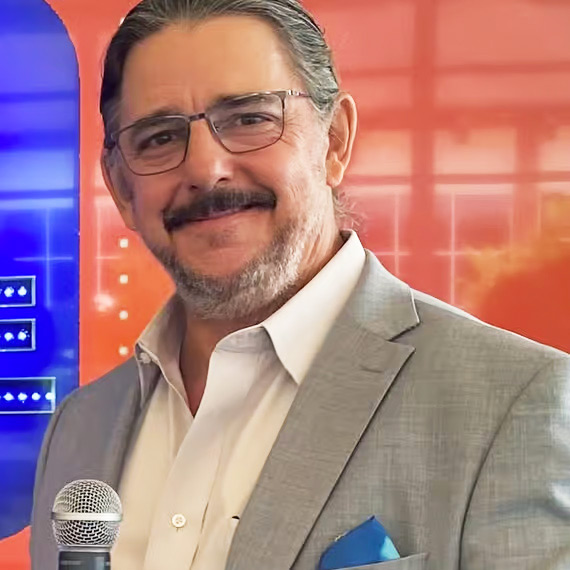
John Kovatch and Joe Shoemaker of AFC Industries join Eric Dudas to air the whole idea out. Kovatch, who is out in the field constantly, says customers are surfacing that you would not even expect to have been data center customers, because when everybody hears data center they think of just a room full of servers, and there is so much more that goes into it. Shoemaker brings the marketing and communications perspective on the same opportunity.
On the Fastener News Report, Mike McNulty is joined by Gary Cravens, president of Advance Components, to reveal the latest Fastener Distributor Index results, and their conversation lands on the same data center activity. Elsewhere on the episode, Ed Smith comes off his one-year term as president of the NFDA, Carmen Vertullo takes on a topic that arrived by email from a client, and Marco Rodriguez returns with the Cresa Industrial Real Estate Update.
What You’ll Learn
- Data center demand is reaching fastener customers who would not have been considered data center customers at all, and Kovatch says it snuck up on the industry fast.
- A data center has three main inputs and outputs: electricity, heat, and the computing power of the servers and racks.
- The FDI’s June 2026 reading of 60.0 versus 56.9 in May marks the 14th straight month in expansion territory.
- The ISM Purchasing Managers Index dipped to fifty-three point three versus fifty-four point oh last month, a softer counterpoint to the fastener-specific numbers.
- Consolidating three locations into one hub can cut redundant overhead, rent, labor, management and utilities, but Rodriguez says the biggest benefit is inventory optimization.
- The service argument against consolidation is the last mile: most end customers operate just in time, and a line down cannot wait two days for a freight shipment from a central DC.
- Nondestructive inspection comes up often enough that fastener professionals should be aware of the common and not so common types, Vertullo says.
- Coming out of the NFDA strategic plan, an ambassador program has already been put in place, with hand-selected connected individuals bringing in new participants.
Featured Voices
Hosts: Eric Dudas, Brian Musker
- Mike McNulty
- John Kovatch: John Kovatch is on the sales side at AFC Industries and is out in the field constantly.
- Ed Smith — Würth Industry USA looks back at his tenure as NFDA president. On the Fastener News Report , Advance Components president Gary Cravens: Ed Smith is just coming off his one-year term as president of the NFDA.
- Joe Shoemaker: Joe Shoemaker is VP of marketing at AFC Industries, a communications and publicity perspective on the data center opportunity.
- Carmen Vertullo: Carmen Vertullo presents the Fastener Training Minute from Carver Labs and the Fastener Training Institute.
- Marco Rodriguez — Cresa: Marco Rodriguez presents the Cresa Industrial Real Estate Update.
- Rosa Hearn
- Aaron Paukovic
- Angela Philippart
- Brad
- Dana Stone
- Danielle Riggs
- Emma
- Gary Cravens: Gary Cravens is president at Advance Components and joins the Fastener News Report with the FDI results.
- George Hunt III
- Jen Fuss
- Mallory
- Melissa Patel
- Michael White
- Mike Robinson
- Pam
- Scott Camp
- Sebastian Janus
- Susie
Also Heard
- Jake Davis — BTM Manufacturing
- Christian Reich
- Alex Goldberg
- Andy Roach
- Anya Falcone
- Becky Russo Body
- Bob Baer
- Bobby Wagner
- Brandon Wiley
- Brandy Bortoya
- Chad Bussell
- Chris Tribble
- Craig Penland
- Dan Crociata
- David Gawlik
- Dr. Mark Broeker
- GH3
- Harry Doherty
- Ian Heller
- Jeff Crume
- Jennifer Sturm
- Jill Lewis
- Joe L. Davis Jr.
- John Leroy
- Ken Sanker
- Kevin Hochstalter
- Marty Nolan
- Matt Delawder
- Nick Viggiano
- Niles Sharif
- Paula Evitts
- Rich Cavoto
- Scott Longfellow
- Scott McDaniel
- Steve Andracik
- Tim Roberto
Explore Episode 229
Timestamped guide to the episode. Times link to the transcript below.
- 00:00 — Cold open: episode ID line plus teaser clips
- 01:41 — Opening segment: Eric Dudas and Brian Musker
- 13:12 — Interview: Ed Smith, immediate past president of the NFDA and Würth Industry USA strategic sourcing
- 32:51 — Cresa Industrial Real Estate Update with Marco Rodriguez (redux): is one big warehouse better than three small ones
- 36:22 — News-segment lead-in: the FDI on fire; Würth Knowing’s new ‘Point of Contact’ podcast on fastener standards with Chad Bussell and Chris Tribble; Carmen Vertullo’s new two-day Risk Management for the Fastener Industry conference, Sept 24-25 in San Diego with Niles Sharif and keynote Dr. Mark Broeker; the Tough Nutters team for the Aug 29 Tough Mudder during MWFA Fastener Week and the Sleep in Heavenly Peace bed build at SWD
- 42:18 — Fastener News Report — Mike McNulty of Fastener Technology International; sponsored by Volt Industrial Plastics
- 42:18 — FNR open: sponsor credit to Volt Industrial Plastics; rundown
- 45:28 — Fastener Distributor Index (June 2026: 60.0, the strongest in five years and a 14th straight month of expansion) with guest commentator Gary Cravens, president of Advance Components
- 01:20:29 — FNR top story: Endries International acquired the business and assets of Blue Chip Engineered Products (Erlanger, Kentucky; founder Ken Sanker stays as general manager; quotes from Endries president and CEO Dan Crociata); FNR Fastener Newsmaker headlines (corporate and personnel); FNR Back Page: the MWFA 2026 Hall of Fame class (seven individuals and two companies, to be honoured during Fastener Week on Sept 2 2026 at the 80th anniversary dinner) and NFDA 2026-2027 leadership (Melissa Patel president; Angela Philippart vice president; Scott Camp association chair; Ed Smith immediate past president); McNulty sign-off
- 01:22:48 — FNR top story: Endries International acquired the business and assets of Blue Chip Engineered Products (Erlanger, Kentucky; founder Ken Sanker stays as general manager; quotes from Endries president and CEO Dan Crociata); FNR Fastener Newsmaker headlines (corporate and personnel); FNR Back Page: the MWFA 2026 Hall of Fame class (seven individuals and two companies, to be honoured during Fastener Week on Sept 2 2026 at the 80th anniversary dinner) and NFDA 2026-2027 leadership (Melissa Patel president; Angela Philippart vice president; Scott Camp association chair; Ed Smith immediate past president); McNulty sign-off
- 01:24:15 — FNR top story: Endries International acquired the business and assets of Blue Chip Engineered Products (Erlanger, Kentucky; founder Ken Sanker stays as general manager; quotes from Endries president and CEO Dan Crociata); FNR Fastener Newsmaker headlines (corporate and personnel); FNR Back Page: the MWFA 2026 Hall of Fame class (seven individuals and two companies, to be honoured during Fastener Week on Sept 2 2026 at the 80th anniversary dinner) and NFDA 2026-2027 leadership (Melissa Patel president; Angela Philippart vice president; Scott Camp association chair; Ed Smith immediate past president); McNulty sign-off
- 01:29:29 — Fastener Training Minute
- 01:29:29 — FTM part 1: an ultrasonic-inspection requirement on an automotive drawing prompts the topic; ‘when I return, I’ll tell you about some of the ones you’re likely to see often’
- 01:42:32 — Feature interview: John Kovatch (EVP, sales) and Joe Shoemaker (VP of marketing) of AFC Industries on the data-center boom
- 02:19:51 — Closing segment: Brian Musker and Eric Dudas
Feature interview
AFC Industries on the data center boom: what one actually is, and where the fasteners are
Eric Dudas frames the segment plainly: if you were tired of talking about tariffs, there is a whole new ballgame, and you do not have to listen to the FDI report to know the buzz is data centers. John Kovatch and Joe Shoemaker of AFC Industries come on to air the whole idea out.
Kovatch, on the sales side at AFC Industries, says he hears about data centers constantly and that more and more customers are surfacing that you would not even expect. When everybody hears data center they think of just a room full of servers, he says, but there is so much more that goes into it, and it is kind of mind-boggling once you start getting into the middle of it. He describes it sneaking up fast, recalling a massive build he saw in Des Moines, Iowa only three or four years ago at the most.
The teaser clip that opens the episode sets out the structure: there are really three main components, or three main inputs and outputs, of a data center. One is electricity. The other is heat. And then you have the computing power of the servers and the racks. The warning that follows is aimed squarely at fastener people who assume all the opportunity sits in the computer part.
Shoemaker is VP of marketing, a different perspective from Kovatch’s, and Dudas puts the communications and publicity question to him directly.
No, it's, it's everywhere. Eric, we hear about, the data centers constantly, and more and more customers are surfacing that you wouldn't even expect to have been a data center customer, right? Because I think when everybody hears data center, they think, you know, just a room full of servers, but there's so much more that goes into it.
By the Numbers
- 965 billion — Valuation cited in the data center discussion (01:49:40)
- $3 — Highest valued company in the world (01:50:03)
Recurring segment
Fastener News Report: the FDI surges to 60.0 with Gary Cravens of Advance Components
Mike McNulty delivers the Fastener News Report, with Gary Cravens, president of Advance Components, joining to reveal the latest results of the Fastener Distributor Index. The episode also carries the top story from Endries International and Blue Chip Engineered Products plus newsmaker headlines.
The seasonally adjusted Fastener Distributor Index for June 2026 surged to 60.0 after posting a solid reading of 56.9 in May, seasonally adjusted. It was the 14th straight month of the FDI being in expansion territory. The Forward Looking Indicator retreated to a respectable fifty-six point seven versus the four-year high of fifty-eight point nine the prior month.
Against the fastener-specific strength, the broader reading softened: the ISM Purchasing Managers Index dipped to fifty-three point three versus fifty-four point oh last month. Fastener Distributor Index data is collected and analyzed by the FCH Sourcing Network and Baird.
The back page covers MWFA awards and NFDA leadership: Melissa Patel of Field Fastener was elected president of the NFDA for 2026-2027, and Angela Philippart of AFC Industries will serve as vice president.
All right. Well, that also is reflected, I think, in our last number, which is the ISM, Institute of Supply Management, the PMI, the Purchasing Managers Index. It dipped to fifty-three point three versus fifty-four point oh last month.
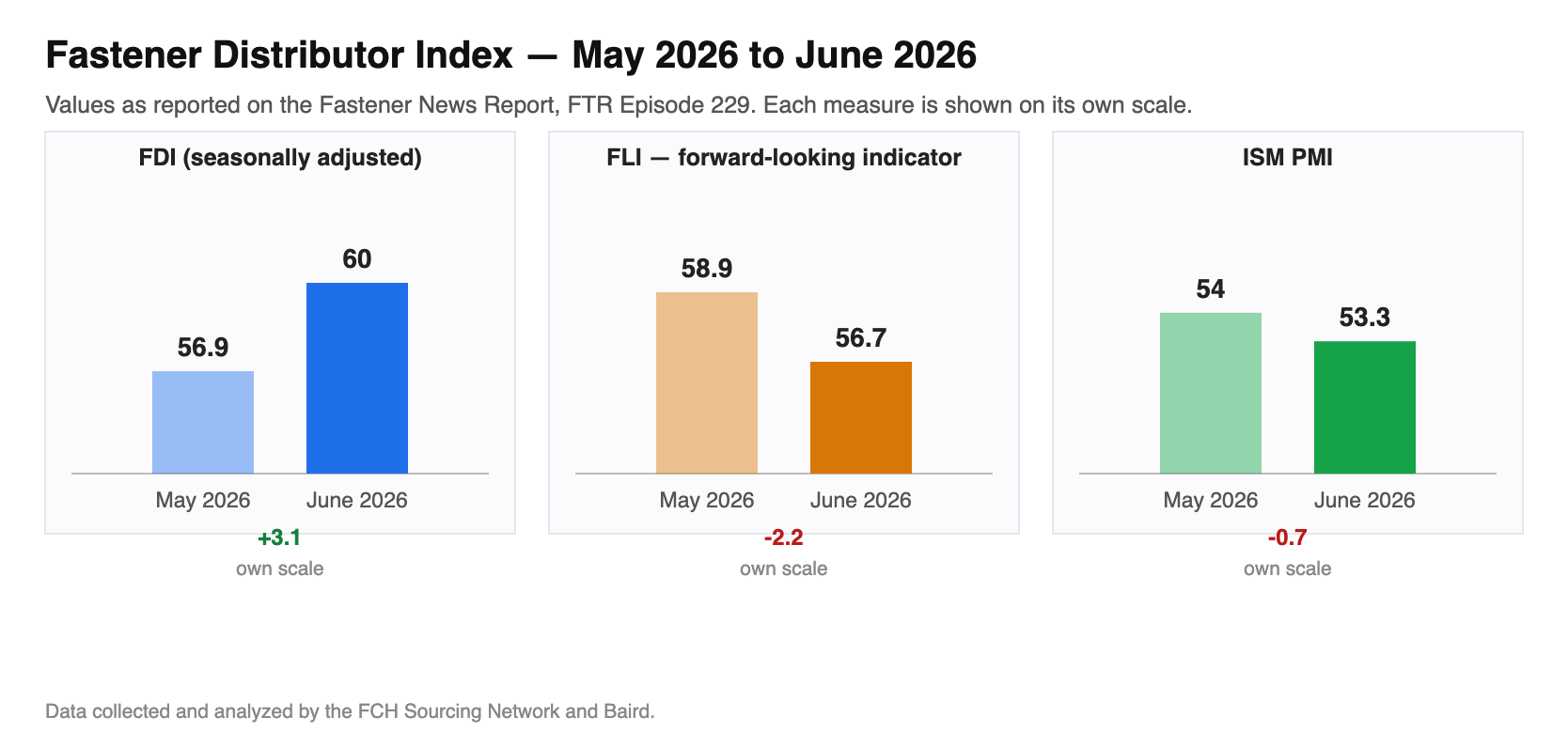
- FDI (seasonally adjusted): 56.9 → 60
- FLI — forward-looking indicator: 58.9 → 56.7
- ISM PMI: 54 → 53.3
By the Numbers
- 60.0 — FDI, June 2026 (00:45:28)
- 56.9 — FDI, May 2026 (00:45:28)
- 60.0 — FDI number for June 2026, as restated on air (01:20:29)
- 56.9 — FDI number for May 2026, as restated on air (01:20:29)
Terms and Technical Notes
- FDI (Fastener Distributor Index) — FDI is the Fastener Distributor Index, the survey result Gary Cravens joins the Fastener News Report to reveal. (00:42:54)
- FLI (Forward Looking Indicator) — FLI is the Forward Looking Indicator, reported here at fifty-six point seven against the prior month’s four-year high of fifty-eight point nine. (00:45:47)
- ISM (Institute of Supply Management) — ISM is the Institute of Supply Management, publisher of the PMI reading cited in this segment. (00:57:50)
- PMI (Purchasing Managers Index) — PMI is the Purchasing Managers Index, which dipped to fifty-three point three versus fifty-four point oh the prior month. (00:57:50)
Interview
Ed Smith closes out his year as NFDA president, from the gavel to the ambassador program
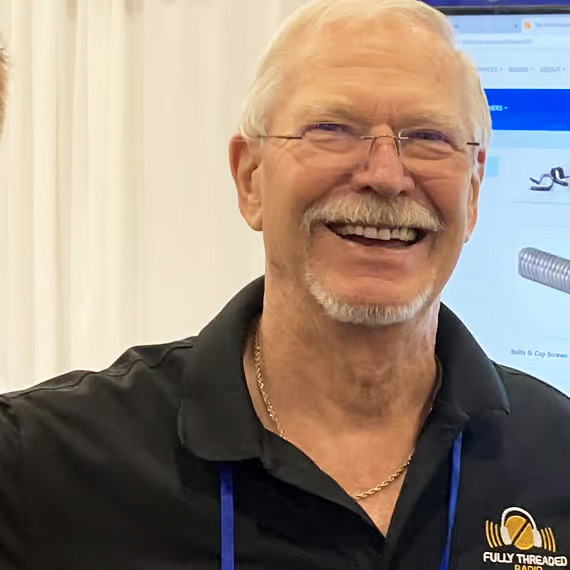
Eric Dudas notes that out in the real world an ex-president makes you think of golf, but this is the fastener industry and the big rage is pickleball. Ed Smith is just coming off his one-year term as president of the NFDA. Smith says he owns some golf clubs but does not swing them as much as he once did, and you can find him on the pickleball court a few times a week, having just been beaten up pretty good playing a few hours with his wife and friends that morning.
Asked about the gavel in the teaser clip, Smith calls it the fun part of the handoff: you become the president, and the immediate past president hands you the gavel and says here you go.
A highlight of the meeting for Smith was a panel that did the heavy lifting on the question of whether it was a reality or just kind of hearsay, with the new presidents of NFDA, Melissa Patel and George Hunt III, Aaron Paukovic from Nucor, and the late Sebastian Janus.
Coming out of that strategic plan, Smith says a few things have already been put into place, one being the ambassador program: hand-selected individuals who have been around a while and are very connected, there to usher in and get new participants coming to the NFDA.
Recurring segment
Fastener Training Minute: Carmen Vertullo on nondestructive inspection testing
Carmen Vertullo comes to the Fastener Training Minute from Carver Labs in El Cajon, California, and also from the Fastener Training Institute. Today’s topic is a little bit obscure, he says, and it came to him in an email from a client who saw a requirement on a drawing they did not quite understand.
It occurred to him that this does not get talked about often, and is not seen often, but is seen often enough that fastener professionals should be aware of the various types of common and not so common testing called nondestructive or NDI testing.
In the second half he covers enhanced visual methods, the most common being magnetic particle inspection. That is done on ferrous metals, that is iron-containing metals, where the part is subjected to a magnetic field to make it like a magnet, then immersed in, sprayed with, or exposed to a fluid.
- 01:29:29 — Part one: an ultrasonic inspection requirement on an automotive drawing prompts the topic, and Vertullo promises that when he returns he will cover the types you are likely to see often and some you are not.
Sponsored feature
Cresa Industrial Real Estate Update: is one big warehouse better than three small ones?
Marco Rodriguez from Cresa poses the question directly. Owners and managers of fastener distributors run their businesses by the numbers, and for companies with multiple locations that have been around a long time or grown through acquisition, there is likely a CFO somewhere pointing at the math.
The answer is not always just about cost, Rodriguez says. There is a clash of strategy, efficiency versus service. The case for consolidation starts with obvious cost savings, cutting redundant overhead, rent, labor, management and utilities, but the biggest benefit is inventory optimization.
Instead of holding fifty thousand of a specific washer at three different locations, a hundred and fifty thousand in total, you can hold eighty thousand of that washer in one central hub. That is a massive reduction in working capital which can be reinvested elsewhere, perhaps in warehouse automation. It can be hard to justify a five million dollar automated picking system for a twenty thousand square foot warehouse, but for a single hundred thousand square foot distribution center it becomes a huge labor saving efficiency gain.
Every yin has its yang, and the powerful case for multiple warehouse networks is the service argument. The biggest factor is the last mile: most end customers, whether manufacturers or on construction sites, operate just in time, and a line down cannot wait two days for a freight shipment from a central DC. Beyond storage, local warehouses become service centers and the base for local delivery.
Episode Links — Review
EXISTING EPISODE LINKS (preserved; never modified by this skill)
Craig Penland on The Journey to CEO Success podcast Risk Management for the Fastener Industry presented with Carmen Vertullo Sept. 24-25 San Diego Ed Smith speaks at the Taiwan International Fastener Show as NFDA president Würth Knowing Point of Contact podcast on fastener standards International Fastener & Assembly Summit at IFE ’26 Tough Mudder Race Info – contact Bob “GQ” Baer for registration info The Pretenders “Message of Love”
PROPOSED EPISODE LINKS TO ADD
No proposed link additions.
Image Opportunities (for review)
No image is proposed. No image is preferable to an irrelevant image.
Complete Transcript — Episode 229
Verbatim Descript transcript. Headings mark approved segment boundaries; speaker names appear only where evidence resolves them.
00:00 — Cold open: episode ID line plus teaser clips
[00:00:00] Speaker: It’s Fully Threaded Radio episode two hundred twenty-nine.
[00:00:03] Speaker 2: Let’s start from the base here. What is a data center, right? Well, there’s really three main components of a data center or, or three main inputs and outputs of a data center, and that one is electricity. The other is heat. We’ll get to that. And then you’ve got the computing power of the servers, the racks.
[00:00:21] Speaker 2: I think a lot of people look at it and think, “Well, it’s just a bunch of servers and, and server racks and, you know, it’s, uh, all my opportunity is in the computer part of this.” And that’s the furthest thing. If you look at a data center
[00:00:35] Eric Dudas: During the meetings and so forth, are you kind of hitting the gavel? I mean, is that really what you’re doing?
[00:00:40] Eric Dudas: Or were you… Help people understand that.
[00:00:42] Ed Smith: Well, there, there is a gavel, yes. Um
[00:00:45] Eric Dudas: Is there really?
[00:00:46] Ed Smith: Yeah, there absolutely is a gavel. Yeah. I
[00:00:48] Eric Dudas: didn’t know that.
[00:00:49] Ed Smith: Yeah, no, that’s the, that’s the fun part of the handoff, right? So you, uh, you become the president, and the immediate past hands you the gavel and says, “Here you go.
[00:00:57] Ed Smith: Good luck.”
[00:00:59] Speaker 5: You could reshore everything in America overnight, but I mean, theoretically, but you don’t have anybody that can do the work.
[00:01:06] Speaker 6: No, they wanna do YouTube influencing instead.
01:18 — Produced show intro: ‘Time for Fully Threaded Radio’
[00:01:18] Speaker 7: Time for Fully Threaded Radio
01:41 — Opening segment: Eric Dudas and Brian Musker
[00:01:41] Eric Dudas: It is Fully Threaded Radio, voice of the FCH Sourcing Network. If you buy, sell, manufacture, import, or distribute industrial threaded fasteners, this is the podcast for you. Hey, everybody, Eric Dudas with you here, coming to you from semi-rural Northeast Ohio, and the co-host of Fully Threaded is with us as well.
[00:02:01] Eric Dudas: He’s the man with the deep Southern accent.
[00:02:04] Brian Musker: Very deep Southern.
[00:02:07] Eric Dudas: And the occasional background parrot incursions. He’s Brian Musker. Hey, Bri, doing all right?
[00:02:14] Brian Musker: I’m good. Yeah, there are the parrot incursions, and it’s a very deep South accent. 8,000 miles.
[00:02:23] Eric Dudas: Well, it’s sizzling here in Ohio, as I know it is in the Chicagoland area where you are, and you’d probably be better off being down there on a day like today if you’re looking to cool off.
[00:02:33] Eric Dudas: But, uh, hey, we’ll take what we get on this episode 229 of the Fully Threaded Radio podcast. We’re gonna try and bring you a summer sizzler.
[00:02:42] Brian Musker: Right, to go with the sizzler that you feel the moment you step outside, actually, so… And it would be m- much cooler down south. It’s their winter.
[00:02:51] Eric Dudas: Exactly, but we won’t dwell on it.
[00:02:53] Eric Dudas: Let’s just lay this one out. Publishing this time, July 14th, 2026. It’s destined to be a classic episode of the podcast, I’m thinking, Bri.
[00:03:03] Brian Musker: Okay. We have lo- we have lots of classics, actually.
[00:03:07] Eric Dudas: The hits just keep coming. This time we’re gonna kick off with NFDA immediate past president, Ed Smith. He’s with Würth Industry USA, and we had him on when he was launching his tenure as NFDA president.
[00:03:21] Eric Dudas: I just saw a LinkedIn post fly by the other day, Bri. The new board has been elected, and- Cool … it went by so fast, we had to get Ed on to hear about his experience as president.
[00:03:32] Brian Musker: Yeah, I would think so, actually.
[00:03:34] Eric Dudas: So he warms us up today ahead of our feature segment, which really speaks to the big headline in the fastener industry so far this summer, and that’s the subject of data centers.
[00:03:46] Brian Musker: Yes, you’re right.
[00:03:47] Eric Dudas: John Kovach and Joe Shoemaker with AFC Industries help us to understand why the data center boom is so huge, what it actually looks like out there on the streets these days, and how you might look at this opportunity within your company. One thing’s for sure, the majority of fastener companies that we’re hearing from these days are very much aware of this idea, so hopefully we’ll fill in a few blanks here, Bri.
[00:04:12] Brian Musker: Oh, I would think so. Yeah, we talked to numerous ones at the show in Charlotte who said the same thing.
[00:04:17] Eric Dudas: And that’s gonna carry over from the conversation you’ll hear on the Fastener News Report. This time, Mike McNulty’s joined by Advanced Components president, Gary Cravens. The FDI’s on fire, partly due to the data center activity that’s going on right now, and their conversation would not be complete without touching on that subject.
[00:04:38] Eric Dudas: So, the Fastener News Report is another one of these Mike McNulty Show editions, Bri.
[00:04:47] Brian Musker: But he’s very, very focused on fasteners
[00:04:49] Eric Dudas: He can’t help himself. But that’s not all, we’ve also got the Fastener Training Minute for you. Know anything about NDI testing? Non-destructive inspection testing, that is. Well, Carmen Vertullo does.
[00:05:03] Eric Dudas: He’s gonna tell us all about it. That’s the Fastener Training Minute.
[00:05:07] Brian Musker: Cool.
[00:05:07] Eric Dudas: And we’ve got a redux Marco Rodriguez Industrial Real Estate update because some of them are just so good you have to hear them twice, Bry.
[00:05:16] Brian Musker: Okay.
[00:05:17] Eric Dudas: Nothing to do with the whole summer rerun syndrome.
[00:05:20] Brian Musker: Oh, yeah. Right. But apparently new shows are coming in three months, okay?
[00:05:26] Brian Musker: We’re told.
[00:05:27] Eric Dudas: Good thing there’s this new episode of Fully Threaded Radio, plus a couple more before the new shows start, Bry. We got a lot to put in this one, and that’s because we have a lot of input from our partners. They make this possible, the title sponsors of Fully Threaded Radio, Britenbest International, tested, tried, true, Britenbest, and Star Stainless, and the Linfast Solutions family of companies.
[00:05:50] Eric Dudas: Right off the shelf, it’s Star. Fully Threaded Radio is also sponsored by Buckeye Fasteners and the Ohio Nut and Bolt Company, BTM Manufacturing, Eurolink Fastener Supply Service, Fastener Technology International, GOBO Fasteners, InSQL Software, J. Lanfranco, MW Components, Cressa, the International Fastener Expo, 3Q Inc.,
[00:06:16] Eric Dudas: Volt Industrial Plastics, and Wurth Industry USA. And the email address for the podcast is ftr@fullythreaded.com. Brian and I are also out there on LinkedIn, so catch us that way as well. Plus, Bry, we’re gonna be, of course… Well, we’ll be a lot of places, but among them will be the International Fastener Expo coming up this fall.
[00:06:39] Eric Dudas: That’s happening October 7th through the 9th at the Phoenix Convention Center, Phoenix, Arizona. New-
[00:06:45] Brian Musker: Yep …
[00:06:45] Eric Dudas: all-new location.
[00:06:46] Brian Musker: Right.
[00:06:47] Eric Dudas: And we have so much crammed into the episode today as we just saw, but I was really trying to get Anya Falcone on the episode today. We couldn’t make it happen. They have so many new things coming that I really wanted to let them showcase, so next episode for sure.
[00:07:03] Eric Dudas: They’re working very hard to make the switchover to a new city well worth the effort to show up.
[00:07:09] Brian Musker: Well, I don’t mind. I mean, personally, for me, Phoenix is probably slightly better than Las Vegas. I got sick of Las Vegas. But we’ll see, okay?
[00:07:18] Eric Dudas: Well, I think a lot of people feel the same way, and we will see. One cool addition to the event this year is a pre-show summit date.
[00:07:27] Eric Dudas: Now, information is available out there on the website fastenershows.com, which is the official IFE website, and the summit is being billed as the International Fastener and Assembly Summit. They’ve got two education tracks, and it’s happening actually, I believe, the same day as the golf event, so I’m not sure how that works.
[00:07:46] Eric Dudas: But all the information’s out there. We’ll have Anya on, that’s Anya Falcone, the new IFE show director, I hope on the next episode, because this is a really good idea. People have kicked it around in the past, and I think Emerald is gonna take it to the next level, you know? So let’s see what they can do.
[00:08:02] Eric Dudas: All the speakers for these two educational tracks are out there at the fastenershows.com website.
[00:08:08] Brian Musker: Okay. Well, we should be doing… Looking that up then.
[00:08:11] Eric Dudas: Plus, on the show floor, not related to the summit, I actually landed myself a couple of slots in some of the breakouts too, Bry. So I didn’t tell you about that.
[00:08:22] Brian Musker: No, you did not. You promised me you’re gonna spend your entire time in the booth, okay?
[00:08:26] Eric Dudas: Well, you know, I didn’t wanna upset things, but- … I’m just putting it out there now, so.
[00:08:33] Brian Musker: Okay.
[00:08:34] Eric Dudas: Get that Vegemite ordered, please, if you haven’t already.
[00:08:37] Brian Musker: Oh, good. Yes, you’re right.
[00:08:39] Eric Dudas: All right, one other thing that I wanna mention- Yes
[00:08:41] Eric Dudas: before we cut to a quick message, then onto the Summer Sizzler Our good friend Craig Penland with Eurolink was the featured guest on The Journey to CEO Success podcast. Now, this is a show that I had not heard before, but since Craig was on it, of course I had to give it a listen, and it’s really nicely done.
[00:09:01] Eric Dudas: Craig is just so cool on this thing, and he talks about a lot of subjects, one of them being a very interesting one that we’ve touched on before on the podcast, Bry, this idea of a small to mid-size company that’s being acquired and how that process actually feels to an owner who’s gotta consider what are the best options for their family and their employees and everything like that.
[00:09:25] Eric Dudas: And not surprisingly, Craig is very, very much giving consideration to the whole ESOP idea. In other words, turning the company over to employees. Yeah. And that is just the Craig way, you know? He’s just got such a heart of gold. And, uh, again, that’s The Journey to CEO Success podcast. We’ll have a link to that on the show notes.
[00:09:46] Brian Musker: Oh, cool. It’s probably not quite as common as it should be, ’cause it’s a very interesting way of divesting yourself of all the responsibilities of your company.
[00:09:56] Eric Dudas: That’s right. There’s a handful of them out there in the fastener world, Buckeye Fasteners being another one.
[00:10:01] Brian Musker: Oh, yeah. True.
[00:10:02] Eric Dudas: We had that conversation, oh, geez, some time ago, but well worth a listen.
[00:10:07] Eric Dudas: These things go lots of directions in the fastener world, as we will hear on the Fastener News Report, too. More acquisition news coming. We’ll let Mike break that scoop. Right now we’re gonna take a quick break, be back to put a match to this one.
[00:10:21] Speaker: Okay.
[00:10:22] Eric Dudas: Thanks for listening, everyone. It’s Fully Threaded.
10:24 — Produced show-ID bumper: ‘Two men, one server, a fastener dog, and a stunning lack of more lucrative…
[00:10:24] Speaker: Radio. Two men, one server, a fastener dog, and a stunning lack of more lucrative alternatives. It’s Fully Threaded Radio.
10:40 — Commercial break 1
[00:10:40] Linda: Hi, I’m Linda from Lindfast, the mom of this big hardworking family, and I’m excited to tell you about the newest addition to the family, our new online marketplace at lindfastdrp.com. For the first time, you’ll be able to connect with our family of brands through one convenient online experience. Whether you’re sourcing metric fasteners, stainless and non-ferrous products, carbon steel, or alloy fasteners, it’s all right at your fingertips.
[00:11:08] Linda: Talk to your LSG representative today to learn more and get registered. The same people you know, the same service you trust, just a faster way to do business. Lindfast Solutions Group, one family, endless solutions.
[00:11:23] Speaker 10: Need stainless fasteners? Brightenbest has you covered. From everyday jobs to the toughest corrosion-resistant applications, Brightenbest stocks the industry’s largest selection of stainless engine metric fasteners, ready to ship when you need them.
[00:11:39] Speaker 10: Choose from 18-8 or premium 316 stainless, including hex bolts, socket cap screws, machine screws, nuts, washers, threaded rod, anchors, and construction screws. And when your stainless order reaches 500 pounds, freight is prepaid. When quality, inventory, and fast delivery matter, trust Brightenbest. Brightenbest, the stainless fasteners you need in stock and ready to ship
[00:12:09] Speaker 11: You hear that?
[00:12:10] Speaker 11: Your line is speaking to you. It’s asking you a question. Are we good enough? Is good enough good enough? Are we delivering the best possible solution? Will what we make stand the test of time? Can we be bigger, faster, safer, smarter? Can we get what we need before we need it? Can we increase production? Can we be more precise?
[00:12:35] Speaker 11: Can we work day and night for weeks on end? Can we create what’s never been done? Yes, we can. Let’s discover your worth.
12:52 — YLT: Jake Davis with BTM Manufacturing (heard ‘Jake Davis with BTM Manufacturing’)
[00:12:52] Jake Davis: This is Jake Valdez Davis with PTM Manufacturing, and you are listening to Mi Amigos, Brian and Eric, on Fully Threaded Radio
13:12 — Interview: Ed Smith, immediate past president of the NFDA and Würth Industry USA strategic sourcing
[00:13:12] Eric Dudas: Normally, out there in the real world, when you hear about an ex-president, you think about golf and presidents golfing all the time. That’s what I think about. But this is the fastener industry, and these days, the big rage is pickleball. So we’ve got an ex-NFDA president on with us at the moment. That’s Ed Smith.
[00:13:31] Eric Dudas: He is just coming off of his one-year term as president of the NFDA. Seems like less than a year ago that we had you on, Ed, but here you are again. You’re coming off your term. Thank you for your service to the industry. What is it, pickleball or golf for you?
[00:13:45] Ed Smith: Uh, any, any more, Eric, the, uh, the golf clubs, uh, I own some.
[00:13:51] Ed Smith: Uh, I don’t swing them as much as I, I once did, but, uh, you can find me on the pickleball court, uh, a few times a week for sure. Matter of fact, I, I just got done playing a few hours with my wife and, uh, and some friends, so I g- I got beat up pretty good this morning, so we’re, uh, we’re, we’re feeling, we’re feeling ready to go though.
[00:14:07] Eric Dudas: So it’s pickleball for you mostly. I thought that was the case ’cause we’ve been seeing a lot on LinkedIn fly by. I’m not involved in it, but I see the photos, and I could’ve sworn I saw you out there. So how long you been doing that?
[00:14:18] Ed Smith: Uh, well I guess I’ve been playing pickle for a couple of years now, so not, not that long.
[00:14:23] Ed Smith: So between pickleball and, uh, and uh, and I play a lot of roller hockey. Um, so between, you know, those, those two activities, it, uh, k- keeps me young, right? So that’s, that’s the goal. How do we stay young as we, uh, as we get older so…
[00:14:38] Eric Dudas: Yeah, you have to do something. So good for you for doing that, and good for you for finishing up your year at NFDA.
[00:14:44] Eric Dudas: Of course, you’re still on the board as the past president. You can tell us what the duties there entail, but like to thank you again for contributing to the industry, and why don’t we take a look back? What did you get done during this year? Seems hard to believe, doesn’t it? Yeah. Over, over already.
[00:14:59] Ed Smith: Over already, I know.
[00:15:01] Ed Smith: But, uh, the, the work is still there for sure. No, it’s, uh, this past year has been extremely humbling, and it’s just been a, been an absolute honor to, uh, to serve the industry in, in, in this role. Really for me, it’s looking back to kind of our first event as, uh, as my presidency was, um, the executive summit in Key West.
[00:15:22] Ed Smith: And looking kind of some memories on that one, it was a very successful meeting, great attendance, great weather actually, so that was, uh, we didn’t have any storms slowing us down in October in Florida, so that was good. Um, but one of the highlights out of that conference was a panel discussion that we had, uh, in terms of, you know, the, the topic of reshoring.
[00:15:48] Ed Smith: You know, is it a reality or is it just kind of hearsay? And we had some great panelists, um, that really did the heavy lifting for us on that between the, the new presidents of NFDA, Melissa Patel and George Hunt, and uh, Aaron Paukovic from Nucor, and of course the late Sebastian Janus. But, uh, yeah, that was a great highlight for me from that meeting, as well as Danielle Riggs talking on, you know, trade compliance and the, uh, challenges there.
[00:16:16] Ed Smith: So overall, I thought, um, stepping into that one summit there was, wa- was fantastic and again, I mean, I think that just kind of set the tone for the rest of the term, right? So then looking forward into kind of the next phases of what we had going on as the NFDA board, we all got together in January to come together and establish our new strategic plan.
[00:16:40] Ed Smith: And coming out of that strategic plan, we have, you know, a few, um, a few things that we’ve already kind of put into place. One being the, uh, ambassador program. So we’ve selected, you know, hand-selected some individuals that have been around a while, some very connected folks to, you know, really help usher in and get new participants, um, that, you know, are coming to the NFDA, getting them introduced, getting them comfortable with the people, the association, and you know, really just, just having, um, a, a friend out there, right?
[00:17:12] Ed Smith: ‘Cause, you know, we, we all, we all can be a first-timer somewhere and, and know nobody, but I think with this ambassador program, you can feel welcome and invited and, you know, just feel a lot more included. So that, that was one of my goals was, uh, how do we make the NFDA a little bit more inclusive and, you know, welcoming to, uh, to whether that’s new members or people that haven’t participated in a while.
[00:17:37] Ed Smith: And I think, um, we, we s- we’ve had a lot of success with that. Another area of, uh, the strategic plan was facilitating a rapid response team. So if there was something, you know, a hot topic in the industry or something that’s going to be affected, um, you know, we want to be out in front of that as much as we can to give the membership, you know, as, as much information or details that, uh, that we can.
[00:18:03] Ed Smith: And again, with the trade climate that we’re in, tariffs and so on and so forth, with CBAM, and now PFAS is a big one that, uh, we seem to be battling a little bit. Got some good folks on that committee and, uh, yeah, just trying to spread the word out there a little bit, uh, a little bit more.
[00:18:20] Eric Dudas: So as president of the organization through all this, your role is really leadership role, and during the meetings and so forth, are you kind of hitting the gavel?
[00:18:30] Eric Dudas: I mean, is that really what you’re doing? Or were you… Help people understand that.
[00:18:34] Ed Smith: Well, there, there is a gavel, yes. Um-
[00:18:37] Eric Dudas: Is there really?
[00:18:38] Ed Smith: Yeah, there ab- absolutely is a gavel. Yeah. I
[00:18:40] Eric Dudas: didn’t know that.
[00:18:41] Ed Smith: Yeah, no, that’s, that’s the, that’s the fun part of the handoff, right? So you, uh, you become the president, and the immediate past hands you the gavel and says, “Here you go, good luck.”
[00:18:51] Eric Dudas: Wow. A lot of big hands have touched that gavel.
[00:18:54] Ed Smith: Oh, for sure. Yeah. No, absolutely. Yeah, I think we have such a, a strong group on our board and, you know, we’ve been… we’re very fortunate to have, um, the people that we have and, you know, on, from a volunteer basis. And again, I mean, it’s a- as any board that you sit on, you’re gonna get out of it what you put into it.
[00:19:11] Ed Smith: So if you’re active and you’re engaged and, like, you’re, you’re doing the right things to help, you know, you’re gonna get so much out of that, out, out of your experience. And I, I know I have, for sure. So, you know, and even looking this, at this past fall, I had the opportunity to speak at the Global Fastener Forum at the Taiwan Fastener Show, and for me, I mean, that was, that, that, that was a humbling experience in and of itself just because here I am just trying to provide kind of the state of the US fastener industry-
[00:19:42] Eric Dudas: Just as a simple pickleballer.
[00:19:44] Eric Dudas: Yeah,
[00:19:44] Ed Smith: as, as a simple pickleballer. Uh, yeah, so it was, uh, very humbling, uh, to, to be standing up there in front of a, a crowded room. Um, fortunately, you know, there was… What, I think what put my nerves at ease was English was not everybody’s first language in that room, so that was, uh, certainly helpful. So no, that was, uh, an honor to be part of that and to represent NFDA and the, uh, US fastener industry at, uh- How cool
[00:20:11] Ed Smith: at that show. Yeah, that was, that was very cool. So very unique experience for me, and, uh, something that I’m very happy that I was able to participate in.
[00:20:20] Eric Dudas: Well, you wouldn’t know this, but later in the podcast, we talk with Gary Cravens from Advanced Components, and of course, those guys are all about becoming involved in the associations.
[00:20:30] Eric Dudas: Uh, everybody knows somebody from that family and what they’ve done for the industry. And he basically is saying the same thing. You gotta get involved. You get out of it what you put in. You’re saying the same thing, and you personally got a lot out of it while you were contributing. So, um, good theme.
[00:20:46] Ed Smith: No, it’s, uh, it’s, it’s, it’s been a lot of, it’s been a lot of fun.
[00:20:50] Ed Smith: Um, and again, just being surrounded by, you know, the strong individuals, you know, that are on the board and, and really just getting to know them, right? So you have competitors and, you know, whatnot in there in between whether or not you’re a distributor or an associate member. But at the end of the day, it’s, you know, put the competitiveness aside, and we’re really trying to do what’s best for the industry, what’s needed for the industry.
[00:21:13] Ed Smith: And I honestly would have never had the opportunity to get to know the fellow board members, um, as, as well as I have. I mean, as, as an example, getting to know Melissa Patel and Angela Philippart, and I mean, just those two ladies are extremely strong and just, yeah, you, you compete hard, right? But the personal connection is, was just invaluable.
[00:21:35] Ed Smith: And I think for me, that was probably one of the biggest benefits of just being involved and just being able to get to know these folks in ways that I likely wouldn’t have had the opportunity to by not serving on the board. So I think, you know, if, if anybody’s listening to this and you’re on the fence of, uh, “Hey, should I just volunteer some time to sit on a board?”
[00:21:56] Ed Smith: And, and, and that sort of thing, I say go for it. I mean, you, again, it’s an experience that you’re gonna get. You’re gonna, you’re gonna meet so many good people and, and it’s about, you know, again, building your network and ’cause you never know when you’re gonna need kinda that shoulder to lean on or somebody that’s, uh, can answer or, or help you find an answer to that question that you just, y- you’re just not getting right now.
[00:22:19] Eric Dudas: I know exactly what you’re talking about, Ed. I remember meeting you years and years ago through the Pack West when you were with Timberline, and we’ve talked many times over the years in very many different ways, so-
[00:22:31] Ed Smith: Yeah …
[00:22:32] Eric Dudas: 100, 100%. Now, in contrast to all the cooperation and the, uh, love and peace, the ESPS meetings are where people really get down to business and figure out how they can destroy their enemies, right?
[00:22:45] Eric Dudas: No, not really, but you know what I mean. They’re, they’re really getting down to business, and you had a successful meeting in Indy, so I heard. What was that like this year, and how did you prep up for that?
[00:22:57] Ed Smith: Yeah. Um, real quick, going back to the comment when we met at Pack West, I was with Porteus at the time.
[00:23:01] Ed Smith: So I spent, what? Seventeen years, uh, with, with p- with PFC.
[00:23:05] Eric Dudas: Holy cow, thank you for the reminder. Yeah, that goes back, huh?
[00:23:09] Ed Smith: Yeah. So, although, I mean, Timberline, uh, I, I, I joined Timberline in, in twenty sixteen, but yeah, I started, uh, really the c- the, the career path in master distribution, uh, working for the Porteus Fastening Company and then post-acquisition, Britenbest for a few years prior to making my way over to Würth.
[00:23:26] Ed Smith: But, um, yeah, um, ESPS though, yeah, thanks for, thanks for that. That was a very successful, um, event that we had this year. Uh, I think we’re, what are we? Three years in a row now on having the ESPS. You know, in, in the past, it’s been kind of an every other year cadence, but as a board, we decided a few years back, let’s– it’s– ’cause it’s, it’s one of the best highlighted and well-reviewed, and people show up for it.
[00:23:53] Ed Smith: Um, this year was, again, no different. We had, I think, thirty-two, th- thirty-three, if I’m not mistaken, um, associate tables, so vendor tables that, uh, you could schedule meetings. Distributing participation was okay. Uh, we always want to see more distributors at these events, for sure. But overall, it was, um, it was a solid couple of days, great meetings, great connections.
[00:24:20] Ed Smith: We had a, uh, a speaker on negotiation. We had a, a, an ex-FBI SWAT negotiator come in and talk to us, you know, more about negotiation and various things like that. And I think that– well, I know that session was very well-received as well. So I think we’re, you know, as a board, we’ve, we’ve heard the feedback. We, we know the direction we wanna go.
[00:24:42] Ed Smith: We wanna invest a little bit heavier into, you know, some more quality of speakers as we move forward. The other thing I guess that, you know, we’re also excited about is just reaching the broader regional associations and trying to do more in partnership with the regionals. As an example, we’re, uh, we’re proud to be, you know, involved with the Midwest Fastener Association coming up at, uh, their 80th anniversary here at the end of August.
[00:25:12] Ed Smith: And, you know, we’re, we’re looking forward to supporting that and, uh, just, yeah, just seeing how we can support the other associations, uh, that are, that are out there.
[00:25:21] Eric Dudas: Right on. That’s what we do. I’m looking forward to that too. It’s gonna be a good one. In addition to your NFDA duties, you are, as you said, with Würth Industry USA, you’re on the strategic sourcing side of things, and you mentioned a couple moments ago that at the executive summit earlier this year, that was a big topic and something that you’ve got your eye on.
[00:25:42] Eric Dudas: I’d like to hear about that, and I think some of our listeners would too. What are you seeing in that area these days?
[00:25:47] Ed Smith: Oh, yeah, of course. It’s, uh, it, it comes up on a, on a daily basis. You know, c- our customers are asking, you know, how much risk do they have in their supply chain? You know, how much risk do they have, um, you know, for, on imports from China or even Taiwan now?
[00:26:02] Ed Smith: Um, it’s something that it’s, it’s out in everybody’s mindset, and the truth of the matter is US faster manufacturing, it’s just not robust enough to fully eliminate Asian, you know, Southeast Asian imports. It’s growing, sure. But I think between just sheer capacity and labor as, as an example, we’re a generation away from being able to see the US faster manufacturing truly compete with some of the, uh, the just the volume that, uh, we see coming out of Asia.
[00:26:40] Ed Smith: So it’s, it’s certainly a challenge. And again, I mean, I, I think, you know, from my personal view is we’re looking out… I mean, we’re doing our best to look outside of Asia and, you know, whether that’s in South America or, you know, Eastern Europe, um, there’s good faster makers out there globally. Uh, it’s just a matter of how do we find them?
[00:27:03] Ed Smith: You know, most importantly, take the risk out and, you know, get these guys approved in a sense. And, you know, it’s… I think we can all go and pull up Google and find a, a faster manufacturer somewhere in the world. But I mean, unless you, you know, you have boots on the ground or you’re, you’re, you’re seeing kind of their, their production and understanding the, the quality and the, and the risks, it’s, uh, it’s, it’s, it’s definitely a challenge, something that, uh, that we see on a daily basis
[00:27:32] Eric Dudas: Yeah, it’s not that easy.
[00:27:33] Eric Dudas: Okay, so the takeaway that I’m gonna, I’m gonna summarize that here. The reshoring idea is ongoing, or nearshoring, shall I say, it’s ongoing. It’s not that easy to do, and US manufacturing capacity leaves something to be desired still. Is that pretty much it?
[00:27:51] Ed Smith: That’s an accurate statement, for sure.
[00:27:53] Eric Dudas: Okay, so we’ll stay tuned and we’ll keep pushing.
[00:27:56] Eric Dudas: By any chance, in your work as NFDA president, did you have anything to do with IFI? I mean, that’s just an organization all about North American manufacturing.
[00:28:05] Ed Smith: Mm-hmm. Yeah, no, for, for me anyway, I’ve not worked that much with IFI at all. I mean, we, we, we know of them, of course, but, uh, there hasn’t been any kinda joint, uh, collaboration with the IFI to date anyway.
[00:28:20] Ed Smith: So that’s something that, you know, with, with some of our strategic plan, we’re open for the discussions. We’re open to seeing how we can, you know, further collaborate with, with all the associations. IFI is certainly included in that.
[00:28:34] Eric Dudas: Well, I know they’re working hard to help their membership to become more capable, and again, we’ll be staying tuned.
[00:28:41] Eric Dudas: Well, let’s turn back to the NFDA, Ed. In October, the big NFDA Executive Summit is coming up again. This time it’s hosted in Palm Desert, CA. You’re the past president now, so you’re not fully on the hook, but I imagine you still have some duties. What do you know about it?
[00:28:58] Ed Smith: You know, that one’s gonna be a lot of fun.
[00:29:00] Ed Smith: Um, we’ve got some great content already, uh, ready to go. We’re gonna have some presenters and some workshops on AI. Um, I don’t have all the details on that right now because Melissa Patel, the new president, has been, uh, working hard behind the scenes to, uh, to make sure that goes off without a hitch. So yeah, but this, uh, this upcoming one is gonna be focused a little bit more on AI and then some actual workshops, which should be, um, which should be very exciting to, uh, have some hands-on.
[00:29:31] Ed Smith: Uh, it’s, it’s, it’s one thing to hear a speaker talk about AI and, you know, how, you know, how it can help or whatever, but to actually, you know, have a workshop where you can, you know, bring your laptop in and have some real-life examples in, in how various things can, um, can help benefit your business and kinda what you’re doing.
[00:29:52] Ed Smith: The other things that I’m hearing about the, uh, event is we’re sure to have pickleball, but we’ll also have golf at this one as well, so- So we’ll, we’ll, we’ll have something, we’ll have something for the masses, I think.
[00:30:05] Eric Dudas: Yeah, there was a collective gasp in the audience. I could feel it. But it is the NFDA, so there will be regular golf.
[00:30:13] Eric Dudas: I’m not surprised at all. Okay, well, that sounds good. Again, that’s October 28th through the 30th. The website, nfda-fastener.org. Ed Smith will be there. A lot of other people. Melissa Patel of Field Fastener, she’s the new NFDA president. Scott Camp, I see as associate chair. Always an interesting guy to get to talk to.
[00:30:35] Eric Dudas: Lot of good people at the NFDA. Ed, I really appreciate it. Again, it’s hard to believe it’s been a year, and now you’re the immediate past president of the NFDA, just flitting around pickleball courts, I guess. And I wanna thank you again and congratulate you for your tenure.
[00:30:51] Ed Smith: Do appreciate it, Eric. Thanks for having me on.
[00:30:53] Ed Smith: Look forward to seeing you in Chicago for the MWFA event.
[00:30:57] Eric Dudas: You bet, I’ll be there. Ed Smith with Würth Industry USA and the NFDA. We’ll be back with more Fully Threaded in just a minute.
31:25 — Commercial break 2
[00:31:25] Speaker 13: Rock rebels and industrial icons, it’s time to crank that volume to 11. Eurolink is taking the world stage to celebrate their 25th anniversary tour. You’ve heard our monster singles, Rock Solid Metric Fasteners, Chopped Up in Sevens, Never a
[00:31:41] Speaker 14: No-Quote Jungle. GM
[00:31:44] Speaker 13: in quality metric parts with lightning-fast delivery. Join the Eurolink tour. We’re here to rock your metric fastener world. Eurolink, 25 years of rockin’ hard-to-find metric fasteners, delivered.
[00:31:56] Speaker 15: J. Lanfranco Fasteners has been making quality nuts in all kinds of sizes and materials for over 50 years, specialized in the manufacturing of high-performance locknuts for high temperature, high vibration, and areas where reusability is key.
[00:32:14] Speaker 15: ISO certified and working with a large distributor network that we are always interested in growing with customers who care about quality, performance, and reliability. And if you love nuts as much as I do, then you can reach out to us. We are always looking to grow our distribution network, and we service Canada, USA, and Mexico.
[00:32:36] Speaker 15: There’s not much we haven’t done, and we’re happy to speak to anyone. J. Lanfranco Fastener Systems, serving North America and beyond. jalenfranco.com.
32:51 — Cresa Industrial Real Estate Update with Marco Rodriguez (redux): is one big warehouse better than three…
[00:32:51] Marco Rodriguez: This is Marco Rodriguez from Cresa with your industrial real estate update. Is one big warehouse better than three small ones? Owners and managers of fastener distributors run their businesses by the numbers. For companies with multiple locations that have been around a long time or that have grown through acquisition, there’s likely a CFO somewhere pointing to a spreadsheet showing three separate lease payments, three utility bills, and three piles of the exact same quarter twenty hex bolt So the pressure’s on to consolidate, and that CFO may ask, “Why are we paying for all this redundancy?”
[00:33:24] Marco Rodriguez: It’s a great question, and the answer isn’t always just about cost. There’s a clash of strategy, efficiency versus service. In the case for consolidation, the efficiency argument, you have the obvious cost savings. You cut redundant overhead, rent, labor, management, and utilities. That’s pretty simple, but the biggest benefit is inventory optimization.
[00:33:43] Marco Rodriguez: Instead of holding fifty thousand of a specific washer at three different locations, or a hundred and fifty thousand total, you can now hold eighty thousand of that washer in one central hub. This is a massive reduction in working capital, which can be reinvested to other parts of the business. Maybe there’s an opportunity to implement warehouse automation.
[00:34:01] Marco Rodriguez: It can be hard to justify a five million dollar automated picking system for a twenty thousand square foot warehouse. But for a single hundred thousand square foot distribution center, it can become a huge labor saving efficiency gain. Every yin has its yang, so there’s also the powerful case for multiple warehouse networks, the service argument.
[00:34:19] Marco Rodriguez: The biggest factor here is your last mile. Most end customers, whether they’re manufacturers or on construction sites, operate in just in time. A line down can’t just wait two days for a freight shipment from a central DC. Beyond just storage, these local warehouses become service centers. They are the base for your local delivery and, more importantly, your high margin VMI programs.
[00:34:40] Marco Rodriguez: There’s also shipping costs and speed to consider. If a competitor can promise next day ground and you’re three days away, you’ll likely lose that order. So multiple locations keep you competitive on freight. But finally, there’s the risk. What happens when a snowstorm, flood, or labor strike shuts down your one central hub?
[00:34:57] Marco Rodriguez: Your entire company comes offline. So what’s the right answer? As always, it depends. It depends on your customer and the promise you’ve made to them. So you need to ask yourself three questions. First, what do we really sell? Are you a low cost, high volume national wholesaler or importer? Consolidation supports that model.
[00:35:14] Marco Rodriguez: Or second, are you a high touch solution on the shop floor or VMI partner? If so, a local network is your product. But can you have both? Many distributors are moving to a hub and spoke model, a central DC for bulk and slow moving items which feed smaller local service centers that stock the A items and VMI parts.
[00:35:33] Marco Rodriguez: The takeaway is don’t just look at lease payments. Look at your customers. Cutting a warehouse to save five percent on overhead might wind up costing you twenty percent of your business. Nobody wants that. At Cresa, we build these analyses for our clients all the time. If you want to talk nuts and bolts or roofs and walls, I’m Marco Rodriguez from Cresa, and I can be found on LinkedIn.
[00:35:53] Marco Rodriguez: Hope to hear from you.
36:02 — YLT: ‘Cool Hand’ from Martin Fastening Solutions Fastening Solutions
[00:36:02] Cool Hand: This is Cool Hand from Martin Supply, keeping it in the faster fairway. You’re listening to Fully Threaded Radio
36:22 — News-segment lead-in: the FDI on fire
[00:36:22] Eric Dudas: And it’s time for the news segment. Hi everyone, Brian and Eric back with you. Sorry you couldn’t get in on that conversation with Ed, Brian. Oh. I know you had to run off and deal with, uh… Was it Claude that you were dealing with or was it Harpo?
[00:36:37] Brian Musker: Probably both, actually.
[00:36:41] Eric Dudas: Well, that’s okay. You’re not much of a pickleballer anyway.
[00:36:44] Brian Musker: No, it’s not my specialty.
[00:36:46] Eric Dudas: Fastener Data is, and that’s enough. The industry loves you for that,
[00:36:49] Brian Musker: Bri. Thank you.
[00:36:50] Eric Dudas: We got a couple of tidbits to share with you before we hand off to Mike McNulty. This time he’s joined with Gary Cravens of Advanced Components. Fastener Distributor Index is on fire. We keep saying that month after month, but this time, oh my goodness.
[00:37:04] Brian Musker: Yeah, no, it really is, and it’s, it’s, it just amazes me every time now.
[00:37:10] Eric Dudas: Mm-hmm. All right, our friends over at Würth have a new podcast. Some time ago they launched Würth Knowing, and we did an episode on that. This new podcast is called Point of Contact, and the way I’m reading it is it’s a series under the Würth Knowing banner.
[00:37:27] Eric Dudas: Nevertheless, it’s an interesting format, and it’s kinda like the video roundtable format that people seem to really like these days. This time, International Trade Compliance Officer Chad Bussell, I hope I’m pronouncing that right. It’s either Bussell or Bussell, and QA Manager Chris Tribble, who is the structural fastener ace over there at Würth, who famously enlightened us about the RCSC.
[00:37:49] Eric Dudas: Bri, remember that?
[00:37:51] Brian Musker: Yeah. Right.
[00:37:52] Eric Dudas: Anyway, these guys dig into the topic of fastener standards, and they look at it from just about every perspective you possibly can, and, um, it’s a very worthwhile conversation. Forgive the shameless pun. Get out there on YouTube. Look up Würth Knowing, Point of Contact. The flagship episode of this new series is out there.
[00:38:12] Eric Dudas: Very, very nicely done stuff, and if they keep kicking it out at this caliber, I think we have another really valuable resource for the industry. Good job, Würth Industry USA.
[00:38:23] Brian Musker: Well, we would expect nothing less.
[00:38:26] Eric Dudas: Bingo Now more on the wildcard side of things, Bry. There is an all-new conference that’s been just announced for fastener professionals, but it’s being presented by an old friend, and that old friend is Carmen Vertullo.
[00:38:40] Brian Musker: Oh. Yeah. Okay.
[00:38:43] Eric Dudas: The topic is Risk Management for the Fastener Industry. It’s a two-day in-person event happening September 24th and 25th in San Diego, California. It’s at the Sheraton Hotel. Very nice location. You and I stopped in there during one of our visits out to El Cajon, Bry. I think you remember.
[00:39:01] Brian Musker: Yeah.
[00:39:01] Brian Musker: I’ve been to San Diego a few times.
[00:39:03] Eric Dudas: It’s the Harbor Island Bay Tower. Anyway, Carmen will be joined by his partner, Niles Sharif, who’s an attorney who specializes in complex business litigation, and also Dr. Mark Broker, who’s the keynote speaker. He’s an internationally recognized leadership expert, retired captain, US Navy.
[00:39:22] Brian Musker: Okay, good. Well, he’ll be very experienced in risk management.
[00:39:27] Eric Dudas: Oh, 100%. They are very, very serious about this. Niles and Carmen put their heads together and really took a look at what is needed and put this thing together. We’ll have a link to the PDF that gives all the details. I don’t think they’ve done a whole lot of marketing on it yet.
[00:39:44] Eric Dudas: This is hot off the press is what I’m looking at. Again, we’ll have a PDF right on the show notes for this episode, and I’m sure we’ll have Carmen on to discuss it in the near future. Again, Risk Management for the Fastener Industry, a two-day program happening September 24th and 25th, San Diego.
[00:40:01] Brian Musker: Cool, cool.
[00:40:02] Eric Dudas: Very. So great to have friends doing important things in the industry. Just about as great as it is to have such great partners who help us pull this whole thing off.
[00:40:12] Brian Musker: True.
[00:40:13] Eric Dudas: The Fastener News Report has been sponsored many years by Volt Industrial Plastics and the title sponsors of Fully Threaded Radio, Lindfest Solutions Group, and Brighton Best International And one more here before we make the handoff
[00:40:27] Brian Musker: Right
[00:40:28] Eric Dudas: It’s almost time for the annual 5K Mud Classic, the Tough Mudder.
[00:40:33] Eric Dudas: Our team is the Tough Nutters. This is of course happening on August 29th in connection with the MWFA Fastener Week. Join Jill Lewis, Jake Valdez Davis, Bobby Wagner, Brandy Bortoya, GH3, myself, and of course, the intrepid team leader, Bob GQ Bear, for the 2026 Tough Nutters Mud Race. It’s not really a race, it’s more of like a fraternity of mud and fastener fun, and, um, hopefully you are interested in getting in on this.
[00:41:03] Eric Dudas: Registration is open, and to do that, get with Bob GQ Bear. He’s easy to find. Most of you know him. Yeah Or you know how to catch him. He’s on LinkedIn. New location this year, Bry. We had been having it at the Rockford Airport.
[00:41:16] Brian Musker: Right
[00:41:17] Eric Dudas: It’s not that far away, but the details are on the website, the toughmudder.com website.
[00:41:22] Eric Dudas: Again, don’t join up there because we have a team code that will get you all the Tough Nutter perks, and Bob GQ Bear is the guy to talk to about that. And of course, most of the Nutters show up the next day for the charity bed build through Sleep in Heavenly Peace, which is fantastic. And this year, that’s taking place at SWD, home of the Black Ox, of course.
[00:41:43] Brian Musker: Right. Over in Addison, different part of Chicago, but not too far away.
[00:41:48] Eric Dudas: Thank you, Mr. Delauder.
[00:41:50] Brian Musker: Yes.
[00:41:51] Eric Dudas: Now it’s time to get with Mike and Gary and let the summer sizzle sink in when you hear these FDI numbers.
[00:41:57] Brian Musker: Yeah, I know. Raging hot.
[00:42:00] Eric Dudas: Mr. Musker, please do the honors.
[00:42:03] Brian Musker: Yes. And now, for s- news about screws that you can use, here’s Mike McNulty
42:18 — Fastener News Report
42:18 — FNR open: sponsor credit to Volt Industrial Plastics
[00:42:18] Mike McNulty: Thanks, Brian and Eric. This is Mike McNulty from Fastener Technology International magazine, bringing you the Fastener News Report, which is sponsored by Volt Industrial Plastics, makers of the world’s finest plastic fasteners. All host nation teams were knocked out of the World Cup tournament long before its end, and loads of international soccer fans visiting the USA for the first time were shocked, astonished, and even overwhelmed by the sheer goodness, beauty, abundance, and simplicity of American culture, hospitality, vastness, and day-to-day operations, not to mention our excellent air conditioning.
[00:42:54] Mike McNulty: But I am still focused on fasteners and ready to deliver today’s Fastener News Report. In this episode, Gary Cravens, President of Advanced Components, joins us to reveal the latest results of the Fastener Distributor Index, also known as the FDI. Also in today’s broadcast, we have our top story from Endres and Blue Chip Engineered Products, plus newsmaker headlines from Interstate Threaded Products, RL English, Chicago Rivet & Machine, Field Fastener, AFC Industries, Decker Fasteners, Cable Ties Unlimited, and more.
[00:43:25] Mike McNulty: On the Back Page Report, we’re going to talk about association awards and leadership. We’ll get to all of that and the latest FDI results right after this.
[00:43:37] Heidi Voltrauer: Hi, this is Heidi Voltrauer with Volt Industrial Plastics, and there are four things that separate us from the rest. There is a difference. Competitive pricing, fast lead times and delivery, no minimum quantity orders, and our customer service is above the rest. With a heritage of growth and hard work, Volt Industrial Plastics is committed to our customers and our future.
[00:43:58] Heidi Voltrauer: You are valued. We take pride in our company and the products we manufacture. We welcome every opportunity to put our experience, technical expertise, and rapid response production capabilities to work for you. Contact a member of our friendly, knowledgeable sales team today to find out how we can help.
[00:44:16] Heidi Voltrauer: You know the website, voltplastics.com.
[00:44:25] Speaker 19: From thousands of in-stock fasteners, including NAS and MS hardware to custom parts built to your specifications, MW Components delivers. With US manufacturing across eight locations, we offer cold heading, precision machining, fully custom solutions, and engineering support for challenging applications.
[00:44:43] Speaker 19: From rapid prototyping to full production, we deliver the capabilities and skill for your most demanding needs. Learn more at mwcomponents.com/fasteners.
[00:44:53] Christian Reich: Are you currently building a data center? Pay attention to your fasteners. Blind rivets allow you to install in tight spaces. Think server racks, raised floors, or cable trays.
[00:45:03] Christian Reich: They don’t vibrate loose, and they don’t require blind side access. Bonus, stainless variants resist thermal corrosion. Secure the future, one rivet at a time. I’m Christian Wright with Global Fasteners. We are your leading rivet source.
[00:45:18] Eric Dudas: Global Fasteners. Globalfasteners.com
[00:45:25] Speaker 21: Back to the Fastener News Report with Mike McNulty.
45:28 — Fastener Distributor Index (June 2026: 60.0, the strongest in five years and a 14th straight month of…
[00:45:28] Mike McNulty: The seasonally adjusted Fastener Distributor Index for June 2026 surged to 60.0 after posting a solid reading of 56.9 in May, seasonally adjusted. This was the 14th straight month of the FDI being in expansion territory and the strongest result in five years.
[00:45:47] Mike McNulty: The Forward Looking Indicator, also known as the FLI, retreated to a respectable fifty-six point seven versus the four-year high of fifty-eight point nine the prior month. Fastener Distributor Index data is collected and analyzed by the FCH Sourcing Network and Baird. The FDI seeks to identify demand, pricing, and outlook trends within the American fastener distribution industry.
[00:46:09] Mike McNulty: To get some insight into these results, we’re going to talk to Gary Cravens, President of Advanced Components. Hi, Gary. Thanks for joining us on the Fastener News Report.
[00:46:17] Speaker 5: Well, thank you for having me. Big fan, been listening for years, and thoughted to finally make the cut and join the ranks of the, uh, elite in the fastener industry.
[00:46:27] Mike McNulty: Yeah. Well, welcome to the, welcome to the program. And this is, as you mentioned, this is your first time on it discussing the FDI results, and you got some good numbers. What do you think about the latest results?
[00:46:37] Speaker 5: Well, you know, I think the, uh, the numbers are exciting. The key takeaways look great. The indicators are strong and, you know, they’ve been strong for quite a while now, so I think the market has some real momentum.
[00:46:50] Speaker 5: I don’t think anybody disagrees with that. Uh, as distributors, I think it’s really important that we sort of dig down and ask ourselves what’s really driving this. Are these numbers really being driven by, you know, your top-line numbers, are they being driven by actual demand, or is some of this being driven by price increases or inventory movement?
[00:47:14] Speaker 5: I mean, these are, like, really three different very kinds of growth. And so we have to ask ourself, you know, is the consumer demand really driving this? And a lot of us know that there’s a lot of mixed sentiment, the consumer sector. You know, are prices, are these top-line prices we’re seeing really coming from, you know, increase in tariffs or freight, or are customers starting to restock now because, you know, of these, these stocking events we saw over these last six months.
[00:47:43] Speaker 5: So, you know, for me personally, I’d rather see steady volume, maintaining a disciplined inventory and real profit than just chasing top-line numbers, you know, driven due to, you know, not real consumer sales.
[00:47:58] Mike McNulty: Yeah, inflation, as you mentioned, tariffs, that kind of stuff. So yeah, looking at the volume is, is important, but, uh, you know, speaking of sales, I mean, that’s our number.
[00:48:06] Mike McNulty: It looks like it’s driving the, uh, the big growth or the big, uh, FDI number of sixty point zero this month. We had the sales number came in at seventy-nine point eight, which is, uh, the highest, uh, of the year for sure. And as you say, that’s not necessarily tied to volume, but that’s the sales number. So everybody, you know, evidently, most of the response had a good sales month, and the, the numbers that we looked at, sales and inventories were both up, so that was positive.
[00:48:33] Mike McNulty: And then, uh, we did get a slight dip in employment and deliveries, and then pricing was mixed. You mentioned pricing. Month to month was down, but year to year is up. So what do those numbers tell you?
[00:48:43] Speaker 5: Well, when I see pricing going up, to me, I just think that comes from your supplier’s prices are up. People are passing it along.
[00:48:50] Speaker 5: You know, there’s so much talk about that, like, “Oh, we’re just gonna absorb prices.” Nobody I’ve talked to is absorbing any prices. All the– You know, that talk coming from the government about, “Oh, you know, we’re gonna push these tariffs off on suppliers,” none of that is happening. You know, all domestic suppliers are taking advantage of the tariffs.
[00:49:08] Speaker 5: They’re raising their prices. All the tariffs are being pushed through the supply chain and onto consumers, and you see it in every aspect of daily life, from grocery stores and gasoline and definitely in our business too. I mean, all, all of the, the supply chain is, is passing it to the, to the next person down the line, and that goes all the way to the consumer level.
[00:49:32] Speaker 5: So when you see price increases, it’s just– it’s com- A lot of it’s coming from freight, cost of energy-
[00:49:39] Mike McNulty: Mm-hmm …
[00:49:40] Speaker 5: you know, due to this war in Iraq or Iran and, uh, due to these, these really expensive tariffs.
[00:49:49] Mike McNulty: So the anecdotal question I have is, are we just getting used to the higher prices?
[00:49:53] Speaker 5: Well…
[00:49:55] Mike McNulty: Nobody likes ’em, but…
[00:49:57] Speaker 5: Yeah, I think absolutely. You know, for people, America’s a really wealthy country. You know, for people that are above the 50% line and up, you know, it’s not that painful. When you’re from the 50% down, yeah, it’s pretty painful. In, uh, the lower economic sector of America, they’re feeling the pinch, no doubt, you know?
[00:50:16] Speaker 5: But the upper income people, there’s been such a wealth gain in America over the last 25 years. America’s wealth has increased over 30% in the last 25, 30 years. So Americans have money, but that wealth distribution is not equitable. You know, the people in the bottom 10, 20%, they’ve gotten, like, 3% of the gain.
[00:50:37] Speaker 5: Everybody that’s above that has gotten… As, as the sectors go up, you know, the next 20%, they’ve gotten 10%. The next 20%, they’ve gotten 10%. And then the people at the very top, of course, they’ve gotten, like, 20%, right? But, uh- Yeah.
[00:50:51] Mike McNulty: And then the stock markets just keeps going up, and the real estate keeps going up.
[00:50:55] Speaker 5: Yeah. So, you know, the lower income people are definitely feeling the pinch, but, you know, I don’t know that they’re buying that much consumable. So in terms of our business, you know, like us making consumer products, uh, I, that’s, I think that’s why our business is good is that Middle America and upper Middle America and, of course, wealthy America, they’re all buying like crazy.
[00:51:19] Speaker 5: To answer your question in a really long-winded answer, yeah, I think we’ve just gotten used to it. And we can afford to. Like, we have money. Everybody has money, you know? Except for the lower income people.
[00:51:30] Mike McNulty: Right. Well, and we all… We’ve, we’ve talked about this on other episodes. We’re just waiting for the…
[00:51:35] Mike McNulty: You know, when, when some bubbles burst, then there’ll be some correction.
[00:51:39] Speaker 5: Oh, yeah. That correction’s coming. I- I
[00:51:40] Mike McNulty: don’t know when it’s gonna happen.
[00:51:42] Speaker 5: Well, it depends on who you talk to. If you talk to your stockbroker, it’s never gonna happen. You know? Right. It’s like asking a barber if you need a haircut. But, you know, most experts think it’s gonna happen in the next three, six, nine, 12 months, and it could be pretty severe, 10, 20%, you know?
[00:52:00] Speaker 5: But, you know, it’s gone up so much that seems like you could afford a little correction, but, you know, nobody likes it.
[00:52:07] Mike McNulty: And then if you, uh, if you temper your, your investments in that, you might miss out on, uh, on some more growth, but-
[00:52:13] Speaker 5: Well, that’s, that’s the other thing. Yes. You know? It’s like every day you think, “Maybe it’s time to cash in,” but then it goes up another 10%, and you’re like-
[00:52:21] Speaker 5: “Man, I’m glad I’m still in,” you
[00:52:22] Mike McNulty: know? Yep. Yep. All right. Well, anyways, back, back on the numbers. I did wanna point out, I looked at, you know, when we were preparing this, you know, this month I said sales and inventories went up, employment and deliveries went down slightly, and pricing was mixed. This was like the reverse of last month.
[00:52:37] Mike McNulty: We had sales and inventories went down, employment and deliveries went up, and pricing was mixed, but on the other, other way around. I don’t know what that means, but that’s, that’s something I noticed.
[00:52:46] Speaker 5: Well, you know, and I’ve been a little guilty of that as well. When I report sometimes I… And I think it’s just because there’s some uncertainty, you know, that as distributors, you know, we’re getting this You get mixed signals from your suppliers, you get mixed signals from your customers.
[00:53:05] Speaker 5: Um, you know, we have a dozen different key suppliers. We have a lot of suppliers, but we have about a dozen that are our major suppliers, and two of them have, over the last six months, have really significantly shifted their delivery times from… They were always three, four, five, even six months. They have gone out to as far as twelve to eighteen months.
[00:53:27] Speaker: Wow.
[00:53:28] Speaker 5: I mean, it’s a really big shift. Now, some of our other distributors, they’re really– they’re holding the line pretty well. Most of our distributors are domestic. We only have one product that we import from Asia, and it’s, you know, Asia, their business is so compromised, so slow right now that their deliveries are pretty steady.
[00:53:48] Speaker: Mm-hmm.
[00:53:48] Speaker 5: But for us, they are. So we’re getting some mixed signals, you know, and the volume that we get from the suppliers is not all equal either. So I guess it kinda depends on my sentiment at the moment. I might say supplier deliveries are slower, but then, you know, I talked with my purchasing and sales team, and they’re like, “Hey, things are better,” like we’re really getting some traction with these guys.
[00:54:08] Speaker 5: So then I soften up my response a little bit, you know, and you pull a couple of reports and it’s like, “Oh, we got a few big shipments in,” and so, you know, you feel like things are a little better, but I don’t know, and it, it kinda comes and goes. I, I don’t know. For me, it feel like it’s, it’s just a little inconsistent.
[00:54:27] Speaker 5: I, I don’t know. I, I tend to think that employment is a pretty important indicator, like, because that’s a serious commitment for a business to make. Like, you’re committing pretty significant resources in terms of HR and, and, uh, you know, putting somebody on the line, and it’s not like, oh, we need somebody this month.
[00:54:47] Speaker 5: We’ll let them go next month. You’re thinking like, I’m gonna hire this person. They’re gonna be on the team for a long time. So, you know, you’re thinking like, we’ve got significant business that we’re gonna have to service for a long time. So when you see employment, when a, when a distributor signals that their employment is up, I think that’s pretty significant.
[00:55:08] Mike McNulty: Yeah, that is definitely a good sign. So let’s, uh, let’s jump into the next set of numbers. We have the six-month outlook, and, uh, it stayed pretty bullish, and even the, the last column, which is the, the negative one, went down to single digits. We had fifty-four percent of respondents expecting things to be better in six months, thirty-eight the same, and only eight percent expecting it to be worse, and that’s, uh, an improvement o-on the, on the back end by– compared to last month, which was fifty-four, thirty-four, and thirteen.
[00:55:33] Mike McNulty: So some people moved out of the, the negative column into the, in-into the, uh, middle of the road column. So that’s a pretty good number
[00:55:41] Speaker 5: It’s really good
[00:55:42] Mike McNulty: A pretty good result, yeah.
[00:55:43] Speaker 5: Yeah, it’s really good. You know, in advance, we had our best month last month in fifty-three years. It was-
[00:55:50] Mike McNulty: Wow.
[00:55:50] Speaker 5: Yeah, it was. And, you know, we’re not the only ones.
[00:55:52] Speaker 5: I’ve talked to a few other people, and it’s really shocking. Like, several people have told me the exact same thing. It was their best month in their company’s history. So it doesn’t seem like a coincidence, you know? Like, it’s really good. But kinda answering your question, I think the index is best used when we try to h- we try to use it to figure out what the difference is between what’s shipping today and what customers are really committed to, to buying over the tomorrow, the next day, next month, next three, six months, nine months, whatever.
[00:56:25] Speaker 5: You know, and so these numbers we’re looking at, you know, they’re signals. It’s, it’s no crystal ball. I mean… So I look at it and I s- I say, “Well, if the current FDI is sixty and sales are reading eighty,” then I’m like, “Okay, that means there’s a lot shipping.” That’s like what we’re seeing right now, right? And then I go and I look and I say, “Well, customer inventories, like they’re really lean.”
[00:56:44] Speaker 5: So I’m s- I’m sitting there thinking, “Well, they can’t be lean forever.” So I’m kind of hoping like, that means they’re gonna have to keep buying. So I put that into, you know, my considerations. And like I just mentioned previously, I go, “Well, if employment’s up, that’s really good. That means they’re staffing.
[00:57:00] Speaker 5: That’s a serious commitment.” So I’m making my little notes on all that, and I’m like You know, and I think that’s kinda where we are right now, you know? That I think customers are restocking. I think that employment’s up. You know, I’m seeing, like, these top-line sales numbers, and I, I do really think that some of the top-line sales numbers are definitely because of, you know, tariffs and cost of-
[00:57:21] Mike McNulty: Inflated, yeah.
[00:57:22] Speaker 5: Yeah, they’re weighted. But, you know, I think every time somebody raises their… Sometimes the supplier raises their price 8%, distributor goes, “Oh, we have a 10% price increase.” You know, and then that vendor-managed inventory distributor goes, uh, to his OEM and goes, “Yeah, we just got a 12% price increase.” Yeah, I th- I think every– I think people are making really good money.
[00:57:44] Speaker 5: I don’t think that it’s… I absolutely think that happens like that. Everybody’s taking advantage of it.
[00:57:50] Mike McNulty: All right. Well, that also is reflected, I think, in our last number, which is the ISM, Institute of Supply Management, the PMI, the Purchasing Managers Index. It dipped to fifty-three point three versus fifty-four point oh last month.
[00:58:01] Mike McNulty: But it was the sixth straight month above fifty, and it’s definitely, uh, you know, this is a, a very broad index, so that’s a good sign for the, uh, general manufacturing industry.
[00:58:10] Speaker 5: Very good. Very good. Um, you know, it’s surprising to me that you can sustain this economy like this, but there’s a lot of big drivers.
[00:58:19] Speaker 5: I, I think that there’s good performers and there’s poor performers, you know. Automotive is not super strong, but then you have the military that’s doing great. Um, there is… The government spending is really strong in terms of, you know, maintenance, construction projects. Uh, uh, housing is not super strong right now, but overall, you know, it still comes out on top.
[00:58:43] Speaker 5: You know, there’s still a, a pretty strong sentiment in the market, so, you know. I’m not an economist. You know, I don’t know. I don’t know how it, uh… You know, I don’t know what the macro drivers are for it really, but I just look at the sectors, you know. And you know, for us, Advance, we’re a, we’re a master distributor, so we don’t have a lot of OEM customers.
[00:59:06] Speaker 5: You know, we sell to other distributors primarily, or we sell to catalog customers. But we do know somewhat, just by the nature of the parts that we’re selling, you know, we know kind of how they’re used. So we still have a lot of… Even though people say automotive is, is weak, we still are selling an awful lot of automotive and industrial products.
[00:59:26] Mike McNulty: Right. It might not be growing, but it’s still, still a good market, still a big market. It’s
[00:59:29] Speaker 5: still a really good market. And I would say that it’s actually, for us, I mean, it’s still growing. Even though maybe it’s not double digit, it’s, it’s still pretty robust. So some of it may have just shifted from new car sales to, you know, uh, aftermarket.
[00:59:48] Speaker 5: And I have read some stuff about that, that, you know, Americans are keeping their cars longer than ever. I think it’s like average is like nine years now, but the aftermarket auto sales are pretty robust, so.
[00:59:58] Mike McNulty: Yeah, and they’re pretty well made, you know? They, they last a long time. They are.
[01:00:03] Speaker 5: They do. But, you know, auto maintenance is up and, you know, a lot of the parts we sell go to aftermarket.
[01:00:11] Speaker 5: So, you know, that’s one of the great things about being a distributor is, you know, you have a, a broad customer base. You know, you’re not just, you’re not just… You know, like an OEM is very linear. It’s very specific. You know, you have, you know, you have a very narrow market you’re servicing. But as a distributor, you know, you really can broaden your customer base and at, uh, you know, one segment of your customer base, you know, may be challenged right now.
[01:00:38] Speaker 5: Maybe you’re in, you know, farm, you know, or off-road, but then, you know, another sector or even like I said, new auto, maybe Ford, Chrysler, GM are not buying as much, but all the aftermarket guys, the catalog sales that service, you know, that sector- Mm-hmm … are really doing well, so. And it certainly has been the case for us.
[01:00:58] Speaker 5: I mean, we’re been pretty steady over the years and, you know, this year is… We’re having– Last year we had a great year. This year we’re having a great year. And, uh, when we try to break it down by product category or by customer category, I mean, it seems it’s pretty consistent
[01:01:14] Mike McNulty: Good. Well, I mean, that’s good.
[01:01:15] Mike McNulty: You know, like you said, to be serving lots of different areas is a good thing rather than stuck in one, uh, one lane. So, all right. Anything else you wanna mention on the, the numbers, the FDI, FLI, the, the six-month outlook or the, the PMI before we move on to the comments section?
[01:01:30] Speaker 5: Well, you know, just kinda reiterate what we’re talking about.
[01:01:33] Speaker 5: It’s not just do the numbers look good, like, you know, i.e., when the index is above 50. The question is, is there really a consumer demand? You know, that’s what we’re trying to drill through, you know. Because obviously the numbers look great right now, but are people reporting on, “Hey, I’m just making more money because I’m able to pick up some margin on these,” you know, these things we’ve been just been talking about here, right?
[01:01:56] Speaker 5: Like this, you know, the tariffs, the, the cost of freight, et cetera, and we’re kinda milking that a little bit, or is there real consumer demand? Because if we start stocking inventory, it’s a very, uh, real commitment to working capital, you know, and it’s a long-term commitment. You know, once you put that in there, you know, if over the next six, nine, 12 months this goes the other way, uh, that’s a, that’s a long-term commitment.
[01:02:21] Speaker 5: That’s a lot of money tied up. For sure. So I mean, that’s, that… Yeah, that’s one thing that I, I think a lot of people are sensitive to. Uh, and probably distributors, you know, we kind of live in that, that space, and our margins are healthy enough to probably absorb that. But when you’re a VMI distributor, it’s, it’s a little tighter, and when you’re an OEM, it’s even tighter.
[01:02:41] Speaker 5: So those players are definitely gonna be more sensitive and of course they’re not filling out the, uh the index report, so.
[01:02:50] Mike McNulty: Right.
[01:02:51] Speaker 5: But, uh, we’ll see, uh, how it goes over these next few months.
[01:02:55] Mike McNulty: All right. Good. Well, let’s, uh, let’s move on to the comments. I’ll, I’ll go through them and you can jump in on any of them that you see fit to.
[01:03:00] Mike McNulty: The first one was, uh, quote, “June was a record booking month and a very strong shipping period. Only bad news was hearing of some midyear price increases due in July.” Then, uh, the next one is, “We continue to increase cases month on month with new business coming to on board.”
[01:03:17] Speaker 5: I wanna comment on that first one because, you know, I, I didn’t write that, but I very well could have written that because we had-
[01:03:23] Speaker 5: like I said, a record June. Fabulous. But we are starting to hear from a number of suppliers that, you know, we’ve been notified, like, you guys can look forward to some additional price increases. And from some of the suppliers that we’ve not too long ago had price increases from. And so I, I think the cost of materials, raw materials are just always gonna be a challenge here.
[01:03:47] Speaker 5: It’s… Some of it could be, you know, the cost of moving the materials so.
[01:03:52] Mike McNulty: Right. So brace yourself.
[01:03:54] Speaker 5: Yeah. So I, I just am agreeing with that. That’s what I’m hearing too.
[01:03:58] Mike McNulty: Okay. The next one is one that kind of, I, I think strikes a chord with me. It says, “Hard to believe our economy can hold the current pace.”
[01:04:05] Speaker 5: You know, that’s when you asked me about, you know, that we got– I kind of bogged down there for a minute.
[01:04:09] Speaker 5: You were asking, and I said I’m not an economist. I’m not a m- I don’t understand the macro drivers, and I, I agree with that too. It’s– I’m surprised, you know, like you read the pa- I read a couple papers every morning. I’m l- reading these blogs and, you know, the consumer sentiment is not really great. You know?
[01:04:28] Speaker 5: Mm-hmm. Down at street level, people… Consumers, like, don’t seem like they’re all that excited about things, you know? Like, you know, their trust in who’s driving the economy is not wonderful, and they don’t feel like, you know, they’re being represented. They don’t feel like, you know, that things are all that great, but, you know, the stock market’s on fire, and people are-
[01:04:48] Mike McNulty: Right.
[01:04:49] Mike McNulty: People go out to eat during the week.
[01:04:51] Speaker 5: Yeah. So-
[01:04:52] Mike McNulty: Stores are full. So…
[01:04:53] Speaker 5: Yeah. You know, and we’re selling plenty of parts. Everybody in our industry seems like they’re doing pretty good, so… Or really good, actually. So it’s, it… I, I, I don’t under- I don’t get it either, but I’m enjoying it, you know?
[01:05:06] Mike McNulty: Right. Enjoy the ride while it’s good, so.
[01:05:09] Speaker 5: Yeah.
[01:05:10] Mike McNulty: All right, the next one, it’s, uh, resourcing to, to domestic or non-Class D countries still presenting a minor challenge dependent on certain items that are just not mass-produced in the US. Now, non-Class D countries, that’s, I think, has something to do with, uh, government procurement, I think.
[01:05:26] Speaker 5: You know, we don’t bring a lot of stuff in from out of the country.
[01:05:29] Speaker 5: We only, we only bring stuff in from Taiwan, and I was just over there a couple months ago, and I was a little bit surprised by how slow their economy is. They-
[01:05:39] Mike McNulty: Slow. Okay.
[01:05:40] Speaker 5: Yeah, they were, they were pretty troubled by it, and I, I, I knew that their business was down, but they were… I talked to half a dozen different factories while we were there, and they were pretty troubled by how slow their business is.
[01:05:53] Speaker 5: And, you know, they don’t only just work with America. They do a lot of business with- Mm-hmm … you know, Europe and Australia. But, uh, their economy’s pretty slow, man. And it was, uh… I mean, I felt pretty bad about it. So I don’t think that they are– that they don’t see much light at the end of the tunnel either, so, you know.
[01:06:14] Speaker 5: I mean, it’s, it’s, it’s an opportunity for America. I mean, like, your exchange rates are really good, and your turn times are great, but it’s… I know it’s kinda counterproductive to what, like, the Trump administration is trying to do. They’re trying to reshore, but that’s not helping anything, right?
[01:06:31] Mike McNulty: Right.
[01:06:31] Mike McNulty: Yeah, yeah. And that takes a long time to do all that. I mean, some of the… Yeah, there’s some good new stuff. I think I saw somebody’s… I think Toyota’s gonna do a truck production here now, so.
[01:06:40] Speaker 5: Yeah, there’s always a few success stories here and there. Yeah, yeah, no, but I, I saw a, a guy was, uh, speaking at, like, a big college auditorium, you know, held thousands of people, and he was saying something like, “You know, if, uh, I wanted to bring together, you know, all the so-and-so engineers in America, I could fill up the first three rows of this auditorium.”
[01:07:04] Speaker 5: He goes, “If I wa- That’s just all that’s left anymore. Like, we don’t train that many people, and not that ma- many people go into it because there’s no jobs for them.” He goes, “If I was in China, I could fill up this room three times over in, in a day.”
[01:07:17] Speaker 11: Mm-hmm.
[01:07:18] Speaker 5: Just because China still has so much business there and there’s so much opportunity, they have an incredible amount of resource.
[01:07:25] Speaker 5: So you could reshore everything in America overnight, but you… I mean, theoretically, but you don’t have anybody that can do the work.
[01:07:33] Mike McNulty: No, they wanna do YouTube influencing instead.
[01:07:36] Speaker 5: Yeah. There’s no engineers. There’s no- Factory workers … you know, there’s no machine operators. You know, you’d, you’d have to rebuild, you know, a whole industry that took 30 years to go away.
[01:07:46] Mike McNulty: Yeah, I know if I was ever looking for a side gig, I could go work at a factory.
[01:07:50] Speaker 5: Well, you know, there’s a few really nice ones.
[01:07:53] Mike McNulty: Yeah. All right, next comment is about… It gets into the pricing, uh, issue here. It says, “Pricing continues to be negi- negatively impact by skyrocketing freight charges, and we’re back to being unable to find good workers.”
[01:08:05] Mike McNulty: So that ties in those two things you were talking about earlier, uh, freight and, and workers.
[01:08:10] Speaker 5: Yeah. Our… We just got a container, and it was, like, 5,500 bucks, 6,000 bucks, and we got a notice from, uh, whatever shipping it is, and they’re like, “Yeah, your next container is gonna be an additional $2,000.” Which, which we have coming in a few weeks.
[01:08:26] Speaker 5: So I’m like, “Okay, how much is it?”
[01:08:28] Mike McNulty: That’s a 40% increase.
[01:08:30] Speaker 5: Yeah, 30, 40% increase. So… And, you know, domestic freight, oh my gosh, you know. Like, you know, I look at our, you know, income statement every month, and I’m going through what are the concerned areas, and I’m like, you know, your freight just goes up, up, up, up.
[01:08:45] Speaker 5: We, we work with a freight company that helps us negotiate prices, but, you know, there are surcharges. You can’t do anything about that, so.
[01:08:54] Mike McNulty: All right. The last comment is, uh, a little mixed here. It says, “Usage continues to remain flat with sales tracking near inflationary growth rates. Data center activity remains strong across indirect verticals.
[01:09:05] Mike McNulty: However, we are seeing softness in other markets as a result of oil price pressures. Bookings continue to trend below expectations.” So that’s… That one’s not so
[01:09:15] Speaker 5: euphoric. Well, that’s… Okay, so at the last conference I went to, which was, uh, in, oh, Charlotte. Went out there to Charlotte, and- Mm-hmm … so I’m always talking to a lot of people, so, you know, “How’s business?
[01:09:28] Speaker 5: How we doing?” I’m kinda conducting my own little, uh, index, right? You know, it’s, uh-
[01:09:33] Mike McNulty: The Gary, Gary Cravens Index.
[01:09:35] Speaker 5: Yeah. So I’m talking to people. I’m asking them the same questions, you know-
[01:09:38] Mike McNulty: GCI …
[01:09:39] Speaker 5: you guys ask. And so, you know, I’m telling you, nine out of 10 people are like, “Oh, business is really good. Things are great.”
[01:09:44] Speaker 5: But then you talk to a guy and he’s like, “Yeah, things are not that great, you know? You know, business is flat, you know, blah, blah, blah.” And then you talk to eight or nine people, “Oh, great. Good. Things are great.” Then another guy, “Oh, man, it’s not that great.” So, you know- … I, it, I think it’s just always like that.
[01:09:59] Speaker 5: You’re always gonna get a respondent that is not consistent with the majority.
[01:10:05] Mike McNulty: Mm-hmm.
[01:10:05] Speaker 5: And I don’t know if they, uh, just happen to have a customer, a majority customer segment that’s, you know, in that maybe they’re in ag, you know, and ag’s not good, you know?
[01:10:18] Mike McNulty: Yeah. Or they’ve got a, yeah, some customers that are giving them a hard time.
[01:10:22] Speaker 5: Yeah. Yeah. You know, they just don’t have, or, or, you know, maybe their business just, uh, needs, uh, some process improvement.
[01:10:30] Mike McNulty: Yeah. Well, that’s, I mean, I think it’s actually a good sign we get some mixed, uh, mixed comments and mixed feelings and, like you said, go out to the events, conferences, trade shows and create your own index, so.
[01:10:40] Speaker 5: Well, I think it ma- I think it is important that, you know, that you are getting real feedback and you’re getting results. You know that it’s authentic.
[01:10:49] Mike McNulty: Mm-hmm.
[01:10:49] Speaker 5: So I mean, you do, you do want a full spectrum of, of data.
[01:10:54] Mike McNulty: All right. Well, good. We’re g- Before we, uh, move on, I’ll let you tell the, uh, listeners what’s going on with, uh, with you and with, uh, Advanced Components.
[01:11:01] Mike McNulty: Anything else you wanna close in with the FDI, FOI commentary?
[01:11:06] Speaker 5: Well, I did make one note that I thought it was interesting. A year ago, we got a new administration. People were very hopeful for all the benefits that were gonna be forthcoming, right? You know- Mm-hmm … every time you get kind of a new, you know, administration in charge and all these promi- It, uh, it’s just kind of human nature, and everybody’s very excited, and a lot of promises were made.
[01:11:26] Speaker 5: And now you see the reality of what’s… where we are, right? Not so much. And, you know, even the things that are still hopeful, they’re taking longer than we thought they would take, and so I think that’s some of that lessened consumer excitement. Le- You know, people aren’t ex- as excited as they were. So
[01:11:48] Mike McNulty: Well, one thing I just realized, we’ve, we’ve reached, uh, the end of the FDA, FOI, and comments discussion, and we haven’t mentioned artificial intelligence yet, so.
[01:11:57] Mike McNulty: Oh. So that’s a, uh That’s an accomplishment.
[01:12:01] Speaker 5: I know. It’s like I’ve… all, all people talk about now.
[01:12:04] Mike McNulty: Right. We made it. I brought it up, but I just realized that it wasn’t in the comments, and it wasn’t, uh… didn’t weigh in. I mean, data center is kind of tied into that.
[01:12:12] Speaker 5: Maybe people are getting AI fatigue.
[01:12:15] Mike McNulty: Yeah, right.
[01:12:17] Mike McNulty: We’re all starting to recognize the AI writings and images, so.
[01:12:20] Speaker 5: Oh, for sure.
[01:12:21] Mike McNulty: Good. So let’s, let’s move on and let, uh, let you talk about what’s new with Advanced Components.
[01:12:26] Speaker 5: Well, you know, business is great. Like I said, we’re in our fifty-third year. We’ve hired a couple new people, so we’re in that category of, of, uh, optimism, long-term optimism.
[01:12:38] Speaker 5: We, uh, recently… We’ve… We had a web store selling direct to consumers out there for about 10 years, and then, uh, a couple months ago, we moved our web store to Shopify, which, uh, is just a little more advanced platform. It helps us link to the, you know, to the Google, Google Bot, so you can link your ads more directly and get…
[01:13:02] Speaker 5: You can understand, you know, who’s coming to your store. You can link your ads better, get better data. We, we were not really able to track that very well before. But our sales are doing really well on that. We’re really excited about that. Like I mentioned, you know, we just started importing from Asia. We have one product we import.
[01:13:19] Speaker 5: It’s the construction screw. It’s doing really well. We’re excited about that. But, you know, learning to, uh, learning the import business has been a real… It’s been kind of a challenge, but it’s, but it’s exciting. It’s fun to do new things.
[01:13:32] Speaker 22: Mm-hmm.
[01:13:33] Speaker 5: You know, we made our first trip over there, and that was interesting.
[01:13:36] Speaker 5: That was exciting, and, uh, it’s a lot of fun. Um, we’ve built a new business development team to sort of focus on growing business in a new strategic way. You know, we’ve always had a sales team, but because we’re a master distributor, we’ve always been a more sort of reactive team, more nurturing than, you know, going out and, uh, attacking.
[01:14:00] Speaker 5: And, and some of that’s intentional because we really want to purposefully not compete with our VMI customers. I don’t wanna go knock on somebody’s door, then have a VMI guy go, “Hey, that’s my customer.” So we’re cautious about that, you know?
[01:14:14] Mike McNulty: Mm-hmm.
[01:14:15] Speaker 5: You know, so because of that, we’ve been more of an in-internal sales team, just re…
[01:14:19] Speaker 5: kind of wait for the phone to ring. So we’ve never had a big, robust, uh, sales force. So we’re building a business development team, but it’s, it’s kind of micro-focused on opportunities that don’t compete with our VMI customers, you know, looking for places we can do things.
[01:14:39] Mike McNulty: Yeah, build relationships and provide a good service.
[01:14:41] Mike McNulty: I, I got a… I saw an email blast from you guys this week, or maybe it was today, and it had a, a fastener lab, I think with a couple American flags on it. So I don’t know if that’s a- … a temporary design, but, uh, it caught my attention. I liked it. I just wanted to say, uh, good job on whoever did that.
[01:14:56] Speaker 5: Well, so, uh, the owners for our company, my wife and her sister, so Susie’s sister Pam, and recently, about a year ago, Pam’s daughter Emma came and joined our marketing team.
[01:15:07] Speaker 5: So Pam and Emma do our marketing, and they do such a spectacular job. I mean, they’re so creative, and they do all that fun stuff with-
[01:15:13] Joe Shoemaker: Mm-hmm …
[01:15:14] Speaker 5: you know, modifying the logo, whether it’s a pumpkin at Halloween or, you know- … uh, the flags at, uh, yeah, 4th of July. And, you know, we’ve got a lot of people on our email list, and it’s really hard to keep people on it because people can, you know, unfollow you with the push of a button.
[01:15:32] Speaker 5: So you have to keep really exciting, fun stuff. Uh, uh, keep it brief but informative, and we have a lot of followers, so they do a really good job on that. Thank you for saying that. That was really nice. They’ll, they’ll appreciate hearing that.
[01:15:43] Mike McNulty: Yeah. And you, you guys always do something unique at the, at the trade shows too, Samir.
[01:15:48] Speaker 5: Yeah, we try to. For us, you know, being a master distributor, like, we sort of saddle… You know, on the left, we have all the VMI distributors as our customers. We have a couple OEMs in there, not, not much, just some legacy accounts that were sort of moved over to us many, many years ago from our… Some customers, the suppliers didn’t feel like they wanted to work with for one reason or another, and we sort of i-inherited those guys over the years.
[01:16:17] Speaker 5: And then we have, on the right, we have, like, our suppliers. And you know, we treat our suppliers almost like customers, you know, because- That’s smart … the suppliers work with us, and they’re finding pieces of business that they don’t want to manage, whether it’s small customers or customers that require packaging or kitting or scheduled releases.
[01:16:39] Speaker 5: You know, these are all the things that suppliers don’t wanna deal with, and that’s the parts of the business that we manage for them. So we just sort of like, you know, settle this little nether world in the middle, but we’ve been doing it for over fifty years, and we’ve gotten really good at it, and that’s just sort of our expertise, and it’s, it’s been a good ride for us.
[01:16:58] Mike McNulty: Good. And the last thing I wanna mention, I, I noticed I was looking at your, uh, your profile on LinkedIn, and you’re coming up next year on your 20th year at Advance.
[01:17:07] Speaker 5: I know. I thought… I feel like I’ve been there five years, but, you know- … you blink and it’s been 20.
[01:17:12] Mike McNulty: Yeah.
[01:17:12] Speaker 5: But let me tell you, man, it’s been so fantastic.
[01:17:15] Speaker 5: The, the fasting industry is an incredible industry. And for anybody that’s new that’s listening, I just wanna tell people, and I know you guys champion this more than anyone. It’s get out, get involved, go to the trade shows, join the associations. If anybody asks you, “Hey, would you volunteer to do this?
[01:17:36] Speaker 5: Would you participate in this?” Just say yes. You know, you wanna be on the, uh, you wanna be on the show today? Yes. You wanna be on a panel? Yes. You wanna, you know, you know, come meet with us? Just say yes. I mean, I’ve was on the National, uh, Fastener Association board for three years. You know, Brad, my sales manager, just came off the board for Southwest Fasteners.
[01:18:02] Speaker 5: My daughter Mallory is currently the president of PacWest Fasteners. Um, you know, she was on WiFi.
[01:18:09] Speaker 11: Right.
[01:18:10] Speaker 5: The Women in Fastener she was on. Uh, she’s done something else. But anyways, we have so many people that have been involved in so many things, and I really encourage everybody just to get out there, and it’s so meaningful and adds so much value to your life.
[01:18:28] Speaker 5: And, uh, it also is really beneficial for your business. It’s how you learn, you know, what’s going on out there, and it’s how you integrate yourself with all your suppliers, your customers, you know, other people who are doing similar things to what you’re doing. Uh, it’s, it’s, it’s, it’s just a really a fantastic industry.
[01:18:49] Mike McNulty: Yeah, you’re right, and that’s, uh, that’s good advice and a, a good motto, just say yes, you know?
[01:18:55] Speaker 5: I always laugh. It’s like that Jim Carrey movie Yes Man, you know?
[01:19:01] Mike McNulty: Yeah. But just say yes and, uh-
[01:19:03] Speaker 5: Just say yes …
[01:19:04] Mike McNulty: go out and make your own Gary Craven Index.
[01:19:09] Speaker 5: Yeah.
[01:19:09] Mike McNulty: Good. Well, listen, I wanna thank you for coming on, onto the Fastener News Report and sharing your insights and knowledge and, uh, and, and advice to the audience, and, uh, you did a good job.
[01:19:19] Speaker 5: Well, let me tell you, man, you guys do such a good job with this, and it’s so meaningful for me. I, I’m so excited to get the results every month and, and like I said, I kinda pour through it and I try to cross-reference, you know, the information and figure out, like, what does it really mean? You know? Like, are customers piling up their inventory?
[01:19:39] Speaker 5: Are they actually starting to, uh, you know, to destock, and are they really gonna… You know, are they in this for the long haul? Are they hunkering down and trying to weather the storm? You know? And like, you know, do I need to bring in additional stock, or do I need to sort of slow down and, you know, like, you know, how does, how does it all work, you know?
[01:19:57] Speaker 5: So, it’s, it’s really super helpful
[01:20:00] Mike McNulty: Yeah, yeah. You know, Eric and Brian and the FCH Sourcing Network and Baird, they’ve been doing this for a long time and back to, uh, I think it’s 14 years, something like that. So yeah, it’s a lot- Yeah … a lot of details, a lot goes into it, so glad you get some good use out of it.
[01:20:13] Speaker 5: Well, I think once you reach that 10-year mark, you know, you definitely figure it out.
[01:20:18] Mike McNulty: Yeah. Well, uh, once again, I’d like to thank you for, uh, for coming on the program and for, uh, sharing your insights with the listeners.
[01:20:24] Speaker 5: It’s been my absolute pleasure. Enjoyed it so very much. Look forward to seeing you guys at the next event.
01:20:29 — FNR top story: Endries International acquired the business and assets of Blue Chip Engineered Products…
[01:20:29] Mike McNulty: You too. That was Gary Cravens. He’s the president at Advanced Components. The FDI number for June 2026 was 60.0 versus 56.9 in May 2026. Visit fdisurvey.com to participate in the process and get a detailed PDF copy of Baird’s monthly analysis. Now for today’s top story. Endries International, a leader in industrial fasteners, Class C components, and fulfillment solutions, acquired the business and assets of Blue Chip Engineered Products, a provider of custom engineered fasteners, components, and value-added services.
[01:21:06] Mike McNulty: Originally established in 1984 and headquartered in Erlanger, Kentucky, Blue Chip built a strong reputation for delivering components and value-added services that support complex manufacturing needs across a range of industries such as automotive, medical devices, and lighting. Blue Chip will continue operating from its Erlanger site with Ken Sanker, Blue Chip’s founder, serving as general manager overseeing the day-to-day operations of the business.
[01:21:32] Mike McNulty: Dan Crociata, president and CEO of Endries International, said, quote, “This acquisition strengthens Endries’ position in key industrial and high specification markets. Blue Chip’s legacy of customer-focused service models, combined with its custom engineered fasteners, complements our existing capabilities and enhances the value we deliver to customers.
[01:21:52] Mike McNulty: We look forward to working with Ken and the Blue Chip team as they continue building on the company’s strong foundation.” End quote. Ken Sanker added, quote, “Joining Endries marks an exciting new chapter for Blue Chip. By combining our expertise in engineered fasteners and custom components with Endries’ global scale and supply chain capabilities, we will expand our offerings, strengthen our ability to serve customers, and create new opportunities for growth.
[01:22:17] Mike McNulty: We are excited to continue building on the foundation we’ve established while delivering even greater value for our customers.” End quote. For more than 55 years, Endries has supported industrial and commercial OEMs by simplifying supply chains and ensuring production continuity. Headquartered in Berlian, Wisconsin, Endries leverages global sourcing expertise, advanced inventory management, and tailored fulfillment programs to help manufacturers reduce complexity, improve visibility, and maintain reliable supply.
01:22:48 — FNR Fastener Newsmaker headlines (corporate and personnel)
[01:22:48] Mike McNulty: Managing over eight hundred thousand SKUs and 28 distribution centers across North America and Europe, Endries delivers the scale and consistency that its customers rely on to keep their operations running. Next up, today’s Fastener Newsmaker headlines. In corporate news, Hillman broke ground on a new multipurpose facility.
[01:23:08] Mike McNulty: Rocks Capital Partners acquired Innerstrate Threaded Products. JC Sales and Rivet added Marty Nolan and RL English as its new manufacturer’s rep. Chicago Rivet and Machine rebranded with a new corporate identity, logo, and website. Field Fastener announced an expansion and modernization project at its Tyler Center of Excellence facility in Texas.
[01:23:31] Mike McNulty: MDM released its 2026 top distributors feature, including a list of the top fastener distributors. Dekker Fasteners partnered with Oldford & Associates. BOFAB agreed to acquire one hundred percent of the shares of DC Iron. Fontana Gruppo finalized its acquisition of the Kamax Group. And Flexian sold Advantis Aerospace to Archline Investment Management.
[01:23:55] Mike McNulty: Graybill Stewardship acquired Genesis Industries. And AFC Industries launched a newly redesigned website as well as its red, white, and new discovery challenge. In personnel news, Cable Ties Unlimited added Andy Roach to its wholesale sales team, where he will serve as regional sales manager for the Southeast USA region.
01:24:15 — FNR Back Page: the MWFA 2026 Hall of Fame class (seven individuals and two companies, to be honoured during…
[01:24:15] Mike McNulty: You can get details on all of these stories and more in Fastener Technology International Magazine and the Fastener News Report monthly newsletter, both available online at fastenertech.com. Now let’s turn to the back page to talk about MWFA awards and NFDA leadership. The Midwest Fastener Association, also known as the MWFA, announced its 2026 Hall of Fame class, recognizing seven individuals and two companies for their contributions to the fastener industry and the association.
[01:24:44] Mike McNulty: The individual inductees are Robert Baer of Abbott Interfast, Rich Cavoto of Metric Multistandard Component Corp., Joe L. Davis Jr. of ISCO, Paula Evitts of Avante Imports, David Gawlik of Cellfast, Becky Russo Body of Semmes and Specials, and Nick Viggiano of Brightenbest International. The company inductees are Semmes and Specials Incorporated and SW Inc.
[01:25:08] Mike McNulty: The inductees were selected for their contributions to the fastener industry through areas such as association leadership, education, business development, and industry advocacy. The Hall of Fame awards will be presented during Fastener Week 26 on September 2nd, 2026, at the MWFA’s 80th anniversary and Hall of Fame celebration dinner, which will be held following the MWFA’s 44th annual tabletop show.
[01:25:32] Mike McNulty: Fastener Week is MWFA’s flagship annual event, bringing together the fastener industry for a full week of education, networking, service, and fun. Over the course of five days, members and guests will participate in meaningful experiences that build relationships, support the community, and strengthen the industry.
[01:25:50] Mike McNulty: Visit mwfa.org for details. And the National Fastener Distributor Association, also known as the NFDA, reports that Melissa Patel of Field was elected president of the NFDA for 2026-2027. In addition, Angela Philippart of AFC Industries will serve as vice president. Scott Camp of Atlas Distribution Services will serve as association chair, and Ed Smith of Worth Industry USA will remain on the board as immediate past president.
[01:26:19] Mike McNulty: Kevin Hochstalter of Martin Supply, George Hunt III of Brightenbest International, Tim Roberto of Lynfast Solutions Group, and Brandon Wiley of NAPCO Fastener Company were elected to serve on the board of directors effective June 17, 2026. Continuing on the NFDA board are Harry Doherty of Fastco Inc.,
[01:26:38] Mike McNulty: Christian Reich of Goebel Fasteners, and Jennifer Sturm of Empire Bolt and Screw The NFDA also paid recognition to retiring board members, Steve Andracik of Brighton Best International, Alex Goldberg of AMPG, Scott Longfellow of Hewitt, and Scott McDaniel of Martin Supply. This fall, the 2026 NFDA Executive Summit takes place October 28th to 30th, 2026, at the JW Marriott Desert Springs Resort & Spa in Palm Desert, California.
[01:27:09] Mike McNulty: Visit nfda-fastener.org for details. And check out the July 20th, 2026, edition of the Fastener News Report newsletter for pictures of the MWFA Hall of Fame inductees and the NFDA’s 2026-2027 leaders. This has been Mike McNulty of Fastener Technology International, bringing you the Fastener News Report.
[01:27:32] Mike McNulty: Please send your news, pictures, comments, corrections, or complaints to me at mcnulty@fastenertech.com.
01:28:21 — Commercial break 3
[01:28:21] Linda: Hi, I’m Linda from Lindfast, the mom of this big hardworking family, and I’m excited to tell you about the newest addition to the family, our new online marketplace at lindfastgrp.com. For the first time, you’ll be able to connect with our family of brands through one convenient online experience. Whether you’re sourcing metric fasteners, stainless and non-ferrous products, carbon steel, or alloy fasteners, it’s all right at your fingertips.
[01:28:49] Linda: Talk to your LSG representative today to learn more and get registered. The same people you know, the same service you trust, just a faster way to do business. Lindfast Solutions Group, one family, endless solutions.
[01:29:04] Jake Davis: This is Tough Nutter Jake Valdez Davis here, and when I’m not training for the upcoming Tough Mudder race this August, I’m grabbing some Yubo Blend coffee and heading out to the next Fastener Association meeting.
[01:29:14] Jake Davis: BTA Manufacturing is going to have a busy 2025, and I’m looking forward to seeing everyone. Train hard or not. See you in August.
01:29:29 — Fastener Training Minute
01:29:29 — FTM part 1: an ultrasonic-inspection requirement on an automotive drawing prompts the topic
[01:29:29] Carmen Vertullo: Hello everyone, this is Carmen Vertulo with the Fastener Training Minute, coming to you from Carver Labs in beautiful El Cajon, California, and also from the Fastener Training Institute. Today’s topic is a little bit obscure. Came to me in an email, as usually, from a client who saw a requirement on a drawing that they did not quite understand, and the requirement was for ultrasonic inspection of a part in the automotive world.
[01:29:59] Carmen Vertullo: So it occurred to me that we don’t often talk about this. We don’t often see it, actually, but we do see it often enough that fastener professionals should be aware of the various types of common and not so common testing that is called non-destructive or NDI testing. And when I return, I’ll tell you about some of the ones you’re likely to see often and some of the ones that you might only see once in a lifetime.
[01:30:25] Carmen Vertullo: But when it shows up, you’ll have to deal with it.
[01:30:30] Eric Dudas: Quality products, quality service, quality customers. That’s 3Q Inc, a fastener distributor unlike any you’ve worked with before. With its unique remote managed inventory stocking programs, wide array of secondary service offerings, and wholly owned cold forming capability, 3Q Inc.
[01:30:48] Eric Dudas: has been supporting fastener distributors since 2008. 3Q offers a wide range of 100% American-made fasteners, including ITW Cems lock washers, as well as specialty and imported parts. Give 3Q a call today to discuss your needs and experience 3Q quality for yourself. 3Q Inc, www.3q-inc.com.
[01:31:15] Cool Hand: Downtime and inventory surprises cost time and money and pull focus from what matters most. Würth Industry builds inventory management programs tailored to your operation. The results? Lower total cost of ownership, predictable material availability, higher uptime, faster replenishment, and safer, more organized facilities.
[01:31:34] Cool Hand: With fewer escalation, less firefighting, and clear accountability, companies run smarter and operate with confidence. Visit würthindustry.com today.
[01:31:50] Carmen Vertullo: Well, welcome back everyone. This is Carmen Vertullo with the Fastener Training Minute. Today, we’re talking about a particular type of testing called nondestructive testing or NDI, and it shows up in the fastener world relatively frequently, depending on what segment you’re in. Uh, very common in aerospace, shows up in oil and gas a lot, and also in structural bolting.
[01:32:13] Carmen Vertullo: And even though we perceive it to be a fastener test, nondestructive inspection can be done on any kind of part or metal or anything. It essentially means you’re going to inspect the part some way or another, and when you’re done inspecting it, the part is still usable. You have not done anything to it to destructively affect it such that it can’t go back into the supply chain.
[01:32:38] Carmen Vertullo: Now, the most common type of nondestructive inspection, and this really is not in this category, but sometimes people put it into it, is what we just would call a visual inspection or a check for surface discontinuities. Very common, mostly in the fastener world, and we’re basically looking for cracks and inclusions and seams and things that we can see.
[01:33:01] Carmen Vertullo: Not included in this category, just so you know, are dimensional inspections. You’re measuring the part somehow or putting a ring gauge on it. Even though that is not destructive, it’s nondestructive, it’s in a category of its own called dimensional inspection. So we just covered that most common nondestructive inspection, which is putting some eyeballs on the part.
[01:33:21] Carmen Vertullo: Now, we can do some other tricky things that are visual, but enhanced visual, and the most common one of these is called a magnetic particle inspection. And this is done on ferrous metals, that is iron-containing metals, where the part is subjected to a magnetic field to make it like a magnet. Then it is either immersed or sprayed on or posed on with a fluid that looks like it’s something that came out of an alien ’cause it’s this green and yucky color and it’s got iron filings in it.
[01:33:57] Carmen Vertullo: And then that fluid is removed and the part is examined under a ultraviolet light or a black light And the result will be that the iron filings will cling to any place where there is a discontinuity, that is like a crack or a seam, and you’ll be able to see it. It’s quite dramatic. If you look that up on the internet, you’ll look under magnetic particle inspection.
[01:34:22] Carmen Vertullo: It’s a cool-looking test. The thing about this type of nondestructive inspection is that it can see under the surface. So if you’ve already plated the part or maybe the discontinuity is under the surface, not very far, but it can see things under the surface. Kind of like an X-ray, but not quite as good. In that same category of testing is a process called fluorescent dye penetrant inspection, and this is what we use on materials that are not magnetic, such as stainless steel or aluminum or brass or copper.
[01:34:55] Carmen Vertullo: And in this case, it’s very similar except we do not have the iron filings. We just have the goop. We spray it on, we put some kind of a developer, we clean it off, and then we look under it with a black light, the ultraviolet light, and we’ll be able to see any surface cracks or discontinuities. This kind of test cannot see below the surface or through plating, so you would want to be sure and do this test before you plate the part.
[01:35:20] Carmen Vertullo: Those are the two most common ones that we see, and you’ll see them in, uh, ASTM F3125, for example. Certain types of structural bolting, such as a high-strength A490, will have that requirement Sometimes in the aerospace world especially, you might see a requirement for a hundred percent nondestructive inspection, and this is a manual thing.
[01:35:44] Carmen Vertullo: It’s something where a person has to physically look at every part, and we’re working on, or some people are working on ways to automate this process when we have high volumes of parts. A third type that we don’t really see in commercial fasteners is X-ray, and that is simply subjecting the part to an X-ray.
[01:36:03] Carmen Vertullo: It’s a very high-powered X-ray, more so than what you would see at the doctor, and we can see inside the part that way. Things like turbine blades and aerospace fasteners, and sometimes when you suspect a fastener of having an internal defect, it might be subjected to that. We don’t see it that often in fasteners, but we do occasionally.
[01:36:24] Carmen Vertullo: Now onto the weird stuff, and this is what prompted me to choose this topic. We had a drawing come across our desk today where there was a requirement for an ultrasonic inspection. Ultrasonic means sound waves, ultrasonic, very low-level sound. And it reminded me of a story when I was a manufacturing engineer in the aerospace industry in the 1980s.
[01:36:52] Carmen Vertullo: How far back? Yes, the 1980s. We were making parts for Atlas rockets, and this part that we were making, this particular part, was made out of a block of aluminum, not very large, about two-by-four-by-six inches, and it was a very complicated CNC machined part And we made a couple of hundred of them. They were very expensive, and it was for General Dynamics, and they were coming in the next day to affirm that our part was correct before we sent it out for the next process, which was primer.
[01:37:25] Carmen Vertullo: You put this green primer on everything that’s aerospace. And so we’re doing the contract review, and quality recognizes that there is a requirement for ultrasonic inspection. And we didn’t know what that was, so we did our homework, and we found out that ultrasonic inspection is passing sound waves through the part.
[01:37:45] Carmen Vertullo: Sound waves are recorded or looked at on an oscilloscope or a screen or some sort of a receiver. And if anything in the material is abnormal, you’ll see what’s called an indication, a blip, a squiggle or something. However, it’s only suited or most well-suited for materials of uniform cross-sections, such as bars or tubes or round things.
[01:38:10] Carmen Vertullo: It’s not very well suited for finished machined parts or a fastener, finished fastener, for example. So we did not do the ultrasonic inspection on this part, and we are freaking out because it’s already made and we have a tight deadline and it’s Atlas Rocket. Oh my gosh. So I’m looking at the raw material test report from the aluminum supplier, and lo and behold, it was already done on the raw material And so for the most part, what I learned from that is when ultrasonic inspection is a requirement for your part, it most likely applies to the raw material, that is the bar or the wire that you’re making the fastener from.
[01:38:52] Carmen Vertullo: And chances are, especially if it’s an aerospace specification, but many commercial ASTM standards as well, the supplier of the raw material will have done that ultrasonic inspection. And it’s a very fast, very cheap process when you’re doing it on the raw material. Automated, quick, and easy. If the process finds an indication inside the material, they can simply cut that piece away and continue on.
[01:39:20] Carmen Vertullo: So that’s when you see ultrasonic inspection on the drawing, as we saw here, this part happened to be an automotive part. It was a small– It looked like a rod end of some sort, a threaded spacer welded onto a tube, and the tube was seam welded, and it had the requirement for ultrasonic inspection on it. So that’s where we’re at right now, processing, “Hey, did the provider of the tubing have the ultrasonic inspection on the raw material report?
[01:39:48] Carmen Vertullo: If so, we’re good. We’re golden.” This happened to be an ISO requirement, so we might be a little bit out in the weeds there. We’ll find out. And if not, this thing was a weldment. You could conceivably send it out to an ultrasonic shop, and they can do it, but now it becomes more complicated because they have to set up for it and the sample size is small, and you’ll spend a lot more money getting that done than if it were a simple cross-section, such as a bar or a tube.
[01:40:18] Carmen Vertullo: Now, there are other kinds of interesting non-destructive inspections. Sometimes a hardness test, a simple Rockwell hardness test is considered non-destructive if the end user can live with a very tiny indentation on the part and they– we didn’t remove plating or do anything that they care about in that regard.
[01:40:36] Carmen Vertullo: So sometimes we can reuse the part after doing a Rockwell hardness test, but that is not always considered non-destructive. We also have tests such as eddy current testing, which is similar to ultrasonic inspection, except we pass a current through the part and we see some kind of an indication if the part does not have that uniform look.
[01:40:57] Carmen Vertullo: As well, there are sonic tests that we literally are– They’re like resonance tests where you ring the bell, you strike the part with some kind of a flapper, it flies off the line, it makes a sound, the sound goes into the computer, and if there’s any kind of weird thing inside of it, a crack or it’s not right, that sound will be different and the computer will be able to sort that out.
[01:41:21] Carmen Vertullo: That system really best suited for automation and it works really well. And there are other various things that, that again, that might be considered nondestructive, such as vision system, a hundred percent inspection. Those are dimensional and feature inspections, not really in the category of nondestructive inspection, but sometimes called that because you don’t destroy the part.
[01:41:44] Carmen Vertullo: There are a few others out there I’m not gonna mention because we’re kind of this a fastener thing, and these are the ones that you are likely and semi-likely to see in the fastener world. Well, that’s a little bit about nondestructive inspection or NDI, and I hope you learned something. This has been Carmine Vertullo with the Fastener Training Minute.
[01:42:05] Carmen Vertullo: Thanks for listening.
01:42:15 — YLT: Rosa Hearn from LindFast Solutions Group, home of Star Stainless, Stelfast, Lindstrom Fasteners, Big…
[01:42:15] Rosa Hearn: This is Rosa Hearn from Lindfast Solutions Group, home of Star Stainless, Stelfast, Lindstrom Fasteners, Big Bolt, and more, and you’re listening to Fully Threaded Radio
01:42:32 — Feature interview: John Kovatch (EVP, sales) and Joe Shoemaker (VP of marketing) of AFC Industries on the…
[01:42:32] Eric Dudas: Well, if you were tired of talking about tariffs in the fastener industry, we’ve got a whole new ballgame these days. You don’t have to listen to the FDI report to know that the buzz these days is data centers. Everybody’s talking about them. A lot of businesses are getting a big bump up, although a lot of people are feeling like they’re behind the ball on it, and they’re not really sure what to do, how to approach it, runs the gamut.
[01:42:56] Eric Dudas: Here to talk about that and air the whole idea out, from AFC, it’s John Kovach and Joe Shoemaker. Everybody knows you guys. Thanks for being here.
[01:43:06] John Kovatch: Thanks for having us, Eric. Appreciate the opportunity.
[01:43:08] Joe Shoemaker: It’s a pleasure. Thanks, Eric.
[01:43:10] Eric Dudas: John, you’re out there in the field all the time. Are you hearing the buzz too?
[01:43:13] Eric Dudas: I mean, is it just me?
[01:43:15] John Kovatch: No, it’s, it’s everywhere. Eric, we hear about, uh, the data centers constantly, and, and more and more customers are surfacing that you wouldn’t even expect to have been a data center customer, right? Because I think when everybody hears data center, they think, you know, just a room full of servers, but there’s so much more that goes into it.
[01:43:35] John Kovatch: It’s, it’s kind of mind-boggling once you start getting into the middle of it. And also, it just seems like it’s, it snuck up on us so fast, right? That’s the one thing that I hear, and just, it’s just immediate, right? Totally. So I was… Yeah, I was, I was in Des Moines, Iowa, uh, it was only three, four years ago, maybe at the most, and I saw this massive building that was concrete, no windows, secured like Fort Knox with this big, tall black fence all the way around it, and it was just huge.
[01:44:03] John Kovatch: And I thought, “That has to be something to do with the military or national defense in some way or another.” And come to find out it was a Facebook data center. But nobody called it a data center because even three, four years ago, you’d never heard the term. So they just said, “Oh, that’s a big Facebook building with a, with a bunch of computers in it.”
[01:44:22] John Kovatch: Well, it turns out it’s a four-million-square-foot global data center for Meta serving three billion of their customers, right? It’s-
[01:44:32] Speaker 4: Whoa …
[01:44:32] John Kovatch: huge. So these are cities. These aren’t just, you know, a pole building out in the, out in the field with some data servers. They’re massive structures.
[01:44:42] Eric Dudas: A lot goes into building these things, and that’s why fastener distributors are seeing so much activity in them.
[01:44:49] Eric Dudas: But the huge, huge boom in artificial intelligence, AI, the third rail of fastener podcasting, by the way, guys- All right … it turns out, so I’m taking a big risk by having this conversation, but it’s a fact, you know? That is really what’s driving it, and AI is exponentially growing every month, it seems, and the data centers are supporting it.
[01:45:11] John Kovatch: Yeah. It’s hard to believe ChatGPT just launched in November of ’22. So it, it’s not been that long ago. And just some statistics: 2025, there was more money spent on building data centers than there was on residential housing, which seems- Whoa … yeah, that’s, that’s one of the main drivers of our economy.
[01:45:30] John Kovatch: Always measure everything against residential. Five hundred billion dollars is allocated to build data centers in 2026 alone. Incredible.
[01:45:39] Eric Dudas: It is.
[01:45:40] John Kovatch: Yeah. And there’s, uh, you know, there’s, there’s a couple thousand of them now. It’s, it’s, it’s hard because you know the controversy around it. We’re not here to talk about that.
[01:45:48] John Kovatch: You know, nobody wants ’em in their backyard, but everybody wants the advantage of ’em. So it’s kinda hard to get a number, but we think there’s around between 1,100 and, and 2,000 of them, and they’re planning three or four times of those, and they want ’em immediately. And that’s really where, uh, when you look at it, the opportunity exists for, uh, everybody surrounding them in the supply chain is it’s immediate.
[01:46:12] John Kovatch: Everything right now as fast as you can. Their supply chain is extremely brittle as well. One hiccup, uh, in that supply chain and it’ll, it’ll derail a whole, uh, build, uh, possibly, uh, derail the whole project to where they get canceled and the money will go somewhere else. So supply chain is really a, a vital part of the support of these things.
[01:46:34] Eric Dudas: Well, I did a really crummy job of introducing you guys, but John Kovach, you’re on the sales side over there at AFC Industries. You’re a sales manager there. And Joe, you’re VP of marketing, so you’ve got a slightly different perspective than John does on all of this. But as a communications and publicity guy in old world terms, you have to recognize the big problem that these centers have with their ominous presence, you know, and the, uh, the PR problem that they have overall in coming into some of the communities where they’re building now.
[01:47:08] Joe Shoemaker: That’s right. And, you know, on top of everything else that, that John just mentioned, I think what’s unique about these data center opportunities is that if you think about some of the markets that you would traditionally serve as, uh, as a distributor, you’ve got a wide array of challenges and, and opportunities from industrials to military and defense to tooling and healthcare, et cetera.
[01:47:31] Joe Shoemaker: This data center market presents kind of the most challenging out of all of those ’cause it combines some of the hardest to hit characteristics that the other industries supply all in one. Uh, things like insane speed to market, uh, ridiculous mission critical uptime expectations. Of course, the enormous power requirements that go along with cooling and, and other, uh, supportive factors, but redundancy, security, and then, you know, this precision construction.
[01:48:05] Joe Shoemaker: So when you think about it from a marketing standpoint, the messaging that you’re really trying to hit the market with addresses concerns that are unique to data centers, but that are touched on in other industries. And really what we’re trying to do as marketers in this space is establish trust and give a sense of confidence that we understand the challenges, we know how to work around them, and we can reduce risk at the end of the day.
[01:48:30] Joe Shoemaker: And so from a marcom standpoint, it’s really getting ahead of, getting ahead of that and telling people that you understand that you have to get comfortable being uncomfortable Because the expectations that have come with this sort of an opportunity are just things that we’ve not seen before. From a scale, from a diversity standpoint, from a pace standpoint, it does create an interesting challenge for, for us as marketers.
[01:48:55] Eric Dudas: All right. Good job at avoiding that prompt injection trap that I just laid for you and sticking to the fastener side of it. Guys, I just had a article that, uh, hit the, uh, latest Link Magazine, and for the graphic for it, I used an image from the 1970s dystopian film THX 1138. You guys know it?
[01:49:18] John Kovatch: I don’t. Not even a little bit.
[01:49:19] Eric Dudas: Ah. One of George Lucas’s really early ones, and it kinda sets the tone for the whole thing. But you didn’t step into that trap, Joe, so good for you. I respect that you guys have to keep it that way, so we’ll think about the valuations of some of the companies that are involved with this. I’m looking here at the stats ChatGPT just kicked out.
[01:49:40] Eric Dudas: Course, I’m gonna take this at face value. They’re saying Anthropic, for example, is currently valued at 965 billion. Then SpaceX just IPO’d the other day, and that was our first IPO over a trillion, as far as I know
[01:49:54] John Kovatch: Well, look at Nvidia, N-V-I-D-I-A. They’re the chip and the GPU graphic processing unit manufacturer.
[01:50:03] John Kovatch: Highest valued company in the world, $3 trillion.
[01:50:06] Eric Dudas: Oh, unbelievable. So all these dollars are flying around. We don’t know where they’re coming from. I mean, they’re out there, and they’re flying into these data centers, and thus the crush. So we know that it’s a sudden thing, or it feels like it’s a sudden thing, even though, John, as you correctly pointed out, they’ve been around for a while, but we’ve got a new wave of it.
[01:50:28] Eric Dudas: So what makes selling into data centers or this whole supply chain different from what we’ve had before?
[01:50:35] John Kovatch: Yeah. So even though they’ve been around for a few years, that’s only a few years. And when you’re talking about… So let’s, let’s, let’s start from the base here. What is a data center, right? Well, there’s really three main components of a data center or, or three main inputs and outputs of a data center, and that one is electricity.
[01:50:55] John Kovatch: The other is heat. We’ll get to that. And then you’ve got the computing power, uh, the servers, the racks. I think a lot of people look at it and think, “Well, it’s just a bunch of servers and, and server racks, and, you know, it’s, uh, all my opportunity is in the computer part of this.” And that’s the furthest thing.
[01:51:13] John Kovatch: If you look at a data center, the amount of power and the amount of water that they need, both of which are enough to feed an, a, a small city. They’re huge. There’s a five to seven-year waiting list to get on the grid in a lot of cases, and there’s a two to four-year waiting list for transformers. So there’s a backup in this supply chain trying to get these things in.
[01:51:35] John Kovatch: So the race is to get, uh, is to get online as fast as these guys can, and it’s a challenge to get their product. So just looking at the electricity, so we stick on the electricity side of it. First, you’ve got the power source They’re actually talking about bringing Three Mile Island back online just to feed data centers.
[01:51:55] John Kovatch: Nuclear power that’s been down for years. You’ve got fossil fuels, solar, you’ve got entire wind farms that are feeding these things, right? So when you look at just that from a manufacturing standpoint or from a fastener distribution standpoint, huge opportunities. Then you’ve got the delivery of that energy from the source to the data center itself.
[01:52:18] John Kovatch: So you’ve got the high voltage lines, the poles, all the ancillary hardware that goes with that. Again, millions and millions of dollars of, of fasteners and other components in that. Not to mention then you’ve got switch gear, you’ve got transformers, you’ve got generators, backup generators, transfer switches, uninterrupted power supplies, which include lithium ion batteries, power distribution units, remote power panels, rack power distribution units, and then you finally get that power to the servers themselves.
[01:52:50] John Kovatch: So you’ve got 10 to 12 different places that a fastener distributor can play in just getting the electricity to the building itself, not to mention what happens next when we get inside and start turning the lights on.
[01:53:02] Eric Dudas: Yeah, it’s staggering. So the infrastructure build-out is a big part of it too. Are we counting that in the data center conversation then?
[01:53:10] John Kovatch: Oh,
[01:53:10] Eric Dudas: absolutely. Is that re- Yeah. Is it– So is that what you hear out there in the field?
[01:53:14] John Kovatch: Absolutely. It’s, it’s one of the biggest challenges. So we’ll talk about heat next, but the first challenge is power. You cannot go down. You, you can’t have any downtime at a data center. So you have to have enough electricity now for an, a brand new city which popped up, and you’ve gotta have redundant power.
[01:53:32] John Kovatch: So you’ve gotta have diesel generators backing that power up in the case that something were to happen to it. And then you need uninterrupted supplies like the lithium ion batteries to bridge the gap between the time the utility goes down and the backup generators start. It’s a massive lift. You’re talking about dozens, in some cases as many as 80 of these generators that are the size of semi-trailers.
[01:53:55] John Kovatch: These aren’t little go to Home Depot and get a, a Kohler generator. These are Caterpillar, Cummins, huge, huge pieces of equipment that have to sit, hopefully sit idle for years, but they have to be there before you can turn the lights on.
[01:54:10] Eric Dudas: You know, as you’re running down this huge list of opportunities that are out there with all of this, it occurs to me, or I remember back, I was talking with somebody back at Fastener for a mid-sized distributor, and I asked what their strategy for data centers is, and they kinda gave me a blank stare in reply.
[01:54:29] Eric Dudas: And I thought, “Hmm, that’s very interesting.” So while a lot of companies are thinking very carefully about all this and feeling the wave, it’s obvious that some people are still catching on. So I think you’re doing a really good job of laying it out.
[01:54:44] John Kovatch: I think it’s an education thing, Eric, because when you, when you think about all the things that I just said, you know, uh, power lines, switchgear, transformers, if you don’t really understand the, the mass or the scale at which these data centers are, are built out and the power that they require, again, you’re gonna think about that building, and you’re gonna think, well, all the opportunities in racks and servers and, uh, you know, a bunch of, uh, uh, Panduit cable ties and a bunch of other ways to route the hardware and the, and the wires through the building.
[01:55:14] John Kovatch: That’s just a very small part of the puzzle here
[01:55:18] Eric Dudas: Brian just shot over a text message to me describing a new mini nuclear reactor technology that they’re, I guess, prototyping in Idaho right now. That’s gotta be… I mean, just in that alone, and those are all super exotic alloys and things like that, that would go in, big ticket items.
[01:55:36] John Kovatch: Absolutely. And not just that, Eric, they want them immediately, right? So if you look at the product development, normal product development cycle, uh, you design a product, you test it over months, you, you test it for durability, you do all the different things. And, you know, even the automobile companies, when you look at a new automobile program, it’s typically a start of production is eighteen to twenty-four months from the time you start looking at the product.
[01:56:00] John Kovatch: We’re getting opportunities today that they want product in August.
[01:56:04] Speaker 16: Wow.
[01:56:05] John Kovatch: And it’s not been fully developed yet. So as a distributor, one of the values you have to be able to have is a supply chain that can react immediately with unperfect information, bring that back to the customer with some off- you know, some opportunities, some choices, some things that they can pick from, and then turn that supply chain on immediately.
[01:56:26] John Kovatch: Cost isn’t the main driver. We’ll get the cost later when we offshore the product or we run it in higher production domestically, whatever that is. What they need right now are products as fast as they can get them.
[01:56:40] Joe Shoemaker: And think about the stress that that puts on your existing supply chain. You know, as John mentioned, you, you’ve all got existing relationships, whether it be domestically or globally, but the volume and speed and scale that’s being poured into our industry because of data centers is putting severe stress on, on every corner of an organization.
[01:57:02] Joe Shoemaker: And that takes the shape of, you know, projects expanding, uh, unexpectedly, material requirements doubling in very short windows, as John has indicated. And then you’ve got, you know, the ripple effect if something misses a schedule. Now you’ve got phase overlap within a construction schedule that, that presents yet a different set of challenges.
[01:57:24] Joe Shoemaker: Not to mention, you know, changing specifications. We, we had conversation just recently with a customer who’s been a long-standing customer of ours making, you know, I won’t give you the name, but making turbine engines, and now they’re, they’re making products for data centers, uh, because they’re being pulled into it.
[01:57:41] Joe Shoemaker: So what they have is very talented, capable people on staff who are now being asked to design products that are outside of their core, and they’re being pulled into product development conversations that may expose them to products they need to complete this design that they’re not familiar with Well, they lean on us.
[01:58:04] Joe Shoemaker: They lean on folks like us in the supply chain who’ve got that capability, that experience, that history. Uh, so on top of, you know, run fast, you’re kind of building the airplane as you’re flying it in many ways, and that creates an opportunity for the folks in our space to partner at a stronger level with these people who maybe don’t have a solid base in some of these areas because they’re being asked to do things that they haven’t had a history of doing.
[01:58:34] Joe Shoemaker: Um, so it just, it just presents challenges all the way across the board.
[01:58:38] John Kovatch: Yeah. And it’s a, it’s a breadth of product opportunity as well, Eric, because, you know, a lot of our, a lot of our peers, fastener distributors, um, get a little outside of the box with that stuff. But when you’re dealing with a company like AFC, our breadth of product is pretty incredible.
[01:58:54] John Kovatch: We look outside of where the fastener goes to see what it’s attaching. And in this case, these customers are coming to us because, as Joe alluded, they’re designing the airplane as they’re flying it. If it’s holding onto a bracket, they’ve now got to find a bracket supplier. They’ve now got to find somebody who can do weldings and stampings and precision machine components and other types of products.
[01:59:15] John Kovatch: We take that from them, let us design that entire system and bring that back and supply all of it. So these customers, the opportunity is where they’re looking for somebody who can do more than just one component, more than, uh, one part. They can take the whole system and bring back a solution for that system as well.
[01:59:33] Eric Dudas: You know, I had a chance last week to listen to senior EVP from, uh, Graybar, Dana Stone, who I guess is your counterpart over there at Graybar, Joe, and she was talking about this whole phenomenon of the data center builds outs and everything, and maybe you guys can comment on her observation. She said that because so many of these companies involved with these build outs are scrambling to find products so quickly, they really don’t know in every case what they need, and they don’t know where to get it, needless to say.
[02:00:05] Eric Dudas: And so a lot of times they’re going to the wrong suppliers, and, uh, many times it’s the manufacturers. But the manufacturers are saying, “Look, we are not distributors. Distributors are the ones you should be talking to.” Hopefully, they’re sending them your way, guys. Does this ring true to what you’re seeing out there?
[02:00:22] Joe Shoemaker: I, I would say absolutely, and if you, if you take it even a step further, as you’re putting yourself on the side of the table of these data center customers The hiring that they’re going through to put butts in seats within their own organization is at a record pace. And a lot of those people that are filling procurement roles or supply chain roles are gonna be new to this, and certainly new to the products that we’re used to dealing with on a day-to-day basis.
[02:00:49] Joe Shoemaker: So the natural tendency would be for us as players in this space on the distribution side to be educators, to be hand-holders, to be, um, you know, the, the rock, if you will, that sets the course for those people that are newer in the role on their side of things. Um, so it’s, it’s not necessarily something that is communicated or obvious, but it’s certainly a role that we’re being expected to fill, uh, in these times.
[02:01:17] Eric Dudas: What do you think about Dan and Stone’s observation, John?
[02:01:20] John Kovatch: Yeah, no, it’s, it, it’s absolutely spot on. That’s… Bring us your problem, let us help you solve that. Let us bring back us a few solutions. And as a distributor, we have access to all the manufacturers. We have access to all of the, um, different solutions.
[02:01:37] John Kovatch: Manufacturing is great. Started my career in manufacturing. Nothing would get built without it, right? I mean, it’s obviously at the end of the line here. That’s where it’s at. But when you’re looking to solve a problem fast, you have to have everything available to you. So if you’re a cold header, you’re gonna look at what can be cold headed.
[02:01:53] John Kovatch: If you’re a hot header, you know, same thing. If you’re a distributor, you’re looking at everything from stampings to injection molded parts, to castings, to whatever it might take to solve that application. And so that’s where having some engineering talent, putting a focus on the solution, not just the product, that’s what distributors do.
[02:02:11] John Kovatch: That’s what we bring to the marketplace with, uh, especially in this unprecedented case where, uh, speed is so critical, and to Joe alluded to it earlier, zero downtime. It’s not to say that we’re rushing in with whatever answer might work. It really has to be vetted out in a very short amount of time because you cannot have any downtime.
[02:02:31] John Kovatch: That’s one of the other issues with data centers is they have to be up twenty-four/seven. These aren’t home computers or office computers. They get shut off every night. They run constantly all the time, all day, all night. The power has to be there, and, um, you need products that are gonna sustain that.
[02:02:50] Eric Dudas: Right. This is being treated as mission critical infrastructure in the modern world.
[02:02:55] John Kovatch: Well, how else would you look at cat videos? You have to have
[02:02:59] Eric Dudas: it. If only that was the benign use. Well, we’ll have- Right … to find out about that. You know, guys, again, I, I look at your roles, John, you’re EVP, heavily focused on sales, and Joe, you’re marketing.
[02:03:13] Eric Dudas: So you guys, are you battling it out a little bit in terms of which opportunities to go after, or does that even matter at this point? I mean, from a marketing standpoint, I could see it’s probably a little bit difficult ’cause there’s so much that you could be targeting. I mean, how do you guys work that out with yourselves?
[02:03:29] Joe Shoemaker: John and I have a, a pretty good understanding and, and a shared vision on how we approach those sort of things, where it’s the Wild West, if you will, as you’ve painted correctly, Eric. And I think that we’ve come up with a strategy that allows us to take a sort of holistic view of where things are in the footprint and rack and stack some agreed on priorities.
[02:03:50] Joe Shoemaker: So internally, we’ve actually implemented some things that are targeting certain players and certain opportunities in the space that we feel pretty good about. Um, we’ve aligned some, some marketing resources, put some marketing dollars towards some direct campaigns, and then, uh, you know, got some demand generation activities going to try to get at-bats for John and his team.
[02:04:13] Joe Shoemaker: Uh, but in general, I think there’s a tendency to, to take a shotgun approach. I know a lot of marketers in talking with some in the space, uh, feel that they have to be everywhere all the time, and that feels like you’re going to be spreading yourself kind of thin. And so, you know, when you talk with people like Rosa, uh, and others, I think there’s more of a measured approach that we’re taking or trying to take in terms of how we target things.
[02:04:39] Joe Shoemaker: And, you know, even in conversations with Mike Robinson, you know, some of this stuff just comes up organically, right? As you’re shooting the breeze, it doesn’t take too long before the topic of data centers appears. I mean, heck, we’re, we’re sitting around a, a picnic table at Brisket Fest and before you know it, there’s four or five of us sitting around and, and somehow data centers was a twenty-minute conversation-
[02:05:04] Joe Shoemaker: just organically, right? Uh, so it, um, it’s there, and I think that there’s a, there’s an awareness of it, but how you’d make that awareness of it something that you can turn into an opportunity from a distributor standpoint is the challenge that, that we take on as marketers.
[02:05:20] Eric Dudas: Right. You know, I wanna take an opportunity here real quick before you jump in, John.
[02:05:25] Eric Dudas: You and Rosa are going to be showcasing your high-level skills at the International Fastener Expo coming up in early October in Phoenix. I’m looking forward to that a lot, and, uh, you’ll be, I guess, asked a couple of these kinds of questions, so wanna make sure that we let people know you can hear more from Joe Shoemaker out there at the IFE.
[02:05:47] Joe Shoemaker: I appreciate that, and let’s, let’s not forget who the emcee for that panel’s going to be, and it’s none other than our fine host, Eric, here. So we’re, we’re glad that you accepted, uh, and are going to be the moderator for that panel discussion, and we’re looking forward to it.
[02:06:02] Eric Dudas: I will try not to divert into dystopian nightmare scenarios.
[02:06:09] Eric Dudas: All right, John, I cut you off there. What were you gonna, what were you gonna
[02:06:10] John Kovatch: add? That’s okay. I feel like, I feel like I should have something to plug as well, but I’m gonna drag us back into talking about data centers and, and what goes into these things and, and, and where we can feed into ’em. But, uh, you, you asked the question about kind of the approach to it.
[02:06:24] John Kovatch: So I mentioned all of those, uh, I’ll call ’em components or, or products that go into getting the electricity to the data center. Then once that electricity gets to the data center, our second issue is heat because you take all that electricity, and as you start turning on these chips and these, uh, the blade servers and all the things, they generate an enormous amount of heat.
[02:06:49] John Kovatch: And so what you end up doing is using millions of gallons of water, either through chillers or through actual coolers that go right on the chips themselves. They, they call ’em cold plates. So there’s a couple different ways to do it. So you now were inside the facility. So you’ve got HVAC units, you’ve got fans, you’ve got tons and miles and miles of, uh, piping, flanges, valves, fittings, pumps, all this kind of stuff, right?
[02:07:19] John Kovatch: So from a marketing standpoint or from a sales approach standpoint, we as a company, uh, know where we play in, in the world, right? We know where we, uh, sell transformer products, generator products, uh, power distribution and, and generators, and we also know where we play in the pump, valve, and fitting flange category.
[02:07:39] John Kovatch: So we go and look for those customers that look like customers we already have We take that expertise to those customers, and then with the help of Joe’s group, as he mentioned, with some direct marketing campaigns and some other things, uh, we put ourselves in a, in a position to win with them.
[02:07:54] Eric Dudas: You’ve thought about this a little bit, John.
[02:07:56] John Kovatch: It’s what we do, man.
[02:07:59] Eric Dudas: All right. Here’s the… I don’t know if it’s a fair question or not, but I’ll ask it anyway. What’s your forecast on how long the boom will last? How long does this build-out go? I asked Michael White on the last episode about that. He had his own idea. What do you say?
[02:08:13] John Kovatch: Yeah, that’s a, that’s a great question.
[02:08:15] John Kovatch: I’ve heard the term that data centers are going to become commoditized, which I think is a, is a really big commodity. But, um, I think we’ll continue to build data centers. It won’t be at the breakneck pace that we’re working at right now because we’re just trying to get caught up. I see this for the next eight to ten years, and then the pace of it, or at least the, uh, the feel of the pace of it, will change considerably.
[02:08:42] John Kovatch: I think we’re, uh, when your years lead time for products, that’s when you feel like, uh, everything is at a breakneck pace. When the supply chain finally catches up to it, uh, I think we’ll still continue to build these, but I don’t think the scale will be nearly as what it is now. At, at some point, you’re gonna saturate the, uh, the demand.
[02:09:04] Eric Dudas: Joe, what do you think?
[02:09:05] Joe Shoemaker: You know, it’s an interesting question. Have you, have you heard the latest theory around Elon Musk and why he’s in the spaces he’s in with his company? Yeah,
[02:09:14] Eric Dudas: with all the orbital data centers, yes.
[02:09:16] Joe Shoemaker: So, um, to answer your question, I think if what I’m hearing about his vision is true, I don’t see these things going away anytime soon.
[02:09:26] Joe Shoemaker: You know, they were, they were talking about his desire to occupy Mars. Um, that’s no secret, but the conditions on Mars for humans to live aren’t necessarily ideal or, in fact, even, uh, possible. That’s why he’s building, you know, tunneling equipment to live underground. He’s building electric cars that don’t need combustible engines where there’s no fuel on Mars.
[02:09:51] Joe Shoemaker: They could be solar powered. He has solar power companies. He’s building data centers. He’s an AI. He’s building robots which can be controlled by AI to have a workforce on Mars to build out, you know, a community and a compound with robotic labor. So if all of this stuff plays out, and that’s the vision, uh, I don’t see data centers going away anytime soon.
[02:10:15] Joe Shoemaker: Now, to John’s point, the scale and the speed of which they’re gonna be coming online, you know, you’ll reach a point of saturation, uh, and physical limitations, but the importance of them and where they fit in the ecosystem and the economy, I don’t s- I just don’t see that going away anytime soon.
[02:10:34] Eric Dudas: Right.
[02:10:35] Eric Dudas: Well, that’s probably the only way that anybody who’s honest about it can assess it. But, uh, you know, getting back to your whole jag on Musk and what he’s doing, you know, anybody in the audience who thinks that Joe is batshit crazy for saying all this stuff, hey, there are a lot more serious people than us who are saying these things openly now.
[02:10:55] Eric Dudas: And I dropped this into the Link Magazine article that I mentioned a little while ago, guys, but if you wanna pick up on this, just listen to the Moonshots podcast. I think it comes out weekly. Those guys are covering this exact topic in depth with, like, MIT egghead precision on a weekly basis, and they are saying things every week, and your jaw just, just drops.
[02:11:19] Eric Dudas: I mean, I’m just, like, numb to it now. So I don’t think humans are gonna live on Mars, you know, not in this form, but, uh, there’s definitely gonna be action up there if Musk has his way. And he’s got, uh, what is it? Like, 3 trillion now to, uh, get them there, at least, like, for startup money.
[02:11:35] Joe Shoemaker: Something like that, yeah.
[02:11:36] Joe Shoemaker: I mean, if anybody’s got a shot at actually doing it, my money’s, my money’s on him.
[02:11:40] John Kovatch: And Eric, these MIT guys aren’t the same ones saying that the data centers are the alien pods, are they?
[02:11:47] Eric Dudas: Could be the same guys, John. I don’t know. We’ll have to check back on that. Not sure. You know, when we were talking at Brisket Fest about this whole situation and wondering about it, I’m here in semi-rural Northeast Ohio, as many people know, and of course, there’s a project that’s being proposed right down the road from where my little hideaway is, and, uh, a lot of people around here are very pissed off about it.
[02:12:11] Eric Dudas: You know, you got the signs up everywhere, ‘No data center,’ and I feel that resistance, you know? It’s real. I drive here every day, and I look at those signs, and there’s a lot of it. We successfully avoided talking about AI here, and well, very much at least, you know, again, the third rail in fastener podcasting these days.
[02:12:31] Eric Dudas: But in actuality, these things are, are absolutely connected, and you can’t talk about one without the other. And from everything that I hear, the younger generation has got a very, very negative idea about AI. And I don’t have any kids. You know, maybe a couple of you guys have school-age kids, but apparently they’re all being programmed against it.
[02:12:53] Eric Dudas: They got a big marketing problem, like I was saying, Joe.
[02:12:56] Joe Shoemaker: Yeah. Well, I’m not gonna be the one to take on the marketing of AI, I can tell you that, um, in terms of what they should do or what they should, what they should say. But I will echo that there are a number of younger generation folks, um, I have two daughters, they’re both in their early 20s.
[02:13:12] Joe Shoemaker: One is all about AI, and one thinks it’s, you know, the devil and is listening in on everything and, and knows too much already. So, um, I’m a divided household in that regard, but I do know that there’s a lot of, um, very, uh, polarized feelings in the marketplace today of all ages on, on what AI can do for sure.
[02:13:34] Eric Dudas: Right. Well, you don’t have to market it, Joe. Just sell the screws to the guys who will.
[02:13:38] Joe Shoemaker: Yeah.
[02:13:40] Eric Dudas: A-
[02:13:40] John Kovatch: and Eric, I’ll say as a father of a, of a student at The Ohio State, uh, University, uh, who’s studying pre-law, uh, there is a very big threat out there that some of these youngsters feel about AI taking jobs away from the marketplace, which is one of the reasons why there’s a negative sentiment against it.
[02:13:59] John Kovatch: Uh, if, if you can just plug it in the chat and get your answer, uh, why do you need a lawyer? Why do you need a doctor? Why do you need a lot of the, um, the fields out there today?
[02:14:09] Eric Dudas: A lot of the traditional white collar areas are gonna feel an impact, and it’s impossible to predict how it’s all gonna land, but legal is a big one, man.
[02:14:17] Eric Dudas: Those guys are sweating.
[02:14:19] John Kovatch: Very much.
[02:14:20] Eric Dudas: Yep. Yep, for sure. Okay, I’ll ask you one more unfair question and, uh, then we can call it a wrap. How do you win these contracts, John? What’s gonna give you the edge when you’re looking at getting into the AI game? How are you gonna sell AFC?
[02:14:36] John Kovatch: Yeah. Uh, you’re gonna sell security.
[02:14:38] John Kovatch: Um, y- you need to be the owner of technology and knowhow, and you have to have a supply chain that’s very nimble, that is very close to you, uh, that you have great relationships with, so when you get the information from the customer to figure out what it is they need you to solve, you can take that, uh, very quickly, work with your vendors, um, work with your trusted partners, come back with a solution that you can deliver very quickly.
[02:15:06] John Kovatch: And, uh, by having a short-term and a long-term solution and solving the problem without having all of the answers given to you up front, uh, that’s how you’re gonna win at this game.
[02:15:16] Eric Dudas: Gentlemen, I think we aired this out pretty well for the audience. I’m sure people are thinking a little bit more carefully about it than they were when we started it, and we didn’t talk about AI too much, which is probably good, and we, we made it.
[02:15:30] John Kovatch: Well, you’d have outgrown my knowledge on the topic very quickly if we talked AI, so let’s stick to fasteners.
[02:15:37] Eric Dudas: Well, and you got plenty of that knowledge at AFC Industries. If you wanna connect with these guys, that’s afcind.com. Everybody knows Joe Shoemaker and John Kovach. Thanks for being here, guys.
[02:15:49] John Kovatch: Appreciate you having us, Eric.
[02:15:51] Joe Shoemaker: Thank you, Eric, and, and I would be remiss if I didn’t, uh, take a moment to thank you again for Brisket Fest ’26, I believe the inaugural NFBBQ event, which was great. And I sat in the catbird seat not having to do any of the work like you two fine gentlemen in cooking, but got to enjoy all the spoils.
[02:16:09] Joe Shoemaker: It was a great event, and, uh, good camaraderie, uh, which was to be expected by everybody there. So just one other thing, Eric, you did mention the, the afcind.com. Uh, we do have a new website launching here in July that we’re pretty excited about. Uh, so if your listeners wanna peruse on over and check it out, uh, it’s at afcind.com.
[02:16:32] Joe Shoemaker: We’re gonna have some fun contests that can result in some, uh, some swag items coming out as part of the, uh, as part of the refresh. So we appreciate it.
[02:16:41] Eric Dudas: Nice. Now, did you use Claude to build those, Joe?
[02:16:44] Joe Shoemaker: The website? No, we actually did- … the old-fashioned way. You know, we did it the old-fashioned way. But, but I have, uh, I’ve got a talented person on my staff, uh, Jen Fuss, who, who’s kinda spearheaded that on our end and, um, we’re, we’re excited of with how it’s coming out.
[02:17:01] Joe Shoemaker: So whole bunch of new videos and content, um, with many of the, the leadership from the team, uh, on there, and, um, it’s great. Long overdue.
[02:17:11] Eric Dudas: Well, we respect that organic development here at Fully Threaded Radio. Very cool.
[02:17:16] Joe Shoemaker: Thank you.
[02:17:17] John Kovatch: Yeah, and to put a, put a quick plug in for the Midwest, uh, Fastener Association coming up with their Fastener Week with no vowels, and, uh, looking forward to the, the Tough Mudder and, uh, all the camaraderie that goes around that.
[02:17:30] John Kovatch: It’s gonna be a, a great rest of the year for the fastener industry.
[02:17:33] Eric Dudas: Outstanding. All right, guys. Thanks again, and we’ll be back with more Fully Threaded.
02:17:39 — Produced show-ID bumper: ‘Online Fastener Talk Radio. Hey, at least it kills time on long road trips. Fully…
[02:17:39] Speaker: Online Fastener Talk Radio. Hey, at least it kills time on long road trips. Fully Threaded Radio.
02:17:49 — Commercial break 4
[02:17:49] Speaker 27: First, there was fire, and man said-
[02:17:53] Speaker 22: Fire good.
[02:17:55] Speaker 27: Then there was the wheel, and man said-
[02:17:59] Speaker 22: Wheel good.
[02:18:01] Speaker 27: With the invention of the wheel came the need for fasteners, and man loudly exclaimed-
[02:18:07] Speaker 22: Buckeye good.
[02:18:09] Speaker 27: Buckeye Fasteners, providing quality products since the dawn of man. The preceding message was brought to you by Buckeye Fasteners and the Ohio Nut and Bolt Company, proud fastener show sponsors of Old Rusty Bolt Beer, official beer of the traveling salesman.
[02:18:23] Speaker 22: Tell him Grog sent you.
[02:18:25] Speaker 28: Oh. Are you tired of empty promises from software vendors? Are you paying for support that you’re not receiving? Is it time for another paid upgrade? There is a solution. INxSQL delivers quality software designed for the fastener industry at an affordable price with industry-leading support.
[02:18:46] Speaker 28: INxSQL.com.
[02:18:48] Speaker 10: Need stainless fasteners? Brighten Best has you covered. From everyday jobs to the toughest corrosion-resistant applications, Brighten Best stocks the industry’s largest selection of stainless inch and metric fasteners, ready to ship when you need them. Choose from 18-8 or premium 316 stainless, including hex bolts, socket cap screws, machine screws, nuts, washers, threaded rod, anchors, and construction screws.
[02:19:18] Speaker 10: And when your stainless order reaches 500 pounds, freight is prepaid. When quality, inventory, and fast delivery matter, trust Brighten Best. Brighten Best, the stainless fasteners you need in stock and ready to ship
02:19:34 — YLT: Marcel Goebel from Goebel Fasteners
[02:19:34] Marcel Goebel: Hello, guys. My name is Marcel Goebel from Goebel Fasteners. You are listening to Fully Threaded Radio
02:19:51 — Closing segment: Brian Musker and Eric Dudas
[02:19:51] Eric Dudas: Brian and Eric back with you to close out this sizzling edition of Fully Threaded Radio
[02:19:57] Brian Musker: Sizzling in all sorts of senses.
[02:19:59] Eric Dudas: I just took a little break after that segment before we came back to do this one and finished up pulling the garlic out back. You know, it’s always kind of a race against the clock at this time of year, and yeah, it’s-
[02:20:12] Eric Dudas: it’s definitely sizzling.
[02:20:14] Brian Musker: Yeah. Yep.
[02:20:15] Eric Dudas: But we had several themes on the episode today, obviously one of them being the data center idea big time in that segment we just had with John Kovach and Joe Shoemaker. Gary Cravens and Mike McNulty discussed it also on the Fastener News Report. It’s big.
[02:20:31] Brian Musker: It’s big, and it’s also undecided exactly how they’re gonna provide the power for all these data centers because, you know, they could use up the entire power supply of the US.
[02:20:42] Eric Dudas: Lots of big questions lingering about that. I guess one of the other themes would be, Gary touched on it, so did Ed Smith as he was talking about his tenure at the NFDA, getting involved. You know, that’s half the battle in a lot of cases is just showing up, and that’s true of fastener associations for sure.
[02:21:00] Brian Musker: Yeah, it is. I’d
[02:21:01] Eric Dudas: like to thank all the guests that we just mentioned for appearing on the episode today. Ed Smith with Würth Industry USA, Gary Cravens with Advanced Components, Mike McNulty, Fastener Technology International, and we just spoke with John Kovach and Joe Shoemaker from AFC Industries. Carmen Vertullo had the Fastener Training Minute, and Marco Rodriguez with Cresa snuck in there as well.
[02:21:24] Eric Dudas: Thanks everybody, great job.
[02:21:26] Brian Musker: Yes, that is true. So thanks for all your help and attention, and, um, this is how we provide great content for Fully Threaded.
[02:21:34] Eric Dudas: We are very fortunate in that department and in the partnership department as well. The title sponsors of Fully Threaded Radio are Star Stainless and the entire family of companies from the Lindfast Solutions Group, Star Stainless right off the shelf, and Brighton Best International.
[02:21:52] Eric Dudas: Tested, tried, true, Brighton Best. Fully Threaded Radio is also sponsored by Buckeye Fasteners, BTM Manufacturing, Eurolink, Fastener Supply Service, Fastener Technology International, Global Fasteners, InSQL Software, J. Lanfranco, MW Components, Solution Industries, 3Q Inc., the International Fastener Expo, Volt Industrial Plastics, and Würth Industry USA.
[02:22:19] Eric Dudas: They make it possible, folks. Let them know you appreciate it, and you can let us know if you’ve got ideas, questions, comments, so forth. The email address over here is ftr@fullythreaded.com. So it’s a multi-theme show, Bry, but the big one that’s- … never going away it seems like is this whole data center thing.
[02:22:37] Eric Dudas: It certainly eclipsed the tariff conversation, that’s for sure.
[02:22:41] Brian Musker: Right, and I’ve been t- you know, it’s actually, it’s all over the world. This, this is not only in America. People and my friends in Germany are talking about the same thing, and they’re all worrying about where the power’s gonna come from to power these things.
[02:22:55] Brian Musker: And Google and Amazon are talking about, you know, truck size, um reactors or fission based systems, but we aren’t there yet, and it takes like five or six years to get these things through all the government certifications. So they could build a data center next door now, and it’ll be drawing on the national grid for five years.
[02:23:20] Eric Dudas: Yeah. Well, we acknowledged that this is a big issue during the conversation with Joe and John today, and it’s true. I don’t know how it’s gonna get settled. We’re focusing on the fasteners though, for the moment, and of course, all of these issues are rolled up into the greater issue of AI because that’s why the data centers are needed or wanted, I guess.
[02:23:42] Brian Musker: True.
[02:23:43] Eric Dudas: And, uh, you and I attended the AI for Distributors conference put on by Distribution Strategy Group in Chicago last month. Right. And pulled a lot out of that. We took home quite a bit. One thing that shocked me, Bri, is virtually no fastener distributors there. It was mostly electrical and plumbing supply and a bunch of other industrial categories.
[02:24:06] Eric Dudas: Virtually no fasteners. Weird.
[02:24:09] Brian Musker: Yeah, no. HVAC. We were sitting with, next to a group of HVAC people. You’re right. The fast industry was noted for its absence except Eric and myself, and yet… Oh, and one of the lecturers actually, um, a guy called John Leroy from Grainger, who gave a great speech, and not all of which I could hear, I might say.
[02:24:29] Brian Musker: Um, but it was int- about the Grainger’s approach to AI and how they’re implementing it, and it’s at the, from a top level down, so it’s not as if they have to secretly do bits of it. And they have a very interesting approach because they, first of all, it has to go through a committee what their people are trying to do.
[02:24:49] Brian Musker: It’s gotta be approved really on the basis that its cost, it will show, show s- show some cost savings and efficiency savings, not necessarily through attrition. In fact, not at all by attrition. Um, it has to be through things that will improve how the company operates. And they have two separate tracks, um, which are running in parallel, not on the same things.
[02:25:17] Brian Musker: And one is a rather slow, methodical approach, and they have a name for it. I’ve forgotten what the name is. And the other one is like the crazy fast track.
[02:25:26] Eric Dudas: Yeah. Ludicrous speed.
[02:25:29] Brian Musker: Ludicrous speed. And they are using both of them actually.
[02:25:35] Eric Dudas: Well, the point that he was trying to make, I believe, is that there are times when it makes sense in this new fast-moving AI paradigm that we’re living in to go as fast as you possibly can to take advantage of an opportunity, and the tools that we have now, in many cases, enable that.
[02:25:53] Eric Dudas: However, there are many times also where a more traditional cautious kind of a pragmatic approach works. And he said that in their short experience of doing it this way, sometimes team A wins and sometimes team B wins, but they’re throwing both of them out there and saying, you know, may the best team win.
[02:26:12] Brian Musker: Yeah. Right. It’s a very interesting approach, and it’s not as if they’re sort of just dabbling in it. Grainger is up to its neck in it, okay?
[02:26:19] Eric Dudas: I really enjoyed his presentation, too. Johnny Leroy is Senior VP Chief Technology Officer over there, and as such, he’s got a bird’s eye view of this whole thing. And of course, he’s watching the dollars and cents of it as much as the tech.
[02:26:34] Eric Dudas: You know, you have to at that level. And he threw out a term that I really enjoyed because it’s something a lot of people are scratching their heads over right now, and that’s how all of these AI services are being charged and, and paid for. Uh-huh. And the term he used was tokenomics. Remember that?
[02:26:53] Brian Musker: Right.
[02:26:54] Brian Musker: Yeah. The, the, the secret charging system under your use of ChatGPT-5 or Claude or whatever it is, okay? And no one knows how does a, much is a token actually worth. Does its, does its value vary from day to day, minute to minute?
[02:27:10] Eric Dudas: Right. They have usage units connected with them somehow, and sometimes they’re referred to as units of compute, and it’s all across the board.
[02:27:21] Eric Dudas: This is a subject we’re not gonna tackle right here at the end of the episode, Bry, but I know that we’re gonna come back and wrestle with this one in depth on the podcast going forward, because even though a lot of fastener guys did not show up for this conference, I know people are diving in. They have to, really, they have to, and this is gonna be a major issue we’re all gonna have to understand if we’re gonna do it economically.
[02:27:46] Brian Musker: Yeah. And I’m sure there’ll be lots of mistakes along the way, but that is the path of experimentation and learning. Um, oh, I just wanna say and one other thing. There was another… One of the other, uh, speakers was a really, really interesting guy, um, Eric knows him a lot more about him than I do, from IBM.
[02:28:05] Brian Musker: He’s also a, a part-time professor at one of the universities over in the East, and, um, he was talking really about the practical impacts of AI on the, um, I guess the downside of it, the ability to really mimic someone very, very, very believably, to the extent that you can create a digital picture of some movie star, copy half a second of his voice, and create a complete five-minute video about him talking.
[02:28:37] Brian Musker: Uh, and it’s not him, it’s complete AI for the whole thing. The whole facial expressions, the talking, the mou- the mouth moving, everything. And these things are good and they’re applied to, in a practical and rather unfortunate level, to pretending that your son’s been put in jail and he needs some money to get out, okay?
[02:28:58] Eric Dudas: Right. All kinds of deep fake scams are out there these days, and they’re only getting more difficult to detect. That was Jeff Crume with IBM technology that you were thinking of, Bry, and he was talking about all the ramifications of deep fakes and- Yep … how that’s impacting the legal system and the financial system.
[02:29:16] Eric Dudas: And that particular session, it wasn’t really that useful in terms of how am I gonna be- … able to bring this back to my company, you know, other than it just scared the hell out of everyone.
[02:29:28] Brian Musker: Right. It was, it was very, very salutary.
[02:29:32] Eric Dudas: Sobering is what it was.
[02:29:33] Brian Musker: Yeah, you’re right. Sobering. Better
[02:29:35] Eric Dudas: word. Yeah. Well, a lot got covered in the conference.
[02:29:37] Eric Dudas: It was very well worth our time, and we’re gonna have Ian Heller back with us to talk more in depth, as well as many others on this. I mean, again, it’s a theme that’s not gonna go away from the podcast because fastener distributors and manufacturers are gonna need to understand what’s going on, and in many cases, leverage it, or they’re not gonna be around long.
[02:29:58] Brian Musker: Yeah. That’s true.
[02:29:59] Eric Dudas: That’s all there is to it. Well, speaking of not being around long, it’s time for us to get out of here. We’re gonna put this one in the can. Too hot to go on any longer, Bri.
[02:30:10] Brian Musker: Yeah. Right.
[02:30:12] Eric Dudas: Appreciate you listening, everybody. We’ll be back soon with more Fully Threaded Radio. For Brian Musker, this is Eric Dudas.
[02:30:19] Eric Dudas: Get out there, sell some screws, stay cool if you can, and we’ll talk to you next time.
[02:30:24] Brian Musker: Yes, until next time, folks. Okay
02:30:51 — Production credit: ‘Fully Threaded Radio is a production of Fasteners Clearing House. Music provided by…
[02:30:51] Speaker 30: Fully Threaded Radio is a production of Fasteners Clearing House. Music provided by Audionautix.
 Apple Podcasts
 Spotify