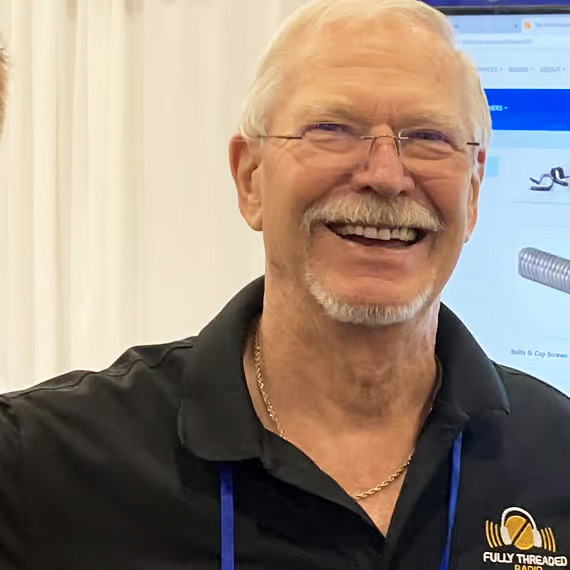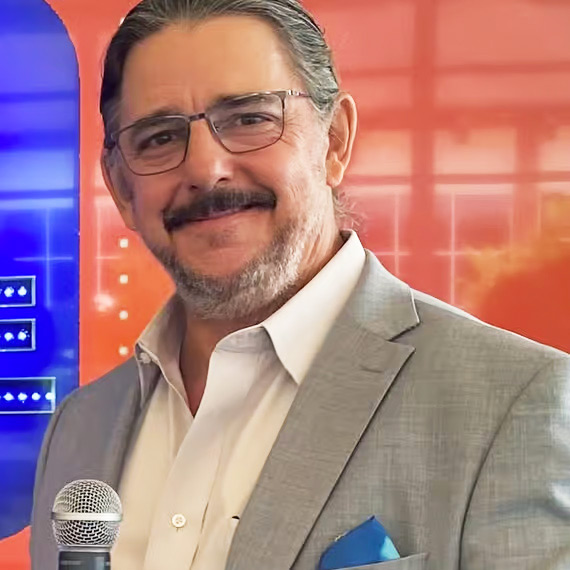
Dr. Salim Brahimi on the recent IFI standards camp and RCSC meeting (16:39), Fastener Industry Coalition chairman and Brighton Best sales manager Michael White (1:46:35), Martin EVP Scott McDaniel joins Mike McNulty on the Fastener News Report (58:08), Rob “Big Country” Reynolds of INxSQL and Tony Martinez of Buckeye Fasteners recap Brisketfest ’26 (49:14), plus Carmen Vertullo explains why your great fastener innovation may be a terrible idea on the Fastener Training Minute (1:39:18). BONUS: Outwit the landlord at lease renewal time (44:21). Brian and Eric imagine an AI filter for parrots. Run time: 02:17:49
Show Links:
Matt Delawder’s Brisketfest ’26 Link
Workin’ Hard Playin’ Hard by Ted Nugent
Eleven Labs AI Voice Cloning Tools
Inside Episode 228
Salim Brahimi recaps the first IFI Fastener Standards Camp, the RCSC meeting and the ISO TC2 agenda; Scott McDaniel reads the Fastener Distributor Index with Mike McNulty; Michael White lays out his plans as Fastener Industry Coalition chairman; and Carmen Vertullo explains how to tell whether a fastener invention is worth the investment.
Episode 228 opens with a standards conversation that earned the episode its name. Salim Brahimi, technical director of the Industrial Fasteners Institute, joins Eric Dudas and Brian Musker from Montreal to describe the first Fastener Standards Camp — an Emerging Fastener Professionals Initiative event held at IFI headquarters in Independence, Ohio, with 24 campers and a faculty of working committee members. There was no canoeing and no archery. There was role-playing, in which participants had to argue both sides of a live standards question until they understood how consensus actually gets built.
From there the conversation widens. Brahimi covers the RCSC meeting in Utica, Illinois, including the committee now drafting a specification for stainless steel structural bolting, and clears up a naming question that has puzzled listeners for years: Bolt Council and RCSC are the same organization, and boltcouncil.org is simply the URL the group ended up with. He then turns to ISO TC2, the international fasteners committee he is hosting in Montreal for the first time since COVID, where the long revision of ISO 898-1 is under way.
The Fastener News Report brings the numbers. Mike McNulty reports the seasonally adjusted Fastener Distributor Index for May 2026 at 56.9, up from 56.3 in April, and is joined by Scott McDaniel of Martin Fastening Solutions, immediate past president of the National Fastener Distributors Association, for a reading of what sits underneath the index — tariff reclassification rather than tariff relief, a sales number at 72.4, a six-month outlook in which 54% expect improvement, and an ISM PMI at 54.0 versus 52.7 the month before. McNulty also carries the top story on the International Fastener Expo’s rebrand and its new show director, Anya Falcone, plus a Back Page on carbon footprinting.
Two features close the episode out. Michael White, chairman of the Fastener Industry Coalition and a Brighton Best International sales manager, talks about widening the coalition’s remit beyond the Fastener Quality Act, the pickleball event he is organizing ahead of the Phoenix show, and the data-center construction demand reshaping his customers’ order patterns. Carmen Vertullo devotes the Fastener Training Minute to the question every trade-show inventor should ask first — not whether the idea is clever, but whether the problem it solves actually exists. And at the very end, Eric Dudas discloses a first for the podcast.
Episode 228 at a Glance
- The first IFI Fastener Standards Camp drew 24 campers to Independence, Ohio, and produced a concrete outcome: a documented pathway for joining ASME, SAE and ISO committees, with mentors assigned to new members.
- Bolt Council and RCSC are one and the same organization — the nickname simply became the website address.
- An RCSC committee is writing a specification for stainless steel structural bolting, an area with no current equivalent to the existing steel specification.
- The Fastener Distributor Index for May 2026 came in at 56.9, up from 56.3 in April, both seasonally adjusted.
- Scott McDaniel expects tariff levels to persist but be classified differently, rather than to disappear — the goalposts move, the total does not.
- The ISM Purchasing Managers Index rose to 54.0 from 52.7, a fifth straight month above 50.
- The International Fastener Expo moves to Phoenix under a new theme, The Power Behind the Build, with Anya Falcone as show director.
- Carmen Vertullo’s test for a fastener invention starts with whether the problem exists at all, then manufacturability, competing solutions, market size and standards conformance.
- Run time: 02:17:49
What You’ll Learn
- Consensus standards work is a human exercise before it is a technical one. Brahimi’s takeaway from the camp was that relationships built over dinner make the technical disagreements tractable.
- The committees need new members and are now explicit about how to join. The camp’s most useful output was instructions: this is what you do to join ASME, this is what you do to join SAE, this is what you do to join ISO.
- Structural riveting has left the RCSC scope, though riveting remains common in aerospace and other areas. Where rivets are replaced on refurbished structures, they are replaced with bolts.
- ISO 898-1 is being revised on a multi-year horizon, and one gap under discussion is the absence of a metric standard covering the largest size range.
- Tariff fatigue is real, but the operational picture has stabilized: customers have had time to work through inventory and re-source, and pricing now carries tariff-related adjustment rather than tariff shock.
- Data centers are the dominant construction story and the one nobody has modeled the end of. McDaniel notes no one is discussing what happens once they are all built.
- Domestic manufacturing capacity cannot simply absorb displaced import volume — the constraint is skilled people and equipment, and those take years rather than weeks to develop.
- White’s redefinition of the Fastener Industry Coalition is coordination rather than replacement: bringing member associations together to share information and resources, not competing with them.
- Retention is the business case for supporting young professionals. White ties YFP involvement directly to what business owners in distribution and manufacturing now treat as a real problem.
- Most failed fastener inventions solve a problem that does not exist, or solve one that a cheaper non-fastener solution already handles. Vertullo’s advice is to get an expert opinion before spending on prototypes, patents and marketing.
Featured Voices
Hosts: Eric Dudas, Brian Musker
- Scott McDaniel: Executive vice president at Martin Fastening Solutions and immediate past president of the National Fastener Distributors Association.
- Mike McNulty: Presents the Fastener News Report for Fastener Technology International Magazine.
- Salim Brahimi — Industrial Fasteners Institute: Technical director of the Industrial Fasteners Institute, based in Montreal, and a past chair of the RCSC.
- Michael White: Chairman of the Fastener Industry Coalition and a sales manager with Brighton Best International.
- Carmen Vertullo: Delivers the Fastener Training Minute from the Fastener Training Institute and Carver Labs in El Cajon, California.
- Tony Martinez — Buckeye Fasteners recap Brisketfest ’26 (49:14), plus Carmen Vertullo: Joined the BrisketFest ’26 recap and cooked chicken this year.
- Marco Rodriguez — Cresa: Delivers the Cresa commercial real estate update, this time on negotiation technique at lease renewal.
- Rob Reynolds: Joined the BrisketFest ’26 recap; hauled his rig from Michigan and cooked brisket.
- John Kovach
- TJ McFarlane
Also Heard
- Anya Falcone
- Christopher Tribble
- Darlene Kallas
- Kevin Menke
- Lynette Deyo
- Matt Delawder
- Nick Lessnow
- Steven Sherman
Explore Episode 228
Timestamped guide to the episode. Times link to the transcript below.
- 01:37 — Opening segment — hosts, episode preview, sponsor roll, news
- 16:42 — Interview — Dr. Salim Brahimi (IFI): Standards Camp, RCSC, ISO TC2
- 17:45 — IFI Fastener Standards Camp recap; RCSC / Bolt Council meeting, Utica Illinois; ISO TC2 fasteners committee and ISO 898-1 revision
- 24:14 — IFI Fastener Standards Camp recap; RCSC / Bolt Council meeting, Utica Illinois; ISO TC2 fasteners committee and ISO 898-1 revision
- 34:20 — IFI Fastener Standards Camp recap; RCSC / Bolt Council meeting, Utica Illinois; ISO TC2 fasteners committee and ISO 898-1 revision
- 49:14 — BrisketFest ’26 / NFBBQA recap with Rob Reynolds and Tony Martinez
- 58:16 — Fastener News Report — Mike McNulty
- 58:16 — FNR open and headline tease
- 01:01:59 — FNR interview — Scott McDaniel, Martin Fastening Solutions EVP / NFDA past president
- 01:28:09 — FNR top story
- 01:29:58 — FNR top story
- 01:31:44 — FNR top story
- 01:36:43 — Fastener Training Minute — Carmen Vertullo
- 01:36:43 — FTM part 1 — innovation at trade shows, the question posed
- 01:46:35 — Feature interview — Michael White (FIC chairman, Brighton Best International)
- 02:10:45 — Closing segment — thank-yous, closing roll, AI disclosure, sign-off
Three committees, one conversation
Salim Brahimi on Standards Camp, the RCSC and ISO TC2
Salim Brahimi calls it a triple dipper: three separate standards tracks covered in one sitting. The first is the Fastener Standards Camp, part of the Industrial Fasteners Institute’s Emerging Fastener Professionals Initiative. It drew 24 campers to IFI headquarters in Independence, Ohio — not Utica, as Brian Musker initially guessed — and worked through real situations in which standards were being applied, with participants required to argue positions from both sides.
Brahimi was supported by a faculty drawn from the committees themselves, including Darlene Kallas, Steven Sherman of the IFI Technical Committee, Nick Lessnow of MNP Fontana Grupo and Kevin Menke of Fastenal. His stated reason for the whole exercise is blunt: the people doing this work are getting older, and the committees need new blood. The camp’s most concrete product is a documented pathway into ASME, SAE and ISO committee membership, with new participants paired to mentors rather than left to find their own footing.
The second track is the RCSC — the Research Council on Structural Connections — which met in Utica, Illinois. Brahimi resolves a long-standing naming confusion here: Bolt Council is a nickname for RCSC, the two are one and the same, and boltcouncil.org became the URL when the site was built. The council has roughly 75 members, has been running for 67 years, and publishes its specification on a five-to-six-year revision cycle. A committee struck last year is now developing a specification for stainless steel structural bolting, an area where stainless fasteners exist but no design specification comparable to the steel one does.
Musker’s detour into structural riveting draws out the engineering history. Riveting was once within RCSC scope and no longer is. Hot riveting required heating on site, offered less flexibility, and never reached the clamping performance of modern bolting — though as Brahimi notes, the Golden Gate Bridge and the Eiffel Tower are both still standing. When the Eiffel Tower’s rivets are replaced during refurbishment, they are replaced with bolts.
The third track is ISO TC2, the international technical committee on fasteners, which Brahimi is hosting in Montreal for the first time since COVID. The committee is revising ISO 898 Part 1, the core standard for mechanical properties of externally threaded fasteners — a process he estimates at four to six more years. Property classes such as 8.8, 10.9 and 12.9 are the metric analogues to the inch world’s grade 2, grade 5 and grade 8. One acknowledged gap is the largest size range, which has no metric standard where the inch world has ASTM coverage.
- 17:45 — Fastener Standards Camp: 24 campers at IFI headquarters in Independence, Ohio, role-playing both sides of live standards questions, with a committee-membership pathway as the main output.
- 24:14 — RCSC meeting in Utica, Illinois: the Bolt Council naming question settled, a stainless steel structural bolting specification under development, and the next annual meeting set for June 7th, 2027.
- 34:20 — ISO TC2 hosted in Montreal for the first time post-COVID, with the ISO 898-1 revision under way on a multi-year timeline.
By the Numbers
- 75 members — RCSC membership (00:33:19)
- 67 years — Years the RCSC has been running (00:34:09)
- 48 countries — Countries in the expanded World Cup field (00:41:26)
Terms and Technical Notes
- IFI (Industrial Fasteners Institute) — IFI is the Industrial Fasteners Institute. Brahimi is its technical director, based in Montreal, Quebec. (00:16:46)
- RCSC (Research Council on Structural Connections) — RCSC is the Research Council on Structural Connections, the body behind the structural bolting specification. Brahimi is a past chair. (00:17:29)
Mike McNulty on the numbers, the headlines and the Back Page
Fastener News Report: the FDI at 56.9, with Scott McDaniel
Mike McNulty opens the Fastener News Report with the seasonally adjusted Fastener Distributor Index for May 2026 at 56.9, following 56.3 in April. The index is collected and analyzed by the FCH Sourcing Network and Baird. His guest is Scott McDaniel of Martin Fastening Solutions, executive vice president and the immediate past president of the National Fastener Distributors Association, on the show for the first time in over a year.
McDaniel reads the result as mildly surprising and says being surprised has become the norm. Sales came in at 72.4, which he and McNulty both treat as a strong number, and the six-month outlook has 54% expecting improvement, 34% expecting conditions to hold and 13% expecting deterioration. McDaniel’s view is that getting 97% of any population to say things will be the same or better is a rare reading, and that the 3% figure from the previous month was probably an outlier.
On tariffs he is direct: it is still complicated, and there is fatigue in the market. He expects Section 122 scheduling changes to shift classifications rather than levels, with the overall tariff burden landing in about the same place under different labels. The practical effect he sees is customers who have had time to work through inventory and re-examine sourcing, so pricing now reflects adjustment rather than shock.
The ISM Purchasing Managers Index surged to 54.0 from 52.7, a fifth consecutive month above 50 after what McNulty describes as a couple of years below it. McDaniel notes that recession predictions have quietly stopped, having been made annually from roughly 2018 to 2024 — and allows that even a broken clock is right twice a day. Data centers dominate the demand conversation, with one observation he flags as unexamined: nobody is talking about what happens when the data centers are all built.
The top story is the International Fastener Expo’s 2026 rebrand under the theme The Power Behind the Build, moving to a new host city in Phoenix with the inaugural International Fastener and Assembly Summit, expanded show floor features and refreshed networking. Anya Falcone, with more than 11 years in trade show and event management, takes over as show director; Lynette Deyo’s bylined article on the rebrand runs in the June/July 2026 issue of Fastener Technology International. McNulty closes on the Back Page with a skeptical look at carbon footprinting and CBAM compliance, arguing that scrap reduction, energy efficiency and extending equipment life are what manufacturers have always done and what actually delivers.
The other, the last number that we have to look at is the ISM Purchasing Managers Index, PMI, and that surged up to 54.0 versus 52.7 last month, the fifth straight month above 50, which I think that's a pretty good, indicator.
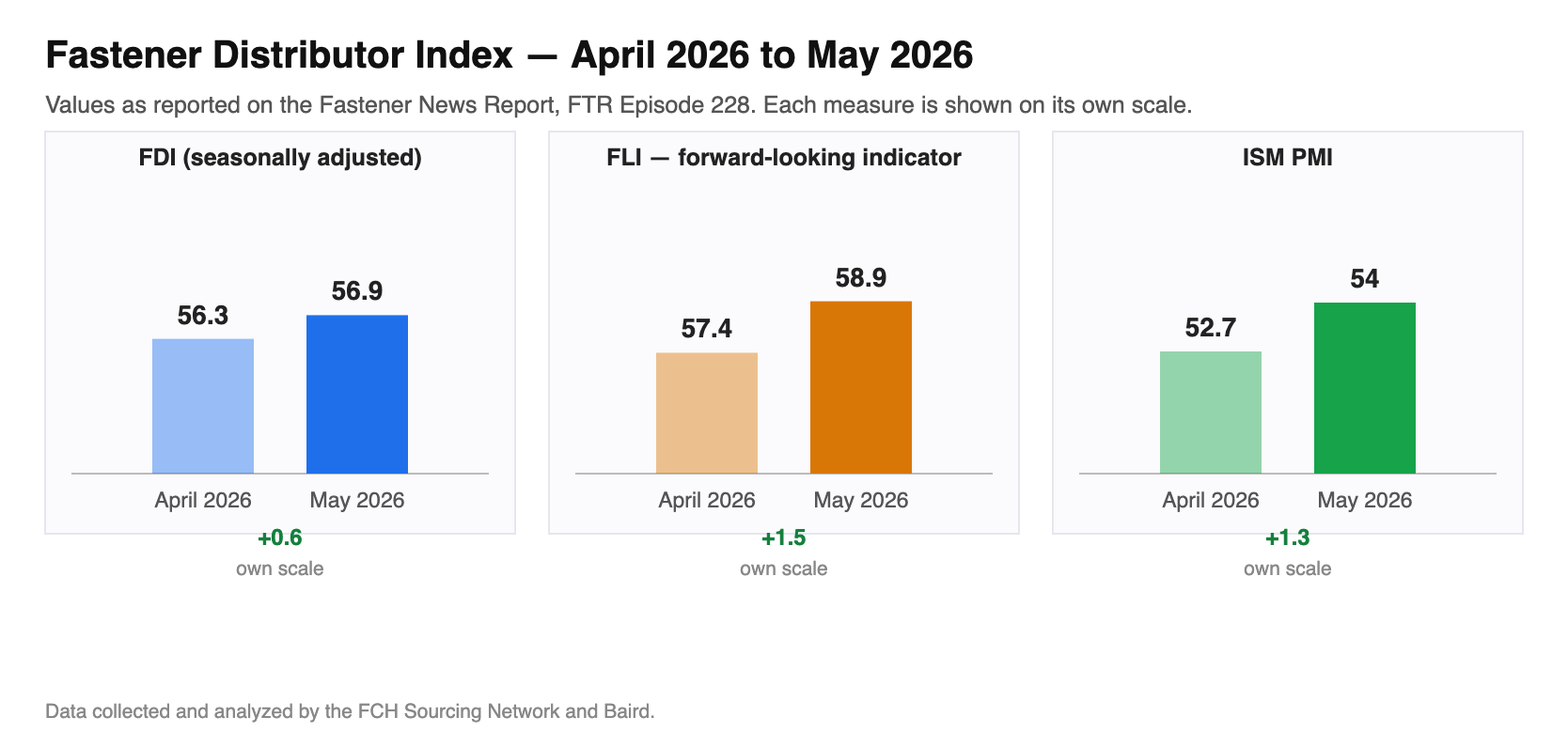
- FDI (seasonally adjusted): 56.3 → 56.9
- FLI — forward-looking indicator: 57.4 → 58.9
- ISM PMI: 52.7 → 54
- 58:16 — Segment open and headline tease, with the FDI results promised after the break.
- 01:01:59 — Scott McDaniel interview: tariff reclassification, a 72.4 sales reading, the six-month outlook, ISM PMI at 54.0, data-center demand, and an NFDA update ahead of the Indianapolis annual meeting.
- 01:28:09 — Top story: IFE 2026 rebrands as The Power Behind the Build, moves to Phoenix, and names Anya Falcone show director.
- 01:29:58 — Newsmaker and personnel headlines across the industry, including new facilities, acquisitions and promotions.
- 01:31:44 — Back Page: CBAM compliance burden and celebrity carbon-footprint reporting, with a case for practical resource stewardship over administrative exercise.
By the Numbers
- 56.9 — Fastener Distributor Index, May 2026 (seasonally adjusted) (01:01:11)
- 56.3 — Fastener Distributor Index, April 2026 (seasonally adjusted) (01:01:11)
- 72.4 — Sales index reading (01:04:19)
- 54% — Share expecting better conditions in six months (01:07:08)
- 54.0 — ISM Purchasing Managers Index, current (01:08:29)
- 52.7 — ISM Purchasing Managers Index, prior month (01:08:29)
- 11 years — Anya Falcone’s years in trade show and event management (01:28:56)
Terms and Technical Notes
- Fastener Distributor Index — The FDI is the Fastener Distributor Index, the monthly survey of distributor conditions that anchors this segment. (00:58:33)
- IFE (International Fastener Expo) — IFE is the International Fastener Expo, the subject of the segment’s top story. (00:59:01)
The feature interview
Michael White on the Fastener Industry Coalition, pickleball and data centers
Eric Dudas met Michael White at the Fastener Fair in Charlotte and discovered they had something unexpected in common: both keep chickens. White’s account is that his wife incubated eggs while he was taking a child to college orientation, and two and a half years later the household runs on a rooster’s schedule — about a dozen eggs a day, none of which he eats himself.
White chairs the Fastener Industry Coalition and works for Brighton Best International. His framing of the coalition’s next phase is a widening of scope: for roughly 25 years it was defined primarily by its work on the Fastener Quality Act, and while he believes that need persists, he wants the coalition to do more. Asked directly whether that means replacing or competing with existing associations, he is unambiguous — the role is to bring member associations together to share information, resources and ideas.
The pickleball events are the visible half of that work. The Charlotte rally space worked well, a Phoenix event is being finalized for October 7th — the day before the show opens — and White’s own role is deliberately behind the scenes. He does not play; he runs the event so everyone else has a good time, which he describes as carrying a Brighton Best customer habit into coalition work.
On young professionals, White ties support for YFP directly to retention, which he says business owners in both distribution and manufacturing now treat as a real problem. He runs a book club built on Patrick Lencioni titles as a mentoring backdrop, and credits BBI leadership for treating public service and industry contribution as part of the job. His read on YFP’s value is that it is agnostic about which company anyone works for.
The commercial thread is data centers. White describes construction and data-center utilization as the two engines behind current growth, with distributors who historically sold one to two percent into construction now fielding substantially larger inquiries. In the corridor between Richmond and Washington, D.C., he puts data-center work at 90% of current construction. Asked how much runway is left, he estimates roughly another decade, on the reasoning that most companies have not yet worked out how to use the technology they are building capacity for. At Brighton Best the near-term emphasis is consumables, following the plastic bin rollout.
We are understanding how to use technology in ways that didn't exist 25 years ago or 20 years ago, and so creating pathways to equip and unleash the best minds in our world, in our industry is only going to make what we do better. I think if you look at the needs of distribution as a whole, the supply chain has shrunk in ways that people didn't see 10 years ago.
By the Numbers
- 25 years — Years the coalition has been defined by Fastener Quality Act work (01:53:01)
- 2% — Historical distributor exposure to construction (02:02:58)
- 90% — Share of Richmond-to-Washington construction that is data centers (02:03:17)
- 12 months — Horizon for the consumables push (02:06:25)
Terms and Technical Notes
- FIC (Fastener Industry Coalition) — FIC is the Fastener Industry Coalition, which White chairs. The audio also carries the variant FFIC. (01:47:15)
- YFP (Young Fastener Professional) — YFP refers to Young Fastener Professional, the group behind the mentoring and book-club work White describes. (01:56:12)
Carmen Vertullo on evaluating a new fastener
Fastener Training Minute: is your invention actually a good idea?
Carmen Vertullo comes to the Fastener Training Minute from the Fastener Training Institute and Carver Labs in El Cajon, California, having just exhibited at the Fastener Fair in Charlotte. Trade shows are where new fastener ideas surface, and his subject is the evaluation that should happen before the booth is ever booked: how do you know whether your innovation is any good?
He starts from the reminder that today’s ordinary fasteners were somebody’s invention — self-drilling screws put a drill bit on the end of a screw, self-tapping screws cut their own threads, and the tension control bolt built a single-use torque wrench into the fastener itself. People come to Carver Labs asking whether their idea is good, and he says it is striking how often someone invests hundreds of thousands of dollars before finding out.
His checklist is unsentimental. Does the problem actually exist — many clever fasteners solve one that does not. Is it manufacturable at scale, as opposed to buildable once in a garage. What else already solves the problem, including solutions that are not fasteners at all and cost less. How large is the market. Does it conform to a recognized standard, because a stronger bolt that meets no ASTM specification is a bolt nobody can specify. And where are the weak points — a lock nut that never comes loose is worth little if vibration defeats it.
The closing test is presentational: is it Shark Tank-able? Vertullo describes one idea that passes the interest test on sight — a flathead screw with no visible drive, where touching the center with a ballpoint pen makes the drive appear and removing the pen makes it vanish. His warning is to get an expert to look at the idea before spending on prototypes, patents and marketing.
Is it manufacturable? I mean, you gotta be able to make these things. Just because you can make it in your garage one-off doesn't mean it's easily mass-producible. Is it cost-effective? Is it a fastener that's gonna cost pennies or dollars? And how many of them will be needed? Is there a large enough market to make that fastener money for you?
- 01:36:43 — Part one sets up the question from the trade-show floor before the break.
The first sanctioned NFBBQA event
BrisketFest ’26 with Rob Reynolds and Tony Martinez
Rob Reynolds and Tony Martinez join Eric Dudas to look back at BrisketFest ’26, billed here as the first sanctioned event of the NFBBQA. Reynolds hauled his rig down from Michigan and worked brisket; Martinez changed course from last year’s pulled pork and brought chicken, on the straightforward logic that he found a deal at the store he could not pass up. The legs had the practical advantage of being ready before dinner, which gave everyone something to eat while the long cooks finished.
The supporting cast was substantial. John Kovach brought ribs, a loaned offset smoker served as the utility machine, and TJ McFarlane could not attend but sent a cooler of beer. With four or five cookers running from 5:00 AM and dinner served just after 5:00 PM, Martinez floated the idea of building one large rig for consistency — an idea Reynolds liked immediately, with Dudas noting the likely argument over what wood to burn in it.
Both guests land on the same point about why the event works: it is not really competitive. Martinez describes it as having blossomed into something relaxed, where everyone brings a side and the value is the getting-together rather than the scoring. The segment ends with the handoff into the Fastener News Report.
I was going to say, we had about four or five cookers going. you know, we've talked about it, but I think it might be time just to manufacture a big rig on the side of, Shagbark.
Terms and Technical Notes
- NFBBQA (National Fastener BBQ Association) — NFBBQA is the barbecue association under which the event was run; BrisketFest ’26 is described as its first sanctioned event. (00:49:35)
Opening segment: a jammed episode
Eric Dudas opens from semi-rural northeast Ohio with Brian Musker in the greater Chicago area, previewing what he calls a jammed episode: Salim Brahimi on Standards Camp, Mike McNulty with Scott McDaniel on the Fastener News Report, Michael White on the Fastener Industry Coalition, Carmen Vertullo on fastener innovation and Marco Rodriguez with the commercial real estate update. The recently published unthreaded edition with Mike McNulty of Fastener Technology International also gets a mention.
Two items of industry news lead the block. INxSQL won the Best Use of Technology Award at the Fastener Fair, and the Canadian Fastener Coalition has launched — Dudas reads its stated purpose of bringing the fastener supply chain together around practical tariff solutions and long-term policy. The rest of the opener belongs to BrisketFest, held May 15th, 2026, with a peak attendance of around fifty and a long list of people thanked by name.
Dudas also teases an AI-related first for the podcast without saying what it is, promising the explanation at the close. Listeners are told there is very little actual AI content in the episode beyond that one thing.
Terms and Technical Notes
- FDI (Fastener Distributor Index) — The FDI, the Fastener Distributor Index, is previewed here as part of the Fastener News Report segment. (00:03:46)
Closing segment and an AI disclosure
The hosts close by thanking the episode’s contributors — Michael White, Salim Brahimi, Rob Reynolds, Tony Martinez, Mike McNulty, Scott McDaniel, Marco Rodriguez and Carmen Vertullo — before the closing sponsor roll.
Then the payoff to the opening tease. Eric Dudas discloses that his own recorded track for the Salim Brahimi segment was unusable, and rather than lose the conversation he used Eleven Labs to clone his voice and recreate his side of it, working voice-to-voice on an entry-level membership. He is candid that it was not perfect and that he does not much like the sound of it, and asks listeners who noticed to write in. His stated boundary for the podcast is that everything else you hear is organic, graphics aside, and that he expects it to stay that way.
The episode ends with a note that the hosts are heading to an AI conference in Chicago, a closing joke about wanting an AI filter for parrots, and the usual sign-off.
Complete Transcript — Episode 228
Verbatim Descript transcript. Headings mark approved segment boundaries; speaker names appear only where evidence resolves them.
00:00 — Cold open teaser montage
[00:00:00] Speaker: It’s Fully Threaded Radio episode 228.
[00:00:04] Speaker 2: You know, overall, I think it’s been a better year than I would have could have hoped for during the budget season last year. But there’s still a lot of work to do and have to watch out for all those things between tariffs and freight and supply chain and, you know, making sure you’re putting the right parts in the right bins every day.
[00:00:23] Speaker 3: See, you learn something new every day.
[00:00:24] Brian Musker: Yeah, nothing to do with standards, okay? I’m just going to ask you another question about standards, and it’s sort of a bit goofy, I guess. The Golden Gate Bridge was built by rivets, big steel bloody rivets, okay? Right. So it means you couldn’t build a structure out of rivets at all, like a bridge.
[00:00:39] Brian Musker: It has to be welded now or bolted.
[00:00:42] Speaker 3: Now, well, typically most of the connections are
[00:00:46] Speaker 5: We’re averaging about a dozen eggs a day. My wife’s terrible about getting the eggs. And the bad thing is I don’t eat eggs. So I get nothing out of the chickens. Like there’s no redeeming value for me. She just sits and watches the chickens navigate the yard.
[00:01:02] Speaker 5: But, you know, they’re chickens.
01:13 — Produced show ID
[00:01:13] Speaker 6: Time for Fully Threaded Radio
01:37 — Opening segment
[00:01:37] Eric Dudas: It is Fully Threaded Radio, voice of the FCH Sourcing Network. If you buy, sell, manufacture, import, distribute industrial threaded fasteners, this is the podcast for you. We’re so glad you clicked in, everyone. Coming to you from semi-rural Northeast Ohio, Eric Dudas with you, and the co-host of Fully Threaded is with us as well.
[00:01:58] Eric Dudas: I know he’s doing really well, ’cause I just got off a video call with him. He’s from the greater Chicago area, Mr. Brian Musker. Hey, Bri.
[00:02:07] Brian Musker: And I’m from completely non-rural Southwest Chicago.
[00:02:10] Eric Dudas: Yes, it is much more of a suburban setting. I’m doing well. You’re doing well. We covered that, and we’re gonna get right into it on this episode 228 of the podcast.
[00:02:20] Eric Dudas: Lot to shoehorn in on this opener, because it’s a jammed episode, Bri, and I’m glad to be doing it.
[00:02:27] Brian Musker: Good. Okay.
[00:02:28] Eric Dudas: We both been going in so many directions at once, it seems like a couple months since we published, but we dropped an unthreaded edition of the podcast just a few days ago. Hope you all got a chance to check that out.
[00:02:40] Eric Dudas: It’s with Mike McNulty with Fastener Technology International. Long overdue, we needed to showcase him, Bri, and we’ve gotten some really good feedback on it.
[00:02:50] Brian Musker: Good. Yeah. Yeah. It’s great working with Mike. We have done for years.
[00:02:55] Eric Dudas: Yep, 100%. Get out there and check it out if you haven’t already, folks. But on today’s episode, we’re gonna talk with Dr.
[00:03:02] Eric Dudas: Salim Brahimi from the IFI. He’s got lots to talk about with us, including a recap of the Standards Camp.
[00:03:10] Brian Musker: Though it’s sort of hard to think of it as a camp, okay? Sitting around with lawn chairs around a fire discussing what we need to do relative to B18.2 definitions.
[00:03:21] Eric Dudas: Right. Not quite that kind of camp.
[00:03:24] Eric Dudas: Although we do have a little fun with that idea during this conversation. I think we get squeezed about as much fun out of it as we could, but you’ll enjoy it. You’ll learn a little bit about the process of standards, also the RCSC, and an upcoming standards meeting that he’s involved with. That’s Salim Brahimi on our opener today.
[00:03:46] Eric Dudas: The aforementioned Mike McNulty will be talking with Martin EVP Scott McDaniel today. The FDI is still on a tear, and they’ll be covering that, and Mike’s got all the headlines for us. Handing off to the Fastener News Report, we’ve got pit masters Rob Reynolds with InSQL Software and Tony Martinez with Buckeye Fasteners.
[00:04:08] Eric Dudas: And we’re gonna talk a little bit about Brisket Fest and the NFBBQA here in just a minute. But when those two come on to hand off, we’ll get their thoughts on this year’s event. They’ve also got a suggestion, a big one actually, Bri. I don’t know if you’ve heard this one yet, but they wanna do something a little different for next year.
[00:04:26] Eric Dudas: We’ll get into that.
[00:04:28] Brian Musker: Okay.
[00:04:29] Eric Dudas: On our second feature today, it’s a conversation with Fastener Industry Coalition chairman and Brighton Best International East Coast sales manager, Mr. Mike White. He’s gonna discuss his work and vision for the FIC, including his comments on the rising popularity of pickleball in the industry.
[00:04:49] Brian Musker: Okay. That fits into the predominantly fastener-related category.
[00:04:54] Eric Dudas: Yes, which we do a little bit more of because I also ask him about his chicken ranching experience, which I just learned about at Fastener Fair in Charlotte. And, uh, yeah, he’s got chicken issues of his own over there. And if you’ve ever had an idea for an amazing new drive type or head style, be sure to catch the Fastener Training Minute with Carmen Vertullo today.
[00:05:18] Eric Dudas: He’ll be talking about fastener innovation, things you need to consider before you take that idea to production. Plus, Marco Rodriguez has our commercial real estate update. This time he gets psychological on us. It’s a pretty good one. That’s the CRESA Commercial Real Estate Update. Show note on today’s episode, several domestic animal incursions, including one over at McNulty’s office.
[00:05:44] Eric Dudas: That’s the first time that ever happened, Bri. He’s got a fastener cat that’s prowling around the office while he’s talking with Scott, and, uh, I called him on it. I said, “Mike, what is this? 200 some episodes and finally we have this happen?” He said, yeah, it’s his son’s cat. He’s watching it. The cat’s name is Mr.
[00:06:01] Eric Dudas: P.
[00:06:03] Brian Musker: Okay.
[00:06:05] Eric Dudas: So in addition to Harpo inevitably in the background chiming in at some point, and possibly Siegfried the rooster over here… Oh, and then when Salim comes on, he’s got a fastener dog that joins the podcast for a minute too, so.
[00:06:19] Brian Musker: Yeah, the need for attention. A
[00:06:20] Eric Dudas: lot of fastener animals joining the conversation today as well.
[00:06:24] Brian Musker: So now we’ve got parrots, cats, and dogs.
[00:06:27] Eric Dudas: And roosters.
[00:06:28] Brian Musker: And roosters. You’re right. Sorry. You’re right. Right
[00:06:32] Eric Dudas: All coming to you on this episode 228 of Fully Threaded Radio, publishing on or about June 17th, 2026.
[00:06:41] Brian Musker: Okay. I
[00:06:42] Eric Dudas: might as well mention it right now, Brian, but there’s one other detail, and it’s an AI-related detail about today’s episode.
[00:06:50] Eric Dudas: This is an AI first that we’ll be dealing with, and I’m gonna save the details of this until we close today and see if listeners can tell what I’m referring to, but something went a little sideways and we fixed it with AI.
[00:07:07] Brian Musker: Yeah. Don’t mention
[00:07:09] Eric Dudas: AI. There’s very little actual AI content in today’s episode other than this, but, uh, anyway, stay with us till the end.
[00:07:17] Eric Dudas: We’ll make all known. Right now we wanna make known our great partners in this endeavor. They make it possible. Let them know you appreciate it. The title sponsors of Fully Threaded Radio are Brighton Best International, Tested, Tried, True, Brighton Best, and Star Stainless, and the whole Lindfast Solutions Group family of companies, right off the shelf, it’s Star.
[00:07:40] Eric Dudas: Fully Threaded Radio is also sponsored by Buckeye Fasteners, and the Ohio Nut and Bolt Company, BTM Manufacturing, Eurolink Fastener Supply Service, Fastener Technology International, Global Fasteners, InSQL Software, Jlan Franco, Cressa, MW Components, Solution Industries, 3Q Inc., Volt Industrial Plastics, and Wurth Industry USA.
[00:08:06] Brian Musker: So we value all of our sponsors, and we regard them as friends. And if you don’t know them as friends, then it’s time you t- you went up to them at a show and, and introduced yourself. Because when you think of fasteners, you need to be thinking of these people first, because they help bring this whole show to you, okay?
[00:08:23] Eric Dudas: As well as the FCH Sourcing Network and the Fastener Distributor Index. One bundle-
[00:08:29] Brian Musker: Tons of fun
[00:08:31] Eric Dudas: Speaking of walking up to them at shows, InSQL was at Fastener Fair, and I read on LinkedIn recently that they won the Best Use of Technology Award at Fastener Fair. Congratulations to them And Worth Industry supplied the very necessary coffee this year.
[00:08:50] Brian Musker: Yes.
[00:08:50] Eric Dudas: Conveniently located right down from where our booth was this year. I was very, very glad about that. Okay, lots to shoehorn into today’s episode, and I wanna do a quick follow-up. We had Jason Baines with Jay Lanfranco on with us on episode 227, and he was hinting at this coalition that he was building along with Hans Fuller from Fuller Metric.
[00:09:13] Eric Dudas: And we can report now that the Canadian Fastener Coalition is a thing. You can go out to the website canadafc.ca and see what they’re doing. The headline for that is Build Canadian, Compete Globally.
[00:09:29] Brian Musker: Okay, interesting.
[00:09:30] Eric Dudas: Yeah. So I’ve got a little summary here. These are guys who do what they say they’re gonna do, and they’re working together with as many companies up there as they possibly can to sort these things out and make sense out of them, and I think bring a little pressure where they can.
[00:09:44] Eric Dudas: So the synopsis is, “The Canadian Fastener Coalition brings together the fastener supply chain to support practical tariff solutions and long-term policies, such as buy Canadian steel requirements on public projects that strengthen domestic production while keeping Canadian manufacturers competitive.” So we have a lot of Canadian operators in the audience and in the industry and in our circles of friends, so this is something to keep your eye on.
[00:10:12] Eric Dudas: Canadafc.ca. Go Jason, go Hans. We’ll talk to you about this at the next show.
[00:10:18] Brian Musker: Cool. Okay.
[00:10:20] Eric Dudas: And further to the subject of fastener friends and all that and things we do to keep the ball rolling, some of you may have seen the posts that were flying around recently about Brisket Fest 26. We were calling this the first sanctioned NFBBQA event, and again, Rob and Tony will be here later in the episode to talk about this.
[00:10:41] Eric Dudas: But I did wanna put it right here at the top of the show that we have so many people to thank for their input on this, and people were doing all kinds of things to contribute and to make it all happen. So I’m just gonna run down the list, Bri. I don’t know how else to do it.
[00:10:57] Brian Musker: That’ll work.
[00:10:57] Eric Dudas: We could spend a whole episode just talking about this.
[00:11:01] Eric Dudas: This happened on May 15th, 2026. We had 50-ish or so people in attendance when it was really at its peak, and we tried to keep a lid on it, but it looks like next year it’s really gonna explode. Huh. We’ll have to do things to make that possible. But anyway, this year our lineup of pit masters, Rob Reynolds with InSQL Software, he’s a charter member of the team, of course, plus Tony Martinez cooked on site with us this year, he with Buckeye Fasteners, plus Kyle with E-Z Lok.
[00:11:32] Eric Dudas: He was the stand-in really for Carmen this year, who was one of our utility pit masters but could not really pull the whole thing off this year due to his travel schedule. John Kovach with AFC was on the pulled pork this year, and my brother Joel came in from Sacramento, California. He was our utility guy, and he looked over everyone’s shoulder and made sure that smoked macaroni came out just right.
[00:11:58] Eric Dudas: That was kind of an added bonus And we added some much needed catering firepower this year. Dorothy, Alicia, Crystal. I know. They did a great job. Darlene Collis supplied the happy birthday cupcakes because we celebrated Carmen’s 70th. And Lynn was there as our greeter and working the raffle table. Just gonna blow down this list of people who made much appreciated contributions.
[00:12:21] Eric Dudas: Dan Hill with Allstate. Jake Davis with the U-Boat Blend Coffee. Rosa Hearn, she swung up from Atlanta, dropped some amazing raffle prizes on us, as did Joe Shoemaker with AFC. Very generous. And Steve Andresik, Charlie Kerr, Morgan Rudolph, Marty Nolan, Anders Green, our MC on the disc golf contest.
[00:12:43] Speaker 5: Yeah.
[00:12:44] Eric Dudas: Speaking of which, Mark Dively with Fastener Tool and Supply came with his wife Sandra. They dropped quite a bit on the raffle, and he wound up taking the disc golf title this year. Upset everyone.
[00:12:58] Brian Musker: Yes, it was.
[00:12:59] Eric Dudas: GH3, Matt DeLaughter, they were there for a little bit. They had to split right after the cube got consumed though, because they had to catch flights back to Chicago.
[00:13:09] Eric Dudas: But so glad they were able to attend, and there were so many other people. It was just a wonderful event. Bri, you were hobnobbing the whole time. I saw you. And, uh, in addition to all the fun, we had some of Ohio’s prime chicken viewing going on in the background. Brisket Fest 26, it was a great success, and the NFBBQA inaugurated, I think, a very nice tradition.
[00:13:31] Eric Dudas: Assuming we do it next year.
[00:13:33] Brian Musker: I know. We have to start preparing for that already. It’s a bit of work.
[00:13:37] Eric Dudas: We’ll put some photos up on the show notes page, and, uh, I think a lot of folks have already seen some of those out on LinkedIn. But again, we’re so grateful to so many of the people who contributed this year, and wanted to put it right here at the top.
[00:13:52] Eric Dudas: We’re gonna break here for a couple messages from our partners, and when we return, we’ll be talking with camp counselor, Dr. Salim Brahimi.
[00:14:01] Brian Musker: Right.
[00:14:02] Eric Dudas: Thanks for listening, everyone. It’s Fully Threaded.
[00:14:05] Brian Musker: Radio.
14:07 — Commercial break 1
[00:14:07] Speaker 9: Brian and Eric, Fully Threaded Radio. It’s fastener, dog approved talk radio for the fastener industry.
[00:14:17] Speaker 10: Hi, I’m Linda from Lynfast, and when it comes to fasteners, family matters. That’s why we’ve built a family of brands, each bringing specialized knowledge backed by broad fastener expertise. Star Stainless specializes in stainless corrosion-resistant fasteners and non-ferrous exotic metals. Lindstrom Fasteners is your go-to for metric products and global European sourcing.
[00:14:41] Speaker 10: And StelFast delivers the steel, carbon, and alloy fasteners that keep jobs moving every day. Together, we offer a wide range of inventory backed by experts who truly know their categories. Different specialties, one trusted team. That’s the strength of Lynfast Solutions Group. One family, endless solutions.
[00:15:06] Speaker 11: First, there was fire, and man said “Fire good.” Then there was the wheel, and man said “
[00:15:16] Speaker 8: Wheel good.”
[00:15:18] Speaker 11: With the invention of the wheel came the need for fasteners, and man loudly exclaimed “
[00:15:24] Speaker 8: Buckeye good.”
[00:15:26] Speaker 11: Buckeye Fasteners, providing quality products since the dawn of man. The preceding message was brought to you by Buckeye Fasteners and Ohio Nut and Bolt Company, proud fastener show sponsors of Old Rusty Bolt Beer, official beer of the traveling salesman.
[00:15:40] Speaker 8: Tell him Grog sent you. Ugh.
[00:15:45] Speaker 12: Need weld fasteners? Look no further than Brighton Best for a full lineup of weld fasteners. Stock across our regional warehouses and ready to ship today. What’s available? Headed weld studs from three-eighths up to seven-eighths. CD studs in mild steel, stainless steel and aluminum, both made in the USA.
[00:16:01] Speaker 12: Weld nuts in multiple styles, including hex and spot weld, both domestic and import available from stock. Looking for something we don’t stock? Our mill sourcing team has you covered, including parts made to print. Your account manager is ready to help, or visit us at brightonbest.com and get what you need
[00:16:22] Marcel Goebel: Hello, guys. My name is Marcel Goebel from Goebel Fasteners. You are listening to Fully Threaded Radio
16:42 — Interview
[00:16:42] Eric Dudas: Way to a threaded odyssey. Ready, Bry?
[00:16:44] Brian Musker: Yeah, I am. Okay, ready.
[00:16:46] Eric Dudas: Summertime’s here, and it’s getting fairly warm here in semi-northeast Ohio, and I bet it is up in Montreal, Quebec. That’s where IFI Technical Director Slim Brahimi is based. He’s here with us, and, uh, just got done with summer camp. Is that… Tell us what’s going on, Slim.
[00:17:03] Eric Dudas: How you doing?
[00:17:04] Salim Brahimi: Hey, I’m doing fine. Hi, Brian. Hi, Eric.
[00:17:06] Speaker 8: Hi. I’m mighty.
[00:17:07] Eric Dudas: Should I have introduced you as Camp Counselor Slim Brahimi?
[00:17:12] Salim Brahimi: Well, first of all, it is, uh… it’s been fairly cool here, only getting warm now. We had a Formula 1… We hosted the Formula 1 races. You know, it’s an annual event here, and it wasn’t as hot as it usually is, which was a blessing.
[00:17:25] Salim Brahimi: And, uh, there are other things happening, so you were asking about camp.
[00:17:29] Eric Dudas: Well, Fastener Camp happened. No, Fastener Standards Camp happened. That was through the IFI. Yeah. We’re gonna talk about that. We’re gonna talk about, a little bit, the RCSC. You and, uh, our other friend, Carmen, as well as another group of people, you were in Utica, Illinois recently, and then, uh, you’ve got something else coming.
17:45 — IFI Fastener Standards Camp recap
[00:17:45] Eric Dudas: So we got a triple dipper here.
[00:17:47] Salim Brahimi: Sure.
[00:17:48] Eric Dudas: And, uh, we can start with the Fastener Camp because we were all excited to talk about that last time we were all together, and sounds like it was a big hit yet. What, 24 campers?
[00:17:58] Salim Brahimi: Yep, yep. So, um, this was… It is part of this initiative that we’ve begun at the IFI. It’s the Emerging Fastener Professionals Initiative, and one of its components is to try to initiate people, now this could be anybody, anybody working in the fastener industry, to try to initiate them into how standards are developed.
[00:18:20] Salim Brahimi: Our industry is a mature industry, so we have w- we have a great reliance on consensus standards. Fastener threaded standards are, in fact, the oldest industrial standards that there exist, so our industry relies on them, and how our businesses are run, what we produce, how we produce them, how we distribute them, all these things are directly affected by what goes into the standards, the details of the requirements, and so on.
[00:18:48] Salim Brahimi: But these are consensus documents. Uh, that’s not… You don’t have some group of gurus sitting in a room without any, uh, communication with the outside world developing these things. Uh, and we’re not robots either. We’re all people, and these are… We’re people who have a stake in the industry from different parts of the industry, whether it’s manufacturing, distribution, end users, and so on.
[00:19:11] Salim Brahimi: So to come to consensus requires a slow, tedious, methodical approach where we introduce changes and debate them, and when there’s disagreement, there has to be a mechanism to resolve them. So the purpose of this standards camp was basically to introduce people to how this, uh, this consensus-building process works in a very real, very human way.
[00:19:35] Salim Brahimi: So that was, that was the idea.
[00:19:37] Eric Dudas: So no canoeing or archery?
[00:19:41] Salim Brahimi: Unfortunately not. All right.
[00:19:45] Eric Dudas: Well, I did take a glance at the report on the IFI website. I saw that you were doing some role-playing where people had to defend both sides of issues while they’re debating the, uh, the crafting of these standards and so forth, so that seems a little more appropriate.
[00:20:01] Eric Dudas: You had some great help, too. I saw that Darlene was another one of- Darlene Kallas, that is, was one of the- Yeah … counselors.
[00:20:07] Salim Brahimi: There’s only one Darlene.
[00:20:09] Eric Dudas: True. Right.
[00:20:12] Salim Brahimi: Um, yeah, we had a great group of counselors. So we had 24 campers come, and, um, I was, uh, helped by a great group of counselors, so Darlene was one of them.
[00:20:24] Salim Brahimi: Steven Sherman, who’s the chair of the IFI Technical Committee. We had Nick Lessnow from MNP Fontana Grupo, and we had, uh, Kevin Menke from Fastenal. We had Toby Anderson from Bay Bolt, and we also had Lydia Stanford, who’s the, uh, staff manager for ASME Committee B18 on fasteners. So it was a good group of people.
[00:20:47] Brian Musker: Wow.
[00:20:48] Salim Brahimi: Um- Sounds cool … and we basically, you know, like you said, we did role-play. So we had real-life examples of situations where standards are being developed. Um, we discussed how voting happens, what happens when there’s a negative vote, how to resolve it, and each group, like, we broke people down into groups, and each group would find different ways to resolve the issue.
[00:21:11] Salim Brahimi: Uh, and I think the biggest takeaway is ultimately it’s a human exercise to, to build consensus, and so it helps when you have, uh, a, you know, more than just a summary relationship with people around you. You know, it helps to get to know them. Very often people in these committees, we, we’ve known each other for years.
[00:21:31] Salim Brahimi: We, we’ve kind of, uh, evolved in our family lives. We go for dinner. We have drinks together, and that all helps lubricate the standard consensus-building process. But I think that was the biggest takeaway, um, and I’m, I’m… I was really happy with the outcome, and I think the feedback that we got was excellent.
[00:21:50] Salim Brahimi: We got some pointers on things to improve for next time around, but for a first outing of this camp, I was very happy.
[00:21:58] Brian Musker: This was your camp at Utica, is that right?
[00:22:00] Salim Brahimi: Uh, no, this was done at the IFI headquarters in- Oh,
[00:22:03] Brian Musker: okay …
[00:22:03] Salim Brahimi: Independence, Ohio.
[00:22:05] Eric Dudas: Yeah, you’re getting those events confused, but I will get to that one next.
[00:22:08] Eric Dudas: I know you wanna get to the whole, uh, question about Starve Rock and all that.
[00:22:15] Eric Dudas: Well, what was the biggest l- learning experience for you? You were really setting out to recruit people and make it easier for people to understand and enter into this whole process. But as a result, you were doing this as a first go, and you said you got some pointers. What was the biggest thing you’re gonna change for next time?
[00:22:34] Salim Brahimi: Well, so basically we are going to make it clear as to which… So we’re gonna provide a pathway for people to join these committees. That was probably lacking at the end. Like, we should give them a handout to say, “If you wanna join ASTM, this is what you have to do. If you wanna join ASME, this is what you have to do.
[00:22:55] Salim Brahimi: If you wanna join SAE, this is what you have to do. If you wanna join ISO, this is what you have to do.” So, so to be very, uh, specific about giving instructions on what the next steps are Um, that’s probably the biggest one. But th- this doesn’t end with the camp because we’re gonna be launching a scholarship program over the summer, and very soon there’s gonna come an announcement where we will be awarding two scholarships to two emerging fastener professionals to facilitate their attendance to standards committee meetings.
[00:23:27] Salim Brahimi: These two people will, um, not only, uh, be asked to come to these meetings, but they will be joined with a mentor or maybe two mentors who will put them to work right away on different projects. So they will be, um, undergoing a, a, a kind of an internship, a high-level internship, so during that course of that one year where they’ll be, uh, sponsored by this, uh, scholarship.
[00:23:52] Brian Musker: It’s a great idea, okay? Great idea.
[00:23:55] Salim Brahimi: And hopefully by doing this, we encourage more and more people to join the committees because we’re all getting older, and we need new blood, and we need new ideas and, and this is the best way that I think we can do that.
[00:24:08] Eric Dudas: IMBFast.org is the website I read up on this recent standards camp on the news events link.
24:14 — RCSC / Bolt Council meeting, Utica Illinois
[00:24:14] Eric Dudas: You can too. Let’s shift over to your RCSC experience. This was in Utica, Illinois. It happened last week. I heard from Carmen that there’s a new committee that he’s a part of. What was that all about?
[00:24:27] Salim Brahimi: So RCSC, the acronym stands for Research Council on Structural Connections. For those of you who don’t know, this is an independent organization that writes a very in-depth, detailed specification on bolting of steel in steel construction.
[00:24:47] Salim Brahimi: So, uh, you know, you can connect things u- by welding, but we focus on bolting, and bolting is, you know, has its own, uh, benefits. But this is part of the steel construction industry, so the specification that RCSC writes is a bit like one chapter of the steel construction manual. But RCSC is an independent organization, and we meet once a year in person with activities in between.
[00:25:14] Salim Brahimi: And our specification gets published every five to six years ’cause it gets revised and updated with new technologies, new tightening methods, and so on. So we’re just in the cycle where we published our, our, or we approved our 2025 specification, and it’s on the verge of being released. And in the meantime, there are other things happening in RCSC.
[00:25:35] Salim Brahimi: One of them is to write a specification for bolting using stainless steel, so stainless steel construction. We have stainless steel fasteners, of course, but we’re talking specifically about structural, structural connections and structural structures, basically. Uh, we’re, we’re, we don’t necessarily think we’re gonna build a skyscraper using stainless steel beams, but there are smaller structures and Um, the external portions and cladding of buildings that will, you know, benefit from using stainless steel.
[00:26:08] Salim Brahimi: And currently there, we don’t have a specification like our steel specification to connect these joints. Like, what… You know, w- w- how do you design the, the connections? How… Based on the strength levels of stainless steel, what should be the tightening strategy? How do you avoid things like galling? How do you match the bolt, nut, washer, and all these things?
[00:26:29] Salim Brahimi: So that’s a committee that we struck last year based on interest from stakeholders and where the, uh, American Institute of Steel Construction is going with this topic, and Carmen volunteered to chair that committee. So it’s a technical specification committee that he’s chairing, and they have a task of writing a specification.
[00:26:50] Salim Brahimi: And, uh, it’s, it’s a challenging, uh, exercise, but he’s, he’s well-suited for it. I’ll try not to give him a hard time, ’cause I’m a member of the committee.
[00:27:03] Brian Musker: So would there have been, would there have been a committee that dealt with structural riveting? I mean, from presumably it still, still exists because the ships still exist.
[00:27:11] Salim Brahimi: Yeah. So, so riveting was part of the scope of RCSC, but not anymore. Um, structural riveting is, is, is not a common- … technique anymore.
[00:27:25] Salim Brahimi: Riveting, uh, blind rivets, semi-tubular rivets, uh, uh, is, is a very common connection technique in a lot of areas, like in aerospace and so on, but not in structural bolting anymore.
[00:27:38] Eric Dudas: Well, I did notice that it’s posted by the Bolt Council, right? So the boltcouncil.org runs the RCSC, so that by itself would suggest-
[00:27:46] Salim Brahimi: Yeah
[00:27:47] Eric Dudas: that it’s not riveting related.
[00:27:49] Salim Brahimi: Yeah, so that’s a, that’s a bit of a confusing thing. Bolt Council is the nickname to RCSC. It’s the same… It’s one and the same. You can say Bolt Council or you can say the Research Council on Structural Connections. Bolt Council sounds better, and it’s shorter and easier. It rolls off the tongue.
[00:28:06] Salim Brahimi: So when we created the website, um, I was the past chair of RCSC by the way. When the website was created, that boltcouncil.org URL was, was used and that’s, that’s what it is, but it really means the same thing.
[00:28:20] Eric Dudas: Got it. Got it. Yeah, Brian and I are just learning of all about this. All these years in the industry are connected with it, and we’d never really heard of RCSC.
[00:28:29] Eric Dudas: Christopher Tribble, who’s a quality guy over at Worth- Mm … dropped it a couple months ago and he brought us up to speed, and then lo and behold, we find out that you guys are all involved in this thing. And of course, Brian has this fixation on Starved Rock, Illinois, you know, so when it was in Utica. Not quite the cosmopolitan destination that Montreal, Quebec is, you know, but nevertheless, that’s where you have your event.
[00:28:54] Salim Brahimi: So the, the reason we held the meeting over there is that every year we move to a different location and somebody hosts the meeting, somebody does the organization and so on. And this year it was Unitite, and Unitite is, um, their factory’s in, in Peru, uh, Peru, Illinois, and they, uh- Yeah … um, Dan Wroblewski, their, uh, vice president of operations, he, uh, did all the work organizing the meeting with the Unitite team, and Hasi Hashimoto was there as well.
[00:29:24] Salim Brahimi: Uh, he came… He flew from Japan and made it a point to come and say hello to the people, um, who were attending the, the meeting. So that was like, you know, that was a really nice event. So that’s why we were there.
[00:29:35] Brian Musker: Okay. Now, you know, you know that Utica was the center of zinc mining in Illinois.
[00:29:42] Salim Brahimi: I did not know that
[00:29:43] Brian Musker: And the German who came and set up and owned the zinc mines built a huge mansion in Utica, which until about three years ago was completely exactly as it was built in 1840 or something.
[00:29:57] Salim Brahimi: Oh, wow. That’s remarkable.
[00:29:59] Brian Musker: Yeah. Yeah. It’s amazing, actually. What happened
[00:30:01] Eric Dudas: three years ago to change that, Ry?
[00:30:03] Brian Musker: Uh, the last member of the family passed away. They– the person, the last member of the family who lived in the top floor for the, for, I don’t know, 30 years or something. It was all complete. It was complete, all of the wall coverings, everything.
[00:30:17] Brian Musker: It was mo- really amazing.
[00:30:18] Salim Brahimi: Hmm. I sh- I wish I had known that before going there.
[00:30:22] Brian Musker: And it’s exactly the same design internally, exact, as the Frick Mansion in Pittsburgh.
[00:30:28] Salim Brahimi: Wow. See, you learn something new every day.
[00:30:30] Brian Musker: Yeah, nothing to do with standards, okay? I’m just gonna ask you another question about standards, and it’s sort of a bit goofy, I guess.
[00:30:37] Brian Musker: But if you were– I mean, the Golden Gate Bridge was built by rivets, big steel bloody rivets, okay? Right. So it means you couldn’t build a st- a structure out of rivets at all, like a bridge. It has to be welded now, or bolted.
[00:30:51] Salim Brahimi: Now, well, typically most of the connections are bolted and in some cases they’re welded.
[00:30:57] Salim Brahimi: It depends on what makes more sense. Um, the benefits of bolting is basically you’re building, it’s a Lego set, so it’s easy to assemble, uh, and, and sub-assemble, uh, in the workshop and then transport partially assembled parts to the job site.
[00:31:14] Brian Musker: But you could do the same with big industrial rivets. I mean, when they’re building…
[00:31:19] Brian Musker: Clearly it failed in the, you know, the Titanic, but when they used to build big things, they built them just as-
[00:31:25] Salim Brahimi: With rivets, right. Yeah. And th- these are, these were hot rivets, so-
[00:31:28] Brian Musker: Yeah.
[00:31:28] Salim Brahimi: Correct … they had to heat them on the job site and get them into the hole and, and, and- Yeah … and hammer the opposing head.
[00:31:35] Salim Brahimi: So you, you know, you don’t have the same level of flexibility. There’s obviously the complication of heating it, and you don’t, you don’t also reach the same strength levels and clamping forces that you would with a high-strength bolt. Uh, you can’t control how much tension you’re creating in the bolt the same way.
[00:31:54] Salim Brahimi: Um, it worked, that’s for sure, but it’s no longer, you know, the state of the art.
[00:32:00] Brian Musker: But it worked. I mean, the fa- the Golden Gate Bridge hasn’t fallen down yet, okay?
[00:32:04] Salim Brahimi: No, and the Eiffel Tower is another example. Yeah. It was, it, it was riveted.
[00:32:08] Brian Musker: Yeah.
[00:32:09] Salim Brahimi: Um, and, uh, you know, Gustave Eiffel built that tower and he, he had no steel construction standards to work with.
[00:32:16] Salim Brahimi: He improvised and he designed things based on, you know, uh, new, new approaches and trailblazing approaches. And there you go, it’s still standing.
[00:32:27] Brian Musker: Right.
[00:32:28] Salim Brahimi: But they keep refurbishing it, and then whenever they replace the rivets, they replace them with bolts.
[00:32:33] Brian Musker: Do they? Okay.
[00:32:34] Salim Brahimi: Yeah
[00:32:35] Eric Dudas: So I see that your meetings are annual and the next one is June 7th, 2027.
[00:32:41] Eric Dudas: I expect that this stainless steel structural bolt installation standard that Carmen and his team are working on will come out way before that though, right?
[00:32:49] Salim Brahimi: Uh, don’t hold your breath. Standardization is a long process, but, you know, I think we have a good set of groundwork or ground rules to work with.
[00:32:59] Salim Brahimi: So, um, our CSE co-funded a, a guide for stainless steel structural bolting, and that guide is gonna serve as the basis for this new specification. All
[00:33:11] Eric Dudas: right. Well, I just like the name, The Bolt Council. We should put a series of ads together- … and at the end we could say, “This was brought to you by The Bolt Council.”
[00:33:18] Brian Musker: The Bolt Council.
[00:33:19] Salim Brahimi: So, so just so that you know, um, you have, you have, uh, about 75 members or more, and it varies obviously with every year. And the people involved are, you know, you have civil engineers, you have academics, you have people who are in the steel construction industry. So, um, steel construc- constructors.
[00:33:41] Salim Brahimi: Um, then you have the bolt manufacturers, bolt distributors. So it’s a really nice wide range of people involved, and they each have, you know, some, some stake in the structural steel bolting business. It’s just a great group. I, I love working with it. It’s a high-level group and, and it’s, it’s self-governed, independent, so we don’t have like this- biggest, uh, organization like ASTM or ASME or AISC, you know, governing us, so we’re really self-governed.
[00:34:09] Salim Brahimi: And it’s not easy but, you know, it’s been going on for, uh, now 67 years, and, uh, I, I really like, I really like the, uh, the vibes I get there.
[00:34:19] Brian Musker: Okay. All
34:20 — ISO TC2 fasteners committee and ISO 898-1 revision
[00:34:20] Eric Dudas: right, well thanks for the wrap-up. Let’s move on to your third topic that you need to expound on during this opening segment here of the podcast, and that is your event in Montreal coming up.
[00:34:32] Eric Dudas: You’ve got folks coming in from all over the place. What’s going on?
[00:34:35] Salim Brahimi: So now we’re talking about ISO, and more specifically the TC2 technical committee on fasteners in ISO. This committee meets, uh, once a year at, in a plenary meeting in October. This year’s plenary meeting’s gonna be in Ningbo, China. And typically in midyear we have one other physical meeting, ’cause between the meetings there’s all these online meetings happening, but we tend to get together, um, in person between the plenary meetings, usually in the summertime, j- you know, May/June timeframe, um, to advance some of the work that we’re doing in the ad hoc groups and the sub-committees, so that when we go to the main annual meeting we have a lot of good progress to report.
[00:35:23] Salim Brahimi: Um, prior to COVID, I made it a habit to invite the committee to meet in Montreal for the midyear ad hoc group meetings, and, you know, for selfish reasons, one, it makes it easier for North American experts to attend these meetings as opposed to having to go to Europe all the time. Um, and so we can increase the attendance from our North American experts, both from Canada and the US.
[00:35:49] Salim Brahimi: Um, and they like coming here. They like coming, when I say here, ’cause I’m sitting in my office in Montreal, because it’s, uh, easy to get to, it’s a cosmopolitan city, um, s- you know, a lot of sights to see, and it gives them a nice little break. And so very often they come with their families and spouses. Um, we spend a week of intense meetings, but in the evenings, you know, we go out, we go to restaurants and, and have a good time.
[00:36:14] Salim Brahimi: So I’m looking forward to it. We’re hosting it. This is the first one that we’re hosting here after COVID. And, um, so my colleagues at Infasco, specifically Baohong Cao from Infasco, he’s, uh, co-hosting it with me. He’s the vice chair of the Canadian Expert Group. I’m the chair. And, uh, so Infasco and Infasco’s parent company is helping us, uh, by, uh, letting us use their meeting facilities at the headquarters.
[00:36:42] Salim Brahimi: So it’s a great, great venue, and I’m looking forward to it.
[00:36:46] Eric Dudas: Okay. Is there a mainline topic that you’re gonna be tackling this time around? I mean, it’s been a while since you convened.
[00:36:52] Salim Brahimi: Um, yeah, so the last meeting we had was in Hamburg in Germany last October, and we’ve had a lot of meetings in between, like I said, online meetings.
[00:37:01] Salim Brahimi: But one thing you should know is we’re in the process of revising ISO 898 Part 1, which is the, you know, the mother lode standard in terms of externally threaded fasteners that provides all the material properties. It’s a huge standard, and it’s what is used in the auto industry all over the world and anywhere else where they’re using metric fasteners.
[00:37:24] Salim Brahimi: But we’re– we’ve begun a process of revising the standard. We’re probably in a five, six years before it’s done, or maybe four or five years more before it’s done. We’re already two years into it, and, um, so that’s, that’s a huge deal. And then we’re also developing standards for large size externally threaded and, uh, internally threaded fasteners that goes up to M100, so from M40 to M- M100.
[00:37:51] Salim Brahimi: There’s no standard for that size range in the ISO world, in the metric world. We have them in, in our inch world with ASTM, and so those are, those are two of the big ones.
[00:38:01] Brian Musker: Wow, M100 bolt is a pretty big bolt, isn’t it?
[00:38:04] Salim Brahimi: Yep.
[00:38:08] Brian Musker: Nice. Okay. So when you, so when you talk about m- materials, what does that mean? That means you’re, you’re considering different materials, or you have a different materials available now that weren’t really covered originally?
[00:38:20] Salim Brahimi: No, no. So the material standard basically tells you what s- what the, um, you know, the, the properties of the fasteners of different property classes are.
[00:38:30] Salim Brahimi: So it’s like your grade 2, grade 5, grade 8- Right … in the inch world. Here you got 8.8, 10.9- Mm-hmm … 12.9. So it tells you what, you know, what type of steel chemistry you should use, or the chemical composition, the tensile strength, the hardness, and the other, all the requirements related to that.
[00:38:47] Brian Musker: So do you do revise the standards, or do you make them more specific?
[00:38:51] Brian Musker: I mean, like 8.8 steel’s been around for a while.
[00:38:55] Salim Brahimi: Yeah, so standards need to be revised every so often, every few years, every five, six years. And then, um, when I say revised, you look at it and say, “Are, are things changing? Do we need to change things based on where the industry’s going?” And that is… Oops, sorry.
[00:39:13] Salim Brahimi: My dog’s barking. Um.
[00:39:16] Brian Musker: He needs, he needs to be fed.
[00:39:20] Salim Brahimi: Yeah. So yeah, standards regularly get updated all the time, and in this case, we have a huge standard, so it’s gonna take more time because there are a lot of things that need to be, uh, brought up to speed. And that’s a normal process, but the reason why I’m emphasizing it is because it is such an important standard, and the changes that we make, um, are going to have an impact.
[00:39:42] Salim Brahimi: Uh, they’re not earth-shattering in most cases, but there may be, there may be one, um, and we should prob- you should probably invite me on another, uh, podcast to talk about this, but there’s a lot of talk about changing the formula for calculating the stress area of a fastener, and that will have an impact that is, uh, very significant on every level where fasteners are used.
[00:40:06] Salim Brahimi: So I can explain it in greater detail if we had more time later on, but that is one of the areas that we’re, we’re trying to tackle right now.
[00:40:15] Eric Dudas: Okay. Well, we’re gonna make a point out of that, Saleem. You have a staggering number of things going on at all times. It’s really quite amazing. We appreciate you taking time to spend with us and bring us up to speed on a few of them, and we will do that.
[00:40:29] Eric Dudas: We’ll talk offline when that might be a smart thing to do. And, uh, I just have to close with one question, and that is, with all these things you’re doing, did you really have to take it upon yourself to be a summer standards counselor? I mean, you might be biting off a little more than you can chew.
[00:40:45] Salim Brahimi: Maybe, but I loved it, so…
[00:40:48] Eric Dudas: Did you ever see the movie, we’re about the same age, uh, Meatballs with Bill Murray from the late ’70s? Remember
[00:40:53] Salim Brahimi: that? Yep. Yep, yep, yep. That was… I remember going to that When I was a little kid, I was, I don’t know, 10, 12 years old, something like that. It had an impact.
[00:41:02] Eric Dudas: Yeah, I’m gonna have to dig that one out sometime in the near future.
[00:41:05] Eric Dudas: You’re making me think of it. Salim Brahimi, technical director of the IFI and a summer counselor now these days, as well as a lot of other things.
[00:41:15] Salim Brahimi: Hey, before I go, the, the World Cup is starting in a couple days, um, being co-hosted by the US, Canada, and Mexico. I’m looking forward to it. I hope you guys are, too.
[00:41:26] Salim Brahimi: 48 countries. It’s gonna be one big party.
[00:41:29] Brian Musker: Now, you forget which country I came from, okay?
[00:41:33] Salim Brahimi: Well, no, I didn’t forget.
[00:41:36] Brian Musker: You… Oh, you’re especially digging it in. Okay. Thank you.
[00:41:41] Salim Brahimi: But New Zealand’s there.
[00:41:44] Eric Dudas: A lot of the world has got their eyes on
[00:41:46] Brian Musker: it. Yeah, I know.
[00:41:47] Salim Brahimi: It’s cool. Anyway, thank you for having me. I really appreciate it.
[00:41:50] Brian Musker: Oh, it’s, it’s a pleasure, mate.
[00:41:52] Salim Brahimi: And I, I look forward to the next time.
[00:41:54] Brian Musker: Lovely.
[00:41:54] Eric Dudas: All right, Salim, we’ll talk to you soon.
[00:41:56] Salim Brahimi: Bye-bye.
[00:41:57] Eric Dudas: Fully Threaded will talk to you in just a moment.
42:30 — Commercial break 2 (includes the Cresa branded update)
[00:42:30] Speaker: Turned to 11. EuroLink is taking the world stage to celebrate their 25th anniversary tour. You’ve heard our monster singles. Rock solid metric
[00:42:45] Speaker 15: fasteners.
[00:42:48] Speaker: Chopped up and served fast. Never an old quote jungle. Jamming quality metric parts with lightning-fast delivery. Join the EuroLink tour. We’re here to rock your metric faster world. EuroLink, 25 years of rocking hard to find metric fasteners delivered.
[00:43:01] Speaker 16: J. Len Franco Fasteners has been making quality nuts in all kinds of sizes and materials for over 50 years, specialized in the manufacturing of high performance locknuts for high temperature, high vibration in areas where reusability is key. ISO certified and working with a large distributor network that we are always interested in growing with customers who care about quality, performance, and reliability.
[00:43:28] Speaker 16: And if you love nuts as much as I do, then you can reach out to us. We are always looking to grow our distribution network, and we service Canada, USA, and Mexico. There’s not much we haven’t done, and we’re happy to speak to anyone. J. Len Franco Fastener Systems serving North America and beyond.
[00:43:46] Speaker 16: jlenfranco.com.
[00:43:53] Speaker 17: From thousands of in-stock fasteners, including NAS and MS hardware to custom parts built to your specifications, MW Components delivers. With US manufacturing across eight locations, we offer cold heading, precision machining, fully custom solutions, and engineering support for challenging applications.
[00:44:11] Speaker 17: From rapid prototyping to full production, we deliver the capabilities and skill for your most demanding needs. Learn more at mwcomponents.com/fasteners.
44:23 — Cresa Industrial Real Estate Update
[00:44:23] Marco Rodriguez: Hello to all the fastener professionals and FTR listeners. It’s Marco Rodriguez with the Cresa Industrial Real Estate update, with actionable information to drive profitability for your business.
[00:44:33] Marco Rodriguez: Today, I’m going to discuss how to deploy a communication technique called tactical empathy, which can help unlock massive landlord concessions and protect your operating margins. If you’ve been listening to my segment, hopefully you’re starting your lease renewal twelve to eighteen months before lease expiration.
[00:44:50] Marco Rodriguez: This is a critical negotiation that can feel like a high-stakes chess match. Right now, market headlines are full of rising vacancies and cooling rent growth. You know tenant leverage is returning. But when you get that first renewal proposal from your landlord, it’s not going to look like leverage. It’s going to look like a hostage ultimatum.
[00:45:07] Marco Rodriguez: Your landlord is going to ask for a hefty rent bump, project absolute confidence, and implicitly challenge you, kind of like saying, “Go ahead, spend half a million dollars moving your racking, your inventory, and your labor force. See if I care.” Most distribution executives see this and immediately get defensive.
[00:45:23] Marco Rodriguez: They counter with a lowball number, the conversation gets combative, and negotiations stall. This is a huge mistake. You don’t win a high-stakes negotiation by pushing back. You win by deploying something called tactical empathy. This is a concept promoted by the former FBI hostage negotiator who wrote the book Never Split the Difference.
[00:45:42] Marco Rodriguez: If tactical empathy sounds like some touchy-feely phrase for a commercial real estate discussion, that’s because its origins are rooted in literal life or death crisis situations. In his book, Never Split the Difference by Chris Voss, Voss outlines how the FBI shifted away from aggressive, old-fashioned bargaining toward an approach rooted deeply in behavioral psychology.
[00:46:03] Marco Rodriguez: In a hostage crisis, a negotiator doesn’t win by steamrolling the counterparty or trading threats. They win by rapidly gaining an understanding of exactly what is driving the other side’s behavior. When applied to the business world, Chris Voss defines tactical empathy as the act of recognizing the perspective of your counterpart and vocalizing that understanding back to them.
[00:46:24] Marco Rodriguez: It’s not about agreeing with them. It’s not about sympathy, compassion, or being soft. It is the cold, calculated act of demonstrating that you understand their worldview, their constraints, and most importantly, their fears. When you can articulate your landlord’s hidden pressure points better than they can, you can gain psychological control.
[00:46:41] Marco Rodriguez: Tactical empathy isn’t about being nice. It’s about aggressively understanding the counterparty’s pressures and using that understanding to shape the deal. It helps to look at the situation of a lease renewal from the landlord’s perspective. Behind that confident asset or property manager is an institutional owner or bank holding a massive mortgage.
[00:47:00] Marco Rodriguez: Their biggest fear is an extended vacancy in that building. An empty building means zero cash flow, a massive hit to the property’s valuation, and a frantic search for a new tenant that’s gonna cost them a fortune in free rent, tenant improvements, and broker commissions. So instead of arguing about pennies on the square foot, you can disarm them using tactical empathy and labeling their reality right out of the gate.
[00:47:21] Marco Rodriguez: For example, you could say, “It seems like maintaining predictable, uninterrupted cash flow for this asset is your highest priority right now, and it seems like the prospect of this building sitting dark for six to nine months is something your investment committee is desperately trying to avoid.” When you explain you understand their fears, two things instantly happen.
[00:47:38] Marco Rodriguez: First, you blast through their defensive posture. Second, you frame your company not as an adversary, but as the solution to their biggest problem. You are the low-risk, predictable cash flow they need to protect their asset value. Once that reality is on the table, you can pivot to structure the terms that actually impact your operating margins.
[00:47:56] Marco Rodriguez: You don’t just ask for lower rent. You can often get concessions that matter more to you as a distributor. These could be things like substantial tenant improvements, allowances to modernize your layout or upgrade your lighting to motion-activated LEDs, or improve offices to make it more comfortable for your employees and want to come into the office.
[00:48:14] Marco Rodriguez: You could al- also ask for things like rent abatement, which is free rent to offset the rent increase. You might also ask for flexibility on expansion options like the right of first refusal so your real estate can scale as your business grows. Ultimately, keeping these high-stakes negotiation dynamics in mind is critical because in the current industrial real estate market, passive management of real estate leads to lost profitability.
[00:48:36] Marco Rodriguez: If you want to talk nuts and bolts or roofs and walls, I’m Marco Rodriguez from Cresa. You can find me on LinkedIn or email me at mrodriguez@cresa.com. And as always, don’t forget to pay your rent.
[00:48:51] Jake Davis: This is Jake Valdez Davis with BTM Manufacturing, and you are listening to Mi Amigos, Brian and Eric, on Fully Threaded Radio
49:14 — BrisketFest ’26 / NFBBQA recap with Rob Reynolds and Tony Martinez
[00:49:14] Eric Dudas: And it’s the news segment. Many people’s favorite time of the podcast because Mike McNulty’s coming up with the Fastener News Report. This time he’ll be speaking with Scott McDaniel of Martin. They, of course, will be looking at the Fastener Distributor Index, which is still on a major tear. Wow Don’t miss it.
[00:49:35] Eric Dudas: All right, we were talking earlier on the podcast about BrisketFest, so th- we’re calling this the first sanctioned event of the NFBBQA. I have two gentlemen here with me now who were participating in that. They’re just great friends of the podcast, partners, and in their own right, pit masters. Rob Reynolds, Big Country with InSQL Software, and Tony Martinez with Buckeye Fasteners.
[00:50:00] Eric Dudas: Gentlemen, thanks for being here. Let’s take a look back real quick.
[00:50:04] Rob Reynolds: Thanks for having us, Eric. Let’s talk some food. Always happy
[00:50:07] Eric Dudas: to be here. Yeah, hard to believe it’s been so long. I think I just ran out of leftovers a couple days ago, though, so we cooked well. Sounds like it’s time to fire ’em back up. I, I agree.
[00:50:18] Eric Dudas: I agree. Let me set this up for us. We had a little bit of a reconfiguration of the pit this year. Of course, Rob, you were there from the beginning, and, uh, you were on brisket, hauled your rig down from Michigan again, and appreciate that. In tow this time with you as our second brisket pit master, you had Kyle with E-Z LOC, and, uh, he did a wonderful job.
[00:50:41] Eric Dudas: You guys were riding shotgun with each other on that rig that you brought.
[00:50:45] Rob Reynolds: Yeah, that’s r- that’s right. Kyle came in from all the way from California to cook. It was great.
[00:50:49] Eric Dudas: Which was awesome, and his brisket was amazing looking. I think he definitely won the look and appearance category, for sure. Tony, you cooked with us on site.
[00:50:59] Eric Dudas: Last year you did pulled pork. This year d- you decided to go a different route. We had an array of meats. You came in with chicken this year, and let me tell you, I don’t know where you picked those things up, but people were calling them Tyrannosaurus rex legs. They were huge.
[00:51:13] Tony Martinez: Yeah, sometimes you, you go to the store, you find a good deal, you just can’t pass it up, and that’s, uh, what, that’s what happened, and I said, “You know what?
[00:51:20] Tony Martinez: I’m sure somebody will eat these or we’ll figure something out to do with it.” So couldn’t pass it up.
[00:51:25] Eric Dudas: The great thing about the legs is that a lot of them were done before dinner time, so we had something to munch on while we were working, and that is always helpful. Somebody brought brats, too, which were really nice.
[00:51:36] Eric Dudas: All right. So rounding out the team then this year, we also had John Kovach with AFC. He didn’t cook with us, but he showed up a little early with his very nice pulled pork. Am I missing anybody, guys? Carmen was there. He’s another one of our charter guys, and, uh, he was sort of filling in the gaps. Oh, my brother, he was also filling in gaps.
[00:51:56] Tony Martinez: Yeah, he did a good job on those ribs. They, uh, they were starting to look pretty, pretty beautiful. Nice glazy color.
[00:52:02] Eric Dudas: Jamie with Hodel loaned us his offset smoker, and that was kind of our utility machine this time. And, uh, well, TJ McFarlane with Linfast was sadly not able to join us. He was watching from afar.
[00:52:17] Eric Dudas: He, not because he didn’t want to be there. He just couldn’t make it this time. But, uh, anyway, that was the cooks. You guys all did great, and, uh, dive in.
[00:52:25] Tony Martinez: I was going to say, we had about four or five cookers going. Um, you know, we’ve talked about it, but I think it might be time just to manufacture a big rig on the side of, uh, Shagbark.
[00:52:37] Tony Martinez: Just throwing it out there.
[00:52:38] Rob Reynolds: Ooh, that’s not a bad idea. One fire, one smoker, it’d all be done on the same, uh-
[00:52:43] Tony Martinez: Consistency …
[00:52:43] Rob Reynolds: yeah, same heat. Um, especially, we’re firing it, we fired it up at 5:00 AM this year, and we were eating what? Just shortly after 5:00 PM. Um-
[00:52:52] Tony Martinez: Yeah. Yeah, it was, uh, pretty spot on. I mean, everything was done, uh, in a timely fashion.
[00:52:56] Tony Martinez: But just think of all the extra room for activities we could have, Eric, if you had one big rig.
[00:53:02] Eric Dudas: It’s definitely an idea. I’ve been out to Carmen’s lab in beautiful El Cajon, California, and he has a carousel-style cooker that he uses for his church group. They call themselves The Holy Smokers. He can, he can do something like 30 pork shoulders on that thing.
[00:53:18] Eric Dudas: I mean, it’s immense. But, uh, now hang on, guys. Don’t you think we’d be having a few fights over what kind of wood to, to burn in that thing if we did that?
[00:53:26] Rob Reynolds: Yeah, I think you could just have a Frisbee throw-off for that.
[00:53:29] Eric Dudas: That works too.
[00:53:30] Rob Reynolds: Ooh. Whoever wins that.
[00:53:31] Eric Dudas: I like the way you guys think. Yes, true Brisket Fest fashion.
[00:53:34] Eric Dudas: All right. Well, I, I agree with all that, and this is the NFBBQA, so we should be able to get along. Not really a competitive event. We just kinda play at that, but I will say that Rob and Kyle, both of you guys with the briskets came in, I think, pretty spot on. My- Crushed it … my, uh, meat this year was a little bit, uh, well, it w- didn’t turn out quite as w- I wanted.
[00:53:57] Eric Dudas: My cooker, I was using the kettle again this year. I think I was too distracted to keep the temps I w- needed. But, uh, it was passable, but I, I didn’t– I held it in reserve, put it that way. Your guys’ was on the, uh, on the buffet.
[00:54:11] Rob Reynolds: Well, uh, you had a lot going on setting up everything and, um, you guys did a great job.
[00:54:16] Rob Reynolds: Lynn, Brian, and then, uh, Dorothy, of course, setting up all the spreads. Uh, the, by far, the best, uh, sides we’ve ever had at one of these. Oh, for sure. Do you remember when we first started, Eric? I think we had, uh, brisket and ribs. Maybe some potato salad from Kroger.
[00:54:34] Tony Martinez: It’s, uh, it’s b- it’s blossomed into something beautiful.
[00:54:36] Tony Martinez: I mean, it’s all just madness. And everybody’s just happy to come in, you know, bring a side, whatever, you know. It’s just a very relaxed atmosphere where, you know, it’s just great. Get together, eat some good food, talk, you know, get rid of the, uh, the work, work-related stuff. Yes, it’s, some could consider it work, but it’s more, more friendship, you know?
[00:54:54] Tony Martinez: Just in a relaxed environment. Can’t beat it.
[00:54:57] Eric Dudas: Amen to that. And let’s not forget the giant cooler of Lone Star beer courtesy of TJ too.
[00:55:02] Tony Martinez: Oh, yes. Oh, yes. That is, uh, that was delicious. Can’t forget about that one.
[00:55:07] Eric Dudas: All right, guys. Well, that’s the way that these events really evolve, and so is Brisket Fest. We’ll see about next year, but I was glad that you were there, and, um, it’s wonderful to have the friendship, as you said, Tony, and also the partnership.
[00:55:19] Eric Dudas: So we had a good group there and, uh, we were joking around because the signage was a little deficient, and I promised- … I’d make it up to you over there at Buckeye Fasteners and the Ohio Nut and Bolt Company, Tony.
[00:55:32] Tony Martinez: You know, I’m just gonna throw it out there. Every time you, you say something, you just, you get so upset, but I’m just gonna keep saying, why do you hate me so much?
[00:55:41] Tony Martinez: And, and that’s just a joke, obviously. You know that. But T- I do wanna give a shout-out, uh, if, uh, nobody knew about it, you guys need to, uh, ask Marty Nolan about his, uh, his hobby or his, uh, hidden talent maybe, if you will, that didn’t know he had, uh, strumming on the, the guitar, singing some good songs. And, uh, also a shout-out to a former, or another, excuse me, June birthday, Carmen, which, uh, Marty was giving him little happy birthday songs.
[00:56:08] Tony Martinez: So that was, uh, that was a good time, too.
[00:56:09] Eric Dudas: Thanks for mentioning that, Tony. Yeah, so, uh, Marty whipped out the ax and sat everybody down right after dinner and serenaded Carmen Vertulo, who turned the big 7-0, and we celebrated that at the fest this year. So yeah, thanks again for saying that. Oh, yeah. No problem.
[00:56:26] Eric Dudas: All right, guys, well, it’s good to have good friends and, uh, partners all together doing stuff like that. So, uh, okay, well, this is the News segment. As I said, Mike McNulty will be coming up, and for many, many years, the News segment has been sponsored by Volt Industrial Plastics, the title sponsors of Fully Threaded Radio, Linfast Solutions Group, and BrightenBEST International.
[00:56:48] Eric Dudas: Of course, right behind them, InSQL Software and Buckeye Fasteners, guys. Uh, let’s get that on there. And you were there in full force at Brisket Fest this year. All right, as we get out of here, one suggestion from each of you for next year, aside from the giant smoker idea.
[00:57:04] Tony Martinez: Uh, I would say, you know, I think, yes, brisket is the main attraction, but maybe we should, uh, coordinate a little bit better on the, the meat selection.
[00:57:12] Tony Martinez: It is nice to have some extras and, uh, different choices, you know, in case somebody decides to go for the lighter fare. But other than that, I think it was, I think it’s always good, man. I think we just roll with it. But it’s gonna get bigger. It’s gonna get bigger, I think.
[00:57:24] Rob Reynolds: And I think maybe one thing we could add if we wanted to was some sausage, smoked sausage.
[00:57:29] Rob Reynolds: That always goes good. Oh, yeah. Easy and quick. There’s usually room by the afternoon, too, so I could bring some sausage next time.
[00:57:35] Eric Dudas: Brian would support that entirely, I’m sure, guys. Okay, good ideas, and I’ve received a few hints from guys in the fastener industry who really would’ve liked to have been there who haven’t, and maybe we’ll rope them into all that.
[00:57:49] Eric Dudas: All right, guys, thanks again for being here. It’s the News segment, and so why don’t you cook up your intro for that one?
[00:57:55] Tony Martinez: Once again, Eric, thank you for having us. Greatly appreciated, but as you said, it is the News segment. So, and now- With news about screws … that you can use Here’s Mike McNulty. Here’s Mike McNulty.
58:16 — Fastener News Report
58:16 — FNR open and headline tease
[00:58:16] Mike McNulty: Thanks Tony and Rob. This is Mike McNulty from Fastener Technology International Magazine, bringing you the Fastener News Report, which is sponsored by Volt Industrial Plastics, makers of the world’s finest plastic fasteners. Marketing fever for the biggest World Cup ever is peaking in North America. Dr.
[00:58:33] Mike McNulty: Jill Biden is pushing a new memoir that many are calling a work of fiction, and the USA is quickly approaching the 250th anniversary of its fantastic Declaration of Independence, but I am still focused on fasteners and ready to deliver today’s Fastener News Report. In this episode, Martin Fastening Solutions Executive Vice President and NFDA Immediate Past President, Scott McDaniel, joins us to reveal the latest results of the Fastener Distributor Index, also known as the FDI.
[00:59:01] Mike McNulty: Also in today’s broadcast, we have our top story from the International Fastener Expo, also known as IFE, plus newsmaker headlines from MW Components, Easy Lock, Packer Fasteners, FDH Aero, Lynfast Solutions Group, Hewitt, Kimball Midwest, Century Fasteners, Jurgens, and more. On the Back Page Report, we’re going to talk about CBAM and carbon footprints.
[00:59:23] Mike McNulty: We’ll get to all of that and the latest FDI results right after this.
[00:59:31] Heidi Voltrauer: Hi, this is Heidi Voltrauer with Volt Industrial Plastics, and there are four things that separate us from the rest. There is a difference. Competitive pricing, fast lead times and delivery, no minimum quantity orders, and our customer service is above the rest. With a heritage of growth and hard work, Volt Industrial Plastics is committed to our customers and our future.
[00:59:52] Heidi Voltrauer: You are valued. We take pride in our company and the products we manufacture. We welcome every opportunity to put our experience, technical expertise, and rapid response production capabilities to work for you. Contact a member of our friendly, knowledgeable sales team today to find out how we can help.
[01:00:10] Heidi Voltrauer: You know the website, voltplastics.com.
[01:00:16] Speaker 23: Are you tired of empty promises from software vendors? Are you paying for support that you’re not receiving? Is it time for another paid upgrade? There is a solution. INxSQL delivers quality software designed for the fastener industry at an affordable price with industry leading support. INxSQL.com.
[01:00:38] Speaker 24: Solution man, Ken.
[01:00:40] Speaker 6: Solution man, you’re my fastener hero.
[01:00:43] Speaker 24: Just doing my job, ma’am.
[01:00:44] Speaker 14: S-O-L-U-T-I-O-N, S-O-L-U-T-I-O-N.
[01:00:55] Speaker 14: Solution industry. We are solution
[01:01:01] Speaker 14: Mike McNulty
[01:01:11] Mike McNulty: The seasonally adjusted Fastener Distributor Index for May 2026 inched up to 56.9 after posting a solid reading of 56.3 in April, seasonally adjusted. This was the 13th straight month of the FDI being in expansion territory. The Forward Looking Indicator, also known as the FLI, also moved up to a whopping 58.9 versus the already optimistic 57.4 the prior month.
[01:01:36] Mike McNulty: This was the highest FLI since 2022. Fastener Distributor Index data is collected and analyzed by the SCH Sourcing Network and Baird. The FDI seeks to identify demand, pricing, and outlook trends within the American fastener distribution industry. To get some insight into these results, we’re going to talk to Martin Fastening Solutions Executive Vice President and the NFDA Immediate Past President, Scott McDaniel.
01:01:59 — FNR interview
[01:01:59] Mike McNulty: Hi, Scott. Thanks for joining us on the Fastener News Report.
[01:02:02] Scott McDaniel: Thank you very much, Mike. It’s great to be here, and, uh, hope, uh, hope everybody out there is doing well today.
[01:02:08] Mike McNulty: Yeah, it’s good to have you back. Last time on you w- it was, uh, March of last year, 2025, and, uh, you are dialing in today with some pretty good numbers.
[01:02:18] Mike McNulty: What do you think about the latest FDI results?
[01:02:20] Scott McDaniel: Um, it, it’s, um, little bit surprising, but it’s, uh, but it, I think being surprised is, uh, kind of getting to be the norm these days. So, um, there’s certainly a lot more, I think there’s a lot more legs in terms of the overall direction of the business. Usually, you know, the normal trends what I’ve seen in my career is usually the first half of the year is strong, is stronger than the second half, and it kind of feels like this’ll be a unusual year.
[01:02:44] Scott McDaniel: Uh, there’s a lot, a lot of positivity going on out there, but there’s still a lot of, uh, potential roadblocks or, or speed bumps. But feels like there’s, uh, w- we’re, we’ve got a good couple of months coming up here for us, for everybody.
[01:02:56] Mike McNulty: That’s good to hear. And, um, yeah, the, the good news just keeps coming. At least- Yeah, yeah
[01:03:02] Mike McNulty: on these, these numbers. Yeah. So I mean, uh, speaking of numbers, you know, we get into the numbers. Sales and inventories were down slightly, but, uh, employment and deliveries were up and pricing was mixed. We had the month-to-month pricing was up and year to year was down, so all that together gave a, a slight uptick in, uh, FDI number and then a big n- big jump in the, or relatively big jump in the forward-looking indicator.
[01:03:24] Mike McNulty: What do the numbers tell you?
[01:03:26] Scott McDaniel: Yeah, the, the pricing pieces are interesting. I think there’s a lot of, uh, flavor in there from the tariff-related price adjustments, so, um, as more people have worked through some of their kind of pre-tariff inventory, um, we’re 14… What? 14, 15 months now from, uh, the, uh, Liberation Day adjustments.
[01:03:45] Scott McDaniel: Um, and so people have had time to work through some of those, not only work through their inventory, potentially work through some of their, uh, sourcing decisions on whether they were able to, uh, localize some things or nearshore some things. Um, and then the, you know, cust- you’ve mentioned customer inventories coming down, which is generally a good thing in my opinion.
[01:04:03] Scott McDaniel: Mm-hmm. So as the customers are burning through their inventory, uh, the lower sales number is a little bit surprising, but again, there’s, uh, there’s always a little bit of a mixed bag on those things. Uh, everything can’t be up at the same time, but overall I think it’s very positive direction for everyone.
[01:04:19] Mike McNulty: Yeah, you mentioned the sales number. It was, it came in at 72.4, which is normally, you know, one of the, the best, uh, sales numbers you would, uh, see, but, uh, last month, April, was 77.1, so still a pretty good sales number.
[01:04:32] Scott McDaniel: B- both, both are good numbers. It’s especially if you look back to where they were in Q4 last year and some of the, uh, concerns in the business about what tariffs or government policies would do.
[01:04:42] Scott McDaniel: I think it’s, uh, we’ve, we’ve come through about as well as, as I certainly could have hoped for.
[01:04:47] Mike McNulty: So let me ask you this on tariffs. Is it, is it getting any easier to deal with tariffs, or is it still complicated?
[01:04:54] Scott McDaniel: Oh, it’s certainly still complicated, and I, and I fear that there’s a little bit of tariff, um, uh, just angst out there that people are tired of hearing about them.
[01:05:02] Scott McDaniel: Right. Um, unfortunately with, with some of the, the government, you know, policies, the Section 122 tariffs are scheduled to, uh, to run out, um, this summer, and so they’ll have to be… Either the government’ll decide just to let them expire, which, um, my personal opinion is, is unlikely. Uh, so we’ll probably see something different.
[01:05:20] Scott McDaniel: But overall I think it’ll be the tariff levels will be in about the same amount, but just maybe just classified differently. So, um, you know, and with the, um, IE- some of the IEPA changes where the IEPA tariffs were ruled, um, you know, un- unconstitutional or out of bounds, um, as the, as the government’s, you know, working on refunding some of those things.
[01:05:41] Scott McDaniel: But, um, again, the, you know, the, there’s not a lot of hope in my opinion that they’re gonna go away permanently. I think it’s just a matter of, you know, kind of moving from one pocket to the other.
[01:05:51] Mike McNulty: Yeah. What do they say? Changing the goalposts, right?
[01:05:54] Scott McDaniel: Yes. Yes. Absolutely.
[01:05:55] Mike McNulty: Yeah, that’s unfortunate. What about, I mean, you talk of refunds.
[01:05:59] Mike McNulty: Does that impact you guys at all?
[01:06:01] Scott McDaniel: Um, a, a little bit, but not a lot. Um, again, it depends on the, you know, it depends on your place in the market, how much you’re importing, how much you’re, versus how much you’re buying from master distributors. I think one of the things that has been a little bit surprising for me is that in the fastener world, the, um, there wasn’t a lot of IEPA impact.
[01:06:18] Scott McDaniel: So when the news came out about the IEPA tariffs, you know, kind of going away or getting refocused, um, you know, we did have certain, you know, some customers that, that asked about it, but really the, the Section 232s, um, and the Section 301s were unem- were not impacted by that. So, you know, I would expect that the government, um, would move more towards those, those, you know, 301 tariff, um, codes, uh, because they’ve got a little, I think they’ve got a little bit stronger legal standing or haven’t been pursued, uh, legally as much.
[01:06:49] Scott McDaniel: So I think that we’ll see more of, more activity or more, more shifting of those goalposts that, that way. But we will, uh, we will see.
[01:06:56] Mike McNulty: So they’re still gonna stick around, unfortunately. Absolutely. Okay. So let’s go back, uh, over into the numbers. The, uh, the six month outlook, uh, stayed fairly bullish overall, but the last column jumped.
[01:07:08] Mike McNulty: So we went, this time around we had 54% of the people expecting things to be better in six months, 34 the same, and 13 worse. That’s, uh, in comparison to last month, it was 55, 42, and 3. So the big change was people moved from, seem moving some from the middle to the worse category. Does that say anything to you?
[01:07:27] Scott McDaniel: Um, I, I think it, you know, that’s probably some of the people that maybe see some of those tariff impacts where they, you know, thought maybe they’d get a little bit of relief, uh, but aren’t, or they thought the, the government refunds would maybe come a little bit quicker. But, you know, I, I think it’s, it’s probably in line.
[01:07:42] Scott McDaniel: I think the, the 3% lower last time, last month was probably a little bit of an outlier- … or anomaly. Um- Right … I
[01:07:49] Mike McNulty: think- Never saw single digits, yeah.
[01:07:51] Scott McDaniel: Yes. I think getting 97% of the, of any, any population to think things will either be the same or better is, uh, probably a pretty rare thing. Uh, but no- Mm-hmm … I think these are good numbers, very positive numbers.
[01:08:02] Scott McDaniel: But again, there’s been, you know, for a long time people have, it seems like people have been waiting for the next shoe to drop or waiting for the next big change, um, which has not come. Um, and so now I think people have been kind of a use, have gotten used to the fact that it’s gonna take a while for some of the busine- for the, some of the news to come out or shake out, and so they’ll, uh, I think people have, have readjusted to that
[01:08:25] Mike McNulty: Yeah, still, uh, as you said, it’s still pretty good, pretty good numbers overall.
[01:08:29] Mike McNulty: Uh, the other, the last number that we have to look at is the ISM Purchasing Managers Index, PMI, and that surged up to 54.0 versus 52.7 last month, the fifth straight month above 50, which I think that’s a pretty good, uh, indicator.
[01:08:44] Scott McDaniel: Yeah, absolutely, and it’s been a good consistent run in the 52s so far, um, this year.
[01:08:49] Scott McDaniel: And then to jump up to 54 I think shows that there’s a lot of, uh, still a lot of strength in the market, um, and a lot of belief in, in the faster business and the, the greater distribution business and manufacturing that, uh, we still have very good days ahead of us.
[01:09:03] Mike McNulty: Yeah, I, I, thinks like I’ve been saying this, uh, maybe four months in a row, but the PMI went a long time below 50, a couple years I think.
[01:09:11] Mike McNulty: Mm-hmm. And now five straight months above 50 and moving higher is a pretty good result.
[01:09:16] Scott McDaniel: Yeah, no, for, for several… It’s interesting ’cause for several years, you know, probably from 2018 to 2024, it seemed like every year people were projecting a recession the following year, um, and then it wouldn’t come and so they would, they would kick out their projections for the next year.
[01:09:32] Scott McDaniel: And I suppose like anything, uh, you know, even a, a broken clock’s right twice a day. Um- Right … and so I think it’s one of those things. But it, it’s interesting that you, you don’t hear that R word very often anymore, and I’ll knock on wood for, for all of our listeners. Um, but it, it does seem like there’s, uh, people have kinda settled in and gotten some stability, um, which is, uh, I think not only a sign of the stability in the overall business, but the supply chain stability too.
[01:09:58] Scott McDaniel: Um, if, if only I could say there’s stability in the price of fuel, um, but it’s, uh, it seems like overall the supply chains have been pretty consistent and reliable, so we’ve not seen huge, uh, swings in terms of people trying to pre-buy inventory or bring more inventory in. Uh, people have kind of, uh, you know, settled into a, what seems like a good, consistent model.
[01:10:20] Mike McNulty: Yeah, you’re right, the, nobody’s really bringing up recession anymore, so.
[01:10:24] Scott McDaniel: No, that’s, uh- … very happy for that.
[01:10:25] Mike McNulty: It’s, uh, scary. And then, uh, you mentioned the energy prices, which, uh, here in Ohio, they, they are inching down the last week, so that’s good-
[01:10:33] Scott McDaniel: That is,
[01:10:33] Mike McNulty: that’s good … news for the-
[01:10:34] Scott McDaniel: Good for
[01:10:35] Speaker: us all.
[01:10:35] Scott McDaniel: Yeah
[01:10:36] Mike McNulty: Right.
[01:10:37] Mike McNulty: Right. Okay. Well, uh, anything else you wanna say about the numbers before we move into the commentary section?
[01:10:42] Scott McDaniel: No, I’d say it, it’ll be interesting to see how the summer goes. You know, generally July is a little bit softer, um, across the market. Just there’s, you know, uh, depending on where the 4th of July falls, I’m obviously celebrating the 250th anniversary of, uh, uh, the Declaration of Independence- Right
[01:10:58] Scott McDaniel: will be exciting. It’s, and I’m happy from a business standpoint, 4th of July falls on a Saturday, so, uh, there should be fairly minimum disruption to the billing and build cycles for everybody. Uh, people can, uh, you know, get a couple good days of work in that week and then still celebrate with, uh, hopefully safely with their friends and family.
[01:11:15] Scott McDaniel: So those, the years when the 4th of July falls on a Tuesday or Wednesday, it almost feels like a-
[01:11:20] Mike McNulty: Takes the whole week out.
[01:11:22] Scott McDaniel: Yeah. People either, you know, go on vacation or take extra time, slow down, uh, either the first half or the last half of the week, but it’s, uh, seems like everything’s, uh, lined up for, for people this year pretty well.
[01:11:33] Scott McDaniel: So it’s, uh, gonna be an exciting time.
[01:11:35] Mike McNulty: Yeah, a lot of good, good to look forward to. Less than a month away.
[01:11:38] Scott McDaniel: Yes.
[01:11:38] Mike McNulty: Okay. Let’s, uh, let’s jump into the comments. We have a lot of comments here. I don’t think we’ll read them all, but we’re gonna, we’ll hit the highlights at least, and then you can jump in if you wanna add any- anything on them.
[01:11:47] Mike McNulty: There, uh, some of the general themes here we got, we got data centers, we got tariffs, we’ve got Energy, we’ve got war, we’ve got some sales numbers too, or some sales responses. So the first one is, quote, “May was a strong month with growth across various industries. Data centers are still driving growth, but recent lagging markets are starting to emerge with growth indicators.”
[01:12:09] Mike McNulty: Any, uh, idea on what’s the lagging markets would be?
[01:12:12] Scott McDaniel: Um, you know, I think for, you know, probably the ag space, um, still continues to, to be, to be a struggle. Um, the, the data center piece is interesting because almost everybody I talk to talks about data centers, and I read, uh, read a couple weeks ago there’s 180 different data centers that are across the US that are in some stage of construction.
[01:12:32] Scott McDaniel: Um, obviously some are, some are just kind of breaking ground, some are in, in further along, but, um, it’s, it’s interesting just how much of an impact that’s had in terms of, uh, build rates, uh, not just on the construction side, but all of the ancillary, uh, markets. So power generation, uh, heating and cooling, electronics.
[01:12:51] Scott McDaniel: It’s really been a, a big driver. It will be… And one thing I’ll say, nobody’s talking about what happens when the data centers are all built. Um, it’s kinda like some of the, uh, you know, the dotcom build-outs. Eventually you got to a, a point where, um, uh, didn’t, didn’t need any more of them. But it’s, uh…
[01:13:07] Scott McDaniel: That’ll be a couple years away. Um, and with the, uh, advent of AI and growth of AI, uh, it may have a l- it may have more, more legs than we anticipate today.
[01:13:16] Mike McNulty: Yeah, that would be the, uh, the dotcom cliff or boom or bust or
[01:13:21] Scott McDaniel: all the above.
[01:13:21] Mike McNulty: Yes.
[01:13:21] Scott McDaniel: I, I was, I was in the tele- I was in the telecom industry at that, at that time, and it, it was interesting to see early in my career.
[01:13:27] Mike McNulty: Yeah, it was a good ride up, and then it was a, a pretty steep drop.
[01:13:31] Scott McDaniel: Yeah. Painful for quite a while, yes.
[01:13:34] Mike McNulty: Okay. Uh, next comment. “Current and new business activity is higher than expected at this point of the year. Sales continue to be strong, mostly through new business.” Uh, next one says, “May was a good month, not quite as good as April, but we hope to see good grow- continued growth in June.”
[01:13:49] Mike McNulty: And then, um, here’s one, somebody saying they have, “Slower RFQ activity in May, but we still pushed out roughly the same value in fasteners.” What are you seeing on, uh, RFQs? Any, any change or pretty level?
[01:14:00] Scott McDaniel: Um, I, I think it, it, there’s been a lot more, um, maybe value-based acqui- or, uh, questions from, from customers.
[01:14:08] Scott McDaniel: So, um, th- there’s not, you know, go back a couple years and there was a lot of price checking. Um, and I think customers, you know, have kinda gone away from some of those things, which is, is good. They see, you know, customers see the value that distributors, distributors provide more than just who’s got the lowest price.
[01:14:23] Scott McDaniel: It’s the, it’s the quality, it’s the relationship, it’s the technology, um, and just the overall relation- business relationship they have. So, um, in certainly, certainly in some places, you know, there, there are still opportunities both for, uh, for growth, um, you know, either brand new customers or wallet share acquisitions.
[01:14:41] Scott McDaniel: Uh, but it seems like there’s, uh, mo- most customers and industries, um, you know, are trying to maintain their, their supplier relationships. Uh, ’cause it is, it is hard, you know, mo- moving from one, one supplier to anothers can be v- extremely disruptive to their supply chain. Doesn’t mean it doesn’t happen, uh, but it’s, uh, I think more and more customers have, have seen the v- you know, the value in those long-term relationships.
[01:15:06] Mike McNulty: Right. Okay, we got another data center comment. It says, “Nearly everyone is attributing growth to data centers. It is real for some of us, but it is a medium term plan. Eventually they will be built and it will become a matter of maintenance, not growth. Everything else has been consistent.” That’s kind of what you were saying earlier about when, when they all get built.
[01:15:23] Scott McDaniel: Yeah. That is very similar. Um, and I, and I think that, you know, there are certain places, I think, you know, one area that probably we haven’t seen as much growth, uh, just overall, but I, I still think is coming, is in robotics. I think that, um, I’m, I’m in, um, in Georgia and I was driving through Atlanta and I saw a ton of Waymo vehicles, uh, those automated, uh, you know, taxi li- or personless taxis.
[01:15:44] Scott McDaniel: So I think we’ll still see a lot. I think that piece is still coming from not just the automotive piece, but I think the trucking piece, the, um, the service industry I think we’ll, we’ll see, see more of that. But there’s, you know, I, I mentioned the ag space before. Eventually, um, we’ll, I think that we’ll see a, we’ll see a pretty significant growth in that market.
[01:16:03] Scott McDaniel: Wish I could tell you when that’ll be. It’ll be at some point. And then other spaces, the, you know, heavy, heavy truck industry, uh, had a pretty sharp downturn last, in the fourth quarter last year, and I think they’re doing better, um, than expected this year. Um, so there’s, you know, there’s, there’s good and bad in the market, but I think there’s, there’s certainly, uh, the good outweighs the bad for sure.
[01:16:21] Mike McNulty: Yeah, a good point on the robotics and I’m, I’m just s- sitting here thinking about, uh, if you get cut off by a robot driven vehicle, what do you do, you know? Yeah. Do you ram it off the road or
[01:16:35] Mike McNulty: Nobody to get hurt except yourself. Hope, hopefully, hopefully
[01:16:36] Scott McDaniel: the, uh, the, the Terminator movies don’t come to life at that point in time.
[01:16:40] Mike McNulty: Yeah. Right.
[01:16:40] Scott McDaniel: So it’s, uh-
[01:16:41] Mike McNulty: Right …
[01:16:41] Scott McDaniel: it will be interesting.
[01:16:43] Mike McNulty: All right, the next comment is all in caps. I don’t know if that was just because they were on or if it was… Doesn’t seem that angry, but anyways, here we go.
[01:16:50] Mike McNulty: “Don’t know why, but domestic lead times are not coming down. Thought they would come down because of the tariff elimination reduction, but they seem that they are actually climbing or maybe just in my part of the world.”
[01:17:02] Scott McDaniel: Yeah, I, I don’t know that I’ve seen that. And I- it’s the, you know, lead times I think, you know, o- over time I think have gotten longer just as, as volumes increase.
[01:17:10] Scott McDaniel: Um, there’s not a, not a ton of new, uh, factory equipment out there. There’s some. I know companies are investing, manufacturers are investing, but the, uh, you know, the US does- just doesn’t have that, you know, much capacity for, um, domestic manufacturing. A lot of it goes to the aerospace industry, the automotive industry, uh, in some cases the construction industry for, um, you know, government type projects.
[01:17:33] Scott McDaniel: So, um, I, I, I don’t think even, even with the tariffs, I, I just don’t think you can fully replace the, you know, amount of manufacturing that comes out of Taiwan and the, and the Far East, um, you know, Malaysia, Taiwan, China, Vietnam to China. Um, so I, I wouldn’t expect those lead times to come down and, you know, there’s still, there’s still the challenge of, uh, the, the workforce, the fastener workforce or manu- fastener manufacturing workforce and getting more younger qualified people into that, ’cause it’s a, it really is an art, um, as you know.
[01:18:06] Scott McDaniel: Um, it’s not
[01:18:12] Scott McDaniel: something- Right … that you can pick up over a, a day or a week. Um, it takes, you know, years of experience to develop those, uh, those critical skills.
[01:18:15] Mike McNulty: Yeah, it’s not like packing boxes in an Amazon fan- plant or something.
[01:18:18] Scott McDaniel: It is not. It is not. So it’s always amazing to me walking through a manufacturer’s and seeing just the, uh, the skill that it takes
[01:18:27] Mike McNulty: Yeah, you’re right, and it, and the learning curve is, uh, is a long one.
[01:18:32] Mike McNulty: Okay, next comment says, “Warren, Middle East is slowing deliveries from factory and raising costs, causing pricing to rise.”
[01:18:38] Scott McDaniel: I’m, uh, yeah, I don’t… I suppose it depends on where they’re, where they’re getting their
[01:18:42] Mike McNulty: products from Where they get it from. Yeah
[01:18:43] Scott McDaniel: I don’t, I don’t see a lot of that from our, our current supply base, but, um, it’s probably a bigger impact in Europe I would, I would guess, just based on their, their transit routes.
[01:18:53] Scott McDaniel: Um, but there’s, uh, yeah, it’s not s- that’s not something I’ve seen a lot of personally.
[01:18:57] Mike McNulty: Well, here’s a couple that, uh, tap into, uh, energy prices. “Actually seeing an average of an additional 5% on our landed costs as a result of crude oil increase. That’s not part of the calculation of cost, but is impacting our supplier prices.”
[01:19:11] Mike McNulty: And the next one says, “Shipping is a disaster owing to fuel surcharges, but everyone’s in the same boat.” That’s a good pun on words if you’re shipping by ocean.
[01:19:20] Scott McDaniel: Yep. No, it isn’t, it- It’s, I think they’re actually, um, it’ll probably change by the time this, uh, th- this is out, but I think the, the shipping prices actually came down a little bit.
[01:19:29] Scott McDaniel: Um, and as you mentioned earlier- Mm-hmm … uh, the fuel prices near you have come down a little bit too. So, um, they, you know, the, like anything, they go up, or, or like a lot of things, fuel prices go up very quickly, um, and come down slowly. Uh, but hopefully we, we continue to see that downward trend back to more, more reasonable historical levels.
[01:19:48] Mike McNulty: All right. Here’s the last one that, uh, taps into tariffs. It says, “Pricing is up due to tariffs, with 50% of the value landing as a final tariff percentage on fasteners. Sales can’t help but to be up in dollars. Volume last few months has been good, but not close to the percentage increase in dollars. US fastener market is performing exceptionally well in Q1 2026 by nearly any measure.
[01:20:10] Mike McNulty: Record sales for many distributors, strong order pipelines, and a robust FDI.”
[01:20:15] Scott McDaniel: I think that, that person’s probably, uh, pretty, pretty happy writing those comments, so- Um, yeah. And, and I think that’s the… Like anything, you know, there’s, uh, there’s people that, in the market that I talk to that are, you know, having great years.
[01:20:27] Scott McDaniel: There’s people, a lot of people having really good years. Um, and you know, there’s other, other people that maybe, maybe aren’t, um, as, having as good or maybe a little bit down. And a lot of that goes to, you know, just their, you know, their markets they’re in, their, the supply base they’ve got, um, and maybe their, just their place in the market.
[01:20:44] Scott McDaniel: But there’s, you know, overall I think it’s been a, it’s been a better year than I would have, uh, and could have hoped for during the budget season last year. Uh, but there’s still a lot of work to do and, and have to, you know, watch out for all those things, uh, between tariffs and freight and supply chain and, um, you know, making sure you’re, you’re putting the right parts in the right bins every day.
[01:21:03] Mike McNulty: Yeah. We didn’t even mention the stock market rises, although it seems to be tempering a little bit. That’s another potential cliff.
[01:21:09] Scott McDaniel: It is. It is. So, but that’ll, that’ll be, that’ll have to be another, uh, another-
[01:21:15] Mike McNulty: But re- yeah, retirement accounts are doing well though, so.
[01:21:18] Scott McDaniel: Absolutely.
[01:21:19] Mike McNulty: All right. So that’s the, that’s it on the comments, if you wanna add anything else to it, or we can move on and let you talk about what’s going on with, with you and Martin and the NFDA.
[01:21:28] Scott McDaniel: Um, no, that, that’s it. You know, and I, uh, appreciate the opportunity to, to share some of my thoughts, and, uh, hope we, uh, hope my… the, the positivity continues through, uh, the rest of the year and then through next year.
[01:21:39] Mike McNulty: Very good. So it’s, uh, like I said, it’s been a little bit over a year since you were on.
[01:21:43] Mike McNulty: What’s, uh, what’s new with, uh, Martin and the NFDA and, and you?
[01:21:47] Scott McDaniel: Um, you know, for, for Martin Supply, last year we, uh, or two years ago actually, we celebrated our 90th anniversary, so things, things are really good at Martin. Um, you know, the, the, uh, we’re, we’re continuing to grow, continuing to add new locations, um, as well as add new, uh, new people to our team.
[01:22:04] Scott McDaniel: So we recently hired, uh, two new sales leaders, uh, from the industry that I’m very, uh, very thankful and very blessed to have on our team. Um, and looking forward to, uh, continuing to support our customers and, um, do more for, for other customers in the same space. So, um, it’s a, uh, it’s been a, been a great, uh, almost three years I’ve been there now, so I’ve real- really enjoyed it.
[01:22:25] Scott McDaniel: Um, and I look forward to, uh, many more years to come.
[01:22:29] Mike McNulty: Now, you said you’re in… you, you’re traveling right now in Georgia. Is that right? Or…
[01:22:33] Scott McDaniel: I, I am. Correct, yes.
[01:22:34] Mike McNulty: Yeah, ’cause you, you moved to, uh, Tennessee, right?
[01:22:37] Scott McDaniel: Yeah, we did. Uh, we were in, uh, my family and I have, have relocated seven times during our career, or during my career.
[01:22:44] Scott McDaniel: My, uh, my wife loves moving, um, and, uh, likes redecorating and- Yeah, I think you mentioned she likes
[01:22:48] Mike McNulty: to decorate, yeah.
[01:22:49] Scott McDaniel: Yes. And she’s, uh, she’s always been very supportive o- of that. And, um, my, uh, my son just finished his freshman year in college, um, at Southeast Missouri State. He’s in the, uh, professional pilot program.
[01:23:01] Scott McDaniel: He wants to be a commercial, um, airline pilot, and my daughter, uh, finished her freshman year, um, in high school and is, uh, enjoying the, the first summer of high school. So, and recently got her driving permit, so, uh, my wife and I are, are, uh-
[01:23:15] Mike McNulty: How’s that going? …
[01:23:15] Scott McDaniel: training up, which, uh, she’s, she’s certainly better than I was when I was 15, and both my kids were, but, um, I just wanted to go as fast as I quick- could as quickly as I could.
[01:23:24] Scott McDaniel: But, um, it’s been, uh, it’s been great to see her, uh, mature and develop and grow into the young lady that she is today. So I’m looking forward to the next three years of high school with her.
[01:23:34] Mike McNulty: Well, that’s why they give the higher insurance rates to, to young men instead of young-
[01:23:38] Scott McDaniel: Yes, they do I’m still, uh, still dealing with that, so.
[01:23:42] Scott McDaniel: So I re- I remind him of that every time I, I talk to him. I’m like, “Make sure you’re, you’re careful in the car, ’cause I don’t wanna see the insurance go up anymore,” so. Uh, but he’s good. Right. He’s really good. Um, and this is, uh, as far as the NFDA, this is actually my last, in June will be my last- Uh, meeting as part of the NFDA as a board member.
[01:23:59] Scott McDaniel: Um, as, as you mentioned, I’m currently the immediate past president, um, and have, uh, it’s been a, been just an amazing experience being part of the NFDA. Um, early in my career, you know, I, I didn’t get involved with the NFDA, with the NFDA until a little bit later in my career. Um, Mark Strandquist, uh, actually was the one that, uh, encouraged me, uh, to get more involved and, and, you know, Mark as, as we know is always was, as, was always a great supporter of the NFDA.
[01:24:25] Scott McDaniel: So, um, you know, I think one of the things that I was, I was talking to some, one of the other board members was just how much I’ve seen the Uh, attendees at the events, you know, change in the last four years, so we’ve seen a lot of, lot of new faces, a lot of new companies join, uh, the NFDA. Um, and you know, we’re seeing people, um, you know, give back, being part of the YFP, or Young Fastener Professional mentoring programs, um, the, some of the training things.
[01:24:52] Scott McDaniel: And, um, this year, uh, we’ve got our annual, uh, annual meeting in Indianapolis in a couple weeks, and, uh, for the first time we actually have an ambassador program. So new companies that are, have just joined the NFDA, they’ll have a former board member, um, spend time with them and, and make sure they’re, you know, meeting, meeting, showing around, making sure they’re, they’re meeting the people they wanna meet and connecting them with some of the, the people.
[01:25:15] Scott McDaniel: And really just talking about, you know, the fact that the more you put into the NFDA, the more you’ll get out of it, and that’s something that I’ve seen personally and experienced personally. But, um, I’ve also talked to a lot of the, you know, former, former leaders, former presidents, and even, even, uh, Amy and Jamie with, that helped lead the organization.
[01:25:33] Scott McDaniel: You really see that, and it’s something that’s, uh, certainly, um, you know, I, I’ve gotten more out of it than I’ve put into it. Um, and I think that’s, that’s the thing. If you, uh, if you, if you spend the time and the foc- a little bit of focus, um, it’s not a huge time commitment, but there’s, uh, huge benefits just from being part of the NFDA.
[01:25:50] Scott McDaniel: So, uh, for anybody that’s, that’s in the NFDA in the audience, thank you for, for being part of it. Um, and for anybody that’s not, um, I certainly would encourage you to, to look into NFDA membership- Check it
[01:26:01] Mike McNulty: out.
[01:26:01] Scott McDaniel: Yeah … and, and, and what it, what it’ll, it can do for you, your employees, and your business.
[01:26:06] Mike McNulty: Well, we’re recording it less than 10 days away from the annual meeting in ESPS in Indianapolis, and, um, looks like a pretty good program.
[01:26:14] Scott McDaniel: Yep. No, it would… I’m, I’m excited for it, and it’s, uh, it’s good to see, uh, good to see old contacts from the industry or people may- maybe you don’t see all the time, and, but being able to catch up with, with other, other, other leaders, other people, um, in the companies, and then, uh, you know, obviously your, uh, um, your suppliers as well.
[01:26:31] Scott McDaniel: So it’s, I think, moving the ESPS to an annual event versus what used to be every two years has been very successful. Um, I think it’s one of the, uh, the great things that comes out of, um, the NFDA, uh, membership. And being able to have a lot of, lot of dis- you know, valuable discussions in a short period of time, um, is something that, uh, you know, is been a big positive for people that are attending the meetings.
[01:26:54] Scott McDaniel: Um, and it’s certainly something that I, I encourage people to look more into.
[01:26:58] Mike McNulty: Good. That’s it. So sounds like everything else is going well with you and with Martin. Uh, anything else you wanna add before we, uh, wrap it up?
[01:27:05] Scott McDaniel: No, apprec- again, appreciate the, uh, the opportunity to, to talk to everybody and, and share some of my, uh, my insights and experiences and, um, it’s always, uh, always great, uh, whenever the, uh, the, the new Fully Threaded radio episodes come out.
[01:27:18] Scott McDaniel: Um, it’s a great opportunity to, to spend some time, um, in the car and, uh, you know- … cont- continue learning about the, uh, the industry and the people in it.
[01:27:25] Mike McNulty: Good. Well, yeah, we appreciate you coming on and sharing your insights and experience, and, uh, good to talk to you again.
[01:27:31] Scott McDaniel: Thank you.
[01:27:31] Mike McNulty: Thanks, Scott. That was Martin Fastening Solutions executive vice president and the NFDA immediate past president, Scott McDaniel.
[01:27:38] Mike McNulty: The FDI number for May 2026 was 56.9 versus 56.3 in April 2026. Visit fdisurvey.com to participate in the process and get a detailed PDF copy of Baird’s monthly analysis. Now for today’s top story. Lynette Deyo, Senior Marketing Director at Emerald Expositions, reports that the International Fastener Expo, North America’s largest fastener trade show, is starting a new chapter for the event and the fastener community it serves.
01:28:09 — FNR top story
[01:28:09] Mike McNulty: Under a new theme, The Power Behind the Build, IFE 2026 will debut an image rebrand, a new host city in Phoenix, the inaugural International Fastener and Assembly Summit, expanded show floor features, refreshed networking experiences, and new leadership under its show director, Anya Falcone. Lynette says the updated IFE brand and newly launched website reflect a broader focus of the role fasteners play across manufacturing and supply chains.
[01:28:36] Mike McNulty: The Power Behind the Build theme positions the event around the products, partnerships, and technical expertise that keep critical industries moving. For the fastener community, the rebrand signals more than a visual change of a new logo. It reflects IFE’s continued investments in serving the people and companies that drive product quality, sourcing decisions, and supply chain performance.
[01:28:56] Mike McNulty: With more than 11 years of experience in trade show and event management, Anya Falcone brings a strong background in strategic growth, exhibitor and sponsor relations, attendee engagement, and operational leadership. Throughout her career, she has built a reputation for fostering meaningful industry connections while delivering high-impact event experiences.
[01:29:15] Mike McNulty: Known for her collaborative approach, creative problem-solving, and passion for supporting industry communities, Anya says that she is excited to lead IFE into the next chapter and continue building valuable opportunities for exhibitors, attendees, and partners alike. IFE 2026 takes place on October seventh through ninth, 2026, at the Phoenix Convention Center.
[01:29:35] Mike McNulty: You can check out Lynette Deyo’s bylined article and the new branding images on page sixty-eight to seventy-one of the June/July 2026 issue of Fastener Technology International Magazine, or you can visit the show website at fastenershows.com. Next up, today’s Fastener Newsmaker headlines. In corporate news, American Securities completed the sale of MW Components to Rosebank Industries.
01:29:58 — FNR newsmaker and people headlines
[01:29:58] Mike McNulty: ZAGO announced relocation to a new facility in Parsippany, New Jersey. Litterer invested in a new packaging hall. Apollo Managed Funds agreed to acquire Emerald Holding, the organizer of the International Fastener Expo. Incora expanded its operations in India. Easy Lock signed Wing-Hamlin for Midwest USA sales.
[01:30:20] Mike McNulty: Packer Fastener expanded with a new Indianapolis distribution center. FDH Aero opened a new office in India and agreed to an investment from Bain Capital Private Equity. And All Pro Fasteners expanded its quality assurance lab. In personnel news, Lindfast Solutions Group, also known as LSG, promoted Brian Wheeler to vice president, sales operations, and Alexis Uwima to vice president, corporate financial and analysis, and it added Carolyn Hassan as VP and GM of LSG Canada.
[01:30:52] Mike McNulty: Liz Wallace is Kimball Midwest’s new chief information officer. Hewitt promoted Kristie Hargedine to controller and Nick Wolf to vice president of operations. Century Fasteners hired Tony Morano as director of human resources Apex Tool Group named Chris Heffler CEO, and Jergens announced Raleigh Guice as US head of sales for its specialty fastener and lifting solution divisions.
[01:31:17] Mike McNulty: You can get details on all of these stories and more in Fastener Technology International Magazine and the Fastener News Report monthly newsletter, both available online at fastenertech.com. Now let’s turn to the back page to talk about CBAM and carbon footprints. CBAM, also known as Carbon Border Adjustment Mechanism, was the main subject of Fully Threaded radio episode number two two four, and it is safe to say that it was simultaneously panned, mocked, and taken seriously.
01:31:44 — FNR Back Page commentary
[01:31:44] Mike McNulty: Personally, I have long been skeptical of going to extremes on either side of the stewardship and common sense use of natural resources. Most people don’t like burdensome regulations and their unintended consequences. At the same time, it’s easy to be a fan of manufacturing and of the great gifts of creation that we are expected to use responsibly and productively.
[01:32:03] Mike McNulty: Carbon footprinting is directly related to CBAM because manufacturers must calculate and document the emissions associated with making their products. Without reliable carbon footprint data, importers may be forced to use default emission values established by the EU, which can result in higher reported emissions and potentially higher CBAM costs.
[01:32:24] Mike McNulty: Many groups have raised concerns about the administrative burden, complexity, and cost of CBAM compliance, particularly for small and medium-sized manufacturers. Personally, I get an imaginary headache whenever I think or talk about it, not to mention the potential for loopholes, bureaucracy, and the diversion of resources such as time and capital.
[01:32:42] Mike McNulty: So I was amused when I came to see reports about celebrity carbon footprints that help put things into perspective. In an article on calculating personal carbon footprints, the Nature Conservatory says that the average carbon footprint of a person in the USA is about 16 tons per year, one of the highest rates in the world.
[01:33:00] Mike McNulty: Globally, the average is closer to four or five tons per person. The article does not mention that Americans also tend to consume and produce more goods and services than much of the world, a factor that provides additional context for these numbers. According to one widely cited study, the average carbon footprint among celebrities examined was about 2,000 tons, or 125 times that of the average American A few years ago, the largest reported offender was Taylor Swift at more than eight thousand tons.
[01:33:29] Mike McNulty: Other notable names included Jay-Z, Alex Rodriguez, Blake Shelton, Steven Spielberg, Kim Kardashian, Mark Wahlberg, Oprah Winfrey, and Travis Scott. Does any of this really matter? I don’t think so. After spending a few minutes trying to calculate my own carbon footprint, I quickly became frustrated with the questions, assumptions, and methodology.
[01:33:49] Mike McNulty: I concluded that carbon footprinting can be a fruitless administrative exercise that produces little practical value for most people. It’s probably only useful when required by a customer you want to keep, a regulation you must follow, or a business need that justifies the extra efforts. Otherwise, I subscribe to a conservative approach to manufacturing that emphasizes responsible stewardship of natural resources, efficient operations, and long-term sustainability.
[01:34:15] Mike McNulty: Manufacturers have long pursued these goals by reducing scrap, improving energy efficiency, extending equipment life, and maximizing the value obtained from raw materials. These efforts often benefit both the environment and the bottom line without becoming obsessive. Measuring emissions alone is not necessarily virtuous or an end to itself, and arbitrary calculations can become wasteful distractions.
[01:34:46] Mike McNulty: This has been Mike McNulty of Fastener Technology International magazine bringing you the Fastener News Report. Please send your news, pictures, comments, corrections, or complaints to me at mcnulty@fastenertech.com.
01:35:22 — Commercial break 3
[01:35:22] Speaker 26: When precision matters, Goebel delivers. Our distributors and authorized dealers partner with us because they’re done dealing with the usual headaches, long lead times, unpredictable back orders, and inconsistent quality from low-cost providers. At Goebel, we don’t play those games. We keep consistent stock, we ensure dependable delivery, and we back every order with real technical support that keeps your projects moving on schedule.
[01:35:49] Speaker 26: Because when precision matters, Goebel delivers
[01:35:56] Jake Davis: Hello, my fastener amigos. This is Jake Valdez Davis with BTM Manufacturing. During our trade show off season, I found myself navigating the hills of Costa Rica in search of the perfect coffee beans. Just like BTM Manufacturing’s commitment to service, finding the right beans matters, especially for our industry favorite U-Bolt Blend Coffee.
[01:36:16] Jake Davis: Whether it’s domestic bent wire parts like anchor bolts, U-bolts, single-end or double-end studs, or great coffee, you can count on BTM to do everything on our end to deliver the absolute best. BTM Manufacturing, a commitment to service.
01:36:43 — Fastener Training Minute
01:36:43 — FTM part 1
[01:36:43] Carmen Vertullo: Hello everyone, this is Carmen Vertulo with the Fastener Training Minute coming to you from the Fastener Training Institute and the Carver Labs in beautiful El Cajon, California. We just recently, uh, had the fun of attending and exhibiting at the Fastener Fair in Charlotte, and one of the things that we see in all of these trade shows is innovation.
[01:37:06] Carmen Vertullo: Anyone who has a new fastener idea that they wanna get into the marketplace, one of the strategies they use is showing up at a trade show to show off their stuff. And we looked at some of it, and it turned out that Eric, for some reason, thought I would be qualified to evaluate some of these ideas. And so I did, and some of them were astounding, but that’s not what we’re going to talk about right now.
[01:37:31] Carmen Vertullo: What we’re gonna talk about right now is how do you know if your idea is any good or not, your innovation, your invention? How do you evaluate whether or not it’s worth investing in? And in a future episode, we’re gonna dive into those brand-new ideas out there that are worthy of examining in depth, and maybe even have some of those inventors on Fully Threaded Radio to discuss it.
[01:37:55] Carmen Vertullo: So when I return in a moment, I’ll tell you how to know whether or not your idea is good or not good.
[01:38:05] Eric Dudas: Quality products, quality service, quality customers. That’s 3Q Inc., a fastener distributor unlike any you’ve worked with before. With its unique remote managed inventory stocking programs, wide array of secondary service offerings, and wholly owned cold forming capability, 3Q Inc.
[01:38:23] Eric Dudas: has been supporting fastener distributors since 2008. 3Q offers a wide range of 100% American-made fasteners, including ITW Cems lock washers, as well as specialty and imported parts. Give 3Q a call today to discuss your needs and experience 3Q quality for yourself. 3Q Inc., www.3Q-inc.com.
[01:38:50] Speaker 28: Downtime and inventory surprises cost time and money and pull focus from what matters most. Würth Industry builds inventory management programs tailored to your operation. The results? Lower total cost of ownership, predictable material availability, higher uptime, faster replenishment, and safer, more organized facilities.
[01:39:09] Speaker 28: With fewer escalation, less firefighting, and clear accountability, companies run smarter and operate with confidence. Visit würthindustry.com today.
[01:39:24] Carmen Vertullo: Well, welcome back everyone. This is Carmen Vertullo with the Fastener Training Minute, talking about fastener invention, fastener innovation, whatever you wanna call that. Now, you know, we have lots of standard fasteners that we take for granted, but we don’t realize that it took some thought and some trickery to make these things work Something as simple as the nylon insert lock nut.
[01:39:46] Carmen Vertullo: Somebody had to invent that. Now, dozens, if not hundreds of companies make them. We think nothing of it. Self-drilling screws. Who would have ever thought you could put a drill bit on the end of a screw? And self-tapping screws that make their own threads. And I will tell you, a lot of people don’t know about some of these things, and as a fastener supplier, whenever you’re selling anybody a screw, you should stop and think, “Could I add some value to that by bumping up the innovation with a standard fastener?”
[01:40:16] Carmen Vertullo: Even the tension control bolt, invented in Japan, by the way, that is a trickity shit fastener, I will tell you. One-use built-in torque wrench, and we take all that stuff for granted. And so as we go into the future, people have new ideas. How do these new ideas become like the bread and butter of the industry like some of these things that we take for granted are?
[01:40:37] Carmen Vertullo: Well, if you have an idea, you have to ask yourself some questions. And people come to Carver Labs often to ask me whether or not their idea is good, whether or not it’s marketable, can it be tested, and so on. So I have about a 12 or 15-point questionnaire, and I rate them on a scale of one to five, and then we can determine whether or not that idea is worth pursuing.
[01:41:00] Carmen Vertullo: And you would be surprised at how many times a smart person will invest hundreds of thousands of dollars into an idea only to find out, well, you know what? It doesn’t do anything any better than whatever else is out there. So here are the things to ask. First thing, does it solve an actual problem?
[01:41:18] Carmen Vertullo: Sometimes these tricky fasteners, they do something pretty tricky, but they’re looking for a solution for a problem that does not exist. And if it does provide a solution, is it unique? What else is out there on the market that does it as good or better than your thing? Is it a better solution or just another solution?
[01:41:38] Carmen Vertullo: Is it manufacturable? I mean, you gotta be able to make these things. Just because you can make it in your garage one-off doesn’t mean it’s easily mass-producible. Is it cost-effective? Is it a fastener that’s gonna cost pennies or dollars? And how many of them will be needed? Is there a large enough market to make that fastener money for you?
[01:41:59] Carmen Vertullo: And then what other solutions to the problem are on the market? There may be a solution that isn’t even a fastener that costs much less than yours, so you have to do some research to find out what else is out there. Does your idea have a patent or does it need a patent? That’s very, very important, and that’s one of the places where you’ll dump money, but not that much money.
[01:42:19] Carmen Vertullo: There are other places that are gonna be money-sucking pits when you develop your part, especially if you don’t have the ability to make prototypes yourself, if you’re paying someone else to do that, for example And then do you personally have the resources or access to the resources to bring it to market?
[01:42:35] Carmen Vertullo: And oftentimes when we see these new ideas at trade shows, that’s what they’re looking for. They’re looking for an investor, or maybe they’re looking for a supplier who will give them a purchase order to stock the product so they have the ability to go and get it made in some massive quantities. And then as a person in the industry, do you have access to the market?
[01:42:57] Carmen Vertullo: Many times people have an idea for a fastener, but they’re not in the fastener industry. They don’t have access to the market, so they have to get a partner that can do that, someone who’s in the industry. And here’s a really important question that most people never stop to ask: Does it or can it meet a consensus standard?
[01:43:16] Carmen Vertullo: So you’ve come up with this great new Kent Gideon stronger than Superman stainless steel bolt, and nobody wants to use it because it doesn’t meet an ASTM standard. So how do you make that happen? And here’s the interesting thing too, will the fastener hold a load and can it be tested to hold the load?
[01:43:34] Carmen Vertullo: You might have some little tricky lock nut that slips down and locks in place and great, well, it’s never gonna come loose, but the minute you put a very big load on it, it may not hold. So can it hold a load? And do some analysis. What are the weak points? What are the arguments that can be made against your fastener, and how do you answer those?
[01:43:53] Carmen Vertullo: Can those weak points be overcome? Can you change something? And then how big is the market for your fastener? This is a great idea, but, you know, not very many people, not very many industries need it, so you want something that’s gonna be prolifically used out there. And then there are two things kind of at the end that I just added.
[01:44:12] Carmen Vertullo: Is it a trickety slick-looking thing? Is it something where people are gonna look at that and say, “That is the coolest thing I’ve ever seen. Oh my gosh, I gotta have that”? E- Even if it doesn’t really solve a problem, if it’s really tricky, that could be it. We saw one at the fastener fair that blew my mind.
[01:44:28] Carmen Vertullo: I mean, I’m gonna just tell you briefly about it. Imagine you’re looking at a flathead screw, except there’s no drive. It looks like it would be maybe a countersunk rivet, right? That’s what we call them when they’re rivets. We call them countersunk rivets, not flathead rivets. It’s a flathead. It’s got no drive.
[01:44:44] Carmen Vertullo: You take your ballpoint pen and you touch it to the center, and suddenly the drive appears. You remove your ballpoint pen and the drive is gone. And that has a great application. As a matter of fact, I’m gonna use it in Lois’ kitchen remodel coming up here. We’ll talk a lot more about that on a future episode.
[01:45:03] Carmen Vertullo: And you’ve all watched Shark Tank, so look at your idea. Is it Shark Tank-able? Imagine yourself standing in front of people that have money to invest, and you are trying to push your idea, and can you do that? Can you be persuasive and convincing that your new fastener idea is the best thing since sliced bread?
[01:45:23] Carmen Vertullo: Well, that is what I have seen in my time of helping people develop fastener ideas. I wanna warn you, at Carver Labs, I often say before I talk to a new inventor or innovator, “Carver Labs is where fastener ideas go to die,” because oftentimes looks like a good idea, but there are several things about it that just make it not worthy to pursue.
[01:45:47] Carmen Vertullo: So be careful. Don’t invest hundreds and thousands of dollars in marketing and prototypes and patents and so on until you get an expert to look at your idea and maybe qualify it to be worthy of that investment. Well, that’s all I have to say about this. This is Carmine Vertullo with the Fastener Training Minute.
[01:46:08] Carmen Vertullo: Thanks for listening.
01:46:17 — YLT bumper
[01:46:17] Tracy Lumia: This is Tracy Lumia of Distributors Link Magazine, the number one publication in the fastener industry. You’re listening to Fully Threaded Radio.
01:46:35 — Feature interview
[01:46:35] Eric Dudas: And it’s feature segment time. Here’s one that should’ve been done a long time ago. I ran into Michael White with Brighton Best International out there in Charlotte. Discovered something very interesting that we have in common. He happens to be a chicken rancher just like I am. He’s here now, we’re gonna talk about that plus a few other things possibly if we don’t get too wrapped up on it.
[01:46:57] Eric Dudas: Michael, thanks for jumping on with me.
[01:46:59] Michael White: No, I appreciate the time for sure. I appreciate the friendship.
[01:47:02] Eric Dudas: It was great to see you out there in Charlotte. We had a good show. I know Brighton had the full force out there as always, but you were among them. And again, I was pretty shocked to find out that you are a chicken rancher, but you’re involved in a lot of things.
[01:47:15] Eric Dudas: You’re the chairman of the FIC these days, which is the Fastener Industry Coalition. You’re a, I guess a national guy for Brighton. I thought you were more East Coast focused, but as it turns out, you’re talking to me from LA right now, so you get around. Uh, where do you wanna jump into this?
[01:47:31] Michael White: I’m being a proud uncle today, uh, watching my niece graduate from high school.
[01:47:36] Michael White: Uh, I got sticker shock this morning because I have to pay $50 for parking, uh, to see her walk across an aisle, one of 440 kids. So, um, LA’s an, an animal just like on the East Coast. $50 for parking. It was a surprise this morning when I got that bill.
[01:47:54] Eric Dudas: Yeah. Well, welcome to 2026, right?
[01:47:57] Michael White: For sure, for sure.
[01:47:58] Eric Dudas: It’ll be good to get back to your chickens, so let’s start on that because it is a subject that I love so much, and as it turns out, there are more and more people out there in the industry that I’m meeting that are into it.
[01:48:09] Eric Dudas: How did you get wrapped up in urban chicken raising?
[01:48:12] Michael White: So I, one, blame my wife. Um, I grew up in Memphis. Uh, my, both of my grandparents were farmers, so I grew up around cotton, soybeans, corn. Uh, we had pigs, cows, horses, the whole bit. Uh, when I moved to New Jersey, I did not anticipate that my wife, who is a native Jersey girl, would want chickens.
[01:48:33] Michael White: But I took my kid to college orientation, and I came home to a carton of eggs and a box that said, “Incubator.” And she incubated, she incubated the chickens over 21 days, and poof, they went to the basement for a few weeks. And then the wonderful people at Tractor Supply sold a really nice chicken coop, so we bought our first one, and, and we’ve been raising chickens ever since.
[01:48:56] Michael White: So we’re about two years in, two and a half years in now.
[01:48:59] Eric Dudas: Okay. Wow, yeah, well, you started off hardcore by incubating your own. Most people pick them up as chicks, and you started with eggs. I, I commend you, or your wife, should I say.
[01:49:08] Michael White: Yeah, yeah, yeah. No, she’s a… She, she’s the type of person when she wants to get into something, she, she tries to do it the right way.
[01:49:15] Michael White: I think the lesson for us… Well, there are a few lessons. One, dogs and chickens don’t mix inside of a house. Uh, we have a golden doodle and a Yorkie, and they did not like the chickens in their space ’cause the chickens made a lot of noise. But it’s been, it’s been a really weird experience because my house moves very differently now because the rooster starts about 4:30.
[01:49:36] Michael White: And because the rooster’s starting, the dogs think that it’s time for them to start moving, and so my house moves an hour and a half earlier than it did before the chickens showed up.
[01:49:46] Eric Dudas: A rooster, too? Oh man, you did go full bore right out of the gate. Oh. So what kind of rooster are you running? Do you know the breed?
[01:49:54] Michael White: I have no idea. I just know that he hates her
[01:49:56] Eric Dudas: is all I know. All right. Well, that’s endless fun in a coop right there. And, uh, you must not live in too tight ass of a neighborhood, that’s all I gotta say, because housing, you know, associations don’t really go for that. And then you might be able to hear Siegfried out in the background right now.
[01:50:12] Eric Dudas: He thinks it’s, uh, 5:00 AM, but it’s actually a little later. He crows all day. Well, good for you. So how many eggs are you pulling in per day these days on average?
[01:50:20] Michael White: We’re averaging about, just about a dozen, a dozen eggs a day. My wife’s terrible about getting the eggs and, and the bad thing is I don’t eat eggs, so I get nothing out of the chickens.
[01:50:31] Michael White: Like, there’s no redeeming- … value for me. She, she, she just sits and watches the chickens navigate the yard, but I… They’re, you know, they’re chickens.
[01:50:44] Eric Dudas: Oh man, you’re, you’re making me scratch my head, and, and this is gonna translate into my next subject too, because you’ve been organizing pickleball, and you told me in Charlotte that you got this thing set up at- for the Fastener Industry Coalition, I think it was a connection with the FIC, and had that very successful pickleball event ahead of the Charlotte Fastener Fair USA this year.
[01:51:05] Eric Dudas: You’re gonna be doing it again out there in Phoenix, where the Vegas show is in Phoenix this year, and yet you did not play.
[01:51:13] Michael White: No, I, I didn’t. So we’re, we’re trying to finalize the Phoenix event. Uh, the rally space in Charlotte’s really, really good And it’s convenient. We did it last year with the NFDA, and then we obviously did it again or did it this year in Charlotte with Fastener Fair.
[01:51:29] Michael White: Pickleball is a fast-growing sport. Our industry is really starting to embrace it, maybe not as, as prolific in terms of attendance as golf, but more and more people are playing pickleball and finding enjoyment in the sport. Uh, we’re, we’re excited to be able to deliver, uh, a similar event in Phoenix. But I, I see my job as chair, president, whatever, of, of FFIC is making sure that we deliver value to those people attending events.
[01:51:57] Michael White: And so I’d much rather stay behind the scenes in an event like that and make sure people are having a great time, make sure that our event space is doing everything that it can in terms of food, alcohol, beverages, and just the overall experience. And so it’s hard to do that and have a racket in your hand.
[01:52:14] Michael White: And so I find enjoyment and pleasure in making sure that everybody that came to a FFIC event had a great experience. And so I put the racket down and was host.
[01:52:24] Eric Dudas: All right. So you’re carrying some of your habits from working with Brighton customers into the FFIC, and, uh, hats off to you for that. So that was a very successful event again that you had in Charlotte.
[01:52:35] Eric Dudas: You’re doing it for the Phoenix show, the Industrial Fastener Expo that is, coming up in October this year. And what do you have planned? What are you doing with the FFIC in general, as long as you’re on that subject?
[01:52:49] Michael White: All right. So when I became chair, I, I really sat down and looked at what FFIC’s role can be in an industry that has changed and is changing on, on a daily basis.
[01:53:01] Michael White: Obviously, in the past 25 years, FFIC has been defined primarily on its impact with the Fastener Quality Act. I think that need still exists, but I also think FFIC can do so much more. And I think, you know, given that we stand on all the hard work of that Quality Act, but also the reshaping of our industry as distributors have gotten bigger and as industrial distribution has changed, the role of FFIC and its ability to deliver value to our member associations and member advocacy partners has never been as valued as it can be as we look forward.
[01:53:35] Michael White: And so this year, my term is about changing or redefining and reshaping what FFIC can be to those organizations. And so we’re really focusing on information and being a place of collaboration. And so FFIC is going to serve a role as a forum and a platform to those associations to help build more collaboration, share more resources, tools, and information to make sure that every association in our, in our industry and every advocacy partner can help deliver resources that support our industry in the short term and the long term.
[01:54:09] Eric Dudas: So just to clarify, you view the FIC’s role not as to do any kind of replacement or competition with associations, but more to coordinate them or help them to coordinate with each other. Is, am I reading that right?
[01:54:22] Michael White: Absolutely. Absolutely. FIC at its best and at its essence is about the industry as a whole.
[01:54:28] Michael White: And so to the extent that we can bring member associations together, we can share information, resources, ideas that help support the industry as a whole is where the FIC needs to live. It should galvanize, it should support, it should connect all of those agencies of our industry together
[01:54:48] Eric Dudas: Okay, and in that pursuit, I noticed that there was recently a completely revamped FIC website.
[01:54:54] Eric Dudas: The website for that is thefic, F-I-C, .org.
[01:54:58] Michael White: Yeah, I think, I think as you move things forward, you really need to make sure that things look and feel the way that they need to. And so we, we rebranded the website, we rebranded our LinkedIn page, and it really is about allowing the, the visuals of the FIC to better connect to the members, uh, the member associations, but also the industry as a whole.
[01:55:19] Eric Dudas: So you’re doing serious work and you’re also having fun with the example being the pickleball .
[01:55:24] Michael White: Yes, absolutely. You, you gotta… Work-life balance is the thing. Uh, we– at, at BBI, we talk about work hard, play hard. I, I work for amazing people who love tennis and basketball and, and we’re trying to convince John to play golf.
[01:55:38] Michael White: He, he hasn’t taken the, the dip yet, uh, but we’re, we’re still gonna work on him on that. But for all the work that we do and all the amazing things that, that our industry does, you’ve gotta be able to find time to, to play a little bit. Yeah, I mean, if you’d ask me where does our industry have fun, it’s we golf, but more than that, we really connect with each other.
[01:55:57] Michael White: I think as, as time goes along, the more, uh, we can create opportunities and avenues for our members and our industry to support each other, embrace each other, it, it’s always gonna be a good thing for us.
[01:56:12] Eric Dudas: We had one of the YFP guys on a couple episodes back and you were talking about the book club that you’re running and you were leading that up.
[01:56:19] Eric Dudas: Is that through the FIC as well or are you double-dipping there?
[01:56:22] Michael White: I’m certainly double-dipping .
[01:56:25] Eric Dudas: Okay.
[01:56:25] Michael White: I’m, I’m, I’m certainly double-dipping. And it goes back to our core. You know, when you talk to John and Peggy, um, they see our role at BBI as, as being stewards of our industry. Uh, you, you wanna be able to give back to the industry and help the industry move forward.
[01:56:41] Michael White: And so we’ve always been a company that believed in certainly public service, but, but also making sure that the work that we do is good for the industry. And so the wonderful people at YFP, Mallory, uh, originally was where our conversation started. Uh, we were having this conversation and I talked about the books that I use from a mentorship standpoint, ’cause I was one of the first– I was in the first class of mentors with, with YFP and NFDA.
[01:57:08] Michael White: And I use these books by Patrick Lencioni, uh, to serve as a, a backdrop for my mentoring. And so we took that conversation into a book club. And so once or twice a year we, we do both in-person and virtual events. And so we’re actually doing one next week in Indianapolis. So for those of you that are registered, we’d love to see you, uh, at the book club
[01:57:32] Eric Dudas: Okay, so we’re recording this in early June.
[01:57:35] Eric Dudas: That’s gonna be the, the NFDA’s ESPS sessions I believe you’re talking about. So this is probably gonna publish right about that time, so I don’t know how useful that’ll be other than it’s happening and it’s a cool event and good for you for doing it. What kind of reaction have you had from YFPers on all that?
[01:57:54] Michael White: I think business leaders today, business owners both in distribution and in manufacturing look at retention as a real thing. Um, if you talk to our legacy owners, they talk about succession planning and also hiring and retaining the next generation of workers. YFP is capable of building a retention mode around our industry in ways that no one else really can.
[01:58:18] Michael White: And so anything that we can do a- as an industry to support YFP is essential to attracting and retaining that generation of peop- of, of young people into our industry. And so the book club, which right now we’re, we’re reading and finishing “The Monk Who Sold His Ferrari,” it’s an interesting read. Um, but we also talk about leadership development, personal development, how to become a better manager, a better leader, a better worker, all those things that help people do what they do better.
[01:58:51] Michael White: I think the great thing about YFP is they are agnostic when it comes to the company that you work for. They just wanna help– they wanna help our members and the people in our industry retain and attract the, the next person that they hire. And so anything, again, that we can do to support that, you know, I’m always gonna be 100% locked in on.
[01:59:12] Eric Dudas: Yeah, that’s one of those aspects of the fastener game that we’ve remarked on over and over. Mm-hmm. And so good for you for keeping your eye on that ball. Do you get the sense that the YFP participants themselves actually appreciate that whole professional development aspect of it for the sake of retention and the health of the industry?
[01:59:34] Eric Dudas: I mean, are they thinking in those terms, do you think?
[01:59:37] Michael White: Absolutely, I think they do. When you go back to mentorship with YFP and NFDA, it began with a conversation about how do we retain people. But part of retention is about development and making younger people know that they have a place in our industry, an industry that is a bit more antiquated than, than other industries, but that doesn’t mean that there are restrictions and barriers to our industry.
[02:00:02] Michael White: We are understanding how to use technology in ways that didn’t exist 25 years ago or 20 years ago, and so creating pathways to equip and unleash the best minds in our world, in our industry is only going to make what we do better. I think if you look at the needs of distribution as a whole, uh, the supply chain has shrunk in ways that people didn’t see 10 years ago.
[02:00:27] Michael White: Uh, we are using new technologies and new ideas, and so much of that can come from young people, and so it’s essential for the future of our industry that we tap into these minds and let them go be the best of what they can be in our companies.
[02:00:43] Eric Dudas: Okay, everything I’m hearing is a fulfillment of this mission, and it sounds like you’re in hot pursuit, so keep it going.
[02:00:50] Eric Dudas: That’s what I have to say. In your mission at BBI now with developing growth strategies and so forth, I have to imagine that it connects quite nicely. Are you looking specifically at some of this technology rollout that’s happening all around us, and is that playing a part in the growth strategies that you’re developing?
[02:01:09] Michael White: I think our first priority is to make sure we deliver value to every customer. That, for us, begins with inventory. At the base of what we do is distribution, right? Like, it’s, it’s not overly complicated. It requires a, a level of information and commitment financially that our ownership and leadership continue to make on a daily basis.
[02:01:28] Michael White: And so, to the extent that we can leverage technology to make us more efficient, you look at the cost-benefit analysis of doing that. Uh, but you wanna make sure that every decision is filtered through how does this deliver value to our industry as a whole. So yeah, you, you, you look at technology, but you look at people, uh, you look at systems and processes and make sure that what you’re doing is, is value-driven.
[02:01:52] Eric Dudas: All right. Well, let me put the focus on this a little tighter then. I was telling you before we turned on the recorder that I’m just putting the fastener distributor index numbers for May to bed as we record this, and I’m seeing tons of commentary about the importance and the impact of the data center build-out on what’s happening right now, and the numbers are off the charts.
[02:02:15] Eric Dudas: I mean, optimism is huge, so you must be seeing that Brighton’s customers are selling into this trend. How does this all connect together in your perspective?
[02:02:25] Michael White: I think if you look at the last five years of change in the construction space, data center construction and data center, data center utilization and, and electrification, like you can’t do one without the other.
[02:02:38] Michael White: Both are the two engines behind growth right now. You can’t talk about AI without talking about data center capacity, and so obviously we’ve seen the uptick in that specific sector of construction. It is the fastest growing sector in our industry, uh, both specific to construction, but also in terms of overall demand.
[02:02:58] Michael White: You, you see that push-pull of distributors who sold into construction maybe one to 2%. Now they’re seeing inquiries that are substantially bigger than anything they’ve ever seen before, just because the, the scale of those projects is so immense. Um, if you’re driving out s- in between or in Texas, you see one million square foot data centers.
[02:03:17] Michael White: If you’re in Northern Virginia between Richmond and Washington, D.C., 90% of the construction in that market right now is data center construction. I think the one thing you have to be mindful of is that there are some concerns that people have about the impact of data centers. Um, I think we will have to consider that over time.
[02:03:37] Michael White: But the reality is we are going to consume data as a function for the rest of our lives, and so the capacity will never go down from where it is today. It will only go up as more things come online. Uh, 15 years ago, you didn’t have a refrigerator that told you you needed to order milk. Today you do.
[02:03:52] Michael White: That’s only possible because of the effective use of technology.
[02:03:57] Eric Dudas: If you had to guess, I know this isn’t a fair question, Michael, but if you had to guess in all your years in the industry and just looking at the trend from seeing what’s coming in from your customers, how long would you figure that this boom, this build-out for data centers would last if it continued at this pace until it was kinda saturated, where we really have kinda finished the build-out phase and we are transitioning into maintenance?
[02:04:22] Eric Dudas: Do you have a feel for that?
[02:04:24] Michael White: I would say there’s probably another decade of- Wow … of build-out. Just because we haven’t onboarded– we haven’t figured out how to use technol- the, the technology yet, so it’s impossible to say, “Yeah, we’re two years away from capa- from raw, from raw capacity of, of construction.”
[02:04:41] Michael White: Most companies, most people haven’t figured out the essential use and functionality of AI in their lives, and so it’s impossible to, to feel like our run rate has apexed. Certainly, you, you would think that there’s substantially more capacity to be built out just because the systems that we use have to catch up to the available technologies that exist.
[02:05:04] Eric Dudas: Sure, sure. And again, that was such an unfair question. I know you were just spitballing there. But I was looking for just kind of the feel, you know? Was it gonna be a short run and then a burnout, or what was it? But I was thinking, spitballing again, maybe five years or so. So I’m impressed, ’cause you know your stuff.
[02:05:20] Eric Dudas: Now, are you seeing any impacts in the supply chain right now in terms of shortages, or is there any jam up that you’re looking at?
[02:05:28] Michael White: No, I think, I think it goes back to as long as your models are elastic, then you can absorb the, the natural ebbs and flows of an expanding and contracting industry. A- again, our leadership is phenomenal at a sustainable, uh, path in terms of their decision-making.
[02:05:46] Michael White: We don’t make short-term decisions, we make long-term decisions, and when I say long-term, they’re, they’re extended long-term decisions. And so I think our value, and this goes back to what I was speaking to earlier about our belief of being good stewards to our industry, you can only have that as your ethos when you filter through every decision of, is this decision good for the industry?
[02:06:10] Eric Dudas: I look at LinkedIn and I watch all these headlines come up. There’s so much going on at Brightenbest International all the time that I don’t know really what to ask you about next. Is there one thing in particular that’s coming down the pipe that listeners might find important?
[02:06:25] Michael White: The most important thing that you’re going to see in the next 12 months is a commitment to more consumable type stuff.
[02:06:31] Michael White: You’ve seen it with our plastic bin rollout, but you’re gonna see a lot more of that over the next 12 months, and that’s what we’re really excited about.
[02:06:37] Eric Dudas: And I’m guessing that’s connected with this whole data center build-out thing too.
[02:06:41] Michael White: It goes back to the, the modern distributors being asked to do more with less.
[02:06:46] Michael White: And so we’re investing in new products that make it easier and more efficient for a distributor to supply more of what the end user is demanding of them today.
[02:06:55] Eric Dudas: We’re talking with Michael White. He is a strategy engineer, I’m gonna call you- … with Brightbest International. And, uh, let me ask you this. Is there any chicken ranching skill that you carry over into the fastener world?
[02:07:09] Michael White: I think if you try to rein in chickens, you’ve already lost the battle. So I, I, I think, I think the smart thing is to let them be who they are, and I think to the extent that we let the market be what it is, we’re, we’re all better for it. So, um, patience is the virtue.
[02:07:23] Eric Dudas: Uh, excellent. Excellent. What do people do if they wanna get in on your pickleball extravaganza out there in Phoenix?
[02:07:32] Michael White: Uh, go to the PIC website, uh, or follow us on LinkedIn. The, the… Obviously, first is follow us on LinkedIn. You should follow the PIC on LinkedIn for, for all the resources and information that we’re gonna be sharing as things continue to roll out. But follow us on LinkedIn, follow us on… Visit the website.
[02:07:47] Eric Dudas: Do we have a date on that event?
[02:07:49] Michael White: Uh, we are looking at October 7th.
[02:07:52] Eric Dudas: And that’s the day before the show, so that’s on your warm-up, folks.
[02:07:56] Michael White: Yes. Absolutely. ‘Cause I think right now the schedule is golf on Tuesday, so we’re gonna pickleball on
[02:08:01] Eric Dudas: Wednesday. You can do it all in the fastener industry, and Michael White is proof.
[02:08:06] Eric Dudas: You can chicken ranch, you can manage an organization, and you can sell a heck of a lot of fasteners.
[02:08:12] Michael White: That’s true
[02:08:14] Eric Dudas: And you can appear on predominantly fastener related talk radio. I sure do appreciate you jumping on here, Michael. It’s been a long time coming. I hope you won’t be a stranger.
[02:08:22] Michael White: I hope not. Just remember the next time you decide to barbecue or smoke meat, you have to call me first.
[02:08:27] Michael White: As a kid from Memphis, I have to taste.
[02:08:31] Eric Dudas: All right. Consider your invitation in the mail. You’re a charter NFBBQA member, I’m thinking.
[02:08:36] Michael White: 100%. If you’re from Memphis, you make your own sauce, you make your own dry rub.
[02:08:40] Eric Dudas: We’ll talk to you in the near future.
[02:08:41] Michael White: All right, buddy.
02:08:44 — Commercial break 4
[02:08:44] Speaker 30: Once you’re in this industry, you’re not getting out.
[02:08:49] Speaker 30: Good thing there’s Fully Threaded Radio, talk radio for the fastener industry
[02:08:57] Speaker 12: Need weld fasteners? Look no further than Brighton Best for a full lineup of weld fasteners. Stock across our regional warehouses and ready to ship today. What’s available? Headed weld studs from three-eighths up to seven-eighths, CD studs in mild steel, stainless steel, and aluminum, both made in the USA.
[02:09:13] Speaker 12: Weld nuts in multiple styles, including hex and spot weld, both domestic and import available from stock. Looking for something we don’t stock? Our mill sourcing team has you covered, including parts made to print. Your account manager is ready to help, or visit us at brightonbest.com and get what you need
[02:09:32] Speaker 31: At Würth, status quo isn’t an option. Würth is a global supply chain solutions provider of fasteners, MRO, and safety products, along with value-added services like kitting and assembly, 3D printing, and engineering assistance. Find out what Würth can do for you at wurthindustry.com.
[02:09:55] Speaker 25: With Star Stainless, our personalized service and nationwide network of distribution centers allows you to order rivets, hose clamps, and fasteners from one source. Star continues to be your one-stop shop to consolidate vendors, reduce transactions, and save on shipping costs. Choose Star Stainless for a comprehensive inventory that meets all your hardware needs.
[02:10:17] Speaker 25: Star Stainless Screw Company is a division of Lindfast Solutions Group.
[02:10:24] Speaker 32: Hi, this is Deb with 3Q Inc. Your source for a wide variety of US-made parts from the heart of the fastener industry. You’re listening to Brian and Eric on Fully Threaded Radio.
02:10:45 — Closing segment
[02:10:45] Eric Dudas: Brian and Eric back with you to close out another one Well, Bry, Michael White is quite the pickleball enthusiast, although he doesn’t really play much himself it sounds like, but he’s a great promoter of this activity for the fastener industry.
[02:11:01] Brian Musker: Yeah, right. Doesn’t seem like he’s too much in on chicken ranching, though.
[02:11:07] Eric Dudas: Not too high on that. I was surprised when, uh, he told me that he doesn’t even eat eggs, so he’s suffering all that for his wife and his kids, but, uh-
[02:11:17] Brian Musker: Oh, really? …
[02:11:18] Eric Dudas: he’s a good man, you know, so he’s– that’s the kind of guy he is.
[02:11:23] Brian Musker: Right.
[02:11:25] Eric Dudas: I’d like to thank Michael White with Brightenbest International for finally doing a feature with us.
[02:11:30] Eric Dudas: That was great. Also, Salim Brahimi with the Industrial Fastener Institute, among other things.
[02:11:38] Brian Musker: And using his job as one of the premier promoters of the Come and See Canada tour.
[02:11:44] Eric Dudas: Yeah, really. Would be a great side hustle for him.
[02:11:47] Brian Musker: Yeah.
[02:11:48] Eric Dudas: And barbecue is the side hustle of Rob Reynolds with InSQL Software and Tony Martinez with Buckeye Fasteners.
[02:11:55] Eric Dudas: They joined us today as well. Thank you, gentlemen. They hand it off to Mike McNulty and Scott McDaniel.
[02:12:00] Brian Musker: I might say Tony Martinez always seems to carry around, wander around tons of swag, okay? He always has all sorts of Buckeye stuff, pens and key rings and whatever.
[02:12:11] Eric Dudas: Brisket Fest had no shortage of-
[02:12:14] Eric Dudas: Chapstick this year.
[02:12:15] Brian Musker: No.
[02:12:15] Eric Dudas: Or those little floss sticks.
[02:12:17] Brian Musker: Yeah, you’re right.
[02:12:19] Eric Dudas: Thanks, Tony. Let’s also thank Marco Rodriguez of Cressa. His real estate updates are adding a lot of valuable content to the episodes, and I think some of our listeners are becoming faithful fans of that segment. Great job today, Marco.
[02:12:36] Brian Musker: Mm-hmm. Yep.
[02:12:37] Eric Dudas: And Carmen Vertulo had the Fastener Training Minute. Hard to believe how much we jammed into this episode, Bry, and we jammed a lot of partners in as well. What would we do without them? The title sponsors of Fully Threaded Radio, Star Stainless and the Lynfast Solutions Group family of companies, and Brightenbest International.
[02:12:57] Eric Dudas: Fully Threaded Radio is also sponsored by Buckeye Fasteners, BTM Manufacturing, Eurolink Fastener Supply Service, Fastener Technology International, the International Fastener Expo, Gobble Fasteners, InSQL Software, Jlan Franco, MW Components, Cressa, Solution Industries, 3Q Inc., Volt Industrial Plastics, and Worth Industry USA.
[02:13:25] Eric Dudas: All right, Bry, we teased at the top of the episode that there was something AI related and a first for the podcast, and I know you know what it is, so I guess I’ll just throw it out there, but I wonder how many listeners caught on. If my voice sounded a little robotic during the opening segment this time as we were speaking with Salim Brahimi- It’s because there was a minor disaster that made my track on that one unusable.
[02:13:54] Eric Dudas: And after I got done listening to it when we were finished recording, you know, with Salim- Yeah … I was just, oh, I was so frustrated. And then I said, “Well, here’s an opportunity for me to learn how to clone my own voice and basically recreate that sequence.” So what you heard was Salim and Brian as they were recorded, but I was completely AI generated.
[02:14:18] Brian Musker: Based on the c- you must have sent it the text to tell it what you’re gonna say.
[02:14:23] Eric Dudas: No, I did voice to voice. So this is not a big secret. I went out to elevenlabs.io and just created an entry level membership over there and started experimenting, and they’ve got an array of tools, and one of them is voice to voice, so that was the way I attacked it.
[02:14:39] Brian Musker: Really? Cool.
[02:14:41] Eric Dudas: Yeah. So it wasn’t perfect, of course, and I don’t like the sound of it really, but nobody likes the sound of their own voice, and I feel just the same. In this case, it’s not just the sound of my own voice, it’s the sound of my own cloned voice. So, you know, I’ve heard a lot of celebrities and things that have their voices cloned, and you can always tell.
[02:15:00] Eric Dudas: So I’m just curious how many listeners could tell, and hopefully you’ll email us or let us know some way or another what you thought today. Because, uh, Fully Threaded Radio is very much an organic process. We don’t use AI to create it or really do anything other than maybe some of the filters to enhance the audio quality.
[02:15:22] Eric Dudas: And then the graphics, we do that now these days. But everything that you hear is organic. So I don’t know, Bri. I think it’s gonna stay that way for the time being.
[02:15:31] Brian Musker: Okay. I’m, I’m with that.
[02:15:33] Eric Dudas: There’s so much going on with AI at the moment, and we’re about to head off to Ian Heller’s AI conference in Chicago next week.
[02:15:41] Eric Dudas: Yeah. I’m sure we’ll learn a lot about that. I mean, the headlines are breaking every day.
[02:15:46] Brian Musker: Yeah. Well, you can, you can tell that Anthropic is under some load at the moment because anything you type in takes a while to get an answer back.
[02:15:55] Eric Dudas: Yeah, I’ve noticed that myself today too. A lot of things seem like they’re right about to bust at the seams.
[02:16:01] Eric Dudas: But everything keeps driving ahead. There’s so much to talk about. We’re not gonna do it here. I’ve got an article coming out in Link Magazine, the next issue, and I’m pretty sure that by the time it hits the streets, you know, it’s gonna be all old news and- … we’ll be onto the next thing. But that’s just the way this is going.
[02:16:19] Eric Dudas: It’s going so fast.
[02:16:21] Brian Musker: Yeah, true.
[02:16:22] Eric Dudas: Unlike this episode of Fully Threaded Radio, which has gone on for maybe too long in some people’s minds. Sure do appreciate you listening to the podcast, folks. We’ll be back again in the near future with another one.
[02:16:35] Brian Musker: Yes, we will.
[02:16:36] Eric Dudas: And we’ll leave this one right here. And really, Bri, we didn’t have too many parrot or rooster incursions, so our worst fears at the top of the episode were not realized.
[02:16:45] Brian Musker: I know. I know. Well, I had the door closed as well, but depends. Sometimes even then it s- gets through.
[02:16:51] Eric Dudas: Sometimes.
[02:16:52] Brian Musker: Yeah.
[02:16:54] Eric Dudas: We need an AI filter for-
[02:16:56] Brian Musker: Parrots …
[02:16:57] Eric Dudas: yes.
[02:16:58] Brian Musker: Yes. I’m sure you could make one. All you just need is the time.
[02:17:03] Eric Dudas: Yep, and it’s time to get out of here. For Brian Musker, this is Eric Dudas. Get out there, sell some screws.
[02:17:11] Brian Musker: Try and have fun.
[02:17:12] Eric Dudas: Don’t try, do. And we’ll talk to you next time.
[02:17:16] Brian Musker: See you next time. Okay.
02:17:42 — Production credits
[02:17:42] Speaker 6: Fully Threaded Radio is a production of Fasteners Clearing House. Music provided by Audionautix
 Apple Podcasts
 Spotify