It’s a rare day that veteran cold-header Mr. Charlie Kerr of Kerr-Lakeside doesn’t serve up some tasty industry commentary, and his latest appearance is no exception (1:32:27). More on the medium rare side, Southwestern Fastener Association president Brad Burel of Advance Components previews the upcoming SFA spring conference and a trip to the stock yards (16:04). On the Fastener News Report, Fastenal CFO Holden Lewis and threaded newsman Mike McNulty put the sauce on the latest FDI, and Marco Rodriguez of Mohr Partners reports on commercial leasing trends (46:07). Plus, Carmen Vertullo provides three recipes for checking bolted assembly tightness on the Fastener Training Minute (1:25:34). Brian and Eric need to grill the industry for ideas on the perfect RFQ, but instead linger predominantly on BBQ.
—
Listen to the podcast here
Important Links
- Pacific-West Fastener Association
- Kerr-Lakeside
- Advance Components
- Southwestern Fastener Association
- Mike McNulty on LinkedIn
- Fastenal
- Marco Rodriguez on LinkedIn
- Carmen Vertullo on LinkedIn
- FTR@FullyThreaded.com
- SmartCert
- Special Report: Mud Race Cancelled?
- Bobby Wegner on LinkedIn
- Brad Burel on LinkedIn
- Episode #147 – Tahini Tell-All – The Fully Threaded Shop
- LindFast Solutions
- Birmingham Fastener
- Kanebridge
- Brikksen
- Link Magazine
- Industry Era Magazine
- Dan Zehnder on LinkedIn
- Fastener Technology International Magazine
- Holden Lewis on LinkedIn
- Mohr Partners
- Baird
- Dave Manthey on LinkedIn
- Fastener Distributor Index
- Fastener Training Institute
- Carver Labs
- Marco.Rodriguez@MohrPartners.com
- McNulty@FastenerTech.com
- CarmenV@CarverEM.com
- North Coast Fastener Association
- Industrial Fasteners Institute
- Precision Machined Products Association
- Fastener Fair USA
- NCFAOnline.com
- #416 – Yann Lecun: Meta AI, Open Source, Limits of LLMs, AGI & the Future of AI | Lex Fridman Podcast
Meat Me In Texas
Introduction
It is Fully Threaded Radio, the voice of the FCH Sourcing Network. This is the online, on-demand, predominantly fastener-related show preferred by the vast majority of fastener professionals who tune in to fastener-related shows. If you also enjoy cooking a hot, juicy steak over hot coals, even better. Eric Dudas here, coming to you from semi-rural Northeast Ohio, where barbecue season is certainly setting in, it seems. The co-host of Fully Threaded, if I can get him away from the grill, is out there in the Chicagoland area. He’s Brian Musker. Brian, are you doing alright?
I’m definitely not in semi-rural Chicago. This is very suburban Chicago. I’m good.
That may be true, Brian, but I’ve seen your grill set up there. You’re no slouch out there with the setup you’ve got.
That is true but Lynn’s probably a little more experienced than I am, if not a lot more.
You mean cooking or blowing up propane tanks?
We’re both pretty good at blowing up propane tanks, but cooking goes to Lynn.
We’ll have to dive into that one of these days. That’s a hair-raising story, but we’re getting predominantly fastener-related. We want to keep it a little bit on point on this episode 198. We’re publishing this time on or about March 15th, 2024. There’s so much is going on in the fastener industry. Things are starting to get ramped up. I returned from the Pacific-West Fastener Association Spring Conference. That was a whole lot of fun. As usual, it was a very valuable experience doing all the networking and stuff with their tabletop.
The feature segment is a command performance by show-favorite feature guest, Mr. Charlie Kerr of Kerr-Lakeside. He returned from a conference not squarely in the fastener space. He’s got some observations that he’ll be sharing with us. As usual, with a Charlie Kerr conversation, we go far afield on this one. I know hardcore Charlie Kerr fans will not be disappointed.
Kicking things off, we’ve got a conversation with Advance Components Vice President of Sales and the Southwestern Fastener Association President, Brad Burel. They’ve got their spring conference coming up very shortly. We’ll preview that. Plus, delve into a little bit of his cooking savvy. It’s not so much cooking, Brian. It’s more along the lines of what I do, throwing meat on the grill. It’s a mouthwatering conversation you won’t want to miss, folks.
That’s still cooking.
In a Texas way, you’re right. On the Fastener News Report, Mike McNulty is joined by Fastenal CFO Holden Lewis. They’ll go over the latest Fastener Distributor Index numbers. Many of you have already seen the report. It seems steady as she goes. Holden’s got some great insights, as he always does. Don’t forget, he was one of the co-founders of the index all those years ago. It’s always great when he can hop on and share his perspective from his seat up there on the ivory tower.
Also, on the news report, we’ve got the second installment from Marco Rodriguez with his quarterly commercial real estate report. This is a glimpse into some of the hottest markets in the country and what’s going on with rental. This time, he includes some sale pricing too, in case anybody’s in the market. What’s going on out there? Marco’s got it. Brian, how many ways are there to tell if a bolt assembly is properly tightened? It’s not to put you on the spot.
I would suspect the best thing is to wait and tune in to the Fastener Training Minute.
You got that right. This time, Carmen Vertullo is going to tell us about not one, not two, but three different ways to check that out, take a look at your bolt assemblies, and know what’s going on. To close out this episode, folks, we’re going to ponder the question of the perfect RFQ. It’s something that everyone in this audience has probably thought about from time to time. We’ll look at it in our FTR way. You never know. A little AI lingo may enter the conversation. That’s what we’ve got assembled for you, folks. We’re doing it all courtesy of our amazing list of partners. Bri, that’s where you come in. Please shout them out.
I’d like to make sure you all know our sponsors and partners are also great friends. They make this possible. If you need fasteners, you should first of all try to think of our sponsors and go and see them. The title sponsors of Fully Threaded Radio are Brighton-Best International, Goebel Fasteners, and Star Stainless Screw Company. Brighton-Best International, tested, tried, and true. Goebel Fasteners, quality the first time. Star Stainless Screw Company, right off the shelf. Also sponsoring Fully Threaded Radio are Buckeye Fasteners, BTM Manufacturing, Eurolink Fastener Supply Service, INxSQL Software, J.Lanfranco, Parker Fasteners, 3Q, Inc., Volt Industrial Plastics, Würth Industry North America, and Solution Industries, home of solution man.
There they are. Thank you, Sir. Reach out to us anytime, folks. We’d be glad to hear from you. For comments, suggestions, or questions, the email address is FTR@FullyThreaded.com. Before we get too far away from the sponsor hat tip portion of the intro here, Brian, I’ll put it out there. I’m fessing up. I got George Rodriguez’s name wrong last time. He is from Brighton-Best International. I realized that as soon as I published, and I felt bad, I’d send him an email, but I called him George Martinez. I had too many names swirling around.
Of all things, out there at the Pac-West, Brighton had their booth on the other side of ours. I had a lot of opportunities to go over there, eat crow, and talk about ironclad gloves. He was nice about it. We had some fun with it, but it’s a screw-up right there. The Pac-West was very successful. In a lot of ways, the tabletop reminds me of what goes on at the MWFA Fastener Week tabletop. It’s that kind of energy. This is the Pacific West Coast crowd. It’s groovy, as we know. The conference session is set up more like a conference than Fastener Week is, more like a traditional conference. Pac-West is known for these kinds of events. The night after the tabletop, I went out to dinner with a large group of fastener friends.
Anyone walking around in sparkly shoes?
Although, not at Fleming’s, where we went for steaks. It’s more of flip-flops.
This is California. You’re right.
It’s Southern California. I didn’t see Joe Truckey this time, or Kelly Cole. Every time’s different. You got a different mix of people. I did see Lonni from SmartCert. She was at dinner with us. I had a chance to get the latest. SmartCert keeps adding companies to its roster. One of the big ones that came out, and you might’ve seen this on LinkedIn, Brian, Star Stainless is now a member of the SmartCert network.
Aware customers will benefit from that, too.
We primed the pump for our opening segment, which we’ll get to in a minute. Before we do that, many of you caught the special edition of the show that we dropped, titled Mud Race Cancelled. That’s been played many times since we published it. I almost regret that we titled it that way, Brian, because in actuality, the event happening August 17th, ahead of Fastener Week out there in Chicago, isn’t canceled, but the whole thing’s way different from what we were hoping.
You’re going to tell us all about that, or is someone else going to?
What happened is that the people who run the Rugged Maniac have gone out of business. They left us a little high and dry. That’s all explained in the episode. If you want to get the details on all this, GQ, Valdez, GH3, and I kick it around a little bit. It’s a short episode, but the upshot of the whole thing, and I’m putting it right here at the top of episode 198, is that there will still be an event. We’re fully expecting that our group will grow. We’re going to keep the name Rugged Nuts. We’re doing a 5K race.
I think it’s happening in Skokie on the 17th of August. Bobby Wegner of Beacon Fasteners and Components is the organizer of this whole thing. He’s the one that you want to contact if you want to get your name on the list. He is reaching out to all team members from past races, but if you’re interested in joining on, we’d love to have you. There’s going to be a large group of people who are doing it more like a 5K stroll if you want to know the truth.
I could do a 5K stroll.
You’ll do it. No problem. It’ll be off to some hopefully Chicago-style barbecue. That’s what I’m voting for, but I don’t know. Bobby’s got that all in hand.
He does great work on it, working out the eating arrangements after these. He has done it a couple of times very well.
We all owe him a big debt of gratitude on that one. Bobby Wegner over at Beacon is the guy to talk to get on the roster. There’s still a little time for that. We’ll discuss it some more. Also, the following Saturday, there’s an actual Tough Mudder race. This is what kicked the whole thing off initially several years back. We did a formal Tough Mudder. The difference is that we’re going to do a 10K.
There are about ten people already signed up. GQ will have more on that as time goes by. Those of you in the area who still want to get muddy, you’ll have your shot. We’re going to stay clean on this episode, but we might get a little barbecue sauce around the place. Brad Burel of Advance Components is going to be up next. We’re going to dive right into that on the other side of this quick break and know about what’s going on with the Southwest. I sure do appreciate you clicking into the show, everybody.
—
Pac-West Recap, Industry Events & Southwest Fastener Conference Preview
Brian and Eric are back with you, searching for truth, justice, and the fastener way of life.
Not so much searching for truth, but just justice.
Truth at this point seems a little bit of a far stretch.
It’s stretched by all these media things, TikTok, and the BBC.
That’s coming at us in droves, Brian. You haven’t even heard later in the show, we’ve got Charlie Kerr. We’ll touch on more of that. We’ve got somebody else whom I’ve been wanting to talk to for a long time on the show. It’s Brad Burel from Advance Components.
How are you doing? I should say first time, long time, as they say in the radio business.
That’ll do. How are you anyway?
I’m doing well. I’m getting back to the swing of things. We had a great event. It was supposed to be sunny California, but we ended up being rainy California.
We got hosed on that one. Go to Southern California once in a blue moon, and it’s rainy and chilly. That’s okay. We were stuck in the hotel, where it was pretty cool. A lot of great things happened. I had a chance to get to know you a little bit better, which I appreciate. A lot of stuff is going on. What’d you think of the conference overall at Pac-West?
Pac-West always does a good job putting on events. It was very well attended. It’s the first event of the year, so it was always nice to see people you haven’t seen since IFE. It was good reconnecting with people in the industry.
One thing I have to say is that it’s a good thing Carmen Vertullo is a part of the industry because he was an anchor on both days. After watching that second session that he did, I’ll tell you one thing I’m never going to do, Brad. That’s to dabble in structural. I’m not doing it. You think he made that message clear enough?
He did. That’s why Advance Components specializes in specialty fasteners versus threaded fasteners.
Not 1-1/2″ diameter structural bolts, you mean?
Correct.
You guys play in an interesting part of the fastener industry. That’s for sure. You’ve got an interesting crew over there. I learned a lot about the industry and also about the history of Advance Components on this one.
2024 will be our 52nd year. Suzy and Pam are second-generation owners. We have Mallory coming in right behind them to take the helm someday. She’s finishing up her master’s degree. She’s coming back from Spain, hopefully refreshed, about to graduate, and get back into working mode and trying to find us some new business out there.
It’ll be a little bit hard after being in Spain for a while.
Two weeks in Spain. The first week, she was there for school. Technically, she was working.
Maybe we can talk to her and find out which city she was in.
I know Barcelona was one of them.
That would be fun.
You’ve got to have a wine story about Barcelona, Brian. You’ve got one near every other European city.
I don’t. That’s the wildest thing. I never stopped except at the airport in Barcelona. It’s a great pity because they’ve got an amazing cathedral that they’ve been building. It’s a completely modern one by this guy called Antonio Gaudí. There are all sorts of buildings around Barcelona. He’s a little bit like Salvador Dali, except he was an architect. The cathedral’s called Sagrada Familia, the Sacred Family. It’s nearly finished. They’ve been building it for 140 years.
Must be the pyramids, right?
I think they built them quicker. They were built faster.
We’ll have to talk to Mallory about that when she gets back. I’m sure she’ll be filled with stories and intrigue. Both of you, Mallory and Brad, were on the Tough Mudder team in 2023. We had a little news about that. We were talking about it when we opened the show up. You had a little bit of a snag, though, in 2023 right, Brad? You weren’t able to get on the team.
In 2022, yes. About a month before the event, I ended up tearing my ACL. I still showed up. I was your photographer. I was walking around the course, taking pictures and videos of you all, and wishing I were able to participate. I wasn’t quite ready in 2023 with the recovery. I was looking forward to 2024.
What are your overall thoughts? Are you looking forward to that 5K, or are you like a lot of us, and you prefer less running, more mudding?
I have never done a mudding event. I was looking forward to the mudding event. It looks like it’s a lot of fun.
You’re in very good company because Lynn and I are concerted devotees of the mud race, except we don’t race. We follow it around as chair people and take photos, so a bit like you.
You’re indifferent to this whole topic because either way, you’re going to be there. You’re going to do your chairing. It’s us who have to grind it out. We’ll see what happens. Who knows, maybe by the end of this episode, we’ll get some update on all that. Stay tuned, everybody. Further to the idea about the Advance Components team, Brad, while we were sitting there having dinner at Fleming’s, which was an amazing experience. I have to say the stakes that we had were top-notch. I learned a little bit more. You got quite a few historical footnotes to your experience over there, don’t you?
We’re a small family-run company. It was my first Southwestern Fastener Conference. We went to Buffalo Thunder in New Mexico. It was our wedding anniversary. The Cravens were nice enough to let me bring my wife. When the gentlemen were playing golf, the ladies went to the local flea market. My wife, Suzy, and Billy Ratchley’s wife were walking around the flea market.
Billy’s wife proceeded to ask Suzy if I was her son. Suzy’s response was, “God, no.” That’s what I learned where I stood in Suzy’s eyes. To this day, I still call her Mom in the office. She covered it pretty quickly. She said, “I’m not that old.” It wasn’t the fact that it was me. She was saying that she wasn’t old enough to be my mother.
She’s got that vibe, though. I’m sure you tuned in to the episode years ago, Tahini Tell-All. She appeared on that cooking show and showed off her baking talents.
She’s retired from her baking competition. She has not done that in a while. For the longest time, for as long as I can remember, she would always compete at the state fair and cooking competitions and bring her leftovers to the office. We’re all getting fat. Maybe it’s a good thing she’s not competing because it helps me keep my figure down a little bit.
Is this a low-carb Advance Components thing we got going on here, or was this a natural course of her baking career?
It was a natural course of her baking career because it was pretty time-consuming on her part. She probably got burned out on a little bit. There’s a lot that goes into it.
She had to practice. I remember us discussing all that. It’s a Dallas Morning News-based thing, isn’t it?
That was a different one. That was the cookie. She would do the cookie one. She won 4 out of 5 years or something silly like that. She also used to do the state fair cook-off, where they would have cooking competitions. There would be themes, like you’d have to cook with Spam. They tell you what the theme is. She would have to enter a dish in that.
It seems like everywhere we go, Brad, we’re talking about cooking or baking food. When we were sitting there at the table, and we had a group around us because we were at the end of the table. We were talking about barbecue, brisket, and sous vide. That was a big one. Brian, you would have gotten into this quite a bit because you’re a big sous vide guy. It turns out Brad is, too. One of your buddies is part of the Meat Church. Was that what you were telling me?
One of my buddies is Mr. Meat Church. I went to college with him. We were at each other’s wedding. He quit the corporate world. He’s doing well for himself. He was on Jimmy Fallon promoting the brand. I haven’t talked to him much for a while because he’s always traveling and doing fancy things. It’s a good gig.
Do they have confession in the Meat Church? If you eat tofu, do you have to admit that?
No, but they do have to do the wine. They do have the communion. In place of a cracker, you get a piece of meat. In place of the wine, you get some whiskey or beer.
I don’t want to know what they say as they put it in their hand.
May meat be with you.
You’re an honorary lifetime Texan bride. That sounds like your kind of church. When did you start sous-viding? How did you get into that? Is that a sacrament of Meat Church? How did you discover?
I want to say Ryan at the office might’ve introduced it to me. It’s the only way I like to cook chicken anymore because it’s so soft and moist. You don’t have to worry about drying it out or undercooking it on the grill. Chicken’s primarily what I do to sous vide. I’ve done a pork butt. I haven’t done a steak yet because my wife and I do not agree on steak temperatures. I just either use the egg or use the good old-fashioned gas grill for that one.
You can disagree on the part of the sous vide. It’s what you do when you’re ready to stick it on the barbecue.
For anybody in the audience who isn’t familiar with the sous vide, briefly, Brian, explain the concept.
You would know much better than I do, but it’s cooking the meat at a fairly low temperature, totally sealed from any air, and usually in water. You put them in a plastic bag underwater. Keep it there for a fair amount of time so that it gets cooked to a degree all the way through, but at a fairly low temperature. You can finish it off however you want to.
Sous vide is a method of cooking meat at a fairly low temperature, fully sealed from air and usually cooked in water. The food is placed in a plastic bag and submerged in water for a long period so it cooks evenly all the way through at a low… Share on XNormally, you take it out of whatever you’re doing. You braise it to some extent. It’s a delicacy. It’s succulent. It’s uniformly cooked. It’s a wonderful thing once you get into it and you understand it.
With chicken, you don’t have to sear it.
We had it on our visit to Texas. One of the Texans turned up. Instead of dumping the steaks on the grill as I was thinking, he suddenly turned up with all this gear to prepare the steaks and sous vide first. They were good.
It is a good way to cook a steak, and then you get your egg fired up to about 700 or 800 degrees. You sear it real quick, and then you just eat it.
Are you into the Pittsburgh rare?
I’m medium rare.
I’m Pittsburgh rare.
I don’t think you can do the Pittsburgh style with the sous vide because that’s still raw and bloody in the middle. The vegans in our audience are probably all tuning out, but some people like it that way.
I’m one of them.
We had a great meal there in LA. It was a good group there. The pictures came out on LinkedIn embarrassingly, but nevertheless, the Pac-West was filled with good content this time. We’ve got another event coming up. I don’t even think I said your official title over there at Advance, Brad. You are the VP of sales for Advance Components. You’re also the president of the Southwestern Fastener Association. You’ve got a big event coming up. We’re going to do a little preview of that.
Thank you so much. It’s the annual conference. We’re going to play golf on April 17th. Follow that evening, we will do a welcome reception at the Second Rodeo Brewing Company. I should mention that this is the 50th anniversary of the Southwestern Fastener Association.
We’re going to be holding the event. We’re going to be staying downtown in the historic Fort Worth Stockyards. If you’ve ever been to Fort Worth, that was the entry to the West back in the day. Two times a day, they still run cattle down the streets of the Stockyards. You can see that. The welcome reception is going to be that evening at a place called Second Rodeo Brewing. All these places are going to be walkable for the hotel. We’re going to do a one-day event this time, Thursday, the 18th.
Lonni from SmarCert is going to be presenting on keeping up with ever-changing technology. We have an interactive speaker named Jon Colby. I’ve never seen him. We’ve had Christian with Goebel. He’s seen him and raved about him. He’s interactive, so it’s not one where we’re going to be sitting and listening. There’s going to be some crowd participation.
There will be mandatory audience participation.
He’s going to do a morning session, then we’re going to break for lunch. He wanted two hours and then come back and do another one after lunch. He’s going to get two spots for us. Round tables will be in the afternoon. We’ll be going to the historic Joe T. Garcia’s, which is a historic restaurant in downtown Fort Worth that’s been around since 1935. It should be a good event. After that, on Saturday, SFA will be hosting at Advance Components. We’ll be having the first one for Southwest.
We’re getting on the Sleep in Heavenly Peace bed build training that a lot of associations and fastener companies have been participating in in previous years. We’re following Parker Fasteners, ISSCO Fasteners, and the Midwest Fasteners. I know they’ve done a great job putting on events for that. It’s a great cause. If you can stay the weekend, 1:00 is our goal to be completed with the bed build. You can head back to your houses after that. That’s our big event.
I noticed you didn’t mention anything about handguns.
I was getting to our future events. You’re leading me down that. We do have a lot of great events.
Every time I fire up LinkedIn, you guys are doing something. A lot of it does involve firearms.
That started a couple of years ago. There are two big events that we do annually. 2024 will be the third year of doing them both. The first one is the Texas Rangers versus the Houston Astros. They play with the majority of the Southwest members being either DFW-based or Houston-based. There’s a natural rivalry between the two cities. We always plan a game with the Astros and Rangers. It’s called The Silver Boot Series. It is the official name of it.
I thought you were going to say you have a shootout.
No. Both teams won the last two World Series. The rivalry has heated up. In 2024, the event’s going to be in Arlington. The Rangers will be hosting. That will be August 6th. With that event being in Dallas, the Distributor Appreciation Dinner and the third annual clay shoot will be in Houston in September. We are probably the only association that hosts a gun shooting event.
Thus, the moniker, the Southwestern Fastener Association, the best armed of all the associations. Rolling back to the spring conference, it’s April 17th and 18th, right?
That is correct.
On the website, which is SouthwesternFastener.org, you can all go and register when you hear about this great event. The Fort Worth Stockyards is adequately pictured there on the website. They’re very cool. To clarify, it’s listed for three days on the calendar, though. What’s the schedule for this event look like?
Primarily, Wednesday is the golf and the welcome reception. Thursday is going to be the actual event. We don’t have anything scheduled for Friday. It’s going to be just the two days. You can stay in town and make some sales calls to people. If you don’t come down there very often, go see some customers and then stick around for the bed build on Saturday morning.
It sounds great. Let’s get a little thumbnail about the association. We don’t talk enough about the Southwest Association. As a matter of fact, that was the lead-up to this conversation we’re having, Brad. I talked to you and said, “We used to be good friends with you guys. Lord knows, Brian being an honorary lifetime Texan and all, we owe it to you to talk up your event.” What’s the association look like these days? I used to be connected when Mike Rodriguez was running things years ago. We lost touch. Bring us up to speed.
The good news is we have a lot of youth involved in the board now. The future is looking bright for the industry. We’ve got a lot of young people getting involved, getting some new, fresh ideas, and trying to get some fun events planned that people want to attend. We’re shy of 100 members. We’re looking to grow that each year.
That’s a big step from years ago, when we had twenty members when we started the organization. I’m excited. We’re always talking about getting youth involved. The YFP has done a good job of promoting young people in the fasteners. It’s finally starting to translate into some of the associations. We’re getting a lot of attendance from people who typically didn’t come in the past.
Maybe you should think about adding some knife events, X-raying, or something like that.
We do a food drive in November in DFW. We do a toy drive down in Houston in December. Our food drive in 2023 was at an axe-throwing event. We have incorporated knives or blades of some sort already into our past events. We’re looking forward to doing it again.
I know Baron was helping out with executive director duties for a little while there while you were going through a transition. Becky Buddenbohn took over. Time flies.
2024 is officially her second year. We didn’t have an ED. Baron stepped up and did a volunteer service for us in 2022. It wasn’t fair to him, especially with him moving on to Birmingham. He needed to focus on his job a little bit more. I’m sure Brad would like me saying that. We got Becky involved. She’s still learning, but she’s doing a great job promoting it. It’s exciting to finally have an ED to run things for us.
This is going back to your conversation a little while ago. When I first arrived in Dallas in 1984, the first thing that people decided I needed to do was get taken over to Fort Worth to Billy Bob’s.
It’s the world’s largest honky-tonk.
I was very out of place there.
Billy Bob’s will not be far from where we’re staying. If you come in town for that, you can walk over to Billy Bob’s and revisit 1984. I’m sure it hasn’t changed much.
It’s good to have the powerhouse companies behind you, and they are for this one. I’m looking at your sponsor list right there at the top. You’ve got them listed as titanium level. It’s LindFast Solutions, Goebel, Brighton-Best, and Birmingham. Right beneath them, BTM, Kanebridge, Brikksen, Buckeye, all great names. You guys are well energized for this. I’m sure you’ve got a good roster. I got my ticket. I’ll be down there for your opening ceremony and your first big day. I’m looking forward to seeing you again down there, Brad.
I appreciate it. Thanks for having me on.
It’s our pleasure.
Let Becky know that we’d like to do a little bit more of this as time goes on. You have some colorful characters down there. Send them our way, will you?
That’s a good idea. I’ll definitely bring that up in board meetings. We’ll have to have a mandatory two board members a year have to be on Fully Threaded Radio.
How do you break that up? You’re sitting in a boardroom and say, “Hi, Mom. What do you think of this?”
We should have someone promoting the clay chute. It’s a very colorful conversation with that one.
Brad, points get made very clearly at these board meetings. Everybody’s packing heat, so things have a way of working themselves out. Brad Burel, you are the VP of sales for Advance Components. You’re also the president of the Southwestern Fastener Association. You’ve got an event coming up. You hung out with us here for a moment. I sure do appreciate it.
I appreciate it. Thank you, guys.
—
Industry News Highlights, Leadership Updates & Fastener Media Roundup
It’s the new segment. Hard to believe, Brian. Tracy at Link Magazine always makes it easy for me because she puts these interesting things up on LinkedIn. This time, it’s even more fun because one of our buddies, Craig Penland of Eurolink Fastener Supply Service, is right on the cover of a magazine called Industry Era. He’s one of the top ten admired leaders of 2024. That went sailing. Congratulations, Craig. You can take a look at this at Industry-Era.com. It’s an international trade magazine. They do a lot of CEO features, technology case studies, and stuff like that. There’s Craig right there on the cover with a big smile.
Another one flew by on LinkedIn with yet another one of our friends. Dan Zehnder got promoted to Director of Hardware Sales at Martin. A lot of you guys know the Zen Master. He’s been quietly hammering away over there and working for the Ruggles. He set off on this course a couple of years ago after his huge success with Trinity Hardware, Trinity Logistics, and all that. Look at him climbing up the ladder there at Martin.
We’ve known Dan for a long time. He’s been very closely associated with Fully Threaded Radio for a long time, too.
I got his tacit approval to do another interview or two coming up. Stay tuned for that, everybody.
Dan, years ago, came to us with an idea. He wanted to do a series of very in-depth interviews or discussions with people who were important in the industry. He called it Legends of the Industry. Great interviews. Not all those people are still alive now. They were aging.
His dad and uncle were among them from Earnest Machine. Those were the early days with those guys. They told that back story. He had a lot of the old timers on that. I’m so glad we got those guys recorded.
That was Dan Zehnder’s idea. It was a great idea.
Trinity, at one time, was a strong sponsor of the show, too. We’ll never forget that. The Fastener News Report is sponsored by Volt Industrial Plastics. That’s been going on for many years. We appreciate it. The title sponsors of Fully Threaded Radio are Brighton-Best International, Goebel Fasteners, and Star Stainless. One more fastener news bit will lie on you. I don’t think this one’s flying around out there anywhere. It’s from the Pacific-West Conference. They’re so laid back out there, Bri. When I went to ask Amy and Jamie about the golf results, they said, “Nobody cared. Nobody was even keeping score.”
That doesn’t sound very golfers.
No, it’s not. I went right to the people who would know. That’s Morgan Wilson from International Fastener Expo. He had a glowing happiness about him. I saw him at the tabletop. That’s because he was on the winning team.
That tends to make a glow. His teammates this time were Rob “Big Country” Reynolds of INxSQL, Bryan Wheeler of Star, and AJ Gallo of Holo-Krome. Those four guys went out there and tore it up. I didn’t get the specifics from Rob. I didn’t see Rob the whole time. He was promoting INxSQL. It looked like he had a never-ending line of people to talk to. We didn’t wind up connecting. Congratulations to you, guys. I know that it’s much more casual out there on the West Coast, but I’m still glad you guys pulled it off.
A footnote to that whole thing. As soon as I landed in LA, I connected up with Doug Wieland, who was out there helping Carmen at the tabletop. We went out to four separate liquor stores looking for a 30-pack of Busch Light for the FTR award. It was not to be had. They had a smattering of other Anheuser-Busch products, but if it’s not Busch Light, it can’t be the FTR award.
It’s very important. That’s been known for sixteen years.
You can’t mess with that tradition. As it stands, I didn’t get a Mulligan report anyway, so it doesn’t matter, but I tried for you, folks. We’re going to try to stay focused on fasteners. What do you say, Bri? There’s only one way to do that around here, right?
Yes. It’s putting the word predominant for. For news about screws that you can use, here’s Mike McNulty.
—
This is Mike McNulty from Fastener Technology International Magazine. I am bringing you the Fastener News Report. It is sponsored by Volt Industrial Plastics, makers of the world’s finest plastic fasteners. Spring training baseball is in full swing in the great American states of Florida and Arizona. Rare and welcome sunshine is melting blankets of snow in Northeast Ohio. Sixty minutes of steroid-fueled shouting is the format for the President’s State of the Union address. I am still focused on fasteners and ready to deliver the Fastener News Report.
In this episode, Holden Lewis, Executive Vice President and CFO at Fastenal and the co-creator of the Fastener Distributor Index, joins us to reveal the results of the Fastener Distributor Index, also known as the FDI. Also, in this broadcast, we have our top story from Endries International, as well as newsmaker headlines from AFC, Crescent Manufacturing, EFC, Sherex Fastening, ZAGO, Brighton-Best International, Suncor Stainless, Martin Supply, and more. Also in this episode, we have a quarterly industrial real estate roundup from Marco Rodriguez, Director of Industrial Distribution at Mohr Partners. On the back page report, we’re going to talk about the top products.
FDI Edges Up, Outlook Softens
The seasonally adjusted fastener distributor index for February 2024 inched up to 50.5 versus 49.7 in January. This was the fourth time the result was above 50 in the last twelve months. The forward-looking indicator, also known as the FLI, headed in the opposite direction, dropping to 47.9 compared to 50.4 the previous month. Fastener distributor index data is collected and analyzed by the FCH Sourcing Network and Baird.
The FDI seeks to identify demand, pricing, and outlook trends within the American fastener distribution industry. To get some insight into these results, we talked to Holden Lewis, Executive Vice President and CFO at Fastenal, and the co-creator of the Fastener Distributor Index. Hello, Holden. Thanks for joining us on the Fastener News Report.
I’m always glad to jump on. It is fun to see how this fastener distribution index has played out over time. You’re right. I was involved in its original development years ago. Dave Manthey does a great job of keeping it going. He’s always done a great job with surveys. You can see how he and Eric have advanced this thing over the years.
It’s over twelve years. I had to look it up.
Has it been twelve years? That’s amazing. What’s funny about it is if you look at the results, when Eric and I were doing it, we didn’t have enough history necessarily to be able to say, “This clearly says something meaningful.” With twelve years under our belts, when you compare it to actual indices, whether it be our daily sales rates or what have you, it does a fairly faithful job of reflecting what’s going on in the marketplace. It’s neat to see.
The report that Baird puts together shows the history going all the way back to 2012. Time flies.
It’s good to have you back on the program. It’s been a while, but what do you think about the FDI results?
It’s great to see that the FDI results do a nice job tracking what we’re feeling in the market. I just wish that the FDI were giving some better signals. It is reflective of what we have seen. The market has been largely stable but weak without a lot of incremental change overall. When I look at the FDI, as you said, it’s only been over 53 times. I forgot how many months you talked about. When I hear you say that, what I’m getting the impression of is that it’s oscillating above and below 50.
When I think about the market that we’ve experienced, the message that we gave was that business continues to bounce along at relatively weak levels. You’re seeing a very similar dynamic playing out in the FDI and the FLI. I wish that there were a more perceptible, favorable trend. The index is pointing us in the direction of a challenging soft market that’s not getting worse and not getting better. That’s what we feel.
I was looking at the numbers going back to the end of 2023 in November. It’s a low-amplitude sine wave. It’s gone right up and above 50 back and forth.
What’s interesting about it is that, unlike the FDI, if you look at the broader purchasing managers index, there’s a tremendous history to that. In excess of twelve years, you can look at how it’s played over multiple cycles. If you go back to the 1970s on that index, you’re hard pressed finding many periods where you’re below 15 or 16 months in a row. That’s what we’ve had happen over sixteen months. What’s interesting about it is that it’s not like the market feels terrible.
When you say that the PMI is below 50 for a record number of months, you would expect to feel like the marketplace is terrible. That isn’t the case. It’s not great. It’s not even good. It’s a little weak, but it’s not terrible by any means. Most of these indices, including this one, are flashing the same thing. There’s not a lot of growth going on. There’s not a lot of contraction going on. It’s churning and can’t get out of its own way.
Is any of that traced to such a big rebound in 2022?
I think so. Bear in mind, I am a hack economist at best. Take anything I say with a grain of salt. It’s not lost on me that during the pandemic, and we’ve got a little time between us and it at this point, we had this dynamic where people weren’t traveling or going to spas, and in general, congregating on vacation, at theme parks, or anything of that nature. Since they were stuck at home, they tended to buy a lot of stuff.
During the pandemic, sales of RVs, for instance, were off the charts. Boats did fairly well. There were a couple of years there where people weren’t buying services, but they were buying things. As the pandemic has fully wound down, and we’ve gotten back to some degree of normalcy, you’ve seen the reverse occur. People who’ve been buying a bunch of stuff but not doing things have shifted their mode. They’re doing things, as anybody who’s been on a plane can no doubt tell you, but they’re buying less stuff.
It relates to where people are spending their income. The way that we’re looking at it is that airports are full, but the manufacturing facilities aren’t. There are some interesting echoes coming out of the pandemic in that regard. At some point, these things will smooth themselves out. It feels to me like there’s maybe a little bit of that occurring.
Let’s take a look at some of the actual numbers. The sales number, not surprisingly, dipped a little bit, even though the whole index went up. Unemployment was unchanged. Deliveries are up, but inventory and pricing were both mixed. Any insights there?
I was surprised by the respondent inventories being as high as they were at 67. When I think about our business, we certainly had a period of time where we had a lot of inventory on hand. That was related to the supply chain challenges that we were addressing, as were others. A lot of the anecdotal evidence is pointing to inventories in the channel beginning to clean up. I’m a little bit surprised that the respondent inventories have remained as high as they have. They’ve come down a bit.
On the other hand, I’m not surprised that customer inventories are where they are because that’s an area that we’ve been seeing as our customers get more comfortable with supply chain predictability. That is enormously greater than it was. They’re beginning to thin out their inventory a little bit. That doesn’t surprise me. Pricing being where it is, certainly nothing like what it was, but still a little bit of that in the market. There’s not a lot here that surprises me. It’s a fairly faithful depiction of what’s happening in the marketplace.
When I think about where our business is and how it relates to the marketplace, a lot of the froth and the unusual factors that we’ve all been dealing with, many of them seem like they’re behind us. The supply chain is pretty clean. It’s operating very effectively. Our manufacturer suppliers, for the most part, are producing at a fairly normal pace, even relative to pre-pandemic. The cost of moving products has been taking up a little bit because of some global issues, but it has normalized as well.
If inventories have gotten to a steady state, costs are at a steady state, and pricing is at a steady state, it also needs a little bit more demand. The market will be fairly good. When I think about what this is telling us relative to what we feel in the marketplace, the market is pretty clean. It’s just waiting for something to cause demand to get better. When it does, there’s nothing that’s going to limit the fastener industry’s ability to grow along with the underlying demand. I don’t see any overhangs anywhere.
We’re ready to go. We just need to get some demand in there. Maybe it’s related to interest rates.
It could be. You’re having a shift in how people are spending. Most of us in the fastener space don’t sell directly to consumers for the most part. The US economy is very consumer-driven. At some point, if the consumer’s not doing well, it has ripple effects. The fact that consumers are traveling and doing so much is playing a role. We’ll see how long this takes to play out.
The last numbers I wanted to bring up were the six-month outlook. We had a couple of months where it was pretty bullish. It weakened a little bit this time. It is still overall strong, but it has weakened compared to the last two months. We had 47% of the people or respondents expecting things to be better, 34% the same, and 19% worse. These are decent numbers, but they’re tempered.
Every month, I try to chat with or have some interaction with the regional vice presidents for Fastenal. I oftentimes ask the question, “What is the sentiment of your customers?” Even though the statement from our customers is that demand is still fairly soft, not better nor worse than it’s been, there is still a fair degree of enthusiasm for the second quarter, particularly the second half. David Manthey could attest to the same factor. There’s always a “tomorrow’s going to be better than today” dynamic that plays through. As long as I’ve covered companies, the second half was always when things were going to get a lot better. There’s a human element to that.
Even though underlying demand has remained fairly soft, that hasn’t dampened an overall positive outlook for 2024. I don’t see sentiment as being a limiting factor either. The market is in a very stable condition. I don’t think there are any overhangs. We’re all just waiting for a bit of a spark to cause demand to get a little bit better. Based on the results that we posted through February, we hadn’t seen that. The optimism for the balance of the year is still there among our customers.
You mentioned stabilization quite a bit. We’re going to go on and jump into the respondent commentary, which focused on stability and steadiness. The first comment that we have, and you can jump in on any of these if you want, was, “Business seems to have stabilized.” The next one was, “Demand for our product continues to be consistent. While knocking on the peripheral door, 2024 is starting very nicely.” Another participant said, “Steady as she goes.” Those are steady, consistent, and stable.
We would all like the underlying demand to be better. There’s some truth as well to the idea that you like a little bit of predictability. The market’s pretty predictable. It’s not just Fastenal, but any business. When the underlying demand patterns are fairly predictable, it allows you to focus on whatever initiatives are important to you to develop your business and gain market share and things of that nature.
There are things we can control. There are things that we can’t. What we can’t control is the underlying market activity. As long as things aren’t falling out of bed, which they clearly are not, it’s an environment that allows you to plan and try to do the things that you can do when you’re not trying to put out a fire in one direction or another.
That’s a good point. The last two comments offset each other. They’re a little bit longer. The first one is, “January was a good month. February was even stronger. There seems to be some good momentum as we move into March. Let’s go.” The offsetting one was, “A sudden drop in sales orders over the past three weeks that falls short of the January trend. This indicates a reduction in sales activity starting. Too soon to tell, but historically, we see minimal growth in an election year.” Do you have any insight into the election year demand for industrial?
In my current role, I’m not sure I’ve had a lot of election years to be able to say, but I recall that prior to joining Fastenal, I was an equity analyst. It is where the idea for this index originally came from. I can say that every time there was an election, everybody would always argue that whatever happened in the marketplace was because of the election. My experience is that if your plant is full, you invest in your business. If your plant is not full, then you don’t. Election years don’t mean anything to that pattern.
If somebody can invest X amount of dollars to increase capacity and therefore increase their profits in February of 2024, they’re not going to sit there and say, “There’s going to be an election in November. I’m going to forego these profits because I don’t know what’s going to happen.” It’s not my experience that that’s how business people function and operate. The election becomes an easy boogeyman. To the degree to which it affects business people’s decisions around their business, I find that the profit motive tends to be much more meaningful than an election that’s X number of months away, historically speaking.
That makes sense, especially when you’re talking about industrial operations. That’s good advice and good to hear because we’re heading into an election that maybe nobody wants to quote some pundits.
I’m going to stay away from the third rail.
That’s on the commentary. The theme here is stability and steadiness. We’re ready to go. We’re waiting for that spark. As we wrap this up, we’ll give you an opportunity to tell the audience what’s going on at Fastenal.
When we talk about the ability to plan, Fastenal has always had various initiatives that it’s been investing in. As a publicly traded company, we’ve always been fairly vocal about those. We continue to have good success with the on-site initiative. There are times when maybe the signings of new on-sites aren’t where we want them to be. 2023 was certainly one of those years, but we still continue to expand the overall installed base of on-sites.
What we find is that when we go on-site with a customer, and we have that position inside their facility, it does contribute nicely to growth with that customer. We’re continuing to invest in that. We continue to invest in what you’ve heard about before, which is the Fastenal Managed Inventory. We’re well known for our vending platform for good reason. A few years back, we began to invest as well in what we call our digital bins, which are our fast stock and our fast bins. Those are relatively new products that we are continuing to grow the installed base of.
When we go on-site with a customer and have that position inside their facility, it contributes nicely to growth with that customer. Share on XWe’re much earlier in that process than we are with vending machines that are a little older. What it is all intended to do is bring visibility to our customer supply chain. When we have people on-site, when we have vending devices or bins that are sitting at a customer’s location, what it provides is data, visibility, and control. We’re continuing to see good progress and good growth in those areas.
We’re investing fairly heavily in digital solutions. It’s the ability to see where your product is, not just if it sits in one of our hubs, but going back to the source in many cases. We’re building out the ability for our customers to have that visibility into their supply chain. It’s the ability to transact in a fully digital envelope and take a lot of that manual process out for ourselves and our customers. All that wraps into what we call the digital footprint.
We’re expecting that approximately 2/3 of our sales will, in some way, shape, or form, be digital. We see that ultimately going to 85% of our sales. There are tremendous efficiencies that we can bring to ourselves and our customers by making those investments. We’re always thankful to be a highly profitable business with good cash flow. It allows us to make these kinds of investments. We are investing.
Those are some of the platforms that we’re building out that, at the end of the day, we want to be able to say to a customer that we can reduce the cost of your supply chain. We can reduce the risk of your supply chain. We can improve the scalability of your supply chain. We continue to invest in the digital and physical assets to get better and better at those three things. That’s where we’re going with the business.
From the outside looking in, I’ve always admired Fastenal. It’s a great American story to me. You’re also doing stuff outside of the United States. I saw that you had an aerospace certification for your UK operations and won a sustainability award. You’re doing some expansion in non-fastener areas as well. It seems like you guys are pretty active.
One of the nice things about the products that we sell, let’s face it, they built the pyramids with this stuff. There is a tremendous need on a global basis in a lot of different end markets for fasteners, PPE, and myriad other products. You’re right. We have a very large, billion-dollar-plus industrial business. A lot of that is in Canada and Mexico, but we’re expanding as well in Europe, Southeast Asia, and China. There’s a tremendous marketplace that’s out there. It’s only limited by one’s imagination.
We don’t consider ourselves to be exclusively a fastener distributor anymore. We are outstanding at fasteners. Because we’re also outstanding at the vending program, we’re good now at PPE. Metal cutting is an area that we have become increasingly effective in. Our on-site initiative was big in that. As we continue to find more products, that also contributes to finding more markets on a global basis. We remain very excited about our opportunities, not only in the US, but in the broader North American and the broader global landscape.
The reality is that a lot of what we do lends itself incredibly well to global and complex supply chains. Increasingly, you’re going to be seeing large customers with global manufacturing footprints asking for a global solution to their supply chain challenges. We see an opportunity to be that global provider as our customers increasingly demand that capability. We don’t see a lot of other distributors that are building that same capability.
You guys are, as usual, out in front.
We’re trying to be. We don’t lack for ideas.
It’s good to watch. The regular audience to the program knows that we like to talk about sports from time to time. I was glad to see you guys are continuing your NHL hockey partnership, which is appropriate for the Minnesota location.
Consistent with the prior comments, we’ve gone global, too. We held an event in Sweden. We signed on with the NHL to be a global partner, not just a domestic partner. That’s great. We’re still working with NASCAR. Our number seventeen car is doing fairly well and having a good run.
That’s a good logical tie-in.
The Roush team has been an outstanding partner for us there as well. We have good partners who have great programs that help us with our customers.
The last thing I want to ask is this. I was looking at your profile on LinkedIn. You’ve been at Fastenal for almost eight years. It looks like you were an East Coast guy in Virginia and Vermont. What’s life like in Minnesota?
The small, frigid, cow-town thing is not all that unusual to me, given my upbringing in Vermont. I’ve had the good fortune to live in the Mid-Atlantic, Northeast, New York City, down in Texas, in the Southeast, and now in the Midwest. I’ve had the opportunity to experience living in a lot of places. Every culture is different, but in the Midwest, you get to have four seasons. There is a real pragmatic streak through your average Midwesterner. You never have an unpleasant conversation. It’s a friendly group.
I certainly have no regrets about having relocated. The opportunity has been great. Getting to do it in the Midwest, it’s an area I spent a lot of time in. When I was an analyst for industrial companies, as you can imagine, a lot of them are Midwestern-based, whether it’s Cleveland or Minneapolis. It’s not like I didn’t spend a lot of time in the Midwest, even before joining Fastenal.
You’re driving around and then pulling up to factories.
For me, there weren’t a lot of surprises. It wasn’t that difficult an adjustment. No regrets moving to Minnesota for this opportunity to work with Fastenal and some great people.
It seems like a great company and a nice location there. It sounds like everything’s on track.
Things are going well. I’m sure, like everybody else tuning in out there that runs a business, we can always look inward and find things we have to do better. Frankly, in many respects, that’s where a lot of the excitement lies. Most of us are wired to try to take on challenges and create solutions around those challenges. It’s something this company’s done for more than 55 years. We’re going to continue to do it. We’ve got a strong platform, but it’s not a platform that we can’t improve.
Keep up the good work. Thanks again for co-creating the FDI. I know the audience enjoys the insights that it provides. It’s good to have you back on the show.
Thank you for keeping it going. The history that you’re building only makes it more effective and powerful. Appreciation to David Manthey for providing his contribution to keep it alive as well. I’ve spoken to Eric and David at different times. They seem to collaborate well on it. That’s fantastic.
Thanks again for joining us.
Thank you very much.
That was Holden Lewis. He’s the Executive Vice President and CFO at Fastenal and the co-creator of the Fastener Distributor Index. The FDI number for February 2024 was 50.5 versus 49.5 in January. Visit FDISurvey.com to participate in the process and get a detailed PDF copy of Baird’s monthly analysis. For the top story, Endries International in Wisconsin has acquired Ace Bolt & Screw Company. Founded in 1969 in Jackson, Mississippi, by Randal Clark and Tom Keaton. Ace Bolt & Screw has grown into one of the largest fastener distributors in the southeastern USA.
A symbol of multi-generational success, Clark, along with his sons, Randy and Mike, continued to grow the business following the 2003 passing of co-founder Tom Keaton. They did this by adding five locations and expanding the company’s product offerings. Ace has thrived not only as a strategic sourcing partner and service provider to OEMs but also through its counter sales locations. It is expanding access to its wide range of products to new customers and practicing its commitment to excellence.
Steve Endries, Endries Chairman of the Board, said, “We are honored to welcome the Ace family into the Endries fold. Ace’s culture and business model perfectly complement our growth strategy.” Michael Knight, Endries President and CEO, added, “This acquisition represents the opportunity to expand Endries’ existing offerings, enhance product accessibility, and strengthen our presence in the southeastern USA.” Randy Clark, President of Ace, said, “In joining forces with Endries, we see the potential to expand our reach and continue offering unparalleled services to our customers.”
Ace customers will see the continuation of exceptional service with the added benefits of expanded product accessibility and enhanced offerings through the synergies of the combined entities. Randy Clark will continue to lead the business, and Mike Clark will retire. For more information, see page one of the March 11, 2024, edition of the Fastener News Report at FastenerTech.com.
Next up, Fastener Newsmaker Headlines. In corporate news, AFC Industries acquired Globe International. Crescent Manufacturing purchased new heading machines. EFC International acquired Inventory Sales Company, also known as ISC. Sherex’s Fastening Solutions named Southeast Sales and Engineering as its new Southeastern USA sales representative. Simpson Strong-Tie acquired PMJ-tec. ZAGO released a wind e-book and launched German and Italian websites.
Hafren Security Fasteners acquired the System Zero product range from PSM International. Alphi Capital announced its partnership with K2 Fasteners. Sumiko in Taiwan is expanding with a new facility in Michigan. In personnel news, Brighton-Best International, also known as BBI, appointed Thomas Stocking to the position of Southeast Regional Manager and promoted Alfonso Paniagua to the position of Southwest Regional Manager. Suncor Stainless announced Michelle Newton as Northeast Regional Account Manager.
DB Roberts welcomed Courtney Lorimer as National Field Sales Manager. In milestone and award news, Martin Supply is celebrating its 90th anniversary. Adolf Würth and Würth IT together won the RETA Award in the Best Enterprise Solution category. Fastenal won a Silver Medal Award from EcoVadis for its Sustainability Management System.
You can get details on all of these stories and more in Fastener Technology International Magazine and the Fastener News Report monthly newsletter, both available online at FastenerTech.com. Next up, and before we turn to the back page report, we have a relatively new feature, a quarterly industrial real estate roundup covering several fastener distribution markets across the USA. Here is Marco Rodriguez, Director of Industrial Distribution at Mohr Partners, with his quarterly update.
This is Marco Rodriguez with Mohr Partners Industrial Real Estate Update, where we provide a snapshot of seven key industrial markets. First, let’s head to Atlanta, where market rates averaged $9.07 per square foot, which represents a 9% increase over 2023. Sale prices reached $104 a square foot, which is 2.2% higher than in 2023. In Chicago, rents shot up 7% to $9.50 a square foot, while surprisingly, sale prices remained at $90 a square foot, which is a 1.8% decrease over 2023.
If you’re into cowboys and barbecue, check out Dallas, which had rents averaging $9.49 a square foot, up 8.3% over 2023. Sale prices dropped a little to $110 a square foot, representing a 0.6% decline. Flying over to the West Coast, Inland Empire in California, rents reached $13.99, which were 5.5% over 2023. Sale prices reached $266 a square foot, which is a 1.4% increase from 2023. Not too far away in Los Angeles, rents increased 3.8% to $19.23. Sale prices were some of the highest in the nation at $317 a square foot. It is a 2.7% decline with respect to 2023.
Down in the new home of Jeff Bezos and Lauren Sánchez, Miami, Florida, rents were at a sizzling $20.19 a square foot. It is 9.4% higher than in 2023. Sale prices were $248, which is a nominal 3.9% higher than in 2023. Finally, headed up the East Coast to New York City, market rents were $19.62, up 6.7%. Sale prices dipped a little to $261, which is 0.9% lower than in 2023. If you have any questions on these rates or any other markets, contact me at Marco.Rodriguez@MohrPartners.com.
Thanks, Marco. We look forward to hearing from you in June. Let’s turn to the back page to talk about the top products. For 27 years, every February-March issue of Fastener Technology International Magazine, also known as FTI Magazine, has contained a special Top Products Editorial Feature article. To prepare the article, FTI’s editorial staff starts the new year by looking for new and noteworthy products presented editorially in any FTI issue of the prior year.
We do not test the products or attempt to endorse their usefulness, but we do applaud the product development and marketing efforts of each company involved in presenting them in the pages of FTI Magazine. The Top Products of 2023 article appears on pages 64 to 69 and 134 to 137 of the February-March 2024 issue, which can be seen online at FastenerTech.com. Over three dozen products are featured in the article, ranging from new fasteners to technological advances to machines, materials, and accessories for making, distributing, and using all types of fasteners.
Companies covered in the article include SPIROL, Kinefac, Suncor Stainless, Kadimi, Sherex Fastening, General Inspection, SACMA Machinery, and Intools Dimac, all of which are exhibiting at 2024 trade shows in the USA. To be eligible for a Top Product of 2024 feature in the February-March 2025 issue of FTI, companies should submit editorial files to McNulty@FastenerTech.com for any of the upcoming 2024 magazine issues.
For new and noteworthy products, a typical editorial submission is 50 to 500 words, plus 1 to 4 images. We also accept stand-alone byline articles in the range of 500 to 2500 words, plus as many images as are needed to tell the story. This has been Mike McNulty at Fastener Technology International, bringing you the Fastener News Report. Please send your news, pictures, comments, corrections, or complaints to me at McNulty@FastenerTech.com.
—
Torque Audit Methods Explained
This is Carmen Vertullo with your Fastener Training Minute, coming to you from the Fastener Training Institute and Carver Labs in the beautiful El Cajon, California. Our topic, like many, came from an email inquiry. The question was, “How do I know if an installed bolt has been properly tightened?” Torqued was the actual word, but tight might be a better word. How can we tell after the fact, after an assembly has been put together? Whether or not the fasteners were properly tightened. One of the ways we can do that is with a process called a torque audit. I’m going to tell you all about the torque audit and maybe a few things that most people don’t know.
The torque audit is a method by which we can ascertain if already installed fasteners, that is, nuts, bolts, and screws, have been properly tightened. There are three different basic types of torque audit. The first one, and the most popular one, is called the first movement test. If we know the fastener was supposed to be tightened to a certain torque, let’s say 30 foot-pounds, we will take a torque wrench. It is an indicating torque wrench, not a clicker torque wrench.
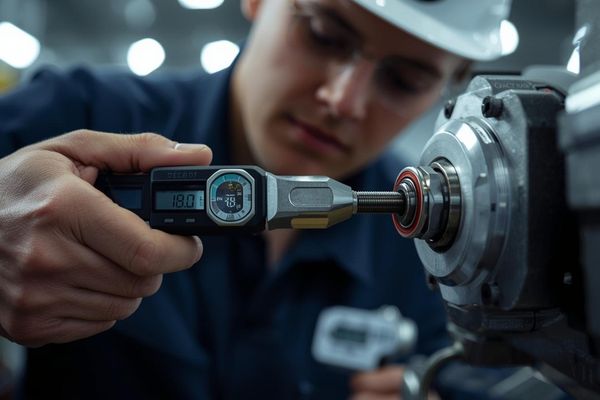
An indicating torque wrench has a dial and a memory needle so it remembers the torque, or some sophisticated electronic version of it. They are far easier to come by and cheaper than they used to be. We put that torque wrench on there. We tighten it and see when it moves. If it moves at less than 30 foot-pounds, we could say it probably was not tightened to 30 foot-pounds. It should move just above 30 foot-pounds because it takes a little bit more torque to get a fastener started than it took to get it where it was torqued to. That’s the first movement test.
It doesn’t necessarily mean the part was improperly torqued because sometimes, you can have relaxation of the joint. This test would indicate one of two things. Either we had some relaxation in the joint if the torque was low, or it was not torqued to the right amount if the torque was low, or if it was over tightened, if the torque was too high.
The second type is called the loosening test. This is similar to the process we described, called the first movement test, except this time, we move the fastener in the loosening direction. We see where it breaks loose. This also should be slightly higher than the specified tightening torque. These are the two most popular tests. The third test is called a marking test. We take the tightened fastener. We mark clearly the surface of the fastener, the nut, the bolt, or the washer, and the clamped surface for reference.
We put a mark there. We loosen the fastener, and then we re-tighten it until the marks line up again. We see what that torque was. If that torque is similar to the required torque, we can presume that the fastener was most likely tightened properly in the original installation. One of the things that most people don’t understand about this process is that it’s much more powerful if you know what the original torque was. You’re coming back and saying, “I knew that was properly torqued at the time. Now I’m checking to see if it was properly torqued.”
If you know what the proper torque is in the beginning, and you know that torque was applied, then this process has a much better chance of indicating that the torque is correct. If you’re just walking up upon a situation, and you don’t know what was done to it initially, then you don’t know. Another powerful thing about it is that, if you know what the original torque is, you now know, “It was properly torqued at 30 foot-pounds. It’s breaking loose at 35 foot-pounds, so I know when I’m doing the torque audit that I should get a 35 foot-pound break loose if it was properly torqued, or I know I will get a 40 foot-pound requirement to get the fastener in motion in the tightening direction.”
Those are essentially the three choices that we have, which are the first movement test, the loosening test, and the marking test. The first movement and loosening tests are easier and simpler to apply. Especially if we have reason to know what that loosening should be based on the part having been properly tightened in the first place. If you want more information on the torque audit, you can email me at CarmenV@CarverEM.com, or you know how to get a hold of me where you see me. I have a couple of documents that will help you be able to put this process into practice. This has been Carmen Vertullo with the Faster Training Minute. Thanks for tuning in.
—
Fastener Distributor Index Update & Market Outlook
It’s been too long. We’re back with Charlie Kerr of Kerr-Lakeside for a feature segment. Hi, Charlie.
How are you doing?
I’m doing great. I can’t believe we didn’t have you on for a full-length segment in ‘23. I was looking back and doing a search. It’s been too long. How are you?
I’m doing well. I’m a little bit older than I was the last time I did the show. I still feel better now than I did years ago. I will attribute that to the fact that I weighed 230 pounds when I was in my late 30s and early 40s. I now weigh 170 pounds. I exercise on my bicycle. It’s about 62 degrees in Cleveland. When you get done with me, I’m probably going to change my clothes, hop on my track, and go out for a 10-mile ride, which takes about an hour.
Good for you.
I’ll be all sweated up and huffing and puffing. Life is good. Business is okay. I have nothing to complain about. Quite frankly, if I did, I wouldn’t complain on your show because it would be a long time before I got invited back if I did that.
I edit it out anyway.
I forgot about it. Back in the day, when I did radio in high school, I did radio with John Carroll. Eric, I know you’ve been at this for a long time, so you’ll probably understand this. We had razor blades and tape. That’s how we edited the interviews we did.
That would have made it a lot more cumbersome. I don’t think I would be nearly as successful if I had to do it that way. I forgot all about that. One of the early times we had you on years ago, you laid that all out. I forgot about that.
We literally would put the tape into a fixture and hold it down. It’s like a saw miter a carpenter would use. We would cut the sections of the tape out. I got hip to the fact that I could take this tape, make a second copy of it, and hit the pause button on the recording machine that I didn’t want to carry on. The problem is that, because it was analog, the sound quality of the first copy of the original was noticeably deteriorated from the original, so we still used razor blades and tape.
In those days, you had to be a lot more resourceful, but you had that sound degradation to worry about on and on. We don’t have to worry about that anymore. Unfortunately, you always give us quality content to work with. Very little gets cut out. As you said, Charlie, when we agreed to get together. You said, “This time, turn the recorder on right when we start, because so often when we’re trying to warm up, we lose some great stuff.” Here we are, pretty much raw, folks.
I know one thing Charlie wants to talk about. We’ll get to that in a few minutes. You’re a guy who follows a lot of things around the industry and elsewhere. You’re into a million things. Bicycling has been a topic that we’ve covered on the show. We also talked about your skiing proficiency in one episode. That’s probably something else that’s led to your youthfulness. I didn’t see you at the NCFA meeting. I usually catch you at the spring event. Were you doing something fun at that time? Is that why you weren’t there?
I was at a meeting in Austin, Texas. Some of your regular audience might know. Kerr-Lakeside is not just a member of these groups, but we’re active in a number of trade associations, such as North Coast Fastener locally and the Industrial Fasteners Institute. We also belong to the Precision Machined Products Association. Every year, sometime in late February or early March, they have this conference called Management Update. I don’t go to all of them, but my daughter lives in Austin, Texas. That’s where this one was, so I decided to make a lengthy trip out of it. Kill two birds with one stone.
As an aside, there was a physician who talked at this conference from the Cleveland Clinic. He said that in all likelihood, those of us my age who are in reasonably good shape will probably live past 100 years old. That was after the economist got up and said, “We’re going to have a major economic meltdown in five years.” It’s like, “Do I want to live to be 100 years old?” If all these unfunded liabilities the government has with Social Security and Medicare, pension problems, and debt problems, I’d like to die in my sleep, maybe in four years, and miss all this.
That’s interesting that you say this, because I got back from the Pacific-West Association meeting. There’s an economist there who I’m not going to name. He’s all sweetness and light. Sure, there are a few bumps in the road, but he’s looking at all the systemic problems we have, pretty much ignoring them, and chalking it up to what he calls miserable-ism. It sounds like your guy was not quite as rosy.
Let me get specific because there are no secrets in this industry. The speaker was from ITR. ITR is used by the Industrial Fasteners Institute, the Precision Machined Products Association, and the Precision Metal Forming Association.
Don’t forget the NFDA.
I’m not a member of the NFDA, so it’s not that I forgot it.
Which one of them was presenting? Was it Alan?
It wasn’t.
Was it Brian?
No, it was the other guy.
Those guys are winding their side of it down, but they’ve got some junior guys that aren’t so junior anymore. They’re all very good. What did they have to say?
They’ve been predicting a major economic calamity arriving sometime in 2029 or 2030. I don’t know if it was Brian or Alan. I’ve said this before.
Nobody does, Charlie.
I’ve never seen both of them together at the same time. I have been suspicious that Brian and Alan are one and the same. One of them gets up at a meeting. He was talking about the debt. At that time, it wasn’t as big as it is now, but it was still sizable. People are living longer. The number of people paying in social security is diminishing. You get the picture. He says, “I know exactly how to solve this problem. I guarantee you it’ll work.”
We’re all like, “What is it?” He says, “The bubonic plague comes back. Everybody over the age of 65 who is in less than perfect health dies.” Everybody started laughing. I thought, “If this guy can think something like that up, there’s someone like Anthony Fauci who might think that up, too.” A few years later, COVID happened. That’s the first thing I thought of when there were all of our mask mandates. We can’t go to a bar. It’s like, “Is this the bubonic plague that Brian or Alan Beaulieu said would cure all the financial liability problems that our country is facing?” I don’t think so, but I’m not a conspiracy theorist.
They’ve been predicting a major economic calamity. It’s 2024. You have four or five years to figure out how you’re going to protect yourself from this. Burying cash in a mattress or a hole in your backyard isn’t going to work. It’s because leading up to that, they’re predicting the government’s going to print a lot of money, which means that if you buried $1 million in your backyard, in the space of a couple of months.
It could lose 25%, 30%, 40%, or maybe even 50% of its buying power. What I’m thinking about is liquidating some of my investments, going out, and buying a brand-new cold header, because that might lose its market value, but it’s not going to lose its ability to make parts that Kerr-Lakeside could sell and make money doing.
The ITR guys have been pretty clear that the only reliable way to weather this is to be involved in a productive enterprise.
I’d like to think I’m productive. My son, who runs the company, might think otherwise.
That doesn’t mean he has to like it, Charlie.
I’m very lucky. Not to digress. Alex was a commercial airline pilot. He got disenchanted with that. He came to work here. If he hadn’t done that, I’m not sure what my exit strategy would be or my succession plan. I told him that as long as my health allows me to, I want to stay involved in the business. He could do anything he wants, unless it needs a board of directors’ resolution. You want to go to the bank and borrow $5 million. I got to sign off on that. You want to rearrange the aisles in the warehouse. Don’t even tell me you’re doing it. I don’t want to get involved in that.
When my dad was alive, believe me, if you were going to rearrange the aisles in the warehouse, if he didn’t sign off on it, there was hell to pay if you went ahead and did it. I’m not a micromanager like that. That’s a big contributor to why our company has been so successful. My dad knew what he was doing, but he didn’t trust anybody to make a good decision without him signing off on it. A lot of things we should have done years ago that would have made us leaner, meaner, and more efficient either didn’t get done or didn’t get done when they should have gotten done. I’m not going to do that to Alex. Quite honestly, some people say, “What do you do?” I say, “I stay out of his way.” It’s working.
You talked about that on an earlier appearance of the show one time. You seemed like you were going in that direction. Now that it’s a little bit down the road and things are unfolding, it sounds like you’ve taken your own advice. Congratulations to you. I’ve been to your facility. Even though you have a lot of older equipment, it’s maintained like crazy. Plus, there’s a nice selection of newer stuff added in. You’re building. It’s a thriving enterprise. Hats off to you, guys.
I’m comfortable. As I said, there are no secrets in this business. When Alex came to work here, we had a fairly large debt with the bank in a neighborhood of $1 million. For a company that does $12 million to $13 million a year in sales, that’s a pretty big nut. We had a defined benefit pension plan that had a very big liability attached to it. We had an employee stock ownership plan. Alex figured out how to get out from underneath all of that without sticking anybody. Our debt to the bank is zero. The defined benefit plan has been terminated. All the participants, if they haven’t been cashed out, will be within the next week or two. The ESOP was cashed out.
Going back to this 2029 meltdown, one thing ITR emphasized is not to carry a debt load that you can’t take care of if something goes wrong. From this moment until we get to where I get a better idea of what the future holds, we’re not borrowing any money. There was another meeting I went to a long time ago. There was a guy there from Wells Fargo Bank who was talking about how companies get into trouble. He said, “Go back to 2007, ‘08, and ‘09. When there’s an economic downturn, it’s a contest to see who can hold their breath the longest. If you’re carrying a lot of debt, you’re not going to be able to hold your breath very long.”
One thing ITR emphasized is not carrying a debt load that you can’t manage if something goes wrong. Share on XI am convinced that no matter what happens going forward, if the guys from ITR are wrong, they’ll clearly state they’d be thrilled to death to be wrong on this. If they’re right, we’re going to survive it because we’re not going to have any financial obligations, whether it’s secured debt to the bank. We have payables. That’s always manageable, but we’re not going to take on any liabilities that will become difficult to service if business should happen to go in the tank for a couple of consecutive years.
That’s old school, serious conservative medicine for surviving this thing. I know you’re of that mindset. Let me ask you this. Did these ITR guys talk at all about the value of gold, cryptos, or anything as an avenue for hedging in this future dystopia that we’re heading into?
They didn’t specifically mention cryptos, but they did mention gold and silver. They gave three ways to prepare for this. He didn’t say, “Deal with it after it happens.” He said, “Prepare for it as it’s coming. Avoid debt.” I already touched on that. “Do not hold cash.” I laughed a little bit. “The last thing you want to do is bury money in the backyard or stuff a mattress because leading into this. There’s going to be a lot of printing of money. It could significantly lose value in a short period of time. They did say holding gold, silver, or other precious metals could be a way to prepare.
They didn’t specifically mention cryptocurrencies like Bitcoin or some of the other stuff. I don’t know if he did, and while I was writing the other stuff down, I missed it. There was a story in the Wall Street Journal. Bitcoin was trading at $65 a coin. Years ago, it was a couple of $100. I’m thinking, “How did I miss out on that?” I don’t like to invest in stuff I don’t understand. To this day, I do not understand cryptocurrencies. Maybe I’m losing out by not understanding it, making more of an effort to learn more about it. If you sold me something that I could hold in my hand, I could understand it. It’s a rock with your picture painted on it. I paid you $1 for it. Can you hold a Bitcoin in your hand?
I get your point. I get all that. We could go on for hours and hours. I don’t know that we want to. The point that we’re zeroing in on here is that everybody’s agreeing that it’s at least a temporary store of value. You can’t deny that. That’s the truth. The same could be said of gold. What I was leading up to with my question, though, Charlie. The same could be said of any fiat currency because the reason it’s an effective store of value or wealth is that everybody agrees to trust it for the time being.
When we were in LA listening to this guy at the Pac-West, he started by slamming the whole idea that crypto, for sure, and probably even gold, are smart things to be using as wealth storage hedges in this new world. Apparently, he doesn’t see the irony there, comparing it to a rapidly losing credibility fiat currency like the US dollar, even though it’s still got a lot of juice in it. That’s where it is.
One thing that I do understand is that fiat currency is another way of saying paper money that’s printed by a government entity. One of the attractions to cryptocurrency, Bitcoin in particular, is that it’s not controlled by any government.
Theoretically.
That we know of. No one government can make some government’s own crypto. Their buying or selling it can affect its value. They don’t control it the way the US government controls the US dollar. One thing I want to point out between gold and silver is that silver has industrial applications. Your cell phone has silver in it. That’s one. There are a lot of electric devices. In your car, there’s silver in there. That creates a predictable demand for silver. It also creates a sustained market.
Gold doesn’t share that. Gold is emotionally driven. If people get paranoid, they buy gold, and the price goes up. If they start feeling good, they would say, “I’ll sell some of my gold.” That pushes the price down. That’s why the price of gold is typically a lot more volatile than it would be the price of silver. I’m going to go back one second. There were five things that this speaker from ITR said were going to drive this crash in 2030. There are demographics. There’s the percentage of the population that gets older.
Remember, I said the guy who talked about living to be 100. There are going to be too many people who live to be too old compared to younger people paying into their pension plan. You got the healthcare costs that go with that. People are going to live longer, but the healthcare technology that enables that to happen is going to become increasingly expensive. You have all the other entitlements.
You’ve got inflation. The government’s going to print a lot of money. Do you think they printed a lot of money in the last couple of years? The printing presses are going to go into overdrive in the next couple of years. Overall, which is related to all the previous four things, is the debt. It’s possible our debt could hit $50 trillion by the next four or five years. That, my friend, is what ITR is telling me that keeps me awake at night.
A lot of that, though, has been known by the fastener industry for a long time, at least the people who pay attention to ITR. It’s becoming a little more real to some people because we’re on the verge of it, and a lot of creepy things are happening. This is being broadcast in other industries as well. What association did you say that it was? What meeting was it?
It was the Precision Machined Products Association. They’re known as the PMPA Management Update. If I could throw out there, the PMPA has three national meetings a year. They have this thing called the annual meeting. It’s what I call the vacation meeting. They go to a nice resort. Owners of the businesses go. They do have speakers.
Didn’t you guys go down to the Bass Pro Shop down there in the Ozarks?
Yes. That was a couple of years ago.
I wanted to go to that one.
They have a meeting in the spring or late winter. This is the management update meeting that I just mentioned. A couple of months later, they have this thing called the Tech Conference, which is cool because there are engineers, machine operators, and other people. It’s a combination of hands-on production personnel. All the way up to ownership. There are some sessions. They’ll pass drawings of parts around.
People talk about, “This is how I would make this part in my shop, the type of equipment I would use, and the skill level of person needed to do that.” Quite honestly, I’ve been after the IFI going back to early in Rob Harris’s tenure to try to do a similar meeting like that because machining is more of a science. I get that cold heading is an art, but there’s nothing anti-competitive about someone saying, “This part lends itself more to a two-dye, three-blow header threaded secondary.”
Another guy might say, “I got a bolt maker in my shop. For small quantities, you’re right. The two-dye, three-blow machine threading secondary makes sense. We typically like to run half a million-piece lots. That’s where the bolt maker comes in.” I don’t want to elaborate on that. It’s a good association. The irony is that precision machine products are a very small part of our sales pie, but it’s the association our company is the most active in.
There are some high-dollar transactions you do there when you do them.
One thing about precision machine parts is that the percentage of the selling price that’s value added is considerably higher than it is on a cold-headed part. Cold-headed, sometimes raw materials, are half the selling price.
Getting back to the comments you were making on silver and the industrial uses of it, you were telling me before we turned on the recorder here in that fleeting moment before you forced me to turn it on that you had something to comment about on EVs. Did this also come up at the meeting, or was this another piece of fluvia that was flying around your mind?
Yes. I’ll tell you in no particular order. Let me start by saying there are no secrets in this business. You and I talked on the phone about how I should prepare for this session. You told me to go back and tune in to a segment you did with Jason Baines. He briefly touched on EVs. One thing he said that I’m in 100% agreement with is that the government is pushing the transition to EVs. The public is resisting it. It’s not a formula that’s conducive to success.
I want to go back, if I can, to the early 1980s. The cell phone became a practical tool for people to use, primarily for outside salespeople. I don’t know who the carriers were back then, but the service providers. Every time they put a tower up or sold a phone, knew there was going to be revenue generated from day one. Their challenge back then was to satisfy the demand for the product or the service.
It was easy for investors to be confident to put the money out because even though profits might not be realized immediately, the revenue would lead to that. They could justify putting some cash up front to get the infrastructure in place. Whether it be the towers or the factories to make the telephones. They were fairly crude compared to what they are today.
EV production is dependent on the creation of demand. The demand is not there. The big three, which would be GM, Ford, and Chrysler, who knows what else is going on with Nissan, Toyota, Kia, and the rest of them, lose a lot of money on every car they build. They’re starting to tap the brakes, no pun intended, because not only did they lose some money on the cars. They’re having a hard time selling them. There’s too much hesitancy on the part of the car-buying public to embrace this.
How does this have anything to do with the fastener industry? There are a couple of angles that I would like to share with everybody. I’m sure a lot of your audience knows this. Internal combustion engines, gasoline or diesel, and their drivetrains, which is a fancy way of saying the transmission, use hundreds, if not thousands, of high-strength threaded fasteners, high-value-added parts that are produced by members of our industry.
The EVs don’t use anywhere near that number of that kind of part. UAW members in Michigan are being told that, as the car companies transition to building more EVs and fewer internal combustion vehicles, fewer of them are going to have jobs. I don’t know if that’s political speak. I haven’t taken the trouble to research how accurate that claim might be. In this industry, if you run a fastener shop, and everything you make goes into a car, particularly the engine or the transmission, as more EVs get built and fewer internal combustion engines get built, the demand for what you make is going to diminish.
Kerr-Lakeside doesn’t do any tier one parts at all. I’m not so sure we do any tier two parts. It’s still a concern of mine because someone deep into automotive or truck is going to have to find something else to make if they’re going to stay in business. Excess capacity in the industry usually puts downward pressure on selling prices, which is not good for people in general. It affects everybody.
Everybody can understand this. If you’re dealing with a new product, no matter what it is, and it has a negative impact on your side of things, which in our case is fasteners, you’re going to have a less favorable attitude towards it. We’re talking about EVs here. Put it this way. Nobody’s surprised to hear that there’s consumer resistance to EVs.
When it was just an idea, it was still flashy. People didn’t have experience with it. There was discussions of all kinds of charging facilities popping up all over. People hadn’t quite thought it through yet. Sure, it might have sounded like an okay idea to some people. That reality is hitting the street. The demand isn’t there. There’s pushback with the dealers and so forth. Do you think that this is going to proceed with the same velocity that it was? Is this still as big a threat as it might have been?
Range anxiety is going to take a long time to deal with. I used to coach baseball players. I would always tell my baseball players, “Sometimes, to make it easier for you to visualize in your mind what I’m trying to get across to you, I exaggerate.” I’m about to do something that would be constituted as an exaggeration. Truck stops and service passes on the turnpike sell gasoline and diesel fuel. If you took every vehicle that uses liquid fuel and immediately replaced it with a vehicle that needed an electric charge, this is what you’re up against.
At a truck stop, think of their electric service as a garden hose. You got lights and refrigeration. They don’t need a lot of electricity because they’re in business of selling fuel, which are diesel and gas. If all of a sudden, the same number of vehicles that they’re selling fuel to need to be charged up, that garden hose, bringing the electricity to the truck stop, probably needs to become 20 to 25 fire hoses. Here’s the dilemma. This is a huge investment. The power companies don’t want to lay out the money. I talked about this with cell phones a little while ago. They want to see immediate revenue.
The truck stops are in the same boat. They don’t want to spend the money because they know they’re not going to see immediate revenue. This is like being between a rock and a hard place. I know the government says, “We’re not mandating electric vehicles,” but by pushing the fuel efficiency standards up, that’s a de facto mandate. If there aren’t readily available charging facilities, I don’t care if it’s trucks carrying freight or people driving their cars. There’s going to be a hard time for EVs to make significant market penetration.
There is something that I do want to mention to everybody. I read this in the Wall Street Journal. Quite frankly, I’d never heard of this car company until I read this article. Lucid’s CEO has decided that they are going to offer a car that only has a range of 125 miles. I’m reading this. It’s like, “There are cars out there that already get close to 400 miles on a charge. That’s not getting rid of everybody’s range anxiety. What’s up with this?” His logic is that because the car’s only going to go 125 miles, it’s going to have a smaller battery and a smaller motor. It won’t weigh as much. They can charge it in ten minutes.
They think that there’s a market out there for what I’m going to call an errand car. It’s a car that goes more than 30 miles in one trip. It’s got a smaller battery and a smaller motor. It’s probably going to have a smaller price tag. If they’re successful at marketing that car, that could start opening some of the constraints on the electric supply to the truck stops and the service plazas. It’ll be slow, but the infrastructure to charge cars is slowly going to grow. You’ve got another problem. You still have to generate and distribute the electricity.
I get it. There’s a cascade of issues that you hit. What reminds me is the old adage. It’s been attributed to many people, but I think it was Ayn Rand. It goes something like, “You can deny reality, but you can’t deny the consequences of denying reality.” That’s where we’re at. The only people who think that this whole scheme is real are the technocrats who are foisting it. That 10-minute or 150-mile car only makes sense if you’re talking about a maximum security, fifteen-minute city scenario. You don’t need travel plazas to begin with.
I got to ask you a question. You used to live in Chicago. There are parts of town where people park their cars in the street. There’s no garage. There’s no driveway. A lot of houses were built 100 years ago. How are these people going to charge their cars, Eric?
The vision is that people who currently have those cars are not going to be car owners of the future, Charlie. That’s the obvious idea. Nobody believes that everybody who owns a car today is going to own an EV tomorrow. It’s not real. That is not the idea. More and more people are catching onto this. I was doing some searching around about debunking the EV myths. The internet is rife with all kinds of misinformation, which is euphemistically called fact-checking these days. You can always rely on Business Insider to give you the straight shot about what they want you to believe. You hit it right on the head.
The internet is rife with all kinds of misinformation, which is euphemistically called “fact-checking” these days. You can always rely on Business Insider to give you the straight shot about what they want you to believe. Share on XThe first myth they’re trying to dispel is how much these things cost, which everybody knows. Myth number two is that I need a 400-mile range car. They’re trying to talk you out of what you already know you need. I need a 2,000-mile range car or more, if you ask me. The bigger, the better. God bless internal combustion. This whole EV thing is something that is a bad dream. I don’t think it’s going away.
I’m not a fan of EVs, but I’m also not totally against them. I know some people who own Teslas. They love them. Their driving habits are very different than mine. I’m going to go back to the episode you did with Jason Baines. He mentioned he lives in a rural part of Canada, where he has to drive frequently, over lengthy distances. In an electric vehicle, of any circumstance, is it going to make sense for people to drive the way he does? That is never going to change.
I don’t readily buy into the conspiracy theories. I do believe there are people out there who truly believe that the motor vehicle, whether it be an EV or a car with an internal combustion engine, enables people to have a degree of mobility that prevents them from being subjects of the government instead of citizens of the country.
A lot of these people live in places like Boston, New York, Philadelphia, and San Francisco, where a significantly large percentage of the population has and still does use public transportation. They’ve got this mindset that anybody who doesn’t agree with their way of getting around is somehow a defective person who’s bad for the environment. I refuse to buy into that.
Amen to that. You don’t have to tiptoe around it because this is all published. It’s widely available information that’s well known in a lot of places. You don’t have to worry about laying it all out here for me. That’s probably where we’re going to leave that part of it for this episode. We’ve laid enough truth out there on that topic. I know you’ve got a lot of other stuff that’s on your mind. You’re going to be at Fastener Fair in Cleveland, aren’t you?
I will be there. Although, we don’t have an exhibit. You gave me permission to do this. The North Coast Fastener Association has chartered the Goodtime III. For those of you who are not in the Cleveland area, it is a boat. It goes up and down the Cuyahoga River, and it goes out to Lake Erie. If the weather’s nice, it’s going to be an extra super deluxe fun party. I will be at that. We have about thirteen people from Kerr-Lakeside that I’ve arranged to get tickets for. It’s a floating version of the annual Distributor Social.
Eric, everybody who’s tuning in to this, that’s going to be in town for Fastener Fair, needs to go to the North Coast website. That’s NCFAOnline.com. At least give serious consideration to getting a ticket or other people from your outfit. This is going to be a party that, 25 or 30 years from now, those who were on the boat that are still alive will probably still be talking about.
Way to go, Charlie. Hype this thing up. I love it. It’s Charlie Kerr, the hype master of the NCFA. Let me ask you this. You’ve obviously been out there for these kinds of cruises. What do you figure is the cruising speed of this vessel? You have even the vaguest ideas. Is it 3 miles an hour, 5, 6, or 8? I was wondering because I don’t know what kind of crankbaits to bring.
Are you going to take your fishing tool?
I figure I might as well troll along as we go. If the speed isn’t right, that might cause a problem.
There’s a friend of mine. We’re getting off topic, but I’m sure a lot of people who tune in to your show like to fish. I got a buddy who’s got a Boston Whaler. When he takes me out on Lake Erie once or twice a summer, he’s got this thing. I call it the fish finder. You see these little blue dots on it where the fish are. That’s cheating, Eric. Back in the Stone Age, when my grandfather or his friends would go fishing, they just had to guess this might be the spot. If they didn’t catch any fish, they moved to another spot.
Now that you have this fish finder, you go out there, and you see all these blue dots. You slow the boat down to about 2 miles an hour. Put all the rigs out. You mentioned Bass Pro Shop earlier in the show. He probably bought the most expensive rods and reels they sell. He said, “This stuff is indestructible. Don’t drop it in the water because you might have to dive down and get it.”
Don’t worry. I’ve been there.
I’m going to repeat myself. I mentioned earlier in the show that Kerr-Lakeside is a member of a number of trade associations, such as North Coast, Industrial Fasteners Institute, Midwest, and a few other things that are not industry-specific. I’m an advocate for participating in trade association events, regardless of what association it is or the nature of the industry that they cater to.
I’m not making light of the situation. We’re going to be on this boat. It’s an open bar. They’re going to be handing food out. People are going to be milling around. They’re going to be sharing experiences and ideas. You can sometimes learn more from a total stranger that you’re talking to for the first time, who has industry experience, at a cocktail party than you can sitting in a lecture hall and listening to someone talk for two hours. That’s why whenever some of this stuff comes up, I get on my soapbox and start beating the drum.
I’ve never met Jason. He did say he’s going to be at Fastener Fair. Hopefully, Jason Baines will be on the boat. I would love to stand there and talk to him for even ten minutes because I could tell by the way he engaged you in his episode that he’s got a different experience in the industry than I do. I’d love to know more about it. I’m still not content that I have possession of the level of knowledge that I should have to continue being involved in this business to maintain. I hate to use the word sustainable because that means a lot of different things.
Avoid that. Come on, Charlie.
I want this company to still be around. We celebrated our 75th anniversary. I’d like to see the company celebrate 100 years still under Kerr family ownership. I believe that my involvement, Alex’s involvement, other people who work for my company’s involvement, and these various professional associations contribute to achieving that objective.
Well done, Charlie. Everybody, this event that he’s talking about, which I’m going to dub the three-hour tour, but is probably only an hour and a half, starts at 5:30 on May 21st in Cleveland, Ohio. That’s the night before Fastener Fair USA opens. That night will be the big shindig at the Rock and Roll Hall of Fame. It’s back-to-back gala events that you don’t want to miss. The usual Distributor Social has 225 people or so. This boat ride is supposed to start around 4:00. They’re going to go well over that. There’s capacity on the boat.
My understanding is that the boat can hold close to 700 people. In all honesty, I almost hope they don’t have quite that many because mingling around will be more difficult if there are that many people there. If there are 700 people, they’d better have more than one bartender.
They’ve got that covered, Charlie. Don’t worry about it. Everybody, sign up. That’s NCFAOnline.com. You, Charlie Kerr, are still the head honcho, at least in the spirit of Kerr-Lakeside, Euclid, Ohio. That’s KerrLakeside.com.
I thank you for the opportunity to be on. Hopefully, we’ll both come up with something else to talk about that’ll keep your audience glued to the radio.
That’s not in doubt at all. I’ll be seeing you for sure ahead of that. You know where. It’ll be on the Goodtime III. Thanks for being here, Charlie.
Thanks for having me. Best wishes to all your audience. I appreciate them taking part of their day to eavesdrop on my conversation with Eric Dudas.
Always a pleasure.
—
Closing Thoughts, Industry Events, & AI In Fastener Search
Brian, you think Charlie’s psyched up for this NCFA Lake Cruise?
I think so.
He’s itching to get out there on that boat. He’s such a great promoter of all the associations. It’s cool to hear that.
He turns up at these associations, too. A fair way from Cleveland, but he’s a regular at the shows in Chicago.
He’s good at those long-distance bike rides. Registration is now open for the NCFA Social, happening on this cruise, ahead of Fastener Fair USA in Cleveland. The whole shindig starts on May 21st. Fastener Fair is on the 22nd and 23rd. Fastener Fair registration is open as well, so go to FastenerFairUSA.com for that.
I’m relying on you to do all that organization for us.
One way or another, Brian, we always make it happen. Don’t ask me how.
We have lots of friends. That’s why.
Charlie Kerr’s got people for that. When you’re in his position, you’ve got people. Let’s thank Charlie Kerr of Kerr-Lakeside for being our featured guest on this episode. Also, Brad Burel of Advance Components and the Southwestern Fastener Association. Holden Lewis with Fastenal joined Mike McNulty on the Fastener News Report. Thank you very much, gentlemen. It’s an insightful analysis, for sure.
Marco Rodriguez, not Martinez, had his commercial real estate special. Talk to you next quarter, Marco. Carmen Vertullo had the Fastener Training Minute. The title sponsors of Fully Threaded Radio are Brighton-Best International. Tested, tried, true, Brighton-Best. Goebel Fasteners, quality the first time. Go Goebel, and Star Stainless. Right off the shelf, it’s Star.
Fully Threaded Radio is also sponsored by Buckeye Fasteners, BTM Manufacturing, Eurolink Fastener Supply Service, Fastener Technology International, INxSQL Software, J.Lanfranco, Parker Fasteners, Solution Industries, 3Q, Inc., Volt Industrial Plastics, FastenerFair USA, and Würth Industry North America. We appreciate your partnership. We couldn’t do it without you. Thanks for helping us bring Fully Threaded Radio to the fastener industry. Get with us anytime, folks. The email address is FTR@FullyThreaded.com. Brian and I do kick around LinkedIn, so you can catch us out there as well.
It’s a great site for news about the industry and what’s going on.
A lot of people keep their eyes on that feed. Those kinds of feeds are very important to the world these days. Getting back to the Pacific-West Conference that concluded out there in Anaheim, Brian, no surprise that technology was prominent in the lineup of conference topics. On the first day, there was a junior guy from an economic consultancy, Beacon Economics. He presented on AI.
All the associations are recognizing that this is a force to be dealt with. People are wondering about it. I’d say he did an okay job of presenting a consumer-level summary of what’s going on out there with AI these days for fastener distributors. The usual assortment of questions came up. Nothing too earth-shattering, but the point is it was front and center.
This is an ongoing story, isn’t it? As Holden said, we’re all in a holding pattern waiting for something.
People are waiting for it to come into focus. We were talking about the Lex Fridman podcast that we both caught, with Yann LeCun, the French guy from Meta. That’s not something that you’d see at a fastener distributor conference, but the point is that these ideas are being wrestled with at the highest technical intellectual levels. What I found fascinating was the way he was talking about the different approaches that AI is addressing in imagery. We’re thinking about it in terms of whether it could understand what a picture of a fastener is and very correctly identify what it is that it’s looking at.
That’s interesting, not for any experienced people in the industry, but for the more inexperienced people, or inexperienced dumb men. Invariably, one of the fastener shows does not go by where we have someone who comes to us, and there’s a picture of something. They want to know what it is and where they can get it. Why they would come to us, I have no idea, but they usually do. It’s a very complex problem, but we’re told there is a way of solving it. We have it on good authority. That’s an interesting way of saying it.
We’ve been thinking a lot about that idea because we’re right now looking at ways that we can improve our inquiry system. That’s both on the inventory side, which people come to FCH all the time looking for hard-to-find parts, and the Source Finder System, which is a broadcast RFQ program. A lot of people in the audience are familiar with it.
We’ve been making tweaks to those algorithms in the background all along, but with the advent of AI, we’re looking for opportunities to use some of these new technologies to improve them all. There are a lot of good ideas, but deciding on which way to go is a little more complicated than you might imagine. I threw into ChatGPT-4 a question about the perfect RFQ for a fastener distributor.
What does it think?
It did a pretty respectable job for a first try. It’s a little generic, but it hit the areas. It spit back ten different categories of information that would go into the perfect RFQ. The first three are obvious, which are detailed product specs, quantities, and delivery. Next would be a little bit optional, which are drawings or samples and application details. That you usually don’t see. A lot of times, our customers are not interested in providing that, or they’re even hiding it, but it’s logical. Budget is not something we typically see, but on bigger orders, that’s regular.
Contact information seems pretty basic. Vendor requirements come into play when you’re doing big package deals. For one-offs, that FCH handles not so much. Additional services, I’m interpreting that as secondary services. Occasionally, people will mention that in the initial requirements. FCH doesn’t go into the idea specifically of what would be required for a product, but it makes sense to be on your RFQ list. Finally, payment terms. That’s ten.
That’s not a bad set of ten. What do we say from this? Watch out for your job. ChatGPT can decide this.
You’re looping back into this whole fear and panic mode, Brian, which we’re not going to do. I was warned about this again at Pac-West.
I’m not in the panic mode part of it. I’m definitely of the view that it can help. We just have to spend a bit of time working out exactly how to get the biggest benefit from that.
The reason I thought it might be appropriate to tag this onto the end of this episode is simply to lay out the welcome mat for any FCH users who have been with us for some amount of time all the way. If you just came on, we’re open to your suggestions and ideas. Not necessarily from an AI point of view, just in terms of usability, because we are putting quite a bit of thought into that whole search and RFQ process right now. It’s FTR@FullyThreaded.com. We’re easy to find.
If you’ve got ideas that you think are good and ones we haven’t implemented or we haven’t implemented them correctly, then don’t hesitate to contact us. We’re actively working through a number of suggestions.
Plus, we’ll be on the Goodtime III out there on Lake Erie with about 500 other fastener professionals. You can catch us there if nothing else, along with Charlie Kerr, the NCFA, and probably half the fastener industry. That’s going to be a great time. Hopefully, Tim Roberto Jr. of Star Stainless will be out there as well, because he’s going to be with us for the next episode of Fully Threaded Radio. He’ll be talking with Mike McNulty about the next FDI. He always drops a lot of sweet intel on us. We’ve got that to look forward to.
You were doing organizing over in California as well, I can tell.
It wasn’t all just thick, juicy steaks, Brian.
So you say.
I’m looking forward to what’s going to happen down at the Southwest Conference. The fastener industry doesn’t exist simply on lettuce. You know that. For now, that’s going to put this episode of Fully Threaded Radio in the can. Thanks so much for clicking in, everybody. We appreciate it.
In the month while you’re waiting for the next one, think about sending us some comments. We would appreciate them. I want some good comments.
For Brian Musker, this is Eric Dudas. Get out there. Sell some screws. Maybe throw some ribs on the grill. We’ll talk to you next time.
See you next time.
 Apple Podcasts
 Spotify