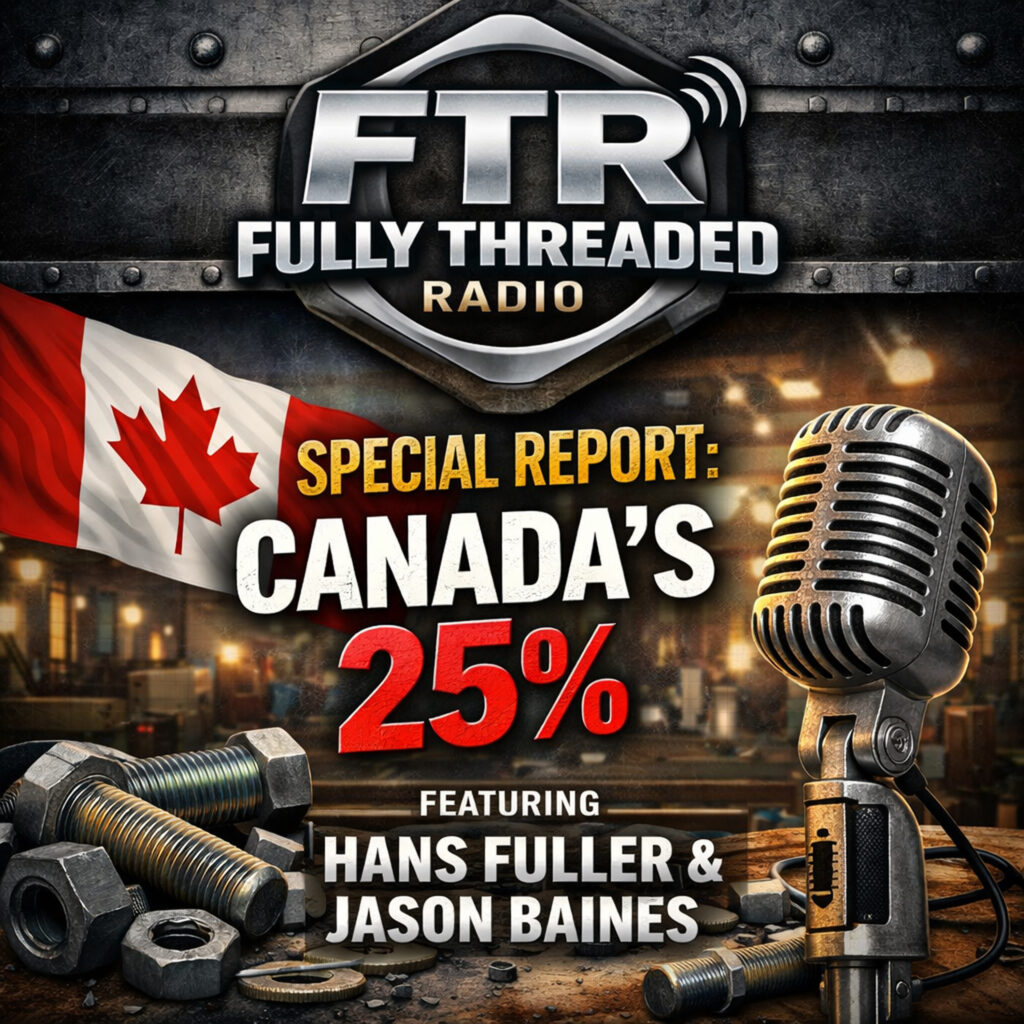
Tariff news: Just ahead of the U.S. Supreme Court major announcement on tariffs, Canadian fastener men Jason Baines, of J. Lanfranco and Hans Fuller, of Fuller Metric, discuss bewildering new changes to Canada’s steel tariffs that could cause serious disruptions.
—
Listen to the podcast here
Important Links
Special Report: Canada’s 25%
Introduction Of The Tariff
Eric Dudas with you, Fully Threaded Radio Special Report. This time, we’re going to cover more on tariffs. Plenty of tariff news is going around. We’re waiting expectantly for the US Supreme Court to make a big ruling. As a matter of fact, we were expecting that ruling to happen after we did this conversation, which is between Jason Baines of J.Lanfranco and Hans Fuller with Fuller Metric. Both of these gentlemen manage Canadian fastener operations, as many of you know. Late in 2025, news broke that the Canadian government was imposing a 25% across the board tariff on steel products and derivatives.
You’ll know more details during the discussion. That’s the summary. As we wait for this big news in the US, things are going on north of the border, too. Lots of business gets transacted that affects both sides. Anybody in the fastener game should be interested in this conversation. We’ve got a full episode of the show coming up pretty shortly. Hopefully, we’ll be able to pack in reaction when the Supreme Court makes its announcement. As it turns out, it was delayed. We were expecting it on January 9th. They didn’t pull the trigger on it. Not sure why. We’ll find out.
The title sponsors of Fully Threaded Radio are Brighton-Best International, Goebel Fasteners, and Star Stainless. Fully Threaded Radio is also sponsored by Buckeye Fasteners, BTM Manufacturing, Eurolink Fastener Supply Service, Cresa, Endries International, INxSQL Software, Fastener Technology International, J.Lanfranco, MW Components, Solution Industries, Volt Industrial Plastics, and Würth Industry USA.
We received lots of commentary about the tariff situation on the Fastener Distributor Index, which is on another surge. We’ll have details on the next episode, but if you want to add your comments, they are very welcome. The email address is FTR@FullyThreaded.com. We pick up a lot of info about the market. We appreciate that. Once again, this is a conversation with Jason Baines and Hans Fuller. It’s a fast discussion, but we touch on the high points. Hope you enjoy it. Thanks again for clicking in.
—
As promised, I’ve got Jason Baines with J.Lanfranco and Hans Fuller with Fuller Metric. Both of these gentlemen are well-known Canadian fastener people and good friends of the show for a long time. I was chatting with Jason about general topics. It went to tariffs. The FDI and so forth are being driven by that, as well as everything else. Jason said, “We should get Hans in here.”
I’ll remind everybody. We’re doing this before we expect a major announcement from the US Supreme Court on tariffs. The Canadian perspective on what’s going on up there with their targeted metal derivatives, as I understand it. These guys will fill us in a little bit more. It’s a perspective that needs to be heard as well. Jason, why don’t you launch it off? This conversation was your idea. Good to have you here.
Surprise Implementation
Thanks. I’m going to call this group therapy with Hans there. Hopefully, Hans’s hourly rate for therapy is cheaper than the other therapists I’ve experienced. Up in Canada, we’ve got tariffs as well on steel. We do have a steel industry in Canada. It’s been targeted under the US tariffs. The government put in a tariff rate quota limiting the quota of raw steel or some semi-worked steel products coming into Canada. If countries exceeded that, they’d face a tariff. What’s changed is that we have a steel derivative tariff.
I’m sure Hans will confirm you as it was a surprised for me. On November 26, there was a very small announcement by the government put out by the Prime Minister’s office saying, “We want to protect the Canadian steel industry. We’re going to put a steel derivative tariff in. It’s going to take effect December 26, in four weeks, but we don’t have a list of what it is. We’ll get back to you and tell you what it will be.”
We waited. On December 12th, they said, “Here’s the list.” They listed everything under the sun and said, “In two weeks, this will take effect. It’s 25% regardless of the country of origin on the finished value of the product and regardless of whether we have a trade agreement with that country.” Everything coming into the country now is a 25% tariff across the board. That sums it up, Hans, as how it went down.
There was one little line item. There was a little buzz. People were talking. Apparently, I don’t know if anyone was consulted. I do know that Pacific Bolt out on the West Coast, which is a manufacturer, was consulted. From what I hear through the grapevine, they said, “We don’t want this to happen. I don’t know who was driving this.”
To me, it makes no sense because Canada virtually makes nothing that’s on the list. Maybe it’s a pure tax play. Maybe it’s something that the upcoming trade negotiations with the US that we’re going into. That maybe there’s a, “This is how we’re protecting the industry.” Again, it’s a mystery who thinks what and who does what up there.
There’s a real lack of consultation.
For further background on both of the speakers, Hans, you’re purely a distributor. Jason, you’re more involved in manufacturing. You also do some distribution, but both of you are heavily involved in US trade and do a lot of business down here. I realize this is a lulu of a question. What do you think is going to be the short-term and then possibly the longer-term impact if this system stays in place?
Immediate Business Pivot
On our end, what I can speak to is the short-term. A few years ago, we opened up a US subsidiary. We’ve got a warehouse in New Jersey. What we’re doing is with our main factory in France, we’ve just called them up. Anything that was coming in, we’ve always used our Canadian operation as the main hub. That’s our main operation. It’s very simple. It’s going to be routed straight into the US because we’re not going to pay a tariff twice. This is where the government was short-sighted, looking at the short-term impact.
If we had been given maybe a six-month run-up, you could plan. You can make contingencies. A two-week implementation is impossible. In the short run, what it’s going to do is reduce the volume of product coming into Canada on our end. The government’s not going to get to tax or touch this at all. It will go into the US to our US customers, and then we wait and see. As a manufacturer, to be perfectly frank, we would look at potentially manufacturing in Canada if there was enough to justify a manufacturing footprint.

There’s simply not now, but even if we looked at it and we could make the business case for it. We could be open to that. A two-week implementation is completely unrealistic. In addition, there are no subsidies for tool creation and whatnot. Two weeks is a joke. This is not a two-week, two-month, or two-year endeavor. For us, we’re going to pivot. It will go straight into the US. That’s unfortunate because it will hurt Canadians. I saw some great comments by Hans on LinkedIn about this. Hans was spot on with the number of jobs and the effect it has on Canadian workers and, ultimately, Canadian manufacturers.
Jason, I saw what was happening maybe a little bit later than you did. We were also involved in trying to get a little bit of a push on the political side, which doesn’t seem to be helping too much. When we look at the big picture, the manufacturing side in Canada employs maybe less than 1,000 people, East Coast only, that are making fasteners and also a very specific OEM stuff and do not generally use it and structural. The amount of money and the amount of cost that’s being downloaded onto our businesses now is in the amount of $500,000,000.
That’s going to be more now because they’ve included so many things. Before, it was just fasteners. Now, it’s all these other things. You have this industry that is quite small. Is 25% going to make a difference when you’re talking about something being made in Vietnam or made in China, or being made here?
In the big picture, it’s not enough to make a difference. The supply chain is going to stay the same. Every business in Canada is going to pay more money. As you said, Jason, all of a sudden, Canada is no longer the place where you could stage things. If you want to move something in and move it out again, you can’t. You’re not going to do that. We’re going to lose all that.
All of a sudden, Canada is no longer a place where you can stage things. If you want to move something in and then out again, you can’t. We’re going to lose all of that. Share on XAs a quick example, we know we have one of our customers. They have a manufacturing facility in the US, one in Canada, and one in Shanghai. All of a sudden, they make machines in Canada. Everything they do is steel. What’s going to happen? The stuff for the US sales has already moved to the US. Canada is not their biggest market. Where can these machines be made? They’re going to move the manufacturer to China. This whole thing doesn’t make any sense. It’s a short-sighted thing that’s going to cause Canadian companies all more money in all these different segments. It’s a head scratcher.
Is there going to be any more administrative overhead that’s being added because of the derivatives figuring? I know this has caused a lot of US guys a lot of headaches. Is that an increase for you with these new regulations that have been announced as of December 26, which went into effect? I don’t know if we said that.
On our end, it’s always adding a layer of administration uncertainty. What I can tell you is they said they’re going to enforce this for anything that’s shipped after December 26. You have to imagine you have stuff on the water pre-December 26. We had stuff on the water. They tried to send us a bill. I said, “This shipped weeks ago.” We’re already dedicating resources to arguing with customs on how to properly apply these tariffs. For sure, it will add administrative costs to it.
It’s a huge head scratcher because, as Hans was saying, there aren’t that many manufacturers. We’re not talking a lot of jobs, but when you start talking about hardware companies and distributors in Canada, that’s over 1,000 companies. They’re employing thousands and thousands of Canadians. That’s a huge impact. We need to be easy to deal with. What we’re hiring for now is someone to do paperwork.
Let’s talk about pricing because all of this gets reflected in pricing, and that’s always where customers push back. On the other hand, it seems from the numbers that we’re seeing that they seem to be getting inured to this. They’re accustomed to the prices or they’re figuring it already in. Is that what you’re seeing? What do you expect?
Cost Passed To End Users
From my side, we’re not the guys leading the charge on the pricing. We’re just guys who have to follow a small fish in the sea. It sounds like people are putting it in. The letters have gone out telling people, “We’re going to do a small increase now and expect more later.” It is what it is. The business climate has changed. It’s become more competitive. We’ve seen prices come down in the last while. We’re not somewhere we can absorb a whole bunch of this. It is what it is.
That’s it. Everyone made a big effort to help customers and work with customers’ key accounts to control pricing and limit the impact of tariffs within the US. There are also other factors you deal with all the time. You look at where you are buying. What currency are you buying in? That’s been more volatile compared to other periods of time. At this point, as Hans said, we’re at a point where it’s been very competitive. We don’t have any real room.
We did the same thing. We immediately contacted customers and said, “This is how it’ll be passed on to you. Whatever we’ve got here, you can secure it. Anything else coming in after, we’re going to have a price increase. Later on, probably another one.” People are frustrated, but at the same time, we’re getting to a point where inventory is exhausted. Everybody front-loaded inventory. We’ve worked through it.

They’re starting to accept the reality that they’re going to pay more. That’s what Hans said. Ultimately, the end user will carry this cost. There’s nobody to make these parts. As Hans said, I don’t know who they consulted. We can probably guess. If they wanted to say, “We want to get one type of structural bolt in Canada.” Maybe we could make those, but there are so many products that we don’t make. We don’t have the capacity. There’s nowhere for the cost to go but the end user.
If you look at it, I don’t know of a spring pin manufacturer in Canada. I don’t know a dowel pin manufacturer in Canada. Yes, there are some washers stamping guys, but not for the high-volume stuff. Do you know of a ribbon manufacturer in Canada? I don’t.
If you find one, you tell me, Hans.
Both of you tend to be outspoken in your own ideas and things that you’re seeing in the market. In this conversation, we have pretty much an agreement. The industry in general, both sides of the border, is very terror-fatigued. That goes without saying, but at this point, we’re waiting to see what comes next. Nobody would be surprised if something major shifted. As I said at the top of this conversation, we’re all expecting this major announcement from the Supreme Court on the US side. Nobody will hold you to this, but any forecasts on what we may hear?
Hans, you have a few more years of experience than I do. I’m going to defer to your wisdom first.
If I were a betting man, all the stuff that I thought would happen hasn’t. I’ve been losing a lot of money right now if I had bet on reasonable things happening these days. If I had bet on factual decision-making, I don’t know. It would be better if they were to be struck down. If they were struck down, they’re going to come back in a different version.
Maybe in a more specific version like what we have. At this point, I’m a little bit more like, “Bring it on. We’ll deal with it.” Otherwise, you get too worked up about it. You get too angry at people. You’ve got to say, “Detach a little bit. Deal with it. It is what it is.” I don’t want to sound like I’ve given up, but in a way, I don’t know.
Hans Fuller, going, is in.
Long-Term Outlook & Adaptation
I’ll follow up the Buddha here with a similar take, but I look at it as I know the Supreme Court is supposed to be independent. They’ll be upheld for now. Even if they were struck down, I agree with Hans that they’ll come back in another form. I’ll even go further to say, I believe that tariffs are here to stay at some level, simply because I’ve never seen a government give up revenue that it’s found. Once the government’s taking in revenue from something, rarely do they like to give it up. Maybe they’re reduced in the future. Maybe they’re adjusted in some form, but it’s part of the landscape.
We accept it now. We may not embrace it. I was describing to another fastener person in procurement at the Vegas show, and was saying, “I remember when I first came into the industry, we had the events of 9/11. I remember the aerospace going out. Montreal had a lot of aerospace. We lost so many jobs there, got back up on our feet, and passed that tragedy. I remember 2009-2010, the housing bubble bursting in the US, and the financial meltdown. We got past that. There was COVID.”
This person stopped me and said, “The thing is, we have to anticipate that there will always be the next challenge. Our job is to be nimble and agile to pivot and find solutions. The people who can accept it, pivot, and remain agile will find a way to be successful. That’s where we are.” It’s a long-winded thing to say the same thing as Hans said, which is we accept it. We roll with it. It’s going to be a part of the landscape. We’re all in the same boat. It’s a level playing field. Those who want to find a way forward will, and people will still need fasteners to make stuff.
We all take comfort in that. Hans, wrapping this up, you’d mentioned that you felt like there was not a lot of opportunity to make your voice heard, or you didn’t feel like there was anyone paying attention if they were. Do you have any suggestions for strengthening the advocacy against these kinds of things? Is that a futile thought? What do you think?
Political pressure has value. It’s just that I’m not sure how much the top level of whoever’s in listens to what the minions are doing down here that are doing whatever. People I’ve talked to are in part of cabinet. I was surprised by how far we could reach up. One thing that Carney said was, “Who buys steel anyway?” He’s about to find out.
It has value that we push and that we create as much noise as possible. It’s a long game. Jason, I totally agree with you. It is what it is. You just have to be able to be adaptable and go with it. I’m going to make an effort, try to stay involved, and hold the people accountable who are coming up with these great ideas.
If you could have seen the look on Jason’s face when you said, “Who buys steel?” Mr. Carney, my friend Jason Baines does. How do you want to take this out, Jason?
I’ll say that Hans and I may not agree on everything, but on this, we’re pretty in line. We’re taking up the fight. We’ve written our local member of parliament. We’re bringing it up to the chain of command. What we’re looking to do as a company is, and this is a great opportunity to put this out to Hans. On the Canadian side, we’ll get a national organization together. I’ve been talking to a number of distributors, importers, and manufacturers.
Everyone’s on the same page. What this comes down to is that it can be distilled down to education. The people making these decisions are not educated as to the reality of what the landscape is. These types of comments, such as “Who buys steel?”, I don’t know. You build a home. There’s rebar in your foundation, your window frames, and your nails. You start adding up the fasteners that go into the construction of a new home or a car. Pick something. What we can do is educate them.
The people making these decisions are not informed about the reality of the landscape. Share on XLuckily, Hans is full of energy. I started out of high school in this racket. I’ve got at least another 30 years ahead of me. Between Hans’s experienced leadership, zest for life, and enthusiasm, and the fact that I’ve got another 30-plus years, we can probably craft something. Maybe by 2031, convince the government that yes, indeed, we use some steel.
They do not move fast. We said that we’re not getting too many fireworks on this conversation, but it’s been great nonetheless. Keep doing what you do. Jason Baines with J.Lanfranco, and Hans Fuller with Fuller Metric, we’ll look forward to seeing you guys in Charlotte, come what may, at Fastener Fair. I’ll buy you a fresca. Until then, we’ll do a recap of the Supreme Court stuff from the US with an announcement coming. I appreciate you being here, gentlemen.
Thank you, gents.
See you all later. Sell some screws.
 Apple Podcasts
 Spotify