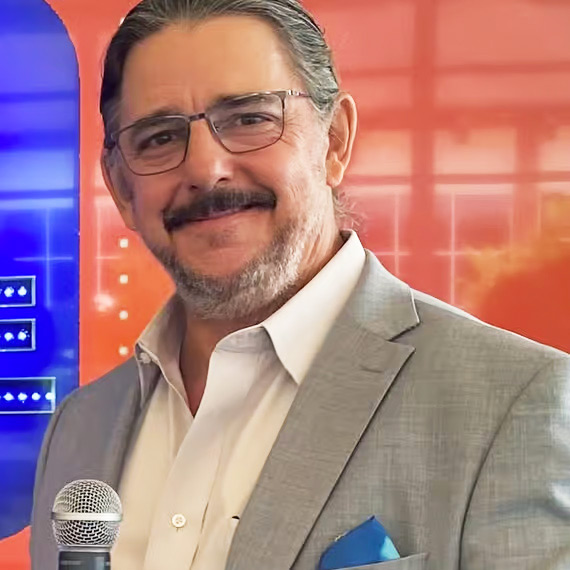
The well dressed Matt Delawder of SWD and threaded golf ace Jake “Valdez” Davis of BTM Manufacturing discuss industry developments and the upcoming MWFA 80th anniversary extravaganza (12:01). Huyett CEO Tim O’Keeffe joins news editor Mike McNulty on the Fastener News Report to analyze skyrocketing FDI numbers (59:41). Feature: Dealing with tariff rebate questions using AI with Nick Pericle of Tenexity (1:45:12). On the Fastener Training Minute, Carmen Vertullo discusses fastener straightness (1:36:01). Plus: How to find “invisible money” on the warehouse floor (48:48), and what happened to Claude on tax day? Brian and Eric order Mac Minis and more Vegemite. Run time: 02:21:37
Episode 226 at a Glance
- The episode’s feature is Nick Pericle of Tenexity on answering the tariff rebate question with AI: it is inherently an analytics problem, and most distribution organizations have under-invested in both their data platform and the analytics staff to act on it.
- His first step is not a data cleanup — catalog the inputs first (what was paid out, the actual invoices, the transactions, the record of how cost changes entered the system), then build a tariff refund rebate modeler.
- The seasonally adjusted Fastener Distributor Index for March 2026 reached 59.7, up from 52.7 in February — the strongest reading in nearly five years.
- The forward-looking indicator also jumped, to 58.7 from 52.2 the prior month.
- 86% of survey respondents reported year-over-year pricing higher, and the commentary put the tariff-driven increase at 10% to 15%.
- The guest commentary put the chance of tariff rebates being paid at 70%, and expected them to flow to all importers rather than a subset.
- Midwest Fastener Association’s 80th anniversary week runs from a bed build hosted at SWD through a Navy Pier show, with over 600 people expected aboard the Spirit of Chicago.
- Marco Rodriguez explained how a foreign trade zone can cap the annual merchandise processing fee and keep duty payments off the books until product ships to a domestic customer.
- Carmen Vertullo covered fastener straightness from ASME B18.2.1 paragraph 2.6, including why a conforming long bolt can still arrive visibly bent.
- Run time: 02:21:37
Inside Episode 226
Tax Day framing, a Fastener Distributor Index that jumped to its strongest reading in nearly five years, and a working method for answering tariff rebate questions with AI tools.
Episode 226 of Fully Threaded Radio was recorded on April 15 and published the day after what Eric Dudas calls “confiscation or Tax Day.” The tax-day setting is not just a joke in the cold open: it runs through an episode that keeps returning to what importers actually owe, what they might get back, and who is going to do the arithmetic.
The Midwest Fastener Association’s 80th anniversary opens the show, with Matt Delawder of SWD and Jake Davis of BTM Manufacturing laying out a week that runs from a Sleep in Heavenly Peace bed build through a golf outing, a ship on Lake Michigan, and a one-day show at Navy Pier. On the Fastener News Report, Mike McNulty walks through a Fastener Distributor Index that reached 59.7 for March 2026, and the guest commentary argues much of that strength is inflation rather than real growth.
The feature is a practical conversation with Nick Pericle of Tenexity about handling tariff rebate analysis with AI: catalog your inputs before any data cleanup, build the model, and expect to graduate out of a spreadsheet. Carmen Vertullo devotes the Fastener Training Minute to fastener straightness, and Marco Rodriguez makes the case that a foreign trade zone can free up cash already sitting on the warehouse floor.
What You’ll Learn
- A rising index is not automatically growth: the Fastener News Report commentary separated growth in units from growth in dollars, and argued that sales not exceeding 10% to 15% are inflation.
- Data work should start from a business question. Nick Pericle recommended cataloging the actual inputs — invoices paid, transactions, records of cost changes passed from suppliers to customers — before any data cleanup exercise.
- Entry-level AI subscriptions run $20 to $30 a month, scaling toward $100 and eventually $200 per person on an analytics team — set against $5,000 to $10,000 for another analyst.
- A foreign trade zone is available to mid-market importers, not just the largest companies: the alternative site framework lets an existing inland warehouse qualify within a grantee’s regional service area.
- Straightness has to be specified if it matters. The standard allows camber per inch of length, so a long bolt can meet the standard and still not enter its hole without persuasion.
- The ISM PMI inched up to 52.7 from 52.4 in February, a third consecutive month above 50.
Featured Voices
Hosts: Eric Dudas, Brian Musker
- Mike McNulty: Presents the Fastener News Report and walks through the monthly index results.
- Jake Davis: Of BTM Manufacturing; golf chair for the anniversary week and a driver of the bed build.
- Matt Delawder — SWD: Of SWD; details the Midwest Fastener Association’s 80th anniversary schedule.
- Nick Pericle — Tenexity: Of Tenexity; walks through applying AI tools to tariff rebate analysis.
- Carmen Vertullo: Delivers the Fastener Training Minute on fastener straightness.
- Marco Rodriguez — Cresa: Of Cresa; presents the Industrial Real Estate Update on foreign trade zones.
- Bob Baer
- Francesca
- GH3
- Ian Heller
- Joe Greenslade
- Ken LeVay
- Preston Boyd
- Salim Brahimi
- Tim O’Keeffe
- Tony
Also Heard
- Andrew Kalnow
- Brian Mace
- Carrie Fletcher
- Celie Wyatt
- Chad Avise
- Erica Landgraf
- Jennifer Baker Reed
- Laura
- Lynn Dempsey
- Maria Garcia
- Pam Lane
- Ryan Bonner
- Stanley W. Anderson
- Victoria Jimenez
Explore Episode 226
Timestamped guide to the episode. Times link to the transcript below.
- 00:00 — Cold open: show-ID line plus three teaser clips
- 02:05 — Opening segment: Eric Dudas and Brian Musker
- 12:01 — Segment: MWFA 80th anniversary / FSTNR Week with Matt Delawder (SWD) and Jake Davis (BTM Manufacturing)
- 48:49 — Cresa Industrial Real Estate Update
- 53:16 — Host news block: Jake ‘Ace’ Davis hole-in-one at the Southwestern Fastener Association tournament; Link Magazine Spring 2026 (S.W. Andersen centenary); Fastener Fair USA education schedule; Talking with One Voice podcast
- 59:49 — Fastener News Report — Mike McNulty of Fastener Technology International, sponsored by Volt Industrial Plastics
- 59:49 — FNR open: McNulty sets up the FDI results with Tim O’Keeffe and previews the top story and newsmaker headlines
- 01:02:24 — Fastener Distributor Index — March 2026 results discussed with Tim O’Keeffe, Chief Executive Officer at Huyett
- 01:28:28 — FNR top story and newsmaker headlines: Edson Manufacturing expansion; corporate and personnel news; Women in the Fastener Industry and IFI awards; FNR Back Page: spring fastener industry events
- 01:32:30 — FNR top story and newsmaker headlines: Edson Manufacturing expansion; corporate and personnel news; Women in the Fastener Industry and IFI awards; FNR Back Page: spring fastener industry events
- 01:36:07 — Fastener Training Minute
- 01:45:10 — Feature: Nick Pericle of Tenexity
- 02:14:07 — Closing segment: Brian and Eric
Segment
Midwest Fastener Association at 80: a week built around Chicago
Matt Delawder of SWD and Jake Davis of BTM Manufacturing join the hosts to lay out the Midwest Fastener Association’s 80th anniversary week, held in Chicago at Navy Pier. Delawder describes an association that was formerly the Chicago Nut and Bolt Association deliberately bringing the event back into the city rather than the suburbs.
The schedule starts with a Sleep in Heavenly Peace bed build hosted at SWD, moves to a golf outing at Cog Hill, takes over the Spirit of Chicago for an evening that will host over 600 people, and finishes with a one-day show in the Navy Pier grand ballroom followed by a Hall of Fame dinner. Davis, the golf chair, notes the previous 144-golfer ceiling filled quickly and left people on a wait list.
Both guests spend time on the bed build itself, which aims to raise $25,000 to build 100 beds. Davis floats a brisket smoking contest alongside it, and credits the association’s executive director Francesca and the board for the groundwork.
Now, I will say, Eric, Preston is doing his job because we have talked probably a couple times every year for the past three or four years about becoming a member of IFI, and there's always been mutual interest from both of us, and it's just the timing thing.
By the Numbers
- 600 people — expected aboard the Spirit of Chicago (00:31:07)
- 50 people — participants in last year’s mud race (00:27:03)
Recurring segment
Fastener News Report: the index jumps, and the commentary pushes back
Mike McNulty of Fastener Technology International presents the Fastener News Report, sponsored by Volt Industrial Plastics. The centerpiece is the March 2026 Fastener Distributor Index, collected and analyzed by the FCH Sourcing Network and Baird.
The index reached 59.7 after 52.7 in February, the strongest in nearly five years, with the forward-looking indicator at 58.7 against 52.2. The guest commentary immediately framed the numbers as inflated, citing that 86% of respondents reported higher year-over-year pricing and that anyone not buying exclusively domestic product is likely seeing 10% to 15% more than a year ago.
On demand by sector, the commentary described infrastructure, data centers, the power grid, bridges and stadiums as strong, with agriculture weak, autos down, and signals that Houston residential housing is softening. On rebates, the assessment was a 70% chance they are paid and that they would reach all importers, with the practical difficulty being the size of the calculations.
The segment closes with a top story on Edson Manufacturing’s expansion, newsmaker and personnel headlines, and a Back Page on spring events that runs from Wire 2026 in Dusseldorf and Fastener Taiwan to Fastener Fair USA in Charlotte.
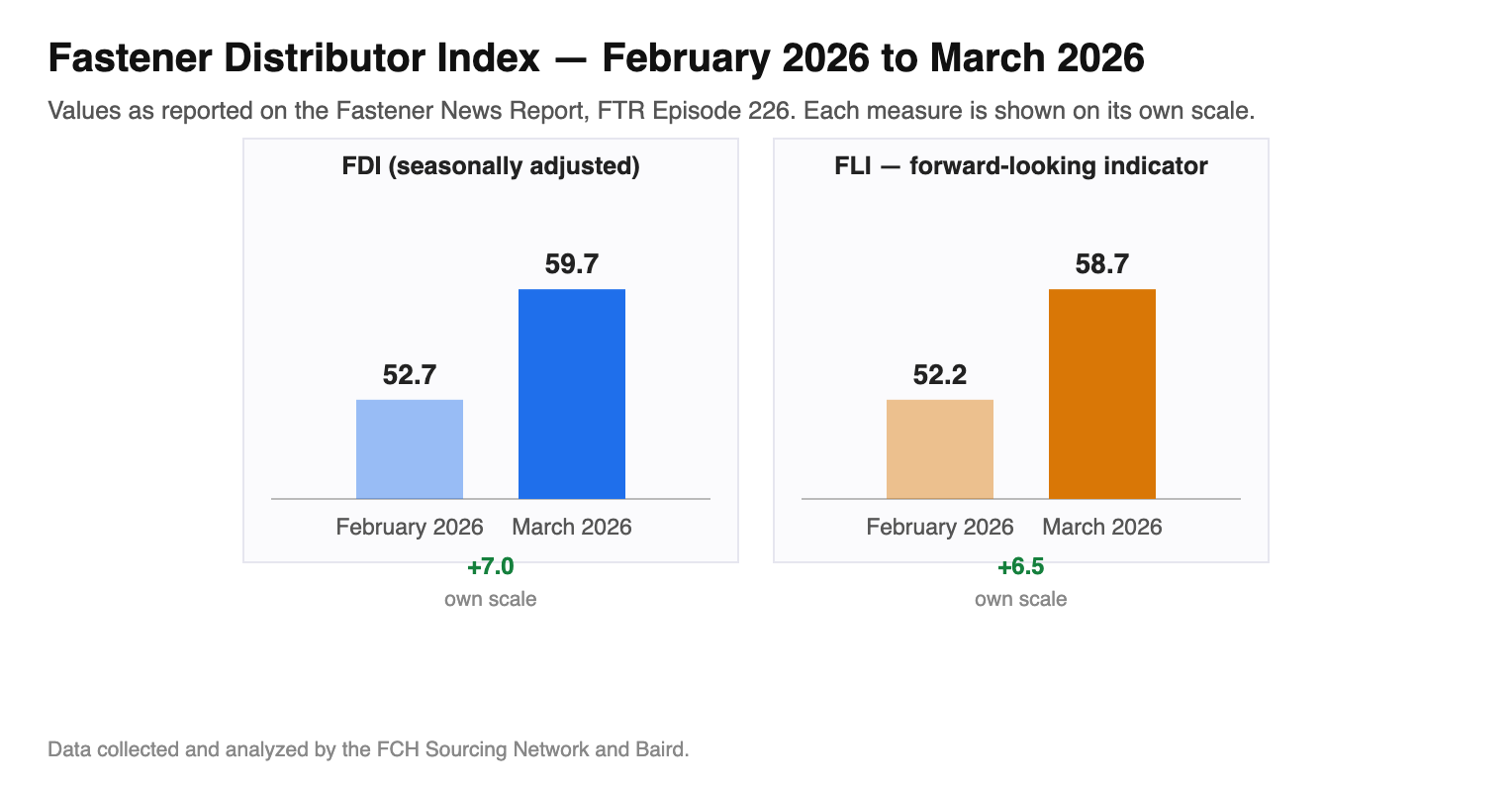
- FDI (seasonally adjusted): 52.7 → 59.7
- FLI — forward-looking indicator: 52.2 → 58.7
- 59:49 — McNulty opens by previewing the index results and the newsmaker headlines to come.
- 01:02:24 — The Fastener Distributor Index discussion: March 2026 at 59.7 against 52.7, with commentary from the Chief Executive Officer of Huyett on whether the gain is real growth or inflation.
- 01:28:28 — Top story and headlines: Edson Manufacturing’s expansion into a larger Wolcott, Connecticut facility, plus corporate and personnel news.
- 01:32:30 — Back Page: the loaded spring trade-event schedule, international through regional.
By the Numbers
- 59.7 — Fastener Distributor Index, March 2026 (seasonally adjusted) (01:02:24)
- 52.7 — February reading (01:02:24)
- 58.7 — forward-looking indicator (01:02:24)
- 86% — respondents reporting higher year-over-year pricing (01:04:30)
- 70% — assessed chance that rebates are paid (01:16:46)
- 52.7 — ISM PMI (01:12:32)
Feature
Nick Pericle on answering the tariff rebate question with AI
Nick Pericle of Tenexity joins Eric Dudas for the episode’s feature. Asked how the industry should handle tariff refunds if a mandate arrives, his answer is that it is inherently an analytics problem, and that most distribution organizations have under-invested in both their data platform and the staff capacity to act on it.
His recommended first step is not a data cleanup. It is to catalog the inputs: what was paid out, the actual invoices, the transactions, the record of how cost changes entered the system, and the records of costs passed from suppliers through to customers. He suggests using an AI tool as a thinking partner to enumerate those inputs, then building a rebate modeler, and expects most companies to outgrow a spreadsheet for the work.
On cost, he put entry-level tools at $20 to $30 a month, expanding to $100 and eventually $200 per person for an analytics team, and framed that against $5,000 to $10,000 for another analyst. The conversation then turns to the agentic era: an AI given access to email, calendar, call recordings and internal systems that figures out how to keep a CRM updated, and that wakes on a schedule to look for work.
Pericle also discusses open-source models now runnable on local hardware and what that means for privacy-minded buyers, and the Distribution at the Crossroads podcast he has launched with the National Association of Wholesalers, which had four episodes out at recording time on a one-to-two-a-month cadence over twelve months.
I think just in that really short assessment of what should be the first steps, you've opened a lot of people's eyes. You know? And I was really excited to have this conversation for just that reason, because it sounds very reasonable what you're saying. It's not simple, but it's not difficult at the same time.
By the Numbers
- $20 — entry-level monthly AI subscription (01:53:16)
- $200 — eventual monthly spend per analytics seat (01:53:46)
- $5,000 — cost of hiring another analyst instead (01:53:46)
Recurring segment
Fastener Training Minute: how straight does a bolt have to be?
Carmen Vertullo devotes the Fastener Training Minute to fastener straightness, prompted by a client part that a customer’s inspection method disputed. The governing standard is ASME B18.2.1, and straightness comes from paragraph 2.6, which applies identically to bolts and screws even though their other dimensional features differ considerably.
The allowance is stated as camber per inch of shank length under maximum material condition, which is why length matters so much: apply it to a twelve-inch bolt and the permitted deviation becomes large enough to see. Vertullo’s point is practical — a bolt can be fully conforming and still refuse to pass through a long hole, so straightness has to be specified to the manufacturer when it matters.
He closes by describing the check fixture from the companion standard — a plate, a fixed and a sliding angle iron, and an indicating gauge — and the simpler alternatives of a granite surface plate or rolling the bolt and sliding a feeler gauge under it.
By the Numbers
- 2.6 — paragraph of ASME B18.2.1 covering straightness (01:37:44)
Recurring segment
Industrial Real Estate Update: the invisible cash on your warehouse floor
Marco Rodriguez of Cresa argues that most medium-sized fastener importers are effectively acting as a collection agency for the government, with tariff rates on certain C-class components running high enough to drain liquidity. His remedy is the foreign trade zone, which he describes as historically treated as a luxury for the largest companies and underused by mid-market firms.
The shift he credits is the alternative site framework, which removed the need to sit on the docks: a warehouse inside a grantee’s regional service area can be designated as a remote usage-driven site. Inside the zone the building counts as outside United States customs territory, so duties are not paid until fasteners leave for a domestic customer, and re-exports to Mexico or Canada avoid the duty entirely.
He then walks the four building modifications an activation requires — a partitioned zone perimeter, surveillance with retention for audits, logged access control, and a digital twin in the warehouse or enterprise system that separates foreign from domestic status goods in real time.
Terms and Technical Notes
- ASF (alternative site framework) — The alternative site framework is what lets an existing inland warehouse qualify for zone treatment instead of requiring a facility at the port. (00:49:22)
- MPF (merchandise processing fee) — The merchandise processing fee is charged per entry; consolidating into one weekly entry under a zone is what caps the annual total. (00:50:11)
Complete Transcript — Episode 226
Verbatim Descript transcript. Headings mark approved segment boundaries; speaker names appear only where evidence resolves them.
00:00 — Cold open: show-ID line plus three teaser clips
[00:00:00] Speaker: It’s Fully Threaded Radio episode two hundred twenty-six
[00:00:04] Speaker 2: If there are rebates paid, I can’t really imagine a scenario where rebates would be paid to certain entities and not to everybody. And so my sense is if there are rebates, I think they’ll flow to everyone, to all importers. And right now, my sense is I put it at, I’m going to say there’s a 70% chance that there’s going to be rebates.
[00:00:27] Speaker 2: Then the question is
[00:00:29] Speaker 3: I break it down like this, Eric. AI is a huge catch-all term for a lot of types of technology. People know the term gen AI or generative AI, and now we’re talking about agentic AI. I simplify it down to this. AI can always analyze data and it’s pretty good at predicting things.
[00:00:44] Speaker 3: Generative AI creates things. Agentic AI does things.
[00:00:50] Speaker 4: The goal remains the same. You know, we’re trying to get $25,000 raised so we can build 100 beds. It’s going to look pretty similar. We’re trying to possibly tweak some of the, I’ll say the lunch options. But well, I don’t want to step on toes because Brighton has been so generous with the food truck.
[00:01:13] Speaker 4: But we had, we were, I just kind of, we were kind of talking about maybe having a little bit of a, I’ll just throw out there an idea of a brisket smoking contest, you know, just to where people might be able to do, start that early AM Sunday. And then we could reap the rewards come Sunday when all the beds are done.
01:41 — Produced show intro: ‘It’s time for Fully Threaded Radio’
[00:01:41] Speaker 6: It’s time for Fully Threaded Radio
02:05 — Opening segment: Eric Dudas and Brian Musker
[00:02:05] Eric Dudas: It is Fully Threaded Radio, voice of the FCH Sourcing Network. If you buy, sell, manufacture, import industrial threaded fasteners, this is the podcast for you. So glad you clicked in. Hey, everybody, Eric Dudas with you, and the co-host of Fully Threaded is with us as well. If I can break him away momentarily from talking to Claude all day, it’s Brian Musker.
[00:02:27] Eric Dudas: Hey, Brian, you out there?
[00:02:29] Brian Musker: Yeah, I’m actually not talking to him at the moment. We’ve had a little bit of a breakup, and otherwise everything’s good.
[00:02:34] Eric Dudas: Yeah, I heard that. The whole internet is actually trying to talk to him today, isn’t it? We’ll get to that, we’ll get to that when we close out the episode today, but a little bit of a snafu in the AI world today, wasn’t there?
[00:02:46] Brian Musker: Yeah.
[00:02:48] Eric Dudas: That could be because we’re publishing this episode, 226, of Fully Threaded Radio the day after, at least in the United States, it’s confiscation or Tax Day.
[00:02:59] Brian Musker: Yeah, right.
[00:03:00] Eric Dudas: So we’re recording this on the big day, and, uh, yeah, it’s causing all kinds of situations So glad you clicked in though. We’re gonna stick mostly to fasteners, but of course, AI will be another sub-theme because let’s face it, there’s a wave happening as we speak.
[00:03:17] Eric Dudas: Fully Threaded is here covering it as we work with the fastener industry. But to kick things off, we’re gonna talk with Jake Valdez Davis and Matt DeLauter, he with SWD, and we’re gonna look at the upcoming MWFA 80th Anniversary Bash that’s happening later this summer. It’s gonna be a biggie. We actually envisioned this segment to be just focused on that, but we really covered the watershed, so we decided we’d throw it at the top of the episode today, and it’s kind of fun.
[00:03:46] Eric Dudas: Minimal AI on that one, Bry.
[00:03:48] Brian Musker: Right. Yeah, no, thank God- … I’ve actually…
[00:03:52] Eric Dudas: But our feature today is a conversation with Nick Pericle of 10xity.ai. He drops some AI red meat on us as we look at how the fastener industry might address the issue of handling tariff rebates using AI. And from everything that I hear as I talk with people, this might be the perfect application.
[00:04:13] Eric Dudas: Very confusing subject. Maybe AI will be able to sort it out for people.
[00:04:17] Brian Musker: Because we don’t believe the government can.
[00:04:20] Eric Dudas: Well, from what we read, they’re using tons of AIs. Maybe our AIs can figure out what their AIs are doing.
[00:04:26] Brian Musker: Yeah, maybe.
[00:04:28] Eric Dudas: Nick also enlightens us on what sounds like a very new development in AI tech, is it sounds like we’re coming into the local agentic era, and you’ll find out what that means during the segment.
[00:04:41] Eric Dudas: Very, very interesting stuff. On the Fastener News Report, Mike McNulty of Fastener Technology International welcomes Hewit CEO, Tim O’Keefe. They pore over the new FDI numbers, and I tell you, Mr. O’Keefe had the luck of the Irish on this one, Bry, because the numbers spiked way up this time. You’ll hear all about that.
[00:05:03] Brian Musker: Good.
[00:05:04] Eric Dudas: Yeah, he’s got a knack for that. On the Fastener Training Minute, Carmen Virtulo talks all about fastener straightness.
[00:05:11] Brian Musker: Wow, the straight and narrow. Interesting.
[00:05:14] Eric Dudas: And he means it quite literally, certainly not in any kind of a figurative sense, I assure you.
[00:05:19] Brian Musker: Yeah. Okay. I was, I was trying.
[00:05:24] Eric Dudas: Marco Rodriguez with Cresa’s got our Industrial Real Estate Update.
[00:05:28] Eric Dudas: This time he looks at the foreign trade zones and how understanding that could lead to invisible cash on your warehouse floor. And let’s face it, Bry, it’d be nice to find a little invisible cash laying around.
[00:05:40] Brian Musker: Yeah, I’d love to find some. That’d be nice.
[00:05:42] Eric Dudas: Well, Marco’s got some ideas on that for us.
[00:05:45] Brian Musker: Cool.
[00:05:46] Eric Dudas: All of it coming your way, all made possible by our partners
[00:05:50] Brian Musker: And great friends.
[00:05:52] Eric Dudas: And we’re speaking of none other than, to start, are the title sponsors of Fully Threaded, Brighten Best International. Tested, tried, true, Brighten Best, and Star Stainless Screw. Right off the shelf, it’s Star. Fully Threaded Radio is also sponsored by Buckeye Fasteners and the Ohio Nut and Bolt Company, BTM Manufacturing, EuroLink Fastener Supply Service, Fastener Technology International, Global Fasteners, InSQL Software, Cressa, Jlan Franco, MW Components, Solution Industries, 3Q Inc.,
[00:06:26] Eric Dudas: Fastener Fair USA, Volt Industrial Plastics, and Worth Industry USA Bry Wirth is not just a great friend of the podcast, they’re also a great friend of the Fastener Training Institute
[00:06:40] Brian Musker: Yes, they are, and they’ve been supporting it for many years.
[00:06:43] Eric Dudas: They have indeed. They are sustaining partners of the Training Institute.
[00:06:47] Eric Dudas: We always like to remind everybody about that. So I don’t know how long this one’s gonna go. I kinda lost track of it. It’s been a blur since the last episode- … to tell you the truth. And I saw, Bry, that you and the lovely and talented Lynn Dempsey made it out to a Naperville Fastener Association meeting in the interim.
[00:07:05] Brian Musker: Yes, we did, largely organized by The Traveling Salesman, um, which is quite often the reason we have these meetings, is he just comes into town.
[00:07:13] Eric Dudas: Yeah, he’s the instigator many times.
[00:07:15] Brian Musker: Yeah. But it was, um, it was actually a fun meeting, and we had two people, um, from Aztech Locknut company turned up, um, none of whom we’ve seen for a long time, and they just happened to find the notification about the meeting on LinkedIn and turned up.
[00:07:30] Brian Musker: It was really good. We, we had a good time actually.
[00:07:33] Eric Dudas: Cool, cool. I wasn’t able to make it, but I did get consulted by the Form and Function Award Committee, and I think we got a pretty good winner for this year’s honor. I don’t know, did you get in on that conversation at all?
[00:07:46] Brian Musker: No, I didn’t. I know it was sort of going on, but it was a little bit out of my hearing.
[00:07:51] Eric Dudas: Yeah, it can be a little hush-hush, but you’ll fi- you’ll find out in August, Bry, don’t worry.
[00:07:55] Brian Musker: Okay.
[00:07:56] Eric Dudas: It’s gonna be a good one.
[00:07:57] Brian Musker: That’s cool. Conversation was really also around all the exciting things that the Midwest Fastener Associations got organized for the, the big anniversary at, at, uh, downtown Chicago.
[00:08:09] Eric Dudas: Well, we’re gonna be talking about that during the next segment. What else? Yeah. Give me some dirt here. Give me something juicy. There’s no…
[00:08:15] Brian Musker: No, there’s no dirt. There’s no dirt.
[00:08:18] Eric Dudas: Well, I scan the Naperville headlines from time to time. You know, it being my old stomping grounds, I didn’t see any, any of your names appear in the police blotter, so I guess it was a relatively mild meeting this time.
[00:08:30] Brian Musker: It was. Yes.
[00:08:31] Eric Dudas: Always good to hang out with fastener friends in Naperville.
[00:08:35] Brian Musker: Cameron was there, and The Traveling Salesman had a guy from MW Industries there, and Matt DeLorda was there.
[00:08:40] Eric Dudas: Good to have friends across the industry, one of them being Solution Woman. I’ll drop right here at the top that I received a brand-new Solution Industries hoodie Thank you, Solution Woman.
[00:08:54] Eric Dudas: Came in the mail the other day. I was quite surprised. It’s looking very sharp. You know, Solution Industries used to be famous for all their swag.
[00:09:02] Brian Musker: Yeah.
[00:09:02] Eric Dudas: And I got a lot of it. Well, now I got a new hoodie to add to the collection, so very much appreciated.
[00:09:09] Brian Musker: Solution Woman.
[00:09:10] Eric Dudas: Yes, otherwise known as Laura.
[00:09:13] Brian Musker: Yeah.
[00:09:13] Brian Musker: Right.
[00:09:14] Eric Dudas: Very, very cool. And this is gonna be a very cool episode of Fully Threaded Radio. We’re so glad you clicked in. We appreciate it a lot, and we hope that you will subscribe and maybe even leave a review if you’re listening to the podcast on Spotify or Apple or one of the other platforms where that sort of thing happens.
[00:09:33] Eric Dudas: We’re supposed to be asking you to do that. Here we are doing it, and I know lots of times people just share the podcast by word of mouth. That’s really helpful for us, too. Thanks so much for doing that. We’re gonna jump right into this segment with Valdez and Matt DeLaughter when we return.
[00:09:50] Brian Musker: Right.
[00:09:52] Eric Dudas: Just can’t get away from those NFA members, can you, Bry?
[00:09:54] Brian Musker: No, I can’t. It’s
09:57 — Produced transition: ‘Fully Threaded Radio, talk radio for the fastener industry’
[00:09:57] Eric Dudas: Fully Threaded Radio Talk radio for the fastener industry. It’s not really all that bad for the most part. Brian and Eric, Fully Threaded Radio
10:13 — Commercial break 1
[00:10:13] Speaker 8: Stainless Stan here from Star Stainless, proud to be part of the Linfast Solutions Group family. If you’re going to Fastener Fair USA, come see us at Booth 103 and meet the LSG family.
[00:10:23] Speaker 8: From Star Stainless and Solution Industries to Stelfast, Lindstrom Fasteners, and beyond, you’ll see how our brands come together as one solutions group, delivering smart inventory management, dependable fasteners, and solutions that move your business forward. Linfast Solutions Group, one family, endless solutions.
[00:10:42] Speaker 9: Are you tired of empty promises from software vendors? Are you paying for support that you’re not receiving? Is it time for another paid upgrade? There is a solution. InxSQL delivers quality software designed for the fastener industry at an affordable price with industry-leading support. I-N-X-S-Q-L.com. Need
[00:11:03] Speaker 10: weld fasteners?
[00:11:04] Speaker 10: Look no further than Brighton Best for a full lineup of weld fasteners. Stocked across our regional warehouses and ready to ship today. What’s available? Headed weld studs from three-eighths up to seven-eighths, CD studs in mild steel, stainless steel, and aluminum, both made in the USA. Weld nuts in multiple styles, including hex and spot weld, both domestic and import available from stock.
[00:11:25] Speaker 10: Looking for something we don’t stock? Our mill sourcing team has you covered, including parts made to print. Your account manager is ready to help, or visit us at brightonbest.com and get what you need
11:40 — YLT: Deb of 3Q, Inc., Inc..
[00:11:40] Speaker: Hi, this is Deb with 3Q Inc. Your source for a wide variety of US-made parts from the heart of the fastener industry. You’re listening to Brian and Eric on Fully Threaded Radio
12:01 — Segment: MWFA 80th anniversary / FSTNR Week with Matt Delawder (SWD) and Jake Davis (BTM Manufacturing)
[00:12:01] Eric Dudas: Brian and Eric, back with you talking about all things fastener related, not including AI, right Bri?
[00:12:06] Brian Musker: Okay, yeah, we w- God forbid don’t mention the-
[00:12:10] Eric Dudas: Been getting a little bit of flack on the amount of AI on the podcast lately, but, hey- … it’s here to stay is what I’m thinking, you know.
[00:12:18] Brian Musker: I talk to Claude every day or so.
[00:12:20] Eric Dudas: Everybody knows that, Bri. All right. Yeah, sorry. Well, in the interest of, uh, moving in that direction, we decided to have a little fun. And two guys who personify fun, especially here in the Midwest, I’m speaking of none other than from SWD, home of the Black Axe, Matt Delauter. Hey, Matt.
[00:12:37] Matt Delawder: How you doing? Great to be here.
[00:12:39] Eric Dudas: Glad to have you. And also from BTM Manufacturing, Jake Valdez-Davis.
[00:12:45] Jake Davis: What is up, my brother, uh, Brian? Yeah. Matt, it’s a pleasure to join you guys, and, uh, I’m, I’m pretty good at lightening things up, so,
[00:12:53] Brian Musker: you know. Really good. And making coffee. I
[00:12:56] Jake Davis: do my best.
[00:12:57] Brian Musker: Yeah. BTM and coffee. Okay? BTM Manufacturing.
[00:13:01] Jake Davis: Yeah. Just think of, of BTM first and then coffee second-
[00:13:05] Jake Davis: is all I ask. Right.
[00:13:06] Brian Musker: I always do, yeah. Thank
[00:13:07] Jake Davis: you.
[00:13:07] Matt Delawder: Well, the coffee’s okay, but that coffee rub is phenomenal, I tell you. You, uh, Eric, you need to put that on a brisket.
[00:13:12] Eric Dudas: Ooh, yes. Matt, thank you. Now you’re turning the conversation to something that I think a lot of people can get into. We’re- We’ve got the NFBBQA news coming up later in the podcast, but thank you for that.
[00:13:25] Eric Dudas: And I do like that rub. Jake, you set me up with some, geez, what was it? A couple seasons ago. I love it.
[00:13:31] Jake Davis: Absolutely. Yeah, more will be on the way. Nice. Um, more will be on the way for BrisketFest, so stay tuned.
[00:13:37] Brian Musker: Okay, yeah, we, we used it too. It’s good.
[00:13:39] Jake Davis: It’s by far the, uh, most used steak rub in the industry in my opinion.
[00:13:45] Brian Musker: Okay. Not that you’re blowing your own trumpet here. Okay.
[00:13:49] Jake Davis: No, and I have no data to back that up, Brian. So it’s just…
[00:13:53] Brian Musker: Hey, I’m dealing with someone who deals with data all day long, okay?
[00:13:56] Jake Davis: I actually just asked, uh, ChatGPT what was the number one steak rub in the bolt and nut industry, and it said U-Bolt Blend, so there you go.
[00:14:05] Brian Musker: Oh, really? Geez.
[00:14:08] Jake Davis: And if you believe that
[00:14:10] Brian Musker: Yeah, I question Matt would
[00:14:14] Jake Davis: That’s it. No more, no more AI, I promise.
[00:14:16] Eric Dudas: Yeah, I was just gonna say, Bry is feeling pretty good right now. He thought he would be the only one who kept stumbling into it. Is AI taking over the heat treating industry like it is everything else, Matt?
[00:14:27] Matt Delawder: Um, yeah, well, actually, the good heat treaters and metal finishers have been using AI, but for production schedules maybe to help them with, with, uh, tracking customers. But, um, the s- the, the equipment, uh, is still really not there. And I’m gonna tell you that majority of the heat treaters and the platers are not there.
[00:14:43] Matt Delawder: Um, it- you’re lucky with some of them that they’ve invested in the last 10 years in anything, so…
[00:14:48] Brian Musker: Yeah, I didn’t expect to get an answer other than that. Okay.
[00:14:52] Matt Delawder: Yeah, that might have been a little mean of me, so
[00:14:54] Brian Musker: No. No, no. No, the honest is fine.
[00:14:58] Matt Delawder: But, uh, no, um, a lot of companies are looking at, at what you can do with, uh, AI, although we’re not, not anybody on this podcast because that’s not the direction we wanna go.
[00:15:06] Matt Delawder: No,
[00:15:06] Brian Musker: no. Do not mention AI, okay?
[00:15:11] Matt Delawder: I know nothing about
[00:15:12] Jake Davis: Claude.
[00:15:13] Brian Musker: Yeah, right. Sorry, I won’t.
[00:15:15] Jake Davis: Just stick to tariffs and brisket and, uh, we’ll be good.
[00:15:18] Eric Dudas: We’ve got some tariff rebate news. The problem is we just don’t know anything about it, so we really don’t have anything interesting to say. Anybody got any tariff rebate intel that they can dump?
[00:15:29] Jake Davis: Um, I, I got a, a bit. I was, uh, in San Antonio a couple weeks ago for a Farm Equipment Manufacturers Association, uh, show conference and, uh, I went to the tariff update and, um, sold, uh, standing room only, just completely packed to the gills. And it’s certainly is a smaller association. Uh, however, uh, like I said, standing room only, um, and they had another, uh, speaker at, at the same time, 1:45, that was on property and casualty insurance, and I just felt…
[00:15:59] Jake Davis: I sat there the whole time listening, thinking, just feeling so bad, uh, for tho- those two guys because I didn’t feel like out of the size of the association, 90% were probably in this, in this tariff room trying to get this update in, you know, a matter of, of, uh, 45 minutes to an hour. And, uh, you know, jotted some things down, but it really, for looking at it from a, from a BTM side and a distribution side with ISCO, it, it was, uh, came down to f- to supplier of record.
[00:16:30] Jake Davis: Um, you know, and, and the gentleman just kinda went through just what was had been decided from the courts and jotted some, some things down. I don’t- didn’t feel like I left, uh, any smarter, but that’s, uh, you know, I at least have some notes on, on paper that I can go back through as we kinda try and make a little bit more sense of it.
[00:16:51] Eric Dudas: Now what was the competing session you mentioned? That guy had, who had six people in the audience? What was the subject of that? Well,
[00:16:56] Jake Davis: I don’t know. I don’t wanna, I don’t wanna… It could’ve been much more than that. It could’ve been 12 or maybe even 24, but it was, uh, it was property and casualty insurance, manage your, manage your risk.
[00:17:07] Jake Davis: So yeah, some long-term supporters of, of FEMA, uh, with Century Insurance, but I just… Based on the, the volume of people that were crammed into this little, uh, this room, I felt, man, I just, I hope somebody went.
[00:17:22] Eric Dudas: Right. No, I get it. I get it. I mean, uh, it’s obvious where everybody’s attention is these days. From what I’ve heard, a lot of customers are expecting these rebates even though it’s not altogether clear on what that means for the suppliers, you know?
[00:17:35] Eric Dudas: So everybody’s jamming into those sessions. But I’m sure you guys have all noticed at our fastener shows, sometimes you get six people sitting in the audience during one of these breakouts, you’re doing pretty good
[00:17:49] Jake Davis: Yeah, no doubt.
[00:17:51] Eric Dudas: That’s the fastener industry. Was the hall carpeted?
[00:17:54] Jake Davis: It was. It was. Oh. Uh, much, again, much smaller, uh, much smaller, uh, association, and just a, certainly a niche part of it, and BTM’s been a long time member of it. So, you know, had a small little show for about three hours on Thursday, and you know, I would say maybe 40 to 50 tables.
[00:18:14] Jake Davis: But just an opportunity to, to see some customers and, you know, just like I said, it’s very similar to the fastener shows, just a smaller scale, but opportunity to, to say hi to some customers and, and meet some new
[00:18:27] Eric Dudas: How many associations are you in? So there’s the MWFA that I know of. There’s NFA, right?
[00:18:34] Eric Dudas: Naperville Fastener Association.
[00:18:35] Jake Davis: Yeah, Naperville. Uh, still waiting on being able to, uh, man, GQ, uh, somehow just we can’t line up, uh, schedules. Every time I suggest something, he seems to be in Taiwan or on a ski slope or something. Yeah. But, um, you know, uh, yeah, MWA, uh, Naperville, uh, Pack West, NFDA, uh, Southwest.
[00:19:00] Jake Davis: I’m actually headed there in a few days for their conference, uh, back to San Antonio for a couple days, and, um, yeah.
[00:19:07] Matt Delawder: No North Coast there, Jake?
[00:19:09] Jake Davis: I don’t think I’m a North Coast. I need to, I need to get a, get in touch with them and see. I, I, I have in the past, and, uh, I, I probably need to talk to, uh, talk to the higher-ups and see if, if I knew of anybody that lived in that area.
[00:19:23] Jake Davis: Wait a second.
[00:19:24] Brian Musker: Right. Na- the Naperville Fastener Association’s having a meeting in some Empire Bar tonight, yeah.
[00:19:30] Jake Davis: Yeah, I did see that, and again, I can’t make it, so that goes hand in hand with their scheduling.
[00:19:36] Brian Musker: Okay.
[00:19:37] Jake Davis: But, uh, you know, I do love all of them, and I, I wish them the best, and I hope, uh, I hope that, uh, they vote on some very important stuff tonight.
[00:19:46] Eric Dudas: Yes, clearly you have not made it to an NFA meeting, Jake. Not IFI, though. Matt, you’re an IFI guy.
[00:19:54] Matt Delawder: I am. Yeah, no, I was just actually at the IFI conference in Scottsdale at the beginning of March, and, uh, it was actually a great conference. One of– I, I, I hate to say it’s one of the best that I’ve seen, but it was a really nice conference.
[00:20:07] Matt Delawder: And, um, they actually had the Soaring Eagle Awards, which we got to see, uh, Ken LeVay from, uh, Mule Technology. He used to be at ITW Shakeproof, has over 26 US patents, many of them for different fastener, um, thread types and things like that. And then, um, the owner of National Machinery was also given a Soaring Eagle Award.
[00:20:29] Matt Delawder: So it was a wonderful event, really well attended. I think it was one of the best attended. I think they had over 150 attendees.
[00:20:36] Brian Musker: Wow, that’s pretty cool.
[00:20:37] Jake Davis: Now, I will say, Eric, Preston is doing his job because we have talked probably a couple times every year for the past three or four years about becoming a member of IFI, and there’s always been mutual interest from both of us, and it’s just the timing thing.
[00:20:55] Jake Davis: Um, almost every spring IFI conference runs in, has ran into a Pack West on their spring conference, or they overlap to where you might be gone the entire week. And, you know, Matt’s able to, Matt’s able to pull that off. He can miss, you know, a good seven to 10 days of work and that place keeps running, you know.
[00:21:16] Matt Delawder: I, I, I typically miss 10 days a week, yeah.
[00:21:23] Jake Davis: But I get a little bit uncomfortable if I’m going that long, so
[00:21:28] Matt Delawder: No, I’ll tell you, at the conference, we typically have Salim Brahimi, who many people know as really kind of taking the place of Joe Greenslade in the industry as far as being the guru of fasteners and definitely of hydrogen embrittlement.
[00:21:42] Matt Delawder: Always gives a great talk. Just there’s so much to hear and so much to see. As a matter of fact, IFI was a sponsor earlier this year. Eric, you and I saw each other for the first time this year, I think it was in February, at a Golf Zone event where IFI was helping to sponsor. They brought in a speaker from Marshall University to talk about apprenticeship programs for manufacturing as well as for distributors.
[00:22:06] Matt Delawder: And I think it was, again, really well attended. And the talk, I think people were amazed this was available to them with the grants and giving them the opportunity to have someone brought in and trained as an apprentice.
[00:22:19] Eric Dudas: Those people from Marshall are on fire for their mission. And they’re very well-funded from what we learned at that presentation at the MWFA that night.
[00:22:31] Eric Dudas: And I mean, they’re just handing it to manufacturers on a silver platter, literally. They’ve got the whole framework for this program. It’s all very customizable to your exact operation. And it’s really all paid for. I mean, why people would not do this is beyond me. I think they’re presenting it out there.
[00:22:49] Eric Dudas: I think they’re going to be wildly successful with it.
[00:22:51] Matt Delawder: Yeah, and we have to thank Preston Boyd for, again, Jake’s absolutely right. Preston is killing it out there. Oh, he’s
[00:22:57] Eric Dudas: a machine.
[00:22:58] Matt Delawder: He brought this to our attention and wanted to do a joint meeting with us and got us the speaker. So it was an amazing event.
[00:23:06] Matt Delawder: It was great to see IFI working with a regional organization like MWFA, even though we’re called the Midwest Fastener Association, but we like to think of ourselves as the North American Chicago Fastener Association.
[00:23:21] Jake Davis: Do I see, do I sense a name change, Matt, in the works? Oh,
[00:23:23] Matt Delawder: no, no. No,
[00:23:26] Jake Davis: I’m gonna get
[00:23:26] Matt Delawder: myself in trouble for that too.
[00:23:27] Jake Davis: You are. Um, I do want, uh, Eric, um, just kind of circling back to, to Saleem. Um, your recent interview, uh, podcast, uh, FDR Unthreaded with him was just very, uh, personal and insightful, and I enjoyed it. Um, I think both you and I had him for, um, the week-long, you know, fastener, um, what’s the, what’s- Training week
[00:23:52] Jake Davis: training week, fastener training week. And he’s just such a soft-spoken, you know, when he’s not, when he’s not teaching, um, he’s just very soft-spoken and, and I just enjoyed, you know, that. It’s just, like I said, very, very insightful. I, I want to go skiing with him now. I’d like to go to, go to his place. Uh, I’m hoping for an invite, Saleem.
[00:24:12] Eric Dudas: Yeah, but not in Iran, hopefully.
[00:24:14] Jake Davis: No, no. But, uh, uh, uh, w- we can do Canada for sure. Um- Yeah … but I, I would just, you know, listeners, uh, to the Fully Threaded radio podcast, go, go listen to that. It’s, it’s a great hour of, of insight, uh, to, uh, uh, just as, you know, we all know what Joe Greenslade meant to our industry and, uh, you know, Saleem is, is, is right up, right up there with him.
[00:24:39] Jake Davis: And he’s just… I f- I found it fascinating. I appreciate you doing it.
[00:24:43] Eric Dudas: Well, appreciate you saying so. And we did get a lot of very positive feedback on that episode. It’s still hanging out there. It’s the one that we just dropped before this one that we’re producing right now. So appreciate that, Jake. You know, while I was talking with Saleem, uh, I had a, one of these brainwaves like I am known for, and, uh, it was why don’t we create a Joe Greenslade Award and the trophy would be a pair of really obnoxious, kinda like Elton Johnny glasses.
[00:25:13] Eric Dudas: What do you think?
[00:25:15] Matt Delawder: He did like to have nice funky glasses and a funky watch. I mean, you could probably pull that off.
[00:25:20] Eric Dudas: That was the thing about Joe Greenslade. You know- Yeah … he was this guy, he looked like he belonged at Mission Control in Houston, you know, like circa 1969. He was like one of those white short sleeve shirt, pocket protector kinda guys, but yet he had the most crazy glasses.
[00:25:35] Eric Dudas: It just always struck me as funny. I, um- I tried, uh, breaking his balls a little bit about that one time. It was really funny because he had no idea why I thought that was amusing. But, uh, that- … that, we never really got off to a very good foot. But, uh, anyway.
[00:25:50] Jake Davis: I could see him, uh, kinda looking at you like, “What are you talking about?”
[00:25:53] Jake Davis: Yeah,
[00:25:53] Eric Dudas: pretty much. You know? If he could only see me now. Sorry, Joe, no disrespect intended. I mean, you know, it was just kinda my way.
[00:26:03] Jake Davis: Oh, that’s awesome. That’s awesome.
[00:26:05] Eric Dudas: Or not, you know? Or not. Yeah.
[00:26:07] Jake Davis: I kinda, well, I c- I’d like that. Be creative in the, in the awards out there, have a little fun. Um, that’s pretty cool.
[00:26:13] Matt Delawder: So, you know, you know, Eric, I’m gonna get in trouble with, uh, the board of the MWFA if I don’t start talking a little bit about Fister Week. Um, you know, the one with no vowels.
[00:26:22] Eric Dudas: Yeah. Don’t tell me you’re, you’re adding vowels this year?
[00:26:26] Matt Delawder: No, no, no. N- no, no vowels. It’s Faster Week and it’s gonna be awesome.
[00:26:30] Matt Delawder: It’s coming up, uh, the very end of August and into September 2nd. But, uh, we’re actually hosting it in Chicago at Navy Pier this year. It’s, it’s gonna be like nothing the industry’s ever seen, and hopefully we’ll continue to be able to do it in years to come. But, uh, Jake’s actually our golf chair, and well, I guess it kicks off with, uh, an unsanctioned Tough Nutter event, um, on Saturday.
[00:26:54] Jake Davis: Yeah, each and every year we try and get it sanctioned, but it g- that gets vote, voted down just due to the, due to the, uh, Arctic enema. Um…
[00:27:03] Matt Delawder: But there were, there were I think over, uh, 50 people who participated in that event last year, again, doing this Tough Nutter, uh, mudder race, um, out in Rockford.
[00:27:12] Eric Dudas: Well, how many do we need before it qualifies to get sanctioned?
[00:27:15] Eric Dudas: I would think it’s the insurance- Just say they all … no, it’s
[00:27:15] Matt Delawder: the insurance company that, and the waivers that r- … that would be required I think is the
[00:27:21] Matt Delawder: bigger piece.
[00:27:22] Eric Dudas: It’s worse than the Straits of Hormuz. S- seriously, is that it? I, uh, you’re, uh, I just, I chalked it up just to miscellaneous acrimony on the board.
[00:27:32] Matt Delawder: It could be that I don’t like to run, but no.
[00:27:36] Brian Musker: I was, that’s the unspoken thing that we were just thinking, going through.
[00:27:40] Eric Dudas: What if we get sequin jerseys this year?
[00:27:44] Eric Dudas: Yes.
[00:27:44] Jake Davis: Yes, blazers, sequin blazers. Matt’s in.
[00:27:49] Matt Delawder: Yeah, that’s dirty gold. I would do that. Oh, sorry about that.
[00:27:54] Eric Dudas: All right, you were, you were very skillfully turning the conversation to promote Fastener Week- Yeah … and we just diverted you. So let’s get back with it because that w- that was the main reason that we dreamed up this segment to begin with, but it is a great week that’s coming up.
[00:28:07] Eric Dudas: So let’s set the table again here. First of all, what’s the date we’re talking about? Late August.
[00:28:12] Matt Delawder: Yes, it’s, um, it’s August 30th through August 2nd. Um, August 30th, we start with the Sleep in Heavenly Peace bed build, and actually this year it’s gonna be hosted at SWD, and, uh, then we go- Oh, right … right into the golf outing.
[00:28:25] Matt Delawder: And this year the golf outing on August 31st is at Cog Hill, uh, which is a premier course in Illinois. And actually I believe it got rated one of the top 10 public courses in the nation.
[00:28:37] Jake Davis: Yeah, we had a great, uh, we had an opportunity to get out, uh, really honestly kind of, if you remember Matt, it was pretty late fall, and we just had an absolutely beautiful day.
[00:28:47] Jake Davis: Um, got to go kind of just check, check everything out. Um, you know, with, golf has always been popular with fastener, you know, fastener association, uh, events and, uh, we’ve always enjoyed our time at, at Lincolnshire the past two and three years, but with it being our, our 80th year of the MWFA, we wanted to be able…
[00:29:10] Jake Davis: But we also ran into a problem where, uh, 144 golfers was our, our max, and we always got there very quickly, and then, you know, golfers and, and friends of the industry were put on a wait list and, and Cog Hill allows us to be able to honestly take over two courses, uh- Two
[00:29:29] Matt Delawder: of their four, so we could, we could grow this thing as big as we want.
[00:29:32] Matt Delawder: We could…
[00:29:32] Jake Davis: Yeah. Yeah. I c- I don’t wanna do the math to see what that, uh, what, how many golfers that would be, but, uh, uh, two 18, 18 hole courses at the same location there at Cog Hill. Uh, as Matt said, golf’s on Monday, uh, this year, so kind of starts our, starts our week. Uh, 9:00 AM shotgun start. That’s certainly a little bit earlier just based on, based on the course and, and location.
[00:29:57] Jake Davis: That’s kind of what worked best, uh, for the association. And, uh, come one, come all, uh, we are hoping to break records with the, uh, amount of, uh, uh, golfers/uh, hackers, uh- … that will be joining us on, on Monday.
[00:30:15] Matt Delawder: Yeah, more, the more hackers the merrier. That’s what we say
[00:30:18] Eric Dudas: Hey, watch it. We can only afford so much Busch Light.
[00:30:21] Brian Musker: Right. Yeah. There is a limit.
[00:30:24] Matt Delawder: On Tuesday we’re gonna be doing a, uh, something a little different this year. We, we’ve had people come and do talks. Uh, this year we’re d- we’re having a keynote speaker in the morning. I’m hoping most people will attend that. Then in the afternoon we’re gonna have breakout sessions with, uh, probably someone on, you know, something like AI.
[00:30:41] Matt Delawder: Um-
[00:30:41] Jake Davis: Really?
[00:30:42] Matt Delawder: Probably.
[00:30:43] Jake Davis: Yeah. Introdu- introduction to AI, Eric.
[00:30:46] Matt Delawder: And, and m- may- maybe something on how to get tariff refunds. I mean, who knows? We’ll see wherever we get to by, by
[00:30:51] Brian Musker: August. They may have worked out the accounting by then. I cannot possibly imagine the federal government did any accounting for any of those tariffs.
[00:31:00] Jake Davis: Oh, I can’t imagine either. It’s
[00:31:02] Brian Musker: gonna be a mess. It just got dumped into the federal fund. Okay. No one cared.
[00:31:07] Matt Delawder: On, uh, that Tuesday night, September 1st, we’re, we’ve taken over the entire Spirit of Chicago, uh, ship. I’m, I’m not gonna call it a boat, it’s a ship. It’ll host over, uh, over 600 people on this, um, where we’ll have, uh, dinners, dancing, and cocktails of course, ’cause that’s what you get in the fastener industry.
[00:31:24] Matt Delawder: Um, but that’s right off of Navy Pier as well. Yeah. Oh, cool. So there’s a hotel right on Navy Pier that’s part of this. Th- this is… We’re really trying to do something special here. Um, and I’ll give credit where credit’s due. When we went to Fastener Fair USA in Cleveland a couple years back, the North Coast Fastener Association had put together a, uh, boat tour.
[00:31:43] Brian Musker: Yes. Yes. Right.
[00:31:45] Matt Delawder: It was phenomenal, and made everybody, everybody on the Midwest Fastener Association board said to ourselves, “Why aren’t we highlighting Chicago? We, we do all these things in the suburbs. We have this phenomenal city, and we never show it off.” So this is our chance, and, and we’re gonna show it off.
[00:32:00] Matt Delawder: So I’m gonna, again, I, thanks to the North Coast Fastener Association for putting together that, that phenomenal, uh, boating event a few years ago at Fastener Fair. We’re doing the same thing, except hopefully bigger. We’ll be out on Lake Michigan, like I said, dinner, dancing, and, um, just a great time to be had.
[00:32:18] Eric Dudas: So what’s the dress code for this, Matt? Because the Midwest Fastener Association is the best dressed of all the fastener associations.
[00:32:25] Matt Delawder: Thanks, Eric. Um, you know, Bob Baer is probably gonna wear a suit, but the rest of us, um- Yeah, there’s, there’s
[00:32:31] Jake Davis: GQ level, and then there’s everybody else, so…
[00:32:35] Matt Delawder: I, I think polos and, uh, even shorts I think will, uh, would be fitting, uh, at the end of August here.
[00:32:40] Matt Delawder: So I, uh, gonna go for
[00:32:43] Brian Musker: business casual. I cannot imagine GH3 in anything except special shiny diamond shoes, okay?
[00:32:48] Jake Davis: Well, yeah. Yeah, GQ… Well, you know, that’s the great thing. You never know what you’re gonna get with GQ and GH3. So they’re a combo.
[00:32:57] Eric Dudas: Well, Matt is no slouch, and you always show up- No, you’re right
[00:33:00] Eric Dudas: looking like you’re ready to kill too, so, uh, you know.
[00:33:04] Jake Davis: Dress to impress.
[00:33:05] Brian Musker: Yeah, right.
[00:33:06] Eric Dudas: Yeah. Well, you have that reputation for a reason. That’s all I gotta say. Well, I will say right now that if the local authorities will permit it, Brian and Eric, the Fully Threaded radio team, are going to be sponsoring the co-host salmon trolling event on the back of the vessel.
[00:33:25] Speaker 2: Absolutely.
[00:33:26] Eric Dudas: Because we didn’t get to do that for the walleyes on Lake Erie due to some sort of, I don’t know, it was just some red tape we couldn’t get through. I’m hoping the MWFA board is gonna let that, uh, you know, green light that one.
[00:33:38] Matt Delawder: I’m glad you brought it up. I think that’s a phenomenal idea. We might have to put you out in a dinghy or something, but l- I think you should absolutely be
[00:33:45] Jake Davis: going for some- I was gonna say, yeah.
[00:33:45] Jake Davis: Eric, you guys get in a dinghy, you could record, you know, for maybe 30, 45 minutes. Yeah. Get a couple- Well, I’ll
[00:33:51] Eric Dudas: record.
[00:33:51] Brian Musker: Eric can row.
[00:33:53] Jake Davis: No, we’ll pull you
[00:33:54] Brian Musker: guys. Oh, okay.
[00:33:57] Eric Dudas: Right, we don’t do dinghies, but I mean, we could bring the Ranger.
[00:34:00] Brian Musker: We could? Right. Right.
[00:34:04] Eric Dudas: We’ll work on that. We’ll work on that.
[00:34:06] Brian Musker: Anyway, look, the setting is astoundingly great.
[00:34:09] Brian Musker: If you… Anyone who’s been near Navy Pier, you sort of see the whole of Chicago skyline all around you, or not, on one side of you. It’s a terrific place to go.
[00:34:19] Matt Delawder: Well, so then on Wednesday, we’re actually doing the fastener show. Um, and, you know, every year we hear from people at every trade show we go to, a- and I think this is pretty much everybody in the industry, is like, “We want a one-day show, and we wanna be able to do it all in one place.”
[00:34:35] Matt Delawder: And so that’s what we’ve tried to put together. So we’re gonna be in the grand ballroom at Navy Pier, which most people have never seen. And when you see this thing, you are gonna be amazed. It was built in the ’20s. Um, it’s beautiful art deco, and it’s also gonna be going with our theme that night. So we have the s- the show starting at 10:00 AM going to 5:00 PM, and then at 6:00, we have our Hall of Fame dinner and awards banquet, which is, um, you know, our Fastener Bash, as we’ve called it in the past.
[00:35:03] Matt Delawder: And we’re going with a, um, Chicago theme of, uh, gangsta.
[00:35:08] Brian Musker: Interesting.
[00:35:09] Matt Delawder: Yeah. So, uh-
[00:35:11] Eric Dudas: All right.
[00:35:12] Matt Delawder: Yeah. We’re expecting to see you guys in your, uh, zoot suits, your pinstripe suits, and, uh, carrying your violin cases. And maybe some hooch.
[00:35:20] Eric Dudas: Oh, so you’re thinking, like, more like Al Capone gangster, not like insane gangster disciples from, uh, 95th Street.
[00:35:27] Eric Dudas: Yeah.
[00:35:27] Jake Davis: No. Oh. We’re thinking, you know, roar- roaring ’20s, uh, you know, prohibition. Okay.
[00:35:32] Eric Dudas: Yeah. Yes. Now, this is Chicago. You may have to make the distinction, Jake.
[00:35:36] Matt Delawder: We
[00:35:36] Jake Davis: will. We’ll be much clearer.
[00:35:38] Eric Dudas: Right. Yeah.
[00:35:39] Matt Delawder: Thanks, thanks for letting us know that. I… That’s a… That’d be a ter- Well, you know what? If someone wants to dress like a, a gangster like that, that’s cool.
[00:35:47] Eric Dudas: The Insane Coho Lips Disciples, you know? And we don’t wanna show up like that.
[00:35:51] Matt Delawder: No. Please. Please do, actually. It’d be a… All right. We’re all about having fun. Uh, and then, uh, believe it or not, on Wednesday nights, uh, at Navy Pier, they do a fireworks show. So we’re gonna get a- Great … a, a fireworks show starting at 9:30 that evening.
[00:36:06] Matt Delawder: I mean, so we’re gonna have music, dancing. It– we’re pulling out all the stops.
[00:36:10] Brian Musker: Wow. That sounds terrific.
[00:36:12] Jake Davis: I think I just wanna, you know, to being on the board and being involved in this, um, and, and Matt’s certainly our, the ringleader around the 80th, and, uh, his passion, uh, for it, and I think you can hear it in his voice, and this, the board that we have, um, certainly pulling off an event like this is going, is, it’s exciting, but it’s, there’s a lot of behind the scenes, so much behind the scenes.
[00:36:40] Jake Davis: Um, and I just wanna take a moment to commend, um, just the entire board, our executive director, Francesca, of course. And, um- Yeah … it’s been amazing to watch it. Just even when we started talking about it, really, Matt, what, you know, October, November of last year, and starting putting things in place, and we just, you know, we want people to get excited about it.
[00:37:03] Jake Davis: Certainly, it looks, looks the same, but it, it’s bigger, better. Um, it’s just a lot of exciting, uh, content. We’re gonna have a blast, um, with everything that we do. And like I said, it’s, I think we’re all gonna leave th- uh, really excited about, you know, what the future of the show with no vowels, what that week looks like.
[00:37:26] Matt Delawder: Well, and what the industry is really, I mean- Absolutely … ’cause, um, th- this is a faster show being put on by the industry. This isn’t, uh, a trade organization that, uh, or a show organization strictly that- that’s putting a show together. All this money goes right back into the f- into the industry, typically through our scholarship donations.
[00:37:45] Matt Delawder: And we have people like North Coast Fastener Association and the NFDA, and I believe Pack West who are g- and IFI, who are gonna be sponsoring different parts of the ev- of the event. I think even Wi-Fi is getting involved. We really want everybody to get involved and make this a, uh, you know, I’m not gonna say a national show because it’s, it’s not, but we want this to be embraced by the fastener industry because it truly is for the fastener industry.
[00:38:10] Eric Dudas: No question. You guys do a wonderful job, and you got a lot to be proud of. A lot of people are gonna show up, so I’m glad we’re promoting it right here. Let’s roll back for a minute. You let it just kind of whiz by, but SWD is hosting the Sleep in Heavenly Peace bed build- Right … this year, which is super awesome.
[00:38:28] Eric Dudas: Thank you for doing that. What do you have planned for this? I mean, this is a big, big group that shows up. We’ve been doing it the last couple years at the hotel, you know what I mean? Yeah. You got a big enough parking lot for this thing?
[00:38:40] Matt Delawder: Yeah. No, we do. We, we have a, a huge parking lot that, uh, we’re excited to have.
[00:38:45] Matt Delawder: I, I think we’re gonna have over, well over 100 volunteers this year. I know my whole team is extremely excited to, to be able to participate. In other years past, it’s an hour away for s- for a lot of people on a Sunday morning, and it’s not as easy to get to, so.
[00:39:00] Jake Davis: Yeah, just to speak to it, Eric. You, you know, we kicked around a couple d- With us not being in, in Lincoln Shire this year and going downtown, we knew, you know, we knew downtown was really kind of out of the question as far as trying to get, uh, logistically a bed build, you know, scheduled and that.
[00:39:16] Jake Davis: And, you know, Matt, God bless him, was early on said, “You know, if you need my s- if you need my place, it’s, it’s yours.” And we kinda looked at couple different, different places, different fastener, you know, houses, um, suppliers and that. And it just felt, just based in Addison where it’s at, kinda centralized, um, people can come from, you know, really, you know, north, west, south, and, and we could all meet there.
[00:39:42] Jake Davis: And, and, you know, the goal, goal remains the same. You know, we’re trying to get $25,000 raised so we can build 100 beds. Um, it’s gonna look pretty similar. We’re, we’re trying to possibly tweak some of the, uh, uh, I’ll say the lunch, uh, options. Um- But, uh… Well, I, and I don’t want to step on toes ’cause Brighton has been so-
[00:40:04] Brian Musker: I know
[00:40:04] Jake Davis: uh, so generous, uh, with the food truck. Um, but we had, w- we were, I just kinda, we were kinda talking about maybe having a little bit of a, of a, of a, uh, I’ll just throw out there an idea of a, kind of a s- uh, brisket smoking contest. You know- Yes … just to where people might be able to do, start that early, early AM Sunday, and then r- we could reap the rewards come Sunday at, at 2:00, 3:00 when it, when all the beds are done.
[00:40:31] Jake Davis: So there might be a few, a few, uh, a few, uh, guys and gals that are partaking in that. But that might just kinda be on the, on the side. Um, so.
[00:40:41] Eric Dudas: Yes, yes. I like this, Jake. I, I think somebody of o- some of the guys on the board of the NFBQA got wind of this, but I didn’t actually realize that it was gonna happen.
[00:40:50] Jake Davis: Well, like I said, I, I’m putting it out there. You know, Matt and I might be, uh, have some lashes at the next board meeting. But, um, uh-
[00:40:59] Matt Delawder: It’ll be worth it. It’ll be
[00:41:00] Jake Davis: absolutely worth it … we’ve ta- we’ve talked about it. We just haven’t made anything official yet, so. But it’s a possibility. I’ll just say that. So stay tuned.
[00:41:08] Brian Musker: Okay. We will
[00:41:10] Matt Delawder: But what a great cause, the Sleeping Heavenly pieces. And, you know, it was, um, the guys at Parker and, and Jake brought it to the MWFA and, uh, I think this is our… Is this our sixth, Jake?
[00:41:20] Jake Davis: Uh, I’m getting ready to have my sixth here in, in Kansas City. I would say it’s, uh, it would maybe be our fourth.
[00:41:28] Jake Davis: Fourth or fifth at the most.
[00:41:30] Brian Musker: Right.
[00:41:30] Matt Delawder: Okay.
[00:41:31] Jake Davis: Yeah. Yeah. And I know Parker just had theirs, uh, a couple weeks ago out at their area, and man, they just, I think they did 250 beds. Uh, th- they partner with a, a large church in the area, and just to watch the video and see that, and they build beds, they deliver beds.
[00:41:49] Jake Davis: Man, it is a, it’s a beautiful sight. And, uh, the Fastener Bed Challenge just continues to roll on. I know, you know, Craig with Eurolink is, is a proud supporter. SFA has done bed builds. I mean, it’s, like I said, never, never, you know, five, six years ago when we started talking about it, thinking about it, that we, we would be here.
[00:42:10] Jake Davis: And, uh, and I know others have done it probably under the radar as well. I know, uh, A Cool Hand, uh, JB, John Bullers, uh, you know, Martin and them are involved in it, even starting a chapter. I mean, speak of, talk to that, uh, aspect of it. They, they so passionate about it, they’re starting a chapter in one of the, a town I think in Tennessee
[00:42:31] Matt Delawder: Yeah, it’s such a great cause.
[00:42:32] Matt Delawder: I mean, I had no idea until, until you brought it to our attention, I had no idea how many children go to bed every night without a bed. I didn’t realize how, just how blessed I, I guess I am and I grew up. But, uh, it’s amazing to be able to help people out and, and bring the whole industry together. And, uh, you know, uh, talking about Bright and Best, I believe they donated the fasteners for the, our bed build last year.
[00:42:53] Jake Davis: Yeah.
[00:42:53] Matt Delawder: So.
[00:42:53] Brian Musker: Yeah, you’re right.
[00:42:54] Jake Davis: And gloves and everything
[00:42:56] Brian Musker: and, you know- And gl- yeah, gloves. I mean, G- GH3’s been… And actually in the early, probably the first one, he was actually cooking.
[00:43:02] Jake Davis: Yep, you’re right.
[00:43:03] Brian Musker: So.
[00:43:04] Jake Davis: Yeah. If we could, if we could only get him to show up a little bit earlier. But, um, you know.
[00:43:11] Eric Dudas: Well, you look under the hood on all these types of events, and you see that the industry is a lot of generous people, and it’s good to see.
[00:43:19] Eric Dudas: It’s good to participate in. And of course, the bed build is gonna kick off Fastener Week 2026, the 80th anniversary of the Fastener- the Midwest Fastener Association, formerly the Chicago Nut and Bolt Association, right, Matt?
[00:43:33] Matt Delawder: That’s it, that, that, CBNSA.
[00:43:35] Eric Dudas: Yeah. Yeah. And, and, uh, back to its roots in Chicago, Illinois, as you would say J- Jake.
[00:43:42] Matt Delawder: Ouch. Ouch.
[00:43:44] Eric Dudas: I’m looking at your website here, guys, ’cause for more information on all this, it’s mwfa.net, and I w- have been remiss. I should have congratulated you and Francesca, I guess. Great job on the new website. I toggled over to Fastener Week. I do see that the mud race, it might not be sanctioned, but it is prominently displayed here on the- As it
[00:44:04] Matt Delawder: should
[00:44:05] Eric Dudas: be
[00:44:05] Eric Dudas: yes, Fastener Week page. So thank you for that, guys.
[00:44:08] Matt Delawder: Hey, Eric, I gotta correct you on one little thing there. Um, we recently bought mwfa.org to get ourselves aligned properly. Um, it was .net because .org had been taken for years, and we were able to acquire that so that now people know we are actually an organization in case they didn’t know.
[00:44:28] Matt Delawder: So, um, the net, the, the .net does still work, but, uh, it’ll redirect you to our new site, mwfa.org.
[00:44:34] Eric Dudas: How’d you pull that off?
[00:44:36] Matt Delawder: You know, our technology committee on the board, um, worked diligently to, to build our new website, so we just, uh, rolled out a brand-new website. And while they were doing it, the, the younger generation, I didn’t realize how important it was to have .org versus .net or .com or any of these things, and they’re like, “No, we’re an organization.
[00:44:53] Matt Delawder: We need to have .org.” So they found out who had it and were able to, uh, negotiate getting that. Um, we s- actually, we said it’s gonna be the Chicago Syndicate party, you know, at, at Navy Pier. Um- They sent a friend And we got some things done.
[00:45:07] Brian Musker: Yeah, that’s how you have to do it. We had the same trouble. We started off Pastors Caring House, we wanted to get FCH.
[00:45:15] Brian Musker: Well, FCH is a completely dead site. It’s been a, it’s a, an address that was bought by a, a, a church-based hospital in Pennsylvania somewhere, and they won’t let it go. It hasn’t, hasn’t been active for 25 years, that URL.
[00:45:30] Jake Davis: Can’t get
[00:45:30] Matt Delawder: it. They still won’t let you get it,
[00:45:31] Brian Musker: wow. No. Do
[00:45:32] Jake Davis: you want us to send our guys?
[00:45:35] Brian Musker: Yeah.
[00:45:37] Jake Davis: I wouldn’t do that. I wouldn’t, I wouldn’t suggest that for any type of church. I just want everybody to know that.
[00:45:44] Eric Dudas: Right. Yeah, we’re gonna need something like that, an act of God if nothing else, Jake, because it’s been many years that we tried to get ourselves out of this whole, uh, un-domaining thing, but we’re stuck with what we have.
[00:45:54] Eric Dudas: Yeah. And that’s just fine. Well, guys- It works … it’s been, uh, it’s been great to have you guys to help us kick this off on a very light AI segment. We’ll call it that, ’cause we did touch on it, but hey, it is 2026, so what do you want?
[00:46:09] Jake Davis: Yeah. Is this really me talking, is what they wanna know.
[00:46:15] Matt Delawder: It was an honor. It was an honor, guys.
[00:46:16] Matt Delawder: I really appreciate you asking us to be here, so thank you so much.
[00:46:20] Eric Dudas: Matt Delauder from SWD, home of the Black Ox, Jake Valdez Davis, BTM Manufacturing, two MWFA guys, and needless to say, you can’t see it right now, but they’re very well-dressed from where they’re sitting. We can see it. We’ll be back in just a minute with more Fully Threaded.
46:37 — Commercial break 2
[00:46:37] Brian Musker: Right here
[00:46:59] Jake Davis: Hello, my fastener amigos. This is Jake Valdez Davis with BTM Manufacturing. During our trade show off season, I found myself navigating the hills of Costa Rica in search of the perfect coffee beans. Just like BTM Manufacturing’s commitment to service, finding the right beans matters, especially for our industry favorite U-Bolt Blend coffee.
[00:47:20] Jake Davis: Whether it’s domestic bent wire parts like anchor bolts, U-bolts, single end or double end studs, or great coffee, you can count on BTM to do everything on our end to deliver the absolute best. BTM Manufacturing, a commitment to service.
[00:47:42] Brian Musker: Precision, efficiency, durability. Jalen Franco has been a trusted name for the finest lock nuts worldwide and across North America for over forty years. Jalen Franco keeps projects on track, on time, and on budget, providing self-locking lock nuts and critical bolting components for applications in aerospace, mining, industrial, and many other sectors where reliability and high performance are essential.
[00:48:05] Brian Musker: Learn more about Jalen Franco online at www.jalenfranco.com. And don’t miss our booth at Fastener Fair USA. Jalen Franco, lock nuts for critical bolted joints.
[00:48:20] Speaker 12: From thousands of in-stock fasteners, including NAS and MS hardware to custom parts built to your specifications, MW Components delivers. With US manufacturing across eight locations, we offer cold heading, precision machining, fully custom solutions, and engineering support for challenging applications.
[00:48:38] Speaker 12: From rapid prototyping to full production, we deliver the capabilities and skill for your most demanding needs. Learn more at mwcomponents.com/fasteners.
48:49 — Cresa Industrial Real Estate Update
[00:48:49] Marco Rodriguez: This is Marco Rodriguez with Cresa and your Industrial Real Estate Update. Many of you have invisible cash sitting on your warehouse floor. In fact, most medium-sized fastener importers are acting like a collection agency for the US government.
[00:49:02] Marco Rodriguez: In our current trade environment, tariff rates on certain C-class components are thirty to fifty percent. For a distributor, this is a massive drain on liquidity. The US Foreign Trade Zone, FTZ program, once considered a luxury for Fortune five hundred giants, has become an important but underutilized tool for mid-market companies to fight these high duties.
[00:49:22] Marco Rodriguez: One of the biggest shifts occurred in late two thousand and eight with the creation of the alternative site framework known as ASF. Before ASF, you practically had to have your warehouse on the docks to get FTZ benefits. Now, as long as you are within a grantee’s regional service area, which in North Texas covers over six thousand square miles, your existing inland warehouse can be designated as a remote usage-driven site in the FTZ.
[00:49:47] Marco Rodriguez: The core of the FTZ is a legal fiction where your building is considered outside of the United States customs territory. This means you don’t pay a dime in duties until your fasteners actually leave the building for a domestic customer. If you’re importing a million dollars in inventory subject to fifty percent tariff, that means five hundred thousand dollars in cash stays in your bank account instead of being tied up in taxes while the product sits on your shelf.
[00:50:11] Marco Rodriguez: And if you re-export these products to customers in Mexico or Canada, that fifty percent duty is waived entirely. There’s also something called the merchandise processing fee or MPF, and this is where the real money lies. Typically, you pay about zero point three five percent of the value of your shipment upon entry into the United States, which is capped at about six hundred dollars.
[00:50:32] Marco Rodriguez: So if you receive ten shipments a week, you file five hundred entries a year, this can cost you over three hundred thousand dollars in administrative fees which go to CBP. Now, if you have an FTZ, you can consolidate everything into one weekly entry. Your annual FPF is capped at approximately thirty-two thousand dollars, effectively moving over a quarter million dollars straight to your bottom line.
[00:50:55] Marco Rodriguez: It’s important to know you don’t need a new facility, but you do need to meet, quote, prudent manager security standards. To activate your remote zone, you need to look at four key building modifications. The first is physical security. You must establish a clear zone perimeter. If you aren’t activating the entire warehouse, the FTZ area must be partitioned with floor-to-ceiling fencing or permanent walls.
[00:51:17] Marco Rodriguez: Second is surveillance. You have to have high resolution CCTV covering all areas where zone merchandise is stored and handled, and typically have thirty to ninety days of video retention for CBP audits. With the advent of digital cameras, this is not expensive at all. The third is access control. Entry points must be minimized, reinforced, and logged electronically to track exactly who enters the zone and when.
[00:51:42] Marco Rodriguez: And the last one is have a digital twin. This means your WMS or ERP must integrate with FTZ software to distinguish between foreign and domestic status goods in real time. So whether you are in New York, which is FTZ zone number forty-nine, Los Angeles, two oh two, or Houston, number eighty-four, the alternative site framework, ASF, allows you to activate your own facility in as little as thirty to sixty days.
[00:52:07] Marco Rodriguez: In North Texas, we recently saw a major industrial player activate a massive new hub in Fort Worth to capture these exact benefits, joining industrial distributors like Mouser Electronics. Plus, for my Texas listeners, inventory held in an FTZ are exempt from inventory taxes, adding another layer of direct savings.
[00:52:25] Marco Rodriguez: So if you are importing more than fifty containers a year and facing these duties of thirty to fifty percent, it is time for a total landed occupancy cost audit. Don’t let the myth that you have to be at the port or a huge Fortune five hundred company stop you from protecting your margins. If you want to talk nuts and bolts or walk your warehouse floors to see if you’re ready, I’m Marco Rodriguez from Cresa.
[00:52:45] Marco Rodriguez: You can find me on LinkedIn or email me at mrodriguez@cresa.com. Don’t forget to pay your rent.
52:57 — YLT: Rosa Hearn of LindFast Solutions Group
[00:52:57] Rosa Hearn: Hey, this is Rosa Hearn from Lindfast Solutions Group, home of Star Stainless, Stealth Fast, Lindstrom Fasteners, Big Bolt, and more, and you’re listening to Fully Threaded Radio.
53:16 — Host news block: Jake ‘Ace’ Davis hole-in-one at the Southwestern Fastener Association tournament
[00:53:16] Eric Dudas: The news segment. Couple morsels to drop on you before we get over to Mike McNulty. This time he’ll be talking with Tim O’Keefe of Hewitt as they look at the explosive FDI numbers from March.
[00:53:30] Brian Musker: Right.
[00:53:31] Eric Dudas: In a good way, in a good way, which brings up all kinds of questions on its own. I’m really looking forward to seeing next month’s numbers, Bry, to see if all this optimism continues because…
[00:53:41] Eric Dudas: Well, anyway, I won’t kill the conversation, but very interesting FDI this time. Hey, it was breaking news that we missed because we recorded with Valdez the previous segment before this one hit. I saw this fly by right before we turned on the mics. Congratulations. On this episode for the duration, whenever we refer to Jake Davis, Bry, we’re gonna call him Ace, because at the Southwestern Fastener Association Golf Tournament this week, he hit the coveted hole in one out there on the greens, impressing everybody, and they gave him some special award.
[00:54:17] Eric Dudas: I don’t know what it was. Hopefully a pile of money, but- … I don’t know how, I don’t know how rich those things usually are on the Fastener Association golf circuit.
[00:54:26] Brian Musker: Right. I think they save their money for all their scholarships.
[00:54:29] Eric Dudas: Yeah, that’s the way this group flies, but he’s gotta be tickled.
[00:54:33] Brian Musker: Well, I’d think so.
[00:54:34] Eric Dudas: He’s gotta be real proud of himself, so congratulations Jake Valdez, Ace Davis. I don’t know how he or his team placed overall in the tourney, but when you hit an ace like that, it really doesn’t matter, does it?
[00:54:45] Brian Musker: No, it doesn’t really.
[00:54:49] Eric Dudas: All right. Also on the agenda here, we wanna mention that since last episode, a new issue of Link Magazine dropped.
[00:54:56] Eric Dudas: It’s the Spring 2026 issue. Cover story, S.W. Andersen, longtime FCH members, 100 year anniversary, that’s the cover story. That’s a headline.
[00:55:08] Brian Musker: Congratulations, S.W. Andersen, or another way, congratulations SWICO.
[00:55:13] Eric Dudas: Yes. Here’s a trivia question for you, Bry, and I didn’t know the answer to this either, so I won’t hold you to it, but, uh, what is the SW in S.W.
[00:55:23] Eric Dudas: Andersen?
[00:55:27] Eric Dudas: All right, it’s the founder, Stanley W. Anderson. So I don’t know what the W was, but it was Stanley.
[00:55:34] Brian Musker: Okay.
[00:55:35] Eric Dudas: Picture of him here on page 16 of Link Magazine.
[00:55:38] Brian Musker: Yep.
[00:55:39] Eric Dudas: You can read all about that in the feature story, and we’ll also congratulate Tracy and Jill. I know it’s a bittersweet issue for you. Their pictures side by side on the masthead this time, first time.
[00:55:51] Brian Musker: Yep.
[00:55:52] Eric Dudas: Of course, everybody knows linkmagazine.com is the digital way to consume that. The Fastener News Report is brought to us by Volt Industrial Plastics, and the title sponsors of Fully Threaded Radio are Star Stainless and Brighton Best International. Also, we’ve got Fastener Fair USA coming up. It’s right around the corner, Bry, and I received from the team over there the education schedule because they’re really trying to emphasize the education tracks they’re offering.
[00:56:20] Brian Musker: Okay.
[00:56:21] Eric Dudas: And I see our friend Carmen Vertullo is prominently featured.
[00:56:24] Brian Musker: Good, as we would expect.
[00:56:26] Eric Dudas: Yes. Tuesday, May 5th, for example, at 11:30, he’s hosting How to Conduct a Fastener Failure Investigation, right up his alley. I’m not gonna list all these here because there are several, but another one that sticks out is Tariffs, Turbulence, and the Opportunity of Reclaiming Margin, which is being hosted by a couple of people from some tech providers.
[00:56:49] Eric Dudas: I’m not acquainted with them, but looks like a great topic.
[00:56:52] Brian Musker: I would think so, especially at the moment.
[00:56:55] Eric Dudas: Yes, very timely. Then later that day, How to Get Your Fasteners ISO Certified.
[00:57:00] Brian Musker: Oh, interesting. Okay.
[00:57:02] Eric Dudas: Yeah, another good topic. The second day, Wednesday, May 6th, kicks off with a favorite of the industry, Ask the Fastener Experts.
[00:57:10] Eric Dudas: Again, Carmen will be leading up a panel. I’m sure he’ll have Saleem and Lawrence up there with him. I don’t know if anybody else will be there, but those are always a crowd favorite. And even though we are consciously trying to have less AI conversation 1:45 that day, The Hidden Deal Killers in Fasteners and How AI is Fixing Them.
[00:57:31] Brian Musker: Really? Okay.
[00:57:32] Eric Dudas: Yeah. That one is also sponsored by QuickCode.ai, who I’m not acquainted with, but will be after that.
[00:57:39] Brian Musker: Yeah, we will.
[00:57:39] Eric Dudas: There’s several others. Get out to fastenerfairusa.com for more info and get yourself registered for the show. I should also mention that all of those sessions are included when you get into the show, so no up charges for any of that.
[00:57:55] Brian Musker: Wow, good.
[00:57:56] Eric Dudas: You know, we keep bumping into this topic of tariff rebates, and we’re gonna be touching on it later with Nick, but I wanna point out to everybody that there’s an excellent podcast to get really well-done information. It’s not fastener specific, but is very thorough, and the people they have are very serious on the issue.
[00:58:16] Eric Dudas: It was recommended to me actually by Jennifer Baker Reed, who is with the Lauren Baker Group. She works extensively with the IFI. Many of you are familiar with Jennifer. It’s called the Talking with One Voice podcast.
[00:58:29] Brian Musker: Interesting name. Yeah.
[00:58:32] Eric Dudas: Well, it’s really focused on the lobbying aspect of all this, and they’re very, very up to speed on the latest developments.
[00:58:40] Eric Dudas: They covered the tariff rebate subject a couple of times in late March. I recommend going back and listening to those if you’re interested in that whole subject of tariff rebates, and I’m very sure that they’ll have updates as they become available. You know, I looked into talking about this on the episode today, Bry, and I came to the conclusion that it’s really, at least as far as I’m concerned, the blind leading the blind, you know?
[00:59:04] Eric Dudas: There’s only so much we have out there, and we’re just waiting around for a lot.
[00:59:07] Brian Musker: Yeah. Yeah.
[00:59:10] Eric Dudas: So again, that’s the Talking with One Voice podcast.
[00:59:13] Brian Musker: Yeah, I think the government would actually prefer if it didn’t have to pay anyone back, actually.
[00:59:18] Eric Dudas: Well, yeah, especially appropriate today.
[00:59:21] Brian Musker: Yeah, tax day. Right.
[00:59:25] Eric Dudas: The infamous…
[00:59:26] Eric Dudas: Yeah. Well, right now we’re gonna switch over to the infamous Mike McNulty, who’s ever focused on fasteners. He’s got Tim O’Keefe with him. And Bry, you know what that means.
[00:59:36] Brian Musker: Yeah. So now for news about screws that you can use, here’s Mike McNulty.
59:49 — Fastener News Report
59:49 — FNR open: McNulty sets up the FDI results with Tim O’Keeffe and previews the top story and newsmaker headlines
[00:59:49] Mike McNulty: Thanks, Brian and Eric. This is Mike McNulty from Fastener Technology International Magazine, bringing you the Fastener News Report, which is sponsored by Volt Industrial Plastics, makers of the world’s finest plastic fasteners. Major League Baseball is back in full swing, Americans are headed back to the moon, and the fastener industry spring events are ramping up this month and next, so I am still focused on fasteners and ready to deliver today’s Fastener News Report.
[01:00:14] Mike McNulty: In this episode, Tim O’Keefe, Chief Executive Officer at Hewitt, joins us to reveal the latest results of the Fastener Distributor Index, also known as the FDI. Also in today’s broadcast, we have our top story from Edson Manufacturing, plus newsmaker headlines from Penn Arrow, Fastenal, Prospect Fastener, Volt Industrial Plastics, Wi-Fi, Brightenbest International, the IFI, and more.
[01:00:37] Mike McNulty: And on the back page report, we’re going to talk about spring fastener industry events. We’ll get to all of that and the latest FDI results right after
[01:00:48] Heidi Volltrauer: this. Hi, this is Heidi Voltrauer with Volt Industrial Plastics, and there are four things that separate us from the rest. There is a difference. Competitive pricing, fast lead times and delivery, no minimum quantity orders, and our customer service is above the rest. With a heritage of growth and hard work, Volt Industrial Plastics is committed to our customers and our future.
[01:01:09] Heidi Volltrauer: You are valued. We take pride in our company and the products we manufacture. We welcome every opportunity to put our experience, technical expertise, and rapid response production capabilities to work for you. Contact a member of our friendly, knowledgeable sales team today to find out how we can help.
[01:01:27] Heidi Volltrauer: You know the website, voltplastics.com, and come see us at Fastener Fair USA in Charlotte.
[01:01:38] Speaker 17: At Würth, status quo isn’t an option. Würth is a global supply chain solutions provider of fasteners, MRO, and safety products, along with value-added services like kitting and assembly, 3D printing, and engineering assistance. Find out what Würth can do for you at wurthindustry.com.
[01:02:02] Speaker 18: Solution Man can
[01:02:03] Speaker 6: Solution Man, you’re my fastener hero
[01:02:06] Speaker 18: Just doing my job, ma’am. S-O-L-U-T-I-O-N, S-O-L-U-T-I-O-N. Solution Industry. We are the Solution
[01:02:21] Speaker: Back to the Fastener News Report
[01:02:22] Speaker 6: with Mike McNulty
01:02:24 — Fastener Distributor Index
[01:02:24] Mike McNulty: The seasonally adjusted Fastener Distributor Index for March 2026 roared ahead to 59.7 after posting a solid reading of 52.7 in February, seasonally adjusted. This was the strongest FDI in nearly five years. The forward-looking indicator, also known as the FLI, also jumped to an impressive 58.7 versus 52.2 the prior month.
[01:02:48] Mike McNulty: Fastener Distributor Index data is collected and analyzed by the FCH Sourcing Network and Baird. The FDI seeks to identify demand, pricing, and outlook trends within the American fastener distribution industry. To get some insight into these results, we’re gonna talk to Tim O’Keefe, Chief Executive Officer at Hewitt.
[01:03:05] Mike McNulty: Hi, Tim. Thanks for joining us on the Fastener News Report.
[01:03:08] Speaker 2: Appreciate it, Mike. Good to hear from you again.
[01:03:10] Mike McNulty: Good to have you back on, uh, the Fastener News Report. Your regular commentary is appreciated on what’s going on, and you, you rolled the dice here and got the largest FDI in nearly five years, so
[01:03:21] Speaker 2: Yeah, I, uh, uh…
[01:03:22] Speaker 2: First of all, let me just, uh, full disclosure. I was an economics student during, uh, 1981. I hate to date, date myself.
[01:03:30] Mike McNulty: Okay.
[01:03:31] Speaker 2: Actually, uh, listened to Paul Volcker back in the day in kind of the darkest time of fighting inflation, and my first instinct in looking at these two numbers is they’re inflated. This is inflation.
[01:03:41] Mike McNulty: Okay They are, they are big. Yeah So, uh, yeah, that’s, that’s a good, good analysis to start out with.
[01:03:49] Speaker 2: I’m gonna sh- I’m gonna share two quotes real quick.
[01:03:52] Mike McNulty: Okay.
[01:03:52] Speaker 2: First is, “Inflation is as violent as a mugger, as frightening as an armed robber, and as deadly as a hitman.” That was from Ronald Reagan. But the second one is, “The first panacea for a mismanaged nation is inflation of the currency, the second is war.
[01:04:07] Speaker 2: Both bring a temporary prosperity, both bring a permanent ruin.” That came from Ernest Hemingway. And so when I, when I look at this, what I wonder is, uh, you know, we all dollar denominated are experiencing a lot of growth right now. And, uh, y- top line sales appear to be really strong. The underlying fundamentals don’t seem to me to be as strong.
[01:04:30] Speaker 2: And so at least in our firm, we’re trying to separate our growth in units from our growth in dollars, so we can really understand, you know, how is the economy and how are we doing out there, you know, winning new business. And so I just find myself wondering, I note, I note that in the report, this is really well done, and Eric, you know, you all do such a nice job on this, but 86% of respondents reported that their year-over-year pricing was higher.
[01:04:57] Speaker 2: And, uh, my, my general thought process is unless you’re buying exclusively domestic product, you’re probably experiencing pricing that’s 10% to 15% higher than a year ago now because of the tariffs. And so if your sales are not greater than 10% to 15% growth, your growth is inflation.
[01:05:18] Mike McNulty: And you’re losing ground.
[01:05:19] Mike McNulty: Yeah.
[01:05:19] Speaker 2: Not real, not real growth. So just something, you know, for people to be thinking about.
[01:05:23] Mike McNulty: Yeah, I mean, that’s a good thing looking at the, the units a- as well as the sales numbers, ’cause you can get deceived by, uh, inflation, tariffs, et cetera.
[01:05:32] Speaker 2: Yep. Yeah, but the FLI, um, is also equally high, so people clearly are optimistic.
[01:05:38] Speaker 2: And there are some parts of the business that are extremely strong. Anything to do with infrastructure, data centers, the power grid, uh, bridges, transportation, uh, sports stadiums. There’s a new sports stadium it seems like in every major city going up. You know, that part’s really strong, but then there remain some areas that are pretty weak.
[01:05:58] Speaker 2: Ag continues to be pretty weak. Um, I’m hearing– We, we, we’re not as big in auto as, as others, but I’m hearing autos are, are, are down. Um, oil seems like it’s up slightly, but the rig counts are still lower than a year ago. Industrial, general industrial is, it’s not recessionary, but not necessarily seeing any- anything growth-wise.
[01:06:19] Speaker 2: And we have picked up on some signals in our Houston market that, uh, residential housing is starting to soften up quite a bit. So it’s a mixed bag out there. The, the heavy truck guys seem like they might be picking up. I don’t know what fuel prices will do now, especially with independents, you know, on buying new trucks.
[01:06:37] Speaker 2: But, uh, it’s, uh, definitely a, a mixed bag out there right now.
[01:06:40] Mike McNulty: Yeah, that’s a, that’s a good way to put it. And I know in the past you’ve always talked about your idea that, you know, that the FDI and the FLI are kind of emotional indexes, and, uh-
[01:06:49] Speaker 2: They are
[01:06:50] Mike McNulty: It’s really playing out even more so now than they have in the past.
[01:06:54] Mike McNulty: I mean, the, you know, to put this into context, we’re recording this, uh, the Wednesday after Easter, and it’s also– you know, these numbers were collected after the war in Iran started. So I was surprised that they jumped up. I thought they might be more pessimistic.
[01:07:06] Speaker 2: I was, too. And I’m, and I’m glad that we’re optimistic and, uh, don’t wanna be, you know, don’t wanna be a wet blanket, but, you know, is this an inflationary mirage?
[01:07:14] Speaker 2: Is the growth real? Is the optimism real, or is it, you know, a dollar-denominated inflated pricing basis? And that would be something that I might encourage people out there to be sure that they’re paying attention to. ‘Cause, you know, you look at, you look at Fastenal sales, they’re up thirteen point three percent.
[01:07:29] Speaker 2: Their fastener portion of the business was thirteen and a half. That calls– kinda falls in line with my sense of, uh, where pricing is at from a year ago. And so it’s, you know… Do they see any real growth? My instincts would be no. You know, it’s, it’s inflation.
[01:07:44] Mike McNulty: Yeah. Well, let’s, um, let’s get into the numbers here.
[01:07:47] Mike McNulty: We’ve got… Yeah, let’s get into numbers. Well, we’ve got sales, employment, and deliveries all went up. Yep. And inventories and pricing dropped, even though, like as you mentioned, people are saying prices are higher than they were a year ago, but it dropped from last month’s, uh, rate. Anything, uh, grab your attention there?
[01:08:02] Speaker 2: My sense is that everyone’s running their inventories really lean right now. The supply chain is, is fairly predictable. Manufacturer lead times outside of the structural people, their, their lead times are really stretched out. But largely, supplier lead times are, are, are predictable. And so I think, you know, I, I, I don’t see any part of this being an inventory correction one way or another.
[01:08:24] Speaker 2: What growth there is, is, you know, in, in, in real production numbers and not, you know, inventory adjustments. And then obviously, I’ve already made my comments around inflation, and I feel like that’s the, the, the vast majority of it. But, you know, inventories and things seem to be pretty good place.
[01:08:40] Mike McNulty: Yeah, the inventory and we had, you know, mentioned that they both went down, not by a lot, they went down slightly, but they’re both, uh, you know, right around the 50 mark, 50, 40s.
[01:08:48] Mike McNulty: So they’re- Yeah … they’re already down there. And then pricing went down, but the year to year is still at 91 per- 91.1, which is still a pretty high number.
[01:08:57] Speaker 2: It is. It is, yeah. And, and, uh, and, uh, you know, there are a lot of comments this month in the report and, uh, you know, it, it, you know, generally is very, very optimistic.
[01:09:08] Speaker 2: But yet, you know, people are looking at tariffs. The war isn’t mentioned yet, but, uh, you know, we’ll see where that ends up. You know, as we sit here today, as you noted, what is it, the Tuesday or Wednesday after, uh, Easter, and, uh, there is a, uh, ceasefire going on. Yeah,
[01:09:24] Speaker 3: right.
[01:09:25] Speaker 2: But, you know, we didn’t get the nukes and, um, I, I think we may have emboldened the Iranians on their ability to control the Strait of Hormuz, and so that could remain a, a risk.
[01:09:36] Speaker 2: I don’t know that it necessarily affects the fastener risk as much for US people because our products, you know, tend not to go through that part of the, of-
[01:09:45] Mike McNulty: Right …
[01:09:46] Speaker 2: of the world, but it will affect oil, which affects everything.
[01:09:49] Mike McNulty: Yeah, energy prices, yep.
[01:09:50] Speaker 2: So.
[01:09:51] Mike McNulty: We will wait and see. It’ll probably all be changed by the time people are listening to this, but…
[01:09:56] Speaker 2: Yeah, I, I would imagine so. I would imagine so.
[01:10:00] Mike McNulty: All right, let’s jump over to the six-month outlook. It increased– Uh, it stayed strong and it increased on the middle this time. We had 54% of respondents expecting things to be better in six months, 29 the same, and 18 worse, and that was compared to last month of 55, 24, and 21.
[01:10:16] Mike McNulty: So the big change is some people moved, uh, from the edges into the middle.
[01:10:20] Speaker 2: Yeah. I would, again, kind of attribute that to the, the mixed underlying economic fundamentals. And, uh, you– there, there does seem to be… How do I say this? We live in a noisy world right now, and, uh, there’s a lot of turmoil in the news, you know, every…
[01:10:37] Speaker 2: It seems like every night or, or, relatively frequently. And so I, you know, I think that it– people are maybe more cautious to, uh, you know, look out into that crystal ball and be confident six months from now. It’s more comfortable to be, you know, conservative the next three months or so. I find it kind of interesting and I, you know, Mike, I, I…
[01:10:54] Speaker 2: Not to toot your horn, but I think it’s worthy of tooting. You’ve got two pretty amazing columns in the Fastener Technology International this month that really speak to maybe the longer-term concern, uh, one, one around the US national debt and the other one around the changing world order. I… Not, not to be overly promotional here, but-
[01:11:12] Speaker 2: I would encourage the listeners to read those articles. They’re very well done. And, uh, you know, I, I look at this debt that we continue to balloon, and I think that, you know, that, that concerns me, especially if you get out, you know, five, six years. So there’s just a lot of noise, a lot of turmoil, a-a-and I think people are gonna be reluctant to have a lot of confidence beyond three or four months.
[01:11:33] Speaker 2: They’re gonna be r-reluctant to really say what I think is really gonna happen.
[01:11:37] Mike McNulty: Yeah. Well, yeah, thanks for, for mentioning the, uh, editorial page in the latest issue. It’s, uh, April/May issue, and that’s page eight if you wanna check it out, so…
[01:11:46] Speaker 2: Yeah, but w- it, it… You know, one thing I would, would encourage you to do sometime is there’s a book out there called The Fate of Empires by a guy named, uh, Sir John Glubb.
[01:11:55] Speaker 2: In your Changing World Order article there, Glubb wrote about this, oh, I don’t know, I think it’s been 25 years ago. He was a British officer, and he traced the fate of empires. And, uh, I think there were 10 or 11 empires, and they all kinda start to wither at about 250 years.
[01:12:11] Mike McNulty: Oh.
[01:12:12] Speaker 2: You know, I, I hate to say what year we’re on, but, uh-
[01:12:16] Speaker 2: you know, we may- We got a big party
[01:12:18] Mike McNulty: coming up.
[01:12:18] Speaker 2: We might look like I- you know, Italy in five years. I’m not sure. So we’ll see.
[01:12:23] Mike McNulty: All right. Well, it’s still, still a great country, but yeah, we’ve got our challenges- It is … for sure. Yep.
[01:12:27] Speaker 2: Absolutely.
[01:12:28] Mike McNulty: All right, the last number we have is the ISM PMI, and that stayed strong.
[01:12:32] Mike McNulty: It inched up to 52.7 versus 52.4 in February. And I would say this is maybe an index that’s less emotional than the FDI, but so it’s third month in a row above 50, so that- that’s a good sign, I
[01:12:44] Speaker 2: think. I agree. My– That is a truly good sign. You know, good news is it’s been above 50 now for three months, and that does, you know, provide a basis for some optimism, especially in the next, you know, three, four months timeframe.
[01:12:56] Mike McNulty: And it went a long time without being above 50, so.
[01:12:59] Speaker 2: A long time. Two or three years, I believe.
[01:13:01] Mike McNulty: Yeah. All right, uh, anything else on the number, the raw data before we jump into the commentary that, uh, is pretty positive this time?
[01:13:09] Speaker 2: Nothing that comes to my mind. I, I guess the only thing I would just note to be sure that, you know, kind of impresses upon people, we’re at 59.7, and we had one reading of 56 and change back in December, and then really nothing well below that, you know, in all other periods.
[01:13:25] Speaker 2: So, um, and the FLI is kind of the same dynamic. So just want to reiterate what a balloon these ratings were, and be interesting to see what happens next month.
[01:13:35] Mike McNulty: Well, we can also conclude that we’re probably a, an optimistic bunch in the fastener industry.
[01:13:40] Speaker 2: Yeah. Especially when the, when, when the cocktails are flowing.
[01:13:44] Speaker 2: So maybe people… Maybe that’s when they did this. I mean, I, I don’t know.
[01:13:47] Mike McNulty: Yeah. All right, well let’s, let’s jump into the comments. I’ll, I’ll read them and then you can jump in and, uh, add to them or, uh, subtract from them as we go. Uh, and overall, Baird said that March commentary suggested a strong tone to close out the first quarter, even though macro and tariff related uncertainty remains.
[01:14:04] Mike McNulty: So the first quote is, quote, “It’s amazing with everything going on in the world, our sales have been very strong in the first quarter. Record high incoming order rate in March too. Shipments are up 13% year to date.” End quote.
[01:14:16] Speaker 2: Just gonna note, interesting that that’s a 13% year to date. That’s the same number that basically Fastenal has.
[01:14:22] Mike McNulty: And close to what you were talking about on
[01:14:24] Speaker 2: Yep.
[01:14:25] Mike McNulty: Uh, next one says, “March sales not only surpassed our previous record but smashed it.” And another one on March sales, “We experienced our best sales month ever in March 2026 and our best sales quarter in Q1 2026. This was due to new business.”
[01:14:40] Speaker 2: That’s real good
[01:14:41] Mike McNulty: Q1 2026 was extremely busy, up 26% over 2025.
[01:14:47] Mike McNulty: Then, uh, the next one, we have seen an increase in new opportunities, some coming from prospects we’ve been chasing for 10 years. That’s another good one. You know, when you’re getting new business and you’re getting new, uh, people that you’ve been working on for a long time, that’s a-
[01:14:59] Speaker 2: Absolutely
[01:15:00] Mike McNulty: Then looking into some specific– We have a comment here.
[01:15:03] Mike McNulty: It says, “Lots of turnaround specific to heavy truck, trailer, industrial. Auto remains flat.” That’s kind of what you were mentioning earlier.
[01:15:10] Speaker 2: Yep.
[01:15:12] Mike McNulty: Then, uh, on the seasonal comment we have, looking at slower summer sales and customers not wanting to hold inventory. And then the next one is expecting an uptick in sales the second half of the year.
[01:15:23] Mike McNulty: I guess they’re gonna skip the second quarter, but
[01:15:26] Brian Musker: Yeah
[01:15:27] Mike McNulty: And then, uh, the last one on, uh, economic or, you know, sales performance, we had an, we had an, an amazing 2025 due to some massive data center projects. Many of these got so far ahead in 2025 that it skewed the 2026 numbers in a very negative way.
[01:15:43] Mike McNulty: Interesting. Now data centers are really out of this world, I could say.
[01:15:47] Speaker 2: They are.
[01:15:48] Mike McNulty: Okay, then we’ve got the last few comments, and these dip back into tariffs. And you know, regular listeners know that we’ve had tariffs on the comments for a long time, and now they’re– they seem to be decreasing, but they’re still there.
[01:15:59] Mike McNulty: So here’s the first one. “The trade is sending mixed signals across North America. Ongoing tariff uncertainty and continued military conflict are still weighing on purchasing decisions across channels.” End quote. The next one says, “Somewhat curious as if pricing on steel items will come down since tariffs have been turned down by the Supreme Court.
[01:16:17] Mike McNulty: Really not expecting any kind of rebate from the master distributors because I don’t think they’re going to receive anything back.” End quote. What do you think about potential rebates?
[01:16:26] Speaker 2: My sense is, w-well, if you, if you read, the Commerce Department is setting up programs to put those rebates in place. If there are rebates paid, I can’t really imagine a scenario where rebates would be paid to certain entities and not to everybody.
[01:16:46] Speaker 2: Now the government tends to try and be fair, um, and so my sense is if there are rebates, I think they’ll flow to everyone, to all importers. And right now my sense is I’d put it at– I’m gonna, I’m gonna say there’s a 70% chance That there’s gonna be rebates. Then the question is, what if the master distributors, of which we’re one, what do we do with those rebates?
[01:17:09] Speaker 2: And, you know, that’s a situation that we’re studying. You know, it’d be nice to find a way to try and pass those back. The problem is the calculations are pretty massive. So my sense is there’s a decent chance that we’ll see rebates.
[01:17:22] Mike McNulty: You’ll see some kind of rebate. Well, when you said if they give them to everybody, then that’ll kinda mean they have to reduce them.
[01:17:27] Speaker 2: I, I know that the people that have sued, and I c- I, I don’t recall right now, there’s a small office inside of the Commerce Department that handles these. There are some, uh, importers that have sued that, uh, office, if you will. And I’ve heard that if you have less than $7 million in re- in rebates, the legal fees and such don’t add up.
[01:17:49] Speaker 2: So there, there are… You know, Home Depot sued them. Lowe’s is, is, is suing them. There have been some lawsuits, but it, you know, these are people that are, have, have a significant dollar amount at stake. The legal fees are high and the complexities are high. But if they really… You know, if you, if you imagine a picture where the headline is, you know, Home Depot and Lowe’s get their rebates, Bed Bath & Beyond gets their rebates, but you’ve got a picture of some small importer that is struggling, I, I think that’s gonna be hard to overcome.
[01:18:17] Speaker 2: And my sense is every- everyone’s gonna get a rebate,
[01:18:20] Speaker 19: if it happens.
[01:18:20] Mike McNulty: Complicated scenario.
[01:18:22] Speaker 2: It is
[01:18:24] Mike McNulty: All right, next comment. Quote, “Prices continue to go up owing to a combination of higher prices due to both tariffs and fuel prices, which are up over $1 a gallon. All of this is being passed through to distribution and ultimately to the end user.
[01:18:37] Mike McNulty: Sticker shock has finally hit the users.” End quote. Then we’ve got, uh, we got two more. “The overall market has been resilient to tariff-related pricing adjustments. The transportation and supply chain availability consistency have been a continued and welcome surprise.” End quote. Then here’s a, here’s a negative one.
[01:18:54] Mike McNulty: “Shipments down 30% from last year, although more future orders was a plus of about 20% from last month.”
[01:19:00] Speaker 2: I feel like when you read these comments, it goes back to it, it just kinda depends on where your customer base is at. And, you know, if you’re in data centers and sports stadiums and roads and bridges and the utility infrastructure, business is great.
[01:19:15] Speaker 2: If you’re in autos, you probably have a little bit of an upset stomach. If you’re in ag, you’ve had the hatches buttoned down now for probably the better part of two and a half years. So it’s, uh, you know, it, it, there is a lot of sector nature to the current demand side of things. There is one thing I also wanna mention about tariffs, beings that we, we just discussed it.
[01:19:36] Speaker 2: Um, if, if, if people wanna go to the White House website, there is a new entry into the Section 232 tariffs that have been implemented since the Supreme Court decision that does suggest a 25% tariff rate on steel derivatives. And there have been times in the past where fasteners were considered a derivative, and so we’re studying that.
[01:20:00] Speaker 2: Uh, have not been able to navigate or negotiate that lower rate, but that’s something that the industry ought to probably keep an eye on because if, you know, we could get the tariffs down 50 to 25, that would be obviously helpful- Big savings … for, for all of us.
[01:20:14] Mike McNulty: Yeah. All right. Well, those are the comments.
[01:20:17] Mike McNulty: Any, any comments you wanna add to that before we move on and let you tell us what’s going on at Hewitt?
[01:20:22] Speaker 2: Uh, not, not a whole lot. I guess just, uh, you know, we’re, we’re trying to study and separate our real growth from inflationary growth and, and, uh, I, I would encourage the same to people out there.
[01:20:33] Speaker 2: Inflation can be a, an illusion, so you wanna be careful that you’re really looking at your true underlying growth.
[01:20:39] Mike McNulty: Keep you from patting yourself on the back.
[01:20:41] Speaker 2: Yeah. That’s right.
[01:20:43] Mike McNulty: All right, good. So, uh, I, I know you guys are always, always busy, a lot of things going on at Hewitt. I read about, uh, you’ve expanded your in-house manufacturing capabilities, and what can you tell us about that?
[01:20:54] Speaker 2: Yeah, we, we’ve, uh, over the last couple years, we’ve invested heavily into Swiss lathes, which are very conducive to making custom, complicated, more complicated parts. Uh, our, you know, our traditional business has been around pins. This business has taken us into more hydraulic fitting type products, more sophisticated pin designs, spacer designs, that sort of thing.
[01:21:16] Speaker 2: So that’s been very successful for us. And we also, uh, bought a business in Florida back in, uh, ’24 and have enjoyed a lot of success in our adhesives line. We, we have a A line of adhesives, uh, think threadlockers. We’re doing a lot of private label work for distributors where they wanna put their own name on it.
[01:21:35] Speaker 2: The price point’s about half of the leading brands, and that’s worked out for us. And right now we’re really thinking a lot about, uh, internal automation. We- we’re- we’re making a big investment in our Houston operation. We’re gonna be moving our business down there into a high cube, uh, highly automated facility.
[01:21:50] Speaker 2: We’re excited about that, and that’s gonna support an exciting new product line that we’ll be talking about bringing to the trade later this year. So we’re… We are busy. We have a… We got a lot, lot on the plate and are happy to be where we’re at.
[01:22:02] Mike McNulty: Good. That’s good that, uh-
[01:22:03] Speaker 2: We’ve been blessed.
[01:22:05] Mike McNulty: That’s good. I also saw that, uh, that you were a speaker at MSC’s national meeting.
[01:22:11] Speaker 2: I was. I was.
[01:22:12] Mike McNulty: Well, tell us about that.
[01:22:13] Speaker 2: MSC has made a real concerted effort in the last three years or so. They’ve recognized that their relationship with their suppliers is, has been very limited and, in fact, impaired, and so they formed a supplier council. Um, I’ve been on it now, I think two and a half years.
[01:22:30] Speaker 2: Uh, I’m actually s- a small, small member of that council. There’s about a dozen of us. Uh, most of the companies around there are billion-dollar type companies, but they, you know, MSC views fasteners as a strategic part of their future and, and so I’ve, I’ve learned a lot, and I think that MSC’s done a very, very good job of trying to embrace supplier development best practices.
[01:22:53] Speaker 2: And so they had a, they had a meeting in Dallas last month or m- month and a half ago, and really set it up as a business planning type of format versus a conventional trade show, and I think they did a spectacular job on it. I was privileged to speak at it, and honored and, uh, very happy that we can contribute, you know, to them and to all, all of our distributor customers.
[01:23:15] Speaker 2: We, you know, wanna try to work to make our distributors stronger in their own respective fields, and we’re trying to do that with, with MSC, uh, along with- You know, all of our distributor customers. So it was an honor, true honor.
[01:23:26] Mike McNulty: Yeah. Sounds like a good, a good approach, and, uh, any general consensus coming out of that meeting?
[01:23:31] Mike McNulty: Any nuggets that, uh, you gleaned from it?
[01:23:33] Speaker 2: I think that, you know, MSC has a strong background in cutting tools, which is a very, very technical product line. And, uh, I think that it’ll be interesting to kind of sit back and watch over the next few years to see how these large national distributors navigate the competitive landscape out there.
[01:23:51] Speaker 2: And, uh, um, you know, I think the general mood, uh, with MSC is very positive, and they’ve made a lot of changes. Made some changes to their executive team, and I think they’re in a- in good order. And, uh, bottom line is, I think their future is very bright. You know, and I, I, I think they’ll… w- we’ll maybe see them a little more present in our industry as time goes on.
[01:24:12] Mike McNulty: Good to hear. Um, next thing I wanna ask you about, I saw that you, you wrote an article, I think, for the Tugboat Institute, and you-
[01:24:19] Speaker 2: Yeah …
[01:24:20] Mike McNulty: had a Gaelic saying quote in there that I wanna
[01:24:23] Speaker 2: Yeah …
[01:24:23] Mike McNulty: get a kick out of it.
[01:24:24] Speaker 2: So-
[01:24:25] Mike McNulty: Go ahead.
[01:24:26] Speaker 2: We, we, we wanna try to remain a private company, and I’ve been… I’m a member of the Tugboat Institute.
[01:24:32] Speaker 2: The Tugboat Institute was founded by a former private equity person who, after some time, started to recognize that there is a beauty i- in the long-term, uh, sustainability side of private companies. And so he, he started this organization. There’s about 325 companies in, I wanna say. And these are all companies that are bound by seven common principles around long-term value creation.
[01:25:00] Speaker 2: And, um, I was asked to write an article. So, so bottom line is we wanna try to keep our company private. You know, we’re in an industry that’s being conquered by private equity. And, uh, and so I have five kids, and none of them are involved in the business. And over the last two or three years, we’ve engaged a family process.
[01:25:16] Speaker 2: Actually hired a family therapist, which I encourage all families to get a family therapist, even if you don’t think your family’s messed up. Uh-
[01:25:23] Mike McNulty: Every family’s messed up.
[01:25:25] Speaker 2: Very beneficial tool for us. But, uh, I wrote an article, uh, on eight trailheads that I have to do to, uh, navigate this transition, generational ownership transition.
[01:25:38] Speaker 2: And it kinda starts with a Gaelic saying I heard some years ago, and that is, “A son’s job is to kill his father, and his father’s job is to let him do it.” And while that seems pretty dark, when you think about it for a minute, if you’re in a family business, it is the next generation’s job to establish a level of competence in leadership and management, and then to basically kill the former generation and carry it forward.
[01:26:04] Speaker 2: And in a macabre way, that’s the process we’re going through at Hewitt, and
[01:26:09] Mike McNulty: So how many sons, how many sons do you have?
[01:26:11] Speaker 2: I’ve got three sons and two daughters, so.
[01:26:14] Mike McNulty: So they’re getting ready.
[01:26:16] Speaker 2: They’re, they’re, they’re, they’re scared to death about the, uh, the responsibility to our families and our stakeholders, you know, that we-
[01:26:23] Mike McNulty: Yeah
[01:26:24] Speaker 2: we are, we have a lot riding on a day in and day out basis, and so.
[01:26:27] Mike McNulty: Not everybody’s cut out for it.
[01:26:29] Speaker 2: Nope. That’s right.
[01:26:30] Mike McNulty: Well, yeah, I got a, I got a kick out of that saying, and then also, you know, your Irish roots that we, we share. Yeah. My gra- grandparents were immigrants from Ireland when they were in their 20s, so.
[01:26:40] Speaker 2: Wow. Yeah, my, my great-grandfather came through Ellis Island, 1906, so.
[01:26:45] Mike McNulty: Good stuff.
[01:26:46] Speaker 2: Small world. You and I’ll have to have a Guinness sometime.
[01:26:49] Mike McNulty: Yeah, right.
[01:26:51] Speaker 2: So.
[01:26:51] Mike McNulty: And we just passed, uh, we just had St. Patrick’s Day, so yeah, anytime, uh, you can have a, a good Irish beer is a good, uh, good thing.
[01:26:58] Speaker 2: You got it. You got it.
[01:26:59] Mike McNulty: Great. And anything else you wanna add on, uh, on, uh, what’s going on with Hewitt or with yourself?
[01:27:03] Speaker 2: No, I, I, uh, I, I just once again thank you all for your contribution to the industry. Um, Eric obviously does a pretty stellar job of keeping us all informed and, and networked together, and Mike, your publications are outstanding.
[01:27:17] Speaker 2: And, you know, I’m honored to be here, and I appreciate the opportunity.
[01:27:20] Mike McNulty: Yeah. Well, thanks for, thanks for those comments and thanks for being on with us. Uh, you always do a great job and provide some good insight, including some quotes, uh, at the front from, uh, Ronald Reagan and who was the other one? Was Ernest Hemingway?
[01:27:32] Mike McNulty: Ernest Hemingway. Ernest Hemingway. Yeah, good, good stuff. That’s
[01:27:35] Speaker 2: my man.
[01:27:36] Mike McNulty: Yeah. Good stuff.
[01:27:37] Speaker 2: Actually, I’ll get in with one thing real quick. Ernest Hemingway committed suicide after getting a lobotomy. He had, he had, uh, PTSD from war injuries, but he committed suicide in Sun Valley, Idaho. And that is where the tugboats annual meeting is every June.
[01:27:52] Speaker 2: And so every June, I walk down to his grave.
[01:27:55] Mike McNulty: Oh.
[01:27:55] Speaker 2: And invariably there’s a couple of cigarettes and beer cans on his grave. He was kind of a wild man. So we’ll just end it with, uh, you know, luck of the Irish, I guess you might call it.
[01:28:05] Mike McNulty: Yeah. He had, I think, a tumultuous life, I guess, right?
[01:28:08] Speaker 2: Yes, most definitely.
[01:28:09] Mike McNulty: And I’m thinking of a book, I think I read The Sun Also Rises.
[01:28:13] Speaker 2: If you ever get a chance, uh, Old Man and the Sea is, is, is probably my favorite one.
[01:28:17] Mike McNulty: All right. All right. I will put it on my list.
[01:28:20] Speaker 2: You got it.
[01:28:21] Mike McNulty: Good. All right. Thanks, Tim. Thanks again for joining us. It’s good to have you on.
[01:28:25] Speaker 2: You bet.
[01:28:25] Mike McNulty: That was Hewitt CEO, Tim O’Keefe.
01:28:28 — FNR top story and newsmaker headlines: Edson Manufacturing expansion
[01:28:28] Mike McNulty: The FDI number for March 2026 was 59.7 versus 52.7 the previous month. Visit fdisurvey.com to participate in the process and get a detailed PDF copy of Baird’s monthly analysis. Now for today’s top story. Edson Manufacturing is investing roughly four million dollars to expand into a thirty-eight thousand square foot facility, sitting on over thirty-six acres of land in Wolcott, Connecticut.
[01:28:55] Mike McNulty: Combined with existing facilities, this will give Edson a total of over seventy-eight thousand square feet. What was once a small manufacturer employing seven people out of a fifty-two hundred square foot shop has now grown to employ more than fifty people. A true American success story, Edson has grown through hard work, commitment to quality and customer service, and building good relationships with vendors and employees.
[01:29:19] Mike McNulty: Along with the expansion, Edson welcomed two new team members to strengthen its focus on service, sales, and product expansion. As Edson’s new National Accounts Manager, Erica Landgraf brings more than twenty years of experience in the fastener industry. Erica said, quote, “In my new role at Edson, I look forward to continuing this mission.
[01:29:37] Mike McNulty: I will be focused on developing systems, enhancing service capabilities, and supporting growth for both Edson and our customers. I am proud to join a company known for its longevity, integrity, and unwavering commitment to customer-first service. At Edson, we take pride in being a quality supplier our partners can trust, and I am excited to contribute to that legacy.”
[01:29:57] Mike McNulty: end quote. Ryan Bonner comes to Edson as the Business Development Manager. With over twenty-seven years of experience in sales, operations, marketing, training, and supply chain management, Ryan will be focused on driving business growth and profitability. Ryan said, quote, “I’m excited to work with the Edson team to build the systems, structure, and partnerships necessary to expand the business into new markets, as well as building on an already stellar reputation of hard work and commitment to customer service and quality.
[01:30:26] Mike McNulty: It’s truly refreshing to be able to join a great team with a commitment to growth that cares about their employees, customers, and vendors.” end quote. Both Erica and Ryan will be working closely with Maria Garcia, Edson’s National Sales Manager, to drive growth and customer satisfaction throughout twenty twenty-six and beyond.
[01:30:42] Mike McNulty: Edson produces upwards to four hundred and fifty million fasteners, tools, and components every year for thousands of customers across multiple industries. Next up, today’s Fastener News Maker headlines. In corporate news, Penn Arrow completed its acquisition of Tri-Mass Corporation’s aerospace assets.
[01:31:01] Mike McNulty: Fastenal broke ground on a new distribution facility in Georgia and celebrated twenty-five years in Mexico. Southern Carlson acquired Greenweld Supply Direct. Prospect Fastener invested in new inventory from Davies Molding. EZ Lock relocated to a dedicated facility. Hillman acquired Campbell Chain and Fittings.
[01:31:23] Mike McNulty: Brighton Best International bought land for a new facility in New Jersey. NEFCO opened a new branch in Iowa, and Endline Analytics and Click Bond formed a strategic partnership. In personnel news, Volt Industrial Plastics promoted Chad Avise to chief operating officer, named Carrie Fletcher chief financial officer, and recognized Pam Lane, customer service manager, for 30 years of service.
[01:31:47] Mike McNulty: Women in the Fastener Industry, also known as WiFI, named Celie Wyatt of Stelfast as the recipient of the 2026 Ann Biskeyer Wolz Scholarship, and Victoria Jimenez of Semblex as the winner of the 2026 Margaret Davis Scholarship. The Industrial Fastener Institute, also known as the IFI, presented Soaring Eagle Awards to Kenneth Lavey and Andrew Kalnow.
[01:32:11] Mike McNulty: And Brian Mace joined Samson Specials as its new president. You can get details on all of these stories and more in Fastener Technology International magazine and the Fastener News Report monthly newsletter, both available online at fastenertech.com. Now let’s turn to the back page to talk about spring fastener industry events.
01:32:30 — FNR Back Page: spring fastener industry events
[01:32:30] Mike McNulty: The spring schedule of fastener industry trade events is loaded. Many fastener people are anxious to get on the road as international, national, and regional events are front and center this month and next. At the top of the list internationally is the Fastener Hall at Wire 2026 in Dusseldorf, Germany.
[01:32:46] Mike McNulty: If you want to see where manufacturing is actually headed, not just where the websites and LinkedIn posts say it’s going, that’s the place to see the latest machinery, technology, and tooling. And Fastener Taiwan 2026 is a fantastic spot to gauge the pulse of the world’s third largest fastener exporter nation, from machines to finished fasteners and everything in between.
[01:33:06] Mike McNulty: And closer to home for North Americans is Fastener Fair USA in Charlotte, North Carolina, which has a great slate of exhibits, sessions, and networking for the whole fastener industry supply chain. You can read about all three of these events in the April, May 2026 issue of Fastener Technology International magazine.
[01:33:25] Mike McNulty: And don’t ignore the regional schedule. Popular events like the Southeastern Fastener Association Spring Conference and the North Coast Fastener Association’s Distributor Social are coming up soon. These feature short travel, fast turnaround, and personal touches that don’t always happen on the big show floors.
[01:33:42] Mike McNulty: And finally, a separate category entirely, there’s BrisketFest 26, the Ohio smoked meat and hospitality tradition presented and hosted by Fully Threaded Radio’s own Brian, Lynn, and Eric. This year’s staging will include groundwork on a new fastener association called the NFBBQA. And to that I say, let’s go.
01:34:03 — Commercial break 3
[01:34:03] Mike McNulty: This has been Mike McNulty of Fastener Technology International magazine bringing you the Fastener News Report. Please send your news, pictures, comments, corrections, or complaints to me at mcnulty@fastenertech.com.
[01:34:45] Speaker 20: Precision matters. Goebel delivers. Our distributors and authorized dealers partner with us because they’re done dealing with the usual headaches: long lead times, unpredictable back orders, and inconsistent quality from low-cost providers. At Goebel, we don’t play those games. We keep consistent stock, we ensure dependable delivery, and we back every order with real technical support that keeps your projects moving on schedule.
[01:35:11] Speaker 20: Because when precision matters, Goebel delivers
[01:35:17] Eric Dudas: Quality products, quality service, quality customers. That’s 3Q Inc., a fastener distributor unlike any you’ve worked with before. With its unique remote managed inventory stocking programs, wide array of secondary service offerings, and wholly owned cold forming capability, 3Q Inc. has been supporting fastener distributors since 2008.
[01:35:38] Eric Dudas: 3Q offers a wide range of 100% American-made fasteners, including ITW Cems lock washers, as well as specialty and imported parts. Give 3Q a call today to discuss your needs and experience 3Q quality for yourself. 3Q Inc., www.3Q-inc.com.
01:36:07 — Fastener Training Minute
[01:36:07] Carmen Vertullo: Well, hello everyone. This is Carmen Bertulo with today’s Fastener Training Minute, coming to you from the Fastener Training Institute in Carver Labs in beautiful Elk Grove, California. Today’s topic is fastener straightness. This comes to us from a client who sent us a part to inspect. It’s not actually a fastener.
[01:36:26] Carmen Vertullo: I’m assuming it’s not because it does not have threads on it, but it’s a long fastener. That means its diameter to length ratio is relatively large. And so we had to measure this. The customer did not like our method, and so we had to dig into that a little bit. But it turns out also that in the fastener world, we have a very good handle on measuring fastener straightness, and it really depends on how long the fastener is.
[01:36:52] Carmen Vertullo: Its diameter to length ratio governs that, and the standard we look to is ASME B18.2.1, and that standard covers virtually every kind of headed bolt or screw. I’m gonna read the title to you. It says, “Square, hex, heavy hex, and a skew head bolts and heavy hex, hex flange, lobed head, and lag screws.” So notice that in the title we have the word bolts, and we also have the word screws.
[01:37:21] Carmen Vertullo: And if we dig into B18.2.1, we will find out that the features, the dimensional features for bolts and screws vary a lot. Bolts are relatively crude compared to screws, and we get into a lot of trouble with that all the time. That’ll be a topic maybe for the next Fastener Training Minute, what’s the difference between a bolt and a screw?
[01:37:44] Carmen Vertullo: However, in this particular feature, straightness, which comes from paragraph 2.6, they’re the same. So let me read it to you. It’s got a few very important words right in the beginning that we have to pay very close attention to. So 2.6 from B18.2.1, straightness. “Shanks of bolts and screws.” Shanks, what does that mean?
[01:38:06] Carmen Vertullo: It’s very important that we know what a shank of the bolt, of the bolt or screw is. The shank is the full length of the bolt from under the head to the very end. Of bolts and screws, does not distinguish. So the bolt and screw have the same straightness requirement. “Shall be straight within the following limits of a maximum material condition, MMC.”
[01:38:28] Carmen Vertullo: That is a geometric dimensioning and tolerancing call-out. MMC, maximum material condition, means the maximum space the feature can take up, that sort of like making an envelope around it. What is the largest hole that this bent bolt will fit into? And it says, “For bolts or screws with nominal lengths up to and including twelve inches, the maximum camber,” very interesting word, camber.
[01:38:54] Carmen Vertullo: It means the exact same thing as straightness. So if we were to take a perfectly straight rod and roll it on a flat surface, and by the way, most desks like that have some kind of a, uh, I don’t know what you would call it, artificial material on top of them, they’re relatively flat. But a desk is not good enough.
[01:39:14] Carmen Vertullo: Tell you what you have to use here in a minute. But if you were to roll it on the top of your flat desk and it’s perfectly straight, it’s just gonna roll. If your part has a little bit of a camber to it, that is it’s bent, it’s either not gonna roll or it’s gonna go whoop, whoop, whoop, wobble on the desk.
[01:39:29] Carmen Vertullo: So the maximum camber shall be .006 inches per inch of bolt length or screw– of bolt or screw length So .006, it sounds like a small number, however, it’s per inch of length. So if we have a 12-inch bolt, we get six thousandths times 12, that’s 72 thousandths. That’s a crankshaft. You can see that. That part will wobble.
[01:39:54] Carmen Vertullo: If you have a one-inch bolt that’s 12 inches long, that’s got 72 thousandths of camber, it ain’t going in a one-inch hole or even close to a one-inch hole. So that’s where we get in trouble sometimes when we order long screws that have to go through long holes. You would want to make sure if you needed that screw to be straighter than the standard allows, that you made sure that the manufacturer knows that Then it goes on to say for longer bolts, that is over 12 inch up to including 24 inches, the camber shall be eight thousandths of an inch per inch maximum.
[01:40:27] Carmen Vertullo: It’s even more. So if you had like a 18-inch bolt and you’re at eight thousandths, I’m not gonna do the math, I’ll let you do it, eight thousandths times 72 is probably an eighth of an inch or something like that. That is a bent freaking bolt. Now you might ask yourself, “Man, that doesn’t sound good. Is that bolt gonna work?”
[01:40:45] Carmen Vertullo: Well, the fact of the matter is, once you put a load on that bolt, not very much, you’re gonna tighten the nut down or screw it into the tapped hole, which by the way, would be a nightmare if you had to turn it down through some long holes into a tapped hole, it’s probably not gonna turn, the bolt head is not gonna turn.
[01:41:02] Carmen Vertullo: But if you were to be able to get it in, and even if you had to bang it in with a hammer, which would be fine, that’s not a big problem, you see that on job sites all the time, the bolt won’t go through, so we hammer it in, now we have a bent bolt coming through the other side, we put the nut on the threads.
[01:41:17] Carmen Vertullo: Soon as we start tightening that nut down, that bolt’s gonna straighten right out, so it’s not a problem in terms of the function of the bolt mechanically. So the important thing to know, of course, is if you need a straight bolt, you have to let the manufacturer know. Goes on to describe a fixture that we can use to check these bolt straightness features, and it comes from ASME B18.2.9, which is in the IFI book under quality, and it’s a very cool little feature, not really that hard to make, and we’ve actually made them here, and we’ve used ones that you can buy.
[01:41:52] Carmen Vertullo: I’m gonna do my best to describe this, so try to get a little theater of the mind going on here. Imagine that you have a steel plate probably about 12 inches by 24 inches, so you can check a bolt that’s 24 inches long. You attach an angle iron to it, a piece of angle iron maybe one inch by one inch. You have slots in that angle iron so that it can slide.
[01:42:14] Carmen Vertullo: Adjacent to it and facing it, you put another angle iron, but that one is bolted on solid, it can’t move. In that angle iron, you install one or more indicating gauges, probably one indicating gauge right in the middle is fine, and you can even spring-load this thing to make it easier to operate. Then you slide the bolt into the fixture between those two angle irons, and you twist the bolt and let the movable angle iron move back and forth, and as it moves, your indicating gauge is gonna go up and down, and that total indicator reading would be the amount of camber.
[01:42:50] Carmen Vertullo: So if you were to start at zero, let’s say, and it were to go to 20 thousandths positive and 30 thousandths negative, you add that together and you have 50 thousandths of camber It’s a very straightforward fixture. However, there is an easier way. Remember I talked about you could roll the bolt on a flat surface.
[01:43:09] Carmen Vertullo: Well, if you have a granite surface plate, you could also simply set up your fixture, your indicating gauge on that granite surface plate, and turn the bolt and put the indicator on the bolt and see how much it rose up and down based on the camber of the bolt. You could also simply roll the bolt until you could see some light underneath it and put whatever size feeler gauge would fit into that light underneath the bolt, and that would tell you how much camber or how much straightness you have.
[01:43:40] Carmen Vertullo: Well, I hope you understand a little bit more about straightness and the requirement for it from ASME B Eighteen point two point nine. In particular, remember, whenever you need a very long bolt, if straightness matters, you need to make sure that the manufacturer of the bolt knows that’s a requirement, because you could get a really bent bolt and it would still be in conformance, and I guess you could send it back, but you would really, in some cases, if it were a special, you might be stuck with it.
[01:44:08] Carmen Vertullo: Well, I hope you learned something about straightness. This has been Carmine Virtulo with the Fastener Training Minute. Thanks for listening
01:44:21 — Commercial break 4
[01:44:21] Speaker 2: Downtime and inventory surprises cost time and money and pull focus from what matters most. Wurth Industry builds inventory management programs tailored to your operation. The results? Lower total cost of ownership, predictable material availability, higher uptime, faster replenishment, and safer, more organized facilities.
[01:44:40] Speaker 2: Companies run smarter and operate with confidence. Visit wurthindustry.com today.
01:44:48 — YLT: Craig Penland of Eurolink Fastener Supply Service
[01:44:48] Craig Penland: This is Craig Penland with EuroLink Fastener Supply Service. Hard-to-find metric fasteners delivered. You’re listening to Brian and Eric, Fully Threaded Radio.
01:45:10 — Feature: Nick Pericle of Tenexity
[01:45:10] Eric Dudas: This next segment is a conversation with Nick Pericle. He’s an AI consultant, educator, and visionary. He’s also the founder of 10xity.ai, and he’s focused on developing AI-powered growth strategies for distribution. He has recently teamed up with the NAW, the National Association of Wholesalers, to launch a new podcast, which we will discuss.
[01:45:36] Eric Dudas: Here’s my discussion with Nick Pericle. Nick, your name came up during a conversation with Ian Heller. We were talking about the Distribution Strategy AI conference happening in June. You’re presenting there. I’m so glad you were able to make time to talk to me today.
[01:45:51] Nick Pericle: I am excited to be here today, Eric.
[01:45:53] Nick Pericle: This is gonna be a lot of fun. And yes, in June, Ian and the team over at DSG had an idea on teaching people how to build their own agent, and we’re actually gonna talk about that a little bit today, so maybe I’ll, I’ll share… I’ll save what I’m gonna do, uh, for when we talk about that.
[01:46:08] Eric Dudas: Definitely. You’re charging hard into this whole AI application area, and we need voices like you.
[01:46:15] Eric Dudas: You’re spinning out a new podcast that was just announced. We’re gonna talk about that also. That’s in conjunction with the National Association of Wholesalers, NAW, that’s the big leagues, and I’m really, really excited to hear about this. Let’s throw them a little red meat to get this conversation going, though.
[01:46:31] Eric Dudas: The fastener industry is grappling with a huge one right now, and I bet there’s lots of opportunities to look at AI to solve some of the questions that are gonna rise out of it. I’m speaking about the tariff refund question. We just heard from Tim O’Keefe on the podcast. He was thinking that it’s pretty likely some form of rebate is gonna come through.
[01:46:52] Eric Dudas: What are your thoughts on all that? How are you gonna handle that maybe on your podcast episode?
[01:46:57] Nick Pericle: Well, I know tariffs is one of these areas that it seems we all can’t wait for that to be behind us, just in terms of the disruption that it’s caused to many of our organizations, especially those that do buy from our overseas trading partners.
[01:47:11] Nick Pericle: When the Supreme Court came and ruled it unconstitutional, and then now it’s working its way through the courts in terms of what a refund would look like, uh, talked about this on Around the Horn with Kevin Brown and Tom Burton. Uh, admittedly, I don’t know exactly how the refund from a legal standpoint is going to play out.
[01:47:30] Nick Pericle: Uh, that’s well above my pay grade, Eric. What I do know is this: let’s say that it comes down and there’s a mandate that’s laid out saying, “Okay, the tariff rebates are now going to be paid back all the way through, uh, to everybody, and we’re gonna leave it to the companies to determine the right split there.”
[01:47:49] Nick Pericle: Inherently, that’s an analytics issue, and of all of the work that I’ve done within distribution, most organizations have under-invested in their data platform, whereby they store data, they track it, and their capability, uh, their analytics muscle of who is it that’s on staff to take that data and go drive something forward in the business to do it.
[01:48:11] Nick Pericle: I’m not gonna say no one’s doing anything, but it’s a heavily under-invested area. So one thing that I’ll pause out here and then, uh, I’m gonna pose a question back to you actually, is if it comes down that, all right, there needs to be refunds that are paid back on these tariffs, and there’s some sort of guidance that’s given My bet is that most organizations would say, “Okay, we now need to go get the data together in order to do the analysis.”
[01:48:38] Nick Pericle: What do you think about that? Do you think most organizations are first gonna have to bring and collect all of the data, or are they sitting on it in a ready actionable way? What are you seeing?
[01:48:50] Eric Dudas: Yes, I think that you’ll find a mix out there. You’d be surprised at how on the ball a lot of fastener companies are, at least the ones that I’ve been able to talk with and, and look at how they’re doing things.
[01:49:02] Eric Dudas: Having said that, there’s also a lot of people out there who are sweating hard because I don’t think they even got the first leg, you know, up on this whole thing. And I think frankly, those are the guys that we’re really talking to here, ’cause they’re the ones who feel like they’re really at risk of getting way left behind.
[01:49:20] Eric Dudas: So one of my follow-up questions for you was gonna be, what should we be doing right now to position ourselves? And it sounds like the answer to that is start formatting your data to make it approachable.
[01:49:31] Nick Pericle: Yeah. And, uh, what I find is when we talk about data cleanup exercises, those inherently, like by themselves, disconnected from any other activity, they do not have value.
[01:49:41] Nick Pericle: So I’m not a fan of doing a data cleanup or bringing your data together or just the kinda catch-all when we talk about an AI tool that garbage in, garbage out. I, I don’t think those are helpful in 2026. Rather, what I would say is, when we have a business problem to go solve for, in this case, how do we allocate our refunds potentially coming back from the tariffs?
[01:50:02] Nick Pericle: First thing that I would do is go through and catalog what are all of the inputs whereby we can start to put this data together. What did we pay out? What are the actual invoices that we paid? What are our transactions that we had? Do we have a record of how cost changes were actually put into the system?
[01:50:18] Nick Pericle: Do we have a record from our suppliers and also from our customers, where our suppliers pass costs onto us and then we pass them onto the customers? All of that comes into play. First thing is a very basic one, is to catalog all of those inputs. An interesting use of an AI tool is if you don’t know what those inputs are and you’re trying to brainstorm with them, rather than hire a consultant, and I apologize to my consulting friends in the industry, go to an AI tool and say, “This is what I’m dealing with.”
[01:50:45] Nick Pericle: Turn on thinking mode in Claude or in ChatGPT and say, “I n- I need to put these inputs together. I need to build out a data model. What is that going to look like?” And you will be amazed at what it comes back with. So using AI as a thinking partner is gonna be number one there. Number two, most organizations are likely going to, in distribution, are gonna think that this is an Excel, Microsoft Excel-based activity, that all of this data and we need to build out these formulas in these areas in order to measure this all the way through.
[01:51:15] Nick Pericle: This is likely going to, uh, outpower what Excel is capable of. With that said, your second action, once you have your inputs, I want you to take all of those, and then I want you to say, “I need to build out a tariff refund rebate modeler in Excel And I would l- recommend that you only do this in Claude, and tell it what you wanna do, that you’re not exactly sure.
[01:51:37] Nick Pericle: You wanna determine how are you gonna pay this back, what are the percentages. You want some guidance, you wanna pull from best practices, and then let that thing run for eight to 10 minutes, and it will build you out a really great proof of concept tool that you could use to start modeling You’re then gonna go and iterate on this.
[01:51:54] Nick Pericle: I, I have some other things, uh, to share here. Eric, in your experience, how many of the companies that we’re, we’re talking to here are gonna be using Excel as their primary analysis tool versus something like SQL or Python or something like that?
[01:52:07] Eric Dudas: Well, as you can imagine, I think a lot of them. I mean, I don’t have a number for you, but it’s huge out there.
[01:52:12] Eric Dudas: We’re talking about an industry that has a lot of small and mid-size operators, you know. So that’s, that’s who we’re talking to.
[01:52:19] Nick Pericle: Yeah, and what’s neat is Claude, uh, a tool by Anthropic, got really good over the last three, four months at working with Excel data. ChatGPT is starting to catch up. Microsoft Copilot, unfortunately is not there yet.
[01:52:34] Nick Pericle: Uh, so using those tools as a first baseline to actually build out what that function is great to get a vision. This is where it starts to get fun and where AI plays into this.
[01:52:44] Eric Dudas: Hey, Nick. There’ve been a lot of announcements in the last couple of weeks about the different companies adjusting their pricing models, and as we know, the usage tokens for AI have been heavily subsidized, and the AI bubble and all that is a huge topic in the background of all this, which we’re not thinking about right now during this conversation.
[01:53:03] Eric Dudas: But my point is, the different subscription models that are out there, uh, let’s see, it was Anthropic had the $200 one, which was the pro level, I believe. Now, what level would be required to do the thing that you’re talking about right now?
[01:53:16] Nick Pericle: So what I recommend with, with any tool, you have to be paying for it, and the entry level tool on all of these are gonna be between $20 to $30 a month.
[01:53:24] Nick Pericle: Um, and so I would say go sign up for Claude, the $20 a month plan. Uh, if you’re doing anything significant, you’re gonna run out of, uh, capacity and it’s gonna make you wait another four hours. I’m f- firmly of the belief that we’re gonna be spending more and more on these intelligent, uh, these intelligent tools to increase our bandwidth.
[01:53:46] Nick Pericle: And so you’ll expand to $100 a month plan per person for your a- analytics team. A day’s coming where you’re gonna be spending $200 a month per person in your analytics team to be doing this. But couple that between hiring another full-time person in order to increase your bandwidth. And so spending $200 versus spending $5,000 to $10,000 on another analyst, uh, is what you would wanna do there.
[01:54:10] Nick Pericle: Uh, what I was gonna share, Eric, is this is where it gets fun. After you catalog your inputs, clean your data, you have your template within Excel, um, in that there’s really heavy analysis that I would only recommend to the tool Claude that every company who is thinking about this should be looking at.
[01:54:30] Nick Pericle: And so what you can then do is after you have your template, you can say, “All right, here’s my ERP. Here’s where these data sources live from. This is the method that I want to go look at. Go build for me an application with the integrations to help manage this.” That process is going to take you between 30 to 60 minutes for it to run.
[01:54:50] Nick Pericle: Most companies are going to have to graduate out of Microsoft Excel to manage transactions and manage analysis. And you don’t need to have a technical person on staff. You just need to have the high agency and the domain wherewithal to know what problem you’re solving and then to really go after it.
[01:55:06] Nick Pericle: You can still do that in Claude. You may graduate into Claude Code, which I know we’re going to talk about here with, with OpenClaude and some of these other things. Uh, but Claude.ai can allow you to do all of that from the input to the first pass modeling, the iteration, and then the actual build out of a tool to help you manage this
[01:55:24] Eric Dudas: Well, thanks for that walkthrough.
[01:55:26] Eric Dudas: I think just in that really short assessment of what should be the first steps, you’ve opened a lot of people’s eyes. You know? And I was really excited to have this conversation for just that reason, because it sounds very reasonable what you’re saying. It’s not simple, but it’s not difficult at the same time.
[01:55:42] Eric Dudas: I mean, it’s, uh, very helpful, so thanks for that.
[01:55:45] Nick Pericle: Yeah, certainly. And what, what I find, Eric, is most people, once they get exposed to these capabilities, there is a mental wall to push through between hearing this on the Fully Threaded podcast and then going and signing up. If you’re listening to this, during the rest of the conversation, literally open up Claude, go sign up for it.
[01:56:03] Nick Pericle: It’s, it’s gonna be secure. Go do your independent research to make sure. But if you’re paying for it, it’s secure. Go start building it. And the only thing I can’t take responsibility for is when you’re up till 2:00, 3:00 AM building these, the types of tools that you’ve always wanted to for your business.
[01:56:19] Nick Pericle: So don’t come at me if I’ve caused you to lose sleep ’cause you’re so excited.
[01:56:23] Eric Dudas: Yeah. In the early days of video games, I think a lot of listeners are probably not familiar with the game Doom, but there was this term doom widows because guys would stay up all night building their own wads, you know, their own, uh, universes, and I’m sure the game world is the same today.
[01:56:37] Eric Dudas: Now we have AI widows, don’t we?
[01:56:40] Nick Pericle: Oh, yeah. No, I, my, my wife knows that, uh, when I’m working late at night and she hears me talking, it’s bec- she walks in, she goes, “Are you talking to Claude again?” I go, “Oh, yep, there we go.”
[01:56:51] Eric Dudas: Yep. All right. Well, let’s shift into a related subject. We’re on the verge of really breaking it open with the age of local agentic AI, and one of the platforms for this, or the one that I’ve been paying attention to, is OpenClaw.
[01:57:07] Eric Dudas: People are building their own CEOs to run businesses using this platform or this methodology. Break this down for us a little bit. Uh, introduce the audience if they’re not aware of what’s going on with this movement.
[01:57:20] Nick Pericle: This is such a fascinating time, uh, to be w- in this agentic era of AI. So I, I break it down like this, Eric.
[01:57:28] Nick Pericle: AI is a huge catch-all term for a lot of types of technology. People know the term gen AI or generative AI, and now we’re talking about agentic AI. I simplify it down to this: AI can always analyze data, and it’s pretty good at predicting things, like understanding kind of what comes next. Generative AI creates things.
[01:57:47] Nick Pericle: Agentic AI does things And it’s that two-letter word do that has everyone all excited about what’s, uh, what, what’s possible here. And so agentic AI has always been a theory. It’s been possible, at least publicly, for the last year or so. Uh, it really got good when Anthropic released their model Opus 4.5 in November and then Opus 4.6 in Jan- late January, early February, and it’s, for the first time, an AI tool can go act autonomously on your behalf using the tools that you have access to, using your email, using your calendar, using SharePoint, going in and, and using PowerPoint, accessing your Amazon account, placing orders, going through your ERP, looking at the screen.
[01:58:31] Nick Pericle: It does things like a human does Uh, OpenClaw really took the world by storm, uh, in January, including myself. I went out and bought a Mac Mini, uh, before they all got sold out.
[01:58:44] Eric Dudas: Yeah, have you seen the prices?
[01:58:46] Nick Pericle: Oh, they’re, they’re back ordered and everything like that. What, uh, what’s neat about OpenClaw is this: in the world of software, and I’m gonna try and make this approachable for the group here, in the world of software, you have a concept called open source.
[01:58:58] Nick Pericle: Open source is where many people contribute to a technology platform or library. All of the code is verifiable. Anyone can go in there and review it. It’s completely open. Um, OpenClaw, uh, and it went through a couple of names. It was ClawBot, and then it was MultBot for about, like, 24 hours. We could talk about MultBook, where AI agents were, like, making their own Facebook.
[01:59:21] Nick Pericle: That was crazy. Uh, but OpenClaw, it’s essentially a framework whereby you give an AI tool access to your tools and systems, and then you communicate with it through chat as if there were a human on the other side, whereby that human had the ability to go do things. And so, for example, when I set up my OpenClaw, I followed a path of giving it, like, low permissions to start, and then you realize you start giving it increasing permissions.
[01:59:50] Nick Pericle: I gave it access to my email, I gave it access to my calendar, I gave it access to my call recordings, I gave it access to, and it- some internal systems that we use for project management and our CRM. And instead of me having to design out a workflow, literally, Eric, and I do not exaggerate by saying this, I gave it access to those systems, and then I typed on Telegram, which is a messaging app on my phone, and I said, “Hey, you know, every time I have a meeting, I really struggle at updating my CRM.
[02:00:19] Nick Pericle: Can you just go look at my calendar, go take my call recordings, and just go figure out how to update the CRM?” And Eric, it now does it, and I don’t type- Whoa … notes into my CRM anymore. Wow. I’m talking for me personally. And so what’s neat about that is it’s an AI that has the reasoning to figure out what you need done and then do it.
[02:00:40] Nick Pericle: The other neat thing, and then I’ll– I have a question back to you, is the neat thing about this is it’s an AI that wakes up. It wakes up on a schedule that you can set it, and it looks for things to do. It says, “Okay, what’s on Nick’s to-do list?” It doesn’t wait there. It doesn’t wait for me to go chat to it.
[02:00:57] Nick Pericle: It wakes up on a schedule. We call it a heartbeat, and that opened people’s minds, and the world went crazy. Couple that with all of the data lives locally on my separate computer.
[02:01:10] Eric Dudas: Yeah,
[02:01:11] Nick Pericle: exactly. That’s a huge interesting topic for people because, you know, we have the AI overlords that we’re all concerned about.
[02:01:17] Nick Pericle: So question for you, Eric, in the fastener space, do you think people… I mean, who, who’s experimenting with OpenClaw? Who’s trying these types of things? Is this something that totally freaks IT teams out? What are we thinking about here?
[02:01:31] Eric Dudas: I think any IT person who’s not freaked out doesn’t have a pulse Really.
[02:01:37] Eric Dudas: But, uh, I, I think that it is in use by some people on the leading edge, and I’ve talked extensively to a couple of them. I don’t know that I necessarily wanna mention them quite yet. Sure, yeah. But there are people who are doing exciting things, and like you, you know, they’re up all night, and they’re not just messaging their AI, but they’re actually receiving messages from the AI, asking follow-up questions on next steps and scenarios that the AI wants to react to.
[02:02:05] Eric Dudas: And by the way, they don’t just call it my AI or my agent. No, they all have names and personalities. They give it a name. And that’s another one of the really weird things about this, Nick. I mean It’s getting closer and closer to the point where you can see how these are companions and you’re relating to them like you would another person.
[02:02:24] Eric Dudas: And I mean, even, you know, use your imagination. I don’t, again, know that we wanna get out of scope here with that part of the conversation You know, but, but, but to answer your question, it is in use, but it’s still a newer concept. And let’s face it, it’s only been around for a few months. I’ve been watching this YouTube guy, you probably know him very well, Alex Finn.
[02:02:43] Eric Dudas: Uh-huh. Very much so. He seems to be at the cutting edge with this. He’s really high on the whole, um, Apple framework for it. He likes the… W-what was the one? You’re not using Studio, you’re using, what’s the other one?
[02:02:54] Nick Pericle: I’m using a Mac Mini, but he use, he uses two Mac Studios. He, he hooks two Mac Studios together.
[02:02:58] Eric Dudas: Right. So he’s s- he’s a power user. He’s turbocharged with it, you know, but and that’s what he’s doing. Do you know off the top of your head, is there a, a, a PC or a Linux alternative that people can use if they’re not in the Apple world?
[02:03:12] Nick Pericle: Yeah. So we kind of took the conversation in two ways. Uh, let me answer it by saying this.
[02:03:17] Nick Pericle: What people are most excited about with OpenClaw is it’s an AI that can do things, an AI that can connect to various systems, and that you can message back and forth and tell it to go do increasingly complex things, and it does it. What people are also excited about is it’s a bring your own AI type of model.
[02:03:34] Nick Pericle: Now, we all know ChatGPT, we- OpenAI, we know Anthropic and Claude. There’s a number of other, uh, model providers that are out there, Groq being one of them with xAI. Uh, open source models where these are, uh, they’re, they’re AI models that you can download and run on hardware have been outta scope for most people because they’ve required such an intense amount of compute, uh, that you would have to go buy your own NVIDIA GPU and run it, you know, go install it on a machine and run it.
[02:04:03] Nick Pericle: That’s far beyond the technical specs of most people. Uh, local source models have gotten good enough to the point now that you can go download them and run them on Apple hardware and increasingly on some, some Windows or Linux type hardware, particularly with Google’s model that they released a week ago, Eric, called Gemma.
[02:04:25] Nick Pericle: Uh, and I don’t remember if it’s called Gemma 4, but yeah, Gemma 4. And what’s fascinating about this is Besides Llama, which Meta put out a while ago, and Llama was good for some basic things, but Gemma is very close to what the leading AI tools are, and it’s fully American-made. Uh, you have DeepSeek, you have GLM, you have Minimax, you have Kimi, you have a number of other Chinese open source models, which are great if you can run them locally on your, your model.
[02:04:55] Nick Pericle: But now we have really good leading US open source. What is tricky is it does require a knowledge of hardware and some technical expertise in order to manage. And so this isn’t something that you go plug in an API key and it works at, you know, out of the box. But it is showing us that open source will continue to be competitive.
[02:05:14] Nick Pericle: It’s going to continue to get better. Uh, and for very sensitive or those who are privacy-minded, it is going to be a compelling option.
[02:05:22] Eric Dudas: Well, that’s the big one right there. I mean, that’s why some of the CEO-level people that I talk to are interested in it, and that’s been one of the big, um, concerns. So yeah, this is huge news.
[02:05:34] Eric Dudas: I’m sure that during the AI conference in June, this will be covered and a lot is gonna unfold in the meantime. But I think we’ve whet everyone’s appetite for this, and, uh, we’ll all stay tuned for the next step. Let’s talk about the next big development, and that was the announcement that came from the NAW, I believe I saw it on LinkedIn first, the Distribution at the Crossroads podcast.
[02:05:58] Eric Dudas: Wow.
[02:05:58] Nick Pericle: Yes.
[02:05:58] Eric Dudas: This is huge, man.
[02:06:00] Nick Pericle: Yeah, very excited about this. This has been in the work for a while. So appreciative of the partnership that I have with the National Association of Wholesaler Distributors. They are doing so much for the industry, uh, in terms of providing spaces for leaders to get together and talk.
[02:06:14] Nick Pericle: And what’s neat about that is it’s cross-vertical. And so you’ll go to conferences, and there’s someone from the fastener industry, or there’s someone from, uh, industrial safety supplies. There’s a food distributor, electrical, chemical, and there’s a lot of differences in those business models, but there’s also a lot of overlap Uh, which is, wh- which is neat.
[02:06:34] Nick Pericle: Uh, the idea for this came, Eric, because I’ve been ha- I’ve been having conversations, much like we’re having now, with leaders who are grappling with AI, yes, but also trying to determine how do we help this 80-year-old company, that has been around for 80 years, that I am currently the steward over, continue for another 80 years?
[02:06:52] Nick Pericle: How do I set the organization up to do that? How does the business model need to change? There’s a lot of really strong experience and value in learning from that experience that I was having in conversations, and when I would ask if they would be willing to share this publicly, uh, one thing that’s neat about this industry is people are willing to give and share and lift others.
[02:07:13] Eric Dudas: So true.
[02:07:14] Nick Pericle: You couple that with I spend a lot of time with newcomers to the industry, a lot of technology folks, people who’ve come outside, and I s- I saw an opportunity to accelerate both the diffusion of what executives and people who’ve been in the industry have done for a long time, and the understanding and kinda learning by osmosis of all these new people, great energy, great ideas, really strong technical skills, that bringing those two things together, having conversations, will drive it forward.
[02:07:41] Nick Pericle: So Distribution at the Crossroads is meant to provide the conversations around leadership, where the industry has come from, where it’s going, with technology people and process, in an effort to help everybody move their companies and their, their missions in support of the industry along. We’ve done four episodes, have a number of others that’ll be coming out.
[02:08:01] Nick Pericle: You can find it on YouTube, Spotify, Apple, a number of other places as well. I’m really pleased with the, with the support so far.
[02:08:08] Eric Dudas: Are you planning on a regular release schedule, or is it gonna be sporadic, or what are you envisioning?
[02:08:14] Nick Pericle: So we’ve released four in our initial batch, uh, and we’ll be doing one to two a month.
[02:08:19] Nick Pericle: We have a number that are already in the backlog that are ready to be released, and so we’ll be looking at doing one to two a month over the next year. Uh, with this being a fellowship project with the NAW, we’re scheduled to do it over the next 12 months, uh, and then based off of the feedback we get, what works, we’ll determine what the, uh, what the format looks like ongoing.
[02:08:38] Nick Pericle: It’s m- it’s always an interview style, uh, so we focus on someone from the industry, what they’ve been doing, what their background is, and actually had some who are pretty closely involved in the, in the faster industry or have been throughout their careers. We hit the big red launch button, uh, about two weeks ago, so they are available on YouTube.
[02:08:57] Nick Pericle: Uh, YouTube, Spotify and Apple
[02:08:59] Eric Dudas: Excelente. We’ve been talking with Nick Pericle. He’s with 10xity.ai. We haven’t talked about that part of his world, but that’s another exciting aspect about what Nick’s involved in. And of course, I’m looking forward to seeing him and a lot of other really smart AI minds at the Distribution Strategy AI Conference happening in June.
[02:09:20] Eric Dudas: You can get out to distributionstrategy.com, sign up for that, which I advise everyone to do. Listen to Ian Heller on the last episode for more on, on that event. Really exciting. And I’m glad to see you out there. Will your dad Tony be out there? I gotta know.
[02:09:34] Nick Pericle: Pops. We’re– I’m not sure if he’s gonna, he’s gonna be there.
[02:09:37] Nick Pericle: I may have him come along. Maybe he can, uh, he can be my helping hand in the, in the workshop we have.
[02:09:42] Eric Dudas: He’s doing some really interesting things, man. Oh, he is. That guy is… Hey, I’m gonna let you get out of here, Nick, and I really appreciate you talking with us, and I know that a lot of people, they have their eyes open at this point.
[02:09:53] Eric Dudas: But I gotta throw one thing at you really quick, and I know you don’t have much time, so it’s gonna be a hot take.
[02:09:58] Nick Pericle: Hit
[02:09:59] Eric Dudas: me. Anthropic last week dominated the headlines with their release of Mythos, okay? So this is an AI model that is allegedly capable of all kinds of autonomous mischief in the realm of penetrating computer operating systems, and, I mean, the headlines were absolutely blood-curdling.
[02:10:17] Eric Dudas: I didn’t look deeply into it. I gotta say, I’m a little bit on overload. You got anything you can drop on us on that?
[02:10:22] Nick Pericle: Uh, some quick thoughts, Eric. First is AI’s best capability, sitting here in mid-April 2026, is writing code. It’s not analyzing data. It’s not summarizing emails, doing meeting notes. It is writing code.
[02:10:38] Nick Pericle: Turns out, when you get really, really good at writing code, you also get really, really good at breaking into code, which is what Anthropic, uh, announced with their Mythos model and now what they’re calling Project Glasswing. Uh, I’ll share this. We’re about to enter a period of acceleration in terms of what AI can do that, uh, even I can’t begin to fully fathom what this is going to look like, how quickly this is going to go.
[02:11:06] Nick Pericle: The capabilities that we already have right now would take years for companies to determine and figure out how to integrate into it. I’m convinced that the big problems, the big technical issues that we’ve had within our companies, the opportunities that, “Man, if we could only find a software, integrate that or build that,” that’s gonna become, that’s gonna become very, very easy very, very soon.
[02:11:29] Nick Pericle: So I’m excited for what that progress is going to look like moving forward.
[02:11:33] Eric Dudas: All right. I don’t know what I expected you to say in about the last closing 30 seconds, but, uh, good job on that. Nick Pericle. Catch him on the Distribution at the Crossroads podcast. That’s new in partnership with the NAW, and he’s also at 10xity.ai.
[02:11:49] Eric Dudas: Thanks, Nick.
[02:11:50] Nick Pericle: Eric, thanks so much, man.
[02:11:53] Eric Dudas: Once you’re in this industry, you’re not getting out. Good
02:11:58 — Produced transition: ‘talk radio for the fastener industry’
[02:11:58] Speaker 8: thing there’s Fully Threaded Radio, talk radio for the fastener industry.
02:12:06 — Commercial break 5
[02:12:06] Speaker 22: Rock rebels and industrial icons, it’s time to crank that volume to 11. Euro-Lake is taking the world stage to celebrate their 25th anniversary tour.
[02:12:13] Speaker 22: You’ve heard our monster singles, Rock Solid Metric
[02:12:23] Speaker 22: Fasteners, Chat Topping Set Fast, Never An No-Quote Jungle. Jamming quality metric parts with lightning-fast delivery. Join the Euro-Lake tour. We’re here to rock your metric fastener world. Euro-Lake, 25 years of rocking hard-to-find metric fasteners, delivered.
[02:12:37] Speaker 24: Looking for the latest innovations in fastener technology?
[02:12:39] Speaker 24: Then mark your calendar for Fastener Fair USA, May 5th and 6th at the Charlotte Convention Center. Meet leading manufacturers, discover cutting-edge solutions, and connect with industry peers from across the supply chain. Kick things off at the opening night networking party at the iconic NASCAR Hall of Fame.
[02:12:54] Speaker 24: Plus, you’ll have access to the Aluminum Executive Summit, a two-day program delivering actionable insights into aluminum market dynamics and strategic decision-making. Register now at fastenerfairusa.com. We’ll see you in Charlotte this May.
[02:13:09] Speaker 10: Need weld fasteners? Look no further than Brighton Best for a full lineup of weld fasteners.
[02:13:14] Speaker 10: Stocked across our regional warehouses and ready to ship today. What’s available? Headed weld studs from three-eighths up to seven-eighths. CD studs in mild steel, stainless steel, and aluminum, both made in the USA. Weld nuts in multiple styles, including hex and spot weld, both domestic and import available from stock.
[02:13:31] Speaker 10: Looking for something we don’t stock? Our mill sourcing team has you covered, including parts made to print. Your account manager is ready to help, or visit us at brightonbest.com and get what you need
02:13:46 — YLT: Rick Porter of Mid Valley Distributors
[02:13:46] Rick Porter: This is Rick Porter with Mid Valley Distributors, the largest stocking distributor of fasteners in Central California. If we don’t have it, weld it. You’re listening to Fully Threaded Radio
02:14:07 — Closing segment: Brian and Eric
[02:14:07] Eric Dudas: Brian, did you get the Vegemite ordered for Charlotte? Are we good with that?
[02:14:11] Brian Musker: Um, I have, I have enough, but there ha- there has been a rather, a dwindling demand, I have to say, okay? What? I know. Clearly we’re not getting the word out. Or people say, “Oh, I already had tasted it. I don’t like it.” I mean, how could they say that either, really?
[02:14:29] Eric Dudas: All right. Well, I wasn’t expecting it. We’ll talk about this offline. Brian and Eric back with you, mostly 100% organic despite some AI conversation. Guess that goes without saying, Bry, for the moment
[02:14:44] Brian Musker: Yeah. We’d be only people in the world who weren’t talking about it.
[02:14:48] Eric Dudas: Yes. But I think after folks hear what Nick Pericle and others like him are saying, you know, it’s hard to ignore
[02:14:56] Brian Musker: Right, or after you’ve used it and found it can be sort of useful.
[02:15:00] Eric Dudas: Well, the price of Mac Minis has gone through the roof. I mean, that is really the setup that people are recommending to do these local agentic OpenClaw platforms. So the demand is just going crazy.
[02:15:13] Brian Musker: And Apple’s noted that they have the delivery time of the higher end… It’s the new little Mac Mini, um, the higher end ones, 48 gigabytes to 64 gigabytes.
[02:15:25] Brian Musker: It’s the max you can possibly get. It’s gone out to five months.
[02:15:29] Eric Dudas: Wow. Well, this is breathing new life into Apple. I don’t know if they were expecting this or not. This is just one of these windfalls, but you as a longtime Apple guy, you’ve got to be just laughing to yourself. Finally, all these years of suffering through it, you know, and you’re in the catbird seat now.
[02:15:47] Brian Musker: Yeah, well, my Mac, my Mac isn’t quite big enough to run the stuff on it. Mine’s about the max you can go with ordinary memory.
[02:15:56] Eric Dudas: Which is what?
[02:15:56] Brian Musker: 24 gigabytes.
[02:15:58] Eric Dudas: Well, that’s perfectly adequate to get started. I mean, they say if you can, 32 meg is good, and I’m talking only about running OpenClaw on a local device here.
[02:16:08] Eric Dudas: That’s all we’re really talking about, but-
[02:16:10] Brian Musker: Yeah …
[02:16:10] Eric Dudas: 24 will do it.
[02:16:12] Brian Musker: Uh, they recommend bigger, the 48 version. Anyway, whatever.
[02:16:16] Eric Dudas: All right. Well, I’ve got ChatGPT open on my screen right now, and he says 24 is fine, 32 if you can do it. I know 48… More is always better, Bry.
[02:16:25] Brian Musker: Yeah, I know, especially with memory.
[02:16:26] Eric Dudas: And with Vegemite too, so I don’t want to like pound on it, but come on, man.
[02:16:32] Brian Musker: I have to go and look at my supply of Vegemite, I must say.
[02:16:35] Eric Dudas: Like to thank Nick Pericle of 10xity.ai for helping us along the learning curve. Also Jake “Ace” Valdez Davis with BTM Manufacturing and Matt DeLauter of SWD for helping us kick things off today. They’re working super hard behind the scenes to get everything ready for the big MWFA event later this year.
[02:16:56] Eric Dudas: That’s gonna be a blowout, sounds like.
[02:16:58] Brian Musker: Oh, yeah. Yeah.
[02:17:00] Eric Dudas: Tim O’Keefe with Huyett joined Mike McNulty today. Great job, guys. Carmen Vertulo had the Fastener Training Minute, and Marco Rodriguez brought us the Industrial Real Estate Update. Which is really the icing on the cake this time, Bry, considering all the invisible cash that people are now gonna be finding on the warehouse floors.
[02:17:20] Eric Dudas: If you skipped over that one, you know, circle back, go listen to Marco.
[02:17:25] Brian Musker: Right.
[02:17:25] Eric Dudas: He’ll dial you in. And we hope you’re dialed in to the partners of Fully Threaded Radio. They make it all possible. The title sponsors, Star Stainless Screw, and Brighton Best International. Fully Threaded Radio is also sponsored by Buckeye Fasteners, BTM Manufacturing, Eurolink Fastener Supply Service, Global Fasteners, InSQL Software, Fastener Technology International, Cressa, Jlan Franco, MW Components, Solution Industries, 3Q Inc.,
[02:17:56] Eric Dudas: Volt Industrial Plastics, and Wurth Industry USA. Our email address is ftr@fullythreaded.com. You can catch us that way. Brian and I are also out on LinkedIn. And if you enjoy the podcast, please subscribe, drop us a review, share it with your friends. Helps us out a lot. So Bry, one of your great helpers has been Claude the last couple of months.
[02:18:18] Eric Dudas: And, you know, we were talking about doom widows and open claw widows when we were talking with Nick. I, I felt like a Claude widow from time to time lately with you being so immersed in all of it. But today, we’re recording this on April 15th, which is an infamous day if you live in the US, and I saw a headline flash by that Claude actually came to its knees today, and it’s widely speculated that that’s because last minute tax preparers are using it to try and scramble in, beat the deadline, and I guess you noticed this morning you were not aware that it was related to that, but what happened?
[02:18:59] Brian Musker: Well, I was actually getting it to redesign a, an email form, and normally just feed it through code and stuff like that and whatever, and nothing happened. It just went up and kept the little wee red star thing kept r- going round, round, round. And you can tell when it isn’t working ’cause it repeats the prompt, leaves the prompt sitting there.
[02:19:23] Brian Musker: And, um, so I said, “Well, what’s going on? Like, you can’t reply to the, what I’m q- uh, the question.” And it just another, this message flagged up saying, “Temporarily, the system is unavailable,” which I’ve never seen before.
[02:19:36] Eric Dudas: Yeah. So I can imagine all these CPAs around the country have smoke coming out of their ears today.
[02:19:42] Eric Dudas: And Claude was doing the same thing. Everybody at Anth- at Anthropic was freaking out, and they dropped a whole bunch of statuses, and they were just saying, “Hey man, it’s just not working. We’re gonna update you later.” I didn’t see that it’s in the clear yet, so I don’t know.
[02:19:57] Brian Musker: I think it’s working. It sent an answer back about h- an hour ago.
[02:20:01] Brian Musker: So don’t rely on artificial intelligence on tax day.
[02:20:06] Eric Dudas: Well, we’re into new territory with all this, so we’re all learning as we go.
[02:20:12] Brian Musker: Yeah.
[02:20:12] Eric Dudas: Hopefully you picked up a few tips on today’s episode, and we’ll be back in the near future with another one. I think the next one, Bri, we’re gonna have some interviews from the show floor in Charlotte at Fastener Fair USA.
[02:20:24] Eric Dudas: Hopefully we’ll see a lot of you out there. If not, then we’ll be able to give you a little taste of it.
[02:20:30] Brian Musker: Yeah, make sure you stop by.
[02:20:31] Eric Dudas: But not a taste of Vegemite perhaps, it sounds like.
[02:20:34] Brian Musker: Well, there’ll be… There’s always Vegemite around, okay?
[02:20:37] Eric Dudas: All right. Well, I’m not taking it for granted, so- … I’m counting on you.
[02:20:43] Brian Musker: Right. There will be some. Don’t worry, okay?
[02:20:45] Eric Dudas: Appreciate you listening in to the podcast, folks. With that, we’re gonna put this one in the can. For Brian Musker, this is Eric Dudas. Get out there, sell some screws, get your taxes in, and we’ll talk to you next time.
[02:20:58] Brian Musker: Yeah. Free app applaud for me, okay?
02:21:25 — Production credit: Fasteners Clearing House
[02:21:25] Speaker 6: Fully Threaded Radio is a production of Fasteners Clearing House. Music provided by Audionautix
02:21:33 — Post-credit tag: Carmen Vertullo
[02:21:33] Speaker 19: That is a bent freaking bolt
 Apple Podcasts
 Spotify