When do the AI job losses hit? Distribution Strategy Group chief strategy officer Ian Heller describes the advance of new tech impacting every level of the thread game (1:46:33). Meanwhile, the fastener industry faces a raft of other pressures, including tariff uncertainty and global conflict. The affable Jason Baines of J. Lanfranco offers perspective (23:38). On the Fastener News Report, Würth Industry USA director Chapman Revercomb joins newsman Mike McNulty to explain an unusual alignment in the latest FDI reading (59:57). Industry guru Carmen Vertullo looks at rigging and lifting hardware, on the Fastener Training Minute (1:35:00). Also, Fastener Fair USA show manager Blanca Delgado previews the upcoming conference in Charlotte (52:14). PLUS: A surprising retirement announcement, and when is it NOT good to locate near a shipping hub? Brian and Eric try getting a bot to draw a pentahead.
Listen to the podcast here
Something Big
Fully Threaded Radio: News, Insights, & Updates For The Fastener Industry
It is Fully Threaded Radio, the voice of the FCH Sourcing Network. If you buy, sell, manufacture, import, or distribute industrial threaded fasteners, this is the show for you. Thanks for clicking in, everyone. Eric Dudas with you, coming to you from semi-rural Northeast Ohio, as usual. The co-host of the show is with us as well. He’s a lifetime honorary Texan and well-known code slinger, Brian Musker. Brian, are you doing alright?
I’m doing fine. Thanks. You forgot to mention that I was from the very suburban Western Chicago suburbs. I’ve managed to finally get my head out of my screen and luxuriate in releasing a much-updated search engine for FCH. That involved all sorts of things, dealing with Claude on one screen and ChatGPT-5 on the other.
You’re a pro jock. You’re managing those two back and forth, ping-ponging as needed. Keep doing what you’re doing because I was out there banging around in the new search interface. FCH has been upgraded using some of your handiwork and very impressive. Good job.
It’s been in the making. It sounds crazy for nearly a year.
Things are changing fast. On the other hand, they still take time, don’t they?
Yes.
Long-time audience knows full well, Brian, that you’re out there in the Chicago suburbs. I should have kept in mind that we have a lot of new folks coming on. Welcome aboard if you’re new to the show. Brian, the combination of that article we had in Link Magazine, where we talked about the show as well as our connections with the IFI are expanding the audience. That’s cool.
It’s good.
I’m so glad to have you on board, everyone. This is episode 225 of the show. It’s jammed. Hopefully, we’re not going to be too heavily weighted with AI talk on this one. Let’s face it, folks. Something big is coming. Something big has happened. That’s our theme. By big, we mean that it could be big.
There are lots of big things, Eric. You could talk about AI. You could talk about a lot of work that went into our search engine over the years. You could talk about the price of gas. There are huge things happening everywhere.
That’s an excellent lead-in, Brian, because the world is stacked with big things now, isn’t it? We’re going to launch off with a conversation with Jason Baines, with J.Lanfranco. Brian, as you full well know, Jason’s about one of the most soft-spoken, easy-to-get-along-with guys there is.
Especially if he cruises by his booth at the show.
That’s true. Anywhere you meet him, he’s always a very congenial guy. Let’s face it. Most Canadians are like that. They’re gentle people, by and large. Easy to get along with. He was a good sport about it, but I T-boned him this time by asking him about his view of the last episode, where we talked about CBAM, but also the Supreme Court ruling on tariffs and how he sees that impacting everything. To make matters even worse, I queried him on his thoughts on the war that’s going on in the Middle East.
Next thing, you’ll be trying to discuss religion with him.
I didn’t take it that far. Although, we did touch on our hens, our chicken raising, which is pretty much like a religion to some people. Anyway, that’s how we get into this episode. Along that same theme, our feature is a conversation with Ian Heller of Distribution Strategy Group. He’s also one of the masterminds behind the Applied AI for Distributors Conference happening in June, which we’ll touch on. We framed the conversation with an essay that came out, which rocked the AI world.
You’ll hear for yourself, but no matter how you’re thinking about the impact of AI on the world now, this conversation has something for you. Here’s a hint. We talk about what jobs are going to be eliminated first if some of these things come to pass, which may or may not have already reached the tipping point. Clearly, Brian still has his job using AI.
You can work with them. They’re not going to be taking some of these jobs away anytime in the immediate future, in my mind, but they can certainly help you.
We’re off to the races, so we’ll see. On the Fastener News Report, perhaps a little more mundane, but very exciting to most fastener folks. Mike McNulty’s got Würth Industry USA Director Chapman Revercomb with him. They take a look at the February FDI numbers, which were solid. There was an unusual alignment this month. If you’re wondering how the market is reacting to all of the tumult out there, they throw that into the conversation as well. Plus, don’t miss McNulty’s back page report. He decided to go way off the AI reservation on us and throw in one of his patented rants about the national debt.
He and I are very much aligned with this.
Good old-fashioned political griping always comes in handy when you’re drowning in all this AI morass. Do you handle rigging hardware, chains, lifting hooks, and that stuff? On the Fastener Training Minute, Carmen Vertullo is going to take a look at that subject and specifically the risks associated with it.
He’s got some thoughts you’re going to want to know if you’re concerned about the liabilities connected with rigging hardware. That’s the Fastener Training Minute. Handing off to McNulty, Blanca Delgado, of Fastener Fair USA Manager, gives a preview of the 2026 event, which is going to be kicked off, it turns out, Brian, by a Pickleball tournament sponsored by the FIC. Did you hear about this?
I haven’t, surprisingly.
I’m surprised you and Lynn are not Pickleballers. You seem like you have the perfect demographics for it.
I gave up anything that looked like tennis when I couldn’t play tennis with my mother, who was represented in New Zealand at tennis. As a teenager, you couldn’t possibly play anything that you’re beaten by your parents at continuously.
It’s a deep emotional wound thing for you.
It is very deep and unpleasant.
I heard they have a lot of sign-ups already, so they’ll be alright without you. Some of our audience may be interested.
I can watch. I’m good at watching tennis or pickleball.
You like real estate. Fortunately, Marco Rodriguez is back with the Cresa real estate update. He’s going to take a look at the pros and cons of locating your facility near a shipping hub. I didn’t know where there were any cons to that, Bri.
Traffic jams, I guess.
We’ll find out. There’s a lot to jam in. Let’s hat tip the partners who make it all possible. The title sponsors of Fully Threaded Radio are Brighton-Best International, tested, tried and true, Brighton-Best, and Star Stainless. Right off the shelf, it’s Star. Fully Threaded Radio is also sponsored by Buckeye Fasteners and The Ohio Nut & Bolt Company, BTM Manufacturing, Eurolink Fastener Supply Service, Fastener Technology International, Goebel Fasteners, INxSQL Software, J.Lanfranco, MW Components, Solution Industries, Cresa, Fastener Fair USA, Volt Industrial Plastics, and Würth Industry USA. The email address for the show is FTR@FullyThreaded.com. Brian and I are out there on LinkedIn. If you want to DM us, fire away.
Eric’s there a little more frequently than I am.
That’s true, but in this coming agentic AI age, you may have your avatar out there. We’ll never know the difference.
I know.
You can do that now, Brian.
We live.
We’ve already established that you’re not going to be playing pickleball. However, tough mudding might be more up your alley. I don’t know. We don’t have to get a commitment one way or the other. I know you’re on the fence this year, Brian. You had a heroic outing in 2025. It was also a little traumatic. We won’t put you on the spot here, but for everybody else tuning in sign up.
If I can do it, anyone less than 100 can do it.
It’s August 29th, 2026. It’s outside of Chicago, but it’s happening in connection with the MWFA Fastener Week, which is going to be a huge one this time because it’s the 80th anniversary. They’re going to have this over-the-top event happening at Navy Pier, but that’s not what we’re promoting directly here. We’re saying get out there, look at ToughMudder.com, and check out the website to get yourself jazzed up about this. This goes for everybody at Field Fastener, too, by the way, Brian. They only had 30 or 40 people from their office out there in 2025. We need a few more.
I was very thankful they were there because I got help from a number of people. Some from Field, too.
Without Field Fastener, Brian, that might not have made it through the Tough Mudder event.
This is quite possible, or I’d still be finishing.
There were a lot of people helping each other out on that course. It’s a wonderful event. Bob “GQ” Baer is still the chairman of this thing. Although, he’s trying to phase out, but I know you can get in touch with him. I think we’ll close in on 50 people going in 2026, Bri. We may have to do two waves. That’s my suggestion.
Maybe the people who want to take a slower pace than the others who want to go more aggressively. I don’t know but one way or another, whether we do it that way or we go the traditional way, all in one giant pack of threaded lunatics. The Tough Nutters or Rugged Nuts, or whatever we’re calling ourselves, we’ll be glad to have you on the team.
You’ll have fun when you sit back and look at it.
Again, it’s happening on August 29th, 2026. That is the Saturday before Fastener Week, which is when all the events happen. Regardless of whether you’re doing the Mudder in 2026 or not, Brian, you and Lynn train like beasts. I sure was glad to check out your new gym with you when I was there. That was an awesome facility.
It’s very timely because in our previous gym, which you introduced me to, finally closed down. We’ve been bouncing around the place, not happy with anything. They announced they’re going to open a new gym called Crunch Fitness, a quarter of a mile away. It’s convenient.
It’s a pretty well-known chain. That was the first one that I ever went into, but it’s extremely well-equipped. It’s brand-new. One of the cool things was that you’ve got that training room off to the side with all the different apparatus in it, including these giant monkey bars. I had not done monkey bars in many years. I kept hoping that was going to be something offered in the Tough Mudder, but it never has been. I jumped up on that thing. It was cool. I made it across the whole thing. It’s got to be 40 feet across.
I didn’t. As you’ll notice, I sat and watched. My days of dealing with monkey bars finished at primary school.
If you had a couple of Field Fastener guys there, you would have been right across it. I grew up with all that stuff. You were playing cricket and chasing sheep around, weren’t you?
Playing rugby, too. We had two compulsory sports. No mother’s letter could let you off them. You had to play cricket, and you had to play rugby. In true British style, there was no choice that you might be even interested in soccer or football. That wasn’t a possibility.
Since your gym is new, it won’t be like the old place. Remember, one of your favorite pastimes there was walking around and picking up cap screws all around, lying around the equipment.
As it was all falling apart. You’re right. That is true.
You take a giant hex nut or something up to the desk and say, “This was lying over there by the Smith machine.” They give you this cross-eyed look.
They are not even interested. This thing could fall apart.
I seem to remember you reassembling the leg press one time years ago. There’s another reason to stick with free weights. That’s all I got to say. Keep on training, Brian. Keep taking Lynn with you, whether or not you’re going to do the Mudder or not. I recommend everyone do that, especially since we’ve got all these eating opportunities coming up. There’s Fastener Fair. Brisket Fest is another one.
I’ve been thinking a lot about that. I was talking with Tony Martinez. He’s going to be doing a pork shoulder with us this time. He’s quite excited to be one of the pit masters.
Tony normally does his cooking at home and then brings it along.
I told him to get there in the pit with us and I think he’s going to do it. A lot of things are going on with him. He’s got the two young ins. He’s got all kinds of stuff going on at Buckeye. They’re longtime partners with the Fully Threaded Radio show. Lots are going on at Buckeye, too, including the fact that customers are looking for transparency, better data access, and stronger partnerships.

Buckeye’s responding by rolling out more digital tools like part number search features, certification portals, and self-serve documentation, all while meeting growing demand for domestically made components. He’s super jazzed now with Buckeye’s new line, their US-manufactured hex nuts in Grade 5 and Grade 8 Buckeye Fasteners. See how I snuck that dry read in there, Brian?
Yes, I did.
Tony’s dry rub made me think of it. We got to jam stuff however we can. We got a lot to jam in on this episode of Fully Threaded Radio. I sure do appreciate you joining us, folks. We’ll hear from a couple of our other partners quickly here. We’ll come back to you in a minute to put a wrench to this one.
—
Industry Events, Trade Updates, & Tariff Insights
Did you see all those source finders come in?
Interesting, isn’t it?
It’s quite a flurry. Hopefully, some good sales were made. It’s a nice piece of the FCH Sourcing network, the Source Finder RFQ System. Brian and Eric, back with you. We are going to jump pretty quickly into this conversation with Jason Baines. We want to make sure you heard about a couple of upcoming events here. I saw a post fly by from Nancy Rich, who is still with the Southeastern Fastener Association.
Many of you know her, mostly from her many years at the MWFA, but she’s still running SEFA. She said registration for the SEFA Spring Conference, which is happening April 28th through the 30th, 2026 in Greenville, South Carolina, is now open. They’ve got their usual mix of information sessions, social events, golf, and more. Get out to TheSEFA.com for more info on that. Say hi to Nancy for us. I haven’t seen her in quite a while, Brian.
She did a great job. She is very friendly.
She knows her stuff. The NFDA has its annual meeting and ESPS sessions coming up this time in Indianapolis at The Westin Hotel. That’s happening June 17th through the 19th, 2026. We’ve talked about those ESPS sessions many times on the show, Brian. It’s a unique thing in the industry where you can sign up to speak to industry partners or potential partners on a one-on-one basis in private or semi-private, however they have it set up. We spend some high-bandwidth time with them and get to know them. All the social and conference sessions that go on around that make it into a worthwhile event are happening in Indy, centrally located. You should have pretty good attendance for this.
I would think.
Ed Smith is the President of the NFDA. It will be good to see him polishing up those MC skills.
I’m not sure he needs to polish them too much.
I don’t know that I’ve seen him run a meeting yet, to tell you the truth. I’ve talked to him many times. I don’t know if I’ve ever seen him running a meeting. I’m sure he does a good job. Brian, it was at one of the annual meetings many years ago that I met Mark Lenhart. He was an attorney. Does that name ring a bell with you at all?
It does not.
During that time, the countervailing duties on threaded rod were the big buzz. Remember that hubbub?
Yes.
There was all that alleged dumping going on. The NFDA brought in Mark Lenhart as their consultant on all that he was presenting. I ran across his name again when they announced the Supreme Court overturning part of the tariff stuff. Right away, when I saw it whiz by, I’m like, “I know that guy.” He posted on LinkedIn. It could have been Twitter. I pasted this in my notes.
He said, “Let the refund suits begin. The US Supreme Court strikes down Trump’s “trade imbalance” tariffs on every country in the world as an unlawful exercise of legislative branch powers. All trade agreements “negotiated” with the tariff gun to the other country’s heads are now likely invalid,” says Mark Lenhart.
There are a whole lot of opinions going in the same vein as that. We all knew that the 800-pound gorilla in the corner. It was, what do you do with the money. Even though we’ve all been told countless times that overseas people are paying all the money, we know from talks with our buddy from Kerr Lakeside that he has to pay the money. The levy is on his new equipment.
Among others.
You’re right.
The fastener industry knows a little bit differently. As mentioned previously, Jason Baines with J.Lanfranco has his thoughts on that subject, too. Let’s get to that conversation now.
—
Tariffs, CBAM, & Navigating Supply Chain Challenges With Jason Baines
I’ve got Jason Baines with me once again from J.Lanfranco, Mission Critical Bolting Solutions. Most of you know him well. Hi, Jason.
How’s it going, Eric?
It’s going okay. It’s a tumultuous world at the moment. We’re going to talk about that in a minute. I know you know the feeling much more than I do, probably, but thanks for being here.
Pleasure as always. It’s long overdue. I’m happy to chat it up with you.
You are overdue but I always feel that way when I talk to you, Jason. We always have so much to talk about. You and Hans Fuller from Fuller Metric were on a couple of episodes ago, it seems like. We were talking about the tariffs and everything. We were waiting for a Supreme Court ruling. We thought that it might have some impact on everything. I decided, since that dropped, so much else has happened in the interim, and to have you back, we could catch up.
It seems just like yesterday. You, me, and Hans had a quick chat. I was down in Florida at the time. Since then, it’s been a long, cold, snowy winter. I woke up and it’s still very cold, snowy, and lots of tariff stuff to deal with for Hans and me up here in the Great White North.
We’re having a thaw down South of the border, but other than that, it sounds like it’s pretty much the same. Lots of things are going on. What I want to line up with you is on the tariff issue, but we’ve got a couple of other biggies, too. Maybe before we jump into that, let me ask you this. Did you happen to catch the previous episode on CBAM? You’re one of these guys who’s got a foot in Europe. A lot of our guys aren’t set up that way. How’s this hitting you?
You’re correct. We like to have exposure to all of the areas that can have adventures with them, on the US side, the Canadian side, with tariffs up here, tariffs in the US, and with CBAM in Europe. We’ve got a large factory in France. For us, I don’t want to say it’s been any less onerous than anyone else. Since we’re set up there and so well integrated, we saw this coming for a long time. It’s an administrative burden. We’ve been implementing it along the way.
On my end, as I was tuning in to your CBAM conversation, I started breaking out into a cold sweat and having some flashbacks. I hit pause and called my guys on the other side of the pond. I said, “I want to make sure that you’re not going to ask me to take this on.” Thankfully, we’ve got some people employed full-time taking care of this. In my day-to-day, it’s not a huge portion of what I do. We’re very aware of it. At the factory, this is something that everybody is watching. It’s the reality now. It’s part of the landscape.
We’ve talked about this before. I don’t think there’s any one hurdle that we take on and then resolve, and we figure its business as usual. Our job is to continually be able to remain agile and pivot. This is another one of those things that is new. It will take an adjustment. It’s going to increase administrative tracking of all of this. It will be quite cumbersome, but we’ll find a way to get efficient and move on. At the end of the day, people still need fasteners, nuts, bolts, and everything. We’ll find a way to fill those requirements.
Our job is to remain agile and be able to pivot continually. Share on XYou’re always the optimist. I’m with you on that, but we’re going to have to keep dancing to this music. You are bringing in the material from France, in your case, because you’re fabricating it over there. You have been. Let me ask you this. Did you get any feel from your factory over there if they’re going to be going with the default values? Are they doing the whole verification process? How are they going to establish what their rates are?
We work in all kinds of industries. Some of them are going granular. To answer your question, we have been and are going as granular as possible. It’s being demanded of us. We do have parts that go the other way that we send into Europe because the supply chain is international. There are some add-ons. We do some kitting over there. They will require things that we might grab here for them. We’re quite granular more so than I thought would ever be possible. The question always comes up. I don’t know ultimately what this change, to be honest. That’s my personal opinion.
When we start getting down to an M2 locknut, I don’t know how detailed we can get, but we’re far more granular than I would have thought possible if you go back a few years. Luckily, we’ve got folks way smarter and patient than me trying to track all of this down and keep it straight. We don’t have a choice in the matter. We’re plodding forward as best we can. It’s a very relevant topic for everyone to discuss because it’s a part of the landscape. The more you know, the better informed you are.
I remember when we overhauled all of our surface treatments. We started that several years ago. We didn’t know how we would get forward on all of it. This is obviously different, but we did. We adapted. Now, it’s business as usual day-to-day. Maybe CBAM is going to be viewed the same. I don’t think so now, and I don’t want to offend anyone by suggesting that.
You don’t have to worry, Jason. Charlie already took care of that in the last episode. The audience is cool with that. I don’t want to beat CBAM to death. Frankly, many people are sick of it or bored to tears with it. Since you are based in Canada, do you see any type of equivalent coming your way? As you know, Canada is more out front with those types of things than the US. What do you see?
In terms of day-to-day implementation now, we’re not there. Canada is going to align with Europe long-term on this, it would be my opinion. Especially with the government we have. It’s one that tends to follow EU leads on some legislation. The short of it is, we’ll have something like this eventually. It will creep in. I don’t know in terms of what that timeline looks like to have it fully implemented. There are talks right now. There are parallel programs they want to get off the ground. In terms of our day-to-day, it’s not a major thing for us right now, but it’ll creep in.
It is Canada.
With everything going on with the US and whatnot, Canada is looking to increase trade partnerships with other jurisdictions. This will probably be worked in somewhere in an agreement with Europe. I know that they talk about things like carbon pricing as well. The government, along with Europe, aligns on other things. I don’t have any doubt that we’ll see something more formal as we go forward. That will be another thing for us to jump over or another hoop to jump through.
It’s that good distinction, what you want versus what the government seems to want.
We’re just along for the ride.
In other news on that same vein, let’s hop over to tariffs. You and Hans were on. You were looking at what was happening between the US and Canada at that point. We were all holding our breath waiting to see what the Supreme Court would do. They shut things down. What has been the impact on you guys, if any?
For most people in the fastener industry, we’re talking about reciprocal tariffs. We’re not addressing the tariffs under section 232. Steel, aluminum, and copper are still on. We’re talking about the various tariffs under Fentanyl. We’re still going to have copper, aluminum, and steel derivative tariffs going forward in the short term, which is all of our products. The question of how it ultimately gets resolved, I don’t think that’s been answered.
There’s still going to be some form of tariff application. I’m not waiting for any refund checks in the mail just yet. In the short term, in the near term, I don’t think there’s a big change to the day-to-day business and the tariffs under section 232. We still have our tariffs up here in Canada. It’s still a tariff landscape. What has changed? I don’t think a whole lot, to be honest, in our world.
You jumped ahead there with the refund or rebate question. Whatever you want to call it. Most people feel the same way. I don’t see any refunds in sight.
I don’t think so. Going back to your question of tariffs in the Supreme Court, what happened up here is that everybody was waiting on this. Everybody thinks it’s every single tariff that they ruled on. That’s not the case. There are still tariffs in effect. We’ll see where it all goes and how it’ll be solved. I don’t think the question’s been answered yet. Part of the equation is when the rubber hits the road, how are they going to look at potential refunds?
That’s another big question, whether we like it or not. How does the government refund everyone properly if that holds up? I bet you that if ultimately the majority of tariffs are suspended, I don’t know how they would do it legally, but I can’t imagine all of the money gets refunded. On this, maybe I’m a cynic in that sense. I rarely see the government give money back.
Cynic or realist, that’s alright, Jason. You’re entitled. You were telling me off mic, and I don’t know if this is cool to talk about or not. You were getting some fellow Canadian businesses up there in alignment to react to all of this. Is that still a thing?
Yes. What’s happened up here is we had this talk with you. Hans and I did and generated some interest from fellow Canadian fastener distributors and importers. We started to talk. What we’ve realized since is that the government up here did a terrible job of letting everybody know that these tariffs are in existence. What we’ve had to do is explain them to our customers and send out URLs to show them that this is legit.
Even then, some customers are skeptical. We’re having to show them real concrete proof that yes, these tariffs are in effect. Everybody can’t believe it. We started with a small group of us. We’ve written our local equivalent to a congressman or congresswoman in the US. We call them MPs, Members of Parliament. We reached out to them, we got some traction, and we’ve been letter-writing.
That letter-writing has produced some decent results where we’re in touch with some of the tariff policymakers and members of parliament at the federal level. We are a very small group now. We’re trying to organize across the industry in a more coordinated fashion to highlight to the government that I don’t think that this has been fully thought through. There are some fasteners that are made in Canada. You could make a carve-out for those easier than you can with an across-the-board blanket.
The message that we’re seeing here is that with the two-week implementation that they gave everyone, ultimately, fastener importers and distributors are the ones affected. The ones who pay the price and have the real impact on them are manufacturers, who have had these critical inputs increase 25% overnight. They’ve got to compete internationally. They’ve been faced with a tough decision. They can either risk market share or they have to operate on lower margins.
That’s counter to the general message of wanting to promote Canadian manufacturing. We’re trying to get that message out and look for a pause of at least six months so that there can be proper consultation and give people time to react and adjust supply chains if need be. The fact is, we don’t have the manufacturing capacity here. We’re well below even what the US is. We’ll see. At the very least, I’ve made a bunch of new friends, getting to coordinate with a lot of smart and experienced people.
Hans and I are on this. We’re forming this little group. Very soon, we think we’re going to have an official name and additional news. We’ll be super happy to share that with you. I know what everyone’s thinking, “Jason, you’re getting to spend more time on the phone with Hans Fuller.” It’s true. What Hans doesn’t know is that I’ve been secretly recording him. I play that at night to fall asleep.
If he ever put out a spoken word album, I would buy it. He’s quite suave there, Mr. Fuller. We’ve been chit-chatting. We’ve got some other folks who have jumped on with us. At the end of the day, the important thing is that you’re always looking for your voice to be heard. I don’t know if we’ll ultimately be successful.
That shouldn’t be a reason not to try. That’s what we’re doing. In the meantime, the whole theme of your conversation with everyone, whether it’s CBAM, tariffs, or various supply chain disruptors that are occurring is that we still have to get up, go to work, and supply quality parts to customers. Business goes on. Everybody gets up, goes to work every day, and puts their best foot forward.
The fact that people need parts doesn’t change. You’ve got to get them the parts they need on time. The challenge remains the same. The obstacles have perhaps increased, but we’re just trying. A bunch of Canadian bolts and nuts people on a couple of calls are writing a few letters and trying to stay out of trouble.
Keep us posted on that. Speaking of supply chain disruptors, we’ve got a big one now. This just broke. Who knows where it will go? It could be a quick hit thing, but I doubt it. It could be a long, protracted situation resulting in who knows. In the past, when we’ve had massive military action, as we saw. I’m speaking now of the attacks on Iran. How is the fastener industry likely to react in your experience? You’ve been at it a long time, Jason Baines. What have you seen when things like this have happened? What do you expect we might see this time?
It’s always different. When I first started, we had 9/11. We then had the housing meltdown, then COVID. Those would be the big three. The tariffs are number four. We don’t know. At some point, what will happen is there’s always a pinch somewhere on the supply chain, unforeseen effects further down the supply chain that somebody hasn’t identified. It creates pressure on supply. Typically, there’s always an opportunity.
From a pure supply side, there will be an opportunity somewhere for someone. If I had to guess, you’re going to have oil be affected. If you’re an API-certified company, you’ve got inventory. You’re probably somebody who’s going to be looking for parts and looking for a supplier. It’s hard to say. I woke up and watched that. As I said, we always get up and go to work. In the interim, you can’t think of anything except that there are people in harm’s way.
You hope that this thing is resolved quickly without a lot of loss of life. I have a lot of friends in the Iranian community up here in Canada. They’re hoping that family members are safe. I always go down to the human element. We’ll still get up and go to work. It’s a crazy time in the world. You just hope and pray that the outcome is positive. We won’t know that for a long time. These things don’t reveal themselves very quickly.
Be patient and supportive. Come in and be ready to work. At the end of the day, we always do. There will always be an opportunity somewhere because there’s going to be a supply chain disrupted. Again, your ability to react to this and fill that need has been set up months or years ahead of time in terms of how you’ve scaled and structured yourself and what you have on the shelf. Normally, that’s how we’ve always found it.
A big event happens. There’s uncertainty. Later on, there’s a pressure point, and somebody needs something. You’re either in a position to supply and take advantage, or not. In the interim, you watch the news. You hope everything ends up okay and the decisions being made are the right ones, but we won’t know for a long time. Let’s sit tight, be patient, and hope for the best, which is such a cliché thing to say. In those situations, that’s all we can do. That’s what we will do. I keep coming in and doing the boring work of bolts, nuts, washers, and all of the other fasteners.
You’re right. It is a moment in time. What this point in history will come to mean, we won’t know for quite a while. Thanks for the analysis. I know that it wasn’t a very fair question. You did a good job with it. I’ll say this, Jason. You always bring it back to the human level. That’s the way I think about things, too. That’s probably why you and I get along so well together. What do you have coming up in the near term? Are you lining up to switch gears completely? Are you lining up your strongman competitions for the season? What are you going to do for fun? Hopefully, you’re going to work some fishing into all that as well.
For fun, it’s been getting prepped for the Highland Games season. It’s been a good winter of lifting with all of the tariff talk and everything going on.
A lot of steam to blow off.
That will be coming up. I’m planning out the summer for competitions. There will be some fishing. There will be some projects at the cottage and some projects at home. I’m going to increase the quality of my chicken coop and up my game there for my hens. That will be another project. In terms of us as a company, we continue to be busy like everybody else. We brought on a general manager, despite various headwinds. We’re looking to hire.
We’re looking at expanding up here in Canada and getting some more space. We’ll do the same in the US. We’ll continue to build. We’ve got lots of travel coming up, more travel than I had realized. I say yes to everything. It’s time to execute. There’s going to be a lot of frequent flyer miles being made. We’re doing a huge US tour in 2026.
In Canada, we’re going to be going coast to coast. There will be lots of travel. I always love doing that, getting out, meeting people, and meeting customers on the ground. We’re going to be doing that from the Southern US all the way up to Northern Ontario. I love that. We always go back to the human element, but every person I meet, I find that we have so much in common. That brings me a lot of happiness and a lot of reassurance.
We’re so similar in so many ways. I’m looking forward to getting out and seeing people. Your time is never lost connecting with people on the ground. Luckily, in our industry, we’ve got so many awesome people. I’ll be everywhere. When I go out to British Columbia, I’ve sectioned off an entire afternoon with Hans Fuller. I’ve booked the couple’s retreat at a local spa. We’re going to get some TLC. Hans and I, by the end of that, will have solved the Canadian fastener tariff issue.
Time spent connecting with people on the ground is never wasted. Share on XYou’re always the optimist. Way to go.
Hans doesn’t always agree to this, but if you’re reading it now, Hans, I’ve got us booked.
I love it. I’m going to see you at Fastener Fair USA in Charlotte. I know that. JLanfranco.com is the website. We’ve been talking with Jason Baines. You reminded me that you’re also a chicken keeper. There’s got to be a better term for that. We’ve got to do an unthreaded episode or something where we get a bunch of fastener chicken people on one day and forget about tariffs, CBAM, and everything else, and talk about our hens.
It’s not a hobby. It’s a lifestyle when you have chickens. It’s been a long, cold winter for them. Nobody’s frozen yet, touch wood. I’d love to do that. Let’s recruit some chicken stewards, as we could call ourselves, perhaps.
It’s a deal. Jason, we’ll talk to you soon.
Take care.
—
Rethinking Port Proximity: Inland Warehouses & Total Landed Cost
This is Marco Rodriguez from Cresa with your FTR industrial real estate update. If you’re importing fasteners into Newark or Long Beach, you’ve likely operated under one golden rule for decades. Get as close to the port as possible. For a fastener distributor, weight isn’t the enemy. Every mile a container of grade eight bolts’ travels is a dollar out of your pocket. In the industry, this is called drayage, that first critical leg of the supply chain where a truck hauls your container from the port to your warehouse. It sounds simple, but for heavy industrial goods, drayage is often the most volatile item on your P&L.
However, that old rule is starting to rust. While national industrial vacancy has climbed to 9.6%, space immediately surrounding major ports remains structurally locked. In hubs like Northern New Jersey or Houston, we aren’t just seeing sticky rents. There’s a proximity premium that can be 50% to 100% higher than inland alternatives. If you’re paying $18 per square foot in rent near the port just to save $500 off a drayage bill, the math is likely working against you. Let me explain.
Many of you know that trucking capacity is tightening and freight rates are forecasted to double-digit hikes. The instinct to shorten that drayage trip to keep fees down is understandable, but here is the calculation you need to run. Let’s take an example of a 50,000 square foot building. In a port-adjacent sub-market, you’re likely looking at $18 to $22 per square foot in rent. If you move 60 miles inland, say from the port of New Jersey, New York, to the Lehigh Valley in Pennsylvania, or from Long Beach to the California Inland Empire. Those rents drop by about $8.
On 50,000 square feet, that’s about a $400,000 annual savings in base rent alone. Taxes are generally 2also cheaper in inland markets. Ask your logistics VP. How many containers are we importing a year? Even if drayage costs spike by $400 per container due to the extra distance, you would need to bring in over 1,000 containers a year to break even on the rent spread. If you’re a mid-sized importer bringing in 300 to 500 cans a year, you’re essentially overpaying for this convenience.
Another major consideration is that many port-adjacent buildings are vintage. They have lower clear heights, congested truck courts, and limited power availability. When you go inland, you aren’t just getting cheaper buildings. You’re often getting 36-foot clear heights that allow you to stack product higher and more efficiently. You’re also getting slab PSIs that can handle high-density racking without cracking. In many cases, the operational efficiency of a modern inland building far offsets the extra two hours of transit time from the pier.
Don’t let legacy port-centric strategy blind you to the fact that urban landlords are finally facing competition from high-quality, lower-cost inland markets. My advice is audit your total landed occupancy costs. If your rent-to-drayage ratio is out of whack, 2026 is the year to make your move. If you want to talk nuts and bolts or roofs and walls, I’m Marco Rodriguez from Cresa. You can find me on LinkedIn or email me at MRodriguez@Cresa.com. As always, don’t forget to pay your rent.
—
Fastener Fair USA Preview: Exhibitors, Training, & Networking In Charlotte
It’s the new segment, often regarded as the high point of the Fully Threaded Radio show. Thanks for joining us, everyone. The big news everybody’s talking about, or a lot of people are, is tariffs. I was looking down the road at Fastener Fair USA talking with Blanca Delgado. She is the show manager. She was telling me that there are quite a few new manufacturers. They’ve been in business for a while, and they’re new to Fastener Fair. They’re coming on board. Blanca is here with us now to talk about that and what’s going on for Fastener Fair USA in Charlotte.
How are you?
I’m hanging in there. I don’t have the fast-paced lifestyle of a trade show manager. Better question, how are you doing?
I’m doing well. There’s been a lot going on, so we’re trying to get it all together and get it moving for May 5th and 6th, 2026 for the show. We have a lot of stuff going on. I know we’ve been working with the Fastener Training Institute. They’re planning on having their Fastener Week at our event.
That’s great news.
They start on May 4th, 2026. They’re going to go all the way to May 8th, 2026. They’ll be there for the full week. Hopefully, that’s going to help us with May 6th, 2026, the last day of the show, of people not leaving so early.
It’s always a good chance for folks to double dip and get their Fastener certification while they’re attending a fantastic trade event. We’ll get to more details on that in just a second, Blanca. For my small part in helping you get these things organized, I’ve seen the emails flying fast and furious. Let’s talk for a second about all these new exhibitors you were telling me about. That’s pretty exciting.
The domestic exhibitors have increased by 16%, so we have a lot of new names, a lot of packaging, and a lot of computer systems to make it easier for folks with their inventory and all that good stuff. We see a lot more machinery coming into the show. Most of them are US-based, so it’s great to see.
An expanded footprint, the Fastener Training Institute, and we haven’t even gotten to the party or some of the other things that are going on. I’m getting psyched. Once again, Fastener Fair USA, Charlotte, North Carolina, May 5th and 6th, 2026. That’s what we’re talking about here. You mentioned the Fastener Training Institute. How do people get signed up for this since it’s probably going to be a full class this time?
There are two ways to sign up. One is to go to our website. In our registration system, there is a link to go to the FTI website, or you can directly register with them. Registering for the class also gives you free entrance to the show. Networking parties are separate, but at least you’ll get into the show for free for both days, too.
That’s FastenerFairUSA.com. I don’t think we mentioned it. When we get to Charlotte, we’re all going to be looking forward to the welcome bash. Is that happening the day before or is that after the first full day of the show? How do you guys work it?
The networking party happens on the first day of the show after the show floor closes. It’s usually around 6:00. It’s going to be at the NASCAR Hall of Fame, which is right around the corner from the convention center. It’s a walkover. It’s close to all the hotels. Optimas is our sponsor for our networking party. It’s exciting to have them on board. I know they’re going to have some moonshine drinks that we can enjoy. There’s going to be a lot of different activities that you could do. There’s a movie theater in there that gives you the history of NASCAR racing, and then some cool cars to look at, too.
Plus, hundreds and hundreds of your Fastener friends wandering around. Anders Green included. You never know what he’s going to do, Blanca, especially if he gets a taste of that moonshine. I don’t know. We’d better warn everyone about that.
He is the party.
I knew we were going to touch on this. I looked it up. One of our good friends of the show, Würth Industry USA, is a major sponsor of NASCAR, unless things have changed. Car number twelve, Ryan Blaney. I know you’re not a huge NASCAR fan, Blanca. I’m not either, but that’s a pretty big deal when you’ve got your own car out there. I’m sure we’ll see a lot of Würth people at that party. There’s still time. Maybe you should ask them if they want to drive their car out there for it.
Watch yourself, Eric. Don’t get yourself in trouble there.
Thank you for reining me in there. I’ll take the advice of the show manager on that one. I’m going to have a good time anyway. Fastener Fair has become the largest fully carpeted national fastener event every year. I’m looking forward to getting out there. What else do we need to know? Are there still some booths available? How about that?
There are still some booths available. You can contact me directly. You guys have my email address. It’s Blanca.Delgado@RXGlobal.com, or call me up. Either way, I could help you with your exhibiting spaces. We still only have a few left, so act now before they’re all sold out.
Good advice. Again, FastenerFairUSA.com. I’ll take care of a little business here. The Fastener News Report’s coming up in a minute. Mike McNulty has Chapman Revercomb with NASCAR sponsor Würth Industry USA, talking about the fastener distributor index coming up in a minute. The new segment is sponsored by Volt Industrial Plastics, makers of the world’s finest plastic fasteners. The title sponsors of Fully Threaded Radio are Brighton-Best and Star Stainless.
It goes without saying that I’m looking forward to Fastener Fair USA, Blanca. It will be good to see you, as always. I don’t know a lot about Charlotte. I have been there, but not for a long time. The same with Brian. Brian’s never been there. He told me. I looked it up a little bit. As it turns out, Charlotte is known for its NASCAR, but here’s a little trivia thing that stands out. It’s the second most important banking city in the United States, which I would not have guessed.
I wouldn’t either.
No banking events are apparently tied to Fastener Fair in 2026. That’s okay. I’ll probably go around and sample some of the ATMs while I’m out there. You never know. There’s another big piece of this we got to jam in here, Blanca. You were telling me that the Fastener Industry Coalition is doing something very different. Are they having a pickleball tournament?
Yes, they’re having a pickleball tournament. Their pickleball tournament is going to be on the Monday before the show opens. It’s something to do right before you set up your booth and do all that good stuff. Go in and get yourself a trophy and a pickleball tournament. I think the FIC is going to have its own registration form that you fill out. We’ll have a link on our website on how to do that. I think that would be something fun to do on your first day in North Carolina.
I’m sure GQ and Cavoto are going to be all over that one. Blanca Delgado, Fastener Fair USA show manager, I appreciate you being here. You’re going to get your own chance to get into a little bit of trouble. Why don’t you lay it on us, Blanca?
With news about screws you can use, here is Mike McNulty.
—
Fastener News Report: FDI Analysis, Executive Insights, & Industry M&A
Thanks, Blanca. This is Mike McNulty from Fastener Technology International Magazine, bringing you the Fastener News Report, which is sponsored by Volt Industrial Plastics, makers of the world’s finest plastic fasteners. By many measures, the 2026 Winter Olympics were a resounding success, especially for the host country, Italy, the overall medal champion, Norway, and the dramatic hockey gold medal game winners, the USA men and women.
Additionally, by several measures, the past month was more eventful than usual for the USA’s executive branch, highlighted by a tariff temper tantrum and a new war. I am still focused on fasteners and ready to deliver the Fastener News Report. In this episode, Würth Industry USA Managing Director and President Chapman Revercomb joins us to reveal the results of the Fastener Distributor Index, also known as the FDI.
Also, we have our top story on MW Industries, plus newsmaker headlines from Howmet Aerospace, Olander, Goebel Fasteners, Fabory, Birmingham Fastener, Century Fasteners, LindFast Solutions, and more. On the back page report, we’re going to talk about the USA’s national debt. We’ll get to all of that and the FDI results.
The seasonally adjusted Fastener Distributor Index for February 2026 inched up to 52.7 after posting a reading of 52.0 in January. The forward-looking indicator, also known as the FLI, dropped to 52.2 after the excellent result of 54.0 in January. Fastener Distributor Index data is collected and analyzed by the FCH Sourcing Network and Baird.

The FDI seeks to identify demand, pricing, and outlook trends within the American fastener distribution industry. To get some insight into these results, we’re going to talk to Würth Industry USA Managing Director and President, Chapman Revercomb. Chapman, thanks for joining us on the Fastener News Report.
Thank you, guys, for having me.
You’re welcome. It’s good to have you back. The last time you were here was right at the beginning of the summer of 2025.
That seems right. I got my headphones charged up, ready for battle.
We’re in the back end of winter, inching into spring. What do you think of the FDI results?
Honestly, it’s interesting to see everything pointing in the same direction. It matches what we’re seeing at where the rubber meets the road at the individual business level, talking to customers and seeing what we’re doing. We’re cautiously optimistic that things will stay stable and expand here over the next few months. It looks like that’s a pretty widespread sentiment out there.
One thing I want to give a note to the audience is that a good portion of the survey results came in before the activities in the Middle East, and some came in afterwards. When we get to the comments, you’ll see that nobody makes any allusions to the war that’s going on. I don’t know if those changes things, but we’re going to report on what we have here. As we said, we had 52.7 on the FDI and 52.2 on the FLI. If we get into the numbers, the details of the FDI, we had sales, customer inventories, and pricing all went up, and employment, deliveries, and respondent inventories all dropped. What does that tell you?
It makes me even a little bit more optimistic, with the exception of the employment piece, because the sales, going up at a rapid level, are easy to get excited about. We have to be a little cautious looking at sales when you think about all the different pricing impacts we’ve had. We watch the activity metrics as much as sales at this point, down to the customer level. It also supports that high growing faster sentiment from the survey. That’s an accurate reflection, not just maybe caught the inflation sentiment there to see the sales growth. I don’t think that’s the only story now, which is a positive thing.
That obviously tends to go hand in hand with the inventory’s topic. When activity is up a little bit, sometimes, inventory tends to lag. It’s not always a good score, but its underlying shows some strength in the markets that we support. It’s interesting. Everything’s moving in the same and in the right direction to a certain extent, which we haven’t seen in a while. Everything’s coming back to a little bit of normalcy. We have geopolitical developments that might challenge that.
My first reaction when I saw the numbers, things were balancing out, smoothing out a little bit.
It seems to be setting a bit of a baseline that everyone can react to across the board. Hopefully, that will remain. We’ll deal with the inventory pressure and the supplier delivery pressure as activity out there builds, but hopefully, it remains a normal supply and demand issue and not a larger challenge.
The other big number I’m going to bring up now is the ISM PMI. It stayed strong. It dipped a little bit to 52.4 versus 52.6 in January. That was the second straight month above 50 and only the last two times in 2025 that it’s been above 50. That’s a good sign, too.
All the stars align when you see all the different indices pointing in the right direction and seeing that PMI. That maybe is up a little bit, down a little bit compared to the FDI, but to see that same trend continues. As we were mentioning earlier, another sign of consensus and a good consensus on a positive direction.
I’ve been doing these reports for a long time. I can’t remember any time that these three numbers were all the first same two of 52. I don’t know what that means, but that’s something I noticed.
At least, they’re consistent and positive.
Let’s jump into the six-month outlook, which doesn’t have the number 52. It says the six-month outlook increased on the high and low ends of the responses. We had 55% expecting things to be better in six months, 24% expecting them to be worse, 24% expecting them to be the same, and then 21% expecting them to be worse compared to 50%, 35%, and 15% before. We went up on the high end, we went up on the bad end, and then went down in the middle. The curve got a little flatter. I don’t know.
That makes sense, to be honest. When I was reading the review prior to this call, when you take a step back and look at the last few years, everything’s moved the same across the broader market. We seem to be returning towards a little bit more normal state, where certain industries are seeing more distinct trends versus everybody being busy or everybody being slow.
I would attribute a lot of that spread down to individual markets, whether geographical or in-customer. It makes perfect sense because not everyone is experiencing the same level of demand or activity in their markets. As always, I’m optimistic. I’m happy to see that with the higher expectations, people are busier. We see that across a broad customer base, from the worst side, that in ‘21, ‘22, and even ‘23, everybody went the same direction.
We’re not seeing that now. We’re seeing a little bit more historical trend where different parts of the economy and the industrial economy are moving in a little bit different way. Which is a more historically stable way of things going. It doesn’t put as much pressure on that whole supply chain. It makes good sense that we have haves and have-nots out there based on the customer base and geography.
People in the tough areas are being exposed.
Maybe their time is coming soon.
Prompt them to do something different. Anything else you want to add to the numbers before we move into the commentary part?
Through my notes, we covered it pretty well. The one thing everyone’s going to have to watch and be prepared for is the inventory topic. If we continue to see the expansion, the inventory and supply chains will become compressed. We’ll see if all the work everyone did to learn from the last expansionary period we saw will help make it through the next one, all the way up that value chain. We saw more people focusing on forecasting and managing their data in that area over the last couple of years than we probably had seen for a long time. It’ll be fun to watch the results of that and make sure we take advantage of those efforts.
Overall, we got a lot of comments. Responded commentary in February was mixed as tariff and policy-driven uncertainty continues to weigh on people’s sentiment. I’m going to go through these comments. Anytime you want to jump in with some of your own commentary, feel free to do so. The first one is, “Sales have remained high for the first two months of 2026, continuing the strong sales we experienced in the fourth quarter of 2025.” The next one is, “February was a good month. Our inventory is up, but our incoming order rate was 17% higher than in January. It’s always nice to start the year with a lead.”
It sounds like this commenter is on the same track we are, looking at more than just the top-line impact, because there’s a lot of variation in the numbers before the previous year. When you start looking at line counts, incoming orders, and all the activity comparators we have, it seems pretty strong.
The next one does mention the top line. It says, “Sales momentum continues to build. Top-line sales dollars are growing faster than bookings. Margin growth percentage is smaller than top-line sales.”
Maybe a little more tariff effect for that commenter.
Cost of goods sold. Next comment, “February, a shorter month than our daily average was equal to January. Not hearing much from customers so far, other than to expect the year to be similar to 2025.” The next one says, “Regardless of what I read in the papers or hear on the radio, demand for fasteners in the USA is very strong for our business. Going to continue to ride it out as long as we can.”
This goes back to the earlier comments. It seems to be a little bit different experience for different entities depending on who they’re supporting and who they’re close to.
The next one reinforces that. “Still bullish on USA-made parts.” Here’s one that touches on geography. “Things are rapidly slowing down here in the South. Our vendors are complaining, our customers are complaining, and now we’re complaining. The housing market, which was red hot here in Florida, is grinding to a halt and turning into a buyer’s market again for the first time in a while.” It is definitely geographic.
Market, too. There’s plenty of activity in a positive way in Florida, but when you start looking into that specific segment of the market, housing and light construction there, for sure, is different challenges than other areas.

That’s been a seller’s market for so long everywhere. It’s going to eventually flip around. Next comment. We’re coming into tariffs now. “Latest tariff issues are frustrating. No need to focus on growth and customer relationships. We need to focus on growth and customer relationships, not tariff roller coaster.” We’ve got another tariff one. “Ongoing uncertainty with tariff calculations. Add to that the thought of applying for refunds now that IEPA has been deemed illegal. Business slowed a bit in February compared to January.”
I’ll drop in another tariff one. “Meanwhile, the first batch of tariffs, which the Supreme Court of the United States widely struck down, has been replaced with new, equally illegal tariffs. Uncertainty is always bad for business. That’s a bipartisan statement right there.” You’ve got three tariff ones to think about.
We’ll try not to hit any partisan fastballs down the middle of the plate. I certainly agree that the uncertainty around such an important topic is a lot for everyone to work through. Whether it’s us, the supply base, the distributor community, the end users, OEMs, or down to the consumer. It certainly makes things a little more challenging to know where you stand, what the future might hold, and what is the right decision. From a distributor’s standpoint, the main thing we can do is try to be transparent and fair.
That way, it gives you a little flexibility to work through these things with your customer base when you’re not trying to slide something in there or when you’re able to do it in an organized way. That’s at least been our approach. Not every discussion about tariffs with the customer is a great one. At least when you have a change and you’re transparent with it. You’re able to recalibrate, sit down, make the necessary adjustments, and focus on what matters. Which is delivering value to the customer and not making sure that our tariff codes and the associated import duties match up with how we’re then pricing to the customer base.
They have to deal with the potential refunds, too. That will be a nightmare.
I’m sure there’ll be a lot of teams calls to come on that one.
It’s a lot more unproductive activity. There’s a lot going on there. It sounds like you’ve had a good approach to that. We’ve got one more comment. It’s not tariff-related. It says, “We have a heavy mix of stainless products. Prices are trending higher. Automotive pressure to move from Taiwan to the USA is a difficult task and a waste of resources in most cases.” That’s industry-specific.
Without knowing exactly the topic there, I would say that it may be a little bit tariff-affected. At least a geopolitically driven topic with the Taiwan comments or the tariffs. Trying to build a supply chain that was moving in a different direction for many years. It’s never easy.
It’s not like flipping a switch, like, “Get them from somewhere else here.”
Especially when you get into certain product ranges that have been heavily commodity price driven like a stainless situation. I can see that being a frustrating exercise, but you don’t know until you do the evaluation.
That’s it for the comments. I had quite a big range there. If you’ve got anything else you want to add to the commentary, if not, we can move into the segment where you can tell the audience what’s going on at Würth Industry USA.
The only commentary I would add is going back to the inventory and sales pressure topics from above. No one likes chasing parts and dealing with inventory challenges. That’s also a huge part of our value proposition and value add to the overall supply chain as a distributor. It is to make sure that we’re bridging those gaps and trying to insulate the industrial economy from that as much as possible. While it might be a challenge, not a bright spot on the industry’s front, at least from an import distributor standpoint. We see that as an opportunity for us to showcase our value.
To have what people need as well.
Also, make sure they realize why they need us and what we add to the overall value creation chain for people making things in America. It’s an opportunity.
That sounds good to me. What’s new at Würth Industry USA?
That’s a loaded question. It seems like something every day. We are excited and optimistic about the future of our customer base. We have a diverse and great customer base. We get to see a little bit of everything, and geographically as well. We’re very bullish about the next months and years ahead from a general activity standpoint. Also, about a lot of the work that we’ve done to organize our business to support the customer expectations in a good way. We’ll see that pay off. As well as a lot of the investments. We’ve made over the last several years in facilities, systems, and teams to support growth with different customer types.
We’re feeling very good about a lot of hard work over the last several years coming together at a good time to match what our customers need, going back to the inventory, and how we add value. We feel we’re well-positioned. When the pendulum swings for an extended period, we’re going to be well-positioned to support our customers during that period. We always like to increase market share and do a nice job for our customers.
It seems like you guys got a lot going on. I was looking at your LinkedIn page. You’ve got a lot of video content here with the Würth Knowing series and different things. I know Eric would like this. There’s a thing on hydrogen embrittlement and electroplating. There’s a lot of technology in what you guys do, too. You got the good relationships, the value added, the inventory, and everything. You also got a good technical base, it looks like.
I have to say it, but I feel that from quality and reliable processes and systems. That’s where we see ourselves as best in class and a market leader. Somebody might be a couple of pennies cheaper than we will on hardware for sure. When it comes down to overall reliability and dependability as a supply chain partner, that’s where we want to be the best. We don’t want to be the cheapest. We don’t want to be the most expensive. We want our total value and the total cost we deliver to our customers to be high.
That’s something we’ve been focused on for decades. We’ve tried to make sure over the last few years, especially on the brand and marketing side. That we’re able to convey that knowledge base and the efforts we’ve put in that area out to the general market. It’s good to hear the Würth knowing and the hydrogen employment topics near and dear to us. That’s some of these are quick hits. We want to help everyone understand HE and how important that is. Also, just to make sure they know that we’re focused on those types of topics as a business. It’s good. That’s a very nice thing to hear.
As a technical industry, you can say, “It’s a commodity. It’s just buying and selling,” but there’s a lot of technology in the background in fasteners.
A part that’s measured in the dollars by thousands can ruin your life pretty quickly if it doesn’t work, so we try to make sure that we insulate our customer base from that type of risk as much as possible.
Anything else you want to add?
We’ve covered a lot of it. We’re focused on our customer base as a business. Looking at the indices and the reality of what we see day-to-day. It’s the absolute right time to make sure that we’re ready and positioned across the whole industry. To be there and support our customers who, as an OEM distributor, without hardware there, the right parts and the right time. It’s going to be awfully hard for people to make things in this country. It’s an important time to see that. Maybe we’re looking at a bit of a renaissance in that area coming up here. We need to be positioned to support it. We, across the whole industry, or even down to the supply base, are up to that challenge. It’s time to make it happen.
I want to jump back to the technology for a minute. I recalled, as we were talking there. I saw a story that you guys continued your sustaining sponsorship with the Fastener Training Institute. That’s an eighth year in a row. Congratulations on that. That ties into the technology and the training thing. Good job there.
It’s super important. Unless someone else has found one or so, I’d love to hear about it. I don’t think there’s a college out there or a graduate degree where you come out of there ready to be able to support. You could make the argument that mechanical engineers are there. Still, the stuff we see from that community would dictate that there’s still an opportunity for expertise in the fastener space. We see the need to keep having an opportunity to teach people.
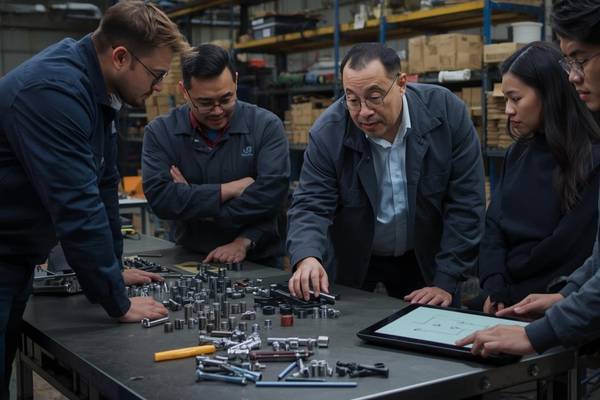
To expand that knowledge base is not something that you can come into the industry with, in general. It’s important that as a group, we make sure we keep building and keeping that knowledge as we see a natural turnover and a knowledge transfer that we have to capture. We’re hyper-focused on that, even with our four walls, or however many walls we have. It’s a lot more than four now, but also within the industry. It is a good point. We’re appreciative that the Institute exists to be able to teach people.
There’s a lot of good information there. I majored in Mechanical Engineering a long time ago, but we might’ve spent an hour or two on screw threads or something like that. That was about it.
We probably spent two hours figuring out how to design a brand-new fastener for every application.
It’s good that you guys are doing that and all the other stuff that you’re involved with. I want to thank you for coming back on the show and talking about the FDI, Würth Industry USA, and everything else in between.
Thank you for having us. We’ll look forward to seeing the March results. Maybe we even get above that 52 number. It’d be great to see a stress 53. That’d be big.
We’ll see what happens. Anecdotally, I saw that the gas prices are up. Hopefully, things will settle down here.
I’m not going to pretend like I can be your energy analyst. I’ll leave it with the hardware distribution.
React to what happens.
Thank you, guys.
You’re welcome. Thank you for joining us, Chapman. That was Würth Industry USA Managing Director and President, Chapman Revercomb. The FDI number for February 2026 was 52.7 versus 52.0 in January 2026. Visit FDISurvey.com to participate in the process and get a detailed PDF copy of Baird’s monthly analysis.
For our top story, American Securities LLC, a US private equity firm, entered into a definitive agreement to sell CPM and MW Components, two of its portfolio companies, to Rosebank Industries in the UK. The transaction is valued at $3.25 billion. The founders of Rosebank have a long track record and experience of successfully executing their buy, improve, and sell strategy. They acquire businesses in which they see potential for further improvement and effect meaningful change through decisive management action and investment.
Founded in 1883, CPM is headquartered in Blaine, Minnesota. It is a leader in the design and manufacture of highly engineered process equipment and automation systems. MW Components, headquartered in Charlotte, North Carolina, is a manufacturer of fasteners, springs, and precision metal components all made in the USA. MW Components serves over 14,000 OEMs, distributors, and aftermarket customers through multiple channels across the aerospace, medical, electronics, energy, agriculture, construction, and other industrial sectors.
MW houses over 24 brands and makes products that are mission-critical, but represent only a small portion of the overall finished product cost. The company operates 24 manufacturing facilities across the USA. It employs more than 1,750 people. Michael Fisch, Founder and CEO of American Securities, said, “It has been a true privilege to partner with these exceptional management teams. With Dave Webster’s leadership at CPM and Tom Amato’s leadership at MW, both businesses have built durable platforms for sustained success. We are confident that CPM and MW Components are well-positioned to build on their momentum and pursue the next phase of growth with Rosebank.”
Thomas Amato, CEO of MW Components, added, “American Securities has played an instrumental role in MW Components’ evolution. Over the years, American Securities has brought thoughtful guidance and operations rigor to support the company’s growth and strategic repositioning initiatives. Their partnership has positioned MW Components for well-continued success in the years ahead.”
Next up, the Fastener Newsmaker Headlines. In corporate news, the Watermill Group sold Cooper Turner Beck, also known as CTB, to Waterland Private Equity. Howmet Aerospace acquired Brunner Manufacturing. TR launched an immersive data center 360-degree experience. SPIROL received Caterpillar’s 2025 Supplier Excellence Recognition Award. AMFT, also known as the Associated Metal Forming Technologies, acquired the assets of P&B Metal Components. Olander achieved AS9100D certification.
Goebel Fasteners announced a new partnership with Crest Fasteners as an official authorized distributor. Fabory acquired Metrik Fasteners and Stern Instruments. All-Pro Fasteners, also known as APF, celebrated its 50th year of providing fastening solutions. Birmingham Fastener launched Atlantic Fasteners in North Carolina. Maximum Fasteners acquired Weld Engineering and Fabrication. AFC Industries launched Cline Tool Customs.
In personnel news, Century Fasteners promoted Joan Nissen to General Manager, Aerospace and Government Sales, and Dan Williams to General Manager, Operations, and appointed Jayne Williams to Independent Contractor and Serina Damesworth as Director of Quality. LindFast Solutions Group, also known as LSG, promoted Meghan Swanson to Vice President, Corporate Controller. Douglas Ruggles, co-CEO of Martin Supply, joined the Board of Directors of the National Association of Wholesaler-Distributors, also known as NAW.
One final personnel story. After a distinguished 43-year career in the fastener industry, OJ Simpson announced his retirement from the LSG Group, effective February 27, 2026. OJ served as President of Stelfast during the last six years of his career. For the previous nine years, he was National Sales Manager based out of Stelfast’s New Jersey branch.
Some people were aware that around the time that he made his retirement announcement, he was dealing with a medical issue that required surgery. OJ would like everyone to know that he came through the procedure with no serious complications. He looks forward to beginning his retirement in very good health and with fond memories of good friends from the fastener industry. Fully Threaded Radio caught up with OJ to reflect on his retirement.
—
Reflecting On Retirement: Choosing Family, Health, & New Adventures
The good part is that it was my choice. Nothing pushed me to do this other than the fact that I wanted to spend time with my family. I got a grandson. I want to be around him more. I want to play a little golf. I want to travel. I want to do some things. This is going to allow me to do anything I want to. Nothing drove it. It was more of a decision based on good things going on in my life and wanting to continue on with that. The LSG team, from top to bottom, has been wonderful.
I want to take it one step further. We’re owned by private equity, Nautic Partners. Those guys treated me well also. I have great managers at Stelfast that I’m going to miss, great people who work for me. I’ve been the president of Stelfast for years. I like going to work. I like doing my job. I didn’t have to struggle to go in every day because I enjoyed the people I worked with, and I enjoyed the job. It was fun, but I’m a little older. Sometimes, you just have to say, “It’s time,” and I did.
The last week of my employment, before I started retirement, I had a medical issue that I had to get taken care of. The good news is I’m in great shape and that everything worked out. There’s other good news, too. I lost 13 pounds in two weeks. We could say that’s good, but I’m in a much better place. I had to do the hospital visit for a couple of days to take care of something immediately. I had surgery. They took care of everything that needed to be taken care of. I’m going to be a healthy man.
I got some messages from people who had some concerns and wanted to make sure I was okay. I want to let everybody know I’m okay. I’ve made a lot of friends through the years. I’ll never forget. I appreciate the well-wishes and all that, but I’m in a great place. I know my voice doesn’t sound that way, but that’s because there was a tube down it for a day and a half. That’s going to get better, also. I’ll miss you all. It’s been a great ride.
—
Back Page Insights: The Rising Cost Of The US National Debt
Thanks, OJ. Best wishes on your retirement. You can get details on all of these stories and more in Fastener Technology International Magazine and the Fastener News Report monthly newsletter. Both available online at FastenerTech.com. Let’s turn to the back page to talk about the USA’s national debt. On past back page reports, I have shared the economic insights of Dominic Pino, who writes for National Review Magazine.
In the April 2026 issue, he has an entry titled 50.5%, which is the proportion of individual income tax revenue that will be spent paying interest on the national debt in 2036, according to forecasts by the Congressional Budget Office, also known as the CBO. Pino reports that the CBO’s ten-year budget baseline document, updated to include the tax and spending changes from 2025’s One Big Beautiful Bill Act, projects that the federal government will spend more than $2.1 trillion on net interest on the national debt in the year 2036.
In 2025, it spent $970 billion on the national debt, which was $77 billion more than it spent on the defense of the country. In 2036, the CBO projects that individual income taxes, the largest source of federal revenue, will raise $4.25 trillion. This means that over half, or 50.5%, of individual income tax revenue in 2036 will be used to finance spending that already happened. The CBO projections are optimistic, as opposed to realistic projections of what will happen.
There are projections of what might happen if today’s policies generally stayed in place. They assume that if a law is going to expire in ten years, the new government programs will be cut in ten years. We know that this is not likely. They also assume that interest rates for the next decade will remain relatively low, which is not guaranteed. Even under those mild and possibly naive assumptions, the CBO projects that the budget deficit will be 6.7% of the GDP in 2036. That’s more than the average deficit from the years 1976 to 2025 and higher than any of the years in the 1930s.
In ten years, the US will be running deficits higher than those it ran during the Great Depression. That’s assuming that everything goes pretty well over the years. In other words, which are mine, not Dominic Pino’s, prepare for another depression in the 2030s. This has been Mike McNulty of Fastener Technology International Magazine, bringing you the Fastener News Report. Please send your news, pictures, comments, corrections, or complaints to me at McNulty@FastenerTech.com.
In ten years, the US will be running deficits higher than those during the Great Depression, assuming everything goes fairly well over the years. Share on X—
Fastener Training Minute: Safety Risks In Rigging & Lifting Hardware
This is Carmen Vertullo with your Fastener Training Minute, coming to you from the Fastener Training Institute and Carver Labs in beautiful El Cajon, California. Our topic came to me via a client who sent me a drawing, otherwise known as a print or a blueprint of an eyebolt. This print was full of risks. I thought it might be a good time to talk about the risks associated with what we generally call rigging hardware and lifting hardware. I’m going to focus on this particular eyebolt, but we’ll do some general risk management work in the whole area of lifting hardware.
There are lots of different kinds of rigging and lifting hardware but, generally, for fastener suppliers or distributors, we’re going to see things like chain, shackles or eye shackles, lifting eyes, and hooks. Those are the four things that I generally see distributors getting engaged in. When I worked for a distributor, those were the things that we engaged in. As you can imagine, because of the nature of the very word that we’re talking about, lifting or rigging, there’s substantial risk associated with the sale and use of this hardware.
Anytime you’re hoisting something off the ground, overhead with a crane, a chain, or any kind of thing like that. If that thing falls, you could have some serious consequences. Not just damage to equipment or facilities, but you can kill people and hurt people badly. It’s important that those types of hardware be selected properly and that they be manufactured properly. My experience had to do with a drawing for a lifting eye. We’ll talk about that in some detail in a minute. I can’t talk about this topic without at least addressing, at a very superficial level, some of the other hardware items that are important.
Let’s start with hooks. You’ve seen these big giant steel hooks that are about the size of your hand. Sometimes, they’re the size of your head, and sometimes, even bigger than that, that we use for lifting. They’re generally designed to latch onto a chain. They have a long, narrow slot in it where the chain link can go in and stay put. One of the charms of these hooks is that they often have a latch on them that will prevent the chain from slipping off. Some of them have them. Some of them don’t.
We see these hooks used commonly in another area of rigging, which we’re not going to talk about. These are the straps, chains, and binding hooks and chains that we use to keep stuff on the bed of big trucks. We see those hooks and chains there with the binding straps and so on. That’s not what we’re talking about here. We’re talking about the hooks that are used to lift. It’s important that those hooks be rated. It’s not just the hook itself. The hook has an eye and a pin. That’s going to attach to whatever you’re going to use to do the lifting, the hoist, the crane, or whatever.
It goes without saying, make sure that all of your hardware is rated for whatever it is that you’re lifting. Attached to that is a chain. We have different types of chains. There’s a very specific chain that is used for lifting overhead. This is called the G80 chain. It’s generally heavier-duty. It’s made from alloy steel. It’s expensive. Be careful as a supplier that when someone comes in to buy a chain, and you sell maybe a G30 chain or a lower strength chain, a steel chain, that they’re aware they must use only the right chain for overhead lifting.
This has been a problem for some suppliers who did not make this clear. We ended up having lawsuits over an end user using the wrong kind of chain, and ending up with an accident. If you’re in the chain business, be very careful about that. This is completely unrelated. This is from my personal experience. Fastener suppliers tend to be willing to cut this chain. In other words, it comes in a 100-foot piece. If you only want 20 feet, they will cut 20 feet for you.
They use a machine, a big pair of loppers or scissors called a chain cutter, to do that. These are also tools that can be used for breaking locks and things like that. Criminals like to have these things. However, when you snap that chain with those cutters, the links tend to fly across the room, and they can cause damage. They can hurt people. These chain cutters should have a box around them. Sometimes, they’re hydraulic and so on. Be careful if you’re cutting the chain, so you don’t end up with that kind of accident. Some suppliers refuse to cut the chain because of that risk. That’s not a bad idea if you can’t control it.
There’s a hook. There’s a chain. There’s a thing called an eye shackle. That’s a thing that looks like a big loop. It’s got a couple of eyes on the end of it. It’s got a pin that goes through it. The pin has a head on it that has a hole in it. One of the eyes is threaded, and the other one is clear. You slide that pin in and screw it down. There’s controversy about how tight you should make that pin.
Sometimes, people say the pin should be loose so it doesn’t end up tightening up with the up and down motion. Generally, you should tighten that pin. Either you can tighten it with a wrench or a screwdriver through the hole. Make it snug so there’s no chance time after time that it’s getting used that the pin doesn’t end up falling out.
On to the item that we came here to talk about. That is the lifting eye or forged lifting eye. There are two types of these. If you want to imagine this eye bolt, it’s a ring. They come in a variety of sizes, down to very small with a quarter-inch thread, up to gigantic with as big as an inch and half or larger thread. Let’s pretend for the sake of argument, because this is the one we’re talking about. It has a half inch thread. It has a ring on top of that half inch thread. That ring is about 2 inches in diameter with about a 1-inch hole through it. It’s forged alloy steel or carbon steel.
There are standards for these lifting eyes. There’s an ASTM standard called A489. It has a lot of requirements in it for testing, chemistry, impact, and so on. There’s even an ASME standard for the dimensional requirements for this. That’s ASME B18.15. We’re fairly well covered on the standards on these. However, most suppliers who sell this hardware don’t adequately warn their customers about the risks.
One of the biggest risks is that oftentimes, when using these lifting eyes with a chain, rope, wire, rope slings, or nylon web slings. They do not understand that, unless you’re pulling straight up, the load rating is dramatically decreased. If we have two slings on two sides of a plate that we’re lifting, and we now have a triangle of chain, wire rope, or web. Those lifting eyes are being pulled at an angle. Especially if they’re what’s called a plain lifting eye. That means there is no shoulder under that big loop between the thread and the eye.
Therefore, they’re subject to bending. We never want to use a non-shouldered lifting eye except for a straight pull because we’ll bend it at the thread. That could be a catastrophe. When we have a shoulder, we can tighten it all the way down. It sits on the shoulders just like a bolt or a hex cap screw would sit on its bearing surface. It’s safer to pull that lifting eye at an angle.
For the most part, if you are a supplier who is supplying out of a catalog, Chicago Hardware, for example. They have very good information in their catalog about how to safely use this rigging hardware. That’s what you want to show to your client or your customer. Don’t give them any advice ever about whether something is suitable for a particular application or not, like, “Here’s the catalog. You read it. Do what you want with that information.”
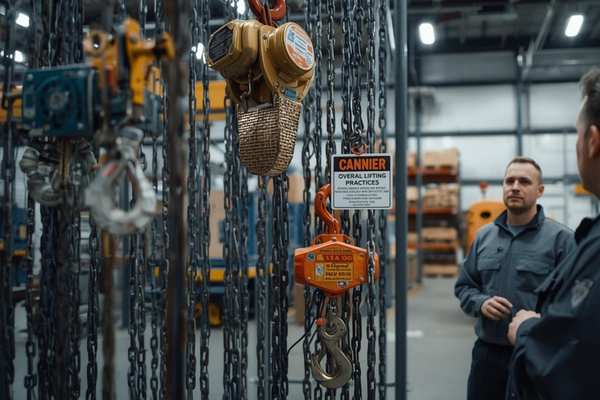
It should be incumbent on any supplier selling lifting hardware that they have a warning notice on their packing slip in their front lobby or wherever. Whenever they sell chain to warn the customer, they must be sure they’re using the proper chain if they intend to use it for an overhead lifting application. If they are using these machinery eyebolts, they are aware that when they are loading them at an angle, the load rating is substantially decreased.
This was more of a safety lesson than it was a Fastener Training Minute, but it is one of the most important lessons for suppliers to realize in terms of risk. There’s a significant risk associated with selling this hardware. As a matter of fact, many suppliers choose not to be in that game. There are also suppliers who are heavily into that game. In fact, some focus on just the sale and use of rigging hardware.
By the way, we test rigging hardware. At Carver Labs, we test ropes, straps, and lifting eyes. We proof load all kinds of slings and stuff like that. If you ever have an issue or a question regarding the qualification and testing of rigging hardware, look us up. That’s it for now. This is Carmen Vertullo. This has been your Fastener Training Minute. I hope you learned something. Thanks for tuning in.
—
AI In Distribution: The Shift From Tools To Agents
Brian and Eric, back with you, fighting for truth, justice, and the fastener way of life, Fully Threaded. You are there, Brian?
I’m here.
I was concerned because every time I reach out to you, you’re deeply involved with Claude or ChatGPT. Sometimes, I have a hard time breaking you away from that world. Thank you for being here.
I had an argument with Claude.
These have become a regular thing around here. As we said before the break, we’re going to jump right into it. We’ve got Ian Heller here with us. He is the co-founder of Distribution Strategy Group. A lot of you know him. He’s out there. Let’s say it that way. I see him on LinkedIn all the time. He’s doing a show. What’s the name of your show, Ian? Welcome. Thanks for being here.
Thanks for having me. We do a bunch of virtual programs. The one that you’re probably referring to is called Wholesale Change. That’s the one that I co-host with my business partner, Jonathan Bein.
You do a great job on that. You’re also doing a video. I’m very envious of what you guys produce over there.
I don’t know about that. You guys have been around a lot longer. You’re a legend in your industry. We’ve been working hard to produce good content, too.
The last time we talked to you was in connection with your AI conference that was held in June in Chicago. That’s coming up again right around the corner when you think about it. We’ll get to that. There’s so much going on. AI is speeding up its development like you can’t even believe. There was an essay that came out. Matt Shumer on X posted. I don’t know what you want to call it, a blog or an essay. It was called Something Big Is Happening.
By my read of it, and we’ll get into this more as we discuss it, guys, if he’s correct, this is going to be one of these seminal articles, much like Bill Joy’s Why the Future Doesn’t Need Us back in 2000 in WIRED Magazine that blew people’s minds with its forecasts, prognostications, and gloomy outlook. Here we are. We all made it. What do you think of this one, Ian, when you first read this thing the first time? I’m sure you’ve read it several times by now. Something Big Is Happening, and it is, isn’t it?
Yes. A lot of this has been floating around in different forms by different writers. He brought it together in a nice, concise way. It’s the promise and peril of AI in one. Dario Amodei, who’s the Founder and CEO of Anthropic, has done two white papers on AI. One is about the good things that it’s going to bring. The other is the risks that are associated with it. Shumer’s done a nice job distilling that message into one column. It’s very well worth reading. It’s on his personal blog as well. I think it was published in Fortune, too.
For someone who wouldn’t be quite up on AI, if they stumbled across this article, they’d get a bit of a surprise because it would indicate that we’re racing headlong towards singularity.
As a more of a practically useful point, and this is what we want to think about right here during this conversation, guys, Shumer’s saying that the time when massive job losses due to AI deployment are here. I don’t know if you want to call it a singularity yet, Brian, because that talks about AGI. This idea of AI becoming sentient and all that. We don’t need to think about AI in those terms in this context. We want to kick this idea around. Is this the point where job loss is going to kick off?
Ian, being so well-placed in the wholesale distribution arena, I thought you’d have some ideas on this. Do you see it coming? What do you make of it? Shumer was using as his foil during this essay a senior partner in a law firm. He was looking at it from a software engineer’s point of view, but saying this is bleeding over into less technical areas, too. How does wholesale distribution sit in all this?
Wholesale distribution will be affected about average when it comes to industries, but average is going to be huge. There are three things that make AI different than previous technology breakthroughs. The pushback that I get when I talk about, and a lot of people give when they talk about how AI is going to affect jobs or not, is that they’ll say things like, “Historically, every new technology created more jobs than it displaced.” That’s true. Over time, new technologies like eCommerce created a whole new class of jobs that never existed before.
You didn’t have SEO analysts in 1990, or dozens of other jobs. The difference with AI is that AI is the first technology that’s more capable than humans in many ways. Soon, it will be more capable than humans at most things. As a result, when it creates new jobs, it’s going to go ahead and take those jobs because it’s better qualified. The difference is that when eCommerce created new jobs, it created new jobs that humans had to do because technology couldn’t. AI is going to create new jobs that technology can do better than humans.
It’s going to consume its own jobs that it creates. That’s never happened before because we’ve never created a technology entity that’s smarter and more capable than human beings. There are a couple of other things, too. One is that AI is not like ATMs, where it’s one technology affecting one narrow part of the job market. Artificial intelligence is going to affect so many jobs simultaneously that people can’t retrain because the jobs that they would normally retrain for are evaporating at the same rate as the jobs that they’re leaving or losing.
The third one, and I wrote a column about this, is the attrition myth of AI. I’m sure you guys have run into this, many times you’ll hear some companies say, “We’re adopting AI, but we’re not going to lay anybody off. We’re going to let attrition take care of the headcount reduction we need to achieve the productivity goals that AI promises.” Two-thirds of people who leave a job leave for another job.
If those other companies are also embracing AI and they’re not laying off anybody. There’s not going to be very much attrition because everybody’s attriting at the same time. In that environment, if companies want to achieve their productivity goals, they’re going to have to turn to layoffs because the attrition is going to halt as people don’t have anywhere to go. That’s going to be a lever that makes all this happen a lot faster once it begins in a real way.
It happens more slowly as people sit and think about it when they’re having their evening cocktail about what to do.
Employees aren’t going to have a choice because companies are going to set three-year AI productivity targets. Not ten-year AI productivity targets. They’re going to say, “If people aren’t leaving, if attrition is slowing down, we’re going to do layoffs instead.”
Let’s put this into very concrete terms for the audience. Specifically, in wholesale distribution, what jobs are leaving first?
Customer service is leaving first. You guys know about these order automation tools that are out there. I heard about three new order automation products. They’re ubiquitous. They’re everywhere. Automating that order placement and taking a list of SKUs. Whether it’s in an Excel spreadsheet or handwritten on a piece of paper and turning it into an ERP order. That is being automated at a ferocious rate. People who answer the phone, talk to customers, and enter orders into the system are already declining at a rapid rate and are going to decline a lot faster.
It’s anyone who’s doing white-collar work in an office at a distributor. That may be a financial analyst, a marketing analyst, a marketing copywriter, an AR specialist, an AP specialist, etc. You got people in finance, operations, marketing, and more. If you are interacting with the computer most of the time, then that’s next after customer service.
This will sound tongue-in-cheek, but I mean it seriously. Salespeople will be human as long as customers are human. Customers are increasingly becoming not human. You’ve got automated purchasing, which may take the form of, “We use eProcurement.” It may take the form of industrial vending machines, or bins that have replenishment mechanisms built in to automatically reorder when they get low. You are seeing some of that regular transactional purchasing already being automated.
If I were in sales, I would work on my ability to negotiate large-scale contracts with big companies with senior executives. That’s going to be the last bastion of sales to get automated. Generally speaking, humans like dealing with humans, so sales is around longer than customer service or these other White-collar jobs. That’s the order in which I see jobs being shed by distributors.
In Shumer’s essay, he says what you said. Anybody who looks at a screen for a living had better start to think about what other things they can be doing. At least doing the things that they are doing now in a much different way.
A keyboard and a mouse are an inefficient way to connect computers and brains. It’s always been the slowest part of the connection because your brain’s a computer, and it can go fast. Your laptop’s a computer, and the ERP is connected to is a computer. Yet we connect the brain to the computer with these clunky manual keys and a mouse. It’s always been a slow interface. Some of that’s being replaced by voice technology. We’re seeing that increasingly.
Ultimately, if you can take the human out of it entirely, you go even faster. Fast equals productivity. Speed is productivity is efficiency. This has been inevitable, but the order of magnitude increases in capability that LLMs have brought us have meant that. Rather than just take the keyboard out of the equation, I can take the human out of the equation entirely. That’s increasing what you’re seeing happening.
How do you separate this idea of LLM-centric AI versus agentic AI, which seems to be a separator in the way you hear things these days? How do you break that down?
LLMs just respond to what you ask them to do. They don’t do anything proactively. Their output is primarily text, code, image, or video. That’s the output of an LLM. It tells you something, it shows you something, or it writes code. That’s the output of an LLM. Agentic acts on your behalf as an agent working for you. The simple example I give is that it’s not going to be too long before you tell an LLM, “I’ve got to go to a conference in Miami on May 7th. I need you to plan the trip, put it all on my calendar, and track my expenses for it.”
That agent will go and access your hotel account, airline account, and credit card accounts. It knows your preferences, where you’d like to sit, what airlines you like to take, and that you like to go direct and skip connections. Unless there’s a significant cost savings. It will plan the whole trip out before you come back and say, “How does this look before I book everything?” You’re going to glance at it and say, “Great.” It’s going to go and make the reservations for you. It’s going to book the flight and the hotel and make sure your loyalty numbers are attached. It’s going to put all of that on your calendar.
If you have meetings on your calendar that are conflicts, it’s going to go ahead and reach out to those people and reschedule them. It’s an agent acting on your behalf. That’s where the term comes from. Imagine that technology applied to customer service inquiries, expediting orders, getting technical information, answering questions of all kinds for customers. Processing a return, taking care of your accounts receivable and payable. These are going to be software agents that do that work proactively. They’re not just responding with image code or text like an LLM is. They’re reaching into the digital and physical world on your behalf and doing things for you.
In about 1986, Steve Jobs talked about a program that would float around the web on your behalf and do things like that.
I didn’t know that.
I forgot the name. He dreamed up a name for it, but it was something that you would set going from your own computer. It would float around somewhere, probably on an Apple server somewhere, that was doing things for you, and then send you back messages.
It’s funny how visionary he was. Here’s a prediction I have. In the not-too-distant future, you’re going to be on a Zoom call or a Teams call. You’re not going to know which of the people in the windows are real and which ones are agents.
It is mind-blowing.
I don’t think I want that for the moment.
I get it. I’m not saying it’s desirable. I’m just saying it’s going to happen.
You could take this back, Brian, from Steve Jobs. You could go back to HG. Wells. You could go back to Sir Francis Bacon. How far do you want to go? The point is we’re here now. This idea of the global mind or hive mind that it seems like this is all approaching is unknowable. At least by people like me. I’ll tell you why. While you’re describing this, my mind immediately goes to how a regular person would manage all the permissions involved in doing something like this and maintain any kind of security or privacy. That’s what I’m thinking.
There’s an IBM engineer. His name is Jeff Crume. He’s speaking at our conference. He’s got a PhD in Cybersecurity. He’s a bright guy. He did a YouTube video specifically on that because you’re not just going to give these agents your credentials. You’re going to have to have a new approach to security where they get credentials in an automated, efficient, but safe way. Meaning they’re temporary and very limited. It’s an interesting video. I suggest people go watch it. He’s talking about cybersecurity in the age of AI. Giving credentials to agents is a big part of what we have to work out.
You’re giving them yourself, all of your passwords, and everything.
How do you manage that in a way that doesn’t compromise your identity or your security?
You were saying, Ian, that you’ll be on a Zoom call or something, and there’ll be all these people “on this call.” You won’t be able to tell who’s real and who’s an AI. In a lot of cases, this will be an avatar of maybe your personal agentic AI, at least for some time, until they start enslaving us. Did I say that? What it comes down to is truly this is a justification for all kinds of biometric identification, isn’t it? This is the next level of internet ID.
If you’re on the call and somebody is in the window and you don’t know if they’re real, that person’s digital twin, their clone. If it’s a non-existent person at all, you don’t necessarily have control over whether they’re on the call if you’re just a participant.
Let’s reel it back to the world we’re looking at right now. You see a lot of tech out there. You mentioned it before. Who do you see out there making big waves? Who are people paying attention to in wholesale distribution and AI tools, or anything that you’re looking at?
As I mentioned, order automation is everywhere. It’s ubiquitous. There’s a whole bunch of those companies. We’re seeing it across the distributor’s enterprise. If you put order automation at the front or quote automation at the front, then you start running it back. There are other things about customer service that are becoming AI-enabled. There are sales functions that are becoming AI-enabled.
Order automation is everywhere; it's ubiquitous. Share on XWe’re increasingly seeing AI applied in various ways to CRMs so that CRMs are increasingly more proactive. Rather than just tracking the account manager, they’re arming them with better information to make smarter and more effective sales calls. You’ve got everything related to the transaction. You’ve got setting credit. There are technologies coming out that help you manage credit better because, remember, as you know, distributors manage their own credit. They’re not, for the most part, using credit cards.
That’s a big area of risk and value add for distributors. Getting better tools for managing credit lines is important. You’ve got people managing accounts receivable, so there are tools that will go through your accounts receivable and tell you which ones you should worry about, which ones you should make phone calls for, and which ones are going to be okay. Accounts payable is the same thing. There are returns. There’s a company called Continuum that coordinates return with distributors, manufacturers, and customers to make them easier.
There are eCommerce platforms that are increasingly AI-enabled. There’s warehousing that is increasingly becoming robotic. Whether that’s inventory counting drones or integrating humans and robots to achieve better picking. There’s logistic software to help you deliver better. From across the distributors’ value proposition, increasingly, you’re seeing AI enablement.
The net effect of that is going to be better service. It’s going to change the expectations of service. You think about now, if you make a phone call to a customer service number. You spend a lot of time trying to figure out how to get to a human being. It’s an operator because you’re trying to get the software to get you to someone who can help you better.
It is a representative.
I predict that that’s going to flip. You’re going to want to talk to the software because the software is going to have access to every system. First of all, there’s going to be a point in time when you never get put on hold again ever because they’re going to have infinite capacity or effectively infinite capacity with AI agents answering the phone. The AI agents will have access instantly to more and better information and will be able to resolve your problem better than humans can. That’s going to flip sometime.
One thing to watch is that software economics are changing. For years, people didn’t write their own software. Economically, it made sense for one entity, a software company, to write that ERP or CRM and then license it out to many users who could collectively fund the development of that software. That’s the way software economics work. That’s beginning to change some now. In fact, it was a big market reaction. You’ve got tools like Lovable out there where you can create your own software.
Increasingly going forward, the software companies that have an advantage have a network effect built in. It’s like, “We have information collectively among many customers that makes the software stronger, better, and more useful.” If I run software that’s only good for one company at a time, there’s no network effect where the more companies that use it, the more important my software becomes. People are going to use tools like Lovable to write their own substitutes. A big thing that the software industries reacting to now is how do we get network effects into our software to make sure that people don’t just write their own to replace whatever it is we do.
I don’t know Lovable. Is that like Replit? Is that a parallel idea?
They’re both application development platforms. I don’t know if it’s right. I think of Lovable as quick, prompt-based, with a focus on UI and speed. Replit is a lot more comprehensive. It’s more in-depth and has more complex logic and direct code control. I do think that as I’m thinking through it, but there are others out there, too. There’s Bolt, Caffeine, and others. I know in our company, we’ve been toying around with Lovable the most.
We’re watching all these companies pop up. There’s so much going on all at the same time with this AI. It’s blinding speed. There’s too much to keep up with. You’re on top of all of it, and you’re only aware of a fraction of it. Therefore, what I’m getting at is, as I see some of these companies come into the fastener industry, and there are a handful of them, I wonder to myself. I wish them all success. I don’t have anything against any of them. The point is, how long is the lifespan of a company like this before it becomes a commodity due to the very AI that they’re helping to improve?
That’s why you’re looking for companies that have some staying power in terms of having network effects-built in. They have the ability to capture a lot of market share in a relatively short period of time. Most markets tend to boil down to a handful of competitors in the long run. Certainly, if you’re looking at startups versus stalwarts, the stalwarts are more likely to be around in the long run. The startups are often where the breakthrough leading or new functionality is.
The companies that go to our conference are typically pretty well capitalized. Every year, we get companies that show up that I’ve never heard of before. I’m looking at the list, and it’s like, “I got to look up to see what that company does.” They’re new. To your point, part of my job is to keep up with this stuff, but it’s impossible to keep up with. You can only consume so much. Honestly, one of the things I use LLMs for is, “Help me catch up on what’s going on in AI,” because it’s impossible for me to sort through it. I use it as a vetting and filtering mechanism because I can’t pay attention to 1,000 different brands at the same time as software.
Do you have a favorite LLM then?
It depends on what I’m using it for. I use Gemini for image generation if I’m not using Canva. It is by far the best for image generation. Also, it’s the best for searching the web in real time. Although, Perplexity is good at that, too. If I want to know what’s on the web right now, I use those two. If I want to write something like a script for a presentation, Claude is good at that. ChatGPT is bad at that.
For regular Q&A about more in-depth expertise on specific subjects, I use ChatGPT. Those are the four that I use the most. That’s how I use them. Both Claude and ChatGPT, and Shumer points this out in his article, are both phenomenal at writing code now, but I don’t write a lot of code. We have Brian Hopkins, our COO, who does. He seems to prefer Claude for code writing.
I’ve been dealing with Claude. I had this weird thing happen to me. You carry on these conversations. You rely on the fact that your browser doesn’t shut down. If it does, it brings you back to the same thing when you turn your machine on again. I went through this whole thing. It says, “You’ve got to go to a paid plan or something.” My whole three-day conversation with Claude completely disappeared. I went back. “We’re just talking about this.” “I have no memory of anything that happened before.” Eric knows because I sent him a panic note saying, “I’ve lost all my work I was doing.”
It turns out, people much smarter than me and not even necessarily had to be amazingly smart, the conversations are all stored. I just never knew that. I stewed the whole night, having lost three days of work. I went to Google. I said, “If my conversation gets interrupted, can I go back and find it?” He said, “Sure. It’s in one of the buttons on the left-hand side of the screen.” Everything was there. I went and found it. Claude, the new version of it, when I said, “I’ve lost everything.” You’d think Claude would have said, “No, you haven’t. Look at your conversations.” It never said that. It led me through to a complete rework of where I was when it all stopped.
That’s another one of those examples of when you’re dealing with this stuff, at least in today’s world, with today’s versions, you always have to question it. You cannot be completely trusting. You have to still have your wits about you when you’re doing it. A lot of times, those gut calls, Brian, as you can see, they save you a lot of work.
Getting back to the Shumer article, his suggestion is to start using AI more and to begin to adapt to all these changes that are coming. A lot of them, we don’t know what they are, so that’s a little bit of a frightening ask for a lot of people. It’s the same takeaway that happened at the Distribution Strategy AI Conference, Brian.
When you came back from that, you said, “My pledge is that every day, I’m going to use it for a minimum of half an hour.” Ian, I was talking with Tony Pericle from ProfitOptics. Let’s say it this way. He’s a senior in this space, also. I don’t even think he needs to be worrying about adapting. He’s pretty much where he needs to be, but he is digging right in. He’s learning this stuff. He’s learning agentic AI because he is looking down the road. He’s excited by it. I know he’ll be at your event this summer. How are you lining it all up?
First word on Tony, he’s worth following on LinkedIn. He’s got interesting posts. He’s a bright guy. Are you asking how we are structuring the event?
How are you going about the process of setting it all up not knowing what’ll be around in six months?
First of all, we have 34 technology companies already signed up to be there. We’ll probably have a handful more. We’ll have about 40.
Is HawkSearch in the mix?
They are.
I want to talk to those guys some more. I met them out in Vegas.
They’re sponsoring one of our tech leader panels. They’ll be on stage for a little while. They’ll have a table. HawkSearch is awesome. Good partners for us. We’re trying to provide value in a combination of ways. Some of it is having the right technology companies there. We don’t just let anybody in the show. You’ve got to have a high story. We have to approve your speaker and your slides because it can’t be a bunch of demos and sales pitches. It’s got to be educational. If you’re going to speak to our audience, you have to educate the audience. That has to be your focus.
If you’re going to speak to our audience, your focus has to be on educating them. Share on XWe have a bunch of keynote speakers. We’ve got the CTO from Grainger, Jonny LeRoy, who’s going to be talking about how they’re using AI, which is a big deal. We’ve got the CEO of the Burning Glass Institute, a guy named Matt Sigelman. He specializes in jobs, generally speaking, but he’s been working a lot with how AI is going to impact jobs. He’s going to be talking about that. We’ve got a bunch of distribution executives on stage talking about how they’re adopting AI. You’ve got the technical side of it. You’ve got industry people talking about how they’re using it.
There’s the networking, which is probably the most important of all of them. This is a different conference. You guys saw that when you were there in 2025. This doesn’t look like a typical association conference. It feels more like a tech conference about distribution rather than a distribution conference with some technology support. As you know, our dress code is that you must wear clothes. That’s it. We don’t want this to be about people in blue sports coats. We want it to be about the technology itself.
The very nature of the audience that this attracts is different than a normal distribution conference. These are the most technologically forward people you’re going to meet at a conference. It’s a good place to network and ask some of these hard questions to a group of people who’ve been thinking about them through a distribution context or in a distribution context. We’ve got leading technologists presenting on stage. We’ve got leading distribution executives talking about their adoption of AI.
There’s a whole bunch of networking time built in. There’s a chance for one-on-one meetings with a bunch of different people. It’s a total immersion in AI that happens over two days. Plus, we’ve got a pre-show workshop, which is the future of AI and distribution, taught by Jonathan Bein, my business partner, who’s got a PhD in Computer Science in AI. We have two post-show workshops. One is about how to develop your AI roadmap for your distribution company. The other one is by Nick Pericle, who’s Tony’s son. You probably know Nick. He’s brilliant, too. He’s talking about how you build AI agents. He’s going to help you build an agent in the class.
That’s awesome. I didn’t realize he was going to be presenting.
I assume you guys are going to come back. If you do, you’re going to love it. It’s a more total immersion in AI for distributors.
That’s awesome. I should have done this at the top, Ian. I did a bad job here, but for everyone tuning in, this event that we’re talking about is being put on by the Distribution Strategy Group, happening in Chicago, June 23rd through the 25th, 2026. The website for all of it, DistributionStrategy.com. We’re talking with Ian Heller, the one and only. He’s got several of his articles on this website, as well as other contributors’ good stuff. The MDM pedigree is showing through, Ian. That’s a blast from the past. I think that’s how you and I first connected.
I think it was. I was only there for a couple of years, and then we started this company. I have a lot more time here than there, but that’s how I got started in content.
For anyone who’s in the distribution industry, which includes many of our audience. You should go to this conference. Most people probably think, “How can I implement it? How can I do it?” You’ll talk to people who are implementing it or have done it. They can tell you how to do it and give you advice. You can sit and talk to people, thinking about it and doing it. That’s a great chance to move into the next decade.
You’re already planning your wardrobe for this. I can tell, Brian.
I don’t have to wear a blue coat.
No wardrobe planning required. You can show up in shorts. We don’t care.
Ian, we appreciate your advice on all this and your wisdom. We look forward to seeing you out there in June. Any final thoughts you have on this Shumer essay before we call it a segment?
First of all, you’re the one who pointed this out to me. I appreciate you did because I hadn’t heard of it until you told me about it. You can go to Shumer.dev. That’s his blog. This one’s called Something Big Is Happening. It’s a nice distillation of where we are with AI. His point is that it’s going to eliminate a lot of jobs. You can’t control that as an individual. All of us as citizens of the United States and citizens of the world need to be concerned about that. We should be pushing for some type of macro solutions.
What we can control is our careers and, if we run a company, the companies that we run. Our job in those contexts is to adopt AI as fast as possible because if you don’t know AI, you’re probably not going to have a job. If you run a company and you don’t adopt AI, then you’re not going to be employing anybody soon because your competitors are going to take away your business. Your only choice in your personal context and in the context of running your business is to be as good as you can be and better than most of your competitors in adopting AI because that’s what’s going to protect you the most.
That’s well said. That’s a takeaway we can all percolate on. I will say this again. I want to continue to be on the record here, but I am of the Erik Larson school of AGI. I don’t see it coming in the near future. That doesn’t mean that I don’t see the urgency of this moment, and a lot of what Shumer is saying is being 100% correct. In the ensuing time, we’re going to see a lot of chaos because it’s going to sort out.
There’s going to be a lot of false starts. Brian and I are well acquainted with that. Believe me, we climbed a tall ladder. It got us nowhere, which is where we find ourselves today. Fortunately, Brian is digging back in. We’re taking another stab, but you’ve got to be tough to succeed in all this. I got to say that.
I agree.
Thanks, guys. It’s always great to be with you. I’m looking forward to seeing you. Let’s make sure they reach out to me offline. We’ll get you registered for our show. We’d love to have you there.
I learned a lot in 2025. I look forward to it. Keep well. See you there.
Ian Heller, Distribution Strategy, I appreciate you being here.
Thanks, guys. It’s my honor.
We’ll be back with more Fully Threaded.
—
Navigating AI, Misinformation, & The Challenges Of Innovation In Fasteners
It looks like I’ve got to get myself suited up to come back to Chicago on June 2026 for sure now and hit this AI conference with you.
I went to it in 2025. It was amazingly informative. A lot of the stuff, which is the hype that goes with this AI, is dispelled by people who are doing it and can tell you how to do it or do it for you. It’s very interesting expo.
I was glad you went out there because when you came back, you were on fire for it. You got a lot of stuff achieved. It was a good investment of time for us.
The main idea that the keynote speaker said was, “It’s here. Don’t be terrified of it. Learn how to love it.” Peter Sellers said, “Learn to live with a bomb.” The thing is, you have to get used to it. Make sure you use it every day, and then you’ll realize that it can help you, and the bits that won’t help you. That’s how you get used to it.
Ian Heller is the Dr. Strangelove of AI. Is that what you’re saying?
He was Dr. Strangelove. It was good. I met a lot of very talented and interesting people, and people who can tell you different things they’re doing. Instead of hearing so much talk, you can see real bits of it working.
I understand. I got you. That is very exciting. A lot of people, after reading the conversation we had, maybe some of them will go and check out that essay, Something Big Is Happening. They might also have other thoughts in the back of their mind that are creeping in, too. They’re all there. They’re all things that we have to deal with, though. It was great to have Ian Heller of Distribution Strategy come on the show and share his ideas with us. Thanks also to Jason Baines with J.Lanfranco, the congenial Jason Baines.
When he’s not being asked questions, he doesn’t want to answer.
Sorry about that, Jason. Blanca Delgado with Fastener Fair USA was here. Chapman Revercomb with Würth Industry USA joined Mike McNulty on the Fastener News Report. Excellent job, gentlemen. Carmen Vertullo had the Fastener Training Minute. Marco Rodriguez brought us the Cresa real estate update. I should say congratulations also to OJ Simpson, formerly with LSG. He made a cameo on the news.
Enjoy your extended time off there, my friend. He said he’s going to swing back with me and do a sit-down. Maybe we’ll bust out a segment on that. He could tell all now, now that the handcuffs are off him. I’m sure he didn’t have many constraints on him, but he was always extremely professional when we talked. Hopefully, he’ll get in the mud with the rest of us.
We had numerous times when we would meet up at various places like airports, bars, and things. When there are no other people around, we could sit and have a very interesting conversation. He’s a nice guy.
That’s right. A lot of people are going to miss having him around, including the people at Star Stainless and the whole LSG group, the title sponsors of Fully Threaded for a long time. Much appreciated as well. Also, title sponsors of Fully Threaded Radio, Brighton-Best International. Fully Threaded is also sponsored by Buckeye Fasteners, BTM Manufacturing, Eurolink Fastener Supply Service, Fastener Technology International, Cresa, Goebel Fasteners, Fastener Fair USA, INxSQL Software, J.Lanfranco, MW Components, Solution Industries, Volt Industrial Plastics, and Würth Industry USA.
Do us a favor, folks. Next time you run into somebody from one of these partners, let them know you appreciate their support of the show. They keep us going. It isn’t getting any easier. I’ll tell you that. One of the things that’s swirling all around, and we’ve been pretty much clear on the theme, is uncertainty caused by AI. Brian, I want to close by sharing with everyone a tweet I sent you that underscores this whole idea of not being sure about what’s around the next corner. Do you remember this headline I shot over there?
I know. I read the article.
On one of the news aggregator sites where I scan headlines every day, and more and more of them do this. There was a link directly over to X. It was another one of these hair-raising AI headlines about a big layoff that happened this time at Amazon Prime, allegedly. I saw this thing. I thought it might be thematic to what we’re going to talk about. I’m working on an article for Link Magazine. I click over to this thing. It’s a post on X by a handle, @TechLayoffLover. That’s the guy’s name that he’s using. I’ll give you a flavor of this. It’s a lengthy post.
It says, “Amazon Prime Video Bloodbath. Two thousand eight hundred forty-seven employees got the email at 6:47 Pacific time. ‘Your role has been eliminated effective immediately.’ Badges are dead by 7:15. Slack access revoked mid-sentence. Senior engineers who built the entire streaming infrastructure are gone. The team that shipped 40% faster last quarter, using Claude for code generation, was eliminated. Eight hundred forty-seven contractors in Bangalore just got handed their prompt libraries and deployment scripts.” You get the idea. It goes on like this for quite a while. It closes out. “If you’re not seeing this coming, you’re already dead. DMs open for anyone who needs to talk.” It is very sobering and attention-grabbing, wouldn’t you say?
Yes. Also, what do you expect to come in the news these days?
It is. You’re already prepared for it and there it was.
We’ve been told that there’s going to be an entire world of unemployed people, 7 billion of us all working at how you’re going to buy your groceries.
I’m not trying to be an alarmist with that at all, but we spent half an hour talking about this essay, Something Big Is Happening. It’s pretty convincing and alarming. We try to moderate all that with what we’re seeing. There are many economists who are telling us that there’s no unusual job loss activity, no layoff activity happening, which is comforting for the moment. We get this.
Let’s cut to the chase here because the next curve in the road, there’s a reader-added context section at the bottom of this post, which you don’t see on all posts. It says, “This post is made up. No such layoffs happen. The account itself confirmed it is intended as satire.” Though the post fails to disclose the satire.
Disclose that it is a satire.
Disclose that it’s probably an AI itself. You go back, and you look at the thing. You say, “This is obviously a bot that wrote this thing in the first place.” Here’s the kicker. There was a headline on a serious news aggregator site that was pointing to this. The headline was very serious-sounding. Nothing satirical about it. By and large, it’s not a satire website. This is the point.
What do we believe then?
Bingo.
Nothing. Check your sources carefully.
For people who use AI, even casually, or even people who consume news and have any discriminating sense about it, this is the question. What do you believe? I don’t have the answer to that, but this is the point we’re at. It wouldn’t surprise me if these kinds of misleading headlines and all kinds of similar things, when you take this into the realm of security. It leads to some crazy places. Job loss is one of them. That’s something big. This is another thing, though. It’s the loss of meaning and the loss of anything appearing credible. If you want something big? There it is.
For anyone using AI—or even just consuming news critically—the key question is: What do you truly believe? Misleading headlines and misinformation can take us to some wild places, from security risks to job loss. Share on XYou can say, as I did say, watch out for your sources. If a source that you trust suddenly posts a link to something like this. Now you have to be doubly careful all the time. You could have the same thing on the BBC news or something.
It’s everywhere. Reel this back to fasteners. We were talking off mic. Your latest challenge is to use an AI model to help you draw a penta head bolt. What’s the hangup with that, Brian? It seems pretty easy. I have it draw things for me all the time, and it always works. What are you experiencing?
I started by clicking on a link. Suddenly, I’m on Microsoft Copa. There are not a lot of these AIs that can generate images. They can copy them, they can change them a little bit, but they can’t generate one from nothing. You’re left with making sure your description’s pretty good. I was just trying to generate images of bolts. I was struck by the security bolt, a penta head bolt. Try as I might, I could not get Copilot. Which uses a version of ChatGPT as its engine underneath, to generate a five-headed bolt. It couldn’t.
At one stage, the best it got to was a square-headed bolt with two sides on what would have been a square. It truly was five sides, not what I had defined. I got help from Claude AI. How do I define a five-headed bolt? I tried with ChatGPT-5. I tried about eleven times and failed every single time. It never, ever could generate that. Claude says, “You just have to give up. It can’t do it.” This is the state of AI where it is. It doesn’t know what a five-headed bolt looks like. It can’t work out how to generate five sides on something because it’s either 4, 6, or 12. It can generate those easily, but it’s never had to generate five sides.
Brian, in the description there, you’re giving a few people some hope that their jobs are still safe for the moment.
It’s very safe.
It seems like the fastener industry is a place where we do have these natural moats around us a little bit. Some of it stems from the blacksmith nature of it. We are old-world in a lot of ways. AI is creeping in, but we’re just watching all this. We’re working with it. We’re experiencing it like all of you are. It’s ongoing. Good luck, Brian. I know we need all those graphics that you’re adding to the FCH Sourcing Network. It adds a lot to our search results. We’ve needed it for a long time. That’s a long story in and of itself.
It’s a very long story.
For now, we’re going to say we’ll have to get to it next time. We’re going to have Tim O’Keefe of Huyett with us. He’ll be looking at the FDI with McNulty and lots of other good stuff for you, folks. I sure do appreciate you clicking in.
Also, the parting comment is, don’t worry about your job quite yet.
Keep in mind that something big is happening. With that, we’re going to put this episode in the can. For Brian Musker, this is Eric Dudas. Get out there. Write a few prompts. Sell some screws. We’ll talk to you next time.
Secure if you can draw a five-headed bolt.
Important Links
- Mike McNulty on LinkedIn
- Carmen Vertullo on LinkedIn
- Bob “GQ” Baer on LinkedIn
- Anthony Martinez on LinkedIn
- Jason Baines on LinkedIn
- Ed Smith on LinkedIn
- Marco Rodriguez on LinkedIn
- Blanca Delgado on LinkedIn
- Chapman Revercomb on LinkedIn
- Ian Heller on LinkedIn
- Jonathan Bein on LinkedIn
- Nick Pericle on LinkedIn
- FTR@FullyThreaded.com
- MRodriguez@Cresa.com
- Blanca.Delgado@RXGlobal.com
- McNulty@FastenerTech.com
- Episode #224 – See? BAM! – Previous Episode
- Claude
- ChatGPT-5
- J.Lanfranco
- Distribution Strategy Group
- Würth Industry USA
- Fastener Fair USA
- Fastener Industry Coalition
- Cresa
- Tough Mudder
- Field Fastener
- Southeastern Fastener Association
- National Fastener Distributors Association
- Fuller Metric
- Fastener Training Institute
- NASCAR
- Optimas
- MW Industries
- Howmet Aerospace
- Olander
- Fabory
- Birmingham Fastener
- Century Fasteners
- LindFast Solutions
- Würth Industry USA on LinkedIn
- Fastener Distributor Index Monthly Survey
- American Securities
- CPM
- Rosebank Industries
- Cooper Turner Beck
- Brunner Manufacturing
- TR Fastenings
- SPIROL
- Associated Metal Forming Technologies
- P&B Metal Components
- Metrik Fasteners
- Stern Instruments
- All-Pro Fasteners
- Atlantic Fasteners
- Maximum Fasteners
- Weld Engineering and Fabrication
- AFC Industries
- Martin Supply
- National Association of Wholesaler-Distributors
- Stelfast, Inc.
- Nautic Partners
- National Review Magazine
- Fastener Technology International
- Carver Labs
- Wholesale Change
- Something Big Is Happening
- Why the Future Doesn’t Need Us | WIRED
- Anthropic
- Continuum
- Lovable
- Google Gemini
- Perplexity
- Replit
- ProfitOptics
- HawkSearch
- Grainger Industrial Supply
- Burning Glass Institute
- Shumer.dev
 Apple Podcasts
 Spotify