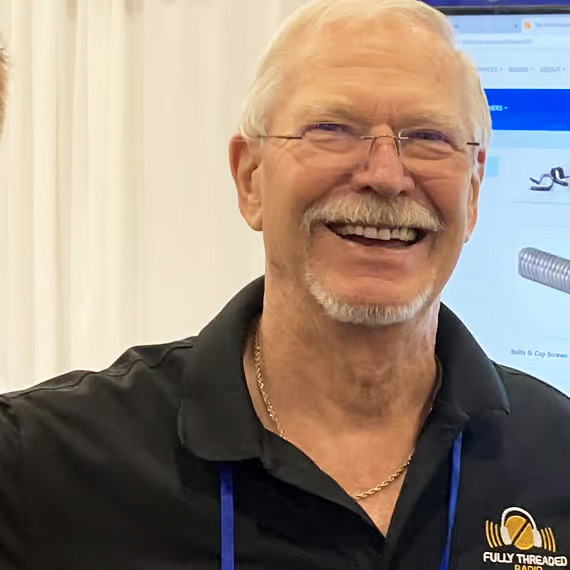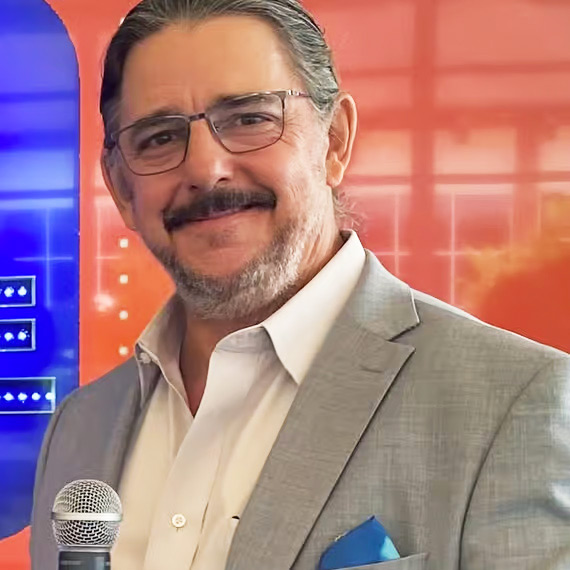
The good old days of the fastener industry are right now, as Jim Derry and Adam Derry of Field Fastener grow their successful family business and learn along the way (1:35:13). Industry pundit, Bob “GQ” Baer asks senior Baird analyst David Manthey to explain the inventory component of the FDI (25:22). On the Fastener News Report, Star Stainless president Tim Roberto Jr. sits in with Mike McNulty to review the encouraging numbers (50:44). Industry educator Carmen Vertullo speaks on the PPAP process on the Fastener Training Minute (1:22:16). PLUS: Fastener Fair USA show manager Blanca Delgado previews this year’s May event in Cleveland (39:37). Brian and Eric keep things predominantly fastener related, hardly mention hydrogen embrittlement at all, and agree that it’s good to be part of the fastener industry.
—
Listen to the podcast here
Important Links
- Bob “GQ” Baer on LinkedIn
- Jim Derry on LinkedIn
- Adam Derry on LinkedIn
- Mike McNulty on LinkedIn
- Carmen Vertullo on LinkedIn
- FTR@FullyThreaded.com
- Dave Manthey on LinkedIn
- Laurence Claus on LinkedIn
- Martin Pepin on LinkedIn
- Tim Roberto Jr. on LinkedIn
- Blanca Delgado on LinkedIn
- McNulty@FastenerTech.com
- CarmenV@CarverEM.com
- Chris Pauli on LinkedIn
- Brian Musker on LinkedIn
- Eric Dudas on LinkedIn
- Southwestern Fastener Association
- Baird
- Field Fastener
- Fastener Fair USA
- Star Stainless
- SmartCert
- Fastener Training Institute
- Birmingham Fastener
- Skidmore-Wilhelm
- Industrial Fasteners Institute
- LindFast
- Brikksen
- Abbott Interfast
- Fastener Technology International Magazine
- Fastener Industries
- Big Timber Construction Fasteners
- PennEngineering
- Endries
- KATO Fastening
- Howmet Aerospace
- Bulten
- Semblex
- Institute for Supply Management
- International Fastener Expo
- Lindstrom
- Stelfast
- Hi-Q
- Fastener Distributor Index
- Carver Labs
- National Fastener Distributors Association
- Microsoft Power BI
A Great Industry To Be In
Introduction
It is Fully Threaded Radio, the voice of the mighty FCH Sourcing Network. If you buy, sell, manufacture, import, or frequently think about industrial threaded fasteners, this is the show for you. I’m so glad you clicked in. Everybody, Eric Dudas is with you again. I’m joined, as always, by the co-host of Fully Threaded from somewhere deep inside the data lab over at FCH West. He’s an honorary lifetime Texan, Brian Musker. What’s up, Brian? Are you able to break away for a couple of minutes and talk to us?
Yes, just for two. You missed out the bit about maybe you dream about fasteners, too. Maybe you have nightmares about fasteners occasionally.
It’s probably all of the above. With the whirlwind of high-intensity fastener experiences I’ve had, I’m in that camp myself.
I could tell. In fact, you just arrived back from somewhere else.
I got back from Fort Worth, the Southwestern Fastener Association Spring Conference. We talked about it on the last episode. It was a blast. We’ll speak on that in a few moments on this episode 199 of Fully Threaded Radio. We’re publishing this time a little late because of aforementioned travels, but we’ll be getting it out there if all goes well.
It’d be a pleasant chance to have you back in the office. I was wondering whether you’d turn into a professional event attendee.
It feels like it sometimes, Brian, but the guy’s got a show too, as well as taking care of all the other FCH business. That’s what we’re doing here. I’m glad you clicked in, everybody. We’ve got a pretty good episode. We’re going to launch things off by drilling into an obscure topic that only Bob “GQ” Baer could think of regarding the Fastener Distributor Index. Many of you know that he’s pretty much our super pundit and a fan of that index.
He is the guy who makes the graph for us every month.
He does that as well. He came up with one of his obscurian questions. I couldn’t answer it. We threw it over to Quinn. Finally, we got Dave Manthey, Senior Analyst over at Baird, to jump on a call with us. We’ll open up the show with that. On the feature segment, it’s Jim and Adam Derry of Field Fastener. Jim is a long-time serial guest on the show, although not for a little while. Adam is the president over there at Field. We get them together on this conversation to talk about what’s going on over there and what it’s like to run a highly successful family fastener enterprise.
It’s been successful for a long time, too.
They just keep going. During the conversation, we have to insert the topic du jour, which is AI, and hear what they have to think about that and what the impact on the fastener industry might be from their perspective. Plus, Blanca Delgado is running Fastener Fair USA. She drops in to warm up the news segment for us and gives us a highlight of everything that’s going on there, including the big NCFA boat cruise and Rock and Roll Hall of Fame Welcome Bash. It’s going to be a big one in Cleveland. That’s happening May 22nd and 23rd. She’ll throw all the details at us.
On the Fastener News Report, Tim Roberto Jr. of Star Stainless joins Mike McNulty. The FDI is looking pretty good these days. Tim picked a good one to jump in on. He and Michael kicked that around. On the Fastener Training Minute, Carmen Vertullo drives into the automotive sector with a question on PPAP. When do you worry about updating the documentation and all that? It’s a little bit of a confusing area. Carmen weighs in on that. Despite the swirl of activity, you’re buried with data. I’m traveling all over the place doing this and that. We’re going to get it out, Brian. What do you think?
We need to.
We also need to hat tip our fine partners on this endeavor. We couldn’t do it without them. Brian, please.
I always say we’re very lucky. On your recent trip down to Fort Worth, you would have met most, if not all, of our sponsors down there. That’s the good thing about these shows. We get to meet these people and get to talk to them again, who we’ve become friendly with over the years. Remember, if you think of fasteners, you should think of these sponsors first because they bring this show to you.
The title sponsors of Fully Threaded Radio are Brighton-Best International, Goebel Fasteners, and Star Stainless Screw Company. Brighton-Best International, tested, tried, and true. Goebel Fasteners, quality the first time. Star Stainless screw company, right off the shelf. Also sponsoring Fully Threaded Radio are Buckeye Fasteners, BTM Manufacturing, Eurolink Fastener Supply Service, INxSQL Software, J.Lanfranco, 3Q, Inc., Volt Industrial Plastics, Würth Industry North America, and Solution Industries, home of solution man.
Reach out to us anytime. The email address is FTR@FullyThreaded.com. You were right, Brian. Down at the Southwestern Fastener Association Conference, the big sponsors were all represented. Lots of coverage is out there on LinkedIn and so forth. We’ll get back to that in a moment. I was glad to see Rick from Buckeye Fasteners out there. I didn’t expect to see him. He is more of a Cleveland guy. Seeing him in Texas was a new thing, but Buckeye has spread its wings.
We’ve had a very long association with them. It’s a good one, too.
Before we get back to that, I want to mention the golf highlights down there because I could feel the energy surrounding that event. I rolled into town right as those guys were coming off the course. Did you know that March was National Women’s History Month, Brian?
I did not. I’m sorry.
I didn’t either. You must have been in the data lab that whole time, but it was. I’m glad for it, too, because I’m sure it went well. I saw this flyby from our friends over at 3Q. I thought I’d take this opportunity. It was as part of the National Women’s History Month celebration that 3Q wanted to highlight Anna Maddelein, their HR representative. They did a little thumbnail of her.
There’s a factoid in that thumbnail that stuck out to me. I thought I’d share it with everybody because I didn’t know this. Maybe you did. We should have asked Scott Camp with Atlas Distribution. I should have asked him about this when I saw him down in Fort Worth. The fun fact is that 3Q means thank you in Mandarin Chinese slang. Did you know that?
I had no idea. It must have been Mark who dreamed that up. That’s obscure.
3Q, Inc. is a longtime partner and a big supporter of the Fastener Training Minute. 3Q to you, too, 3Q and to Anna.
Mark and I usually meet on airplanes flying back from shows or occasionally in an airport.
He’ll be out here in Cleveland in May. We can 3Q him out there again. Getting back to the Southwestern Conference, we talked to SFA President Brad Burel on Episode 198 of the show and did the preview on this. We talked about barbecue most of the time. When I got into town, everybody was out on the golf course, and so I strolled down to the Stockyard area. He talked about that a little bit. I’d never been to Fort Worth, Brian. That’s your stomping grounds, isn’t it, or right next to where you used to spend a lot of time?
Yes. I was taken numerous times to Fort Worth, but I lived in North Dallas. It’s an interesting place. It had some great museums and art galleries, too.
The Conference Hotel was right there, so it was nothing for me to walk over there. I was starving. I went right to Riscky’s Barbecue across from the Stockyards. I was going to have brisket, but when I saw they had all-you-can-eat beef ribs on the menu for $18, you know what I ordered.
Was it good? Was it as good as the barbecue we had down in Austin?
I was pretty happy. It was all-you-can-eat that caught my eye because those things are so expensive. I love beef ribs. The main reason I don’t cook them more often is that they are so expensive. I got a second helping, and I was happy. I rolled out of there in time to see the cattle drive, so-called, and go down the main drag. That’s quite the tourist crowd-pleaser. They got the Cowboys out there. They’re moseying along with these longhorns. It’s not quite a huge herd, but you get the idea what it might have been like back in the day when these were going on. These things were a mile and a half long.
The center of the cattle trading part of Texas was the Fort Worth Stockyards.
It’s a very historic area for a lot of reasons. I noticed that the next day, when the SFA went there as part of the conference, they put some videos up on LinkedIn. I’m sure they’re elsewhere too, if you’re interested, folks. One of the highlights of that meeting was the golf, and it was the buzz during the welcome reception later that night. There was a lot of competition. I could tell it was friendly, but it was there.
As they were coming in, I was waiting down in the hotel lobby. I was hanging out with Heidi Volltrauer in the lobby bar as they were rolling in off the course. There were several teams that thought they might have had it in the bag. Rob Reynolds was on one of the teams that had pretty high hopes. They shot eleven under, so they did well, but it wasn’t to be, Brian. Another near miss for him.
As it turns out, newly announced Brighton-Best Atlanta warehouse manager Tom Stocking and his team took it this time. They had minus fifteen. They were quite happy. Tom was joined by Rene Gutierrez of Nuts and Bolts, Rusty Wicks of All-Spec Sales, and Dick Slusser, a retired fastener veteran. A lot of you guys down in the Southwest know him. They were feeling pretty good there at the welcome reception later that evening. It was a great time. Tom Buddenbohn was in fine form. I didn’t ask him about his golf score, though, Brian.
That’s fine. We’ve known Tom for many years.
His lady, Becky Buddenbohn, is the executive director of the Southwestern Fastener Association. Brad Burel is running the show down there. It was an excellent job by everybody. The sponsors came through for them. The day one program launched with Lonni from SmartCert. She gave a nice presentation on technology and change. As it turns out, she left her notes at the welcome reception. I guess that was the story. I don’t know, but she did it off the cuff with just her slides. I got to say, Brian, she’s a natural.
That would be very hard to do.
She’s a pro. No wonder SmartCert is taking off the way it is. We’re going to let this episode take off. After a word from our partners, I’m going to talk a little bit about my experience at Fastener Week with the Fastener Training Institute before we get to our conversation with Bob “GQ” Baer and Dave Manthey on that FDI question. Do the best we can here, even with very few notes. Make Lonni proud, Brian. Thanks for tuning in, everybody. It’s Fully Threaded Radio.
—
Fastener Training Week: From Theory To Real-World Failure & Industry Insight
Before we get too far into this, why don’t we start the episode with the clip about the Bay Bridge and the hydrogen embrittlement?
That’s going to roll nicely into what I want to talk about here with Fastener Week, Brian. Thank you for asking. It turns into the Salim Brahimy show at the end of Fastener Week. It was very appropriate because it’s a high-intensity week. You’re getting all kinds of information. It’s bell to bell every day. On Friday, he wrapped up the whole thing with a presentation on the Bay Bridge hydrogen embrittlement case, which Salim was deeply involved in. It’s a slide presentation that he gives. It’s a great way that rolls the whole week into an actual super high-critical example of why fasteners are so important.
Why regulate them is important, too. This is the story of when rubber hits the road. There are all the procedures and all the theories. Finally, you come down to realize what happens when the rules aren’t properly applied.
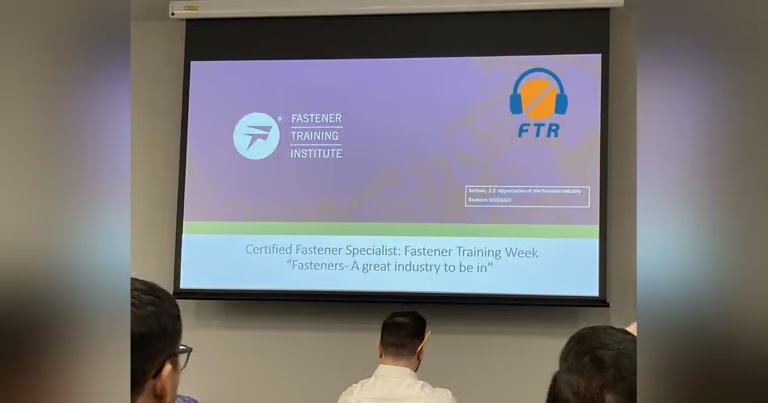
There are procedures and theories, but ultimately you realize what happens when the rules aren’t properly applied. Share on XThe last full day of class work also centered on fatigue and fastener failure reasons. It builds. Going back to the beginning, I want to give a big hat tip to Laurence Claus and the whole FTI because I know it’s a very intentionally developed message that they present. When we sat down on Monday, the first slide that came up set that tone. It said, “Fasteners: A Great Industry to Be in.”
Laurence then proceeded to spend about 15 to 20 minutes discussing the significance of fasteners, a little bit of history, and why the industry is so important. Why is it such a cool thing to be a part of? There were a lot of younger people in the group and a lot of people who were newer to the industry, maybe not necessarily all younger. It was such a well-presented and necessary message. Good job to Laurence and the whole team on doing that.
It does get back a long way.
I learned a lot from the history side of it, too. I went there to survey the whole thing and to be able to understand the industry better. I feel like I owe it to the industry at this point, but being more of the liberal arts-minded guy that I am, I always like to start things with the history. I sometimes even get a little lost on that side of it. They did a good job of touching on it and then moving on to the highly technical aspects of it. It’s all part of Fastener Training Week, which I can now strongly recommend to anybody.
A very well-educated industry is a good industry.
We should point out that Würth Industry North America is a sustaining partner of the Fastener Training Institute. The Cleveland edition of Fastener Training Week was sponsored by Birmingham Fastener. One of the other cool things, Brian, and we mentioned this in a previous episode, is that Brighton-Best International hosted this. As it turns out, we were the first group to go through their new training facility out there in Strongsville, Ohio. It’s a state-of-the-art training facility just as advertised. I was extremely impressed.
BBI does things pretty well. When we went there, it was just their brand-new distribution center. Didn’t we?
That’s right. Yes, a couple of years back. It seems like just the other day, but it was a few years ago. They had their tour and all. They added another 200,000 square feet, plus this training facility and test lab, which is coming online. Frank Devito and Bill Davis walked a group of us through there and showed us their new packaging and secondary processing area. They’ve got a ton going on at Brighton.
It might be time for another visit for me. You’ve already seen it.
You’ll get that chance because they’re opening their doors during Fastener Fair. I believe it’s on the first day that they’re going to have shuttle service to and from the convention center. I hope they have city barbecue again. It seems to be the house barbecue of Brighton. We had them one day and, man, did they do a good job. You won’t be disappointed, folks. If you go out there for the tour, make sure you try a little bit of that, too.
Barbecue sneaks its way into the things that we talk about.
It’s funny how that works, isn’t it?
Isn’t it strange?
Don’t worry, though, folks. Bob Baer and Dave Manthey will be coming up here in a minute. They don’t talk about barbecue at all. It’s all numbers and business with those guys.
At the end of it, you’ll understand everything about how to calculate the FDI.
At least the inventory portion, because that’s what they focused on. You’re correct, Brian. They’re all p[]hgfdsbusiness. It’s somebody else who is not all business, but predominantly a fastener-related guy, Martin Pepin, over at Spaenaur. He was sitting behind me. It turns out he’s a longtime Fully Threaded fan, which is so cool. He was going there for a CFS refresher. He’s an industry vet, and I think he was just brushing up. I don’t know, he might have just been there to kill time. What do I know? We had a few good conversations. He’s a hardcore fisherman. We got a couple of good stories swapped while we were on the breaks.
You never know who you’ll meet at these things. That’s all part of Fastener Training Week. Another noteworthy thing that happened, Brian, John O’Brianen is the CEO of Skidmore-Wilhelm. He came out for one day when we were doing torque tensioning training. He was there in the test lab with a couple of his devices. We were all able to lay into the torque wrenches and talk about the mysterious K-factor, among other things.
This is the thing that we’ve had probably three or four mentions about, the Skidmore-Wilhelm instrument.
It’s the torque tension tester.
For the Fastener Training Minute.
Two or three, what are you talking about? Yes, the one and only. It turns out they’re right down the road here in Solon, Ohio. John is a very interesting guy. I’m going to get him on a future episode as he got the stories. I’m not going to spoil it but I’m going to have him on to talk about something in particular that everybody who drives on the highway is going to be interested in.
As a follow-up, after Fastener Week, Carmen came into town. He and I went over to the Skidmore-Wilhelm facility. He had to bring a couple of units in for some service, so I had a chance to talk further with John, a super interesting guy. They’ve got quite an operation there. They do much more than just the torque tension testing devices. I learned a ton. After that, we headed over to the IFI. Carmen’s a committee chairman of one of the B18 committees. I got a chance to sit in on an actual B18.2.1 standard revision meeting.
There are hex heads, flange bolts, tap bolts, hex bolts, machine bolts, and cap screws. There’s a lot.
Plus, don’t forget the lobed heads. There was quite a bit of discussion about multi-lobularity, Brian.
Socket, too. It’s a fairly wide set of sockets and hexes.
It’s one of the most dramatic of all the B18 standards. Salim and Laurence were there. That was cool to see them in action. I don’t know if they noticed me. I was hiding in the back of the room drinking my coffee, which was not you, Bolt Blend, I guarantee you that. They were there doing their work. Darlene from Solution was there. She’s been on the show. It was great to see her in action as well. I saw a couple of Fastenal guys there. It was IFI as it should be experienced. That was a little field trip that I made as a layer on top of Fastener Training Week. It drove it home for me.
It sounds like a fairly full week.
That was as I was packing my bag to go down to Fort Worth. I have an okay excuse for not being overly prepared for this episode. Whether that’s true or not, there it is.
We’ll give you a pass just this once.
Thanks again to everybody over there at FTI and everybody who hosted me. A couple of people bought me dinners. Thanks to everybody. I know LindFast, Brighton, and Goebel. I saw Christian and TJ from Brikksen. I saw everybody pretty much. With that, let’s get on to something far more practical for most of our audience. That is this discussion with Bob “GQ” Baer and Dave Manthey of Baird.
Get your calculator out.
—
FDI Explained: Understanding The Diffusion Index & Inventory Signals
I got Bob “GQ” Baer, Abbott Interfast, and the Fastener Training Institute, along with Senior FDI Analyst Dave Manthey, on the line. Bob, you had some questions about the FDI. We got Dave on to talk about it. Lay it on us.
Thanks, Eric. I appreciate it. Dave, thanks for jumping on the call.
Sure thing, Bob.
What this stems from is that I was tuning in to an episode of Fully Threaded. I heard the discussion about inventory. It jogged my memory that when I was on, we were talking about how to gauge whether customers’ inventories were growing or shrinking at a faster pace than respondent inventories. I was looking at the numbers that get distributed monthly by FCH Sourcing Network as a result of the survey and the FDI numbers that are put together. I honestly do not understand the scoring.
I wasn’t 100% sure about how those scores came to be. I remember seeing an inventory number one time at 70, and then a few months later, it was 50. I wondered about that swing. It’s a pretty big swing. I wanted to understand the scoring of that a little bit, how it’s put together, and how you come to post the final number. Do they relate to one another? If I see a 70 on a respondent’s inventory and it was 69 the month before, it tells me it didn’t move much.
If the customer was 50 and now, they’re 70. It would seem to me that my impression is that customers’ inventories are rising quicker than the respondent inventories. It would lead me to believe we might not have such a good shipping month because customers’ inventories are rising at a faster pace than the respondents, who theoretically are the suppliers to the customer. It might not be such a great shipping month. If it were the opposite way, we might prepare ourselves for a larger-than-normal shipping month.
I can tell you the mechanics behind the calculation here. The index here is what they call a diffusion index. You’re probably familiar with these. For example, the ISM PMI is also a diffusion index. The way I always think about it is when you go to the eye doctor. They put the thing on you. They say, “Is this better, or is this worse?” As a respondent, in the case of inventories, you’d say, “I’m seeing them at the customer level growing or shrinking.” I would respond accordingly.
What we do over here when we do the analysis of the numbers that we receive from the survey is we assign values to that. I won’t go into depth on how the diffusion index is calculated, but the way to think about it is that if inventories are growing, that would lead to a diffusion index greater than 50. If they’re shrinking, it would be less than 50. To your example, if it goes from 70 to 60, it still means that inventories are growing. They’re just growing at a slower pace.
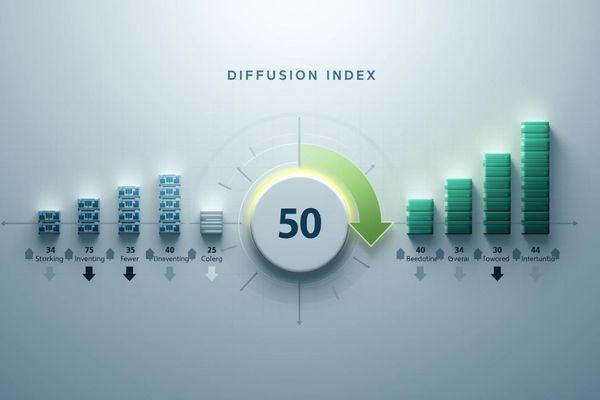
If you get to 50, that means they’re pretty much stable with where they were. This is why when you think about the nature of a diffusion index, it doesn’t stay below 50 for a long period of time. Going back to that eye doctor analogy. When you think about it, “Is it better? Is it worse?” It would be very unusual for you to say, “It’s worse. It’s worse. It’s worse. It’s worse,” for a year in a row.
At some point, you’re going to say, “It’s bad, but it’s the same as it was a minute ago, or the opposite in terms of getting better.” At some point, it’s like, “Yes, it’s perfectly clear,” and then you start going the other way. Net-net, there is a gravitational pull towards that 50 number. That’s how we calculate the index. That’s what that diffusion index means.
I understand a diffusion index. I suspect that’s how it worked. I did see your note about how the numbers count and then divide by 100. I understood all that. My hang-up is the change in the number, not necessarily the fact that it’s up or down or above 50 or below 50, but the rate of change. If a customer’s inventory was 50 last month, that means it was neither growing nor shrinking compared to the previous month.
If it goes to 70, 20 points up on 50 is a 40% increase. If respondents were 40, and they went to 45, that’s an increase. It’s still growing. It’s below the line, but it’s growing. It’s a far less percentage-wide. It’s more like 12% to 15% change only. Does that mean that the customers’ inventories are growing at a faster pace, or is it just an accounting of the number of people responding?
It is the latter. In terms of the respondent inventories or the customer inventories, we’re asking them, “Is it too high in line or too low?” Those are the responses they get, so that the change in the number is related to the number of people in each of those buckets. It doesn’t have anything to do with a magnitude per se. It does have to do with clearly if it moves a lot, that means many people are moving to one side of the boat or the other.
I don’t know if you can read into it in a linear fashion that a percentage in one is directly correlated or related in any way to a percentage in the other, other than maybe if there’s the same number of respondents in both buckets and then the same number of people move one way or the other that would lead to a similar percentage change. Even if your starting point is different, you can have the same number of people move. That would lead to a different percentage. I would be a little bit hesitant in terms of looking at that as a percentage relationship.
That clarifies it for me because I made a statement about inventories moving higher in one category than the other. That was based on what I thought the number meant, which turns out to be incorrect. I’m glad we got this straight because I do look at that. I thought that would be a good metric to add to the monthly report. With clarification, it turns out that it’s probably not a good number to add because it’s just a statistic and not an indication.
You’re one of the most inquisitive of all of the FDI pundits that I’m aware of, Bob. You always do a very thorough job in anything you’re involved in. Thanks for being our watchdog. I’ll tell you both gentlemen, by the way, after this segment, we’ve got coming up, Mike McNulty and Tim Roberto Jr. will be poring over the March numbers of the FDI. What I hear the most often misunderstood about a diffusion index is the month-to-month nature of it. The number is supposed to represent and be referred to as relative to the previous 30-day period. I’m constantly trying to remind people about that.
That’s a good point because people just look at that number. The numbers could be interpreted in any number of ways. We all understand it, but it’s great that we got some clarification on it because there are a lot of numbers here that make up the index itself. As Dave said, we’re not breaking down the index. I was curious if there was a way for us to measure inventory levels and whether they were going up or down compared to one another.
It’s certainly something we could look into for the future. Some of those elements are captured in the analysis that we do for the forward-looking index. I would say that the biggest factor here is when you’re thinking about that diffusion index. If it moves a lot, there is something to be said for that. If it moves a lot, that does mean that there’s a large number of people who are moving from net from one bucket to another in that direction. It’s definitely got a lot of value as it relates to the movement within the category, but you can also compare it to history. If we were comparing one versus the other, that might require a little bit more thought. We’d have to analyze things slightly differently.
I understand. Let me throw one question out there. Is it pretty clear that the assumption that if customers’ inventories are below the line and shrinking, and respondents’ inventories are above the line and growing. We could say that they’re going in the opposite direction. If customers’ inventories are shrinking, I almost feel like that indicates that we’re going to have some good shipment months coming up, assuming they’re below the line.
I would agree with that. That is one of the elements of the forward-looking indexes that we look at. If customer inventories are seen as being too low, that’s a positive indicator for the FLI. That’s part of the reason we put it together that way. It captures that. You’re saying, Bob, that if the customers’ inventory levels are currently too low, that would imply that in the future, those should try to top up and get to a point where they’re in line with where they should be, or even maybe slightly over-correct. That would lead to a number higher than that. It would imply and indicate a better shipment number going forward. I agree with that.
The mystery of my question has been solved here. I appreciate you coming on again.
I sure do appreciate it, Dave. Bob and I were wrestling with this one for a while. We got Quinn Fredrickson involved initially. He answered it pretty adequately, but as I said, Bob is one of those guys. He gets an itch. It must be scratched.
It’s my pleasure to come at any time. let me know. I was happy to go through things. Best of luck, everyone.
I appreciate that.
Once again, Bob “GQ” Baer, Abbott Interfast, and Dave Manthey, senior analyst at RW Baird. He, along with his partner Quinn Fredrickson, does a great service for the fastener industry by providing those numbers for the fastener distributor index each month. We’ll be right back with more Fully Threaded Radio.
—
Fastener Fair USA Preview: Shows, Strategy & Networking Highlights
Brian and Eric are back with you. It’s the new segment, Brian, your favorite. This time, Mike McNulty’s coming up with Tim Roberto Jr. of Star Stainless. They’ll be taking a look at the FDI, which is in cruise control, Brian, as you know, in a good place.
It’s cruising just like we want it to cruise.
That’s right for the moment. Let’s keep things steady as she goes, and as always, by Volt Industrial Plastics, as it has been for many years. As we said, that’s a good place to be for the FDI. A good place to be this spring is Cleveland, Ohio, because Fastener Fair USA is coming up, Brian. That’s happening May 22nd and May 23rd here in the fabulous Mistake by the Lake. Running the show over there is Blanca Delgado. She’s here with us now. What’s up, Blanca?
How are you doing?
We’re good. Thanks. We’re very glad that you’ve joined us here. You can tell us all about the show, which we love, incidentally.
First time coming up. We’ve been getting to know you because I don’t know if you’re filling in or you’re taking over for our good buddy Bob Chiricosta, but I did talk to him earlier. I know a lot of folks are used to him usually giving the preview. He’ll be there. He’s overcoming some medical challenges, but he’s in good spirits and doing better. It’s great to talk to you, Blanca.
We’re missing Bob, but he is still in the background. I get to talk to him weekly, so we figure out what’s missing and what’s going on. We pretty much keep it on the personal side and see how either of us is doing. Best wishes to Bob. I love that guy, so it’s always good to catch up with him. I’m happy that he is going to be at the show. He’ll be walking around.
He’s made a lot of friends over the years. You’re on the scene. It’s been great getting to know you as well. You were telling us before we turned the recorder on that you have quite a history in the trade show industry. You have some thoughts on it. We’re going to have some fun with this. One thing that stuck out to me is you came up with a very good suggestion in your approach to marketing handouts and stuff. As you know, Brian’s a little stingy with the pens.
I’m very stingy. I don’t mind giving pens to people who are interested in talking to us. I don’t like these people who just walk by and pick up a bit of everything, no matter what.
I had to sneak in and grab a pen from you guys one time.
Careful. Don’t let them see you doing that. What’s your take on marketing giveaways? A lot of people give them away at these shows. It’s a lot of fun to do that, but you’ve been thinking about this for a while now in various industries. What do you have to say?
The most important thing is that now that we have websites and all that stuff, people can always look at your materials already on site. They know who you are. You know who your customers are, and you know who your potential customers are. The best way to approach that is giving them the information, knowing that you’re going to be at a show. For Fastener Fair, you definitely want to reach out to them early on.
Having websites and digital materials, people can already see who you are and what you offer before they meet you. You know your customers and potential customers. The key is to give them the right information in advance, especially when they already… Share on XTell them, “I invite you to my booth.” We give out CIP codes. They’re invitation codes to give them free entrance to the show. At that point, when they do show up, when you do set up a meeting with them. That’s when you should give them the gift. That’s when you should say, “We made this gift for you. Thank you for coming.” This is the time that you want to do that face-to-face approach.
Everyone’s used to, “I’ll talk to you via email or phone call.” Mostly, email talks now that you want to take advantage of that face-to-face stuff. That’s what trade shows are for. That’s the part that you want to be part of. Being in front of your customer in one place is going to give you much more of an ROI than just giving them a pen. They’re probably going to stick with the rest of their pens and never see it again.
Is Brian right?
He’s like, “You’re only going to get this pen.”
This is a good pen. I don’t mind you having it if you’re going to use it.
I still like the magnet idea, though.
Sorry, we stopped doing magnets.
More banter from before we turned the recorder on. We’re never going to live down that whole idea of the magnets that didn’t stick to anything, but we’re here to talk about Fastener Fair. It’s coming up. You know all about it. Why don’t you give us the rundown for this year’s edition, because it’s sounding like a big one?
We have a lot going on, for sure. First, there’s going to be a Fastener Fair conference that FTI is doing, the Fastener Training Institute. That starts May 21st, the day before the exhibit hall even opens up. Joe set up a very good conference that’s going to be geared toward OEMs, engineers, and such. Hopefully, the next day, on May 22nd, it will continue on the show floor. They’ll have an “Ask the Experts” panel, and then we have the Young Fastener Association, too, having an education in the theater. There’s a lot of stuff going on.
On Tuesday, May 21st, the day before the show, the North Coast Distributor boat cruise is happening. That’s always a fun activity that the North Coast Fastener Association is setting up. Information you can find on our website regarding that, and how to register for that.
That’s going to be huge. The cool thing is, every time I talk to Mike Robinson, the President over there, I ask him, “How many people can you fit on this boat?” It seems like it grows by 100 every time I ask him.
It is a big boat. We will have shuttles. You can get picked up at the conference to shuttle you guys over there. It’s a walk. I tried walking. It’s a good fifteen-minute walk. It’s doable, but I’m out of shape, so take the shuttle.
That’s at 5:30, on a good time, out on Lake Erie. They’re going up the river as well, as I heard.
Yes, it’s a couple of hours. There’s going to be food and drinks there, too, so that should be fun. On the day of the show, the trade show opens. There’s still going to be the conference going on and exhibitor activities going on, too. I am going to have this area where we’re going to showcase a few fasteners. It’s going to be called the Innovation Station.
You could take a lot of photos and things like that in that area. We also have the huge networking party at the Rock and Roll Hall of Fame that’s going to happen from 6:00 to 9:00. We’re going to have live music. It’s going to be Radiate Live, who’s going to be performing. It happens to be the band of Tim Vath from Solutions Industry, so that’s exciting. We’re also going to have an open bar, appetizers, and access to the garage, which is on level two.
Other folks can come in and record their music, play the guitar, and do anything they want. It’s a cool area. I got to view it, so I walked around. You could spend all day in that place. If you guys have any musical talent, you might want to get those little shaker things. What are they called? Get back there. You’re going to be one of the backup dancers.
I don’t think I’m going to be a very good backup dancer. The people would bring out a wheelchair in case something goes wrong.
Have you ever shaken a box of grade two number eight screws? It sounds like a maraca.
Someone should do that. Just shake up a little box. What’s next? After that, the next day of the show, the 23rd, the show floor opens. It’s going to open at 10:00. We also have a factory tour happening from Brighton-Best. We will have a shuttle going out at 11:00. They’re going to have a special lunch and a tour of the new facilities that they opened up. That wraps it all up.
Once again, May 22nd and 23rd are the days that the show is open. You can get a lot more information and details on this, plus registration, at FastenerFairUSA.com.
We also have a conference full package of $600. You get lunches included in that package, plus the full conference and everything else, such as the networking party, getting into the show, and some added bonuses. You could use the shuttles. You have a bit more VIP treatment with that badge. Other than that, you do have the different badges. Also, most customers can go to their exhibitor to get the CIP code to get entrance to the show for free.
That’s a great thing to stress, Blanca. If you’re an exhibitor and you want to get your people on the floor, make sure you take advantage of that CIP code. Blanca will be happy to help you out there, too. She’s got a team working to smooth things along for Fastener Fair USA. We’ve been promoting it all along. We look forward to seeing you out there, Blanca. It’s such a lot of fun talking to you. Before we turned down the recorder, something else you were telling us is that years back, when you got your start in the trade show business, you were involved in beauty shows. That’s got to be a big departure, although not too big, from fasteners, when you think about it.
Fasteners are a lot sexier.
Eric’s view is that the only way you can get people to stop by a fastener booth, since they’re all so boring, is that you have to have some model draped over one of the tables in your booth.
It’s been discussed.
I remember walking through the Fastener Fair Mexico show. They would have these women in every single booth. You would ask them, “What are you guys selling?” They’d just hand you a pamphlet. They wouldn’t tell you anything about the booth.
That’s how they do things in South America. I’ve been to a few shows down there. It’s a different world. It’s going to be good. We’re going to see you there. We’ll see our sponsors there as well. I might as well mention them right now because they are the title sponsors of Fully Threaded Radio. They are Brighton-Best International, Goebel Fasteners, and Star Stainless. Plus, the star of our next feature will be there. Blanca, Bob has done this for us when he’s introduced the shows in years past, but you’re here. You know what to do next.
I’ve been looking forward to this part. For news about screws that you can use, here’s Mike McNulty.
Thanks, Blanca.
—
FDI 53.0 & Fastener News: Markets, Manufacturing & Outlook
This is Mike McNulty from Fastener Technology International Magazine, bringing you the Fastener News Report, which is sponsored by Volt Industrial Plastics, makers of the world’s finest plastic fasteners. I am on call for jury duty. I’m headed to Düsseldorf, Germany, to enjoy some alt beer, pretzels, sausage, and the excellent fastener exhibits of the Wire 2024 Trade Fair, while musing about the temporary darkness of the solar eclipse and March Madness games being played in April. I am still focused on fasteners and ready to deliver the Fastener News Report.
In this episode, Star Stainless Screw President Tim Roberto Jr. joins us to reveal the results of the Fastener Distributor Index, also known as the FDI. Also, in this broadcast, we have our top story from the Industrial Fasteners Institute, as well as newsmaker headlines from Fastener Industries, Big Timber Construction Fasteners, PennEngineering, Endries, KATO Fastening, Howmet Aerospace, Bulten, Semblex, and more. On the back page report, we are going to talk about car lovers.
The seasonally adjusted Fastener Distributor Index for March 2024 jumped up to 53.0 versus 50.5 in February. This was the highest FDI recorded since November. The forward-looking indicator, also known as the FLI, was practically unchanged at 47.3 compared to 47.9 the previous month, and the second straight sub-50 result. Fastener Distributor Index data is collected and analyzed by the FCH Sourcing Network and Baird. The FDI seeks to identify demand, pricing, and outlook trends within the American fastener distribution industry. To get some insight into these results, we’ve talked to Star Stainless Screw President, Tim Roberto Jr. Tim, thanks for joining us on the Fastener News Report.
Mike, thanks for having me.
It’s good to have you back. The last time you were on was the beginning of summer 2023, so we’re glad to have you back. I would like to let you dive in and tell us what you think about the FDI results.
I wanted to wait until it got better before I came back. It seems like it bounced back. It’s good to see both the FDIs. It’s indicative of what we’re seeing in the market, but I was a little surprised by the FLI being a little bit lower than I would have anticipated. There’s a lot of narrative that’s being spread out there that causes maybe some uncertainty and fear in the market about what’s coming.
It tempered the forward-looking. We’ll get into some of the six-month outlook numbers later on. On the positive side, the sales and employment numbers both increased. If you calculate by percentage, it was 19% and 12%, respectively.
It was impressive.
The other numbers we had, the deliveries and pricing, both dropped. I’m not sure what that is foretelling. Delivery and pricing dropped, and inventory was basically unchanged. Any insights into those results?
People are starting to get squeezed a little bit on deliveries because of some of the geopolitical issues that are going on between the Red Sea and in different areas of taking longer to get into the ports. You have the Panama Canal, that’s been an issue. You have so many different avenues that are causing a little bit of havoc, both in the delivery time. We’re also seeing that in the freight rates that are going up for those containers coming in from overseas. That’s causing a little bit of havoc in the supply chain.
When we get into the comments, there were a couple of comments about freight and shipping being a problem. I mentioned the six-month outlook. It retreated for the second straight month to what I see as an unprecedented, completely balanced result of 33%. One-third of the people expect things to be better in six months, 1/3 expect it to be the same, and the final third expects them to be worse. I don’t know what that triple 33% is.
That is an impressive breakdown of what people were thinking.
It was 47% expecting it better, 34% the same, and 19% worse. It’s pretty much like the better people shifted over to the worse, or a combination from the middle. When I first saw those numbers, I thought maybe that’s a typo, but then I read in the commentary that’s how it came out completely equal.
That is indicative of the narrative that we’re hearing out there. There’s always that fear in the back of our minds. We’re always worried about an election year because there are uncertainties that go on there. As I’m looking through some of the economic indicators, there are a lot of positive things that’re going on out there as well. That’s showing us that things are good and going to continue to improve.
I know Bob Baer helps to track the US PMI through the Institute for Supply Management, which was 47.8 in February, but in March, it came out that it’s up to 50.3. That’s a positive. It’s the first time it’s been positive in sixteen months, which is definitely impressive. The PMI is helping us to see where things are going because you’re getting ahead of those purchases, so that’s a positive thing. The Philly Fed has a manufacturing index that they follow as well. That was also back in the positive. If you look at the six-month, it grows even greater. They’re anticipating that in six months, it’s even going to get better.
There’s a lot of head scratching. You hear lots of complaints and fears, but then you look at a lot of, like you said, positive stuff going on.
Ultimately, it depends on what news cycle we’re listening to and what people are telling us. There’s a lot of fear when you have your money tied into your inventory. Those decisions you’re making sometimes are going to lean on the side of being a little bit more conservative because you don’t want to hang yourself out there. For us, as we see some of those indicators, that’s given me some respite that it does look like it’s getting better. In fact, you see that the US economy has weathered this storm in the midst of these high interest rates, inflation, and other aspects that we’ve been up against.
Supposedly, I’m hoping that in June we’re going to see some relief on the interest rates if the Fed holds to what they said. For us, we’ve been facing all those aspects of it and still coming out strong. When you compare us to the world economies, as I talked to our manufacturers overseas. They’re saying the US is strong, where Asia and Europe have been lagging, at least on the fastener side. I don’t care about the rest of the industries, but I’m going to focus on the fastener side of things.
Fasteners feed every other industry.
They’ve said that it’s been very strong, and that I take heart in. They’re seeing it in the US. We’re feeling it somewhat as we do the day-to-day. You see some inability to continue to commit to long-term things. You see people who are still a little timid in that area. At the same time, what we’re seeing is still strong. The indicators continue to point that way moving forward. I’m definitely hopeful.
That’s good to hear. I don’t follow it in detail, but commodity prices seem to be doing unexplained things as well. I get some newsletters from different commodity people. The same thing. They’re not sure what’s going on, but everything keeps going forward.
We’ve seen it on our side, especially. We focus a lot on the nickels. Being Star Stainless, the main index that we follow is the nickel. It’s been all over the board between the issues going on with the Ukraine war that caused some havoc in that market. It got better, improved, and stays pretty steady. We’re seeing it come back down a little bit. That’s also an indication of what’s going on in the world market. The overall world market is still a little soft, especially when you look at China. Which consumes a huge percentage of the world’s nickel, up to 51% of the world’s nickel. If they’re going to lag, you’re going to see nickel going to have a hard time continuing to bounce back in those kinds of markets.
I’ve seen the same thing on copper and some other metals, and it’s like that. The guy who gets his newsletter is like, “I don’t know what to say.”
That’s a great point.
The thing is, you don’t try to prognosticate it. You just go with the flow.
If we could have such accurate forecasting of where that commodity is going to go, we’d be in a lot different position.
Anything else you want to comment on the numbers before we jump into the commentary?
It’s very hopeful. When you see the 53 on the FDI, that’s a good sign of a healthy market. We’re seeing it. Most distributors that we talk to are feeling that as well. There is always that anticipation. It’s always that fear of what’s the next shoe that’s going to drop between the geopolitical and things we face. That’s where you’re going to see more timidness in the FLI. The FDI is near and dear to our hearts because that’s exactly what’s going on, and we’re seeing that. I’m hopeful, but I’m happy because I’ve seen that as well.
I’m glad you brought up the PMI because that is an inflection point. There were sixteen months of being below 50. It crept up over the top. That’s good.
That was exciting to see. That shows that things are improving and getting better in areas where we had felt like it was almost stagnant for a while.
Let’s jump into the commentary. I’ll go through and read some of these. If you want to jump in with any comments on those, feel free to do so. Overall, demand commentary leaned positive, but freight and supply chain negativity was an offset. The first comment is, “The last twelve months have been surprisingly good for us, praying for no Black swan events in the coming year so we can continue this trend.”
I would echo that, but to your point, that is the great unknown. We have no idea with everything else that’s going on in our world. That Black swan event is always poking its head around that corner.
Here it comes.
Yes. For us, what we do is we try to plan for those contingencies of what we’ll deal with as it comes. You’ve seen it with our market. The different distributors that we have been very resilient with the things that we’ve faced. When we realize the things we’ve faced and how we’ve overcome those, it gives us confidence that we can face the next challenge that’s going to come.
The next comment is, “March continues the previous two months of this year with strong demand for our domestic products, surprisingly due to the election year, continuing to ride the wave while it lasts.”
When they mentioned the domestic product, that has to do a lot with the infrastructure bill that got passed. We’re seeing the fruits of that start to slowly come forward. It was slow to come forward, but that’s because you’ve got to plan. You’ve got to project then you go ahead and you implement. We’re starting to see some of that implemented. Those are some significant projects that are going on. It’s been good to see. That’s also helping to give that boost to the domestic market as well, which has been very positive to see.
The last positive comment is, “Good March. Consistent with the February incoming order rate. Hoping for a strong second quarter.”
I echo that. We, too, want that same strong second quarter. It seems like it shouldn’t. For us, what we were hearing at the end of ‘23 is they expected maybe the first half of ‘24 to slow down a little bit and then pick up the second half. If we’ve been pretty strong in the first half, it’s going to continue to be that way. That’s my hope.
On the other side of the coin, a little bit of negative stuff related to freight costs. First quote is, “Prices for products had been steadily coming down in some areas, but out-of-control freight charges drive it back up. Everybody is wrongfully blaming supply, but it is the carriers overcharging without care.”
We saw some of it in the midst of the pandemic. We realized we don’t have a lot of control over those supply chain logistics for the most part when it comes to market pricing. You’re dealing with huge industries that dictate the mode and model of the way that’s going to go. For us, we have to navigate through that. It isn’t as bad as it was. You’ll see little areas here or there where they’ll try to pop through and push for a little bit more profitability.
Overall, what we’ve seen is more slow and steady, gradual rather than this crazy spike that we saw before. That’s also an indicator that we’re seeing a little bit more health and a little bit more competition within the shipping markets as well, which can at least hold it down a little bit, although it’s to the point of the comment that we have seen some definite lanes that have spiked a lot higher.
Hopefully, they’re not grouping. The last comment is more of the same. It says, “I don’t believe pricing is being affected by anything except shipping. The freight companies and ocean freight companies use any excuse to raise the rates. It’s adversely affecting stable pricing. We will see what happens.”
One of the other things you see about pricing overseas overall is that we have to deal with the onset of additional costs that go outside of our main business. Labor is up. Energy is up. Cardboard is up. You have all these other inputs that are up. Our manufacturers are seeing the same inputs that are up as well overseas. Even as the quantity is coming down, capacities increase, so that’s driving the price down.
They still get to that point where they’re going to try and push to get at least not the increase in price, but at least steady pricing so it’s not coming down so quickly. With the worldwide demand, it’s going to hold that off for a while. Overall, what we’re hearing from overseas is that sense that the worldwide demand can’t pop up or sustain any price increase that we’re seeing overseas for those prices at this point.
You mentioned labor. The last comment we have is about labor. It says there are some labor issues in Europe having a negative impact. “Labor strike in Germany is causing delivery issues.” It looks like the strikes are spreading across the world.
Overall, labor is continuing to be something that we have to take a look at. In my home state of California, we raised our minimum wage for fast food workers to $20 an hour. We’re seeing different labor issues come up. It’s weird. My daughter watches kids. She only gets paid $16 an hour. If she were to go across the street to McDonald’s, she’d get $20 an hour. We see different aspects of labor that continue to have some definite influence and impact on what we’re bringing, because that’s one thing that we can’t always control. It’s an external of the things that are going on.
When a fast-food meal costs more than a sit-down restaurant, something will happen.
That’s a great point.
It’s like, “What are we doing? Food through the window.” That’s a subject for another talk. Anything else on the FDI or the comments before we’re going to jump in and let you tell the audience what’s going on at Star Stainless?
I felt very good because it reflected what I was seeing in the market. I was hoping that it was going to be a little bit higher, but it was reflective of what I saw. It was good to see that it was affirming of what we’re seeing and that others are seeing it as well. That felt good, that confirmation of having that from an outside perspective. That’s why I do enjoy the FDI because we only see what we see, but you want to take a more macro approach to what the industry is seeing. This gives a great macro-level look at what’s going on.
Maybe the low FLI was some people straddling the fence. Things look good, but I’m not going to jump all the way over.
I get it.
What’s going on? What’s new at Star Stainless Group?
Star Stainless is continuing to grow and evolve as a company. We launched our eComm, which has been very successful. We are giving people that option. We love that Progressive Insurance commercial where it’s that person when you want it and a computer when you don’t. The model that we’ve always wanted to have is people who are working 10:00 at night to be able to look at inventory or look at a quote.
That gives us those kinds of options, but it also gives transparency to what we carry and helps our customers to get those quick quotes that are out there. That’s been good. We’re continuing to expand the product. That’s been a real big push for us. For the hose clamps, the rivets, and different areas where we weren’t always carrying them before, we’ve definitely had to take a look because we’re getting this feedback from customers about this idea that they love that one-stop shop.
That’s exactly what we’re trying to bring. It’s that one-stop shop that everybody can come to to get. Again, they’re stainless. The mentality that we want to have is that when somebody’s thinking stainless, they’re going to come to us. They’re going to try us out. We’d better have it on the shelf. If not, then I am not doing my job. I’m going to continue to challenge myself to bring that product to our customers and to satisfy exactly what they’re looking for.
The mentality we want to have is that when someone thinks of stainless, they come to us and try us out. We’d better have it on the shelf—if not, I’m not doing my job. Share on XYou mentioned the online stuff. The website is StarStainless.com. I also saw that you guys are the training sponsor for the Fastener Training Institute for their sessions at Fastener Fair USA and at the IFE in Las Vegas.
We’ve always had a good relationship with FTI. We’re continuing to help educate the industry.
That’s a good thing to see. Finally, you’re part of the LindFast Solutions Group. That’s a lot of big names there. You guys are going to be exhibiting together at Fastener Fair USA.
It’s been good to leverage that industry knowledge across brands. When you get a more macro level of what’s going on, you don’t know what you don’t know until you know it. We were dealing with Star as a family-owned company, and then you become part of this larger organization. You get to learn and leverage some of what they’ve learned well, logistics, and those aspects of a business. It’s been a great partnership for Star to continue to grow what we can offer, but also to learn in certain areas and help us to evolve into the company that we know we could become.
I imagine some of the conversations you guys have with your contemporaries and other companies. It is probably helpful to everybody.
That’s the goal of it. That’s the hard take sometimes. You’ve gotten so used to business being the way that it always has, but we have to look at that process improvement because we’re only going to be as good as what our customers anticipate. If we’re not meeting their needs, then we need to evolve as a company. That’s the thing that I love working with Lindstrom, Stelfast, Hi-Q, and Solutions, because that’s exactly what they’re looking to do as well.
Keep up the good work. Thanks for coming on and sharing your hopeful attitude with the audience.
I always appreciate the time. I’m thankful for what you bring, Mike, and Fully Threaded Radio, for continuing to push this narrative out there of what’s going on in the industry. Thank you for what you do.
That was Star Stainless Screw President Tim Roberto Jr. The FDI number for March 2024 was 53.0 versus 50.5 in February. Visit FDISurvey.com to participate in the process and get a detailed PDF copy of Baird’s monthly analysis. For the top story, the Industrial Fasteners Institute, also known as the IFI, announced its 2024 award winners and elected a new slate of leaders to its board of directors for the 2024-2025 term. Dan Curtis of MacLean-Fogg was selected to lead the IFI board as chairman, along with Larry Spelman of JH Botts as vice chairman and Gene Simpson of Semblex as ex officio chair.
John O’Brianen is the 2024 IFE Soaring Eagle Service Award recipient. Ken Gomes of REMINC is the 2024 IFI Soaring Eagle Technology Award recipient, and Viral Varshney of REMINC is the 2024 IFI Joe Greenslade Young Leadership Award winner. The IFI board of representatives and division chairs have also been elected. The Division One industrial products officers and representatives are Chairman Attsie Hashimoto of Unytite, Vice Chairman Sebastian Janas of Sems and Specials, and Representatives Brian Prodoehl of Valley Fastener Group and Steve Sherman of Industrial Rivet and Nut.
The Division Two aerospace products officers and board representatives are Chairman Doug Carlton of Click Bond, Vice Chair Mehrzad Bahri of Novaria Group, member-at-large Marty Goeree of Vegas Fastener Manufacturing, Technical Chairman Mike Mowins of IFI, ALMA Technical Chair David Roberto, and board representatives Devin Wilson of Parker Fasteners, Robert Gurrola of Howmet Fastening Systems, and Jim Erbs of Safety Socket.
The Division Three automotive products officers and board reps are Chairman John Medcalf of Agrati, Vice Chair Genevieve Gurnick-Long of Seaway Bolt & Specials, board reps Kevin Vollmert of ITW Shakeproof Automotive, Greg Rawlings of Nylok, and Steve Dixon of Camcar Innovations. The associate suppliers division officers are Chairman Herb Gottelt of Metal Resource Solutions and Vice Chair Nilo Urbani of Precote USA.
The IFI is a trade association representing manufacturers of mechanical fasteners and form parts made in North America. IFI is an engineering-oriented organization addressing the operational concerns of its members. It is involved in setting industry manufacturing standards with SAE, ASTM, ISO, and others, as well as developing its own standards in response to member issues. See page one of the April 15th Fastener News Report newsletter online at FastenerTech.com for details.
Next up are Fastener Newsmaker Headlines. In corporate news, Fastener Industries purchased Die Company. Linc Systems is partnering with Big Timber Construction Fasteners. Fastener Warehouse acquired Ridgeline Fasteners. PennEngineering and Entries International formed a partnership. MSC Industrial acquired IP Assets from Schmitz Manufacturing and Technology. Birmingham Fastener is expanding into Mexico. Cooper Turner Beck acquired ENI. Böllhoff is setting up an operation in North Africa. DB Roberts is now a stocking distributor for KATO Fastening Systems. Bostwick-Braun sold its wholesale hardware division to House-Hasson Hardware. TFC acquired Supaseal UK.
In personnel news, John Wall has joined Howmet Aerospace as President, Engineered Structures. White Cap welcomed Tracy Rosser as Chief Supply Chain Officer. Bulten named Michael Richards President of Region Asia. Dan Giliberto joined Semblex as a Strategic Account Manager. DB Roberts appointed Jeff Senter as Field Sales Manager for Central USA. You can get details on all of these stories and more in Fastener Technology International Magazine and the Fastener News Report Monthly Newsletter, both available online at FastenerTech.com.
Let’s turn to the back page to talk about car lovers. Lost in the endless discussion, prognostication, pontification, hand-wringing, chest-beating, and finger-pointing about electric vehicles and climate change is the truth that most people love cars. According to columnist Charles W. Cook, this is a defining aspect of American culture. His take on this subject is refreshing in contrast to the stale debate of the future of automobiles in the USA and all other sophisticated countries.
Cook writes, “As many Americans, I have all manner of problems with the Biden administration’s ongoing attempt to coerce us into electric vehicles over the next decade. I object to the federal government presuming that its role in our lives includes telling us what we may drive. I am unpersuaded that the law that the White House is using accords Washington, DC with the power to remake the car industry. I am bothered by the false assumption that because upper-middle-class people seem to like Teslas. The average citizen is yearning for their Ford Explorer or Toyota Corolla to be converted into a glorified golf cart.”
“’In addition to all of these more reasoned explanations from my opposition, I have another. I like cars. Does that seem irrelevant to this debate? If it does, it shouldn’t. This is a free country. One of the good things about a free country is that people who live in it are allowed to decide how they want to live without apologizing for it. America is a complicated place. It can be hard to put one’s finger on exactly what makes America so American. For me, at least, one of the things that springs to mind when I try is that it is full of gasoline-powered cars.”
“It is true that if those cars went away, America would not instantly perish, but that is also true of baseball and jazz, hamburgers in the Rocky Mountains, and roller coasters in the Statue of Liberty. That it is true is not an argument in favor of rapidly phasing out those things either. Properly understood, conservatism consists of a great deal more than reaction, but within reason, there is a place for reaction within it. I like America, and because I like America, I do not wish to see America as it is currently constituted go away. Petrol engines are part of America. I wish to keep them.”
To that, I say amen. I add the simple, uninflammatory definition of a conservative as someone who seeks to conserve and protect things that are good, true, and beautiful. In my view, gasoline-powered cars meet the criteria on all levels, while EVs make me think of science fiction and computers on wheels. Furthermore, the improvements in the internal combustion engine are dramatic and worthy of actual celebration, analysis, and expansion.
Cook concludes, “I have detected in the leading advocates of mandatory electrification a profound hostility toward cars and toward the people who like them. Nobody involved in this project cares that a great culture will be lost if the EV brigade gets its way because nobody involved in this project values that culture in the slightest. I like gasoline-powered cars. You’ll take my ability to buy them at will from my cold, oiled, stained hands.”
You can count me in as someone willing to stand up to conserve, protect, and admire the goodness and beauty of the internal combustion engine and my fellow Americans’ love of automobiles. This has been Mike McNulty of Fastener Technology International bringing you the Fastener News Report. Please send your news, pictures, comments, corrections, or complaints to me at McNulty@FastenerTech.com.
—
PPAP Basics: When To Resubmit Production Part Approval Data
This is Carmen Vertullo with your Fastener Training Minute coming to you from beautiful El Cajon, California, location of Carver Labs and the Fastener Training Institute. Our topic, as usual, comes from a question from a client or a student. I can’t remember which. It involves one of my least favorite and most favorite topics in all of fastenerdom. This is not a fastenerdom topic. It is an automotive industry quality topic. That’s PPAP. The question came regarding when and if a new set of PPAP documents needs to be submitted to the customer.
This was a complicated question. I didn’t have a very good answer. I’m not sure I still have a good answer, but it caused me to drill down on a few things regarding PPAP. I have a little bit to learn. Maybe some of you can help me, so if you’re tuning in to this, one of the things I want you to do is to contact me. If nobody contacts me, I’m not going to continue with the PPAP series, which is worthwhile for the Fastener Training Minute. I will tell you what happened in this little PPAP question and hopefully clear up some issues regarding when you have to submit new documentation for the PPAP.
PPAP stands for Production Part Approval Process. It is a system for quality management in the automotive industry that is established by a group called AIAG, the Automotive Industry Action Group. There’s a lot to know about it. I’m going to touch on one very tight topic which is, when do we have to resubmit the PPAP documents?
First, you have to know what the PPAP documents are. They’re based on levels. You’ve heard that terminology, PPAP level 1, level 2, level 3, level 4, and level 5. There are five levels. The level of submission depends on where you are in the process. In the very beginning, you might have a level three PPAP, which requires that you submit all of the documents. Based on the level, you will either need to submit or retain documents.
One thing that you need to be very clear about is that none of the levels excuses you from generating any of the required data. There are eighteen different types of data that are generated by the PPAP requirement. You have to generate every single one of them unless you’ve asked for and been granted a waiver by your customer. One of the things that can make PPAP a little bit complicated is how many people are in the supply chain.
Ideally, there’s a customer and a supplier who is the manufacturer of the part completely. In other words, there is no distributor involved or any outside processing. That manufacturer is going to be completely in control of the process. When we look at the definition or the acronym PPAP, production part approval process, production is the key. This is all about being able to demonstrate control of the production process. Not necessarily anything about the part itself.
We are not going to look at a finished part and prove that it’s good. We are going to be looking at the process all the way through and proving that the process is under control. When we get to the final inspection part of the PPAP, that does not define anything. That would be silly. We’re just proving something that we already know at the final inspection level, which should be true of all manufacturing processes, by the way.
As PPAPs go, fasteners are probably about in the middle in the automotive world. If someone out there has a better idea about that than me, I would like to know. For example, it’s a little bit more complicated than a doorknob, a door handle, or a button, and a little less complicated than a piece of window glass, a piston, or something like that. If you are the customer and your items are being provided by a vendor who submits the PPAP, that package is going to have at level three all kinds of documentation.
You’re going to prove the process was under control before you even made a part. Your customer is going to approve you to make the part. You’re going to submit documentation the first time through, maybe more than the first time, but certainly the first time. All kinds of statistical process control data, X-bar, and R-charts are proving that everything about that part is under control. There’s the material certification that came with the raw material.
If you used an outside process for anything, such as heat treating or plating, you will have to prove that their processes were under control. That’s where it gets a little bit complicated if you are a distributor or a supplier between the end user and all these other people providing parts and processes. You have to put that package together. You have to prove that your tooling works. Your tooling is reliable.
You have to prove that your inspection tooling is accurate and works properly. There’s a process for doing that called Gage R&R. There’s an awful lot to it. I just touched on a few things. If you’re tuning in to this and you think this is worth talking more about, I could probably do a ten-part Fastener Training Minute PPAP process. We’ll start from the beginning instead of in the middle, which is where we are with this.
Let me get back to the story. The client calls me up and says, “We are having a controversy here because we have a PPAP product, which we’ve already submitted our level three PPAP information for.” We’re at level four, which does not require you to submit anything. It only requires that you retain all of the documentation. Every time you run the part, you have to do every single thing that you had to do the first time. It’s just whether or not you submit all of it. The thing you would normally submit at the end of that process might just be a part submission warrant.
There’s a level five sometimes, which requires you to retain the information and make it available to the customer upon request. Level three is the starting point where you have no choice. You have to do everything that is required and submit it to the customer so the customer can approve your part submission warrant. It is a cool thing because when they get the part submission warrant, you sign it, but they also sign it. They approve that your process is under control and your parts are good.
In this particular instance, there was a change. When do we have to resubmit data? That’s one of the big questions that happens to us. We’ve changed something. We have to submit all of the products with a new part. If there have been any changes to the drawing, it could have been a customer change. It could have been something you requested or a design change. We could change the material or supplier.
Anytime a supplier changes, either in-house, as a material supplier, or an outside processor, you have to resubmit. If you have not made the part in a long time, because this is designed for a product that is in continuous ongoing production. You haven’t used the tooling for more than a year, for example, you would have to resubmit. In this particular case, the change was simple. They had a new material supplier for this wire that they were making the product out of.
The material did not change. It’s the same alloy. It meets all the same requirements, and nothing else has changed. They’re going to use the same heat treater, the same plater, and the same process, but they have a new material supplier. Based on the logic of what PPAP is all about, if you make a significant change in anything that could affect the outcome of the finished product, you should resubmit your level three PPAP data along with that.
In this case, changing a material supplier, even though you have not changed the alloy and the requirements of the material, would require you to resubmit the PPAP information. That’s my opinion on how I read it. If someone else has a different opinion, let me know. Technically, it would seem to me, and this is where the controversy comes in. We have a new lot of material and the same supplier. Maybe that’s a wire supplier, and maybe that wire supplier gets their wire from different mills.
We have the same wire supplier but a new mill. Does that require a change? We have the same wire supplier, but it’s a new lot of material or a new heat of material that has different chemistry, made at a different time, but meets all the requirements. Would that require us to have a new PPAP submission? I would say probably not. For example, if you were submitting a painted product and you’re painting it, and now you have a new lot of paint. The same paint manufacturer, comes out of a different can, and got a different lot number on it, that should not require you to resubmit.
Here’s my thinking. If you change the wire supplier, you must resubmit the PPAP information. Let’s say that the wire supplier supplied you with some wire that was from the same heat as the wire you were already using. Should you have to resubmit? You should, because that wire could have been reprocessed by the wire supplier. If you have a new wire, a different heat of wire, but from the same supplier. Should you have to resubmit? That is the great question right there. My thinking is no. You should not have to resubmit just because the heat changed.
If someone else knows better than that, I would like to know the answer to that going forward. I’m going to drill down on it. That is a very small little look into right in the middle of the PPAP process. There are so many tentacles that go in either direction from that. This is where suppliers sometimes struggle. At the end of the day, you could call up your customer and say, “Here’s the situation. We have a new wire supplier, but the wire we’re getting is from the same heat as the previous run. Do we need to resubmit?” They’ll probably be reasonable and say no.
If you were to say, “We have the same wire supplier, but a different mill.” You probably have to resubmit. We have the same wire supplier, but a different lot or a different heat of wire. Maybe not, but maybe so. There’s a yes, no, and maybe in there. That’s what it looks like to me. I am not necessarily a PPAP expert, but I have dealt with lots of PPAP issues over the years and examined lots of PPAP submissions. I’d like your help on this. If you are tuning in, please get back to me. It’s CarmenV@CarverEM.com. That’s all I have to tell you about PPAP. There’s a lot more to know. If you want to know more, get hold of me. This has been Carmen Vertullo with the Fastener Training Minute. Thanks for tuning in.
—
Field Fastener: Family Leadership, VMI & Data-Driven Growth
Jim Derry and Adam Derry of Field Fastener, welcome to Fully Threaded.
It’s great to be here.
Thanks, Eric. Great to be here.
Jim, it’s been a little while since you’ve been on the show, but when I look back over the years, you’re a frequent guest that we’ve had on. If you want to know specifically, it was episode five the first time you were on.
That was a long time ago. Isn’t this 199?
Yes, sir. Last time was 168. That was back on September 18th, 2021. You were coming out of a health issue back then. How have you been?
Great. Thanks for asking, Eric. Cancer is a distant memory. My health is wonderful. I feel great to have that behind us.
That’s very good to hear. Adam, welcome aboard. You’re the president over there at Field. We’ve got a few questions for you about how that’s all working out, being another one in the family to assume the role. Glad to have you on.
Great to be here. Thank you.
How long has it been now that you’ve been president of Field?
It’s coming up on two years. I joined the organization years ago, on the sales, sales leadership, and customer-facing side. When Jim moved to the CEO role, I moved into the president role. Our CFO, Chris Pauli, moved into the EVP role. He and I are running the business. That’s allowed Jim to spend more time on strategic things, acquisitions, the relationships with key customers, and the development of high-potential team leaders.
Interesting point, at least from my perspective. I was reading up on your bio on LinkedIn earlier. You got into Field in ‘06. That is when we launched FCH Sourcing Network. Same class we are. You are in a very interesting perspective in this industry. Everybody knows Field. A lot of people watch what you’re doing and try to keep up with you. What are you seeing in the industry these days? What do you have to make of the FDI?
It’s good news. We’ve hovered around the 50 range. It was a little bit over that. There seems to be some growing optimism in the market, which is great. It’s good to see inflation coming down and hear talks about cutting interest rates. To me, that’ll be further good news. There were talks about when the recession is going to come. It seems like there are fewer talks about that. Hopefully, we get through this without any recession even happening. We’re optimistic about what’s ahead. It’s steady business. The OEM market for us is pretty steady. We’re optimistic about where things are going.
Field is deeply immersed in the VMI area. That’s what you’re most known for. What do you think is the next big thing in VMI?
About 85% of our business is in some form of vendor-managed inventory program. It is core to who we are. It seems like that’s a table stakes. It seems to be the standard now. There’s a lot of focus in the industry around using data and analytics to make the systems better and use technology more core to the replenishment. There are talks around RFID, infrared, scales, and other technology systems.
We have found that there are still some costs associated with those types of programs. We want to stay close to the customer and have our people in the facilities of our customers because that’s where the value comes in. We’re certainly staying close to the technologies that exist and making sure that we’re embracing those where it makes sense.
We want to stay close to the customer and have our people in their facilities, because that’s where the value comes from. We also stay close to emerging technologies, embracing them where it makes sense. Share on XThere’s going to be a lot of traction going forward where there’s more management around the data. Historically, we’re managing parts, but going forward, especially with some of the tools that are out there, there will be a higher emphasis on managing data and getting useful information into the hands of our customers in the most efficient way possible. Access to useful, powerful data to help our customers make decisions and help manage their business more effectively is going to be important.
Have you looked very closely at AI and putting all that data into LLMs or these libraries that you could use for Field? Is that something that you guys are interested in?
Absolutely. AI is going to affect every function of our business over time. Some of the functions are certainly using it already, but I don’t think there’ll be any function in the business that in some reasonably near future isn’t using AI to become more efficient, make better business decisions, and operate more quickly and more efficiently. It’s going to be everywhere. It’s not like it’s going to affect one element of the business.
It’s going to affect all of them. It’s the whole idea of trying to better predict usage and buy inventory at the right time and the right quantities to support the demand. I don’t think there’s anything that could be more powerful from an AI perspective than good tools to predict future demand and help our sourcing people buy the right quantity of parts at the right time. When we get good at that, it’ll have a huge impact on our ability to manage inventory more effectively.
To add to that, we’re trying to be more transparent with customers and suppliers in terms of the data that we can get through our VMI systems, usage, and those kinds of situations. It’s the ability to have portals and information centers that people, whether it’s a customer or supplier, can go in and see information that’s relevant to them that can help them in their business, whether they’re an operation or assembly person, a buyer, or an engineer, to give them information that’s helpful in their job or more real-time. That’s the stuff that we’re trying to push outside of the four walls of Field.
That’s a good point, Adam. When we have those conversations with our suppliers about giving them more real-time access to the usage on their parts and our inventory positions on their parts. They’re very interested in getting that information so they can help them manage the manufacturing aspect of the supply chain.
All of this makes sense to me. I’m going to drill into this a little more. I hope that it’s not asking for any trade secrets here. I asked you about the next big thing in VMI, and you said data. We’ve been talking about data for a long time. We might not be fully able to utilize or even understand AI and what it means for our businesses yet. A lot of us realize that we’re right on the threshold of it, but we see that it’s coming, and we know it’s coming. I’m wondering if you have more specific ideas about data, Jim. I’m drilling into it because I’m very curious. What exactly are we asking of our data? We’re awash in it.
One of the biggest challenges initially in this whole process is getting access and getting clean data that is going to help you make better decisions. That’s not the easiest thing in the world, but this whole master data management aspect of AI is a big deal, to get the right data and make sure it’s clean. The thing that the right data from our customers and what market information can ultimately better predict future demand is a big thing. No one has perfected that yet, as far as I can tell. To look at all the factors that influence our customers’ demand, they have forecasts, but they’re never right.
What are the other things? That’s why VMI systems exist, because our customers can’t forecast the demand for their parts. If they could forecast accurately, then we wouldn’t need to do VMI. How do we take the forecast that’s available and take other information from our customers and other market data that ultimately helps us get a better sense of what the future demand is going to be, and ultimately buy the material at the right quantities and time, so that this future demand will be serviced with the right inventory?
We don’t have too much. We don’t run out because no one’s broken the code on that. How do you look at historical data forecasts and these other market data sets that are out there to help predict what the demand is going to be in the future? There’s a lot of work to be done on that. We’ve been talking about data for a long time, but there’s work to be done to dial in on predicting future demand.
It seems like the holy grail.
Especially if you think about the number of SKUs that we could sell to a customer, there are hundreds and thousands of part numbers. To get to that granular level of detail, that’s a challenging task.
To add to that, Jim, when there’s either bad data or no data, all that does is buffer inventory in our stock and our supplier’s stock. Everyone who supports that customer up the value chain is buffering. There’s waste and inefficiencies baked into that because either the data, information, and forecasting are bad, or we don’t get it, and you make assumptions through that process.
You have changes in lead time. Freight times change when coming from Asia. There’s a bunch of moving pieces in this.
That seems definitely an area where AI, as I understand it, is going to be able to plug all those moving pieces together very cleanly, as we’ve never been able to do before. I can’t wait to see somebody breaking away from the pack who has a great solution with this. Do you think it’s going to happen? Do you think this is possible, or are we chasing a fairy?
To Adam’s point, it has to because when we don’t have good data and don’t have the right assessment of future demand, it adds cost. It’s material inventory in the supply chain. It’s expedited freight. It’s fill-ins. It’s all these non-value-added activities that you have to do to make sure somebody doesn’t run out of parts. Someone’s going to figure it out. They’re going to have to because the economics of doing that is so significant.
The other piece of AI that’s intriguing to us is around machine learning. You think about all the effort and time that goes into identifying a part. If we’re awarded a new item, that whole part creation process, or the implementation process to onboard a new part or a new customer, takes a significant amount of time. It is to be able to eventually look at AI to help understand what an item is to automate that identification process, and then push that information more automatically into our system so we can buy parts faster and manage that whole implementation process faster. There’s so much opportunity for improvement there for us.
Do you see any of the technology providers making any advancements with this? I know you are Epicor. Have you seen Prophet 21 moving in the AI direction to a point where you think it’s going to impact your business?
They talk about it. I don’t think so, honestly. There’s going to be a bunch of AI add-on tools that people can use because you’re going to have a different AI tool set that’s going to help sales and marketing, and a different tool that’s going to help the human resources function and the IT team. They’re going to have a whole different set of AI tools.
My opinion is that it’s not like one thing, where it’s, “Here’s our AI engine that does everything.” We’re going to be looking at more function-specific AI tools that are going to use the data that’s available. Ultimately, they’ll integrate into a P21 ERP system. A lot of the real intelligence is going to be done in these one-off point solutions or function-specific solutions.
I take your point exactly. You’re right on that. Since we were on the subject of supply chain, I thought of P21 because that’s where it would seem to be the logical plug-in. Many of our important distributors are using that platform. You don’t have to chime in on this because I’m not asking you to slam Epicor or anything, but everybody’s frustrated with those guys. I’m always curious to see who’s doing what in that area.
Epicor partnered with a company called Smart Inventory. It’s a higher-end and more robust predictive inventory management system. It loses a bunch of additional information and different forecast stuff to predict future demand. They would look at something like that. They ended up partnering with a company as opposed to buying it or developing themselves. We’re scratching the surface on this stuff. What we’re seeing today is going to be different than what’s going to be available in six months, a year, and two years, certainly.
Both of you were the president of the NFDA. Bill was, too. Three Derrys have been NFDA presidents. Do you think that associations are doing a good job right now of carrying the AI torch or facilitating the conversation? What’s your observation on that?
The association getting together and talking about it is half the battle because, to Jim’s point, we’re scratching the surface with it. We’re not sure how it’s going to impact the business. We know it will. Getting smart people together through the lens of the NFDA is helpful, so we can see how to apply, how to use it, and how to embrace it, and then engage speakers on the topic and other experts in the field that can help us.
We’ve enjoyed the NFDA. We love that association and the people in it. It’s certainly paid dividends for us in the business in terms of peer learning, best practice sharing, and better connecting with peers in the industry and our suppliers. That form’s been beneficial to Field over the years. AI and navigating that would be no different than that.
On the subject of serving as NFDA president and being the youngest Derry to have done so. Any addition to your career that you can pin to that role?
When I became president was when COVID happened. During my term, we didn’t get together in person. We had to totally transform the association to try to drive value to its members without meeting in person. Historically, the NFDA has always been a group that gets together to network and be in person. During my term, we weren’t able to do that. Embracing online learning and virtual sessions, and trying to drive value and alternative means was important.
In hindsight, it was a great experience to go through to navigate that with the board and try to drive value and alternative means. They’re still embracing some of those things. Thankfully, we can get in person again, but there are still those virtual sessions that people are engaging in and hopefully still seeing value in. Being in that role, I know it was a big thing for Bill and Jim to go through as well. I certainly enjoyed it. Melissa Patel, who’s our VP of Supply Chain, is on the board and enjoying that, too. We certainly enjoy being involved in the NFDA and giving back through engagement on the board.
You had to be innovative and very flexible at that time. It was a pretty unique way to do that. It was good training for your future career with Field. As I said, I was looking at your profile on LinkedIn, Adam, as a newcomer to the show. It’s an interesting career that you’ve had there for sure, working your way up in all the different roles. You can’t be participating in any YFP meetings anymore. Sorry about that, buddy.
Are you saying I’m old, Eric? Is that what you’re saying?
You’ve been around the block already.
I feel that way, so thank you.
Looking at what you’ve got here on this profile, you’re not looking to impress any recruiters with this. You’re 100% selling Field, and very convincingly, I might add. You’re all about efficiency. You’re all about getting out all these inefficiencies for your customers. That’s clear. I wonder. How do you go about personally managing your day? You must be a king of efficiency.
That’s a complex topic. My goal in life is to be a great dad and husband. I have huge aspirations at Field. I try to balance those buckets appropriately and do each of them well. That is not easy, as so many people know. I’ve enjoyed my time at Field. I’ve had tons of great mentors at Field, my dad, my uncle, and others at Field and others in the industry that have played a huge part in that. It’s been a great run. We know our best days are ahead.
That sounds very much right out of the Field culture playbook. Do you have one killer strategy that you use for managing your time that helps you to maximize your efficiency?
I try to get clear on expectations and engage in things that are of the highest priority. I am trying to sift through the noise and not engage or spend time on things that aren’t going to, at the end of the day, move the needle to what’s most important. I do that at home as a dad and a husband, and also at work. I try to manage my time so I can do that well.
It makes sense. Prioritization is so key. How many Derrys are involved with Field?
Bill and I each have two sons in the business. That makes six of us. We have a nephew who’s in the business as well. That makes seven.
Do you ever wind up having feuds?
No, it’s all kumbaya. We never have disagreements.
How do you work those out? I’m going to jump right to the chase, Jim.
Bill and I had three arguments in the first 25 years of the business. We hit a couple of bumps, but we just worked through them. Stuff happens. We have disagreements. We have been able to talk and work through stuff. It’s great now with Adam, Chris, and the roles. The four of us are now what we call the senior leadership team. We get together once a month. With issues that come up, the four of us can hammer it out and work through it. We respect each other’s opinions.
We certainly don’t always agree on stuff, but collectively, there’s a lot of pretty diverse thoughts, approaches, and opinions. The four of us have been able to work through stuff that has come up. We have spent a lot of time together. The family gets together at least once a year. The six of us who are in the business for a day or two retreat, get away, and talk about long-term business and strategy, and what’s going on in your life.
It’s just to create a forum where there’s a solid connection so that we have the ability to work through stuff when it comes up because you spend time together, generally know each other well, enjoy each other’s company, understand how each other is wired, and spend a lot of time talking about why we do what we do. What are we in this for? What’s the long-term goal and vision of the business? We make sure that everybody’s aligned to the same long-term goal. If we’re all heading to the same place, we may have different opinions, but we tend to be in line because we’re all trying to get the same thing accomplished in the long run.
There are pros and cons to being in a family business. You have received the benefits of the positive side of that. There’s something to be said for it, for sure. You have that continuity, close-knitness, and so forth. Frankly, I thought you were going to say, “We all talk it out very calmly, and then in the end, we do what Bill says.”
Every so often, you have to do that. He’s the oldest chairman of the board, and he’s a third-degree black belt. He could hurt you, too, if he needed to. He just can’t catch us anymore. If he could catch us, he could probably beat us up, but he’d have a hard time catching us.
There you go.
You can’t be the slowest one. To Jim’s point, we talk about multi-generational family business. Our plan is to keep this business in the family for a long time. Part of that is family harmony. It is working through the Derrys that work together and the Derrys that don’t work at Field, and making sure that there’s harmony throughout. That becomes increasingly challenged as the company grows and as there are more Derrys and generations. Bill and Jim did a good job thinking through that and putting some structure and process to it.
We’re working through that right now to make sure that things get teed up well for the subsequent 10 years, 20 years, or 50 years. Who knows where this thing goes? It’s fun to be a part of it. It’s a very important topic to make sure we manage it well. The worst thing that could happen would be if we can’t spend Christmas together because we don’t want to be together. We want to make sure we protect our family and the business. Both are important to us.
I know you were at one point working off ten-year plans, but I heard you make reference to a 50-year plan. Is there such a thing for Field? I’d be interested just in your immediate succession plan. Is there a 50-year plan, Adam?
No, the plan we’ve got gets us through 2030. It was a ten-year plan that we set in 2020.
Jim, you hand it off to Adam, at least the president role. How do your styles differ, and how do you work through those differences?
It was fun to watch Adam take over. To set the stage for that, he and Chris were intimately involved in developing this ten-year plan from 2020 to 2030. When he took over, we were early on in that plan, so the strategy didn’t change, but his style is super comfortable. He’s very engaged with our team. I was impressed from the beginning by how comfortable he was in all these situations and not getting stressed out. You talked about how I manage all this stuff. I don’t think I’ve ever seen him worked up about it. He handles all the different things effectively and efficiently.
It’s been fun to see his spin on the business. He and Chris work well together. They see the world differently. You’ve got a sales guy and the CFO working together, so they tend to look at the world differently. Those inherent differences make them stronger together as a team. Bill and I have been extremely pleased with how the company didn’t miss a beat. He and I were able to step away and focus on some other things. A lot of people are saying, “Why didn’t you guys do this a long time ago? Things are good since Adam and Chris took over.” We’re glad we made that change.
I had big shoes to fill. I’m not Jim, and I’m not Bill. They both embraced that my style is a little different than theirs, but the team was very comfortable with me and with Chris Pauli, our CFO, now EVP. We’ve both been at the company for 18 to 20 years and have a good relationship throughout the team. There weren’t any surprises. We got a lot of feedback from our team and from our customers about how smooth that transition was.
I’m grateful Jim took me under his wing, especially before I took the president role, to get a clear sense of how he managed the culture and the team. We’d go to our various COEs or centers of excellence, our facilities around the country. I’d get a sense of how Jim would engage with the team and connect with each person individually because that’s an important piece of our culture. The playbook with some of those things was well teed up for me, so that I could take some of the things that he did and others and make it my own. Culturally, we’re still in a strong place. That’s a testament to Jim, Chris, and the others on our leadership team who helped us get through it and make it so smooth.
One of the specific things that is noticeably different is the utilization of actionable data to make and drive decisions throughout the organization. Specifically at the leadership team. Under Adam’s direction, we took that to the next level. Power BI is the tool for that, but the data that we have now, which each of the functional leaders can look at, helps them understand how that function is working and how we address profitability with our customers. We’ve completely changed how we manage the business from a leadership perspective because there are very clear dashboards that the leaders are looking at.
We’ve completely changed how we manage the business from a leadership standpoint. Clear dashboards guide every leader, and we’re all aligned on the same metrics and direction. When performance is off, there’s a clear, agreed-upon path to correct it. Share on XWe all agree on what the metrics are. We all agree where we need to go. When we’re not operating where we need to be, there’s a very clear approach to what we do. The rigor and discipline around looking at this data and then driving action from it is something that Adam is, under his direction, taking the organization to the next level on that for sure. That’s not a style, but it’s an example of how his style and his approach are different from mine.
The other thing that’s changed is the ability to find talent more across the country. Pre-COVID, we got to hire somebody. We’re thinking about Rockford, Illinois, or Tyler, Texas. Now, we’ve got ten COEs around North America and Taiwan. Our ability to find people and hire them virtually and give them still great training. We do that without having them necessarily go into a facility each day has been super powerful.
Jim mentioned Power BI and how we’re using that tool. We’ve now got several people. That’s all they do. Those people are in Florida, Mexico, and other places. Historically, if we were just to look in Rockford, Illinois, for a Power BI talent, we’d still be looking. By expanding that and filling those roles more virtually, we can find people faster and more effectively.
That’s an interesting topic. We could spend an hour just there. Many people are focused on it, as we’ve seen from the commentary on the FDI. Let’s segue into a related but slightly different topic. We’re getting a little deep into the conversation here. I was looking at your website. You have all of these distribution centers. You call them centers of excellence. I love that. Field Mexico is something that started several years back. You’re operating down there. I’m wondering, based on what you’re doing these days, what do you see in the tea leaves about the reshoring movement? Is this anything you can report on?
Our main hub is in Monterey. There’s a lot going on there with automotive manufacturing. That is continuing to grow. There’s certainly an influx of suppliers there to support automotive and other industrial manufacturing. That growth has driven labor rates up and supply and demand changes. We’re trying to stay ahead of that curve culturally, to make sure we’re a great place to work and we’re competitive in our wages, and overall, so that we continue to attract and retain the best people to support our customers in that region.
I agree with Adam and would add that we see there are lots of businesses that are companies that are pulling out of China. They’re going to Mexico because it’s not as expensive to produce stuff. The logistics hassles associated with getting stuff from Mexico. In some cases, they make it more competitive to have a product produced in Mexico than in China because of the ocean freight and some of the challenges and delays with some of the freight issues. We see that trend will continue. Mexico will continue to be a larger manufacturing marketplace to serve the US. We see that trend continuing.
We’re going to stay tuned on that. Thanks for that info. We watch reshoring that trend pretty carefully here on the show. You guys are in a good position to keep us advised. Turning back for a moment here on the website, I was looking at your contact page. You got your whole crew there with these T-shirts that say, “Family fights.” I would mention family feuds earlier. What are those T-shirts about?
That goes back to your first comment. We’re all in this together. We fight. That’s when I was sick. I came in. Everybody’s wearing these green shirts and these green wristbands to say, “In this family, we all fight it together.” It was super heartwarming to see people wearing those green shirts. Every so often, somebody would have one on. That’s what that was. We fight this together as a family.
I love that. That is so Field. The website I’m referring to, you can see, folks, at FieldFastener.com. We’ve been talking with Jim Derry and Adam Derry. We’re going to close the conversation here. Before we do, I want to say also on your website, it says you have a mission. “Everyone who interacts with us loves us.” As we close, for those audience that haven’t fallen in love with you yet, Adam, what do you have to say to a Fully Threaded audience?
How can you not love us? Come on. Spread the love. Three guys could be at a show talking about love. The first time I heard our mission statement, it was for real. It is this very memorable thing that people can connect with. When we talk about love, we talk about customers loving us. Also, our suppliers and how important they are to our success, and them loving us, as well as our team members, and them passionately wanting to come to work each day. Giving back to those in the community, helping those around us, and improving lives. Those are the four tenets of that love.
Gentlemen, I sure do appreciate you hopping on the show. It’s been a while, Jim. Adam, you’re welcome back anytime.
What does that mean, I’m unwelcome now? He’s taken over?
We’d love to have you.
Thanks for setting this up. I appreciate it. It’s good to connect. It’s fun knowing that this has been going on for so long. Well done and congrats to you for building something from scratch and having it have a lot of momentum, energy, and a lot of traction in the industry. Well done.
Thanks for your time, Eric, and for all that you do for our industry. We appreciate you.
I appreciate that, guys. We’ll be back in a moment with more Fully Threaded Radio.
—
AI Will Be A Toolbox, Not A Single Solution
Jim Derry is right. He always has some interesting overviews of the whole industry, but his idea is that we’re not going to see AI as one huge, all-embracing solution. We’re going to see it as a lot of smaller tools that come through time to help with little bits and pieces of what we do.
Back at the Southwestern Fastener Conference for a second, AI came up at several points during the presentations down there. People are still trying to figure out what to make of it. Jim had that point during the conversation. He’s onto it, but we’ll all have to wait and see. One thing’s for sure, the race is on. I’ll tell you the big picture. There’s a lot of Skynet kinds of fears that are still swirling around. Not so much in the fastener industry necessarily, but you see it out in the popular media. I’ve fallen a little bit away from that major fear view of it, though.
That’s the way the news made it easier to present to us because they always have to make it sound like some horrific endgame that’s going to engulf us. The practical reality is it’s taken a lot of time to try and overcome some of the little, rather fundamental shortcomings. A lot of careful thought is still required to make it work. As you and I know, you’ve only got to ask Alexa an even slightly muddly question and get the craziest answer, or Siri to realize we are a long way from some of this. Automatons are wandering around and serving us dinners and things like that.
If Siri’s going to run the world, we’re in big trouble, but it’s a little way off.
It’s a long way off.
We’re not far off from the end of this episode, folks. I’m sure glad our guests were with us. Those included Jim and Adam Derry of Field Fasteners. Bob “GQ” Baer of Abbott Interfast and Dave Manthey with Baird kicked things off for us. Thank you, gentlemen. Tim Roberto Jr. of Star sat in with Fastener Technology International editor Mike McNulty on the Fastener News Report. Blanca Delgado of Fastener Fair USA gave us the rundown of this year’s edition. Hope to see you all out there for everything from the boat ride to the closing bell at Fastener Fair in Cleveland, everyone. Carmen Vertullo gave us the Fastener Training Minute.
The title sponsors of Fully Threaded Radio are Brighton-Best International, tested, tried, true, Brighton-Best, Goebel Fasteners, quality the first time, Go Goebel, and Star Stainless Screw. Right off the shelf, it’s Star. Fully Threaded is also sponsored by Buckeye Fasteners, BTM Manufacturing, Eurolink Fastener Supply Service, Fastener Technology International, INxSQL Software, The International Fastener Expo, J.Lanfranco, Solution Industries, 3Q, Inc., Volt Industrial Plastics, Fastener Fair USA, and Würth Industry North America. Get with us anytime, folks. The email address is FTR@FullyThreaded.com. Brian and I are out there on LinkedIn. You can catch us that way, too.
Don’t hesitate to try and give us any comments, helpful or otherwise, about things we can do that would interest you relative to Fully Threaded. We’re always ready to listen.
That’s true, as well as the FCH Sourcing Network. We don’t plug it very much here on the show, but that is our main focus. We’re doing some big things to improve FCH for the industry. We’ve been speaking to many of you about that. You’ll be hearing a lot more as the episodes unfold. We appreciate all of you who use the network on a regular basis.
We’re interested in your feedback, especially now as we’re rolling in a lot of the frequently requested and long-hoped-for features into the platform. It’s a big job, but it’s well underway. It’s something exciting to look forward to. We’re hoping to show something a little bit later. As we close out the episode, I wanted to share with you one thought that occurred to me while I was sitting near the back row. I wasn’t quite in the back row at Fastener Week, Brian, but I was second to last.
I wasn’t back there with the real delinquents like Marty. I was looking around the room. I remember back when we first got into this industry in 2006 or 2007. We didn’t know that many people. Now, we know a lot of people. There were many faces out there that I didn’t know, mainly because I was looking at the back of their heads, but also because they’re relatively newcomers to the industry.
To them, this is their first exposure. I remember going out to the Pac-West. Bob and Barry Porteous were out there, as well as Andy Cohn, Russ Doran at Timberline, and all those guys. We took it for granted that that was the way it was. Those are memories. Heads & Threads and Porteous were big names. That was our era when we first came into it. As I was sitting there, it occurred to me that we’re in another golden age. These are the good old days.
There are Salim Brahimy, Laurence Claus, and Jo Morris. She’s never in a bad mood. She’s always up. She’s always bouncing around. We take it for granted, but these guys are out there bringing this opportunity to the industry. Carmen Vertullo is one of them, too. They’ve got some great people on the board. They’re being hosted by Brighton-Best, which is building out this facility with 200,000 additional square feet of warehouse space.
We’re in this industry that’s growing, thriving, alive, and well now. For a lot of these folks, these are the good old days. That’s including us, too, Brian. We’re on the ascension. I don’t want any of you to take it for granted. Sometimes, it’s easy to start feeling a little bit in a rut or down about what you do. As we said at the top of the episode, this is a great industry to be a part of. My experience at Fastener Training Week reminded me of that.
It’s a great industry. It’s full of a lot of great people, too.
You got that right. We’ll be seeing a lot of them at Fastener Fair in May, Fastener Week in August, and then in Vegas at the big one at the IFE in September. We hope to talk to you on the next episode of Fully Threaded. We’re going to drop that before Fastener Fair and probably come out with another special report as we frequently do right after Fastener Fair. Let’s not make it too long this time, Brian. What do you say?
Yes.
Thanks for tuning in to this one, everybody. For Brian Musker, this is Eric Dudas. Get out there. Sell some screws. Sign up for Fastener Training Week if you haven’t got your CFS yet, will you? We’ll talk to you next time.
See you next time, folks.
 Apple Podcasts
 Spotify