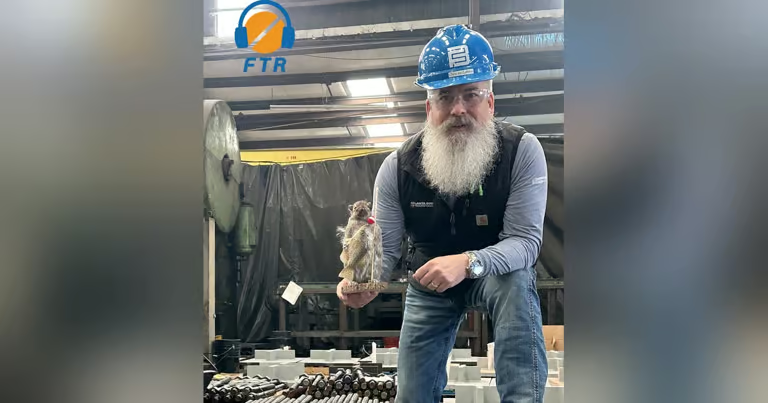
Infrastructure projects create huge demand for fasteners once they work their way to the market. The always affable Jason Baines of premium locknut provider J. Lanfranco knows how to provide the parts, as well as a few nut jokes (1:33:20). Meanwhile, domestic manufacturing benefits by the need to re-shore parts, as Atlanta Rod sales manager Chris McCaffrey explains (17:34). He also tells the tale of an unlikely travel companion. On the Fastener News Report, Brighton-Best International president Jun Xu offers his evaluation of the latest FDI, with his signature confidence and pragmatism, as he joins intrepid screw biz reporter Mike McNulty (50:34). On this edition of the Fastener Training Minute, thread guru Carmen Vertullo addresses the age old question of where to torque a bolt (1:22:53). Brian and Eric fearlessly resume normal air travel and get rewarded with a down home Texas brisket.
—
Listen to the podcast here
Important Links
- Jason Baines on LinkedIn
- J.Lanfranco
- Chris McCaffrey on LinkedIn
- Atlanta Rod
- Birmingham Fastener
- Brighton-Best International
- Mike McNulty on LinkedIn
- McNulty@FastenerTech.com
- Carmen Vertullo on LinkedIn
- Carver Labs
- FTR@FullyThreaded.com
- INxSQL Software
- Volt Industrial Plastics
- Tim Vath on LinkedIn
- Fastener Fair USA
- Tony Martinez on LinkedIn
- Brad Tinney on LinkedIn
- Baron Yarborough on LinkedIn
- FTR Episode 196: Clean Up – Previous Episode
- Jo Morris on LinkedIn
- Jake “Valdez” Davis on LinkedIn
- Fastener Training Institute
- Pacific-West Fastener Association
- FastenerTrainingEvents.com/Training
- Southeastern Fastener Association
- Pilgrim Aerospace Fasteners
- Nylok
- Ramco Specialties, Inc.
- Grainger
- Hillman
- Optimas Solutions
- Solon Manufacturing
- Young Fastener Professionals
- MSC Industrial Supply
- FDI Survey
- Meidoh Company Limited
- Pilgrim Screw Corporation
- Fastenal Manufacturing
- Ivaco Rolling Mills
- Fastener Technology International
- FastenerShows.com/Conference/Become-A-Speaker
- Industrial Fasteners Institute
- FTR Episode 184: Resolutions – Previous Episode
- SmartCert
- MDM Distribution
- Mike Hockett on LinkedIn
- Michael Knight on LinkedIn
- Fastenal
Flying Squirrel
Introduction
It is Fully Threaded Radio, voice of the FCH Sourcing Network. If you buy, sell, import, manufacture, think about frequently, industrial threaded fasteners, this is the show for you. We’re very glad you clicked in. Hi again, everyone. Eric Dudas with you. Coming to you from semi-rural Northeast Ohio and the co-host of Fully Threaded is with us as well. He’s a lifetime honorary Texan and code slinger, Brian Musker. Brother, are you doing alright?
I’m very good. I’m even better because I had a chance to brush up my Texan. Though I have to say it, I don’t think it made it. It’s still failing a little bit.
We were down in Austin talking to some actual Texans. I don’t know if they were buying the whole honorary Texan thing at first.
They thought it was pretty crappy, the whole idea.
Based purely on the accent, we weren’t fooling them. Once they heard the story, they were cool with it though, Brian. It was a great trip. Got a lot of big important FCH things done that will be unfolding over time. We’re not going to dwell too much on that one on this episode, Brian. We got a lot of other good stuff to cover on this episode 197 of the show. We’ll be publishing about February 20th or so, in 2024. Minimal prattle on this one from Brian and Eric due to again, that trip and a few other things going on around here. We do have some things to talk about with our good friend, Jason Baines from J.Lanfranco.
The man who makes all the nuts and bolts and things for railways and carriages.
He has more fun doing that than most people could imagine. He talks about the nuts in every way you can imagine and some that you probably shouldn’t be. Jason Baines from J.Lanfranco is our feature. We cover quite a bit on this one. You’ll like it. It’s also a double feature because we’re going to launch with a conversation with Chris McCaffrey. He’s with Atlanta Rod.
Also, Birmingham Fastener.
That’s right. He’s a guy a lot of people know in the industry. We hooked into something he shares with us on this discussion to set the theme. It has something to do with flying squirrels. You’ll no doubt guess. It folded in nicely to Jason’s general demeanor and so forth. Thematic, entertaining, fastener jam-packed. You’re going to love Chris McCaffrey.
If this sounds too light, we’ve got some fastener gravitas to drop on the episode too, as Brighton-Best International President, Jun Xu joins Mike McNulty on the Fastener News Report. If you’ve seen the Fastener Distributor Index, the January 2024 numbers came in. Jun and Mike go over those. Hint, I don’t know what’s going on. Things are looking pretty good for the fastener industry.
They’ll cover that. Mike’s got all the headlines. As always, Carmen Vertullo has got the Fastener Training Minute. All this for the low admission fee of absolutely nothing. Why? It’s because it’s brought to us by our fine list of sponsors. There are partners in all of this, plus everything we do with FCH, the FDI, etc. Brian, you’ve got all that. Please shout it out.
If you are thinking of buying fasteners and you like listening to Fully Threaded, then you should think of these sponsors. They’re important people who supply fasteners to the industry in the United States. They have enabled us to bring this to you by being sponsors. Think of them first. The title sponsors of Fully Threaded Radio are Brighton-Best International, Goebel Fasteners and Star Stainless Screw Company.
Brighton-Best International, tested, tried and true. Goebel Fasteners, quality the first time. Star Stainless Screw Company, right off the shelf. Sponsoring also Fully Threaded Radio are Buckeye Fasteners, BTM Manufacturing, Eurolink Fastener Supply Service, INxSQL Software, J.Lanfranco, Parker Fasteners, 3Q Inc., Volt Industrial Plastics, Würth Industry North America, and Solution Industries, home of solution man.
Thank you. As Brian said, anytime you’re looking to make a fastener acquisition, think of these guys first. Let us know what you think of the show, folks. If you’ve got comments, questions, so forth, the email address is FTR@FullyThreaded.com. We’d be glad to get your message. Speaking of Solution Man, Brian, Solution Industries is the home of Solution Man. I got a message here from Tim Vath over there.
Everybody knows Fastener Fair USA is coming to Cleveland May 22nd and 23rd, 2024. It’s going to be a blast. The big party is at the Fastener Hall of Fame. Tim and his band, his brother’s in there. It’s a solid tight group. They rocked it out last time the Fastener Fair was here. They’re up again. This is an exclusive we’re dropping. It’s not widely known. He’s the bass player in the band. He’s got a brand-new ax for this gig. The cool thing about this is the new base that he’ll be wielding is the custom solution paint job.
That sounds very cool.
He’s pretty psyched to show this thing off. Yet another reason to hit Fastener Fair USA. The welcome reception at the Fastener Hall of Fame.
There’s a few needed, no other reason.
You don’t, but Tim just gave you one again. That’s May 22nd-23rd FastenerFairUSA.com. We’ll be there. We’ll have Jason’s booth right near us INxSQL. It’s going to be great. Before we scoot out of here for a break, one other note related to one of our partners. I had the opportunity to drop in on is Tony Martinez over at Buckeye Fasteners. I’m very glad I did that.
We also headed over to the Ohio Nut and Bolt facility, which is a little way across town, not too far. I wanted to see that overnight equipment that they’re running. Needless to say, it was amazing. I tell you, it’s been several years since I walked through that heading operation they’ve got over there. It’s come a long way. It was amazing when I was there the first time. They’ve reorganized things and added a lot of equipment.
I don’t think I’ve been there. You skipped that to yourself.
We were there together. Marty took us there maybe 12 or 14 years ago. You might not remember. We’ve been to so many at this point. One thing I noticed was in the room, where they were doing all the stainless. The first time we went, it was hazy in there. They’ve put all this state-of-the-art HVAC equipment in there. All those machines are shrouded. It’s a lot less hazy.
Also, much healthier.
I would expect that’s a subject that we don’t hear that very much talked about in the fastener industry. I wonder if there’s any kind of Hallermann syndrome or something.
I would think that the only thing floating around in the air is the bits of droplets of the oil that protect the bolts as they’re running through the machines and being pressed.
There’s plenty of oil flying around those places. Every time I go, I make the mistake of wearing a shirt that I shouldn’t be wearing. I get some greaser oil smeared on it. “There goes another one.” It’s still something you got to do. One other thing that I want to mention about this is they’re dropping a new SACMA header machine over at Ohio Nut and Bolt.
This is a substantial piece of equipment. This is going in the near future. It’s been quite a journey of them deciding to do this, suspecting it out, and then ordering it. It’s on its way. It’ll be set up pretty soon. We’re going to do some coverage of this process. I’m very much looking forward to this. This could be a first of a new type of thing that we cover with Fully Threaded.
You’re going to be telling me about that sometime offline, I presume.
I’m just dropping it on you here. I forgot about it. There was too many things swirling around. That was cool. Tony showed me a lot of stuff. You never know what you’ll pick up when you head out to a fastener manufacturer/distributor. We’ve picked up quite a bit over the years. Folks, we hope you’ve picked up a lot from the show. We thank you so much for being here. We’ll talk with Chris McCaffrey of Atlanta Rod on the show.
—
Fitness, Fasteners & A Squirrel Story: Chris McCaffrey Joins The Show
Brian and Eric, back with you. Having more fun than a Skidmore-Wilhelm bolt tension calibrator on a trampoline.
You’re talking to Carmen again.
It’s Fully Threaded.
Never heard Carmen say anything like that.
I’m always talking to Carmen. He’s always in my other ear, it seems like. Something’s always going on with him. I was on his Fastener Experts’ group. I missed the last one. I’m thinking of the one before. He was talking quite a bit about bolt tensioning and all that. That’s why it was stuck in my mind. Speaking of Carmen, he’s doing great on his training for the upcoming Rugged Maniac race in August 2024. He started training in the fall. He’s going serious about this. He’s dropping pounds. He’s training. He’s doing well.
He’s dropped lots of pounds. That’s not easy as I know.
You’re doing a pretty good job, too. I had a chance to compare notes with you on the plane when we were flying back from Austin. I’ll tell you while we’re on the subject of training and fitness in general. I got a couple of messages from some folks who were talking about the idea of doing this race in August.
It sounds like they had their sights set. January came and they were going to get going. February’s here and, I don’t know, just a little discouragement I was detecting. I just want to say to you guys. It’s too early to get sad about what’s going on with your training. If you fell off your original plan, it’s still February.
Get back on the carriage.
Get back on it. You can do it. It’s a new year, don’t give up. I was talking to Carmen about this a little bit, Brian. We’re going to set up a call. It’ll follow the experts’ meeting. It’s going to be for fitness. We’ll call it the Fastener Fitness Call. I don’t think it’s going to be as frequent as what he’s doing. We haven’t worked out all the details.
There’s some folks out there in the fastener industry who would appreciate it. I know GQ would jump on. A lot of people ask him for advice. He’ll do it. There’s several others. That’s what we’re going to do. Don’t give up folks. It’s only February. Get in there. When Bob starts calling for signups, get your name on there. It’ll be a lot of fun.
You don’t have to be a participant, even though that’s much better. You can always join Lynn and I and run around and take photos and things. Be the encouragement spectators.
Brian and Lynn, official sponsors of the official pit team of the fastener mud racers. Speaking of all this, I swerved into it. We’re going to talk with Chris McCaffrey. I don’t think he said it during our conversation here, but he told me he’s on for 2024. He’s 100% going to be doing the race. Yet another reason to join in. The team keeps growing. This will be the fourth one. With that, why don’t we get over to this conversation with Chris McCaffrey, Atlanta Rod.
—
We’re talking with Chris McCaffrey. He’s a sales manager at Atlanta Rod. Chris, how are you?
Eric Dudas, I’m doing fine. How’s it going? It’s good to be here.
It took us long enough. How long have we been threatening to do this?
It’s been at least a month.
I ran into you in Detroit, I remember. At the time, we framed out a hilarious segment we were going to do. I don’t even remember what it was, but it wouldn’t be relevant. We got a whole new set of stuff to talk about. Welcome aboard.
Thank you. It’s great to be here. I remember the last time. I’ve been on the show once before. I’m thinking it was 2018, if I’m correct. Ryan and I did it from my previous employer. That was a lot of fun. We talked about skateboarding and all kinds of California adventures.
We went a little Joe Rogan on that one, if I recall. That was fun. You guys shifted. You’re back under the same umbrella again, you and Ryan.
It’s crazy. After COVID of 2020, when we were all working at home, especially if you’re in sales. You were probably working at home from March on. During that time, my wife and I said, “Let’s go East.” I put a plan to the company at the time and said, “Most of our customers are East. I’d like to move East so I could get around quickly and see customers. I’ll come back to Cali once a quarter.”
By golly, Eric, they said yes. In March of 2021, we packed up and headed East to South Carolina. Life has been a roller coaster ever since. It’s been crazy. Part of that was a career change from R&D Fasteners, which is a wonderful company. I will always love those guys. It’s a twenty-year long relationship there. I’m working for the Birmingham Group of Companies. It has been pretty life-changing and a fresh new start. Twenty plus years into the fastener career.
We’d like to hear a little bit about the way that you’re set up over there at Birmingham because a lot of people know Birmingham. It’s a venerated name in the industry. You’ve got a whole slew of companies under Birmingham. Was it 2020-2021 you were on a real headhunting mission over there?
We’re privately held by a gentleman who’s a very brilliant businessman, a young, high energy Brad Tinney. He inherited the company from his father who left him a wonderful business. Brad’s taken it to the next level. His strategy has been to bring in the best possible people he can. Along the way, there were a couple of companies that he acquired. In 2023, we purchased Pacific Coast Bolt in Santa Fe Springs. At the time, after that purchase went down, we needed the best bolt guy on the West Coast when it comes to manufacturing and distribution. That was my brother. I facilitated that handshake and then got right out of the way.
It works nice.
It’s incredible because I got to tell you, Eric. One of the amazing things about this industry is the relationships you have. To be able to work hand-in-hand with my brother Ryan for many years was one of the most special things you can have in a career. We’re very close friends. When I said goodbye to R&D, I never, in my wildest dreams, thought that we would circle back around and be on the same team again. You just got to thank your lucky stars. When they align like that, it’s been pretty incredible and surreal. It’s pretty cool.
One of the amazing things about this industry is the relationships you build. Share on XThat worked out well for you guys for sure. How did Baron get dragged into Birmingham? You guys are there, this is the battle of the beards. Although, Ryan did shave his down a little, I noticed from LinkedIn.
Ryan keeps his nice and tight. I let my ebbs and flows, Eric. It depends on my mood. Moving into the Southeast, there’s a lot of bearded characters around. I got special permission to see if I could compete with a big beard. Honestly, I get the temptation to keep cutting it back. Baron is the master of beards. He came into the Birmingham Group of Companies before I did.
He ran Champion Gasket down there in Houston. That was just a wonderful move for him. I’ll let him tell you the story on how that all went down. He ran Champion and got them through some nice projects, a nice growth stage. They built a new building down there and added capacity. They make rubber gaskets for the waterworks industry.
Exciting news for Baron, it was just announced on LinkedIn that he has been promoted. It’s a lateral move, but he has taken over the general manager role at K-T Bolt. He’s getting back in the bolt game. Our gentleman who ran K-T and owned K-T for many years, Randy Peck is retiring officially. Baron is going to take that job.
I can’t think of a better gentleman, fastener guru, fastener freak, the Bearded Nut, himself, to run a manufacturing division. I know he’s excited to be back in the bolt game. We’re certainly excited to have him back in the bolt game. We work closely with those guys over here at Atlanta Rod. That’s pretty exciting. It’s just a testament to the opportunities with this organization that they try to put the right person in the right seat. He’s pretty stoked.
It was great to see him get that bump up. I’ve known him for a few years. It’s pretty obvious right from the beginning that he was destined for greatness in this business. Especially, starting off at a young age on the manufacturing side, getting to know it hands-on, and playing every role over there, probably even including toilet cleaner at the time.
I remember when he came in. Spring Bolt was always run under the radar. In my previous company, we were direct competitors. To try to get Intel in Spring was always a challenge. This young cat, internet savvy with social media, starts working sales. He starts posting Spring Bolt stuff. That got us to get connected and become friends. He was chasing us down for a lot of years. He did a good job at it. To be in a circle many years later, we’re on the same team. It’s pretty cool.
One thing that I always remember is occasionally after the Vegas show and we were all breaking down. Our booth was always super simple to take down, tear apart and everything. Baron would be over there all by himself. They knew how to do bolts. They did not know how to set up a trade show for ease of breakdown. Literally, he had to take this whole thing apart. He had a socket kit out. It was like a four-hour job. On top of the complexity, these are enormous structural bolts and nuts and everything. Some of these seem to weigh 80 pounds. His cases was insane.
The trade show guru.
We live and learn to make all those mistakes. You lived and learned a little bit, one of the things that caused the delay yet again in our getting together for this segment. I heard you’re flying with a squirrel. What’s this all about? What did I hear? You got the beard for flying around with a squirrel on a plane. What’s the story behind this, Chris?
If you can picture this, I will fly out for a weekend visit to see a customer. This particular customer is a buddy. They’re having, in their small town, a fundraiser for their local hospital. It’s a rural hospital. They have this nice dinner. They call it Boots and Bling. Everyone gets together. They auction off crazy stuff. I come prepared to give because I’m a giver. I’ll dig deep for a good cause.
I’m bidding and bidding. I’m getting outbid by these big-time rollers. It’s getting close to the end of the night. Almost all the items are gone. I’m thinking, “I didn’t have a chance to contribute. I’m going to just give some cash.” Out walks this Southern Belle lady in her dress and boots and hat. She’s carrying this item with a handkerchief over the top of it.
They start talking about this as the greatest thing since sliced bread. They finally pull the cover off. It’s a taxidermied squirrel holding a taxidermied fish in a fishing pole named Rocky after Rocky and Bullwinkle. This thing started going on the auction block. I ended up bidding several hundred dollars and taking this thing home with me which I kept in my lap. I felt like I would break it if I tried to pack it in anything.
How are you going to check-in the squirrel?
You’re not going to check-in your squirrel. You’re going to carry your squirrel at all times. I took it to the airport. Got to the airport. It was an early 6:30 AM flight, which ended up not boarding until 3:30 PM. It was quite an experience holding this squirrel on my lap for several hours and having the people who were interested. It was like having my own little rock star. It’s given me an idea. I ought to carry this squirrel around to sales calls, industry events, trade shows and keep it around because it does draw in the conversation.
It’s funny. Later in the episode, we’re going to have Jason Baines on. I don’t know if you know the joke. Their mascot is a squirrel for obvious reasons. We have a theme developing here inadvertently, Chris. Thanks for that.
You’re welcome. Anything I can do to help. I told you I’m the idea guy.
Thank you. When we were warming up for this, one of the things you were mentioning is on your mind. Fastener-wise, we’ll get away from the stuffed animals. You were saying something that is being talked about out there. Something that you guys at Atlanta Rod and beyond are experiencing is the fallout from some of the nearshoring, reshoring, the push in domestic manufacturing. Let’s put it that way. Which is something that you’re glad to see. Tell us about it. What are you seeing out there?
At Atlanta Rod, we’re passionate about domestic manufacturing. Pretty much all the material as far as the stainless and the alloys, Grade 55s, 105s. Stainless steels are 100% domestic. That’s what we take to market. We definitely love the news of onshoring. We go after the AIS work, the BABA work, where the federal dollars go to the jobs. It dictates 100% domestic. That’s where we like to play.
We’re passionate about it, Eric. We think domestic manufacturing can not only be price competitive if we get smart and efficient as manufacturers, and safe. We can compete with the overseas items. Maybe not on everything, but on a lot of it when you’re talking about structural, waterworks, bridge work, oil and gas.
There’s no reason why the American manufacturing base can’t meet the demand that is here in the United States. There’s a place for import, but where I spend my time and focus is on the domestic side. We even spend time at the EPA in Washington and the EPA Director talking about these issues and how American manufacturing can meet the demand and also follow the law. It’s a big deal to us. That’s where we like to play.
Speak on that a little bit. Are you guys experiencing a welcome mat for this by the EPA and any other regulatory folks? What are you seeing in that area?
What we found is the EPA has been aggressive to want to hear what the manufacturers have to say. They want to make sure that the capacity is there. That’s one of their biggest questions. Is the capacity there to meet the demand for these projects that are coming up? We show the capacity map and what we have available for it. That case is easily made.
When it comes to BBBA, the Build Back Better Act that Biden passed, It hasn’t gotten off the ground like it should. The guts of the domestic, we like that a lot. If it’s federal dollars, it’s going to require domestic material. One of the deals is that you can get a provision as a contractor that if domestic is not available, you can import. That’s where we go and have the year with the EPA to show that the capacity is there. The delivery requirements could be met to obey the law. That’s where we put our influence, so to speak.
How about on the street? You’re pounding the pavement all the time. You’re a sales guy. You’re talking to customers. Are you seeing demand increase? Are you hearing people talk about it?
We listened to ITR, the Bolio brothers. We’re experiencing something very close to what they’ve been talking about. Obviously, 2022 was a banner year for all of the Birmingham companies. The year 2023 was closer to the 2021 level. We saw a dip there. We’re optimistic for 2024, but we’re seeing that it’s probably going to be flat by 2023.
Saying that as a sales guy, we don’t have infinite capacity in the Birmingham group. There’s certainly going to be enough work. If we’re smart, we can get our name out there. We can meet the need and the delivery requirements. Get a look at the RFQs that there’s enough business to fill our capacity. I don’t pay too much attention to the market buzz on whether it’s going to be a good year or bad year. Even in a low year, we can find the business. We can find something to put on our machines.
That’s the aggressive approach that we take as we go out and look for it. No question about it. Saying that, the bid activity is extremely strong. We’re quoting a lot of packages. We see a lot of work come through. The actual jobs that are breaking ground have been slow. We’re picking up what we can, but we’re staying consistent. It’s been busy. It’s just not as busy as we would like. The measure to that was 2022.
A weird baseline to go off of for sure.
You can’t. It was a crazy year, but it was so good that we want to get back to that.
We were talking earlier. I know you heard Bob Baer talk about the FDI wrap up for ‘23. He was referencing this idea of nearshoring and reshoring as well. He used as an example why that’s happening or a possible reason, the sense that things are heating up in Asia. People want to cover their bases, basically. That’s what I’m curious about. Are you hearing that same thing? Does anything that you’re hearing reinforce what Bob was saying in the last episode?
I can’t talk too intelligently about that because I don’t get involved in the distribution side or the import side. I can tell you that we’ve sent several people to Asia to see. Birmingham has quite a large distribution side as well. We do import and stock import products on the distribution side. They’ve been making plenty of trips to Asia and doing their due diligence, no question. It’s definitely a hotspot. I just don’t know a whole lot about it. I’m probably not the guy to put the two cents in on it.
You shoot it straight, Chris. I know something that you do know a little bit about. In the last episode also we had Jo Morris and Valdez on. They were talking about the Fastener Training Institute, the FSTNR Week, and all that. We went on and on about it. We don’t have to do another whole segment on it. In the process, it was mentioned that you’re connected in a big way with the FTI. I’d forgotten that when we set up the original segment. How did that happen? How’d you get involved? What are you doing with the Fastener Training Institute?
How it came together was I was on the Board of the Pac-West for three years or so, whatever the term was. During that time, there were several people on that Board that were also part of FTI. FTI was birthed out of Pac-West. When I came off the Pac-West Board in 2018, I joined the FTI Board as a Board Member.
I’ve been a part of FTI on the Board for quite some time since 2018 and in 2023, as the president of the organization. That’s been a lot of fun being in the manufacturing side of things. We’ve always been passionate about industrial fastener training specific to our industry. FTI met that need. As a manufacturer, I was able to use FTI as a resource. Not only that, partner with them in tours and things over the years.
I became close to John and Jo who run Desert Distribution. You know them well, heroes and titans of the industry. As the president of the Board, we give oversight. We have an amazing Board of Directors at FTI of some of your favorite people that come together. We get a little oversight, help make some of the decisions. It’s Jo Morris that brings the heat there and does the heavy lifting. We’re so lucky to have her. She makes the Board’s job pretty easy.
She was certainly excited about this new learning framework that you’re throwing up. It sounded great. We’ve been talking off and on for the last several episodes on the topic of AI. She didn’t mention anything specifically about that, but I certainly have been thinking about it. I wonder as the president, you’re going to be guiding a lot of this stuff along. Do you have any thoughts about how AI might be contributing over time in passing some of this institutional or enterprise knowledge along to some of the younger folks that we’re trying to bring in?
We’ve got to use it smart. As manufacturers, we’re starting to incorporate it into our software. We’re starting to incorporate it into our safety systems, our EHS programs. As far as having it do the hard thinking of planning, strategy and what we’re going to make in our shop. We’re not using it for that. We’re trying to capture AI where it makes sense to make us leaner and quicker with administrative-type tasks or calculation-type tasks.
On the AI note, if you’re not using ChatGPT, you’re probably going to be behind the times. It’s important to master those new technologies as they come out. We’ve got to keep them in their proper place. I don’t want to slow down technology. I’m not afraid of it. What I don’t want to see is where AI creates more problems than it helps by using it too fast.
Everybody’s feeling around that boundary. Nobody knows quite where it is. Do you have a killer application that you’re using? Are you putting it to good use in your day-to-day work?
What we’re doing at Atlanta Rod is we’re on a mission to be the safest fastener manufacturer in the world. That is our goal. It’s our corporation’s goal. It’s what we measure our goals off of. What we set our activities around is safety. We want every employee to come into work and leave completely whole physically and mentally. That’s what drives our decisions. Wherever we can use AI to incorporate there, we will. To give an example of that would be using robotics in place of human hands doing dangerous activities. Having AI help run those robotics efficiently is a big goal for us.
I look forward to seeing how you guys roll that out because I know that there’s a lot of people thinking about it over there.
We’re trying to use it where we can bring basically safety applications first and see where it goes from there.
What else are you thinking about over there at Atlanta Rod or just in general on the Birmingham team? We’ll wrap up with a chance for you to tee off on everything good happening over there.
Let’s see. What are we thinking about over at Atlanta Rod? We want to grow this 2024. We want to grow the company. Atlanta Rod is big in anchor bolts, waterworks, oil and gas, domestic projects, infrastructure, and structural. We’re trying to grow in those areas and be real aggressive at it. Bring the marketplace there at a competitive price, and then world-class service. We want to do that by building relationships. This is quite an industry to build those relationships.
What’s crazy about our business is at the beginning of the year, we don’t always know what our top customer list will look like. That’s going to be driven by what projects break around the country and then who’s purchasing the hardware for those projects. Our challenge is to stay in front of everyone, have our name out there, and just get a chance to see a bid. If we can see the bid, we know we have a good shot at capturing the business.
That’s the big challenge for me this 2024. That’s driving strategic sales plans, doing trade shows and industry events. I’m excited. I’m going to be out at the Pac-West event in March. I’m looking forward to seeing all my friends out there in California. It’s great to get back to California. It’s in Anaheim. It’s going to be sweet.
City of fun.
My old stomping grounds. That’s going to be cool.
I’m definitely going to see you out there, Chris. I’m looking forward to doing something fun out there. I don’t know what it’ll be, but there’s so many opportunities. We’ll come up with something. You’re going to be out there in May at the Fastener Fair, I take it?
We’re going to be at the Fastener Fair. We’ll be at the Southeast Spring Conference in Charlotte. We’ll be doing a Fastener Fair. We’ll be doing Pac-West. I’ll be at all those events. That’s exciting. I love these events because it’s a great chance to just put your finger on the pulse of what’s going on, rubbing elbows with some of the industry’s best. It’s always a good time and encouraging to me.
It’s going to be good. You’re on LinkedIn. You’re everywhere pretty much, but do you want to drop a website or anything?
We were talking a little bit about fastener training. The Fastener Training Institute has a jam-packed 2024 schedule. If you go to FastenerTrainingEvents.com/Training, you can get the schedule there. There’s some stuff coming up soon here in February with geometric dimensional and tolerance training. In March, we got a couple of events coming up. Please check that out.
If you want to learn more about Birmingham or Atlanta Rod, you could go to AtlRod.com and get a snapshot of what we do over at Atlanta Rod. There’s a link there. You could go to Birmingham as well. You can find me on LinkedIn if you just search Chris McCaffrey or Birmingham or Atlanta Rod. I’d love to connect with you and talk with you. It’s always fun to exchange emails or texts or phone calls. I’m pretty much down to how anyone wants to chat. Just reach out to me. That’d be awesome. We could connect.
If you see someone in an airplane flying around with a giant stuffed moose. That’s got to be your next acquisition.
If you see me with my taxidermied squirrel, just come on over and pet my squirrel. It’s going to be fine. We’ll have a good time.
Director of fun from Atlanta Rod, Chris McCaffrey. Good to finally do this.
Let’s do it again soon.
We’ll be back with more Fully Threaded.
—
News Segment: Events, Updates & Industry Highlights
It’s the news segment. Brian, originally, I had three potential different guests for this slot. Here it is, just you and me.
That’s good in a way.
It’s not that bad, but not what I was planning originally. First, I thought, “We’re going to have George Rodriguez on from Brighton. He’ll be promoting the Pac-West because that’s coming up on March 7th through the 9th, 2024 out there in Anaheim. I realized that doesn’t make sense because most folks are going to read this too close to make plans.
I just screwed up the timing on that one. I figured there’s another big event coming. We haven’t promoted much from SEFA. We used to plug those guys all the time. I reached out to Stephanie down there at the Southeastern Fastener Association. Their conference is coming up April 22nd to the 24th. It’s happening in Concord, North Carolina.
She’s super jazzed up about their keynote speaker at that conference. It’s a lady by the name of Meredith Elliott Powell. Stephanie’s jazzed up about this lady. They’re going to play golf, talk about fasteners, and do what the SEFA folks usually do, which is have a great time and get to know each other better.
Anyway, that didn’t work out, scheduling and all that. My third idea was Craig Beaty. He’s been elected YFP President. They got a whole new slew of officers with the Young Fastener Professionals. That one didn’t work out either. Here it is just us. It’s the news segment. All those things were newsworthy. It’s par for the course.
The new segment has been brought to us by Volt Industrial Plastics for a long time. I went out to the Volt website. I was helping Heidi put a new ad together for her. I stopped at the homepage. I hadn’t been on that homepage for a little while. At the bottom of that homepage, there is a video that I would encourage everybody to go and check out. It’s right there at VoltPlastics.com.
It’s five minutes long. It’s like a Hollywood production, very well done like everything that Volt does. It’s a mini bio of Joe Volltrauer and the family, how they got the business going. The origins with JV Tool up in Chicagoland, how they made their shift down to Arkansas, and all that. Absolutely inspiring. You ever want to see the salt of the earth, real people who make the fastener industry go. Your business partners are who they should be. Make sure you check this video out because Joe Volltrauer is one of those guys in the industry who’s definitely worth knowing about and someone to be inspired by.
He’s built a company up and it’s great. Not only has he built it up, but he left it in great hands to allow it to continue. Heidi’s that person.
He still offers his abundant advice to her whenever she needs it. He stepped back a little bit from the business. Volt Industrial Plastics, many thanks. The title sponsors of Fully Threaded Radio are Brighton-Best International, Goebel Fasteners, and Star Stainless. Another inspirational voice in this industry, especially when it comes to news headlines and overall being focused on them, is Mike McNulty. You know what time it is, Brian.
For news about screws that you can use, here’s Mike McNulty.
—
Fastener News Report: FDI Trends, Industry Headlines & Global Market Outlook
This is Mike McNulty from Fastener Technology International Magazine, bringing you the Fastener News Report, which is sponsored by Volt Industrial Plastics, makers of the world’s finest plastic fasteners. None of these candidates received the most votes in the recent Republican presidential primary in Nevada, possibly foreshadowing a good option for November. In the short span of four days in February of 2024, we were treated to the feasting and fasting options of Super Bowl Sunday, Super Sick Monday, Fat Tuesday, Ash Wednesday, and the subdued Valentine’s Day. I am still focused on fasteners and ready to deliver this algorithm-free fastener news report.
In this episode, Brighton-Best International President Jun Xu joins us to reveal the latest results of the Fastener Distributor Index, also known as the FDI. In this broadcast, we have our top story on Pilgrim Aerospace Fasteners, as well as newsmaker headlines from Nylok, Ramco, Grainger, Hillman, Optimas, Solon Manufacturing, the YFP, MSC, and more. On the back page report, we’re going to talk about conferences at trade shows. The seasonally-adjusted Fastener Distributor Index for January 2024 recovered with a solid rise to 49.7 versus 47.5 in December 2023. This was the eighth sub-50 result in the last eleven months.
The Forward-Looking Indicator, also known as the FLI, also inched up to 50.4 compared to 49.6 in February 2024. Fastener Distributor Index data is collected and analyzed by the FCH Sourcing Network and Baird. The FDI seeks to identify demand pricing and outlook trends within the American fastener distribution industry. To get some insights on these results, we talked to Jun Xu, president of Brighton-Best International. Jun, thanks for joining us on the Fastener News Report.
Thanks for having me back again.
Welcome. It’s good to have you back. It’s been about almost a year since you were last on. I’m curious as well as the readers are curious to think what you think about the latest FDI results.
The numbers, as I said before, they’re always directionally accurate. January is slightly more negative than I expected. A lot of it is probably attributed to weather. Remember coming back from the holidays and half the country is frozen under ice. Not a lot happens when you can’t get to work. You can’t be out in the environment building things. I’m not too surprised by it. We do feel like we are looking forward to 2024. That there will be some growth. Although, we’re not expecting a massive amount of change. Certainly, we think later on into the year, there’ll be some growth.
We’ll jump ahead to the Forward-Looking Indicators that we had. Numbers were even stronger this February than January 2024. Where we have 54% of the respondents expecting business to be better six months from now, 36% expecting it to be the same, and only 10% expecting it to be worse. Those are some of the strongest forward-looking numbers that I can remember coming back from the respondents. Would you concur with that?
I do. It’s partly why I like to do this at the beginning of the year. Months from now in the summer, usually the summers are pretty good. We definitely concur with that. Generally speaking, the US is on pretty strong footing. Everything in economics is relative in nature. When you look at the rest of the world and what’s happening, certainly the US is on the right track.
The two comparable markets, I would say, if you look at China. China is in for a rough transition, mainly driven by demographical issues. If you look at their birth rates per month, it was around 9 million or 10 million a month. If you just take the ten million number and assume people live for 75 to 80 years, then you’re at a 750 million to 800 million population.
Still huge numbers, but it’s about half of where they are. It’s still a huge market. Eight hundred million people per capita GDP is probably going to increase. The transition will be difficult. That’s what they’re going through. If you have half the people, do you need all these houses to live in? That’s a demographical tide that they’re going to have to face as the years go on.
The other real market is Europe. Europe is a large market collectively, but individually, it’s an odd family. You have all these different countries with histories and grievances. The way that they look at fiscal policy and fiscal responsibility, it’s all very different. One of the bigger issues that Europe is facing is over-regulation. In many ways, they’re over-regulating themselves into a recession.
If you look at all the different rules that are coming out, I’ll just think of a couple like GDPR. That’s the data one. You have CBAM, which is the carbon one. There was one about Russian minerals. Nothing to say, we’re probably wrong about any of the regulations. The point is that if you’re working hard to just maintain and understand your current level of business, to sustain that, you’re not looking to expand.
If you’re focused on maintaining and understanding your current business, you’re not looking to expand or grow—you’re just trying to sustain it. Share on XYou’re not looking to grow because you’re just trying to figure out how to maintain your current business. If you look at that and the two other markets to compare against the US are Asia and Europe. The US is on pretty strong footing. We feel that the US is probably going to continue to grow throughout this decade.
That’s a good point. You bring up the demographic situation in China and other parts of the world and in Europe for that matter. Those are things that you can’t turn around very quickly. It’s like trying to turn a ship around. They’re pretty much ingrained. Just like you said, you have to deal with that for many years. The other thing you bring up, over-regulation doesn’t do anything except choke out growth. Without people and without freedom, it’s hard to grow.
Regulation is only fair if it’s uniform. If everyone’s faced with the same regulations, then I think it’s an equal playing field. That’s not the way the world works. Some markets will be more regular than others. Usually, I’d say the US tends to benefit when other parts of the world are going through transitions. The US, historically, has always been an island sheltered by two oceans. You have friendly neighbors. For the most part, the US benefits when the rest of the world transitions.
We’ll segue to this. I was just at a trade show in Monterrey, Mexico. It was a general manufacturing show. They had a pavilion in it for the wire industry, which is another sector that we cover in another magazine. That’s why there are a lot of fastener people as well. It was a robust manufacturing environment. Their slogan for Monterey is the Capital of Manufacturing. It was interesting to see all the different types of things that are being made down there.
That’s going to bode well with, as you said, having friendly neighbors. Things being in good shape in North America and in the US in particular. Let’s take a look at some of the numbers that we got back from the respondents. The sales were basically flat at 50. That ties into what you were saying that it was bad weather. People slow to come out of the shoot after December 2023. Employment went up a bit to 50 and then deliveries were up. We had mixed inventory and mixed pricing. Any analysis on the actual numbers?
We’re basically in a period where everyone is facing what they see in their own respective markets. You’re not going to get a consistent answer just because the economy is so diverse. Some parts are going to be growing, some parts are going to be contracting. You take the ups or the downs. You’re probably about 50. That’s where we are.
From a demand standpoint anyway, there’s nothing that is driving demand in a very consistent fashion. I will say, from the supply side, one of the other sort geopolitical issues that we’re all facing is ocean freight. Ocean freight has gone up tremendously since December. We’ve seen a doubling, if not tripling, of ocean freight coming from Asia.
The main reason is because there’s two canals in the world. The Suez Canal and the Panama Canal. The Suez Canal is effectively being blocked because of what’s going on in the Middle East. Ships are going around Africa to get to Europe and to the East Coast. That adds much longer transit times and also costs to fuel and all that. The Suez Canal is basically blocked.
The Panama Canal is in a drought. Half the canal is a lake. That lake is in a drought. Large weight container ships can’t go through. That’s another choke point that we’re seeing. That would be a supply issue facing everyone. From a demand standpoint, it’s nothing like after COVID, where there was a stimulus check. Demand all of a sudden surged across all sectors. There’s nothing like that going on. It’s all just market-based. When that happens, people invest. The two things that they like. It could be a wide range of them.
The other number that’s included in the report is the PMI, the Purchasing Managers Index. That went up as well, but that has not been above 50 or at 50 for a long time. Is that something that you guys take a look at as well?
Not so much. I do think that manufacturing is growing, but it’s going to be pretty moderate growth. There’s still quite a few headwinds as regards to manufacturing. Labor rates are high. Freight rates are still high. The cost of doing things is still quite high. The thought is, “Let’s wait and see where this goes.” I don’t think anyone’s doubling down on expanding capacity. Everyone’s just waiting and seeing where this economy goes before making more investment, especially as it relates to manufacturing.
Let’s jump into some of the commentary. Some of it you’ve already alluded to with the mixed things, some areas being good and bad. The Baird report says, “While there continues to be a healthy mix of bulls and bears, on balance the commentary was skewed slightly more optimistic in January.” The first quote we have is, “January started very strong, much different than a year ago, which is good.”
Another participant said, “We experienced extremely highs and lows in the month of January. Overall was a positive month, but very hard to predict the finish. Will be interesting to see how the rest of the year will go as the election heats up.” There’s some people who keep bringing up the election. It’s absurd no matter how you look at it.
We could talk for an hour just talking about that.
A separate thing, not going to matter that much for manufacturing.
It’s a slow boat train wreck. That’s all accurate., again, it just depends on the sector. Manufacturing is quite up to be super hot this 2024. Maybe come to see which party comes to power or retains power before investing because there are maybe tariff implications or tax implications if you wait. People are waiting to see what happens there.
Again, it’s just based on the market at this point. I will say that the other part is the Fed, the interest rates. The last time we spoke, the Fed was increasing rates quite dramatically, quite quickly. They’ve held off on reducing rates. Our forecast and our belief is that they’re not going to be reducing rates anytime soon., the economy is pretty healthy. As soon as they start to reduce rates, the economy might heat up again. They have to increase rates. What they don’t want to do is be consistent or appear that they don’t know what they’re doing.
Maybe they don’t.
They’re waiting for a recession. The only way to reduce rates is through a recession because that gives them the rationale and the ammunition to do it. In some ways, where we are, it’s contractory, which is probably true. They also like having gunpowder. Where we are, there’s quite a few decreases they can do to fix the problem down the road. If there’s no problem to fix, why would you need to reduce it? They’re waiting to see down the road what happens. If there is a sudden shift and we go into a recession, then the Fed has quite a bit of gunpowder or room built up already, their rates.
They want to save it until it’s needed.
That’s what we would do.
Here’s a comment on the automotive market. “Automotive tier customers continue their pursuit of cost reductions. Heat, treat, and plating subcontractors continue. Surcharge passes along increases in energy.” The last comment we have is talking about OEM fasteners being weaker than MRO. It says, “Our MRO customers are doing well while some of our OEM seem to be struggling across a wide range of markets.”
“We’re having slowdowns and putting some of their employees on four days a week, hoping not to have layoffs. Some of the concerns are that if they lay them off, when and if business comes back, they won’t have the manpower to start back up. While the stock market is doing well, that’s not an indication of what the market looks like on the street. Not to be doom and gloom, but some markets that we sell into are doing quite well. Others are struggling.” As what you were saying a little bit earlier.
MRO is the stabilizing factor. To me, I always think of MRO as the baseline. No matter what, you’re going to have to invest in MRO. Given some of the age of some of our infrastructure and equipment, that’s probably likely to grow, honestly, as a baseline. No matter what, you have to make it what you have.
The OEM side of it is more like the gas. There’s your baseline. OEM reflects more the confidence and attitude of the economy. Are you going to step on the gas? Are you going to step on the brake? The OEM side of it shifts more if you will, but the MRO is baseload. If you look at energy and energy use, you have your baseload. Your plants that come online when there’s peak usage, the MRO is a baseload.
That’s a good way to look at it. The comment that is a little bit interesting to me too is not letting people off because then you might not be able to find anybody to come back. Ties into the difficulty in getting good workers.
Especially skilled workers. Workers that have trained on your systems, on our equipment. It makes sense. It’s going to take months to train new people. Long term, look at the US and look at the rest of the world. The US should be growing. I always think of it as you’re trying to read the waves or trying to read the tide. You can stand on the beach and try to predict the next wave coming. It’s hard because it’s so sporadic.
If you just take a step back and scale up in time, you can see there’s tidal shifts. These tidal shifts are much easier to do. If you’re trying to time it by predicting the waves, I would say 50% of time. Probably maybe wrong. If you take a step back and try to look at it more from a holistic point of view and a larger scale point of view, your chances of being right increases.
From a waves point of view, it’s hard to predict what’s going to happen in the next few months. Even for the rest of the year, although we do expect some growth. From a tidal point of view, the US is very strong. This is where we need to be. This is where the rest of the world looks up to in terms of where they want the economy to be. Again, the US is usually the beneficiary of investment for the rest of the world.

It’s still the envy of the world in terms of lots of factors. I like your references to the ocean and the waves and cars. People will look at the ocean a little bit differently going forward. It’s like you said, hard to predict. Some things are out of your control.
Usually, I find it more philosophically. The closer you try to look at something, the more likely it will be wrong. If you scale back and you increase your span of view, whether in distance or time or whatever, you can start to see patterns more effectively. That’s something that hopefully helps everyone when they look at the issues they’re facing every day.
That is helpful. Good way to look at it and good advice. Anything else on the FDI or the FLI before we give you a chance to tell the readers of what’s going on at Brighton-Best International?
Again, we expect not a huge amount of change this 2024. We think there will be some growth. We’ll see how the rest of the year comes through to fruition. We think it’ll be a good year.
I noticed lots of things going on at Brighton-Best. If you go to the website BrightonBest.com and go to the news section, lots of news and developments. Anything you want to highlight?
We’re growing and investing in the business every year. One of the things that we’re excited about is Cleveland. It’s going to be our largest warehouse in the country. We expanded the capacity to about 440,000 square feet. It’s going to have a training center. It’s going to have a lab and be the flagship for our distribution centers.
We’re excited about opening that up and having the industry come through. We’re hosting some fastener one-on-one sessions again this 2024, which is important for us. Supporting the industry is something that we want to stand behind. I came into this industry about 2007. It’s amazing how quickly time flies. This industry has come to accept us. We’re very appreciative of that. We want to be good citizens and support the health of the industry. The education and supporting all the different groups, that’s something that we look forward to doing every year.
You’re talking about opening this new facility. Do you have a target date for that?
It should be in March. We’re pretty much done with the expansion. A lot of it is just the cleanup. We’re putting in the racking down in the expansion. We have a training center in there that we’re hoping the industry utilizes. We’re starting to look around our closets. We’re going to put in a lot of things that are historic to this industry, like Kardex files.
We’re hoping to create a museum, if you will. Not a full, long college museum, but in reference to where we came from. Majority of our industry came from the Midwest and is part of the Midwest. We started in the Northeast. We’ve also made quite a few acquisitions. All those companies have a story to tell. All those companies have a ton of history. We just want to showcase it. When people come into that training room, I hope they see that they’re part of something.
They’re not just there to take class on fasteners. It’s part of the 100-year history of this industry. It’s an industry that will be here for the next 100 years. I don’t see how you can have anything built without fasteners. It’s a great industry to be part of, helping them feel a sense of community. That’s what we’re trying to do. We’re trying to build that training into not just the training, but something where new people go in and just get a feel that they’re part of something much bigger.
It’s a good industry to be part of. Lots of good history. Training is always important, always needed. It’s good to hear that you’re doing that. I know the last episode of Fully Threaded Radio Training was one of the subjects there as well. Good to hear. I also saw that you have a new catalog for your US anchor products, Tapking, Ultrawedge. It looks like you’re adding some stuff there as well.
We’re adding ranges all the time. We’ve been adding people, expertise. Not just in the US, but we’re investing quite a bit into Australia as well. We acquired a facility in the UK.
Get some personnel announcements out there.
We’re international business, but our culture, our ethos, if you will, is consistent. We’re the same Brighton-Best anywhere we are. That’s important to us.
You guys mentioned culture. You guys also know how to throw a good party. I know lots of people enjoyed the Brighton-Best October Best Festival at IFE in Las Vegas in 2023. Thanks for doing that. I was one of the people who went to that. A lot of people enjoyed that. Good job with that.
That’s our pleasure to host that. It’s been a tradition. We’re thinking maybe we’ll make some changes here and there to improve the experience. It’s something that we’ll continue doing for sure.
Anything else to add as we wrap up?
We’re in a good spot.
As always, it’s good to have you on the program and sharing your insight, knowledge, and some different references or different metaphors for us to think about.
I’m all about metaphors.
I keep some of your old ones from other ones, the different buckets and things like that. The water thing, stepping on the gas, and stepping on the brakes. Good job with that. I appreciate it and so do the readers. Thanks again for joining us on the Fastener News Report.
Thanks for having me.
That was Jun Xu. He’s the president of Brighton-Best International. The FDI number for January 2024 was 49.7 versus 47.5 in December. Visit FDISurvey.com to participate in the process and get a detailed PDF copy of Baird’s monthly analysis.
For this top story, Meidoh Company Limited, an international leader in the production of automotive fasteners, acquired Pilgrim Screw Corporation, which does business as Pilgrim Aerospace Fasteners. Pilgrim is a leading manufacturer of screws, bolts, rivets, clevis pins, and other fasteners for the aerospace market with its manufacturing operations located in Chandler, Arizona and a small office in Providence, Rhode Island.
Pilgrim’s customers include some of the world’s biggest names in the aerospace industry. Meidoh, a third-generation company owned by the Hasegawa family in Japan, is the premier supplier of bolts to Toyota. The company has manufacturing plants in Japan, China, Indonesia, Thailand, and the USA with more than 2,000 employees worldwide. Revenues in excess of $1 billion US dollars.
Yasutaka Hasegawa, the president and CEO of Meidoh, said, “Pilgrim is a trusted supplier to the aerospace industry. This acquisition will allow us to diversify our business while furthering our mission of being the world’s number one fastener manufacturer.” Geoff Grove, President of Pilgrim Aerospace Fasteners, added, “Meidoh is a recognized leader in our industry. We felt they were the right partner at the right time. With Meidoh’s resources, Pilgrim will reach a new level of growth and success.”
Pilgrim established its Chandler operations in 1998. There are currently 50 employees at the 24,500-square foot facility. The property includes land for future growth. Chandler Mayor Kevin Hartke weighed in by saying, “Chandler is a thriving hub for manufacturers of all types and sizes. Pilgrim has long been a key supplier within our regional economy. We look forward to their continued growth in Chandler.” Pilgrim was recognized recently as the Arizona Small Manufacture of the Year by the Arizona Chamber of Commerce and the Arizona Manufacturers Council. It will continue to be led by its existing leadership team.
Next up, the Fastener Newsmaker headlines. In corporate news, Nylok opened a new facility in Mexico. Ramco added a new Nut Former at its Ohio location. Grainger is building a new distribution center in Texas. Hillman Solutions acquired Koch Industries. MSC acquired KAR Industrial. Fastenal Manufacturing‘s UK location received AS9100 Certification. Ivaco Rolling Mills filed an anti-dumping complaint on wire rod imports into Canada from China, India, and Vietnam.
In personnel news, Optimas Solutions hired Jim Heller as its new Senior Vice President of Distribution and Chris Martens as the new Vice President of Manufacturing for the Americas. Suncor Stainless added Sam Pegram as Regional Account Sales Rep. BlackHawk Industrial promoted Trent Moss to the newly created position of Vice President of Sales East.
The Young Fastener Professionals Association, also known as YFP, elected Craig Beaty of Beawest Fasteners as its 2024 President, Christian Georgievsky of IFE Americas as Vice President, Mallory Nichols of Advanced Components as its immediate past president. Nihar Sinha of AmeriSteel Fasteners was elected to the YFP Board of Directors to serve with Jake Glaser of Sherex Fastening Solutions and Zech Williams at Würth Revcar Fasteners.
In milestone news, Solon Manufacturing is celebrating its 75-year anniversary this year and the Hillman Group is celebrating its 60th anniversary. You can get details on all of these stories and more in Fastener Technology International Magazine and the Fastener News Report monthly newsletter, both available online at FastenerTech.com.
Let’s turn to the back page to talk about conferences at trade shows. Exhibits, networking, giveaways, and receptions usually get the most attention at fastener trade shows. I would like to shine a spotlight on the conference and education sections of these industry events. Over the years, I’ve learned a great deal of useful information from attending these sessions at various fastener shows. I’m sure that this is the case for attendees as well as for the presenters.
In 2023, both Fastener Fair USA and the New Year International Fastener Expo, also known as IFE, had good lineups of sessions. In Las Vegas, some highlights for me included the introduction and acceptance speeches at the Hall of Fame and Young Fastener Professional Awards Ceremony, Sherex’s presentation on rivet nuts, ALOX’s talk on sci-fi technologies for distributors. The panel sessions on mentorship, family succession planning, and adapting to changes in the fashioner industry.
I’m sure that upcoming 2024 events will have some excellent conferences. IFE 2024 is calling on industry thought leaders and experts to share their insights, skill knowledge, and practical strategies in 30- and 45-minute session stage presentations, keynote speeches, and fireside chats. IFE has issued a call for speakers. They are looking for cutting-edge content topics that solve the biggest challenges in the fastener industry.
Proposals are welcomed from well-versed industry experts as well as professionals just beginning to transition into leadership roles. All topics must be educational, provide actionable ideas, and must not violate the conference’s no-pitch policy. The selected speakers will receive a complimentary badge for access to the welcome reception and the exhibit hall, industry exposure through event marketing, and recognition as a fastener industry leader.
Potential speakers are invited to submit a proposal to join the IFE 2024 Speaking Faculty by going to the website FastenerShows.com/Conference/Become-A-Speaker. The deadline to submit a proposal is April 12, 2024. Check out page one of the February 19th Fastener News Report newsletter or page 26 of the February-March issue of Fastener Technology International magazine to get all the details. This has been Mike McNulty of Fastener Technology International bringing you the Fastener News Report. Please send your news, pictures, comments, corrections, or complaints to me at McNulty@FastenerTech.com.
—
Fastener Training Minute: Torque Strategy, Variables & Tightening Best Practices
This is Carmen Vertullo with your Fastener Training Minute, coming to you from Carver Labs in beautiful El Cajon, California and the Fastener Training Institute. This Fastener Training Minute comes from the other side of the world, at least the other side of the world from where I’m at. I’m in San Diego. This Fastener Training Minute comes all the way from Cape Town, South Africa.
By way of that exchange, I just wanted to give you a reminder about some good fastener technical resources. This particular inquiry, we had some back and forth. I’m going to read you the last line of the email from this gentleman. One of the things I said to him was, “How did you know to call me about this from South Africa?” He said this, “Lastly, I found the article on the FCH Sourcing Network that you wrote titled, ‘Do you torque the bolt or nut and does it even matter?’ and decided to reach out to you. I’m sure glad I did. My motto is follow where your curiosity leads.”
I just wanted to remind you that the FCH Sourcing Network FastenersClearingHouse.com is a great technical resource. There are over 100 Fastener Training Minutes there that you can listen to and also read. I just wanted to throw that out there. You’ll notice from the sign off that my new friend from South Africa asked the question, “Do you torque the bolt or the nut or does it even matter?”
This is not the first time. It may not even be the second time, we have addressed this on the Fastener Training Minute. In the context, it’s a little bit different. I’m going to share a few things about this particular application. There’ something that dovetails into it, which is the overall tightening strategy. We have talked about it many times in many contexts on the Fastener Training Minute.
Our topic is, “Do you torque the bolt or the nut and does it even matter?” I got this question from a gentleman in South Africa. He is assembling large carports with solar panels on top of them. They come as a kit. They use M16, M20 size hardware with nylon insert lock nuts. It’s all stainless steel. Not going address that. His question had to do with, should we torque the nut or the bolt when we’re putting these assemblies together?
Fortunately, for this particular situation, these questions we don’t always have this one resource, which I like to call an authoritative citation. The IFI, the Industrial Fasteners Institute, has a document written many years ago by Joe Greenslade that addresses this very issue. If you want that document, you can go to the IFI and buy it, or just call me. I’ll give you my version of it.
That’s obviously a variable in the assembly process. We’re going to do this thing. This guy’s going to tighten the bolt. This guy’s going to tighten the nut. By that, we mean, which is going to be the held component? Which is going to be the turned component? That matters because that turned component has a bearing surface which has friction, which greatly impacts the torque tension relationship.
Does it matter that much? I’m going to read to you exactly what I wrote to this gentleman. I said, “All things being equal, a rigid joint, parallel surfaces, hard washers, same bearing surface area, same coating or lubricant. By the way, adding a lubricant or friction control coating is an excellent way to control the K-factor variable. All that being equal, I say I would standardize on tightening the nut and use a short socket, if possible.”
The reason I say the short socket is I saw a photograph of his situation. The bolt was much too long. It had a couple of diameters of thread sticking out. That’s a waste of a bolt length. He says, “We use the same bolt length so we don’t have to worry about people using the wrong bolt somewhere.” Somewhere too long. You have to use a deep socket. That deep socket can be a variable on the torque wrench as well.
We use the word variable, which is a very important word. In the manufacturing world, as a manufacturing engineer, there’s a subset of manufacturing engineering called process engineering. Our job is to identify all the variables in a process. Whether it’s a cold heading process, a machining process, a plating process, a heat-treating process, even the testing procedure.
Identify all the variables. Eliminate anything that you can eliminate, and control what you can’t eliminate. That way, if you ever do have a problem, you don’t have so many different things to ask questions about. It’s much less likely that you are going to have a problem because there’s not a lot that can go wrong. You’ve eliminated all that stuff for as much of it as you can.
Identify all the variables. Eliminate what you can, and control what you can’t. That way, if a problem arises, you’ll have fewer factors to question. Share on XSometimes the only reason to do something the same way all the time is to eliminate the variable that can occur when you do it a different way. You have to wonder that that different way caused a different outcome when I’m trying to troubleshoot a problem. Back to this tightening strategy, they use torque wrenches. Going further, I advised him.
We’re going to segue into another topic that we have discussed before on the Fastener Training Minute. Another method of achieving consistent tension is the torque angle method, where we don’t use the torque wrench as our final tightening strategy. We use it as an initial tightening strategy to get us snug tight.
You probably could do that without a torque wrench in this application because it’s highly controlled and pretty well-engineered. We turn the fastener a certain number of degrees or wrench flats or wrench corners to achieve the desired tension. How do we know how many degrees or wrench flats to turn it? We know that because we’re going to do an experiment in our Skidmore-Wilhelm Bolt Tension Calibrator to determine how many degrees we’re going to turn it.
This is a very common procedure used on structural job sites where we have structural steel held together with structural bolts. We have to do that down on the ground in the Skidmore. That informs the installer how to install the fastening up in the steel. It’s a very good method. I highly recommend it. It’s easy to learn. It’s easy to train for. As far as having a torque wrench or using a torque wrench, there are so many variables that make torque not the most reliable method for achieving a given amount of tension.
Three things I hope you learned. 1) It doesn’t matter all things being equal whether you tighten the head of the bolt or the nut. 2) Eliminate all the variables that you can in any given manufacturing or assembly operation. The ones you can’t eliminate, you should control. Sometimes, the best reason to do something the same way all the time is it eliminates a variable. Finally, and maybe most importantly, remember that you have a great technical resource in the FCH Network and use it. I hope you enjoyed this Fastener Training Minute. This has been Carmen Vertullo. Thanks for reading.
—
Fastener Talk With Jason Baines: Lock Nuts, Infrastructure & Industry Growth
I’m talking with Jason Baines, J.Lanfranco. Hey, brother. It’s been a while.
It’s been far too long. How are you doing, Eric?
Keeping it together for the moment. It’s always good to catch you. We’ve been threatening to put a segment together for a while. We’re both going in different directions all the time. I’m glad we’re able to get this one going. You wanted to talk about fasteners I heard.
We dabble in it sometimes. It could be an appropriate topic for someone like you.
For folks who might remember when you appeared back in a past episode. It was a while back. You were breaking out with J.Lanfranco. Refresh everyone’s memory of what you guys are all about.
We’re mostly about lock nuts. We’re a manufacturer of imperial and metric all-metal lock nuts. We top out at M60 or two and a half inch. We’re a European origin company. We’ve been in North America since the mid ‘90s and been operating in the US since that time. In 2018, just before COVID, we got J.Lanfranco USA going. We service anything that’s heavy industries, safety critical. People need high-quality, high-performance lock nuts. We get into that. We source or try and fabricate parts to plan, things that folks aren’t going to find elsewhere. We like weird stuff sometimes as well. We like to have fun doing it.
Understatement.
Some people don’t like our little squirrel that says, “I love my nuts.” Most people love having that hoodie. That’s us.
Come on, Jason. Everybody loves it. We just heard about the FDI. Those were the January 2024 numbers. It was pretty positive news overall. Let’s face it. The market’s not going gangbusters, but we’re moving in the right direction. Did you see that? Has that been your experience in your markets?
We’re continuing strong. I know when we first spoke, I told you we were a little bit slow. There was a lag for our business throughout COVID. We fully expected that as others started to slow down, we’d pick up. We do a lot of infrastructure. That’s exactly what happened. The year 2023 was great. We see Q1 of 2024 following through. We’re pleased with everything and just trying to keep up with it all.
You were expecting to see a lot of government projects, weren’t you? Did that ever come through? Is the money faucet turned on up there?
The projects are starting up. That’s exactly what happened both on the Canadian and US side. Those infrastructure projects are trying to get money out through the government. It’s like pouring water through a sponge. You’re waiting and you’re waiting. When it does come out though, then it’s all decks on hand.
That’s what we’ve been rushing around for. A lot of pressure on the supply chain in terms of raw material. There’s a big focus on domestically made parts more and more. We can see that despite all the efforts being made. Sometimes, you just can’t get material out from the mills quickly enough. That’s our job. To get those buys in ahead of time and try to stay on top of it.
There was tremendous demand. The biggest challenge we see for those end-users is for them to construct. We certainly expect that this is going to continue. A lot of that money took a long time to get going. That machine is up and running. We’re expecting 2024 and into 2025 to be solid. Hopefully, beyond is looking promising for the spaces we work in anyways.
You know a lot about trains in your business. I don’t know if we mentioned that again, but you’re selling into railroads. It takes a while to get that locomotive going. Once it’s heading down the track, it’s like driving one of those giant Winnebago’s.
It takes a while to get going. We do a lot of the railroad stuff and other heavy industries like mining. All of those businesses are going out. You see money going into that. Those heavy industries are always the backbone of the North American economy. When times get tough, typically, you see investment there. We’ve got mining customers, who produce equipment for exploration and whatnot. People get scared. We’re even seeing that picking up.

Railroads, mining, anything infrastructure-related, if you’re involved with mining related to things like getting everything that’s needed for EVs. There’s a lot happening there. It may not all be happening yet, but it’s certainly in process. We’re in a good space. We’re on a real good path. More and more people are looking to get stuff onshore and have those good quality parts from manufacturers who can deliver in a number of weeks rather than six months, ten months. We’ve just seen that it can be a bit of a challenge. So far, so good.
That’s a neurotic area though, that whole EV market, don’t you think? I’m sure you saw this headline out of Volvo. You just see these headlines popping up more and more, this resistance to EV. People are questioning it. Are you catching that up there?
For sure. What’s happening is that from a governmental point of view, certainly in Canada, the current government has gone all in on EV. The amount of subsidies that are being handed out to create these battery plants and whatnot are so substantial that they’re going ahead, whether the public is getting behind it or not.
They’re actively and forcefully legislating a lot of these moves toward EV. I don’t think any of them. It doesn’t matter where you fall on the EV. This is not an environmental debate. The fact is, we don’t have the grid. We can’t produce enough vehicles. People can’t afford them. The Canadian government has set out very aggressive targets, which I don’t think are based in reality, if you talk to people on the ground and in the know. They’re going ahead anyway.
At this point, we’re subsidizing one plant at the tune of $15 billion. There’s another plant that we’re going to be subsidizing. When you have that amount of money going in, for sure there’s going to be opportunities around it. Whether or not the public gets on board at this point, the money is going to be spent. It’s going to create opportunity.
The question is, “When does the opportunity get created?” Canada, for instance, has good lithium reserves. We’ve got nickel. We’ve got everything we need to do this. The question becomes, “Is the government going to permit these projects to the extent when we see that economic windfall?” It’s a very similar thing in the US.
Are we going to import or are we going to do it domestically? As everybody, we want to see it done domestically. Time will tell. There certainly are opportunities, but are they fully realized? No. Am I driving an EV? Absolutely not. I just picked up a V8 Wagoneer. I love it. It gets me where I need to go because I live in the middle of nowhere.
You’re not telling me anything that I’m surprised by here, Jason. I realize fully that these guys in these ivory towers are fully invested in the idea. It’s withering on the vine because it’s not realistic. It’s just not. My question is, how long does it take before these systems that are in motion are going to crash into reality? How does that look to you? You see it.
In Canada, it’s a little bit different than the US because of how our government is structured. As long as we have a majority liberal government, who is the government that’s behind this and subsidizing it, as long as they maintain a majority in our parliament. We have a parliamentary system, then they’ll continue to put money into this regardless.
It’s going to come up to the voter. There’s been so much money put in. I only say this because in the Province of Ontario, we have an incredible amount of debt. We have the highest per capita debt in Canada, in the Province of Ontario. We bankrupted ourselves by putting in or subsidizing solar panels about many years ago.
We’ve demonstrated that even though something’s not commercially viable and it can’t power our grid, we will sink the money into it and go ahead regardless. That may be unpopular with some people reading this. I live here. I’ve seen it. We have the highest energy costs in North America because we’re subsidizing these artificial rates that were guaranteed to the solar developers.
We’ve demonstrated that that’s something we’re fully capable of doing. Subsidizing and going through with a project that’s not viable in any way. We’ll see. For me, it comes down to politics up here. Most Canadians, like most Americans, are not going to be able to afford an EV. We also have to think about how the heck do we recycle these batteries?
We’re looking at what’s in front of us. The real question is, “Where is the end of life? How do we deal with the end-of-life cycle on these products, whether it be windmill blades, solar panels, or lithium batteries?” It’s not a very enjoyable conversation for some people to have, but we should have it. We do a lot of oil and gas. We’re going to be pro-energy.
What we see from those industries is that they’re being very progressive on carbon capture technology and trying to get better. Sometimes, if we look at what’s the net impact, I don’t know. I just look at what the lithium production in Bolivia and Peru are doing to the people who live down there. I don’t know if we’re a world community, if that is the best solution for all stakeholders. If we’re buying into this, we’re a community of one. My opinions are not always popular at the Thanksgiving table with my family because they live in downtown Montreal.
That’s alright. They probably don’t listen to the show, Jason.
They probably don’t, now that you’ve sunk me with the family.
You’ll be alright. Don’t worry. You come on over to my place, have some brisket. Speaking of downstream effects of some of these off-the-rail technologies that are clearly nonsensical, we’re going full steam ahead. How about this for another sideline? I’m sure you might’ve seen that headline that came out about the EV pickups and SUVs going right through the guard rails. There’s a whole market right there for you. These enhanced guard rails on highways and stuff. Go after that one.
They are heavier vehicles.
They’re going through them like they’re aluminum cans.
That’s a whole other kettle of fish. They’re heavier. They wear the roads quicker. You go through your tires quicker. We’ve got an ex-mechanic on staff here. He’s got a whole set of opinions on this. I listened to him. I didn’t realize how bloody heavy these things are. There’s unforeseen consequences to everything we do. I may be tied up. I’ll get on the guard rails as soon as I have a free moment, Eric. I put it on my to-do list.
I know you’ve got a lot going on. We always find things to discuss. You’ve got a lot of things that we have talked about in the past. Before we hopped on this one, you were telling me about a change of life that you’re going through involving the move from your four-wheel life, shall we say, into more of a traditional house. What’s that all about?
As everybody, I discovered the convenience of living in a house on wheels. I’m going back into a traditional home. The story goes, Jason lived in a beautiful, large five-bedroom, three-bath farmhouse that I had lovingly restored. Unfortunately, when you do that, you come to the realization that you and your partner are no longer compatible.
You’ve got a great kid. You’re great friends. I want stability for my kids. We had a rental on this 30-acre property. What I did was leave the home and that way my daughters got the same environment, which is so important. I’ve talked to some of our contemporaries at the shows. I’m an open book. You connect with certain people. I’ve shared this story. I moved into a mobile home on wood blocks at the end of my property.
I’ve been living there for three and a half years. It shakes in the wind. I’ve done all the things. If you’re in a mobile home long-term. You put a metal roof on and siding. You insulate as best you can. You put some new flooring in. You get the hairdryer out. You get underneath. You unfreeze your pipes. You’re constantly fighting the critters trying to get underneath the skirt of the mobile home. I discovered you got the same quality sunset.
You got to get all the cats out from under there.
There were cats when I moved in. There was a raccoon. There was a weasel in there. I ripped it all out, built it up. You still get to enjoy the same sunset. I’m right by the house. I get my kid on the bus every day. After, I’ve got the world’s smallest barbecue from Walmart out on this little deck I made. It’s been an awesome place. You just live at the office, then you go home. You can barbecue. I got a record player. Probably, I got a vehicle that’s worth more than the mobile home. It’s been a great lifestyle.
Eventually, this house came up and I said, “Maybe I’m ready for a house that’s not on wheels.” That’s it. I’m going to have a place where I, too, can have a full-size smoker. I won’t have to have the blow dryer and the little space heater to keep my pipes from freezing. Hopefully, there’s not going to be any raccoons or cats getting in. It’s been a heck of a ride.
It’s been good. It gives you a lot of perspective. It just reinforces that the most important thing is the people within the walls. If you have good relationships at work where we spend a lot of time, that’s helpful. I got to tell you. I’ve told this story to a couple of folks at the show that you develop a friendship with.
The most important thing is the people within the walls. If you have strong relationships at work—where we spend much of our time—that’s incredibly valuable. Share on XAt first, it was hard to tell people that, “I’ve been divorced.” There’s people I respect in the industry. They seem like they’ve got it all together. You shared it with people and everybody was so supportive. The fact that I’m there for my daughter. I just can’t thank everybody enough. It took me from feeling bad that I’ve moved out of this place because I’ve got the same job, the same company, and everything. You feel like, “These are salt-of-the-earth people.”
That’s the best thing about our business. It’s the salt-of-the-earth people. They’ve been super supportive. I won’t say who, but somebody was talking to me. I had tears in my eyes. They were so supportive. They gave me a little T-shirt to work out in, to dry my eyes out, and everything. They said, “If you’re down in South Carolina, you can come see our new warehouse.” We’ll see if anybody can guess who that was. Good people all over. I’m going to keep the mobile home though, because it’s the coolest bachelor pad.
That’s going to be the man cave going forward, is it?
If they ever let you into the country up here, that’s where you can go.
That’s debatable if that’ll ever happen. The trailer, that’s not in a park then? That’s just a standalone in a forest somewhere? I’m imagining almost like a Northwoods version of Jim Rockford’s pad if you remember.
You got to think more. This is in the middle of a farmer’s field. I’m right by a muddy creek. I just got cash crops behind me. It will rotate between corn or soy. It’s alfalfa this summer. We just seeded it for alfalfa. In the fall, I’ll get geese and ducks coming in on the creek. It’s just a flat, open sky. When the wind howls, it howls. It’s nothing so romantic as a forest setting. It’s about 3/4 of a mile from a big truck stop.
That’s where I go, if I’m short on something. I can go to Herbs. You can look up Herbs online. I just go right there. I can get everything I need. They got a restaurant. If my pipes freeze and I can’t take a shower, they got a shower there for the truckers. It’s been super convenient. My daughter’s been with me half the time. You go sit at the counter at Herb’s. You order breakfast or whatever. She’s been as happy.
What an existence. I didn’t realize all that. You hadn’t painted all the details in for me. You were doing all this as an unexpected detour in your world and then, it turned into what you said three and a half years.
We’re blabbering about this. I’m sure other people go through this too. You got to keep work up. Life doesn’t stop because your personal life falls apart.
I know what you mean.
I got in there. I see my ex-wife every morning. You have a kid. You get along. You do what’s best for the kid. We respect each other. It was made easier because as I said, you go to a show. You got a heavy heart. We end up seeing everybody all the time. You connect with certain people. I’m just the type to get it out. Better to get it out than keep it in. Our people are both so supportive and positive. It made a huge difference. Your coworkers in the office, these people work for me. We’ve got these relationships. You count on them as well to support you in different ways. You hope you can do the same for them one day.
You hit it on the head. This is that kind of industry. You’re doing some stuff over at J.Lanfranco with your small crew that it’s definitely par for this course that we’re on. You’re down a key man. Everybody’s doing what they have to do just to keep things running.
Yeah, for sure. We lost a couple of people. Some people moved on. Others moved out of the country. We were already short-staffed. We’d been trying to hire. Our key guy does all our inspections and runs our warehouse for us. He’s Jack-of-all-trades. This is this guy who was a mechanic for years. We’re so lucky to have him.
The same old working all the time. He doesn’t get time for the doctor. Unfortunately, he had to go into the emergency room. They finally checked him out. He’s got a big battle ahead of him with pancreatic cancer. We all know what that means, but you want to stay positive. We feel like we’ve just been sucker punched. This guy is just the best guy in the world. You always hear that.
We talked about this during COVID, or other people probably talked about it. How do you keep your team engaged? How do you retain good talent, good employees? How do you make them feel valued? This all goes together. 1) As human beings, we should want to do the right thing. 2) When you’ve got your team all pulling in the same direction, it’s like a force multiplier.
I’ve got everybody working nights and weekends. They just want to cover whatever this guy does. They want to cover it for him. There’s only so much your benefits package can take up. They’re like, “No, we’re going to pull together.” He’s full payroll for us because that’s one stress he doesn’t need. It’s so hard to navigate all of these avenues and get questions answered.
What does the government cover? Our healthcare up here is supposed to be nationalized and provided by the government. There are a lot of holes within it. We want to make sure that he doesn’t get lost in any of those alleyways and has any lapse in coverage or financial assistance. Everybody pulled together to cover for him. It’s super inspirational.
I feel very blessed to be able to work with these people. What I would say is, we have such good leaders in this industry. All of those little things you do, a little team barbecue, team activities, taking the time to have a coffee with your employees. All of these things that we talk about team building, it seems a little abstract.
When you see it go into action, a team of our size, this could be devastating for us. People have trained to be able to cover different areas. We’re not skipping a beat. It’s a powerful thing. We’re going to come out of this. We’re going to be an even more dynamic and galvanized team and company. All of those things. They’re topics that we don’t often give a lot of attention to or we don’t put a lot of weight behind them.
There’s the human payoff, which we should all care about. There’s a real benefit to the company when you do it right. Those are conversations we should all have. Going just from an HR point of view, this was an eye-opener because people look at these different coverages that are available in different benefits packages. You don’t always give it deep thought and analysis.
There’s too much to absorb. They’ve overwhelmed us with red tape and stuff. That’s why you need a whole department just to figure it out.
In these cases, we’ve got a great person here, Miria. She’s been wonderful in navigating all of this and just trying to help out where she can. We made sure. We got in touch with our benefits provider. Let’s look everything over because you never know. It’s that same thing you always say. To sum it up, make sure to hug your kids. Tell them you love them. Spend time with friends. Enjoy the people you work with. Make a good work environment for your employees. They’re here all the time.
As business owners, as corporations, we’re the beneficiary of what they’re doing. They take care of us. We take care of them. It’s just been another thing we weren’t expecting. I’m sure glad that when Christmas came, I pulled the trigger and made sure we did this giant Christmas party with too much food and way too big of a Christmas tree. If anybody saw us on LinkedIn, we had the Griswold family Christmas tree.
This guy is the one who went and cut it. He cut a 24-foot tree in the middle of the forest and brought it back. We got a 16-foot trailer we can hook up to one of the pickups. This was loaded up. We needed the forklift to stand it up. We needed ratchet straps to keep it up. I always say, “Is it worth spending this much money on the Christmas party every year and bringing the casino in?” Our casino is not as big as some of the other fastener companies that I see out there.
We have a heck of a time with a casino and all of this buffet. The answer is a resounding yes. It is absolutely worth it. We’re going to work through that. I know other companies are doing it too. We’ll all just keep doing our best. Thank God we’re in an industry with people who genuinely care and go out of their way to give to their colleagues and fellow men.
God bless your man down and you for doing everything you can to take care of him. I appreciate that a lot. I know that the thoughts and prayers of the audience and the industry are with you guys. What’s going on over there at J.Lanfranco? What are you keeping your eye on as we wrap up here?
For us, we had a big year in 2023. We got behind our first US production. We did, depending on what infrastructure projects you do and how they’re funded. You’ve got what’s called a Buy America requirement. You have different legislation. Buy America is the one where you have to have 100% US steel. You’re going to make the part in the US.
That was a vision of mine when I came onboard with J.Lanfranco, I always wanted to be able to fabricate in the US. We had an opportunity to do that. We’ve made it happen. I tell our guys and girls at the factory. We got a factory in France. I tell them, “I take my hat off to you because once you’re getting the material out of a mill. You’re trying to get everything through. You have so many little things that can slow you down.”
Production is never fast enough, but we did it. That’s the big project and accomplishment we had, moving a lot of material and making a lot of material. It’s something that we’re exceedingly proud of. I started going to the US as a kid. When I was four years old, my dad’s boss would invite us down sometimes. They had a cottage and were gracious enough. My parents didn’t have any money for that.
I started going to Plattsburgh, New York. I fell in love with everything about Ponderosa Steakhouse, and thought, “This is the greatest thing ever.” You start working for a company, spending a lot of time in the US. I always wanted to bring us there. We’ve done that. It’s ongoing. We have those capabilities. We want to expand upon it.
We’ve got a lot of new products we’re working on. We’re making a big push to work on fastening systems for interiors of buses and trains. As well as the big composite pieces that get attached on the outside of them. We’ve got some innovative products that we’ve been developing and having a lot of success with in Europe.
We’re bringing them over here. It’s all about streamlining integration of these components from subcontractors. That’s a big initiative that we’re taking on. Our big thing that we continue to work on has been through all of these shows. Fastener Fair is coming up in May 2024. Getting out there, we want to further increase our relationships, presence and business with distributors.
That’s our main goal. We want to bring our products to market through distributors. Going to all of these shows and participating in all the various organizations, we’ve met more and more distributors. It’s always about finding the match between what we produce and have on the shelf and what their customers need.
Slowly but surely, people are getting to know us. We’re finding those matches here and there. That’s super exciting because we’ve predominantly been a company that focuses on specific end-users and fixing their problems. We then integrate with whomever their VMI provider is. We have a big enough offering and enough stock in North America.
We feel it’s very appropriate to go and meet with all these other distributors. They’re fantastic people. I was in Vegas. You can walk up to just about anybody and introduce yourself. They don’t tell you to go fly a kite. They’ve got time for you. Those are the three big things that we’ve been working on and continue to work on. We’ll be doing more of it come this May.
We will see you there. Fastener Fair USA is right down the road. I believe your booth is going to be right near the FCH Sourcing Network booth. We’ll get to catch up quite a bit more.
We wanted to make sure we were going to be beside the celebrities so that we can pick up your table scraps. Anybody you don’t have enough time for, we’ll take care of.
We’ll slide them right over, Jason.
The other thing is, I forgot, probably the biggest bloody thing we’re doing. We’re implementing an entire new ERP. We’ve been working with Lonni and Lyndon over at SmartCert. We’re looking for how we streamline. We’re very excited to work with our ERP people. You know who they are. Everybody knows who they are. I don’t know if I can plug them, but I’d love to. I don’t want to overstep my boundaries on your show.
I’d be glad to know that you guys are working with INxSQL, which is exactly what you should be doing.
I haven’t been on enough with you. I forgot how it works.
I caught up with that. I didn’t know if you were going to let that one out, so good for you guys. INxSQL and SmartCert is a great combo.
We’re super excited. We’ve been happy with everything we were looking into. We probably should have done this before, but we’re moving ahead. We’re super excited, a little bit scared. It’s so many more things than we’re used to. You can’t let fear hold you back. It feels like we’ve got the right team who’s going to hold our hand, bring us forward, and make it as painless as possible. That’s probably the biggest project in Q1 for us or towards the end of Q1. I’m either going to roll into Cleveland a nervous wreck after all of this training, or I’m going to roll in so relaxed because everything’s just running smoothly.
We’ll take either way. We’ll fix you up. Let me ask you this before we split. What was it that allowed you to turn the corner on this? ERP is a big thing. It’s scary for everybody. What was it that made you turn the key on that?
For us, it’s about having more of a seamless integration. The quality part for us is huge. All of our customers use us in safety critical applications. We have a full lot of traceability, everything that goes out. We’ve got to attach those mill reports, all the mechanical testing. We were already working with SmartCert. We liked how seamless that part was going to be.
When we got in touch with the INxSQL folks, once we get it up and running. It consolidates everything we needed into one area from our shipping, picking, and packing. It provides us a lot more visibility than we have. We’re trying to juggle a lot of balls because we’ve got an office and warehouse in Canada, warehousing in the US. Some production there, as I said.
We’ve got the big hub in Europe. You’re trying to coordinate those three sites. You’ve got different vendors you’re going to source from. This lets us take care of the customer side, but then also have visibility of what’s happening on the supply side coming out of production. It was just having everything in one spot.
The big thing that you always come down to is the people behind it. At the end of the day, you can have the best tool, the best whatever. If you don’t have the right person behind it, it’s not going to be a success. Ultimately, it’s the people behind it. Rob and all of his team, when I sat down with them, they were thorough. They were transparent. They were very thoughtful and deliberate in the answers they provided us to our questions.
I’ve had a couple of bad experiences before, signing on for big expensive software. Having learned from that, I wanted to vet everything. They had well-researched answers and transparency. I keep coming back. I’m mentioning it again. It’s so key. We know exactly what to expect, even down to what the implementation process is.
“What do we need to run this? How do we get it set up and running properly?” They seem to have a wonderful network of people they’ve put us in touch with. That was it. If I have to distill it down to one thing, it will be the team behind that ERP. You’ve got to put your confidence in people. That’s what I’m banking on anyways.
We’ll take it. You did well. Jason Baines, with J.Lanfranco. Again, you’re going to be in the Fastener Fair in Cleveland in May 2024. We could talk more then. Anybody hit him up at his booth, which will be right next door to FCH Sourcing Network. Hard to believe we blew through 40 minutes or so here, Jason. We did and we’ll cut it there. Thanks for coming on.
I appreciate that, Eric. You guys are always a pleasure to hang out with.
—
Episode Wrap-Up: Squirrels, AI, & Industry Connections
I went out to the J.Lanfranco website, JLanfranco.com. I knew that they had a squirrel somehow connected to their logo. Jason’s always making all these comments, these nut jokes and things. I knew there was a squirrel involved. Sure enough, if you go to their web page, there’s an icon there with a squirrel on it on the Nut Jobs page.
If you click on that, you’ll see that that’s the name of the group that they have for their Corporate Social Responsibility. They do some very interesting things with the Nut Jobs. Never failed to take the opportunity to add some humor to things. Glad we could have Jason Baines’ J.Lanfranco on the show. We’ll thank our other guests also.
Chris McCaffrey with Atlanta Rod, who’s mostly responsible for this whole squirrel theme. Jun Xu with Brighton-Best International joined Mike McNulty. Appreciate that very much. Not sure exactly what was going on with the audio during that recording process. It wasn’t the strongest. You got your message across.
Next time we do this, we’ll have to look and see what’s going on with that. Thanks for being here. Carmen Vertullo had the Fastener Training Minute. The title sponsors of Fully Threaded Radio are Brighton-Best International, tested, tried, true, Brighton-Best. Goebel Fasteners, quality the first time. Go Goebel. Star Stainless Screw, right off the shelf, it’s Star.
Fully Threaded Radio is also sponsored by Buckeye Fasteners, BTM Manufacturing, Eurolink Fastener Supply Service, Fastener Technology International, INxSQL Software, J.Lanfranco, Parker Fasteners, Solution Industries, 3Q Inc., Volt Industrial Plastics, Fastener Fair USA, and Würth Industry North America.
We couldn’t do it without you. We appreciate it so much. We appreciate each and every one of you tuning in to the show. Please let us know what you think. The email address is FTR@FullyThreaded.com. We’ve sailed through the Brian and Eric segments of this one. You weren’t able to sit in on the features just because there’s so many things that we’re trying to put to rest here. It was a pretty good episode. Maybe this is just another reason why people are urging us to use AI to get all this done.
They don’t have to always rely on a person like me.
Juggling all this stuff. It makes me think. I had the chance to sit in on this most of the day-long MDM AI conference. In the middle of the day, the keynote, you could say, Mike Hockett interviewed Endries International CEO Michael Knight, who’s been on the show before. Most of the conference was how-to and hands-on, but Michael was thinking about things in a big picture philosophical way. He spent his half hour opening a lot of eyes into the ramifications of AI. I learned a lot during the whole day. I enjoyed listening to his segment.
I’m sure he has thought about it plenty. This is a matter of time. Somewhere, there’ll be an app that is, basically, one of these things you can’t possibly live without in the world of fasteners.
The theme of the conference was AI in Distribution. This is a theme that’s going to be repeated and repeated as people start understanding this. Things are developing so quickly. On this one, one of the aspects that I was unfamiliar with that I learned about is the Microsoft Copilot platform. Believe me, I’m no advocate for Microsoft in particular.
What they were showing and some of the capabilities of this thing, its ability to use just enterprise data as opposed to going out and looking at all the OpenAI platform and stuff like that. For me, I hadn’t thought of it quite that way before. Technologies like this, as they become more widely understood, you’re right. They’re going to be helping us. I’m excited by it.
In fact, it’s interesting for us. Nearly twenty years of involvement in the IT industry you’d say, or related things is in a world that is separated from Microsoft. We’re in the IBM world. They’ve come together because they’re both part and parcel of these AI developments, probably more so Microsoft at the moment. IBM’s deep work is in quantum computers. In the end, they all work on the same things. The quantum computers are there to try and make this AI happen much faster.
One of the presenters early on in the conference pointed out that a lot of the concepts behind this technology have been around for many years. The reason that it’s taking off so rapidly is because the processing capability is enabling all of it. Some of the visionaries are long gone. If they could see us. It’s HG Wells stuff on steroids. Anyway, for the next 60 days, depending on when you’re reading this, over at MDM.com, you can get the conference on demand. It’s free. Again, they said about 60 days, so it should be. Many of you will be able to check that out if you need to, or you want to.
You should want to. All you got to do is sit down, get yourself a beverage, sit and watch it. It takes a while. You get a very interesting, not so high-level, view of just things that you can do and how to do them.
In the next episode, we’re going to have Fastenal CFO Holden Lewis joining Mike McNulty to talk over whatever happens on the FDI next time. I’m going to ask Mike to slip in an AI question with Holden to see if he has anything in his pocket about that one. You never know.
That’s nasty. He might not be prepared for it.
He’s a trained professional, Brian. I have complete faith in Holden. I have complete faith that you folks have enjoyed this episode of Fully Threaded Radio. We hope that you’ll join us again next time. Going to put this one in the can.
It’s been fun.
For Brian Musker, this is Eric Dudas. Get out there. Sell some screws. Ask ChatGPT if you’re not sure how to do that.
 Apple Podcasts
 Spotify