Is there more than hot air behind the CBAM regulations now in full effect in the EU? How should the North American fastener industry view these new mandates? Braving conditions created by inevitable climate change, the gas loving Charlie Kerr of Kerr Lakeside offers his views from the ski slopes of Lake Tahoe (1:42:54). Würth Industry USA compliance officer Danielle Riggs provides more sober commentary from the conventional setting of her office (14:52). On the Fastener News Report, Brighton-Best International president Jun Xu joins senior news editor Mike McNulty with strong FDI numbers, and plenty of reaction from the market (44:40). Thread guru Carmen Vertullo presents options for meeting non-conformance situations on the Fastener Training Minute (1:32:28). BONUS: Where is the sweet spot in new warehouse space? (38:07) Brian and Eric look ahead to significant warming as they consider who vandalized the Sphynx.
—
Listen to the podcast here
Important Links
- Danielle Riggs on LinkedIn
- Mike McNulty on LinkedIn
- Carmen Vertullo on LinkedIn
- Marco Rodriguez on LinkedIn
- McNulty@FastenerTech.com
- MRodriguez@cresa.com
- FTR@FullyThreaded.com
- Würth Industry USA
- Fastener + Fixing Magazine: The New Reality of CBAM
- Brighton-Best International
- Charlie Kerr
- Cresa
- Fastener Fair USA
- Fastener + Fixing Podcast
- Pacific-West Fastener Association
- Advance Components
- Simpson Strong-Tie
- BOLNUT Fastener CO., LTD
- Rotor Clip
- Prime Industrial Fasteners
- American Ring
- Suncor Stainless
- Century Fasteners Corp.
- Decker Fasteners
- Fastener Distributor Index
- Fastener Technology International
- Principles for Dealing with the Changing World Order
- Fastener Training Institute
- Carver Eng & Mfg
- Kerr Lakeside Inc.
- ASTM
- ASME
- Nucor
- Charter Steel
- LIBERTY Steel Group
See? BAM!
It is Fully Threaded Radio, the voice of the FCH Sourcing Network. If you buy, sell, manufacture, import, or distribute threaded fasteners, especially if you generate any kind of carbon dioxide while doing so. This is the show for you. Eric Dudas with you coming to you from North East Ohio as always. Also, joining us, it’s the return of the globe trotting co-host of the show, Brian Musker. Brian, good to have you back.
It’s good to be back even though I’ve come back onto the frigid oclic West lands known as the mid-West.
You still need you shades on, don’t you?
Sometimes.
It is bright out there. If it’s anything like it is here, it comes up off that snow and blinds you. How Harper when you came back in? I bet he was flapping and singing the YMCA song and going crazy after you folks were gone for so long.
Harper was more music because she has already been put to sleep few hours before we got back. Sydney was a different story. He was all over with like a rash.
Let’s fasten your dogs for you. I’m sure most readers are feeling the exact same way knowing your back. I’m glad you’re here. We’ll jump right into this episode 224 of Fully Threaded. We’re producing this a little early in the monthly cycle because I’ll be heading out to Chicago. Probably crashing on the MWFA event, hang out with you and get some work done for a little while. This is big one so we’ll get right into it.
We’ll launch off with a conversation with compliance and logistics Vice President for Würth Industry USA, Danielle Riggs. We’re going to be taking a look at a show that was produced earlier by Fastener + Fixing Magazine covering the CBAM regulations in the EU which went into full effect January 1st, 2026. This is a big deal over there. People have a lot of ideas about it, a lot of thoughts, and questions. This segment will zero you in.
On the Fastener News Report, Brighton-Best International CEO Jun Xu joins Mike McNulty. The FDI started 2026 on a strong footing once again. We added some supplemental questions about CBAM in the February 2026 survey. Plus, Mike’s got all the headlines. I’ll tell you, Brian, this is another one of these episodes where the Fastener News Report is like a show within the show. They were on a roll this time.
The feature segment in some ways is a continuation with our theme because the outspoken Charlie Kerr joins us once again this time from the ski slopes of Lake Tahoe. He went out there on his annual ski trip. He’s doing little something different than skiing. You’ll find out why that is. Charlie Kerr fans are going to love this one. He was in rare form on the Fastener Training Minute. What can you do when a part doesn’t pass testing? In other words, you’re facing a nonconformance issue. What do you do? Carmen Vertullo lays out the options. That’s the Fastener Training Minute. Plus, Marco Rodriguez with Cresa has our commercial real estate update. All coming up for you.
The title sponsors of Fully Threaded Radio are Brighton-Best International. Tested, tried, and true, Brighton-Best. Also, Star Stainless, right off the shelf, it’s Star. Fully Threaded Radio is also sponsored by Buckeye Fasteners, BTM Manufacturing, Eurolink Fastener Supply Service, Fastener Technology International, Goebel Fasteners, INxSQL Software, Cresa, J.Lanfranco, MW Components, Solution Industries, Volt Industrial Plastics, and Würth Industry USA.
Our email address is FTR@FullyThreaded.com. Let us know what you think of the show. We appreciate it if you give the show a review. If you’re a Spotify or Apple podcast subscriber, like, subscribe, share, all that stuff. It’s apparently extremely important that we continuously say that. Check that box. While we’re hat-tipping all of our partners and sponsors, the new Link Magazine came out, Brian. I should have mentioned that MW Components got the cover this time.
The American dream, 50 years. That’s a great compliment to them, too.
Congratulations, MW. I have a feeling we’re going to be congratulating Kara next time we talk to her, too. We’ll just leave it at that for now. Also, we’ll throw this right in at the top. Right around the corner, May 5th and 6th, 2026, Fastener Fair USA is coming up this time. It’s happening at the Charlotte Convention Center, Charlotte, North Carolina. A city I know a lot of people are looking forward to experiencing.
Me included.
You’ve been all over the planet pretty much, but you haven’t been to Charlotte. Is that what you’re saying, Brian?
That’s exactly what I’m saying. I’ve been to North Carolina, but I haven’t been to Charlotte.
Get your pith helmet out and pack it up. We’ll see you there in May 2026. Still time to get a booth. If you haven’t gotten yours yet, give Blanca Delgado a call. I have it on good authority. There are still a few available. Not many but a few. We’ve got a nice floor plan. I see our booth location is not bad.
I love that show.
Fastener Fair USA has turned into something. See you there. Go to FastenerFairUSA.com. Registration is open. Brian, here’s what I’m going to say. We should dedicate time on an upcoming episode in the very near future to debrief you on your recent travels. We have so much to put in on this one. It would be like a five-hour episode if we tried to do it. It’s good to have you back.
—
Brian and Eric back with you shadow boxing the apocalypse. It’s apocryphal walking around the Egyptian ruins. Wasn’t it, Brian? Did you stumble into a lot of Egyptian magic and sacred geometry?
They don’t show that to the people. What’s more interesting is that everyone at some stage left their mark. This had 3,000 years of people scratching over their monuments and temples and things. The Romans couldn’t resist chiseling things out. The Greeks couldn’t. Everyone had a go at trying to create bits of Egypt.
They don’t tell you that the archaeologists were always bearing these big piles of wine bottles around the Sphinx and stuff.
They didn’t tell me that. They did bury a big ship next to it though.
FCH Source Finder RFQ Clarification
We’ll get into all that as we said in an upcoming episode. I’m looking forward to hearing all about that. Back on the fastener front, many of you may remember that Brian and I also, in addition to Fastener podcasting, dabble in the FCH Sourcing Network.
That’s a nice way of putting it.
You can see that at FastenersClearingHouse.com. One of the systems that is connected to that is the FCH Source Finder System. I want to make a fast announcement here that we’ve been running this thing for many years. Yet a lot of people who get the inquiries still come back to us and ask why they’re getting these inquiries for parts that they aren’t listing.
I don’t know how we’re ever going to get this message across, Brian. This is just a public service message. The Source Finder inquiries are broadcast RFQs. We may be getting more of these messages lately. For whatever reason, towards the end of 2025 and so far in 2026, it seems like a lot more of these RFQs have been coming through the network. Have you noticed that, Brian?
I have.
People are on the hunt for materials. They know that FCH is a place to look. We appreciate that very much. If you’re an FCH member and you’re getting these Source Finder RFQs, don’t be confused. We don’t want to overload your inbox with stuff that isn’t interesting to you. On the other hand, a lot of people are doing pretty well with Source Finder. It’s something to understand clearly. FCH Sourcing Network, appreciate you all being out there.
People are on the hunt for materials and know that FCH is the place to look. Share on XIn our 20th year.
That’s a whole another thing.
I know.
We’ve got Danielle Riggs with Würth Industry USA coming up. We’ll be talking about CBAM.
She knows a lot about it, too.
She does. In general, people connected with Würth Industry know what they’re talking about. I was listening to the new Würth Knowing episode, which is on YouTube. Quick question for you before we start this segment with Danielle. Are you familiar with the RCSC Research Council on Structural Connections? Have you heard of that?
I’ve never heard of it. It indicates how little I know, I guess.
I never heard of it. Christopher Tribble is the guest on this Würth Knowing episode. He compares it with ASTM. We’ll have to have him on an episode and pick his brain about that a little more. I’ll go back and play that Würth Knowing episode. They do a great job with that show on YouTube.
I think that ASTM F3125 defines structural applications or structural bolting.
That rings a bell. What this other standards organization, if indeed that’s what it is, I don’t know. We’ll have to look into that a little more. You got to listen widely folks. If you want to pick all these things up in the fastener industry. That’s how I do it. Which is also how I got wind of this Fastener + Fixing show.
From your buddy in England, isn’t he?
I’ve never met those guys in person but I listen. Let’s listen to that and get Danielle’s take on it.
—
CBAM Uncovered: Navigating Compliance, Default Values, And Supply Chain Transparency With Danielle Riggs
Danielle Riggs is Vice President of Compliance and Logistics, Würth Industry USA. She’s become something of a thought leader on the subject of CBAM. She’s here with me. Hi, Danielle.
Thanks for having me.
Could you believe I was looking over my shoulder, November 2019, the last time I spoke to you on the podcast? How did that happen?
I’m not sure how it happened. I don’t remember how we were connected but I remember it vividly. It was the first time that I had to think about my voice being heard on a recording. No one likes to hear their own voice.
It’s an experience for sure. You did well then. You’ve been on tour ever since. That’s how your name came back into my mind. Craig Penland with Eurolink was on and he had just returned from the NFDA, the executive summit. Was it Naples, I think, you guys were?
We were in Key West.
Even farther. You were a speaker speaking about various compliance issues. What he took away was the CBAM stuff.
It is a big topic and a tough one for us to have to tackle in the distributor world especially with the reporting requirements and where the information has to come from. At least someone took something away from that conversation. I always love those. Someone listens to the compliance person.
You got his attention because he was concerned with what might be coming. If you don’t know what we’re talking about here, it went live on January 1st, 2026. It’s their Carbon Border Adjustment Mechanism. It’s a big trick bag of compliance issues. It makes the whole tariff thing look like a sideshow. We can let the readers draw their own conclusions on that.
I’ll just say that it came to the top of my mind when I received a link to a show that was put out by Fastener + Fixing Magazine, which is based in the UK. They put out an episode. Danielle and I are going to listen to a couple of outtakes from that conversation, which presents what went live in January 2026. Although, there is nothing directly that is affecting North American fastener distributors and manufacturers. Danielle, I hope you can shed some further insight on this because I’m learning as I go.
So are we and so is everybody. Without a similar law here in the US that we’re having to deal with. It’s easy to think you’re not affected as a US distributor and US importer even, but our customers as you go into the supply chain. Our customers are asking for this information. How do you get it? Where does it come from? What do you have to do to change your business model to make this work?
It seems like ripples from this are going to be far reaching. Worldwide is the plan, as I understand it. To be clear, the EU has been working on this for quite some time, CBAM. It went from what they were calling the transitional period to the definitive period on January 1st, 2026. That basically means that real money is involved among other things. The UK is slated to go live with a very similar set of regulations on January 1st of 2027.
I’m going to be shocked if there’s nothing happening for a lot of other countries. I don’t know about North America. Maybe you can clue us in after we listen to these clips. Again, what we’re going to see is a conversation between host Will Lowry and his guest, Jamie McLeod, who is a consultant working in this area. He’s helping companies in the EU navigate all of this. You ready?
I’m ready.
We have the vast majority of what we were waiting on published by the EU just before Christmas. They cover everything from the basics around the CBAM registry around carbon pricing. The two crucial areas where we finally have not full certainty but a lot more certainty is around default values and benchmark values.
The benchmark values are a crucial aspect of the CBAM calculation. Effectively, the benchmarks reflect the free allowances that are currently in place under the EU’s emissions trading system for importers to also benefit from. When we didn’t know where those benchmarks were set, we weren’t quite sure effectively the percentage of free emissions that you get as an importer.
We have those benchmarks but where I mentioned not quite full certainty. They’re provisional benchmarks because the EU’s emissions trading system is updating their benchmarks early 2026, in March, April time. We will get final benchmarks from that point as well. We have a much clearer indication of those benchmarks that allows us to much more accurately predict what CBAM is going to cost.
On the flip side, what we have are the definitive confirmed default values. The benchmarks are relevant. If you’re using actual data, if you’re going to a supplier and you’re getting their actual emissions data. You can then incorporate the actual data and the benchmarks. Any carbon price is already paid and put that all together with the EU carbon price as well, and calculate what CBAM is going to cost.
If you’re not able to get actual data, which is a real challenge, continues to be, then you have to use the default values. We know what that’s going to look like as well. We had to learn this real raft of information around the verification process as well around the CBAM calculations. We have to learn new boundaries for what type of emissions do and don’t need to be included in the calculation.
Crucially, the outcomes that I think most of us in the CBAM world have jumped to straight away is, what do the benchmarks look like? What does that mean for my costs? Alternatively, if I’m not going to be able to get the actual data, if not maybe in year one. What do the default values look like? That gives us a real understanding of what the commercial impact of CBAM is going to be.
Whilst we’re talking about those values, just as an example. I was looking earlier at threaded fasteners under heading 7318 and 7318.55 specifically. The default values can be high because what we have are country-specific default values that have been published by the EU. As an example, for those threaded fasteners. If I have actual data, and there’s loads of variables here.
I’m basing this on the carbon price being around €90 a ton. That goes up and down but generally it’s going up. Based on actual values of approximately two tons of emissions per ton of fasteners. You’d be looking at a carbon price, a CBAM cost of anywhere between €50 and €100 per ton of goods. If I’m using the default values, if I’m sourcing goods from Taiwan, that would be more like €150. If I was sourcing from China, it would be more like €500 and Turkey €400. We have these country-specific dual default values, which as you can see very significantly. From certain countries, using those default values is going to be highly punitive.
That’s nice. Highly punitive. Danielle, what’s your takeaway on that?
There was a point in time when we didn’t even know if we were going to be able to use default values. The fact that I’ve seen this come here at the end of 2025 is an option that will still exist. Default values came into the conversation early on when they were in the testing period of how this would work. At some point in the whole CBAM evolution, they weren’t even going to allow default values to be used to calculate this. You were required to provide actual data.
The fact that they’re allowing default values still is a little bit of a relief for someone like me. The fact that it’s going to be more expensive when you don’t have actuals is pretty much expected. Think about this from a distributor’s perspective. The data should be actual. The only person who has that data is the manufacturer of the product.
You may buy and sell that product from more than one or two or three manufacturers. Precisely, what you report to your customer later on down the line, did your manufacturer calculate it the right way? Are we responsible in the middle for knowing that it was calculated correctly when we passed it on to the customer who passed it on to the importer in the EU? Those are the things that come to my mind as I start to swirl in the panic bubble.
There are many country of origin questions that arise with this whole thing. There are questions across the board. I think you said it earlier. There’s a chaos pattern here that’s being imprinted on the whole thing. It’s oddly reminiscent of what we’ve been going through in 2025 but in a completely different way for different pretenses.
Let’s jump to this next one. Again, folks, we’re not attempting to discuss the whole CBAM question. We want to point you towards this show here so you can get your feet wet if you haven’t heard about CBAM before. I think we’ll be discussing this for a long time to come. Especially when we think about whether or not the ripples will hit North America. Which is where most Fully Threaded readers are based and operating. The second one is a little shorter and it has to do with the verification process. As we’ll see, only verified sellers will be able to clear into customs through the EU. I guess that’s what it is. Anybody who’s selling into the EU has got to know this.
What this verification process in essence is driving to is that the numbers that the EU importer reports as their actual emissions data under CBAM are going to be third-party verified for accuracy.
Let’s check it and then we’ll talk about it some more.
If you are an EU importer or if you’re a UK exporter and you’re maybe a bit worried about the CBAM competence of your EU customers. The absolute number one priority has to be Authorized Vector Status. I mentioned that EU importers have to have that Authorized Vector Status in order to import CBAM goods. Slight bit of leeway until the end of March 2026.

We are already seeing at the border goods being stopped. The correct document codes on the customs declaration to either say, “I’m authorized. Here’s my authorization number or my application is in. Here’s my application reference number.” It hasn’t been available. Those kinds of delays at the border, which ultimately sometimes can lead to goods being turned around and sent back, are hugely costly for businesses in terms of actual cost. Also, the commercial relationship with those buyers as well.
We’ve seen this recently with a client of ours in Hungary. I’ve had several other stories of other EU member states. Where immediately from the 1st of January 2026, they have been very stringent in quite literally saying, “If you’re not authorized yet or you can’t prove to me that the application has gone in, your customs declaration isn’t being accepted. Your goods are not being cleared to move.”
I can’t stress enough how important that is. EU importer, if you haven’t got to the point of applying, please prioritize that. It’s not simple. The authorities, which is managed by the member states individually, have up to 120 days. One of the applications we’re helping a client with has been in for a couple of months. They’re still chasing. They told us a couple of weeks. It’s not a quick, easy process.
Anyone selling into the EU has to be very aware of all this, don’t they?
I think more importantly, someone that is importing into the EU. As we’re selling into the EU, the EU importer is going to need to figure out how they are supposed to declare with their government. What they’re talking about there is the authorized declaration status. It’s being able to file emissions data properly and then obtain certificates as time goes on.
I just want to make sure that I’m understanding this correctly because I don’t know if we’re using different terminology. I’m not a professional in the compliance area. That’s why I don’t like compliance in general, Danielle.
I understand.
What I’m asking is if I’m a manufacturer or a distributor in North America and I have a customer who’s based in the EU. They’re then importing from me. Therefore, it’s likely that I will have some burden put upon me to comply with all of this. Am I getting that right?
Yes.
This is, again, something to be aware of. My impression is that we’re still in a world where a lot of folks have not heard of it, which is scary.
We are. As the industry group here for Würth, we’ve done three different solicitations just from a supply-based perspective asking if they’re aware of this regulation and if they’re able to meet it. We have been getting more than a 5% response rate, saying that they know what this is, has been a struggle.
That’s pretty shocking. I thought it would be higher than that. Let’s get to this next part. This one has to do with default values. As you said earlier, Danielle, the strategy many companies think they’re going to use is just to say, “We’re not even going to bother ourselves with trying to do these calculations. Nobody can figure it out. We’ll just work with the defaults.” It sounds like they’re going to be high. I don’t know how that will work. Let’s check this and then we’ll talk about it.
Depending on the country, as I mentioned, we can see these dramatic differences depending on the sourcing, on where it gets sourced from. The default values will always be higher than the actual data. If you cannot get that data, you cannot use it on the report. You have to go to default values. That’s where I think it does come in practice.
UK businesses, EU businesses are going to have to help their suppliers on this journey. Even more, they do that because it’s in their own interests. The more likely they will be to hopefully. Even if it’s not in year one at the beginning of 2027. Maybe it will be later in 2027, just in time for the report, maybe it will be right. We have to be hit with the default in year one, but from year two, we’re going to be ready.
The more chance it would be absolutely based on velocity. There will be suppliers who aren’t able to provide the data if they can’t do that. As I said, the option is default. If not, it’s absolutely about considering sourcing strategies and having supplier benchmarking as well. Even businesses we work with who have been able to have lost a few years obtain actual data. They’re at the point where they’ve got a couple of years’ worth of data.
I’m recommending that they do exercises to benchmark those suppliers who are the most carbon-efficient. Who provided me with the data that I can rely on and have faith in? Which of those supplies have told me, “I fully understand I need to go and get verified at the beginning of next year?” It’s a bit of an exercise in, not to be too harsh, sorting the wheat from the chaff. It’s understanding that if I continue to engage with suppliers and source from suppliers who are either not willing or able to be CBAM compliant, I should be looking elsewhere.
I don’t think anybody likes the sound of that.
I know. This has been the crux of the discussions that we’ve had with our customers over the course of 2024-2025. I’ve stuck close to the EU Commission as they worked through this. I got involved in discussions and learning about the regulation ahead of time. When customers came to us and started the conversation about CBAM information, emissions data. It is a business model discussion.
There’s default values. There’s option number one. That’s going to cost a little bit more money. If you’re selling a bunch of standard fasteners, commercial, off-the-shelf kind of product. Do you want to have your distributor’s sole manufacturing source that so you can get an actual emissions figure? The HTS itself is what is being assessed. The emissions going into the country.
If you’re directly importing the fasteners, that might be a different answer into the EU. If you’re not, if you’re using them maybe as just, let’s say, from a repair perspective. It’s a very small portion that’s going in there. Do you want a sole manufacturing source? Every standard fastener. The restrictions that come with that from a cost perspective would be chaos.
Coding questions and again, country of origin questions. Let’s not overlook another thing that’s sticking out here to me at least. That’s this whole supply chain transparency that the process will demand. A lot of people will be uncomfortable with what this would require. I know the ISO process and everything like that, it requires quite a bit. This seems like another step.
Almost to the point of just open book transparency. The information you’re reporting for CBAM is the installation of the manufacturer that has nothing to do Würth as the distributor in the US. It is the manufacturer of that product. In essence, you’re opening up your supply chain from a visibility perspective for everything in the steel fastener world.

This next one’s short. Let’s just see it and we’ll talk about it.
The more you can go to suppliers and support them with, “This is data I need. This is how I need it.” This is when helping them to almost put it on a plate for them and supporting them to be compliant, the better. Initially, it’s just about that initial outreach of, “Here’s what’s changed. Here’s what I need from you.”
If you can support them with standardized templates, for example. Software Solutions, as I said, have a role as well. That gives you the best chance. Hopefully, when it comes to time in about a year’s time, receiving verified, accurate data from them. Definitely, we will find that some businesses are not able to do that. CBAM will lead to some businesses, unfortunately, not being able to comply.
The repercussions of that both commercially, but also in terms of the regime itself are severe. As an example, the penalty regime to CBAM is aligned with the E-Use Emissions Tracking System penalty scheme. Generally, that means a fine of €100 per ton of emissions related to that non-compliance. The penalty regime, in a worst-case scenario, is severe as well. It has to be compliance suppliers, compliant actual data, or default values.
Full disclosure on my part, I have no idea how much a ton of carbon is. What would be required to generate that or any of that. It just sounds like a lot. It sounds like a big headache. I don’t want to pay for it.
I can’t tell you enough how much I love this clip because “Here’s what I need from you” is such a phenomenon from my experience. Most of the customers that are asking us for this information aren’t necessarily concerned with us compliantly reporting it. They just want us to report a figure. Being in the middle and the compliance person saying, “This isn’t what you can report. This isn’t how this works. You need to educate yourself in the regulation to understand. You don’t want me just to give you anything. You need me to give you something accurate.”
It is far more often that we’re having that discussion about, “You’re telling me to give you something that is not what you’re allowed to report. I don’t want to do that to hurt you. Let’s have this conversation.” This one to me was my favorite because he’s right. If a customer of ours, if we can tell our suppliers that they can tell us, “This is what we need and here’s how we want it.” That would be beautiful.
We’re speaking about the EU’s Carbon Border Adjustment Mechanism that went into full effect as of January 1st, 2026. We’re talking with Danielle Riggs with Würth Industry USA. She’s a thought leader in this area. Very knowledgeable and learning every day, just like all of us. Hopefully, this conversation, Danielle, is opening a few more eyes. We’ll be talking about it in the future, I’m sure. Before we wind up this installment, do you have any feel for what kind of a wave might hit North American fastener operators? How do you feel about this thing?
I feel like a lot of us are probably thinking that the default value is the way to go. We’re just going to get this out of the way. The education that is going to take to understand this regulation across the entire supply chain is so immense. I feel like we’re behind the curve here, at least from the North American perspective we sit in. People in the EU have been paying for their own emissions that they output into the environment within their countries for quite some time. We don’t look at things necessarily like that here. It’s big.
We’ll all go to this easy way of just take the default value for the time being. Those of us that can get ourselves ahead of the curve and get some education and capabilities when it comes to being able to report this information. It was clip number three, at some point, where the default values are going to be so expensive. People are going to be able to show themselves as a front runner when they can do this the right way, when they can calculate emissions properly.
The last thing I would ask you, Danielle Riggs. How do you keep your cool with all this? Don’t answer that. I’m just so glad there are people like you out there. I’m so glad that you joined me for this conversation.
Thanks so much for having me. I love to talk about this stuff. Anytime.
I’m going to take you up on that.
—
Industrial Real Estate Market Bifurcation
This is Marco Rodriguez from Cresa with your FTR industrial real estate update. If you’ve been reading the headlines, you might be getting mixed signals about the industrial real estate market. You might also be driving by massive warehouses sitting empty in the inland empire of California or Dallas. Yet when you go look for your own 25,000-square foot ranch location, you’re getting outbid or you’re just finding junky old buildings.
This is a bifurcation we are seeing. In the big-box world, those million-square foot Amazon-style warehouses, there’s a massive oversupply. For the average fastener distributor, the world of Small Bay is tighter than a class 3A thread fit. Here’s what’s happening. Let’s look at the big-box side first. During the post-COVID surge, developers went on a building spree, popping up 100,000, 500,000 plus square foot logistics centers everywhere.
As consumer spending has leveled off and global trade has shifted a little bit, that space is empty. In fact, large format warehouses are where we are seeing the highest vacancy rates. For most of the FTR audience, a 200,000-square foot building is too big. Fasteners are dense. They don’t need a massive footprint. You just need floor load capacity and efficient racking. The irony is that while the news says that the industrial market is cooling, that specific type of building is in high demand.
This brings us to Small Bay industrial buildings in that 10,000 to 50,000-square foot range. This is the backbone of the fastener industry. It’s where the local branch, the regional hub, and the value-added kitting operations live. Why is the market so tight, making it hard to find these types of buildings? First is the replacement cost. It is incredibly expensive for developers to build small bay buildings. Between the cost of land, the number of dock doors required per square foot, and the local zoning headaches. Most developers would rather build one giant box than ten small ones.
The second is the local factor. As a fastener distributor, you’re competing with local service businesses like HVAC contractors, electricians, and specialty manufacturers that are all looking for the same 20,000-square foot buildings. Number three, efficiency over size. We’re seeing a flight to quality where companies are realizing they don’t need more square footage necessarily. They just need better square footage.
For example, a 30,000-square foot modern building with 32-foot clear heights allows you to go higher with racking and operate faster than that 50,000-square foot vintage building with low ceilings. Where do you fit? If you’re an operations manager, you need to realize that you are competing in the most constrained segment of the real estate market. You can’t wait until your lease is six months from expiring to start looking. In the Small Bay world, the best buildings are often leased before they even hit the open market.
You need to position yourself as a high credit tenant. Landlords love fastener companies because they are stable. They stay for a long time. They don’t create a lot of mess when compared to larger manufacturers. Stop looking for the biggest box you can afford. Start looking for the most efficient building you can find. If you want to talk nuts and bolts or roofs and walls, I’m Marco Rodriguez from Cresa. You can find me on LinkedIn or email me at MRodriguez@cresa.com. Don’t forget to pay your rent.
—
FDI Insights, Industry Milestones, And CBAM Challenges: Brighton-Best International Weighs In
It’s the new segment. Mike McNulty will be coming up. This time he’ll be joined by Jun Xu with Brighton-Best International. FDI started out strong, plus we have some supplemental CBAM stuff. Wet everybody’s appetite for that with the last segment. What do you think, Brian?
I’m sure. Waiting with bated of breath.
All kinds of opportunities to get excited about things in this industry. It’s been a while since you’ve broken bread with fellow members of the industry. Especially if you’re out on the West Coast, the Pacific-West Fastener Association has their annual tabletop and conference happening. That’s March 11th through the 13th, 2026. It’s happening at the Westin Anaheim Resort in Anaheim, California. Pac-West.org for this one. Congratulations to Mallory Nichols with Advance Components, Brian. She’s the new president of Pac-West. Did you hear that?
I did. I saw that one of my rare moments on LinkedIn.
You also might have seen there’s another reason for congratulations. Welcome to baby Charlene, the fastener industry’s newest member. The Advance family just grew a little bit. Congratulations, Mallory, on that as well. Maybe she’ll be president of the YFP someday, Brian. It will probably run in the family. Speaking of the YFP, Zech Williams with Würth. We had him on the show. He just got the nod. He’s the new president of that organization. Congratulations, Zech.
That’s good. I might’ve seen that as well.
He’s got the eye of the tiger. Keep it going, buddy. The Fastener News Report has been brought to us by Volt Industrial Plastics for many years. Fully Threaded Radio audience members know that. Little sad news to share with you. Got this from Heidi. Sadly, Mr. Joe Volltrauer has passed away. He was the Founder of Volt Industrial Plastics. An amazing guy, a real pioneer, highly driven individual.
I know the whole Volltrauer family and Volt Industrial Plastics family is feeling pretty rough. Our prayers go out to you. We’ll dedicate this episode to Joe Volltrauer. I’m quite sure he would want us to keep the screw turning. The title sponsors of Fully Threaded Radio, our Star Stainless and Brighton-Best international. Brian, you’ve been gone for a while. You probably forgot most of your passwords.
I have my iPhone for that.
I know you remember how to do your next little bit of work here. Why don’t you lay it on us?
For news about screws that you can use, here’s Mike McNulty.
—
Thanks, Brian, and welcome back. This is Mike McNulty from Fastener Technology International Magazine bringing you the Fastener News Report. Which is sponsored by Volt Industrial Plastics, makers of the world’s finest plastic fasteners. The annual great American cultural TV spectacle, the Super Bowl, is complete for 2026.
Separate from the championship football game, the accompanying commercials that cost about $10 million each and the combined total of $1.75 billion legally wagered online. Suggest to me that the USA is clearly obsessed with sports gambling, AI apps, and online entertainment. I, for one, am still focused on Fasteners and ready to deliver this Fastener News Report.
In this episode, Brighton-Best International President Jun Xu joins us to reveal the latest results of the Fastener Distributor Index, also known as the FDI. Also on this episode, we have our top story from Simpson Strong-Tie, plus newsmaker headlines from Würth, BOLNUT, Rotor Clip, Prime Industrial Fasteners, American Ring, Suncor Stainless, Century Fasteners, Decker Manufacturing, and more. On the back page, we’re going to talk about the changing world order. The seasonally adjusted Fastener Distributor Index for January 2026 moderated to 52.0 after posting an outstanding reading of 56.4 in December 2025, seasonally adjusted.
The Forward-Looking Indicator, also known as the FLI, increased to 54.0 after a decent 51.2 in December 2025. Fastener Distributor Index data is collected and analyzed by the FCH Sourcing Network and Baird. The FDI seeks to identify demand pricing and outlook trends within the American fastener distribution industry. To get some insight into these results, we’re going to talk to Brighton-Best International President, Jun Xu. Jun, thanks for joining us on the Fastener News Report.
Mike, thanks for having me again.
You’re welcome. It’s good to have you back. You’ve been on the show a lot and giving your insight on the FDI. What do you think about the results in January?
One reason why I like to start at the beginning of the year is because things usually start off pretty well. I think January typically is a good month because people are restocking up their inventories from the end of 2025, from the year prior. People are generally optimistic. I think the numbers are accurate. The market is fairly healthy.
What worries me a little bit, if we dissect the numbers a little bit and maybe some of it’s more towards what I’ve seen in the market is. What’s been doing well is construction. We see these data center projects going up everywhere. Certainly, we see that in our numbers. Construction is taking an outsized portion of what we sell on a monthly basis. MRO is always stable. That’s, by definition, a very stable chunk of business.
Where I see some contraction is in manufacturing. The manufacturing sector is still slow. That’s hidden a little bit in these numbers because overall numbers are positive. Again, that slowdown in manufacturing is being taken up by the increase in construction. Between the three buckets they look at, that’s the trend that we’re seeing.

On the construction, is a lot of that related to data centers?
Absolutely. These data centers are being put up. It’s not just the data centers. It’s the data centers and everything that goes around it. There’s four major buckets to data centers. There’s the external building that you have to put up. There’s the inside of it. All the cabling and wires and accessories that go around organizing the servers and the racking.
Another thing about data centers also is that it takes an enormous amount of electricity. I mentioned this before on the show, I’m not sure. An AI search takes ten times more energy than a normal Google search. When you’re building these data centers, they’re taking as much electricity as the entire city. Cities and these data centers are fighting for energy. What these data centers have to do then is basically build their own utilities plants. They’re putting up a lot of generators, spending a lot of money and producing their own energy to fuel these data centers.
The fourth bucket to this with all the energy being used and generated, is a lot of heat being generated. There’s a lot of cooling that has to go into these data centers as well to dissipate that heat. Those are the four major buckets that affect construction in terms of what we see with these data centers. It is a tremendous amount of money being put in. I read somewhere that they want to put in $5 trillion of investments in the next two years. That’s crazy money. That’s Monopoly money.
Where does it come from?
That’s the other question.
Stock market gains maybe.
Eventually, it’s going to crash. People are just putting money in because they feel like they have to put money in. I feel like a lot of these players, not everyone’s going to win. There’s going to be maybe one or two winners in this. If you’re an investor and you’re putting this money into all these different data centers. You’re going to ask, “When am I going to get my money back? What is my return on this?”
The business case is going to be based on what is the value creation of these data centers. We use AI to take notes. We use it to see, “What am going to look like when I’m 80 years old? What am I going to look like when they’re 30?” My kids like to watch dancing cat videos. It’s like, does it make money? When is it going to pay for this thing?
Another thing that people don’t think about a lot with these data centers is there’s also a lot of obsolescence risk with technology. We’re not talking about nuts and bolts that haven’t changed in terms of the mechanics and mechanical properties for decades. Electronics, especially servers, has obsolescence risk.
You’re putting all this money into all these servers that may not work in 3 to 5 years. What are you going to do? You’re going to keep reinvesting all this money. There’s a lot of questions that are open-ended in my mind with AI. It is a massive wave. As a company, what can you do? You ride the wave when you can. Don’t be surprised if the wave crashes. That’s all.
That’s good advice to temper all the exuberance. A lot going on there. The construction is doing well. MRO stable and manufacturing is contracting. We’ll get to the PMI number in a few minutes. Let’s dive into the FDI numbers. Even though we’re still above 50, all the numbers went down. Sales, supplier deliveries, inventories, and pricing all went down. Employment went up, which was the opposite of what happened in December 2025.
Anything jump out to you on those numbers? It’s like a two-track economy. If you’re working on data centers, things are great. It’s pretty lofty. Even not touching that market it may be stable or down. It’s hard to read into the tea leaves with all this. That’s why you see some of the split between things are doing well and maybe not as much.
The other numbers we have, the six-month outlook was basically unchanged. We had 50% of the people expecting things to be better months from now. Thirty-five percent say it’s the same and only 15% say it’s going to be worse. That’s basically the same as we had before, which was 51%, 34% and 15%. Where do you come down in? Are things are going to be better, about the same, or are you in the negative area?
In the six-month outlook, things are going to be pretty good. It will be fairly robust still. There are other factors. We’ll probably talk about this later, but with tariffs and things, they’re still working their way in. In the few months, things should be pretty robust.
To jump the gun a little bit on tariffs, we got some of that in the commentary. I also saw an op-ed in the Wall Street Journal from President Trump. He’s declared that the tariffs are created in the world’s greatest economy. I don’t know if you saw that.
I don’t know if I would comment on that. It’s got to do with who you’re asking. If you’re asking the car manufacturers, I’m not sure they’re going to agree with that. The cost of a new car is too expensive, frankly, for them to be able to sell in the market. What is a car made of, if not steel and aluminum? It depends on who you ask.
Certainly, there’s a lot of investments in technology. All these countries are pledging to put in hundreds of billions of dollars of investment into the United States. We’ve definitely leveraged our economy and our consumer market to push for these investments. It depends who you ask. For manufacturing, cars and trucks and things like that, I don’t think they’re seeing the expansion that they would have expected or maybe that they hope for.
The number that jumped out to me this time was the ISM PMI for manufacturing. It jumped up to 52.6 versus 47.9 in December 2025. That’s the first time that it’s been above 50 in basically a year. This is a huge jump in manufacturing. That surprised me. What’s your take there?
That might be a January effect to the extent that, what does everyone do at the end of the year? It’s the end of their fiscal year and nobody wants to have too much inventory. They’re drawing it down. Basically, we’re getting ready to close the books at the end of December. January picks up and then the orders that have been delayed, they place. They get ready for the new year.
I don’t know if there’s a study on this. I generally think in January, you’re going to see a higher PMI than later parts of the year. I’m curious if you looked at the last five-year history. If there was a trend there, like in December or January, if there’s a jump. There’s always going to be that going on with manufacturing. Nobody wants to carry a bunch of inventory at the end of the year.
I read something that some people are trying to get ahead of some more price increases.
That, too. When you know where the tide is going if people have the resources to do so, they get ahead of it.
Overall, we got pretty good numbers. My take was that things were balancing out a little bit of the emotional stuff. Then we had the PMI maybe went emotional while the FDI is stable. Before we move on to the commentary, is anything else you want to add on the raw numbers?
We’re generally in a good spot if you take a snapshot of where we are. Even into the first couple of quarters, we’ll be good. I do wonder how the later part of 2026 is going to look. In 2025, it was all tariffs. It was all about the changing regulations. You generally had a sense of where the direction was. It was a general lifting of the tide.
In 2026, you still have some of that from the carryover. The latter part of the year is going to be where we see a lot more turbulence. Strategies are diverged. Maybe more of this AI stuff is going to come to fruition. People are to realize, “We’re putting in all this money but where’s the return?” It’s going to take some time. I’ve read that OpenAI and Anthropic were racing towards an IPO. It’s because they want to be the first. The first one’s going to get the better valuation. The second one may not get anything. You wonder why they’re racing towards an IPO.
Before anybody figures out what we’re doing.
You got to wonder why people are racing to look within their business or sell shares of the business. The latter part of the year will be interesting. For the first six months, we’re pretty much on the same track.
We’re off to a good start. Let’s jump into the commentary. Baird says that the commentary mostly pointed to steady to improving activity entering the year. January strength offset by weather disruptions and ongoing tariff uncertainty. I’m going to go through these comments like we usually do. You can jump in and weigh in on them as you see fit.
The first one is, “We had a strong Q4 for 2025 sales. This continued with a very strong January 2026.” Next one said, “Our distributor customers seem very confident that fastener sales in the near future will be higher for them. Which offers us the expectation that fastener sales will be higher for us as well.” You’re in California so you had nice weather. Most of the fastener pockets had not so nice weather. This comment says, “Despite the weather, activity has been hot. We would like to see bookings remain strong.” The next one said, “Sales growth slowed down due to the weather across the East and Midwest.” Did you guys see any impacts on the weather?
If you look at, again on that day. Certainly, the trucking companies aren’t running. It’s hard for our employees to get into the warehouse and get into the sales office. When the weather hits, we certainly see a downturn that day. It doesn’t mean that the business is gone. It’s just because people can’t get into the office. We usually see it pick up the next day and then it all kind of averages out. It’s generally flat, I would say, based on weather effects. Maybe even positives to an extent because of all the repair work that has to go after the weather leaves. It’s probably a net positive to fastener consumption.
When the weather hits, we certainly see a downturn that day. It doesn’t mean the business is gone; it’s just that people can’t get into the office. Share on XIf you’re selling shovels and winter gloves and you guys have the glove line maybe. Those are moving.
We do well in the winter.
You do any rock salt?
Never say never. We’re always looking for new products.
This is an anecdote. I ran out of rock salt and the stores are empty around here in Ohio.
We almost sold tissue paper during COVID. You can’t keep it on the shelf. We’re like, “Maybe we should sell tissue paper.” We volunteered someone, we call them product managers, so PM for TP.
You go where the market goes. The next one, we’re jumping into the tariff waters here. We say, “Customers are feeling the full effect of tariffs as the market has broadly exhausted all inventories. We can see customers realizing the full cost or increase of inputs.” Next one, “Tariffs are also a huge impact on increasing prices.”
I think that’s true. There was language in 2025 that all these foreign governments are going to pay for the tariffs. Foreign companies are going to pay for the tariffs. Someone did a research study on this. They’re like, “98% of the tariffs are being paid by American companies and American consumers.” There is maybe a little bit of helping out. At the end of the day, the factories don’t have 50% to give.
It’s got to go on the price.
I do agree that inventory has been dwindling. How much inventory dwindles is not uniform. That’s dependent on the company and how much inventory they carry. As a general rule, over time, more of the old inventory gets used up. More of the new inventory comes in. Tariffs are massive. They’re massively disrupting, honestly. It’s a huge crunch to cash flows.
If you think about 50% tariffs, to give you some perspective. On the monthly basis, you’re probably spending more in tariffs than you are to run your business. In terms of your warehouse, your employees, or your operating expenses. Tariffs are probably more than the operating expenses or at least equal to your operating expenses as a company.
You have to pay that before you even get a chance to sell the product. It’s almost like a prepaid deposit. You have to pay it and you don’t get a payment plan. You pay upfront. You get your inventory and then you try to sell your inventory. It’s massively disrupting cash flows, I would say. That’s why I think it’s a challenge for many companies.
I agree with what you’re saying there. In this op-ed that I referred to earlier, the President says it’s the opposite. Foreign producers, middlemen, and large companies from outside of the US are paying all the tariffs. They’re citing some Harvard Business School study. I don’t know. The emperor’s new clothes. Here’s a good one. It says, “Have I mentioned the stupidity of tariffs? I wish SCOTUS or the Supreme Court of the United States, would get off their collected backsides and issue a ruling one way or another. Uncertainty at its worst.”
My view on that is, SCOTUS is reviewing the IEPA tariffs. Not Section 232. There are a lot of different buckets of tariffs. Whatever SCOTUS rules on, to my understanding, has no effect on Section 232. If they do strike it down, our assumption is that the President will just find another way to implement it. Most likely by expanding the scope of 232 like he did in 2025. The net difference is probably neutral.
The refund idea is an interesting one. When Section 301 was lobbied, there was some litigation around that. I don’t think we have seen a resolution to that. That’s been going on for I don’t know how many years. I don’t think a refund is likely. At the end of the day, the US government is massively in debt. Honestly, of all the economic factors that people talk about, the US debt, to me, is the number one thing that we should be worried about. We’re not talking about it. We’re $38 trillion in debt. We’re adding $1.8 trillion every year. Our interest payments are a trillion dollars. That’s more than we spend on the military.
The next three to five years, we are at an inflection point as a country. If we don’t get control of our debt, it’s going to run away from us. That’s going to threaten our bond markets. It doesn’t matter what the Fed does at that point. The Fed influences the bond market and your mortgage rates. It’s an influence. They don’t control it. What controls it is the market. The market is driven by two things. It’s driven by supply and demand.
It’s driven by risk and reward. If the risk of holding US assets increases because of the default risk, because of how much debt we have. Trust me, everything’s going to get expensive. Everything. It doesn’t matter what the Fed’s going to do because the market won’t accept a low return on the high risk. That’s something that we need to wake up to. It’s not the terrorists. It’s not the AI. It’s our debt and our reliance on selling more and more debt every year to pay for ourselves.
It’s a vicious cycle and a theory in all this talk about this diverted other stuff like, “Don’t look at the debt. Don’t look at what we’re doing here.”
“Talk about anything else but our debt.”
Meanwhile, every Congress just spend way more than they take in year after year. It doesn’t matter who’s in there.
It’s maybe even taken us down is a dangerous path because if we’re not willing to cut our debt spending. This is all administrations, on both sides of the aisle. Does that lead to foreign adventurism to basically take natural resources as a way to pay off our debt? It opens up a different set of plays and concerns. We all know it’s not sustainable. How are you going to pay for it? That’s what I’m worried about as an individual but we should be worried about it as a country.
Maybe the silver lining is I hear people say this is it. We’ve got all these problems but so does most every other developed country. We’re in a little bit better shape than them.
That’s true. Everything is relative.
Everything falls but we’ll still be in a little bit better shape than everyone else. The last comment is not about tariffs or AI. It says, “OEMs are finding a path to more sales through mergers and acquisitions but the production lead times are being pushed further and further out.”
Companies find growth with their capital. It’s either organically growing or through acquisitions. Generally speaking, companies still have access to good capital. That’s why M&A keeps on going. M&A could either work out well or work out bad. I think more often than not, it doesn’t work out as well as people expect.
There’s a lot of changes, organizational changes and structural, cultural changes. I would say, if it’s one plus one is two. That’s what people are expecting. Hopefully, people are hoping for one plus one is 2.5. I think usually M&A, one plus one is equal to 1.5 or 1.8. If you’re at par, that’s a good result. With M&A from our experience, it’s always been about the people and the culture. That’s what’s the challenge. The inventory is the inventory but it’s people and culture.
People got to work together at the end of the day.
It doesn’t surprise me. M&A is a way to generate growth for businesses that have capital.
We’re going to jump off of the comments. There was a supplemental question this time in the survey. It was on CBAM and on the regulatory front. Baird reports that the responses to the CBAM supplemental questions said that these were responses around the EU CBAM-style regulations worldwide. It was notably mixed. They said one third of the respondents expect regulations to have a large impact, one third expect a small impact and the balance don’t know.
There was some commentary that went along with it. It’s not in the report, but some of it’s pretty animated or funny. I’m going to add some of these comments. You can give the readers your take on CBAM as well. The first one is pretty tame. It says, “We’ve identified current suppliers that are able to meet CBAM requirements and we’re tracking that information.” The next one says, “Another pain in the butt from our friends in Europe.” Next one, “I hate CBAM. It’s a mess.” Another one, “CBAM is a joke.”
I generally agree with the later comments. I think what it is, it’s a rule that has great intentions. Basically, they’re saying, “If I’m a manufacturer in Europe, I have to adhere to all these environmental rules of the European Union. How do I compete against a factory from China who’s maybe 80% coal or India or wherever else they’re bringing products in? I have to use this expensive energy and everyone else doesn’t. They use cheap energy.”
CBAM was a rule to try to level the playing field for European manufacturers to say, “If you’re coming from outside of Europe, not governed by these rules. We need to add on effectively a tax or rate to balance out your costs so that the European manufacturers don’t all go away.” That was the intention and a good intention in that way. Where it fails is in the execution of how they’re putting this together.

We operate a business in the UK and we see this. When it was first rolled out, there was no reporting template. Every factory had their own template. Not only that. There’s no reporting template so everything is self-reported. Where’s the accountability? Where’s the audits? How do you do the verification process? Let’s just say you have 10,000 factories in China or 20,000 factories around the world or whatever that are sending stuff into Europe.
All producing CBAM reports on their own templates and all being self-reported. How well do you think that’s being done? The European entry, the CBP, I think is having a field day trying to figure all this out. It’s not just that. If there’s no verification reporting, then how accurate is that information? If you’re a big business and you’re publicly traded and you have audits. You have to be very transparent about all this. They have to report exactly what’s going on.
If you’re a small company like a mom-and-pop shop that can pop up here and go away and pop up some oils tomorrow. Do you think they’re going to give them the truth in terms of reporting? If your company is tied to the government like it is many times in some of these countries. If you’re 80% coal, you put 80% wind and the government’s like, “You’re 80% wind.” Who’s going to prove them wrong?
They’re going to come out and check it. They’re going to do audits.
That’s where it falls apart. It’s execution. Honestly speaking, this is one of the moments where I’m like, “Thank goodness we have tariffs.” CBAM is another way of enforcing a tariff, but it’s by individual companies. Doing one tariff for the country is a much easier way of implementation. You get the same result. Say as a country-wide basis, you’re 50% coal, 20% renewables and 30% gas. This is your rate if that’s your country. Push the country to change their environmental or their energy generation.
To do it at a company level is mind-bogglingly complex. Honestly, between having terrorists per country versus CBAM, I’d have terrorists per country. It’s also just endemic of the EU in many ways. The reason why the EU still has not recovered and they’re still struggling economically. There’s two or three main forces.
One is they’re not energy independent. They still rely on a lot of imported energy. It’s getting more and more expensive. For example, people are fighting for natural gas with all these data centers. Energy costs are still very high in Europe. It’s overly regulated. CBAM is a good example of over regulation and stretching the powers of the government, if you will. It’s good intentions but poorly executed.
Good intention, unintended consequences, over exuberance and trying to control things.
Some things you just can’t control at the government level at that detail. The third, it is that. As Americans, we look at the EU market as, “They’re all Europeans.” Europeans don’t see themselves as all similar. Even if you’re Finnish or Swedish or Norwegian, they all see each other as being a little different, even though we think of them as always very similar.
The French, Germans, and Italians are all very different. The economies are not as integrated as the US. They don’t have the economic scale that we do in the US. Even though as a block, they are certainly as big, if not bigger than the US. It’s indicative of the European regulatory environment. They come up with these rules that are just hard to implement.
They’re hard to put into practice. They don’t make any sense. I’ve heard people saying, “I’ll just pay the fine and move on or whatever.” As you were saying, just make things up. “We’re CBAM compliant.”
Again, that’s where it’s not fair. If you’re a big business and you have to take care of all these employees and you have publicly reported audits and all that. You’re fighting a different fight compared to the smaller guys.
That’s extra paperwork. I was at a conference that I’ve gone to every year. It’s about the wire harness industry. In 2022 or 2023, everything was about sustainability, carbon saving. This last one I went to, nobody talked about that. They were talking about innovations. That’s the kind of thing. It’s like, “What are we focusing on? Are we focusing on innovations to get better? Are we focusing on drawing ourselves in and trying to conserve everything and not use anything and just sit there?”
Conservation is a great idea. I don’t think we’re going to conserve our way to a greener planet.
You can innovate to a greener planet, I think. Look how far HVAC has come over the last 3 or 4 decades.
There’s a lot of ideas out there.
We got a couple more comments here. “Based on what I’ve seen so far, CBAM looks like it will be a significant burden. We can’t even get accurate information from our suppliers. No one is quite sure how to capture the required data.” The last one, “Not looking forward to any level of participation. Have been dodging any business that includes CBAM requirements.”
For our business, we do have a tab that is for products that are CBAM. Basically, the vendors have given us their CBAM certificates. We have tried to adapt and work with it. A lot of our distributors buy products and ship them to Europe. We do the best we can but it is a challenge. The Taiwanese factories have done a better job than most.
The government in Taiwan has pushed factories to report their energy consumption and sources of energy as a central directive. They’re basically telling factories, “You need to do this. If you don’t do this, you’re going to lose access to the European market.” Many of Taiwan’s economy is export-driven. This is something that Taiwanese companies were a little bit ahead of than the rest of the world. It’s still definitely a challenge. They’re just saying, “I don’t know how to report the numbers correctly. How do you verify my numbers?”
It’s a challenge. Anything else on the FDI or the comments or CBAM before we move on and let you tell the readers what’s going on at Brighton-Best International?
We covered a lot already.
You guys just finished your 100th year celebration in 2025. Congratulations on that. You did a good job with all the marketing of it and celebrations in Vegas. What can you tell the readers?
It was a great year. In many ways, I feel like our company is stronger than ever. To be at 100 and be able to say that, we’re blessed to be able to say that. We’re always looking for new products. We’ve had being our preferred. We’ve added a strut line. Those are all new categories we’ve included. We’re always looking. Something to say about our business is that, and it’s hard to be consistent at a high level and over a long time as a business and even as individuals.
Think about athletes. To perform at a high level over time consistently, it’s a challenge to the body and to the mind. I’m proud to say that we’ve done that year after year. Over a decade, we’ve been doing that. If I can give a shout out to our internal team like our warehouse and our inside team. We’re shipping tens of thousands of different boxes every single day to all over the country the next day and doing it in a smooth and well-oiled way.
We take it for granted because it happens every day. I’ll tell you. It’s not easy to do every day. I think because we do, I’m proud of our team. To be able to do that, it certainly makes our jobs easier when we’re presenting ourselves to the market and talking about other future opportunities. It’s an easier conversation when you’re able to say, “Look at our service levels for what we’ve already done.” If I can just give a shout out to our teammates. They’ve done a great job in keeping this business running for years and decades.
You guys have a lot of locations too and a lot of people on that team. I can say when I come across Brighton-Best people, they always seem to have a good positive attitude. You guys are adding products. You’re innovating. You’re looking forward. You’re working hard. It’s a good example for the industry.
Thank you. I appreciate that. It’s nice when people see that. Sometimes, it’s good to be reminded of that, too. When you’re in it every day and your head’s down and you’re just working. Sometimes, you don’t stick your head up and say, “We’re okay. We’re doing okay. There’s always room for improvement. There’s always things we can do better. Overall, we’re doing okay.” I appreciate you saying that, Mike.
When you’re in it every day, head down, just working, sometimes you don’t stop to say, “We’re okay. We’re doing okay. There’s always room for improvement, and there are always things we can do better.” Share on XYou’re welcome. We’ve got lots of shows coming up. I think you’re speaking on a panel coming up.
It’s the Pac-West Conference. They always have a what’s next, what’s new. We usually have this recording before that. I’ll probably be talking about very much the same things. It’s a nice warm up to that panel. It’s a good panel. There’s three of us. There’s a stainless portion, a carbon portion, and a domestic manufacturing portion.
It gives a pretty well-rounded view of what’s going on in the market. It’s always a good one. I would encourage people to be a part of that, and join the Pac-West. It’s a good session. The next day, the economist is going to come out and talk about what he sees. I’m very curious about that too, because he obviously sees a much broader picture than we do just in fasteners.
We’ve got a multi-page article on the February-March 2026 issue of Fastener Technology with a preview article on that. Jamie Adams wrote that so they can check it out. March 11th to the 13th, 2026 in Anaheim, California. It looks like a pretty good lineup of educational content, networking and exhibitors and speakers, including yourself and a couple other good sessions.
It’s a good industry-driven event. I would encourage people to go.
One other thing I wanted to ask you about. You had mentioned an RV place that you drive by. You were looking at how many RVs were there. I have one close to me, too. Every time I drive by it, I think about that conversation. What’s the RV index look like in California?
It’s going down. There are a few more new spaces. It has been probably five years since everyone stockpiled.
People couldn’t go anywhere except on the road.
People are thinking about working remote from Yosemite or something. I think things are normalizing a little bit. What are you seeing? I’m curious.
The place I go, they’re always filled. They’re always full of RVs. I don’t know. That might just be his strategy. I’m assuming it’s a guy that runs it. That is his strategy to have stuff in stock. He’s got a lot of RVs. They’re some cool looking ones.
Newer ones. If he’s got newer ones, that means he’s turning his older ones.
He’s turning around. He’s got them on display and still in business.
That’s a good thing. There’s a lot of places for us to go in California with the RV. Maybe that’s why we’re doing a little bit better out here.
People want to get out of Ohio in the winter. Anyways, it was good to have you on again. Thanks for your insight and always a pleasure to hear what you have to say and hear about Brighton-Best International.
Thank you. I appreciate it. Thanks for having me again.
Thanks for joining us. That was Brighton-Best International President, Jun Xu. The FDI number for January 2026 was 52 versus 56.4 in December of 2025. Visit FDISurvey.com to participate in the process and get a detailed PDF copy of Baird’s monthly analysis. For the top story. Simpson Strong-Tie, a leader in engineered structural connectors and building solutions, celebrated the grand opening of its new manufacturing site in Gallatin, Tennessee with a ribbon-cutting celebration and plant tours on January 15, 2026.
The 500,000-square foot, $125 million facility will be used to test and manufacture a range of anchors, fasteners, and quick-drive fastening tools. The new building opened with 227 employees on staff, including machine operators, maintenance technicians, heat treatment techs, and process and product engineers. Another twenty jobs are expected to be added in 2026.
Michael Olosky, Simpson Strong-Tie CEO said, “This manufacturing and training facility is unlike any other in the construction industry, featuring end-to-end fastening production under one roof with the latest equipment and technology. We’re proud to expand our presence in Tennessee, a State with a growing, vibrant population, a skilled workforce, and a supportive business environment.”
The grand opening celebration gathered Simpson Strong-Tie leaders, partners and customers, as well as local politicians. Including Gallatin Mayor Paige Brown who said, “Simpson Strong-Tie has a tremendous history in Gallatin. For more than 60 years, they provided good jobs for our citizens and produced products that power construction around the world. Our city is most fortunate the Simpson Strong-Tie worked hard to locate its new expanded facility in Gallatin. We are grateful for their investment here and the outstanding culture they represent.”
You can see a picture of the new Simpson facility on page one of the February 16th, 2026 issue of the Fastener News Report available online at FastenerTech.com. Next up, Fastener Newsmaker headlines. In corporate news, the Würth Group reported record sales in 2025. SW Anderson acquired Aerospace Computer Supplies. Bolton entered a binding agreement for full ownership of its operations in India. Lilly Fasteners acquired Coburn-Myers. Prime Industrial Fasteners was selected for a feature on the Bloomberg Network series, The World’s Greatest.
NEFCO formed a strategic partnership with Leonard Green & Partners LP. White Cap acquired Colony Hardware. Edson Manufacturing invested $4 million to expand into a 38,000 square foot facility. Rotor Clip released a new video of its Czech Republic manufacturing facility. American Ring is celebrating 50 years of operation. Optimus International is being acquired by Exponent, a European private equity firm, while Optimus Solutions remains under the ownership of American Industrial Partners.
In personnel news, Suncor Stainless promoted Alicia Bacewicz to Senior Regional Account Manager, Southeast. Apex Stainless Fasteners appointed Gareth Whiteford as its Commercial Director. Zech Williams of Würth Industry USA was elected to the 2026 President of the Young Fastener Professionals. Century Fasteners promoted James D. Harding to Managing Director, Robert D. Botticelli to Director of Sales, and Denise Murphy Lenci to General Manager of Northeast Sales.
Semblex welcomed Kerem Ipekbayrek as Strategic Business Development Manager. Decker Manufacturing appointed Mark Konkle President and CEO. Women in the Fasteners Industry, also known as WIFI, named Darlene Collis of LindFast Solutions Group as the 2025 WIFI Woman of the Year and Ruth Dowling Coffman of All Integrated Solutions as WIFI Women in Business 2025. While giving Jeff Adams of Wing-Hamlin Company the WIFI Man-Up Award for 2025.
You can get details on all of these stories and more in Fastener Technology International Magazine and the Fastener News Report monthly newsletter, both available online at FastenerTech.com. Let’s turn to the back page to talk about the changing world order. In January 2026, I attended a talk on reshoring and government policy by Harry Moser. One of the many good slides in his presentation caught my attention. It was from a book called Principles for Dealing with the Changing World Order by Ray Dalio.
The 2021 book analyzes the cyclical patterns of empires over the last 500 years, focusing on the rise and fall of world powers. The chart that got my attention was titled Changing World Order. It presented a cyclical model showing how major powers rise to global prominence, reach a peak, and eventually decline. It was a bell-shaped arc that showed the sequence of strengths that build a new order, followed by vulnerabilities that lead to stagnation and finally breakdown.
According to the chart, there are eight characteristics of a nation on the rise, including strong leadership, inventiveness, good education, strong culture and good resource allocation. Also, good competitiveness, strong income growth, and strong markets and financial centers. When a country reaches the top or zenith, four less desirable tendencies begin to appear. They are lower productivity, being overextended, loss of competitiveness, and appearance of wealth gaps.
The final points, which show an empire, nation, or country clearly on the decline are large debts, printing of money, internal conflict, loss of reserve currency, weak leadership, and civil war or revolution. Dalio says that these dynamics collectively mark the transition from a mature order to decline. Eventually giving the way to the emergence of new rising powers and restarting of the cycle. The two questions that came to my mind were, 1) Where are we on this cycle? 2) Can a country at the top or in decline restart the cycle on its own without experiencing massive failures? This has been Mike McNulty of Fastener Technology International Magazine bringing you the Fastener News Report. Please send your news, pictures, comments, corrections, or complaints to me at McNulty@FastenerTech.com.
—
Dealing With Fastener Nonconformance (Tempering Back)
This is Carmen Vertullo with the Fastener Training Minute, coming to you from the Fastener Training Institute and Carver Labs in beautiful El Cajon, California. It’s stunning here. I know the rest of the country is locked down in snow and cold. I think we’re the only place in the country that has decent weather. Sorry to share that with you.
Anyway, this Fastener Training Minute comes from the result of a recent lab test that we did on a very nice Grade 8 double-ended stud, 1 inch by about 10 inches long. I don’t know exactly the application. Based on what was on the drawing, it looks like it’s in the transportation industry. Possibly in a light rail, heavy rail application. A critical application most likely. Based on the testing that was required on it, I would presume so. Also, the drawing had some interesting things on it that you wouldn’t normally see on a run-of-the-mill stud.
This part did not pass the requirements and the question becomes, what can we do now? One of the things that the client said was, “We’re going to have to have these remade. By the way, can we test them before we plate them?” There’s an obvious reason for that because these parts came to us already plated. When we return, I’m going to process all the options the customer would have for dealing with this nonconformance, including possibly recovering the parts.
Talking about a nonconformance we had with a 1 inch by about 10 inches long Grade 8 double-ended stud. First off, it was a very nice-looking part. The drawing had some interesting things on it regarding the thread run out. That’s where the thread stops up against the non-threaded portion. They had some very specific reasons for that being controlled and also the requirement for rolled threads. That would tend to make us think this part is used in an important, if not critical application, which is fine.
Unfortunately, when we tested this part, we did a machined specimen tensile test. It’s because they wanted to know things like yield elongation and reduction of area. Interestingly enough, this part had minimums and maximums for the tensile strength and the yield strength as well as a standard Grade 8 hardness range.
Normally, in the Grade 8 from SAE J429, we do not have a maximum strength requirement. Only a minimum. We do see maximum strength requirements on some other products, such as the ASTM F3125 Grade A490. Which is pretty much exactly like a Grade 8, except it’s a structural product. That’s what we know. Unfortunately, this part was high on strength. Tensile strength and yield strength were both about 10% high. The hardness was out of range, the maximum HRC 39 and these were 41.
There’s a couple of implications there. One is, it’s a very good thing that the client chose to do some third-party testing on this product. As you know, at above HRC 39, we have hydrogen embrittlement susceptibility issues for plated parts. We got to get that out of the way. The client said, “We’re going to have these remade. Can we test them before they’re plated?” That’s a very good idea because why invest in plating on a product or any other secondary processing, inspection, packaging, or whatever that adds value without knowing the part is good. That’s a good strategy.
Some applications, some aerospace applications in particular, do require that the finished part be mechanically tested. That has already been plated. When that occurs, you have to do it. It doesn’t preclude you from testing it prior to plating. That can be a simple test right in your lab without even having any documentation if you don’t want it because it’s not required for the finished part.
It’s a good idea to control your risk to be able to know that the part is in fact properly heat treated before you invest in the plating. The interesting thing is, with this part, there are some options. Since the part is high on hardness and high on tensile strength, it would be a relatively simple matter to take that part. Strip off the plating and do a process called tempering back. That means we would re-temper the part and make it a little bit softer than it was before.
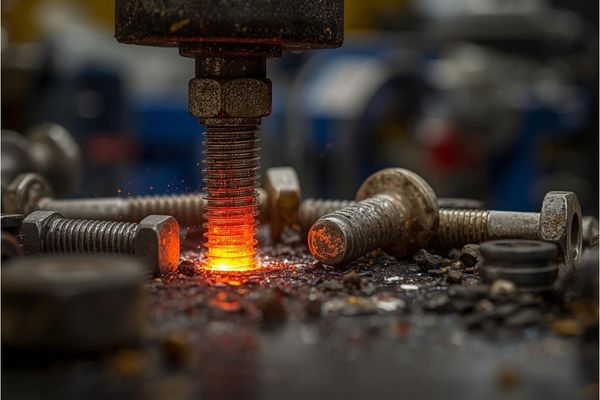
To do that, it would be a good idea to know what the tempering temperature on the original tempering was. We would just go a little bit higher than that. If in fact it turned out that this part was nonconforming because the strength was low or the hardness was low. We would have no choice except to completely reheat treat it as that would be to go through the whole quench and temper process.
A question arises, what about this re-tempering? Does that going to affect the quality of the part? Is it risky? Is it going to make it a less quality part? In fact, double tempering can oftentimes lead to a better-quality part, a more fatigue resistant part. A part that’s capable of better receiving impact and shock situations. Oftentimes, we see that in tooling, in high strength tooling. We’ll do a double temper or even a triple temper.
What that does is it gives us a little better fine-grained tempered martensite, more uniform tempered martensite in the final version of the part. We can take a look at the part and mount it. Polish it and see what we are starting with and then do it again. We see what we are getting after we do that next tempering. Those are all things that can add to the reliability or reduce the risk.
The decision to do this or not do it would be based primarily on time. Is the part along lead time? Is it maybe even irreplaceable? How many of them are there? Do we only have 10 of these things or 10,000? What’s the value of the lot? Most importantly, how reliably can we pull this off? One way that we can know we can reliably pull it off is we can try it on just one or two of the specimens.
We could try it on the remaining piece of the specimen that we tested because we have heat treatment capability on a small scale at Carver Labs. We could figure that out for the client and say, “Here’s what you do. Temper it back to this temperature, strip it, temper it, test it, replay it, and you’re good.” That’s an interesting story about how to recover product that is non-conforming.
There are other issues sometimes that we run up against, such as hydrogen embrittlement or things where the part was not heat treated properly. It falls outside the conforming range where we can recondition the part and bring it back into conformance. There’s no problem doing that. It’s maybe not a common thing that’s done in manufacturing.
I’m certain that any particular manufacturer who would produce a lot of products and at the end of the heat treatment process found it to be non-conforming. They would not hesitate to do some kind of a reheat treatment process to bring that product into conformance. I hope you learned something about heat treating and recovering product that is not in conformance. This has been Carmen Vertullo with your Fastener Training Minute. Thanks for reading.
—
ISO 9001 Revision & Climate Change Controversy
It’s Feature Segment time. Charlie Kerr fans will be glad to know that we’ve got him with us. We’re way overdue, Charlie. Thanks for being here.
It’s my pleasure. I always like to get in on these shows. One of the things that I mentioned to Eric that I wanted to touch on with your concurrence is ISO standard 9001. 2015 is about to be revised to 2026. I’ve done a little bit of research on this because Kerr Lakeside is an ISO 9001-registered company as well as having our ISO 17025. That covers our lab accreditation.
I don’t see where that standard’s in the process of being revised. One of the things that is going to be incorporated in the new version of ISO 9001 is sustainability and climate change. We got an ISO audit conducted on us and we got busted. That’s my terminology. This would have been probably around mid-2025.
We got written up for a nonconformance related to a section in the standard that says that you have to understand the needs and expectations of interested parties. When we first started getting ready to go with 2015, the interested parties were a new element of the standard. As part of our management review process, we identified some of the obvious ones. Customers, suppliers, employees and then there were a few others, believe it or not, the mayor of the city where our factory is located. I’m in regular communication with the local government in case I need a favor they know who I am when I ask for it.
Charlie, let me point out that for our readers who are not aware. I don’t know if there would be many in this audience. Charlie, who’s with us, is the Chairman of Kerr Lakeside based in Euclid, Ohio. Very well-known cold header and venerated, I might add. That gives a little background of what you’re talking about in terms of your ISO audit.
I’ve been involved in our company’s quality management systems. Going back to the mid-1980s, when this thing called HR 3000 was becoming Public Law 101-592, we got our lab accredited. Anyhow, back to this nonconformance. This goes back to September of 2025. He wrote us up because we have a lack of documentation for climate change.
I’m on a ski trip. If I manufactured skis and snowboards and there was no snow on the mountain close to my shop. I’d be concerned about climate change. I make screws. It is beyond me to figure out how this auditor thought that the quality of my product, the quality of the service we provide and the overall experience of doing business with Kerr Lakeside, would be diminished. It’s because I’m not concerned about whether or not it’s going to snow in January or be 95 degrees in July.
What I think is happening here, ISO is an international organization. By coincidence, February 3rd, 2026, this was in the Wall Street Journal. I’m quoting from this newspaper. “International organizations are run by a bureaucratic class with a relatively common worldview. Many have leftist agendas or agendas largely aligned with European left-wing political values.”
Back to another topic that you and I had discussed in show prep, CBAM. That’s a left-wing political value connected to Europe. We’ll get into that later. Where I think ISO is running the risk of losing credibility is they’re starting to use their third-party accreditation or recognition. It’s a method of coercion to get people to affirm a contested concept that’s got a set of facts that are not universally accepted.
I personally think climate change is real. Several years ago, Cleveland, Ohio, if it was there then, was under a mile of ice. There’s only one way that could happen. It got real cold and it stayed real cold for a real long time. All of a sudden, it warmed up and the glacier started to melt. Could you imagine if all those busy bodies that are running around saying, “The planet’s warming up. It’s going to be the end of life as we know it” Several years ago, there’d still be glaciers covering all of Canada and half of the United States. They would try to save the glaciers.
Before you change the subject, I don’t know that we want to get into a complete climate change controversy discussion but it’s valid point. We’ve inadvertently steered into it by events that are affecting our business. As you know, we started the episode with a conversation about CBAM. Simply because of what’s going on in the EU. What we know for a fact is that things change over time. The idea that all this is politicized is too bad but it is. That’s why people get very uncomfortable when it gets raised. Here we are. I’m comfortable with it. I just want to point all that out.
I get that. To go back to ISO, it has a useful purpose to serve. Trying to pursue political agendas by risking, for instance, let’s say we had our ISO 9001 and our ISO 17025 yanked from us. I refuse to affirm that a belief in climate change is man-made. I don’t believe that. I don’t think my business should be put at risk because of an opinion that I hold based on information that I collect. One thing I want to point out here, because ISO butts in the other stuff. Here’s what I’m talking about.
In 2022, ISO came up with this thing called the Merchant Category Code or MCC. When you get your credit card statement, depending on who your credit card is with. It will break things out like lodging, dining, gas for your car, or toys that you bought for Christmas presents. All those different vendors have a merchant category code. There’s a purpose for that. It makes it easier for you, the customer, to organize your credit card purchases.
In 2022, ISO came up with a brand-new merchant category code. It was for retailers that sold guns and ammunition. There is only one reason for them to do that. They wanted to make it easy for governments to track people who buy ammo and guns. They were going to use this credit card merchant category code as the mechanism to do it.
The cell phone companies have been busted for sharing data with the Department of Justice during the Biden administration for senators and some other ranking government officials. They weren’t going along with some of the things the Biden administration was doing. I guarantee you, Chase Bank, Bank of America, Wells Fargo, and some of the larger banks that handle credit card transactions.
I’d be willing to bet they’d be more than happy to turn that information over to the government without a warrant. The reason for that is, the key question is this. You made the purchase, but that information is not yours. It’s the credit card companies’. ISO involved themselves deliberately in trying to stigmatize purchasing or owning firearms and the ammunition that goes with it.
I got a problem with that. I know there’s people reading that probably take a dim view of people that walk around with loaded guns on them. I get that but it’s not ISO’s place to play politics with standards that they release. They’re doing it with the new version of ISO 9001. By inserting that you have to consider climate change and how it’s going to affect your business in order to maintain your certification.
Back to this merchant code thing. I’m not going to name names because I don’t believe in name dropping without getting people’s permission to do it. I was at a Precision Machine Products Association Annual Conference. I was having dinner by coincidence with a machine tool. They weren’t the builder. They were the distributor for a machine tool company that specializes in making machines in the firearms industry.
It’s like milling machines and things like that. On the other side of me was a guy that was one of their customers. He makes firearm components. He doesn’t make the whole gun. He makes slides, bolts and receivers and stuff like that. Neither one of them knew about this. That’s how sneaky this implementation was.
It’s the same with CBAM. People, by and large, are still figuring out what it is. It comes in under the radar.
Back to my own nonconformance with this ISO thing. We pushed back and said, “We’re in the current standard.” This auditor was the first time he’d been to our company. He probably knew this was in the pipeline. If he would have said, “This is in the pipeline.” I’m telling you that they call it, “They identify opportunities for improvement.”
If he would have said, “This is an opportunity for improvement.” Even if you do a top to bottom checklist that you come up with. This is not something we need to be overly concerned with. If you can document that you at least studied the issue, you probably will comply. He didn’t call it an opportunity for improvement. He wrote us up as a nonconformance. We pushed back and his supervisor agreed with us. They dropped it. It was annoying. ISO should not be butting into this stuff.
You said you don’t like to drop names. I won’t either. I was just talking with somebody on the CBAM topic. There’s somebody that everybody would know in a heavyweight and tied up with the whole ISO certification process. He told me if he gets some of that crap raining down on him, he has a mind to start his own certification process to compete. I don’t know how serious that is. That’s how pissed off he is.
I’ll tell you what, it’s ISO, ASTM, ASME. For the benefit of your readers, ASTM stand for American Society for Testing and Materials, ASME or American Society of Mechanical Engineers. They are what’s called Consensus Standards Publishing Bodies. Consensus is a fancy way of saying you adhering to this is voluntary. For instance, we make our screws to ASTM A574 and ASME B18.3. We choose to do that. The FQA mandates that you got to make them to something. It doesn’t mandate that we make them to those standards. It’s voluntary.
If some of these standard’s organizations are going to use coercion for things. Whether it’s a product spec, a system spec, or quality management system. They’re going to use it as a Christmas tree to hang things on it that don’t belong there. When you cut a Christmas tree off at the ground, there’s no ornaments or lights on it. I like them like that. Start tinseling them up in ornaments and lights. If you overdo it, it takes away from the general beauty of the tree. I see some of these standards issuing bodies starting to hang ornaments on their standards. Again, nothing to do with the original attempt of what the standard was about.
Back to CBAM. We don’t sell anything to Europe. We don’t export. I’m personally not too concerned about it, with one exception. This is something I think everybody that sells to distributors, whether you’re an importer or a domestic manufacturer like I am. You sell to a distributor. You frequently do not know who the end user of the product is or what they’re doing with it. We were talking about my bicycle accidents. I have a couple of bikes. One of them is a Trek. I like the Trek because it’s put together with a lot of socket head cap screws. I don’t know if they’re mine.
Everyone who sells to distributors—whether you’re an importer or a domestic manufacturer—often doesn’t know who the end user is or what they’re doing with the product. Share on XThanks for keeping it fastener related, Charlie.
The socket head cap screw that holds my seat to the stem is a side screw. The one that came with the bike was great, too. It had a fatigue failure while I was riding it. I put a Class 12.9. It’s like an M8 by 50 in there. It haven’t had any problems since then. Where I’m going with this is if you sell screws to somebody who resells them to somebody who is assembling something that gets sent to Europe. Without knowing about it, you could see your business being interfered with because of CBAM.
I think a lot of people are spooked out by that. The other side of that coin also, we were asking a lot of people about this on the FDI. How do you feel about the supply chain transparency that it invites? It just doesn’t invite it. It mandates it.
Keep in mind, a lot of this is just stuff I’ve thought of. There’s two ways to make steel. One is what’s called BOF or Basic Oxygen Furnace. It’s a technical term for a blast furnace that you feed iron ore into and coal, limestone. You’re basically making virgin steel. The second way to make steel is called an electric arc furnace.
The BOF furnace, for those that are in the cold heading business. Not too much cold-heading quality steel makes BOF anymore. If you’re a stamper, you’re using sheet and plate. A lot of that is BOF. Cleveland Cliffs makes a lot of it. I’ll come back to that in a second. It’s very carbon intensive. In terms of adding greenhouse gases to the atmosphere, BOF is more polluting than electric furnace steel.
Nucor and Charter, which are big players in the cold-heading market, and Liberty. They all run electric arc furnaces. Even though the carbon emissions from one mill to the next might be a little different. For all practical purposes, it’s the same. If you had steel come into your building, like back in ancient times. Inland had mills up in the Gary, Indiana area. They had both blast furnaces and electric arc furnaces in the same facility.
Carbon Footprint Differences In Steel Production
Sometimes, you’d order steel. We would. Sometimes, it was BOF. Sometimes, it was electric arc. If this transparency in the supply chain has got some teeth in it, it’s going to be impossible to know exactly what your carbon footprint is. Not only is the blast furnace a bit more carbon. It doesn’t use as much electricity as the electric arc furnace.
If the electric arc furnace has a coal-fired electric plant next to it, its carbon footprint from start to finish might be larger than the other guy. I know how to make screws. I’m not going to screw around trying to figure out when a coil of steel comes into my building, how much carbon got put into the atmosphere by the people that made it for me.
That’s why everybody’s expecting that they’re just going to take the default values.
It’s the easy way to go. Let’s hypothetically say every screw that I made went to Europe. I’d be waking up at 2:00 AM wondering about this and in a negative way. Seriously. As I said, I don’t think your machine was recording or we were just batting some ideas around. If screws made in China, Taiwan, Turkey, and maybe South Korea, you have a higher default assessment applied to them than screws made in Canada, the United States.
Even though there’s going to be a CBAM. Tariff is not the right word. It’s a duty of some sort because this is all calculated as it comes in through customs. Product now that is not competitive in the European market could be competitive with stuff made in Turkey, Taiwan, China, and maybe South Korea. I’m not saying it will, but I could see where it could happen. The defaults assigned to those threaded fasteners are going to be higher. Those countries have much looser carbon emission restrictions than in North America.
Interesting thought.
I told you I was going to do some research to sound intelligent. One of the things that I’ve read and thought is Carbon Border Adjustment Mechanism, which is known by the acronym CBAM. There’s this term called carbon leakage. The EU has had much more stringent. I use the word air pollution controls than developing countries like China and Taiwan.
This in effect is a protectionist method. It’s like, “You don’t play by the same rules we do. We’re going to put a fee on stuff you make. Companies like Grady, that’s based in Italy, are coal diggers. They have to deal with environmental considerations in Italy. The factories in China and Taiwan don’t have to consider or contend with.
Therefore, Grady has costs that they have to reflect in their selling price that the Chinese and Taiwanese fasteners don’t. All of a sudden, that cost advantage might disappear. I personally don’t have a problem with that, if that’s the sole purpose of this. I think they’re saying that’s the purpose. They’re just trying to close their market to stuff that’s not made in their market.
It’s like what Donald Trump would do. Except they’re trying not to look like Donald Trump. Trump comes right out and says, “I’m going to charge you more money to do business in my country because I feel like it.” Where they’re over in Europe saying, “We’re going to charge you more money because we love the environment.”
What’s the common denominator? They’re all racketeers.
It’s virtue signal.
It’s more than that, though, because they’re projecting power. They’re taking payoffs and all that.
There’s always going to be corruption.
This is beyond corruption. What has got a lot of people angry about this is that it’s based on such a huge lie to begin with. I didn’t want to necessarily spend the whole time that we have with you, the precious few minutes. Before you get out there onto the veranda to observe what’s going on all around you out there, Charlie. I do appreciate your insights into all that. You’re also a guy who speaks his mind, which we also value.
One thing I do want to cover and I know I’m watching the clock. I told you in show prep. We got a new header coming. I don’t want to turn this into a commercial for Kerr Lakeside. We have a National 1012 Boltmaker that was put in service. We bought it brand new in 1973 or 1974. It makes five eights diameter socket head cap screws and three-quarter diameter socket head cap screws. There’s a couple of long lengths, a half inch that also get run on that machine. It’s an important piece of the equipment. If it was an airplane, it would be grounded.
A lot of people say, “I want a sustainable business.” I ask, “What do you mean?” They say, “We recycle our scrap and waste.” For me, investing in machines means my business will be around 50 years from now. Share on XPlease tell me this story is going to wind up on the tariff issue.
It is. Anyhow, my son Alex was after me in 2024 to order this Edgecroft boltmaker. I’m a National guy. To this day, they make a great machine. They’re Ohio-based. If we needed parts, we can run a truck up the Tiffin and be back in three hours. National doesn’t make bolt makers anymore. Nedschroef does. The difference there is if we would have bought a National machine, we’d have to buy the header. We’d have to buy a pointer and threader. Lots of millions of dollars to do that.
Nedschroef makes a boltmaker, which means the coil comes into one end of the machine. A finished screw thread comes and rolls and the headmark comes out the other. For about half the money that we would have had to invest in brand new equipment with the threader, the header, and the hip or the point of National. There would be some advantages. Nationals machine, no handsome features that would be nice but not necessary.
Anyhow, we ordered this machine from Nedschroef. I’m not going to get specific. Anybody knows anything about machines of that size. This is an all-time million-dollar investor. At the time we placed the order the tariff was 14%. Recently, I don’t know if it was the king of Belgium. That’s where the machine’s going to be made. Or, their prime minister started chirping at President Trump about, “You got no business talking about Greenland.”
I’m thinking, “Will you shut up?” Trump’s going to wake up at 2:00 AM and say, “100% tariffs.” We need this machine. I’m not exaggerating. I’m coming to terms with this. It’s going to be what it is. If that ship is pulling into wherever they’re going to load the machine, New York or Baltimore or New Orleans. Before it hits the dock and Trump raises the tariffs, the tariff’s going up.
One of the things that needs to be understood, the Supreme Court is hearing some issues with his tariff authority, but the Section 232 tariffs. Which basically are applied to steel and steel derivatives like fasteners because they’re made of steel. This machine is made of steel. He has threatened to slap the 232 derivative tariffs on machine tools that are imported in the United States.
I don’t know where that stands. I’m not serious about this. I jokingly told somebody I might rent a warehouse in Mexico until this all blows over. Have the machine delivered down there and let it sit there. In the meantime, we’re making parts on our 1012. It should make close to 3,000 finished pieces an hour. We’re lucky if we get 2,000. We’re behind. I wish I had done this in 2024.
One of the things I’m not letting any secrets out. Our cash position is much better than it was in 2023 or 2024. It’s just some obligations we had then have paid off. This is easier to do. We got this machine coming. It’s due to ship sometime in April. I’m telling people by the time we see it, plug it in, get it turned on and making pieces. It will probably finish goods inventory sometime in July or August. I’m excited about this.
The other thing we did in the meantime, by accident we found out about a National 3H4 Max. It’s a used machine. There was a Hartford 10400 threader, part of the package deal. My son Alex said, “This is what they’re asking for it.” I said, “Buy it because if we ever need this stuff, which we will eventually, it won’t be available.”
Anyhow, we’re doing a lot of rearranging of the factory for this equipment that’s on the way. The good news is our service level has not been what I would like it to be the last couple of years. Once these machines are in the building under power, making parts, those problems will be behind us. Believe me, it’s a big investment. I’m happy to tell everybody that’s reading this that we are committed to the sustainability of my company.
I said that on purpose because a lot of people say, “I want a sustainable business.” I asked them, “What do you mean by that?” “You get a word, sell it. We recycle our scrap and our waste.” Me investing in machines means my business is going to be around 50 years from now. I sell my scrap. They just recycle. They even recycle my beer cans. Anybody who knows me knows I probably produce a lot of them. Scrap is worth a lot of money here.
Machines, Hats, & Industry Insights
Thank you for bringing it. That’s great to hear, Charlie. One of the things I love about visiting Kerr Lakeside, which I’ve done several times over the years. Some of this old war horse machinery that you guys have running. It’s maintained to a fare-thee-well. It does such a great job for you. You’ve also got this mix of newer stuff in. You guys just keep rolling. I’m glad to hear this.
I can hardly understand how you can keep one of that big bloody cold headed machines running for nearly 50 years.
I’ll tell you what. They’re nationals. National makes a good machine. As sI said, if National still made boltmakers, we might’ve bought a National instead of a Nedschroef. One thing that I will tell you though, because we went up to Detroit. Nedschroef’s got a facility up there. Their service team, this would be the guy that if we had some issues would be responsible for making the machine work right. The guy was very impressive. He knew the equipment. I walked out of there thinking any reservations I had about buying a machine that wasn’t built in Tiffin by National. Going with Nedschroef wasn’t going to be a problem for me.
You got to make shifts occasionally. Case in point, I’ve been wearing the Kerr Lakeside hat. It’s like my official fishing hat for a couple of years, as you know. He told me you couldn’t get the kind that you had before with the silver brim and everything like that. You have the all blue model. It took me a little while to get used to it, Charlie, but I’m digging this thing.
I’m a little bit annoyed that the company that made those hats discontinued that version of it. Going back to the mid-1990s, I coached a travel baseball team. The team’s colors coincidentally wore that color blue and that color silver. I sponsored the team. They had a Kerr Lakeside logo on this. Everything looked cool. I stuck with that color scheme. That way, if I wear my coach’s jersey, which is a real baseball jersey, everything matches.
Very shrewd, Charlie.
You’re trying to take over GQ and your attire on the field?
I’ll tell you what. I don’t spend a lot of money on promotional materials. We’ll always leave some hats. In the summertime, it’s the baseball hats. In the winter time, it’s the knit beanies for truck drivers. A lot of our customers come in, we’ll call. There’s nothing better than someone advertising for you wearing a hat or a T-shirt. This is a little bit off color but not too off color. I was in Chicago for their Mid-West Fastener Association tabletop show. These two girls are walking through the aisles that looked like they could have been Victoria’s Secret models. I gave them two hooded sweatshirts.
Typical MWFA event.
Anyhow, they put them on and started walking around the hall. I said, “American Fastener Journal, Link, Fastener Technology International. You’re looking at $50,000 worth advertising now.” They were so grateful like, “We can’t believe you’re being so generous.” I said, “All you get to do is wear it around.” Who knows they could have thrown them away when they left the hall. I don’t know but you did not have to come to my table to see Kerr Lakeside logo.
There’s another shrewd move. I’ll tell you something else you should think about strongly. I know you weren’t out in Vegas this last time. I’m sure you heard the reports about your booth placement. Did you get wind of that?
I’m trying to think. I look at it like this. I am going to go to Phoenix because I like Phoenix.
Your team was out there. They were astounded because you were right next to this giant array of pipes. I think it was either the HVAC or the main switch system for the sprinklers.
It looked like the electrical disconnect box.
I walked by before the show opened. I said, “Don’t worry about it, folks. They’ll put some drapery over that for you. I’m sure before the show opens and everything.” They didn’t.
In all honesty, stuff like that wouldn’t bother me. If they put us in a room that no one knew was there, that would be different. When you go to a show like Vegas, I’ve said this before. Now it’s going to be in Phoenix. If you’re in this industry and they say Vegas, they know what you’re talking about the fasteners show that happens every fall. What are they going to do? They’re going to say, “Vegas has moved to Phoenix?”
We’re calling it the Vegas show in Phoenix.
You read my mind. Debbie Lance, our assistant sales manager, regularly keeps a record of everybody that visits our booth. It’s either existing customers, where people who could buy from us, or don’t buy as much from us as they could. When you look at that list, it would take one person a year to travel around the country to make in-person face-to-face sales calls with all those people. The location of the booth, if it doesn’t interfere with those people coming and giving us face time, I’m not going to get too upset about it.
You wouldn’t mind if you turned up there and there’s a great support column in the middle of your booth then?
It just depends, if it doesn’t impede. Some of the people that would desire to visit our booth, they know where to find us. They got a list. Everybody that they want to visit. They check it off. The easiest way for me to explain this is, I’ve been in this industry since I started working in the factory packing screws when I was 12 or 13 years old. I only worked a couple hours a day. It was something to keep my old man keeping an eye on me.
Some things never change, Charlie.
That would have been in 1970. I’ve been doing this for a long time. If the location of my exhibit space at a trade show is the most serious problem that I have to deal with in 2026, I got smooth sailing ahead of me. I just told you. I might end up with a 100% tariff on a machine that I got on order.
Puts it in perspective.
It sure does.
That’s a very healthy attitude. I admire and respect it deeply. That’s great. I also very much appreciate you being here on your time off. We can always depend on you to come in and go out with a flurry. You did not disappoint this time.
Let’s do this. My machine coming from Europe, as I said, should be up and running in August. I’m going to have an event, not necessarily an open house. I’m going to be inviting people into the plant to look at it. Mr. Dudas and your crew. Brian, you’re not based in Cleveland, are you?
I’m in Chicago.
Anyhow, you’ll be one of the first people to get invited to come down and look at it.
I loved my tour around your place. I loved it. I particularly sat watching that giant cold header. Every time it banged out of bolt, the whole floor shook.
This one’s not quite that big. It’s the next size down. As I said, I’m excited about this. This tariff thing hanging over my head is, I’ll admit it. There’s nothing I can do about it. I just want the President to let cooler heads prevail.
How are you going to do that?
Maybe if he’d shut up.
Send him a bottle of sleeping pills. He might sleep for the night.
He keeps insisting that the exporting country is going to pay the tariff. I am going to pay the tariff regardless of what it is. It shows up whoever the freight forwarder is. It’s going to handle the machine. We import some parts we don’t make, so I see these invoices. The freight forwarder settles the duty before they released the machine to me. I am paying that or Kerr Lakeside’s paying that. We’re going to pay for it because I need the machine.
Everyone knows that except the people who are proposing tariffs, unfortunately.
It’s a two-sided coin. We compete with product that’s made in Taiwan primarily. A little bit in India, not so much. There’s some South American fastener manufacturers. In theory, the tariffs could make me more competitive. If the equipment that I need, the tariff makes it impossible for you to bring that stuff into the building. I’m not going to be able to make any screws at all, regardless of my competitive situation.
You were mentioning the Supreme Court and we were expecting a ruling. It didn’t come. Did you putt your money down on either side of that one?
I’ve been following it. My expectation is the court is going to rule in such a way that Donald Trump starts having a Twitter storm. He’s going to be complaining and degrading the judges. What I’m afraid of is he’s going to say, “Fine. Anything that’s made out of steel or aluminum is going to have a 100% Section 232 attached to it.”
I don’t think he knows anything to that detail, Charlie. It will be people working for him.
He’s got people in his ear that do.
He wouldn’t even know what a cold header was or a company making nuts and bolts.
That’s right. Good thing you’re out in Tahoe. You’re going to spend the afternoon gazing upon the slopes, if not sliding down them. We sure appreciate you being here, Charlie. We’re going to take you up on that offer in August or whenever it happens.
Very much so.
Good to hear you rolling forward.
I’m feeling we didn’t talk about business conditions in general. In ten seconds or less, I’m feeling pretty good about 2026.
I’m glad to hear it. You’re right on board with the FLI then. We’ll let you get back to it. We’ve been talking with Charlie Kerr of Kerr Lakeside. Always appreciate you being here with us, Charlie.
I appreciate the opportunity. You’re doing the industry a very valuable service by engaging people in discussions that disseminate information that people in the industry might not have otherwise. At least under timely circumstances. My hat is tipped to you.
I appreciate that.
Adios, amigos.
Adios.
I would like to thank Charlie Kerr with Kerr Lakeside for taking a little time out of his Tahoe vacation to be with us. I know Charlie Kerr fans always enjoy his segments with us. Also, Danielle Riggs with Würth Industry USA shared her analysis of the latest EU CBAM developments. Jun Xu with Brighton-Best International sat in with Mike McNulty. Amazing job, guys. Thanks for carrying the show for us. Carmen Vertullo and Marco Rodriguez had their regular segments, too. Thank you, gentlemen.
The title sponsors of Fully Threaded Radio are Star Stainless and Brighton-Best International. Fully Threaded Radio is also sponsored by Buckeye Fasteners, BTM Manufacturing, Eurolink Fastener Supply Service, Fastener Technology International, Cresa, Goebel Fasteners, INxSQL Software, J.Lanfranco, Fastener Fair USA, MW Components, Solution Industries, Volt Industrial Plastics, and Würth Industry USA.
If you listen to the show on Apple or Spotify or one of the other players, please give us a review. Give us a share too while you’re at it. We’re trying to grow that part of it. Apparently, that helps the show grow. I appreciate that very much. Also, take a look at the FullyThreaded.com page where we have these show notes pages. We’re trying to enhance those, bring a little more value to every episode.
The Fully Threaded has been left a little bit for some time. Eric has some other people been putting a lot of work into turning it into something that’s a much better logical site.
The framework has come together. It’s at a point where we could start doing some interesting things. I appreciate all that, folks, and you reading as always. Next time on the show, we’re going to have Chapman Revercomb with Würth Industry sitting in with McNulty. Brian, we’re also going to jam in somehow. Maybe we’ll do an unthreaded episode where we can hear all about your adventures. You and Lynn, apparently are doing some amazing things. I saw a few of the photos. I was just talking about these blog pages on the last episode. I put one of you with two guys in turbines. You’re standing in front of what was it? The temple of Horus?
It was a statue to the God Horus. It was meant to be a picture of Lynn and I. These guys were there. They wanted pictures of them instead. That’s what got taken.
They must’ve known who you are.
Horus is the God of rebirth or something. He was Isis’ son.
That mythology is a string you can just keep on pulling and pulling and never seem to get to the center of it. We’ll take a crack at it next time. One thing I got to say, though, is it seems like you missed a choice marketing opportunity there. I thought you were going to have a Fully Threaded hat on in that shot.
Interesting. I did have a Fully Threaded hat with me. I must’ve left it off on that one.
That’s one of the things that makes you so lovable. You’re just completely never thinking about the proper marketing. God bless you. God bless all of you for reading, folks. We do appreciate it. Talk to you again in the very near future.
We appreciate it.
 Apple Podcasts
 Spotify